SE423 · Annotated SlidesChapter 1.2 — Project Performance Domains
Chapter 1.2 · Annotated slides

Project Performance Domains

The 8 areas a project manager has to keep an eye on at the same time: stakeholders, team, development approach, planning, project work, delivery, measurement and uncertainty. Midterm 251 took three MCQs from here (domains, centralized vs. decentralized, cadence), and many final-exam questions on scheduling, estimation and risk start in this deck.

Slide text Instructor’s marks (from the original PDF) Study notes Highlight: key words Tips, tricks & traps Seen again elsewhere How it can come up

Project Performance Domains

SE423: Software Project Management
1
Exam weight Low
  1. Chapter 1 gave the 8 domain names. This deck opens each one.
  2. Domain number badges (1–8) in the top corner of each title slide help you keep the order.
Memory trickOrder: “Smart Teams Develop Plans; Projects Deliver Measured Uncertainty.”
★ Past exam

Project Performance Domains

  • A project performance domain is a group of related activities that are critical for the effective delivery of project outcomes.①
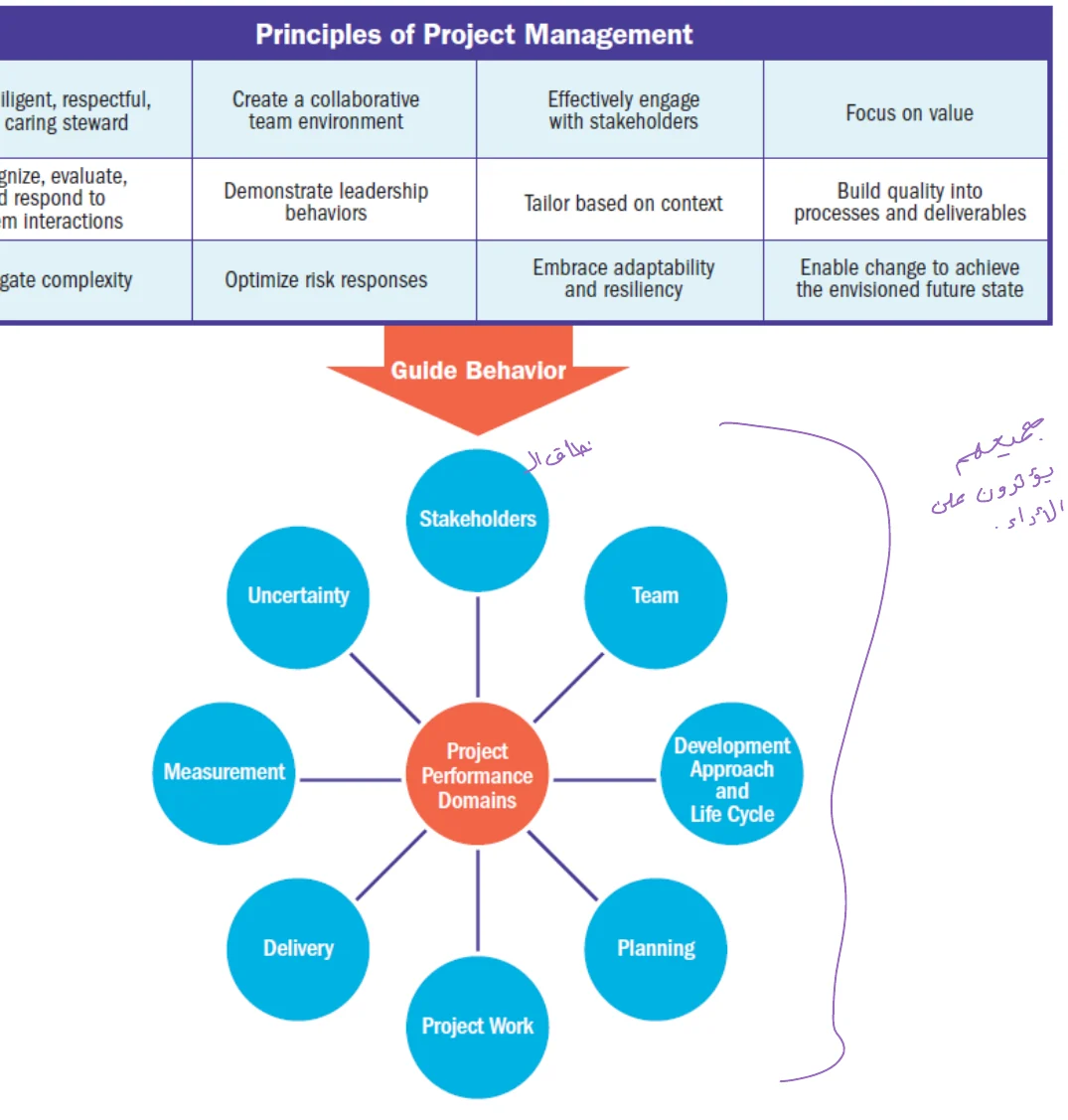
  • Project performance domains are interactive, interrelated, and interdependent areas of focus that work in unison to achieve desired project outcomes.
  • Performance domains run concurrently② throughout the project, regardless of how value is delivered (frequently, periodically, or at the end of the project).
The 12 principles (top) guide behavior; below them the 8 performance domains sit in a wheel around “Project Performance Domains”
Principles guide behavior → behavior shows up in the 8 domains.
2

Top right: “All the principles we covered are the guided behaviors which are the project performance domain.” Arrows from the domains with an Arabic note: “all of them run together”.

Exam weight High
  1. Definition to memorize: a group of related activities that are critical for effective delivery of project outcomes.
  2. Concurrent = all 8 at the same time, not one after another. This is the exact trap in the real MCQ.
Exam trap“Domains are rigid processes followed in order from initiation to closure” ✗. They are interactive, interdependent and concurrent.
🎯 How this can come up · 2 questions
MCQ

Which statement best describes project performance domains?

True / False

Performance domains apply only when value is delivered at the end of the project.

Stakeholder Performance Domain

  • Stakeholder
    • An individual, group, or organization that may affect, be affected by, or perceive itself to be affected by a decision, activity, or outcome of a project, program, or portfolio.①
  • Stakeholder Analysis
    • A method of systematically gathering and analyzing quantitative and qualitative information to determine whose interests should be taken into account throughout the project.
    • includes stakeholders who are internal and external to the organization, those who are supportive of the project, and those who may not be supportive or are neutral.②
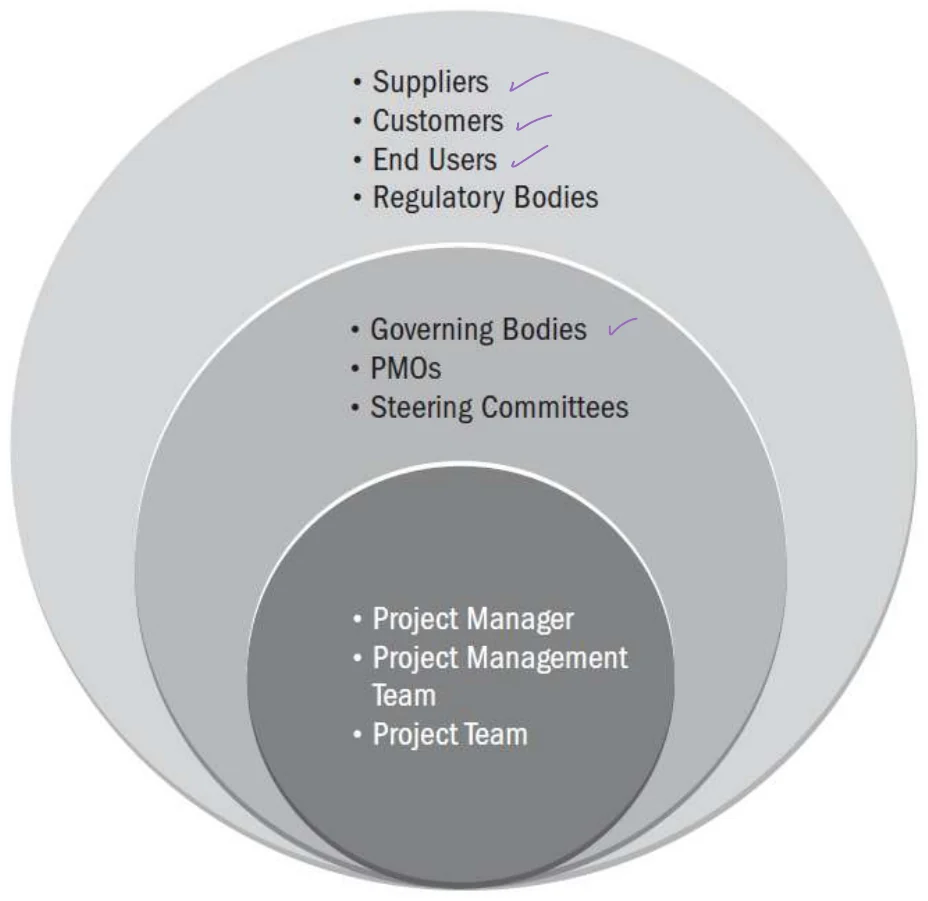
Concentric circles: outer ring suppliers, customers, end users, regulatory bodies; middle ring governing bodies, PMOs, steering committees; inner ring project manager, project management team, project team
Stakeholders from the inside out: project team → governance → external parties.
3

Ticks next to suppliers, customers, end users and governing bodies. “Stakeholder analysis” is glossed in Arabic (تحليل المستفيدين).

Exam weight High
  1. Three ways to be a stakeholder: you affect it, you are affected by it, or you only THINK you are affected. All three count.
  2. Stakeholder analysis covers supporters, opponents and neutral people, both internal and external.
Exam trap“Only people who support the project are stakeholders” ✗. Opponents and neutral parties are included.
🎯 How this can come up · 2 questions
True / False

A person who only believes they will be affected by a project is still a stakeholder.

Scenario

For the Edugate scheduling app (a real midterm case), name three stakeholder groups and place each in the circles diagram.

Stakeholder Performance Domain

  • Technical project management skills are important, but having the interpersonal and leadership skills to work effectively with stakeholders is maybe more important.①
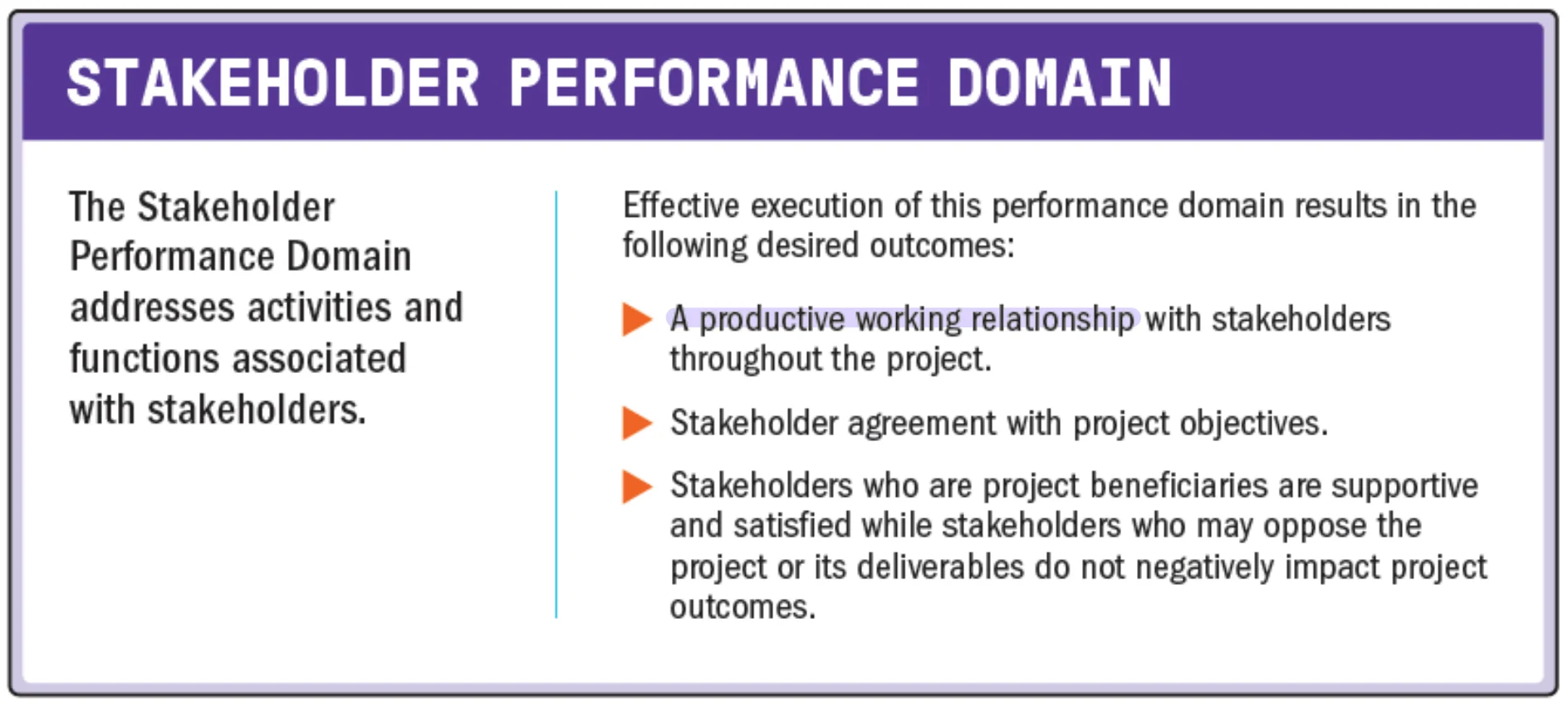
Stakeholder performance domain card with its desired outcomes
Desired outcomes: productive working relationships, agreement on objectives, satisfied supporters and neutralised opponents.
4
Exam weight Medium
  1. Soft skills beat technical skills when dealing with stakeholders.
🎯 How this can come up · 1 question
MCQ

Which is a desired outcome of the stakeholder performance domain?

Checking Outcomes of Stakeholder Performance Domain

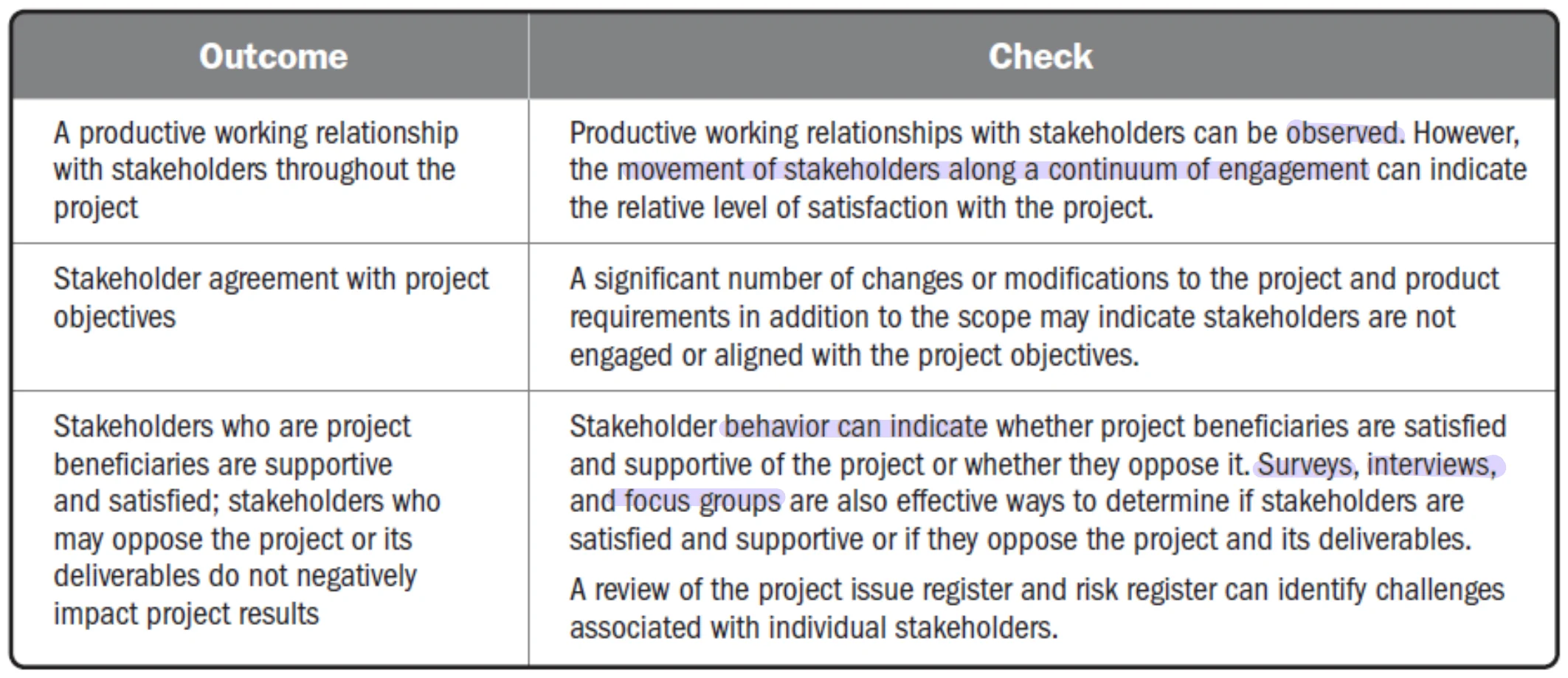
Table of stakeholder domain outcomes and how to check each
5
Exam weight Low
  1. Read the left column as “what success looks like” and the right column as “how you would prove it”. These tables are rarely tested word for word; use them to explain a domain in a written answer.

Team Performance Domain

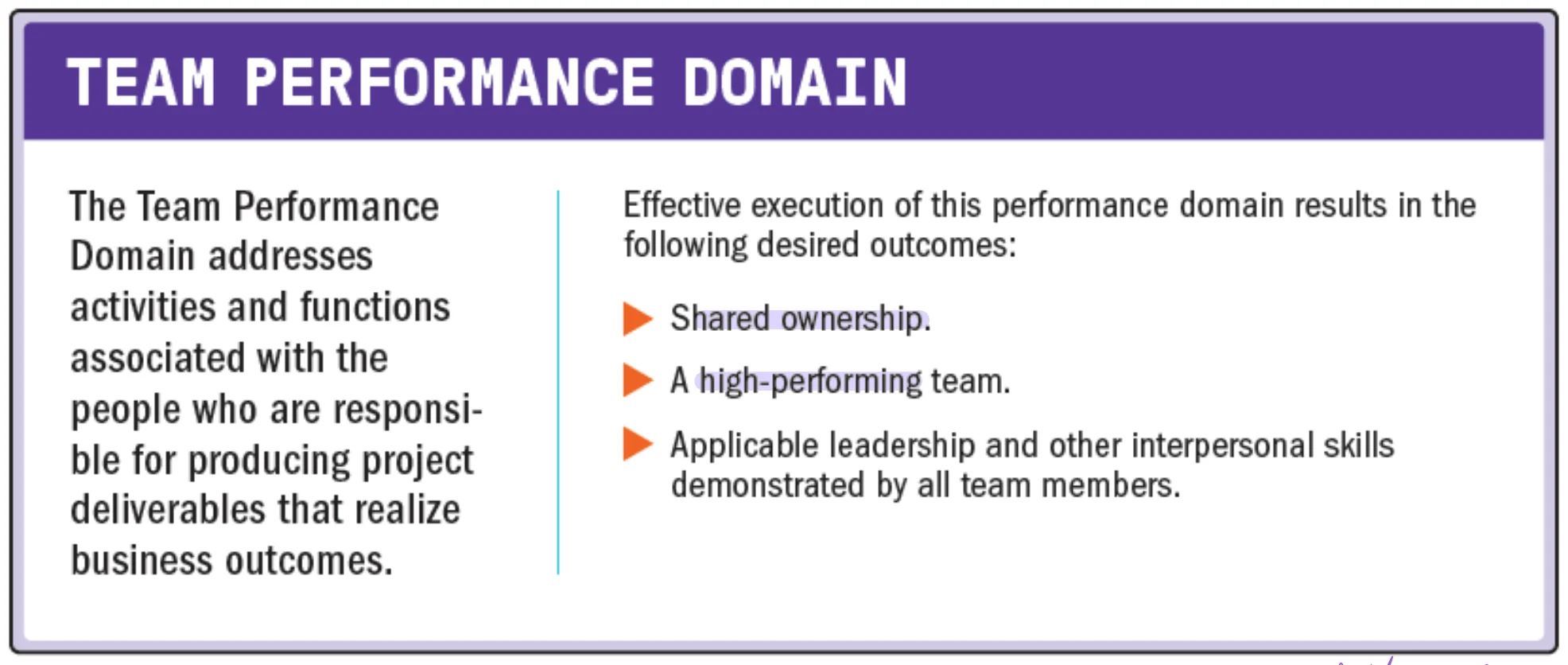
Team performance domain card
Desired outcomes: shared ownership, a high-performing team, leadership shown by all team members.
6

Under the card: “Stakeholders → Team”, linking domain 1 to domain 2.

Exam weight Low
  1. Three outcomes: shared ownership · high performance · everyone shows leadership.

Project Team Management and Leadership

  • Project management entails applying knowledge, skills, tools, and techniques for management activities as well as leadership activities.
  • Management activities focus on the means of meeting project objectives, such as having effective processes, planning, coordinating, measuring, and monitoring work, among others.
  • Leadership activities focus on people① .
  • Leadership includes influencing, motivating, listening, enabling, and other activities having to do with the project team.
  • Both are important in delivering the intended outcomes.
7
Exam weight Medium
  1. Management = processes (plan, coordinate, measure). Leadership = people (influence, motivate, listen). You need both.
Memory trickManagement manages THINGS; leadership leads PEOPLE.
🎯 How this can come up · 1 question
MCQ

Influencing, motivating and listening are examples of which activities?

★ Past exam

Project Team Management and Leadership

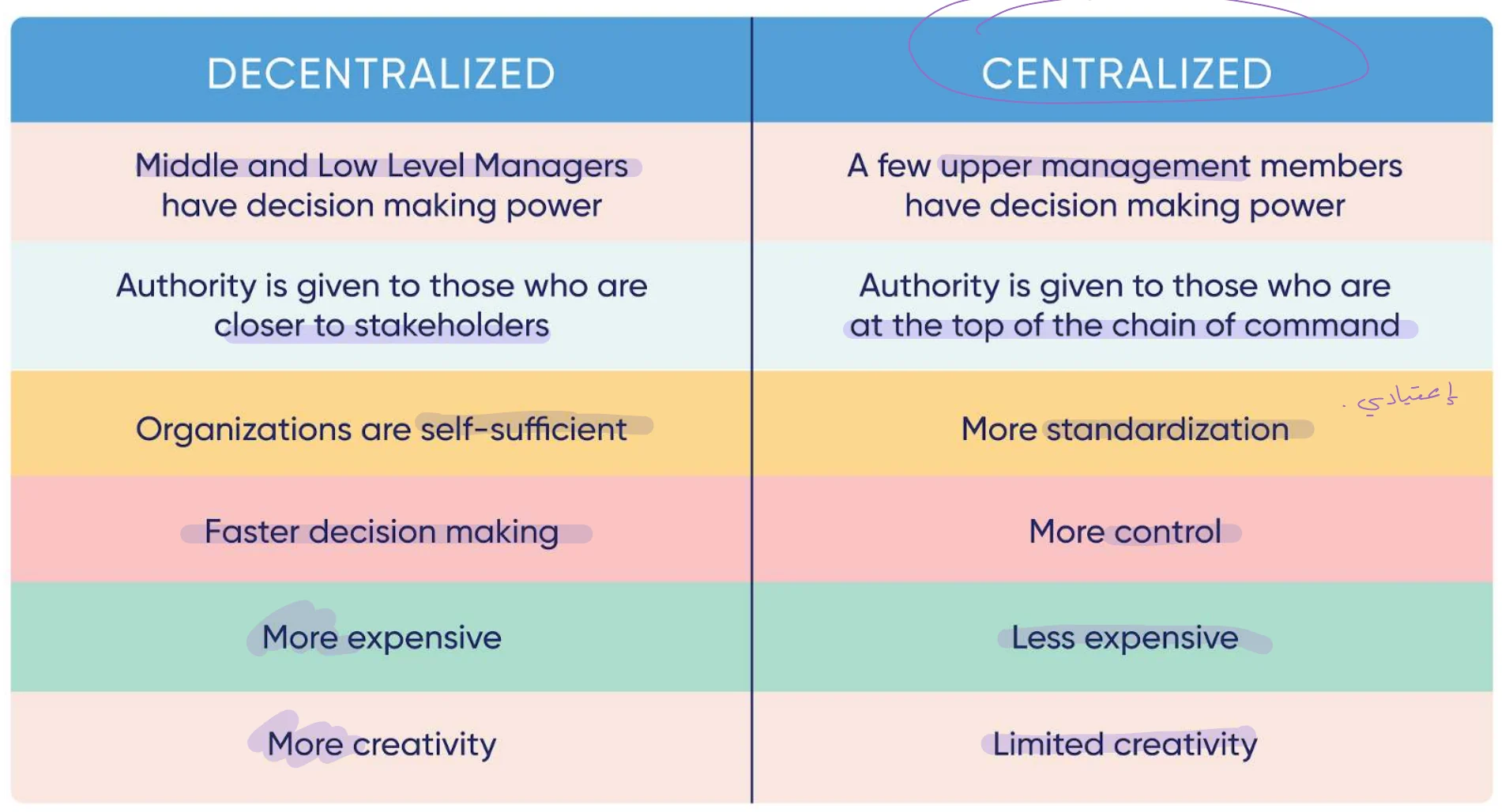
  • Centralized Management and Leadership
    • While leadership activities should be practiced by all project team members, management activities may be centralized or distributed.
    • In an environment where management activities are centralized, accountability (being answerable for an outcome)①, is usually assigned to one individual, such as the project manager or similar role.
    • In these situations, a project charter② (see example in notes below) or other authorizing document can provide approval for the project manager to form a project team to achieve the project outcomes.
8
Exam weight High
  1. Centralized: accountability (being answerable for an outcome) sits with ONE person, usually the PM.
  2. The project charter is the document that authorizes the PM to form the team.
🎯 How this can come up · 1 question
MCQ

In a centralized environment, accountability is usually:

★ Past exam

Project Team Management and Leadership

  • Distributed Management and Leadership
    • Sometimes project management activities are shared among a project management team, and project team members are responsible for completing the work.
    • There are also situations where a project team may self-organize to complete a project.
    • Rather than having a designated project manager, someone within the project team may serve as facilitator① to enable communication, collaboration, and engagement.
    • This role may shift among project team members②.
9
Exam weight High
  1. Distributed: no designated PM, and someone acts as a facilitator (think Scrum master).
  2. The facilitator role can rotate.
🎯 How this can come up · 1 question
True / False

In distributed management, the facilitator role can shift among project team members.

★ Past exam

Project Team Management and Leadership

Comparison table: decentralized vs. centralized
Decentralized: middle/low managers decide, authority near stakeholders, self-sufficient, faster, more expensive, more creative. Centralized: a few upper managers decide, authority at the top, more standardization, more control, less expensive, limited creativity.
10

“Centralized” circled; nearly every cell highlighted; Arabic gloss “اعتيادي” (routine) next to “more standardization”.

Exam weight High
  1. Learn it as three opposite pairs: speed vs. control · cost (decentralized costs MORE) · creativity vs. standardization.
Exam trapDecentralized is FASTER but MORE expensive. Centralized is cheaper but slower and less creative.
🎯 How this can come up · 2 questions
MCQ

Which is a characteristic of DECENTRALIZED management according to the table?

MCQ

In decentralized project management, decision-making authority is primarily:

Project Team Management and Leadership

  • Common Aspects of Team Development
    • Regardless of how the management activities are structured, there are common aspects of project team development that are relevant for most project teams.
    • These include:
      • Vision and objectives.
      • Roles and responsibilities.
      • Project team operations.
      • Guidance.
        • Guidance can be directed to the overall project team to keep everyone headed in the right direction.
        • Individual project team members may also provide guidance on a particular task or deliverable.
      • Growth.①
        • Identifying areas where the project team is performing well and pointing out areas where the project team can improve helps the project team to grow.
        • Working collaboratively, the project team can identify goals for its improvement and take steps to meet those goals.
11
Exam weight Low
  1. Five aspects: Vision, Roles, Operations, Guidance, Growth.
Memory trickV.R.O.G.G.: “Very Rarely Our Goals Grow (without guidance).”

Project Team Culture

  • Each project team develops its own team culture.
  • The project team’s culture may be established deliberately by developing project team norms, or informally through the behaviors① and actions of its project team members.
  • The project team culture operates within the organization’s culture but reflects the project team’s individual ways of working and interacting.
12
Exam weight Low
  1. Team culture can be designed (team norms) or can just emerge from behavior. Either way it sits inside the organization’s culture.

Project Team Culture

  • The project manager is key in establishing and maintaining a safe, respectful, nonjudgmental environment that allows the project team to communicate openly.
  • One way to accomplish this is by modeling desired behaviors①, such as:
    • Transparency
    • Integrity
    • Respect
    • Positive discourse
    • Support
    • Courage
    • Celebrating success
13
Exam weight Medium
  1. The PM builds culture by modeling: Transparency, Integrity, Respect, Positive discourse, Support, Courage, Celebrating success.
TipA real final question asked how you would celebrate a milestone and keep morale high. “Celebrating success” is your hook.
🎯 How this can come up · 1 question
MCQ

Which is NOT listed as a behavior the PM should model to build team culture?

High-Performing Project Teams

  • The list below identifies some of the factors associated with high-performing project teams.
    • Open communication
    • Shared understanding
    • Shared ownership
    • Trust
    • Collaboration
    • Adaptability
    • Resilience
    • Empowerment
    • Recognition①
14
Exam weight Medium
  1. Nine factors: Open communication, Shared understanding, Shared ownership, Trust, Collaboration, Adaptability, Resilience, Empowerment, Recognition.
TipFor “key characteristics of a good team” (real midterm question), list 4–5 of these and add one line each.
🎯 How this can come up · 1 question
Written

What are the key characteristics of a good (high-performing) team?

Leadership Skills

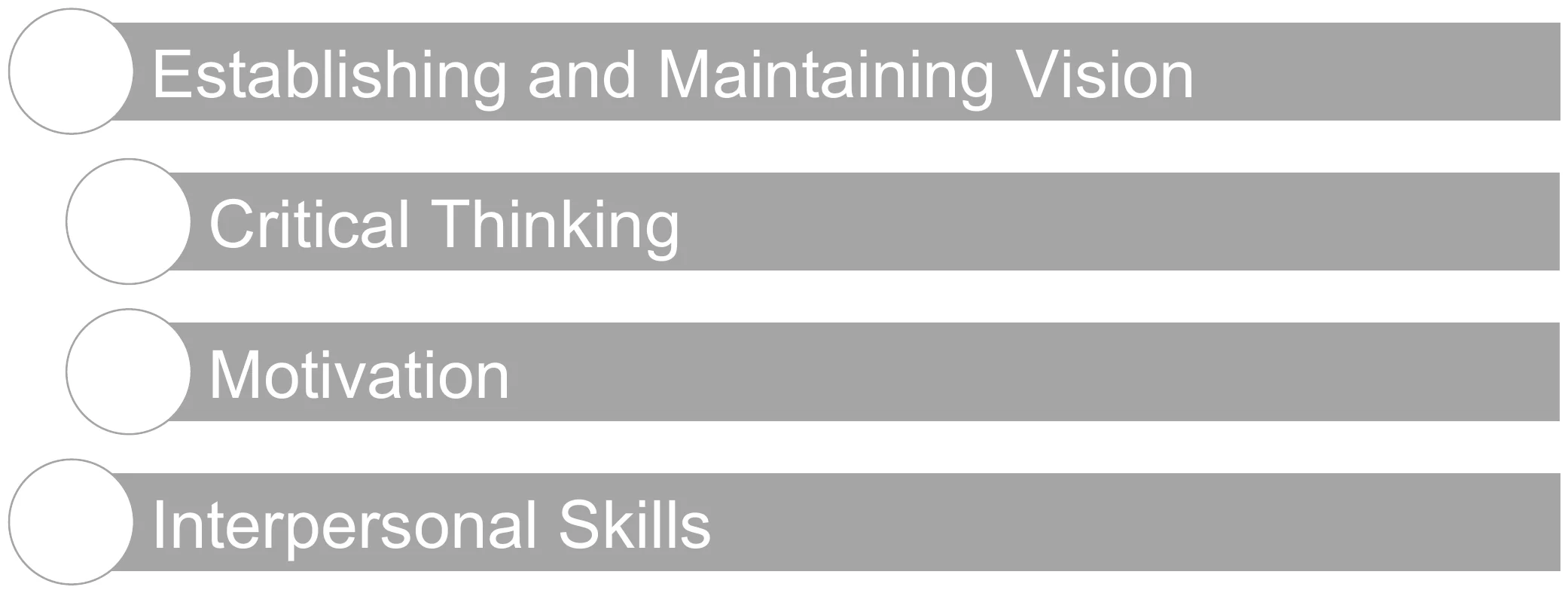
Four leadership skills: establishing and maintaining vision, critical thinking, motivation, interpersonal skills
15
Exam weight Medium
  1. Four leadership skills: Vision, Critical thinking, Motivation, Interpersonal skills.
Memory trick“V.C.M.I.”: Vision Comes, Motivation Inspires.
🎯 How this can come up · 1 question
MCQ

Which of these is NOT one of the four leadership skills on the slide?

Components of Emotional Intelligence

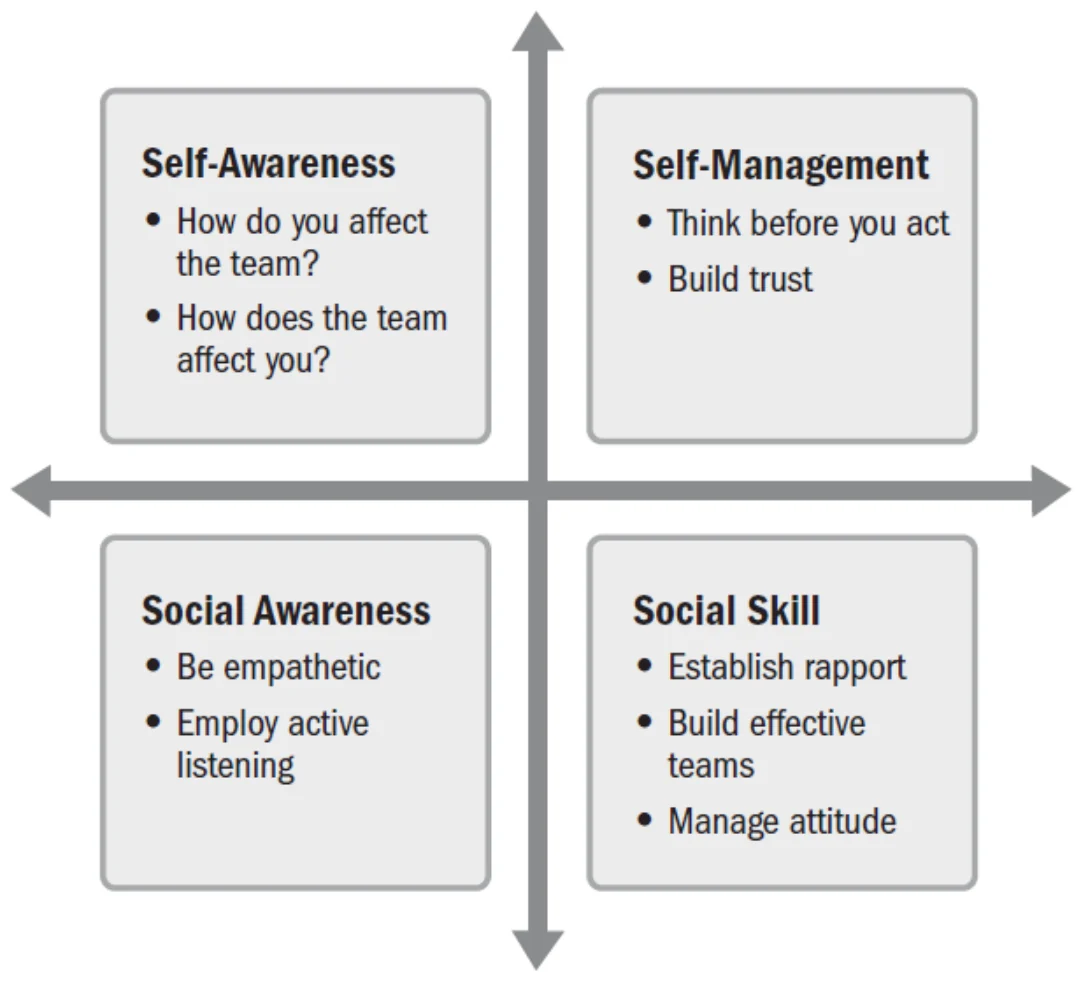
Emotional intelligence quadrants: self-awareness, self-management, social awareness, social skill
Self (awareness → management) and others (social awareness → social skill).
16
Exam weight Medium
  1. Two about you (self-awareness, self-management) and two about others (social awareness, social skill).
🎯 How this can come up · 1 question
MCQ

“Be empathetic” and “employ active listening” belong to which EI component?

Tailoring Leadership Styles

  • leadership styles (ex: autocratic, democratic, laisser-faire, transactional, servant, etc.) are tailored to meet the needs of the project, the environment, and the stakeholders.
  • Some of the variables that influence tailoring of leadership styles include:
    • Experience with the type of project
    • Maturity of the project team members
    • Organizational governance structures
    • Distributed project teams①
17
Exam weight Medium
  1. Leadership style depends on: experience with this type of project, team maturity, governance structure, and whether the team is distributed.
🎯 How this can come up · 1 question
Scenario

Your team is very senior and spread across three countries. How should that affect your leadership style?

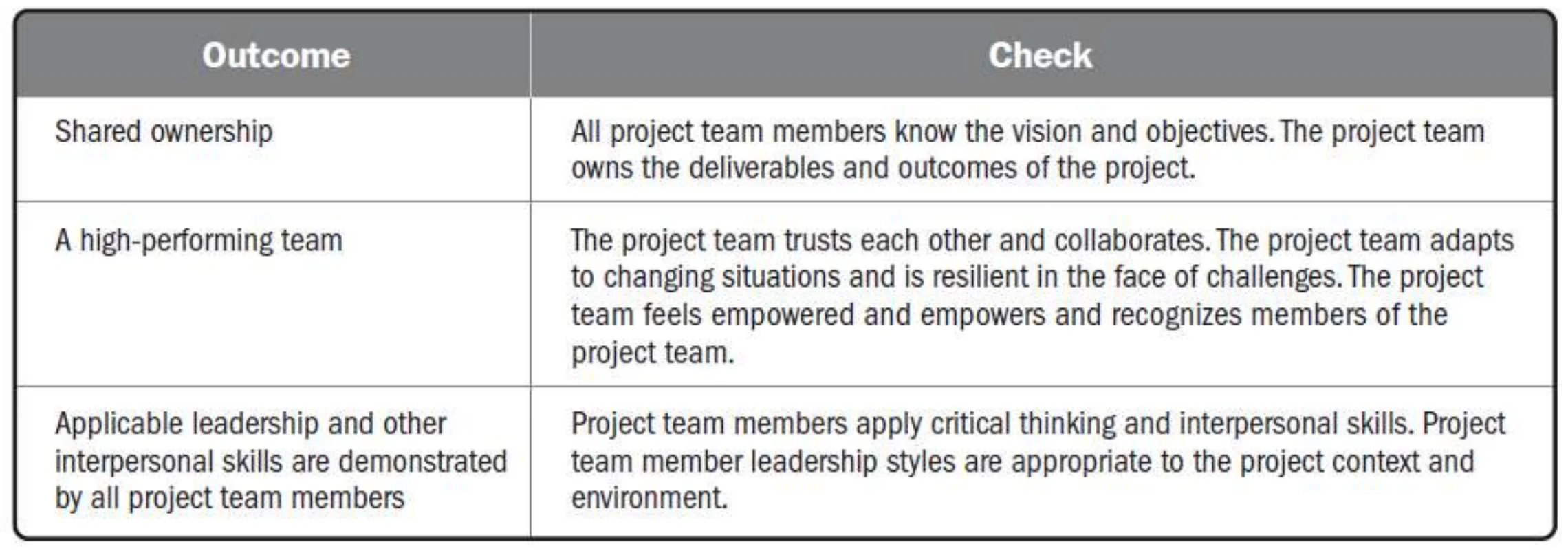
Checking Outcomes—Team Performance Domain

Checking outcomes for the team performance domain
18
Exam weight Low
  1. Read the left column as “what success looks like” and the right column as “how you would prove it”. These tables are rarely tested word for word; use them to explain a domain in a written answer.

Development Approach and Life Cycle Performance Domain

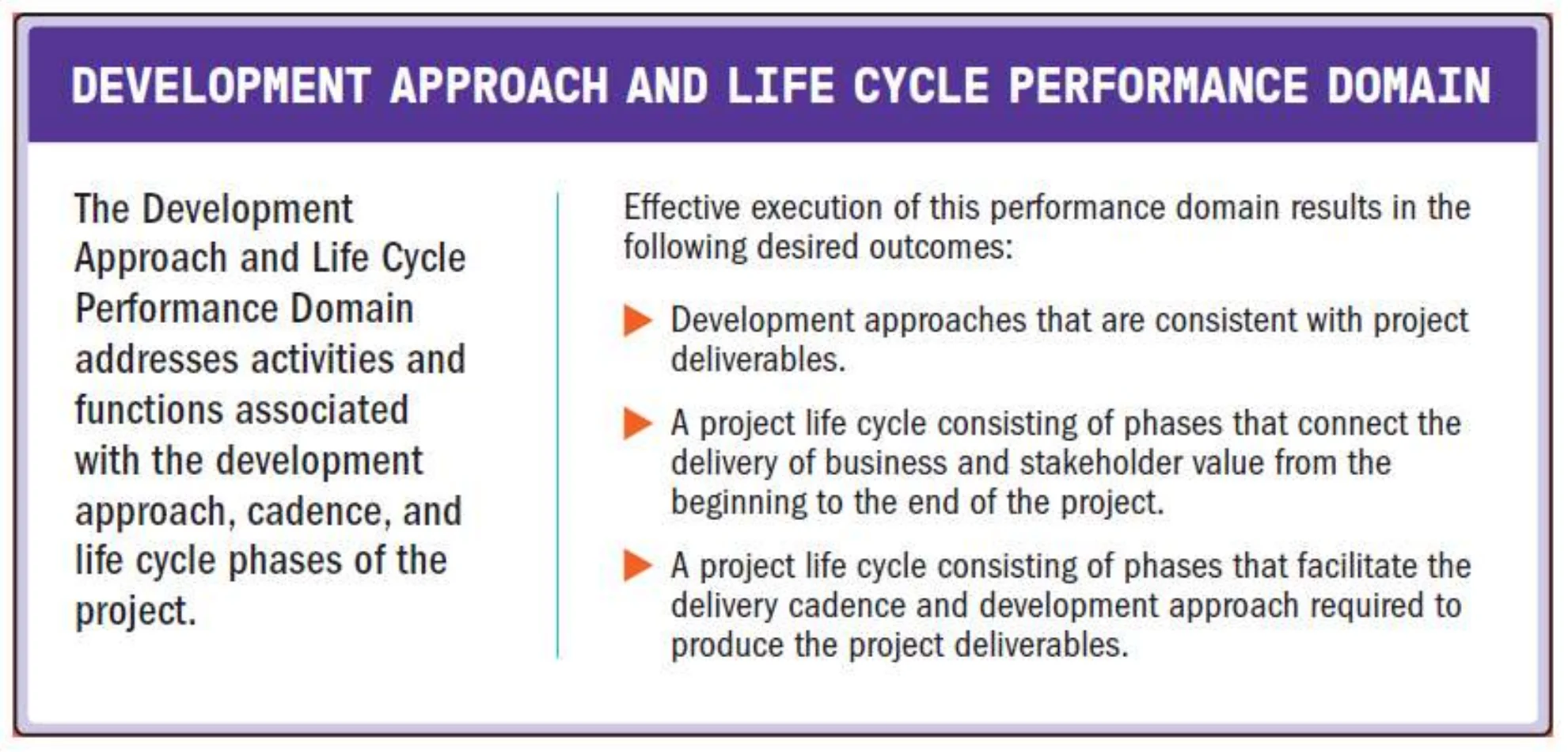
Development approach and life cycle performance domain card
19
Exam weight Low
  1. Outcomes: approaches consistent with deliverables, a life cycle that delivers value from start to end, and phases that support the cadence.
★ Past exam

Development Approach and Life Cycle Performance Domain

  • The following definitions are relevant to the Development Approach and Life Cycle Performance Domain:
    • Deliverable
      • Any unique and verifiable product, result, or capability to perform a service that is required to be produced to complete a process, phase, or project.
    • Development Approach.
      • A method used to create and evolve the product, service, or result during the project life cycle, such as a predictive, iterative, incremental, adaptive, or hybrid method.
    • Cadence.
      • A rhythm of activities① conducted throughout the project.
    • Project Phase.
      • A collection of logically related project activities that culminates in the completion of one or more deliverables.
    • Project Life Cycle.
      • The series of phases that a project passes through from its start to its completion.②
20
Exam weight High
  1. Cadence = rhythm of activities. This word was its own midterm MCQ.
  2. Phase = related activities ending in deliverables. Life cycle = all the phases from start to finish.
🎯 How this can come up · 1 question
MCQ

“A rhythm of activities conducted throughout the project” defines:

★ Past exam

Development, Cadence, and Life Cycle

  • The type of project deliverable(s) determines how it can be developed.
  • The type of deliverable(s) and the development approach influence the number and cadence for project deliveries.
  • The deliverable approach and the desired delivery cadence determine the project life cycle and its phases.①
  • Delivery cadence refers to the timing and frequency② of project deliverables.
  • Projects can have a single delivery, multiple deliveries, or periodic deliveries.
21
Exam weight High
  1. The chain: deliverable type → development approach → cadence → life cycle and phases.
  2. Delivery cadence = WHEN and HOW OFTEN you deliver: single, multiple or periodic.
🎯 How this can come up · 1 question
MCQ

In project management, what is the primary purpose of establishing a project cadence?

Delivery Cadence

  • For digital products, another delivery option is called continuous delivery.
  • Continuous delivery is the practice of delivering feature increments immediately to customers, often through the use of small batches of work and automation technology.
  • From the product management perspective, the emphasis is on delivering benefits and value throughout the product life cycle.
  • This allows the team to respond to market trends and stay focused on value delivery.
  • This practice is included in several approaches such as DevOps①, #noprojects and Continuous Digital, for example.
22
Exam weight Medium
  1. Continuous delivery = ship small increments immediately, using automation. It belongs to DevOps (Chapter 4).
🎯 How this can come up · 1 question
True / False

Continuous delivery means delivering the whole product once at the end of the project.

Development Approaches

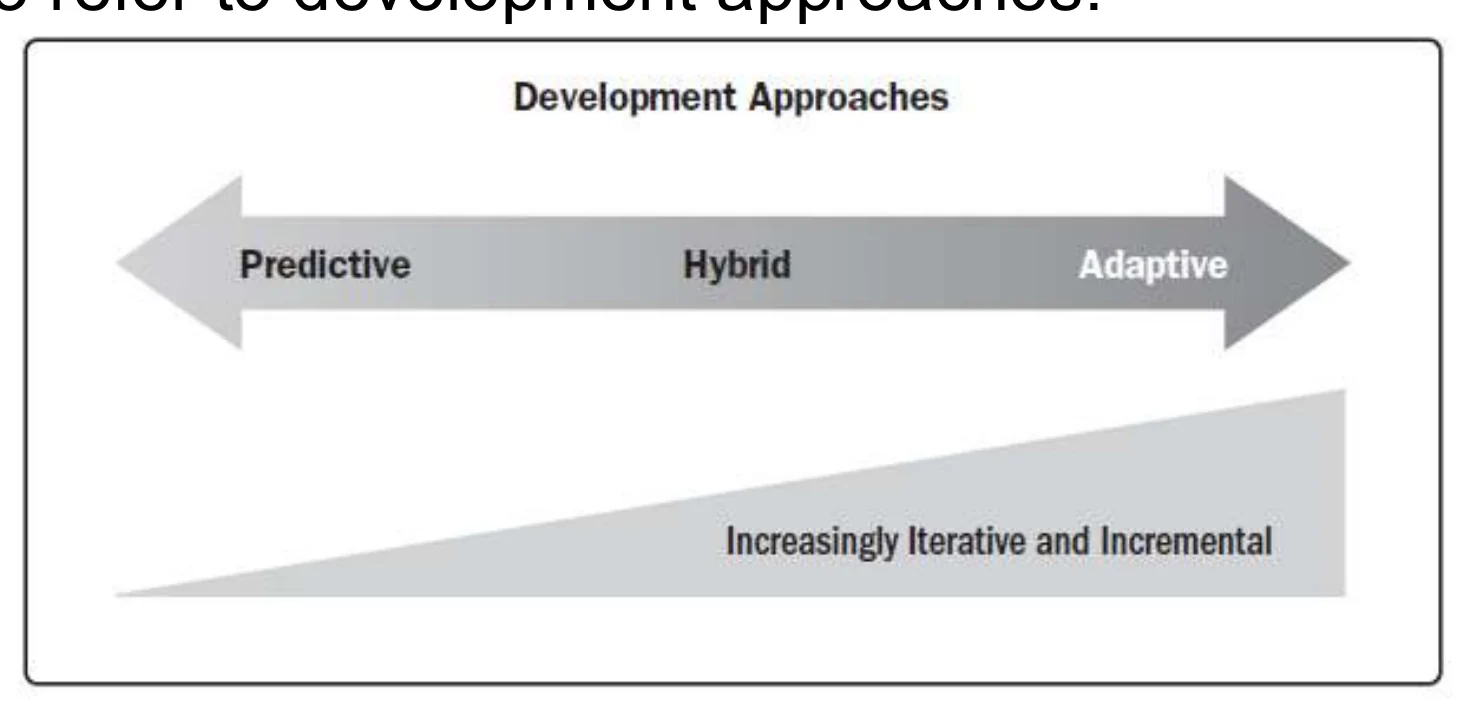
  • A development approach is the means used to create and evolve the product, service, or result during the project life cycle.
  • There are different development approaches, and different industries may use different terms to refer to development approaches.
  • Three commonly used

approaches are

  • predictive,
  • hybrid, and
  • adaptive.①
Spectrum from predictive through hybrid to adaptive, increasingly iterative and incremental
23
Exam weight Medium
  1. It is a spectrum, not three boxes. The further right you go, the more iterative and incremental.

Development Approaches

  • Predictive approach
    • A predictive approach is useful when the project and product requirements can be defined, collected, and analyzed at the start of the project. (Waterfall approach)①
    • May also be used when there is a significant investment involved and a high level of risk that may require frequent reviews, change control mechanisms, and replanning between development phases.
    • The scope, schedule, cost, resource needs, and risks can be well defined in the early phases of the project life cycle, and they are relatively stable.
    • This development approach allows the project team to reduce the level of uncertainty early in the project and do much of the planning upfront.②
24
Exam weight High
  1. Predictive = waterfall. Use it when requirements are known up front and stable.
  2. Also used for big investment and high risk, with reviews and change control between phases.
🎯 How this can come up · 1 question
Scenario

A government payroll system has fixed legal requirements that will not change. Which approach fits and why?

Development Approaches

  • Hybrid approach
    • A hybrid development approach is a combination of adaptive and predictive approaches.
    • This means that some elements from a predictive approach are used and some from an adaptive approach are used.
    • This development approach is useful when there is uncertainty or risk around the requirements.
    • Hybrid is also useful when deliverables can be modularized①, or when there are deliverables that can be developed by different project teams.
25
Exam weight High
  1. Hybrid when some parts are certain and some are not, or when modules can go to different teams.
🎯 How this can come up · 1 question
Scenario

The Edugate app (real midterm case) must integrate with fixed IT rules but student usability needs keep evolving. Which approach would you recommend?

Development Approaches

  • Hybrid approach
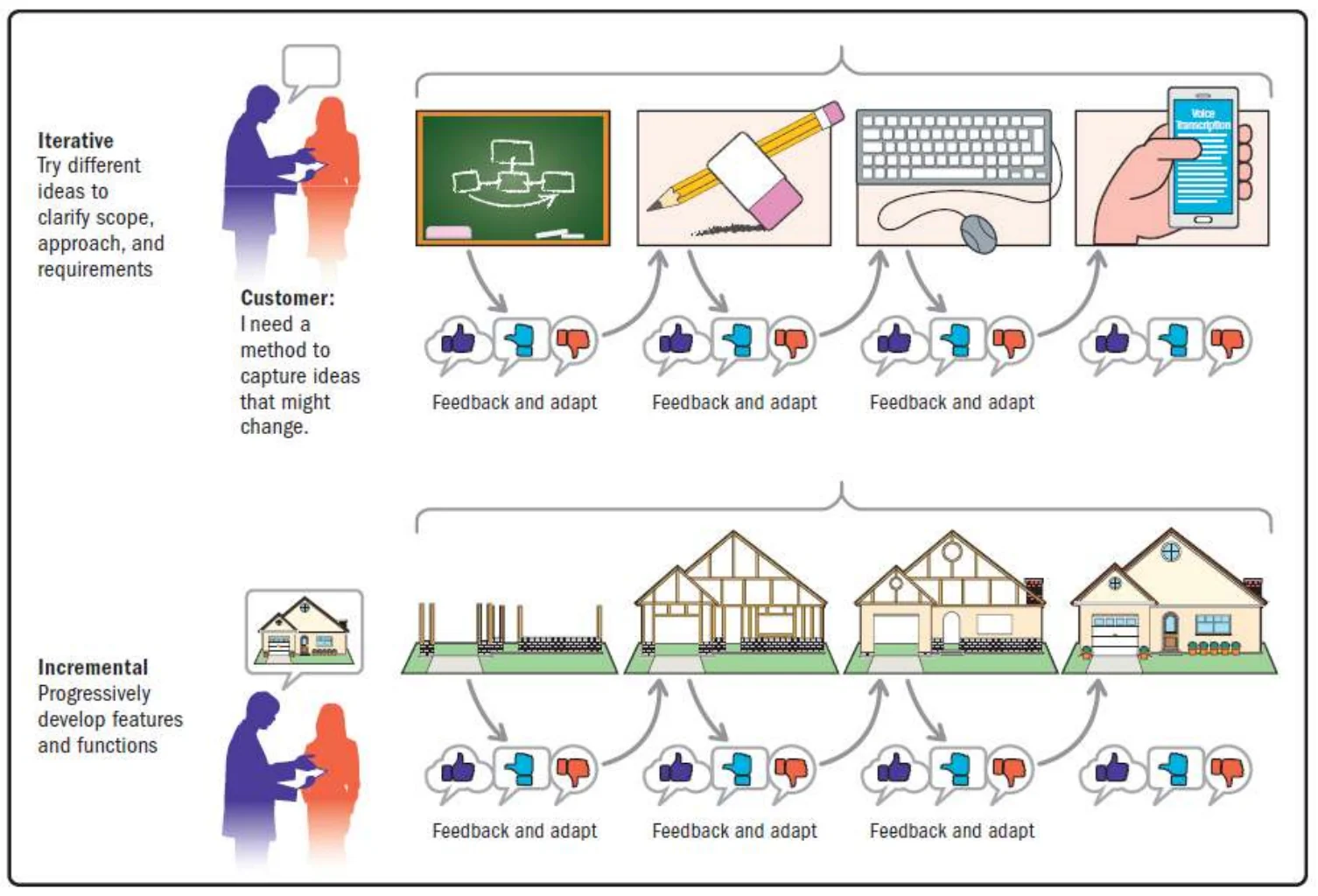
Iterative (refining one idea with feedback) vs. incremental (adding features one at a time)
Top: iterative, the same item refined through feedback. Bottom: incremental, the house grows piece by piece.
26
Exam weight Medium
  1. Iterative = improve the SAME thing repeatedly. Incremental = add NEW pieces each time. Adaptive approaches use both.
Exam trapIterative ≠ incremental. Iterative refines; incremental adds.
🎯 How this can come up · 1 question
MCQ

Adding one new feature to the product in each cycle is best described as:

★ Past exam

Development Approaches

  • Adaptive approach
    • Adaptive approaches are useful when requirements are subject to a high level of uncertainty and volatility and are likely to change throughout the project.①
    • A clear vision is established at the start of the project, and the initial known requirements are refined, detailed, changed, or replaced in accordance with user feedback, the environment, or unexpected events.
    • Adaptive approaches use iterative and incremental approaches. However, on the far side of the adaptive methods, the iterations tend to get shorter and the product is more likely to evolve based on stakeholder feedback.②
27
Exam weight High
  1. Adaptive when requirements are uncertain and volatile. Start with a clear vision, refine the rest with feedback.
  2. Further toward adaptive: shorter iterations, more evolution driven by feedback.
🎯 How this can come up · 1 question
MCQ

In which project would an iterative development approach be most beneficial?

Development Approaches

  • Adaptive approach
    • While agility is a wide mindset that is broader than a development framework, agile approaches can be considered adaptive. Some agile approaches entail iterations that are 1 to 2 weeks in duration with a demonstration of the accomplishments at the end of each iteration.①
    • The project team is very engaged with the planning for each iteration.
    • The project team will determine the scope they can achieve based on a prioritized backlog②, estimate the work involved, and work collaboratively throughout the iteration to develop the scope.
28
Exam weight Medium
  1. Agile iterations: 1–2 weeks, ending with a demo.
  2. The team picks scope from a prioritized backlog and estimates it itself.
🎯 How this can come up · 1 question
True / False

In agile iterations, the project team itself determines the scope it can achieve from a prioritized backlog.

Considerations for Selecting Approaches

  • There are many variables associated with the nature of the product or service that influence the development approach.
    • Degree of innovation
    • Requirements certainty
    • Scope stability
    • Ease of change
    • Delivery options
    • Risk
    • Safety requirements
    • Regulations①
29
Exam weight Medium
  1. Product variables: Innovation, Requirements certainty, Scope stability, Ease of change, Delivery options, Risk, Safety, Regulations.
TipHigh innovation, uncertain requirements, unstable scope, easy to change → adaptive. Heavy safety or regulation → leans predictive.
🎯 How this can come up · 1 question
Scenario

A medical device with strict safety regulations and stable requirements: which way do these variables push the approach?

Considerations for Selecting Approaches

  • Project variables that influence the development approach are centered around stakeholders, schedule constraints, and funding availability.
    • Stakeholders
      • Projects that use adaptive methods require significant stakeholder involvement throughout the process.
      • Certain stakeholders, such as the product owner, play a substantial role in establishing and prioritizing work.①
    • Schedule constraints
      • If there is a need to deliver something early, even if it is not a finished product, an iterative or adaptive approach is beneficial.
    • Funding availability
      • Projects that work in an environment of funding uncertainty can benefit from an adaptive or iterative approach.
      • A minimum viable product② can be released with less investment than an elaborate product.
      • This allows for market testing or market capture with minimum investment.
30
Exam weight Medium
  1. Project variables: Stakeholders, Schedule constraints, Funding availability. All three of them push toward adaptive when present.
  2. MVP = release with minimum investment to test the market.
🎯 How this can come up · 1 question
MCQ

A start-up with uncertain funding wants to test the market quickly. Which approach and artifact does the slide suggest?

Considerations for Selecting Approaches

  • The Organization
    • Organizational variables such as the structure, culture, capability, project team size, and location influence the development approach.
      • Organizational structure
      • Culture
      • Organizational capability
      • Project team size and location①
31
Exam weight Low
  1. Organizational variables: structure, culture, capability, team size and location.

Life Cycle and Phase Definition

  • Project phases often have a phase gate review① (also known as stage gate) to check that the desired outcomes or exit criteria for the phase have been achieved before proceeding to the next phase.
  • Exit criteria may tie to acceptance criteria for deliverables, contractual obligations, meeting specific performance targets, or other tangible measures.②
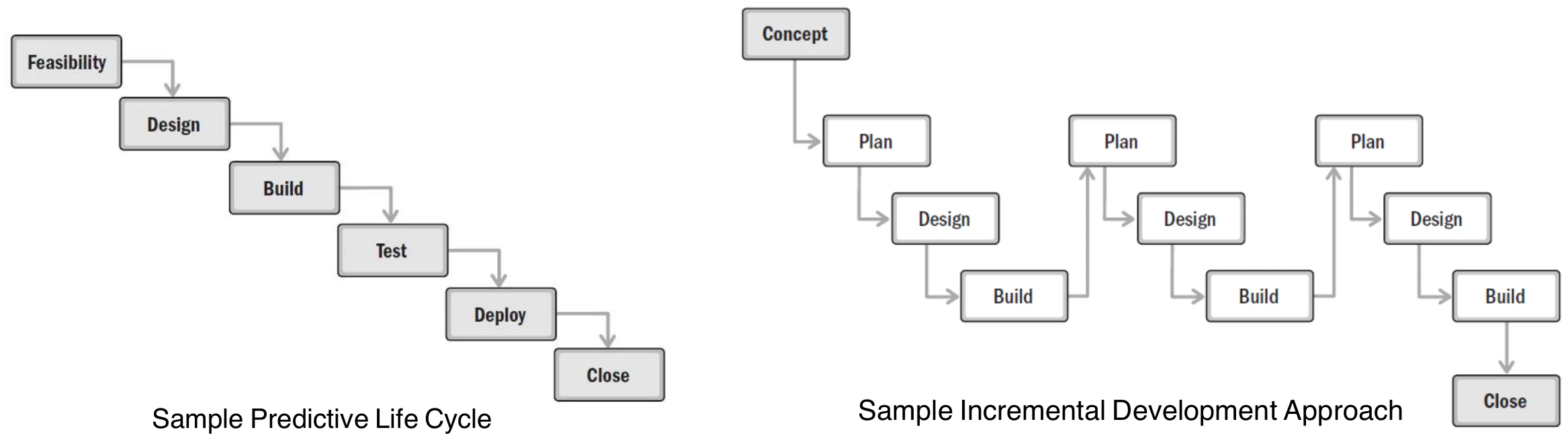
Sample predictive life cycle (feasibility → design → build → test → deploy → close) vs. sample incremental approach (repeated plan, design, build)
Left: predictive, one pass. Right: incremental, repeated plan → design → build.
32

Above “acceptance criteria”: “by stakeholder”.

Exam weight Medium
  1. Phase gate = a checkpoint: are the exit criteria met? Then go to the next phase.
  2. Acceptance criteria are set by the stakeholders.
🎯 How this can come up · 1 question
True / False

A phase gate review checks that exit criteria are met before moving to the next phase.

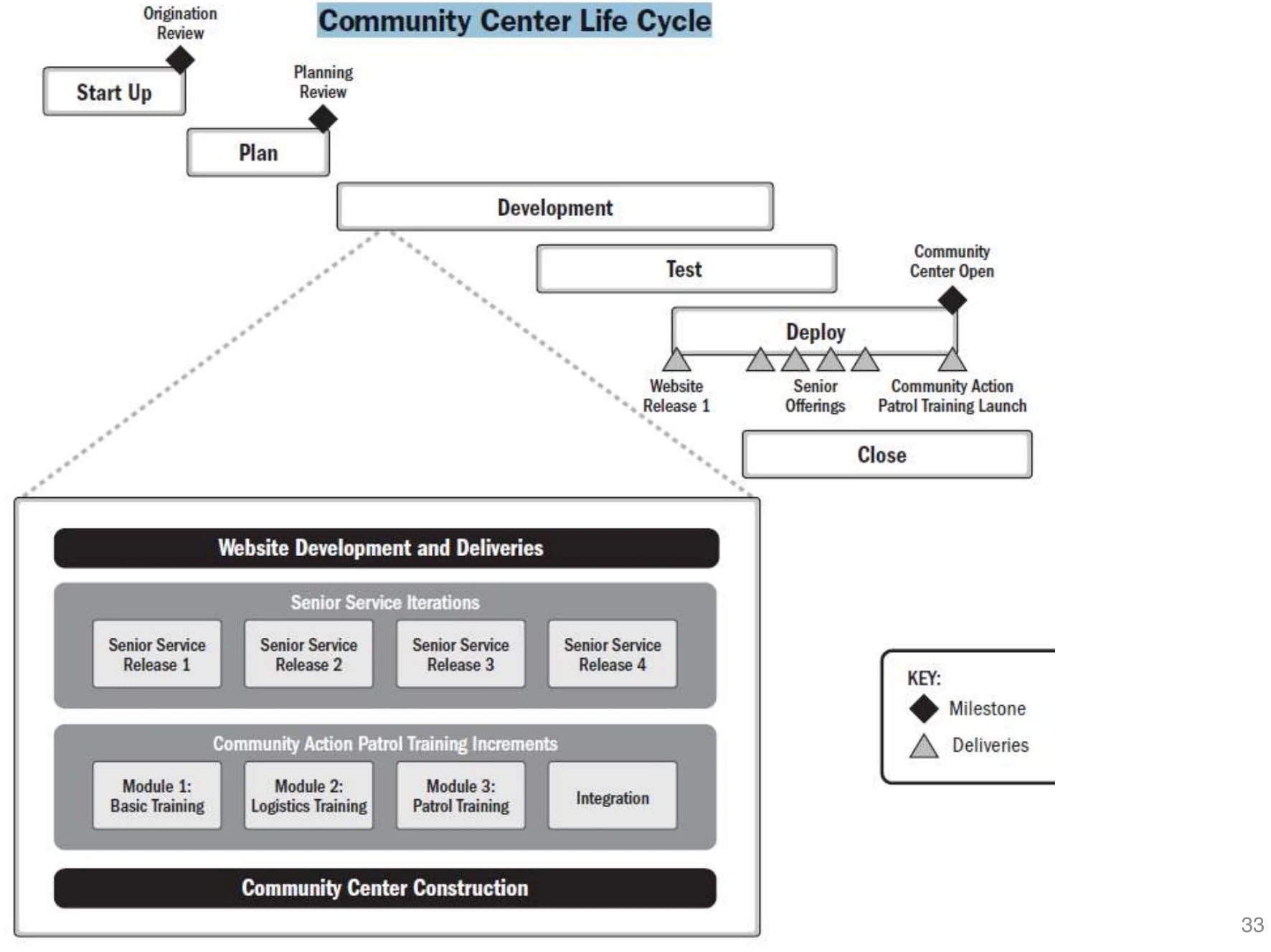
Life Cycle Example: Community Center

Community center life cycle: start up, plan, development, test, deploy, close, with incremental website and training releases
One project mixing approaches: predictive phases overall, incremental releases inside.
33
Exam weight Low
  1. A real hybrid: the building follows phases, while the website and training are released in increments.

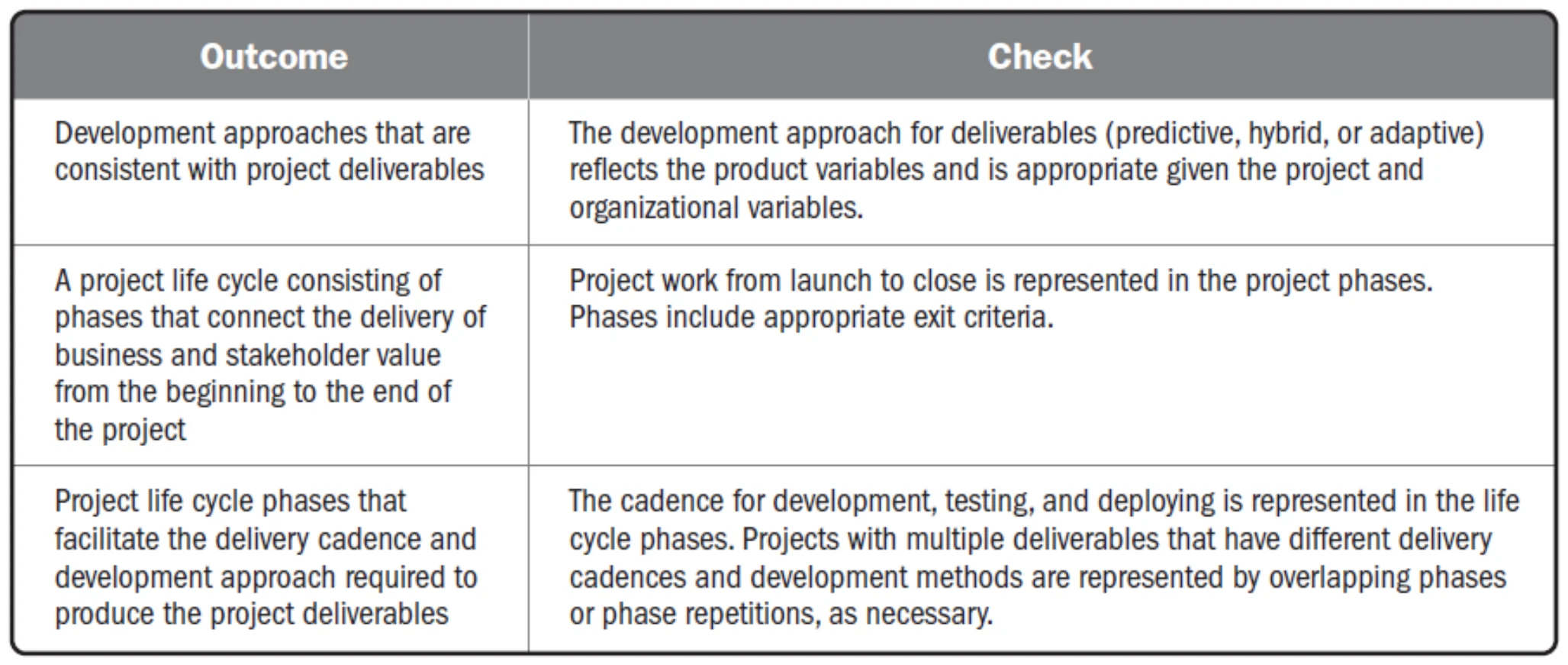
Checking Outcomes—Development Approach and Life Cycle Performance Domain

Checking outcomes for the development approach and life cycle domain
34
Exam weight Low
  1. Read the left column as “what success looks like” and the right column as “how you would prove it”. These tables are rarely tested word for word; use them to explain a domain in a written answer.

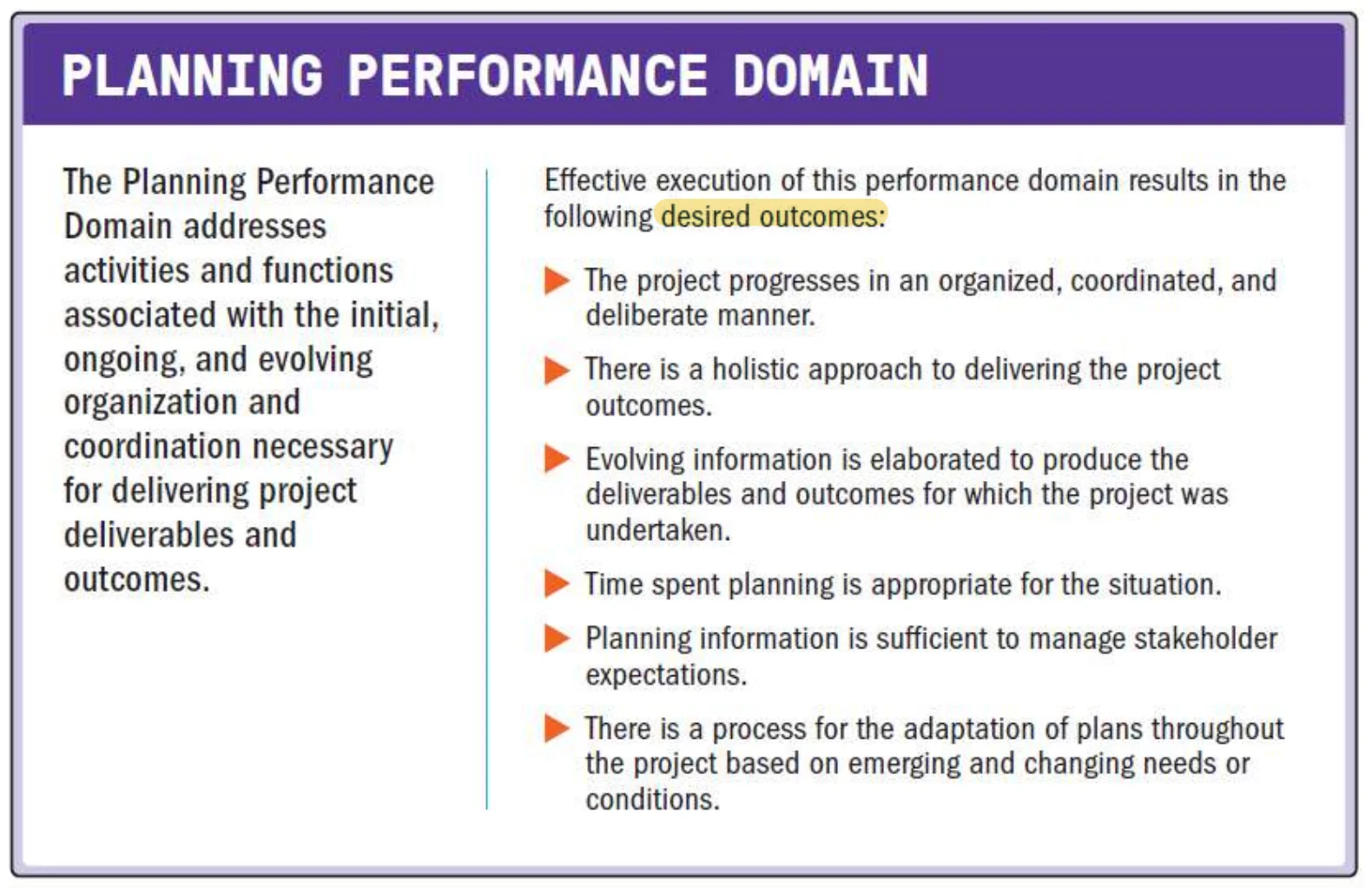
Planning Performance Domain

Planning performance domain card
35
Exam weight Low
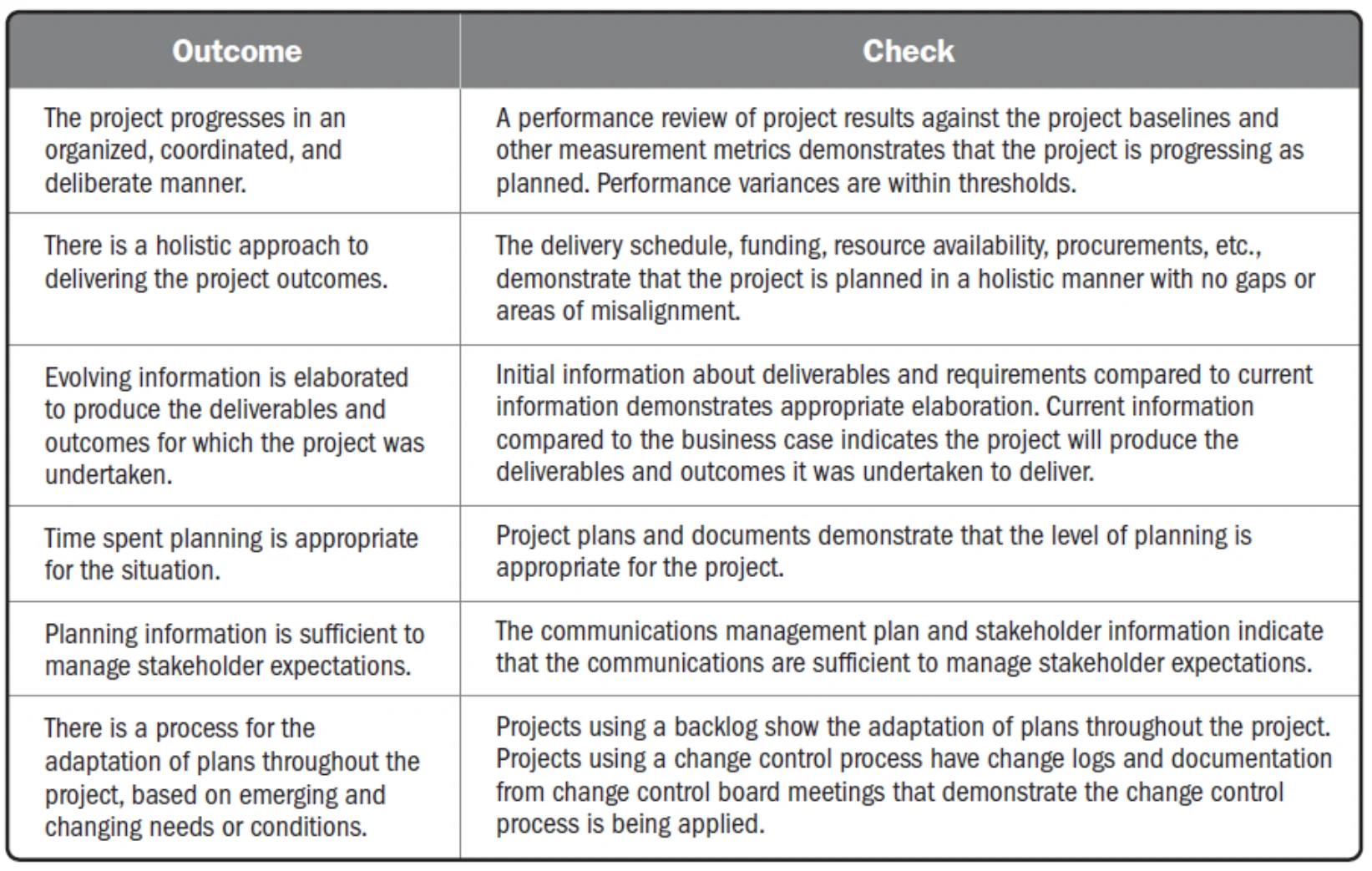
  1. Outcomes: organized progress, a holistic approach, plans elaborated over time, planning time appropriate for the situation, enough information for stakeholder expectations, and plans that adapt.

Planning Performance Domain

  • The following definitions are relevant to the Planning Performance Domain:
    • Estimate
      • A quantitative assessment of the likely amount or outcome of a variable, such as project costs, resources, effort, or durations.
    • Accuracy
      • Within the quality management system, accuracy is an assessment of correctness①: Reflects how well your plan predicts reality (If you estimate a project will cost $100K and it ends up costing $102K, your estimate was accurate)
    • Precision
      • Within the quality management system, precision is an assessment of exactness②: Reflects the level of detail and consistency in your planning assumptions (if your estimates are based on a precise breakdown of the costs): An estimate can be precise because all the details are taken into account but not accurate if the project ends up costing much more or much less.
36

Next to Accuracy: “correctness”. Next to Precision: “exact”.

Exam weight High
  1. Accuracy = correctness: did the estimate match reality? ($100K estimate, $102K actual = accurate.)
  2. Precision = exactness: how detailed the estimate is. You can be precise but still inaccurate.
Memory trickAccurate = hit the target. Precise = tight grouping (detail), even if it misses.
🎯 How this can come up · 2 questions
MCQ

An estimate built from a detailed cost breakdown ends up 40% over budget. The estimate was:

True / False

Accuracy is an assessment of exactness.

Planning Overview

  • The purpose of planning is to proactively ( ) develop an approach to create the project deliverables.①
  • High-level planning may begin prior to project authorization.
  • The project team progressively elaborates② initial project documents, such as a vision statement, project charter, business case, or similar documents to identify or define a coordinated path to achieve the desired outcomes.
  • It is becoming more common for initial planning to consider social and environmental impacts in addition to the financial. Such as a product life cycle assessment which evaluates the potential environmental impacts of a product, process, or system (impacts of materials and processes with regards to sustainability, toxicity, and the environment).③
37

Arabic gloss “مسبقًا” (in advance) for “proactively”.

Exam weight Medium
  1. Planning = deciding in advance how you will create the deliverables.
  2. Progressive elaboration: start high level and add detail as you learn. Initial documents: vision statement, project charter, business case.
  3. Planning now also weighs social and environmental impact, for example a product life cycle assessment.
🎯 How this can come up · 1 question
True / False

High-level planning may begin before the project is formally authorized.

Planning

  • Planning begins with understanding the business case, stakeholder requirements, and the project and product scope.
  • Product scope① defines the features and functions that characterize a product, service, or result.
  • Project scope② also defines the work performed to deliver a product, service, or result with the specified features and functions.
38
Exam weight Medium
  1. Product scope = WHAT the product has (features and functions).
  2. Project scope = the WORK needed to deliver it.
Exam trapProduct scope = features. Project scope = work. Do not swap them.
🎯 How this can come up · 1 question
MCQ

“The work performed to deliver a product with the specified features” is:

Delivery

  • In predictive planning approaches
    • start with the high-level project deliverables upfront and decompose them into more detail.
    • Employ a scope statement and/or a work breakdown structure (WBS)① to decompose the scope into lower levels of detail.
  • In Iterative and Incremental planning
    • can have high-level themes or epics that are decomposed into features, which are then further decomposed into user stories and other backlog items.②
    • Work that is unique, significant, risky, or novel can be prioritized to reduce the uncertainty associated with project scope at the start of the project before significant investment has taken place.
    • Project teams plan routine work based on the concept of last responsible moment③.
    • This approach defers a decision to allow the project team to consider multiple options until the cost of further delay would exceed the benefit.
39
Exam weight Medium
  1. Predictive: decompose scope with a scope statement and a WBS.
  2. Adaptive: themes/epics → features → user stories → backlog items.
  3. Last responsible moment: delay a decision until waiting would cost more than it saves.
🎯 How this can come up · 1 question
MCQ

Deferring a decision until the cost of further delay would exceed the benefit is called:

Estimating

  • Planning entails developing estimates for work effort, duration, costs, people, and physical resources.
  • Estimates are a quantitative assessment of the likely amount or outcome of a variable, such as project costs, resources, effort, or duration.
  • As the project evolves, the estimates can change based on current information and circumstances.①
40
Exam weight Medium
  1. Estimates change as you learn more. That is the cone of uncertainty in Chapter 6.

Schedules

  • A schedule is a model for executing the project’s activities, including durations, dependencies, and other planning information.
  • Schedule planning can use predictive or adaptive approaches.
  • Predictive approaches follow a stepwise process as follows:
    • Step 1. Decompose the project scope into specific activities.
    • Step 2. Sequence related activities.
    • Step 3. Estimate the effort, duration, people, and physical resources required to complete the activities.
    • Step 4. Allocate people and resources to the activities based on availability.
    • Step 5. Adjust the sequence, estimates, and resources until an agreed-upon schedule is achieved.①
41
Exam weight Medium
  1. Five steps of predictive scheduling: Decompose → Sequence → Estimate → Allocate → Adjust.
Memory trickD.S.E.A.A.: “Don’t Skip Every Activity, Adjust.”
🎯 How this can come up · 1 question
MCQ

What is step 2 of the predictive scheduling process?

Schedules

  • The four types of dependencies are:
    • Mandatory dependency①
      • A relationship that is contractually required or inherent in the nature of the work. This type of dependency usually cannot be modified.
    • Discretionary dependency②
      • A relationship that is based on best practices or project preferences. This type of dependency may be modifiable.
    • External dependency
      • A relationship between project activities and non-project activities. This type of dependency usually cannot be modified.
    • Internal dependency
      • A relationship between one or more project activities. This type of dependency may be modifiable.
42
Exam weight High
  1. Mandatory = required by contract or by nature (you cannot test before building). Cannot be changed.
  2. Discretionary = best practice or preference, so it can be changed. This is what you relax when fast-tracking.
Memory trickCan it be modified? Mandatory ✗ · Discretionary ✓ · External ✗ · Internal ✓.
🎯 How this can come up · 2 questions
MCQ

Waiting for a government permit before construction can start is which type of dependency?

True / False

A discretionary dependency usually cannot be modified.

Schedules

  • Adaptive schedule planning uses incremental planning.
  • One such scheduling approach is based on iterations and releases.
  • A high-level release plan is developed that indicates the basic features and functionality to be included in each release.
  • Within each release, there will be two or more iterations①.
  • Each iteration adds business and/or stakeholder value.
  • Value may include features, risk reduction, experimentation, or other ways of delivering or protecting value.
  • The planning for the work in future releases is kept at a high level so the project team does not engage in planning that could change based on feedback from earlier releases.②
43
Exam weight Low
  1. Adaptive scheduling: release plan → each release has 2+ iterations → each iteration adds value.
  2. Future releases stay high level on purpose, because feedback will change them.

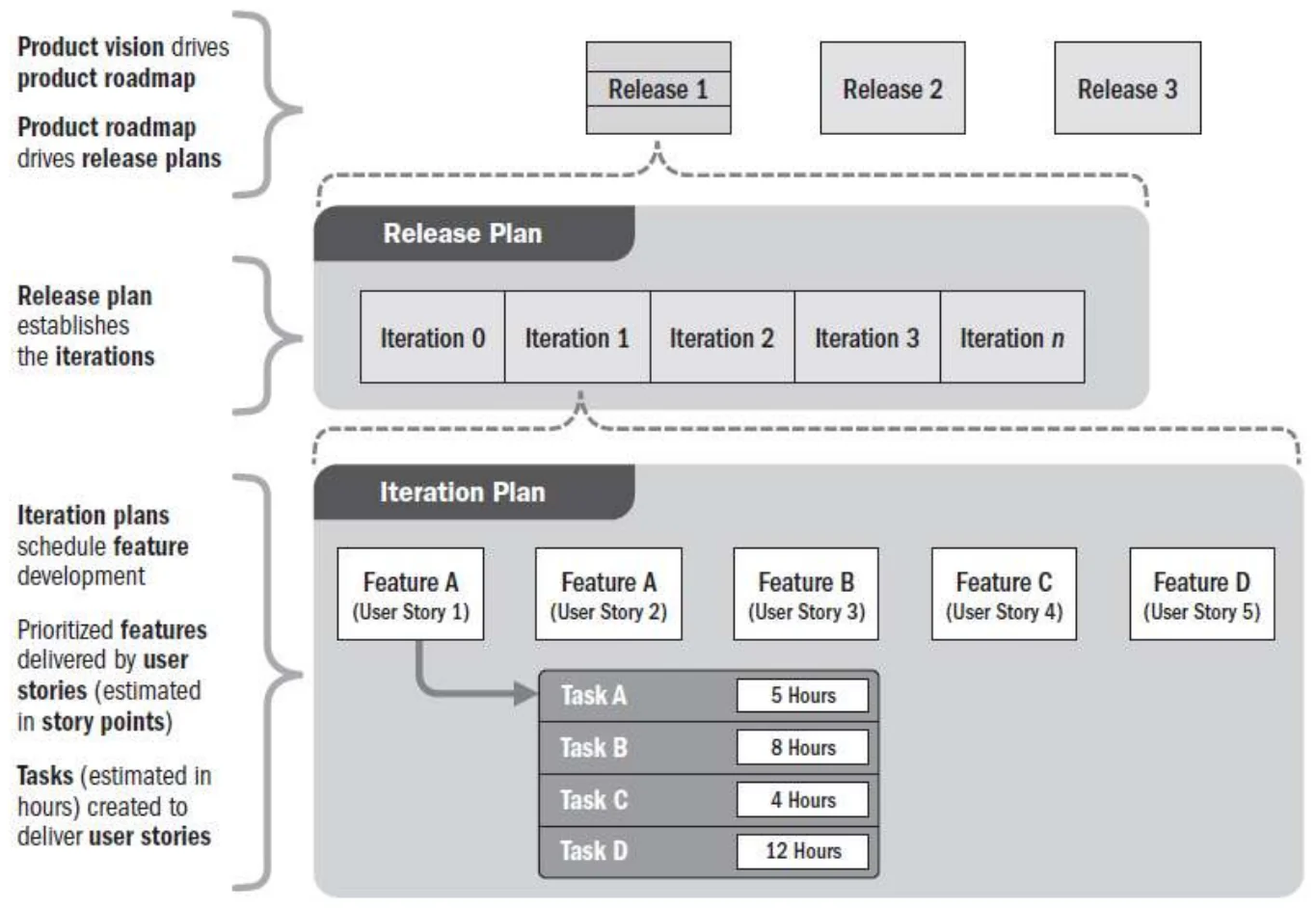
Schedules (Release and Iteration Plan)

Product vision → roadmap → release plan → iteration plan → features → tasks
44
Exam weight Low
  1. Zoom levels: vision → roadmap → releases → iterations → features (user stories) → tasks (hours).

Schedules

  • Adaptive approaches often use timeboxes①.
  • The work in each timebox is based on a prioritized backlog.
  • The project team determines the amount of work they can do in each timebox, estimates the work, and self-manages to accomplish the work.
  • At the end of the timebox, the project team demonstrates the work completed.
  • At that point, the backlog and estimates of work available to be done may be updated or reprioritized for the next timebox.②
45
Exam weight Medium
  1. Timebox = fixed time, flexible scope (a sprint is a timebox).
  2. After each timebox: demo, then reprioritize the backlog.
🎯 How this can come up · 1 question
True / False

In a timebox, the scope is fixed and the time is flexible.

Budget

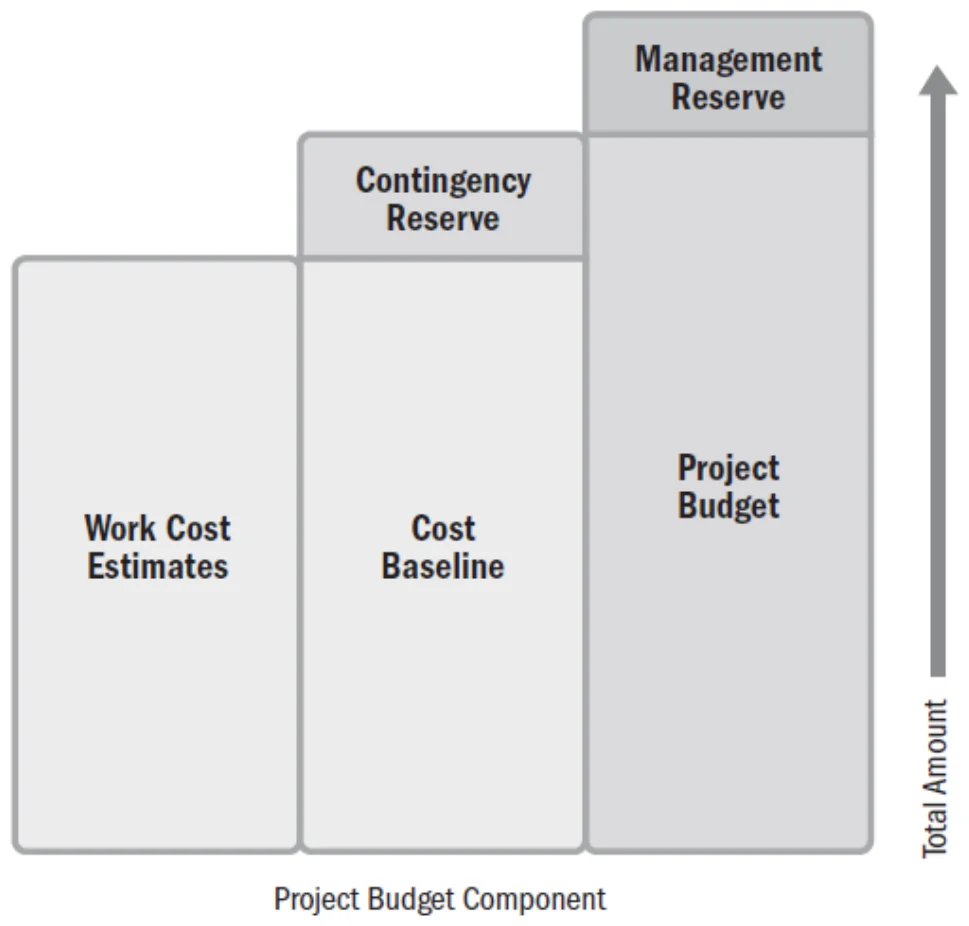
  • The project budget evolves from the agreed estimates for the project.
  • Cost estimates are then aggregated to develop the cost baseline①.
  • The cost baseline (time-phased budget) is often allocated across the project schedule to reflect when the costs will be incurred.
  • This practice allows project managers to balance the funds approved in a specific budget period with the scheduled work.
  • If there are funding limitations for a budget period, the work may need to be rescheduled to meet those limitations.
46
Exam weight Low
  1. Cost baseline = the time-phased budget: estimates summed and spread over the schedule.

Budget

  • The project budget should include contingency reserve funds to allow for uncertainty.
  • Contingency reserves are set aside to implement a risk response or to respond to risk events should they occur (for identified risks, controlled by PM①).
  • Management reserves are set aside for unexpected activities related to in-scope work (for unknown risks, usually controlled by upper management②).
  • Depending on the organization’s policies and organizational structure, management reserves may be managed by the project, the sponsor, product owner, or the PMO at the program and portfolio level.
47
Exam weight High
  1. Contingency reserve = for KNOWN (identified) risks. The PM controls it.
  2. Management reserve = for UNKNOWN events. Upper management controls it.
Memory trickContingency = known-unknowns (PM). Management = unknown-unknowns (management).
🎯 How this can come up · 1 question
MCQ

A reserve for unknown, unplanned in-scope work, usually controlled by upper management, is the:

Budget Build Up

Budget build-up: work cost estimates + contingency reserve = cost baseline; + management reserve = project budget
48
Exam weight High
  1. Build it bottom-up: estimates + contingency = cost baseline; cost baseline + management reserve = total project budget.
🎯 How this can come up · 1 question
MCQ

Which is included in the cost baseline but NOT the management reserve?

Physical Resources

  • Physical resources apply to any resource that is not a person.
  • It can include materials, equipment, software, testing environments, licenses, and so forth.
  • Planning for physical resources entails estimating, as well as supply chain, logistics, and management.
  • Projects with significant physical resources, such as engineering and construction projects, will need to plan for procurement activities to acquire the resources.
  • Planning for physical resources includes taking into account lead time for delivery, movement, storage, and disposition of materials, as well as a means to track material inventory from arrival on site to delivery of an integrated product.①
49
Exam weight Low
  1. Physical resources = everything that is not a person: materials, equipment, software, licenses, test environments. Plan the logistics too: lead time, storage, tracking.

Procurement

  • Procurement can happen at any time during a project. However, upfront planning helps to set expectations that ensure the procurement process is performed smoothly.
  • Once the high-level scope is known, project teams conduct a make-or-buy analysis①.
  • This includes identifying those deliverables and services that will be developed in-house, and those that will be purchased from external sources.
  • This information impacts the project team and the schedule.
50
Exam weight Medium
  1. Make-or-buy: decide what to build in-house and what to purchase.
🎯 How this can come up · 1 question
MCQ

Deciding which deliverables to develop in-house and which to purchase is called:

Metrics

  • There is a natural linkage between planning, delivering, and measuring work.
  • That linkage is metrics.
  • Establishing metrics includes setting the thresholds that indicate whether work performance is as expected, trending positively or negatively away from expected performance, or unacceptable.
  • Deciding what to measure and “how often” is best informed by the phrase “only measure what matters.”①
51
Exam weight Low
  1. Metrics link planning, delivering and measuring. Set thresholds: expected, trending, or unacceptable.

Checking Outcomes—Planning Performance Domain

Checking outcomes for the planning performance domain
52
Exam weight Low
  1. Read the left column as “what success looks like” and the right column as “how you would prove it”. These tables are rarely tested word for word; use them to explain a domain in a written answer.

Project Work Performance Domain

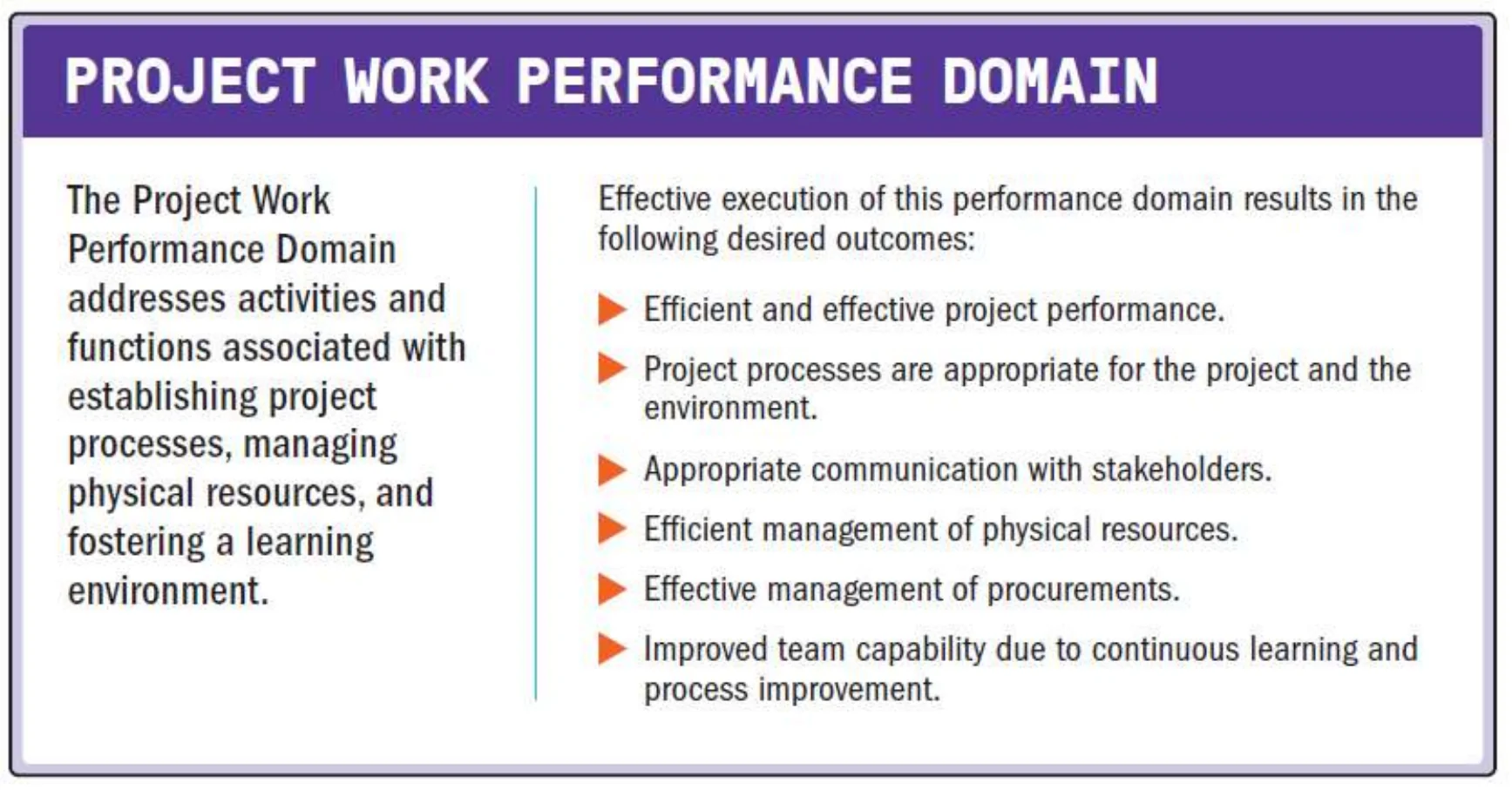
Project work performance domain card
53
Exam weight Low
  1. Outcomes: efficient performance, appropriate processes, good communication, efficient physical resources and procurement, and continuous learning.

Project Work Performance Domain

  • The following definitions are relevant to the Project Work Performance Domain:
    • Bid Documents
      • All documents used to solicit information, quotations, or proposals from prospective sellers.
    • Bidder Conference
      • The meetings with prospective sellers prior to the preparation of a bid or proposal to ensure all prospective vendors have a clear and common understanding of the procurement. Also known as contractor conferences, vendor conferences, or pre-bid conferences.
    • Explicit Knowledge①
      • Knowledge that can be codified using symbols such as words, numbers, and pictures.
    • Tacit Knowledge②
      • Personal knowledge that can be difficult to articulate and share such as beliefs, experience, and insights.
54
Exam weight Medium
  1. Explicit = can be written down (words, numbers, pictures).
  2. Tacit = in people’s heads (beliefs, experience, insights) and hard to share.
Memory trickTacit = Taught by doing; Explicit = Easily written.
🎯 How this can come up · 2 questions
MCQ

An experienced developer’s instinct for which modules usually break is:

MCQ

A meeting with prospective sellers so all vendors share a common understanding before bidding is a:

Project Work Performance Domain

  • Project work keeps the project team focused and project activities running smoothly.
  • This includes but is not limited to:
    • Managing the flow of existing work, new work, and changes to work;
    • Keeping the project team focused;
    • Establishing efficient project systems and processes;
    • Communicating with stakeholders;
    • Managing material, equipment, supplies, and logistics;
    • Working with contracting professionals and vendors to plan and manage procurements and contracts;
    • Monitoring changes that can affect the project; and
    • Enabling project learning and knowledge transfer.①
55
Exam weight Low
  1. Project work = keeping the work flowing: changes, focus, processes, communication, logistics, procurement, monitoring, learning.

Project Processes

  • The project manager and the project team establish and periodically review the processes the project team is using to conduct the work.
  • This can take the form of reviewing task boards to determine if there are bottlenecks in the process, if work is flowing at the expected rate, and if there are any impediments that are blocking progress.①
56
Exam weight Low
  1. Review the process regularly: bottlenecks, flow rate and blockers (task boards help).

Project Processes

  • Process tailoring can be used to optimize the process for the needs of the project.
  • In general, large projects have more process compared to small projects, and critical projects have more process than less significant projects.
  • Tailoring takes into consideration the demands of the environment.
  • Ways of optimizing the processes for the environment include:
    • Lean production methods.
    • Retrospectives or lessons learned.
    • Where is the next best funding spent?①
57
Exam weight Low
  1. More process for large or critical projects, less for small or less critical ones. Optimize with lean methods and retrospectives.

Project Processes

  • Reviewing processes can entail determining if processes are efficient, or if there is waste in the process that can be eliminated.
  • Time spent tracking conformance to process is time the project team cannot spend on delivering the outcomes for which the project was commissioned.
  • Therefore, project teams utilize just enough time reviewing process conformance to maximize the benefits delivered from the review while still satisfying the governance needs of process.①
58
Exam weight Low
  1. Time spent checking the process is time not spent delivering. Use “just enough” review.

Balancing Competing Constraints

  • Successfully leading a project includes understanding the constraints associated with the work.
  • Constraints can take the form of fixed delivery dates, compliance to regulatory codes, a predetermined budget, quality policies, and so forth. The constraints may shift and change throughout the project.①
  • A new stakeholder requirement may entail expanding the schedule and budget.
  • A reduction in budget may entail relaxing a quality requirement or reducing scope.②
59
Exam weight High
  1. Constraints = the limits you work within: dates, regulations, budget, quality. They shift during the project.
  2. Trade-offs: a new requirement adds schedule and budget; a budget cut relaxes quality or scope.
🎯 How this can come up · 1 question
Written

Define project constraints, give three examples and explain how they interrelate.

Balancing Competing Constraints

  • Balancing these shifting constraints, while maintaining stakeholder satisfaction, is an ongoing project activity.
  • At times, it may include meeting with the customer, sponsor, or product owner to present alternatives and implications.①
  • Other times, the decisions and potential variances may be within the project team’s authority to make trade-offs② to deliver the end result.
60
Exam weight Low
  1. Big trade-offs go to the customer, sponsor or product owner with alternatives.
  2. Smaller ones the team can decide within its own authority.

Working with Procurement

  • Many projects involve some form of contracting or procurement.
  • Procurement can cover everything from material, capital equipment, and supplies to solutions, labor, and services.
  • In most organizations, project managers do not have contracting authority①.
  • Rather, they work with contracting officers or other people with expertise in contracts, laws, and regulations.
61
Exam weight Medium
  1. PMs usually CANNOT sign contracts. They work with contracting officers.
🎯 How this can come up · 1 question
True / False

In most organizations, the project manager has the authority to sign procurement contracts.

Working with Procurement

  • Organizations usually have rigorous policies and procedures associated with procurements. The policies identify who has authority to enter into a contract, the limits of authority, and the processes and procedures that should be followed.
  • Prior to conducting a procurement, the project manager and technically qualified project team members work with contracting professionals to develop the request for proposals (RFP), statement of work (SOW), terms and conditions, and other necessary documents to go out to bid.①
62
Exam weight Low
  1. The PM plus technical experts help draft the RFP and SOW; the contracting professionals run the process.

The Bid Process

  • The bid process includes developing and publicizing bid documents, bidder conferences, and selecting a bidder.
  • Bid documents can include:
    • Request for information① (Example: A company wants to build a new software platform but isn’t sure what technologies or vendors are out there. They issue an RFI to learn about different capabilities and approaches.)
    • Request for proposal (Example: After reviewing RFIs, the company decides on a specific type of software and issues an RFP to invite vendors to bid on building it.)
    • Request for quote② (Example: A company needs 500 laptops with specific specs. They issue an RFQ to multiple vendors asking for their best price and delivery timeline.)
63
Exam weight High
  1. RFI = “What is out there?” (learning). RFP = “How would you build it?” (solution).
  2. RFQ = “What is your price?” (a known item, compare prices).
Memory trickInformation → Proposal → Quote: from exploring, to choosing a solution, to buying a known item.
🎯 How this can come up · 2 questions
MCQ

A company needs 500 laptops with exact specs and asks vendors for their best price. It issues an:

MCQ

A company unsure which technologies or vendors exist issues an:

Learning Through the Project

  • Knowledge Management
  • Explicit and Tacit Knowledge
64
Exam weight Low
  1. Learning through the project = managing knowledge, both explicit (documents) and tacit (people). See slide 54.

Checking Outcomes—Project Work Performance Domain

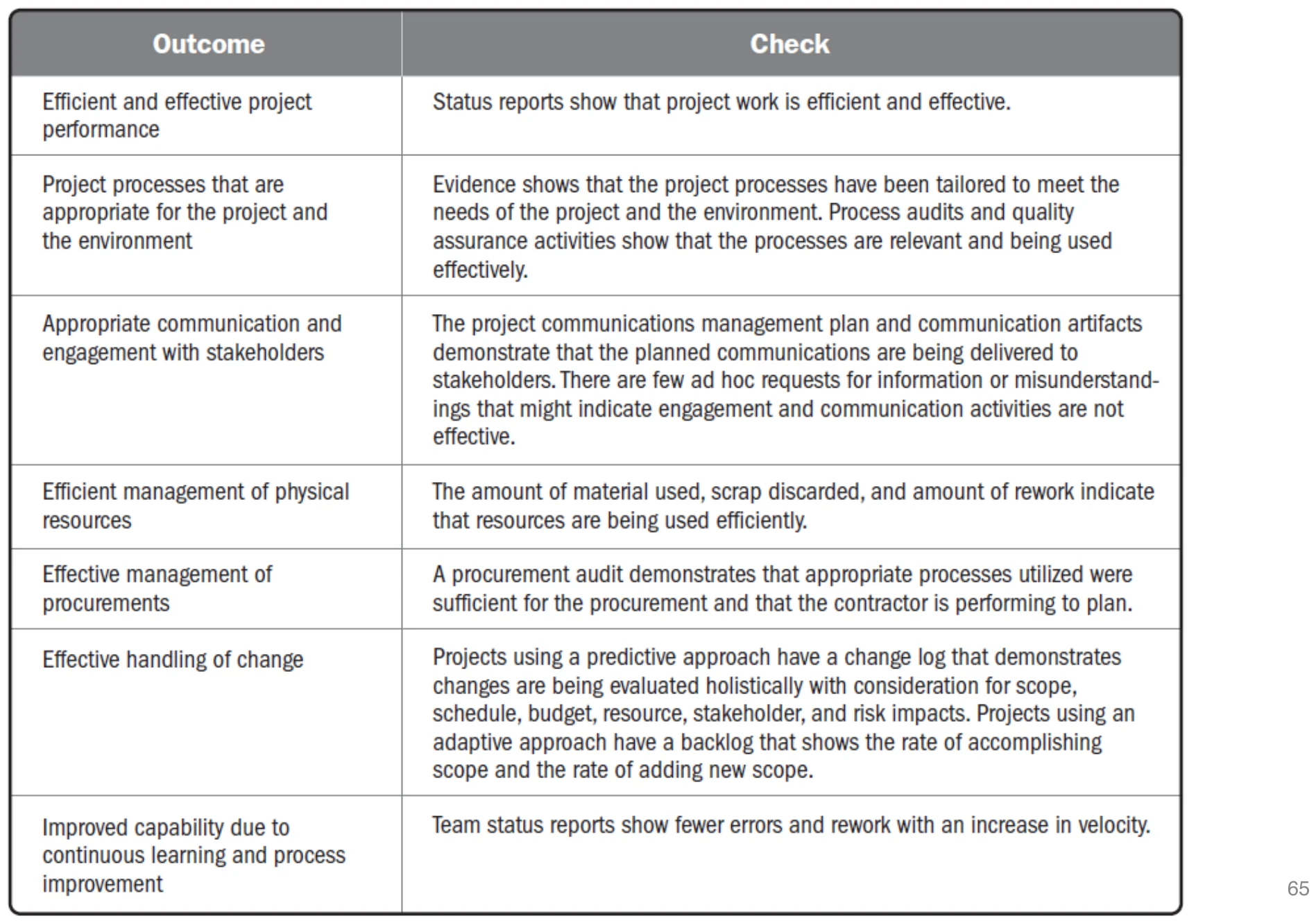
Checking outcomes for the project work performance domain
65
Exam weight Low
  1. Read the left column as “what success looks like” and the right column as “how you would prove it”. These tables are rarely tested word for word; use them to explain a domain in a written answer.

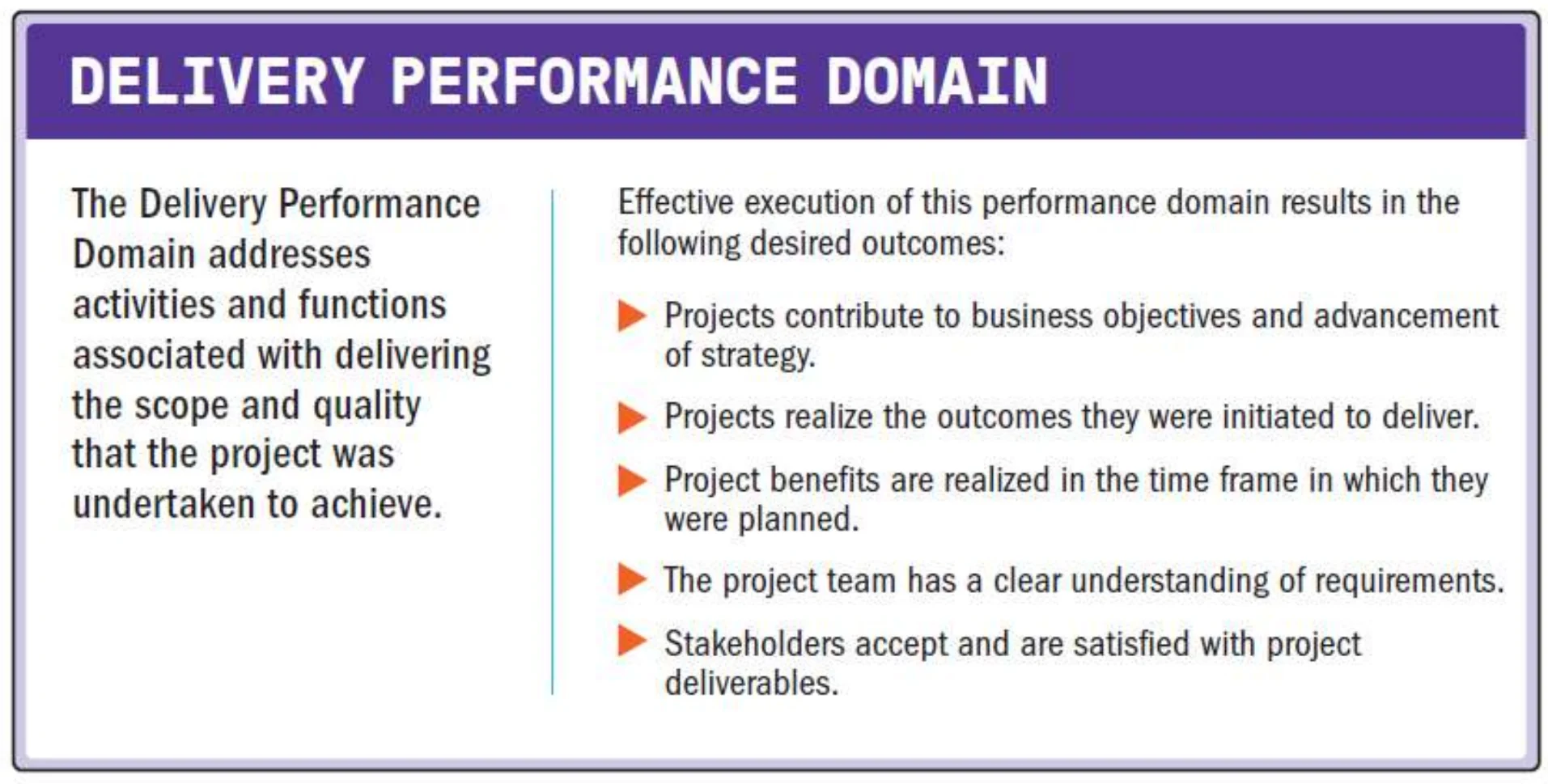
Delivery Performance Domain

Delivery performance domain card
66
Exam weight Low
  1. Outcomes: contribute to strategy, realize the outcomes, realize benefits on time, a clear understanding of requirements, and satisfied stakeholders.

Delivery Performance Domain

  • The following definitions are relevant to the Delivery Performance Domain:
    • Definition of Done (DoD)
      • A checklist of all the criteria required to be met so that a deliverable can be considered ready for customer use.①
    • Quality
      • The degree to which a set of inherent characteristics fulfills requirements.
    • Cost of Quality (COQ)
      • All costs incurred over the life of the product by investment in preventing nonconformance to requirements, appraisal of the product or service for conformance to requirements, and failure to meet requirements.②
67
Exam weight Medium
  1. DoD = the checklist that makes a deliverable “done” and ready for the customer.
  2. COQ = prevention + appraisal + failure costs, over the whole product life.
🎯 How this can come up · 1 question
MCQ

Which three cost types make up the Cost of Quality?

Delivery of Value

h

  • Projects that use a development approach that supports releasingdeliverables throughout the project life cycle can start delivering value to the business, customer, or other stakeholders during the project.①
  • Business value often continues to be captured long after the initial project has ended.
  • A business case② document often provides the business justification and a projection of anticipated business value from a project.
  • The format of this business case varies based on the development approach and life cycle selected.
68
Exam weight Low
  1. Releasing throughout the life cycle means value starts arriving DURING the project.
  2. The business case justifies the project and projects its value.

Quality

  • Delivery is more than just scope and requirements.
  • Scope and requirements focus on what needs to be delivered.
  • Quality focuses on the performance levels① that are required to be met.
  • Quality requirements may be reflected in the completion criteria, definition of done, statement of work, or requirements documentation.
69
Exam weight Low
  1. Scope = WHAT. Quality = HOW WELL (the performance levels).

Quality

  • Much of the costs associated with quality are born by the sponsoring organization and are reflected in policies, procedures, and work processes.
  • For example, organizational policies that govern how work is performed and procedures that prescribe work processes are often part of the organization’s quality policy.
  • The cost of overhead, training, and process audit are born by the organization, though they are employed by the project.
  • Inherent in projects is balancing the quality needs of the processes and products with the costs associated with meeting those needs.
  • The cost of quality methodology① is used to find the appropriate balance for investing in quality prevention and appraisal to avoid defect or product failures.
70
Exam weight Low
  1. Invest in prevention and appraisal now to avoid more expensive failures later.

Suboptimal Outcomes

  • All projects attempt to deliver outcomes, though some may fail to do so or may produce suboptimal outcomes.
  • The potential for suboptimal outcomes exists in every project.
  • In the case of a fully experimental project, the organization is attempting to achieve a breakthrough, such as the creation of a completely new technology, for example.
  • This requires deliberate investment in an uncertain outcome.
  • Companies that produce new medicines or compounds may experience several failures before finding a successful formula.
  • Some projects may fail to deliver outcomes because the market opportunity has passed① or competitors were first to market with their offering.
  • Effective project management can minimize negative outcomes, but such possibilities are part of the uncertainty of attempting to produce a unique deliverable.②
71
Exam weight Low
  1. Failure is possible even with good PM: experiments, a missed market window, competitors arriving first.
  2. Good PM reduces, but never removes, the chance of bad outcomes.

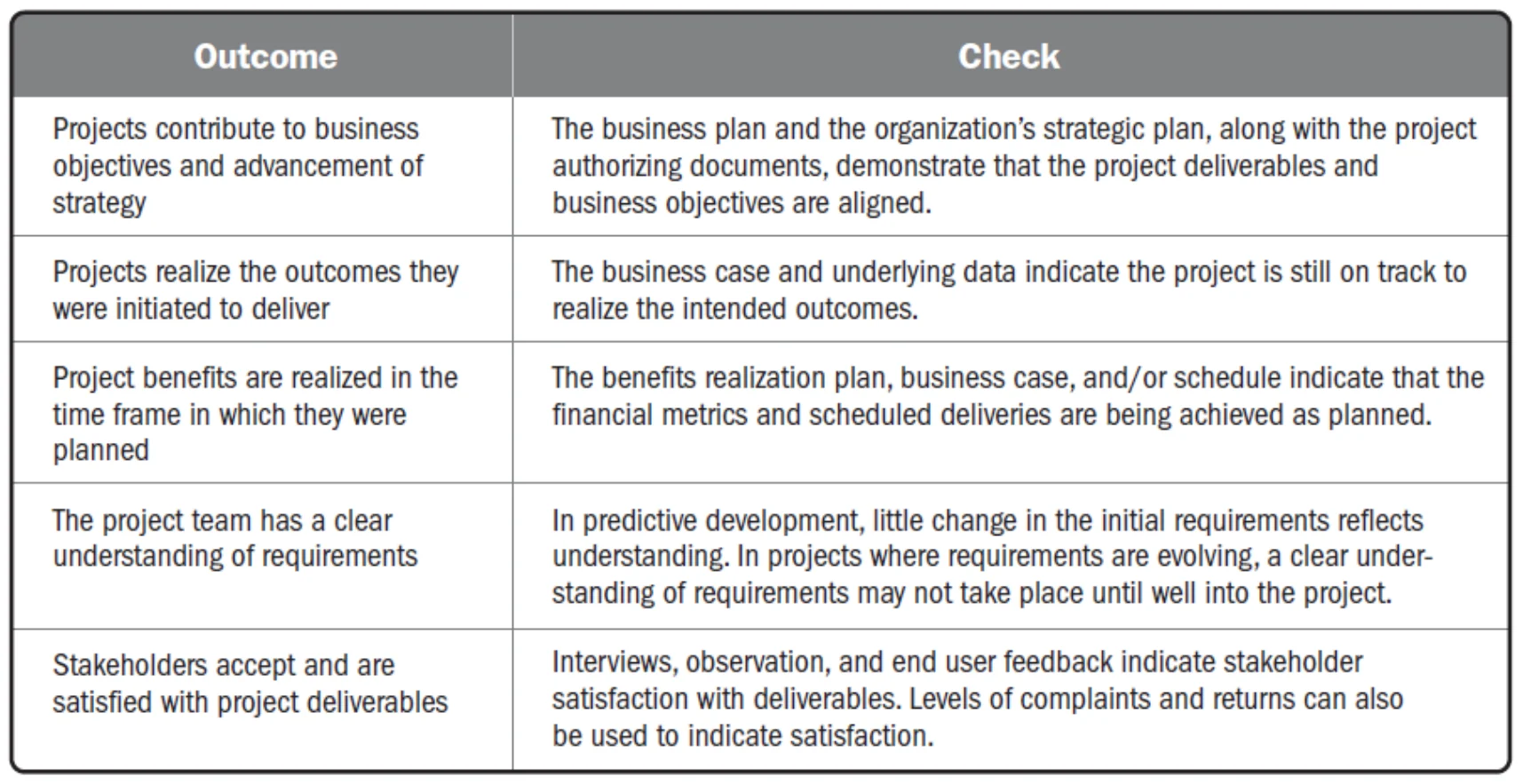
Checking Outcomes—Delivery Performance Domain

Checking outcomes for the delivery performance domain
72
Exam weight Low
  1. Read the left column as “what success looks like” and the right column as “how you would prove it”. These tables are rarely tested word for word; use them to explain a domain in a written answer.

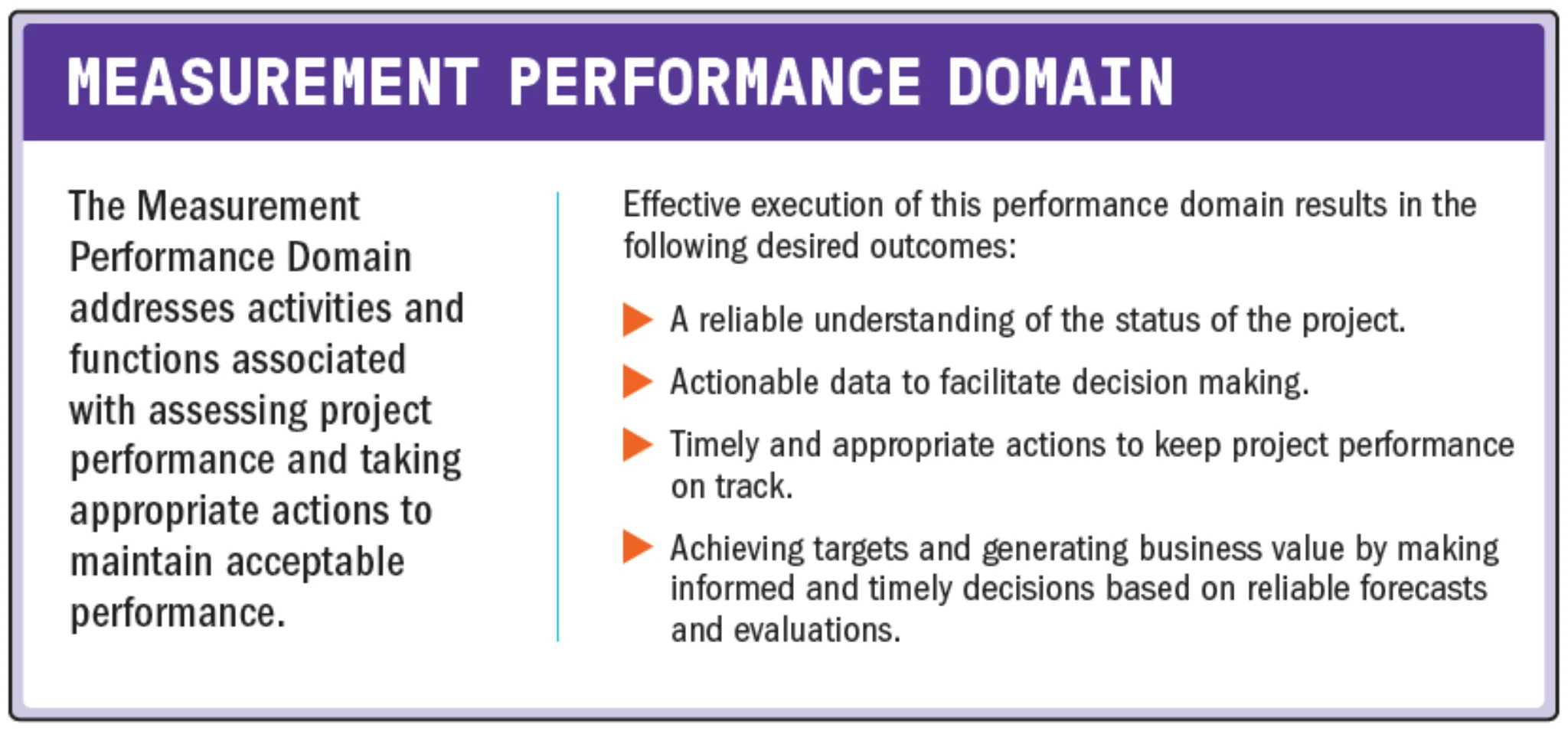
Measurement Performance Domain

Measurement performance domain card
73
Exam weight Low
  1. Outcomes: reliable status, actionable data, timely action, and business value from informed decisions.

Measurement Performance Domain

  • The following definitions are relevant to the Measurement Performance Domain:
    • Metric
      • A description of a project or product attribute and how to measure it (ex: work progress %).①
    • Baseline
      • The approved version of a measure used as a basis for comparison to actual results (cost of a project, duration).②
    • Dashboard
      • A set of charts and graphs showing progress or performance against important measures of the project.
74
Exam weight Medium
  1. Metric = what you measure and how.
  2. Baseline = the approved plan you compare actual results against.
🎯 How this can come up · 1 question
MCQ

The approved version of a measure used for comparison with actual results is a:

Measurement Performance Domain

  • Measures are used for multiple reasons, including:
    • Evaluating performance compared to plan;
    • Tracking the utilization of resources, work completed, budget expended, etc.;
    • Demonstrating accountability;
    • Providing information to stakeholders;
    • Assessing whether project deliverables are on track to deliver planned benefits;
    • Focusing conversations about trade-offs, threats, opportunities, and options; and
    • Ensuring the project deliverables will meet customer acceptance criteria.①
75
Exam weight Low
  1. Seven reasons to measure: performance vs. plan, resource tracking, accountability, informing stakeholders, benefits, trade-off conversations, acceptance.

Measurement Performance Domain

  • The value of measurements is not in the collection and dissemination of the data, but rather in the conversations about how to use the data① to take appropriate action.
  • It helps to ensure the right things are measured and reported to stakeholders.
  • Effective measures allow for tracking, evaluating, and reporting information that can communicate project status, help improve project performance, and reduce the likelihood of performance deterioration.
76
Exam weight Low
  1. Data has no value on its own. The value is in the decisions it triggers.

Establishing Effective Measures

  • Key Performance Indicators (KPIs)
    • Leading indicators① ( proactive metrics)
      • predict changes or trends in the project
      • Ex:
        • Rate of scope change requests (frequent changes may hint at poor planning)
        • Team workload balance (overloaded teams may lead to burnout or missed deadlines)
    • Lagging indicators② (reactive or Backward-looking)
      • measure project deliverables or events
      • They provide information after the fact
      • Ex:
        • Cost variance (budget overrun or underrun)
        • Number of deliverables completed
        • Customer satisfaction scores
77
Exam weight High
  1. Leading = predict (scope change rate, workload balance) → you can still act.
  2. Lagging = after the fact (cost variance, deliverables completed, satisfaction).
Memory trickLeading looks ahead; Lagging looks back.
🎯 How this can come up · 2 questions
MCQ

Which is a LEADING indicator?

True / False

Cost variance is a leading indicator.

Establishing Effective Measures

  • Effective Metrics
    • Measuring takes time and effort, which could otherwise be spent on other productive work; therefore, project teams should only measure what is relevant and should ensure that the metrics are useful.
    • Characteristics of effective metrics (or SMART criteria) include:
      • Specific
      • Meaningful
      • Achievable
      • Relevant
      • Timely①
78
Exam weight Medium
  1. SMART here = Specific, Meaningful, Achievable, Relevant, Timely. Note: M is Meaningful, not Measurable.
Exam trapIn this slide the M in SMART is “Meaningful”, not the usual “Measurable”.
🎯 How this can come up · 1 question
MCQ

According to the slide, the M in SMART metrics stands for:

What to Measure

  • What is measured, the parameters, and the measurement method depend on the project objectives, the intended outcomes, and the environment in which the project takes place.
  • Common categories of metrics include:
    • Deliverable metrics,
    • Delivery,
    • Baseline performance,
    • Resources,
    • Business value,
    • Stakeholders, and
    • Forecasts.①
79
Exam weight Low
  1. Seven categories: Deliverables, Delivery, Baseline, Resources, Business value, Stakeholders, Forecasts.

What to Measure

  • Deliverable metrics
    • Information on errors or defects, Measures of performance, Technical performance measures
  • Delivery
    • Work in progress, Lead time① (total elapsed time between the identification of a need and the delivery of the result), Cycle time, Process efficiency
  • Baseline performance
    • Start and finish dates, Effort and duration, Schedule variance
80
Exam weight Low
  1. Lead time = from identifying the need to delivering the result (the customer’s whole wait). Cycle time = just the working part.

What to Measure

  • Resources
    • Planned resource utilization compared to actual resource utilization, Planned resource cost compared to actual resource cost
  • Business value
    • Cost-benefit ratio, Return on investment (ROI), Net present value (NPV)①
  • Stakeholders
    • Net Promoter Score (NPS), Mood chart, Morale, Turnover
  • Forecasts
    • Estimate to complete (ETC), Estimate at completion (EAC), Variance at completion (VAC)②
81
Exam weight Medium
  1. Business value: cost-benefit ratio, ROI, NPV. Stakeholders: NPS, mood chart, morale, turnover.
  2. Forecasts: ETC (left to spend), EAC (total at the end), VAC (budget − EAC).
🎯 How this can come up · 1 question
MCQ

Which metric belongs to the “Stakeholders” category?

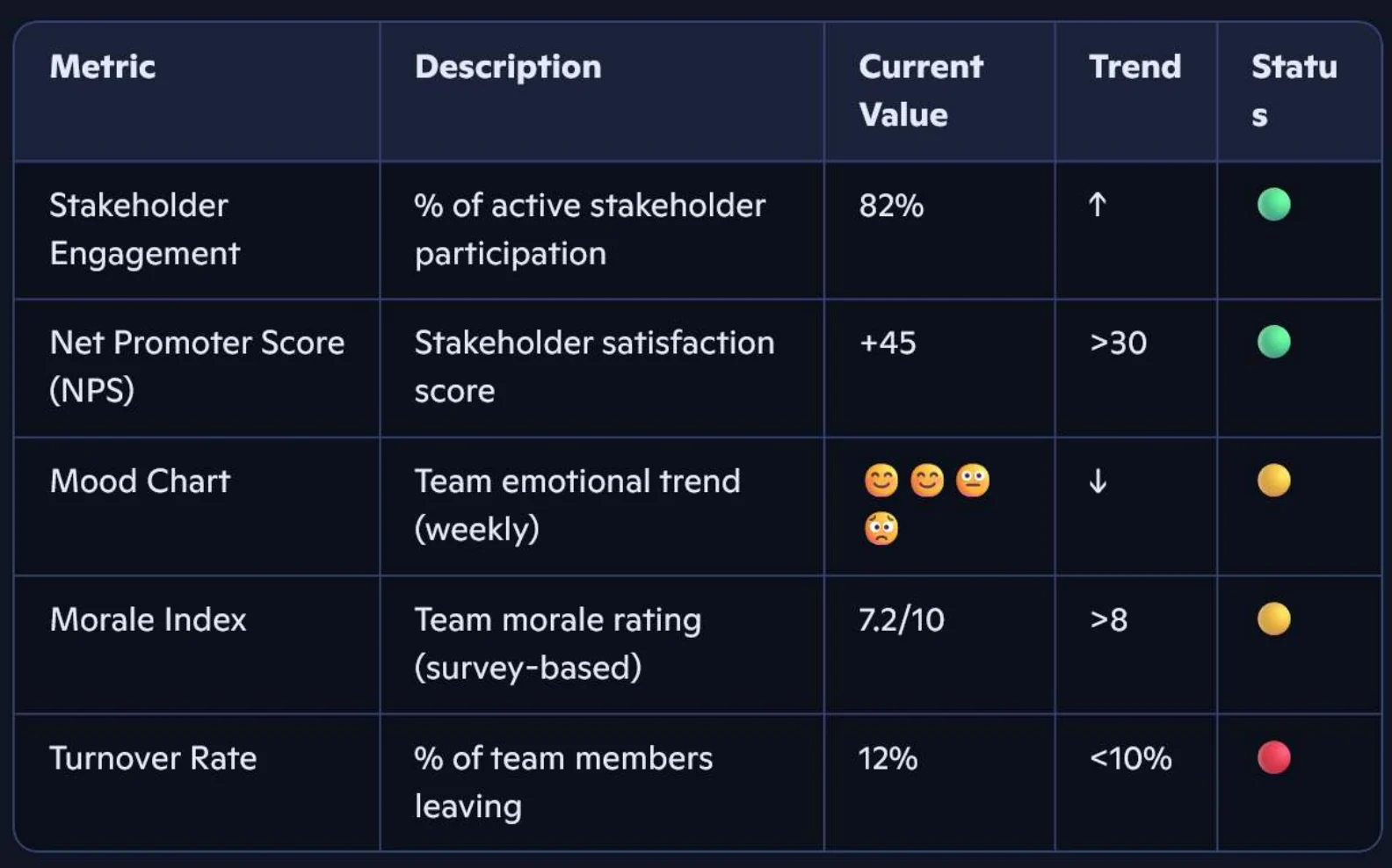
Stakeholder and Team Health Dashboard

Stakeholder and team health dashboard: engagement, NPS, mood chart, morale, turnover with targets and status
82
Exam weight Low
  1. An example dashboard for the people metrics from slide 81, each with a current value, trend, target and red/amber/green status.

Presenting Information

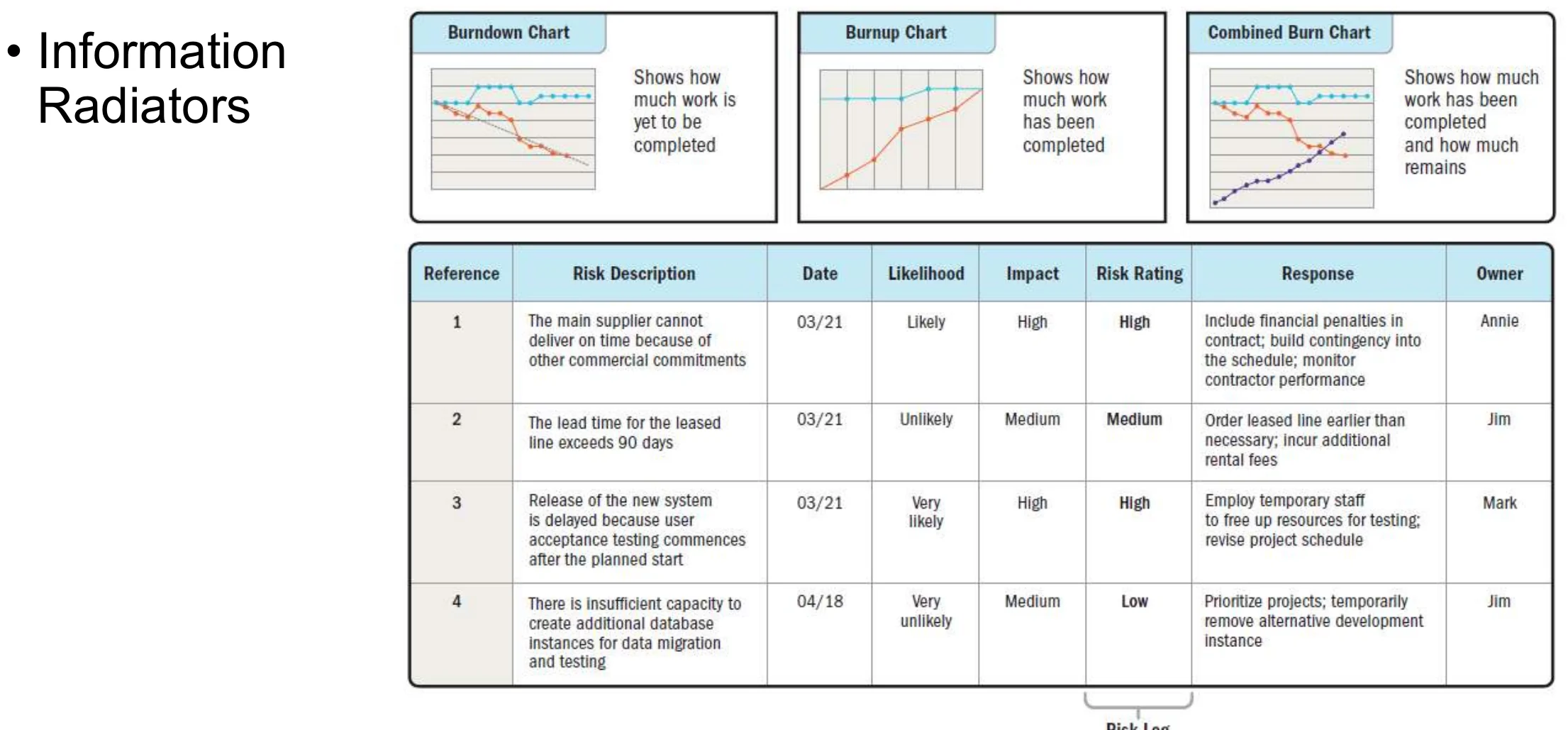
  • Dashboards
  • Information Radiators
  • Visual Controls①
83
Exam weight Low
  1. Three ways to present information: Dashboards (summary), Information radiators (posted where everyone sees them), Visual controls (task boards, burn charts).

Presenting Information

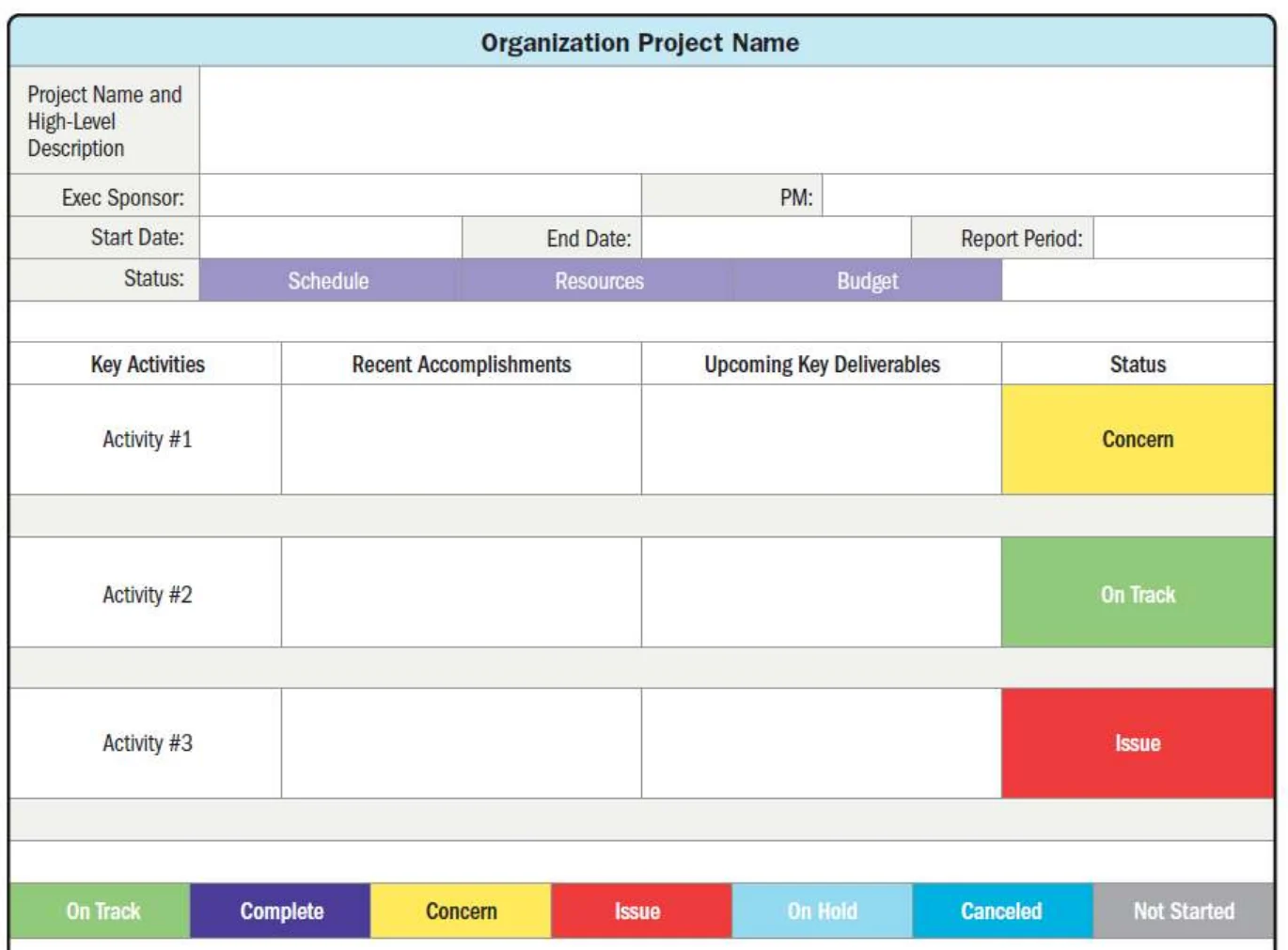
  • Dashboards
Example project dashboard with status colors per activity
84
Exam weight Low

    Presenting Information

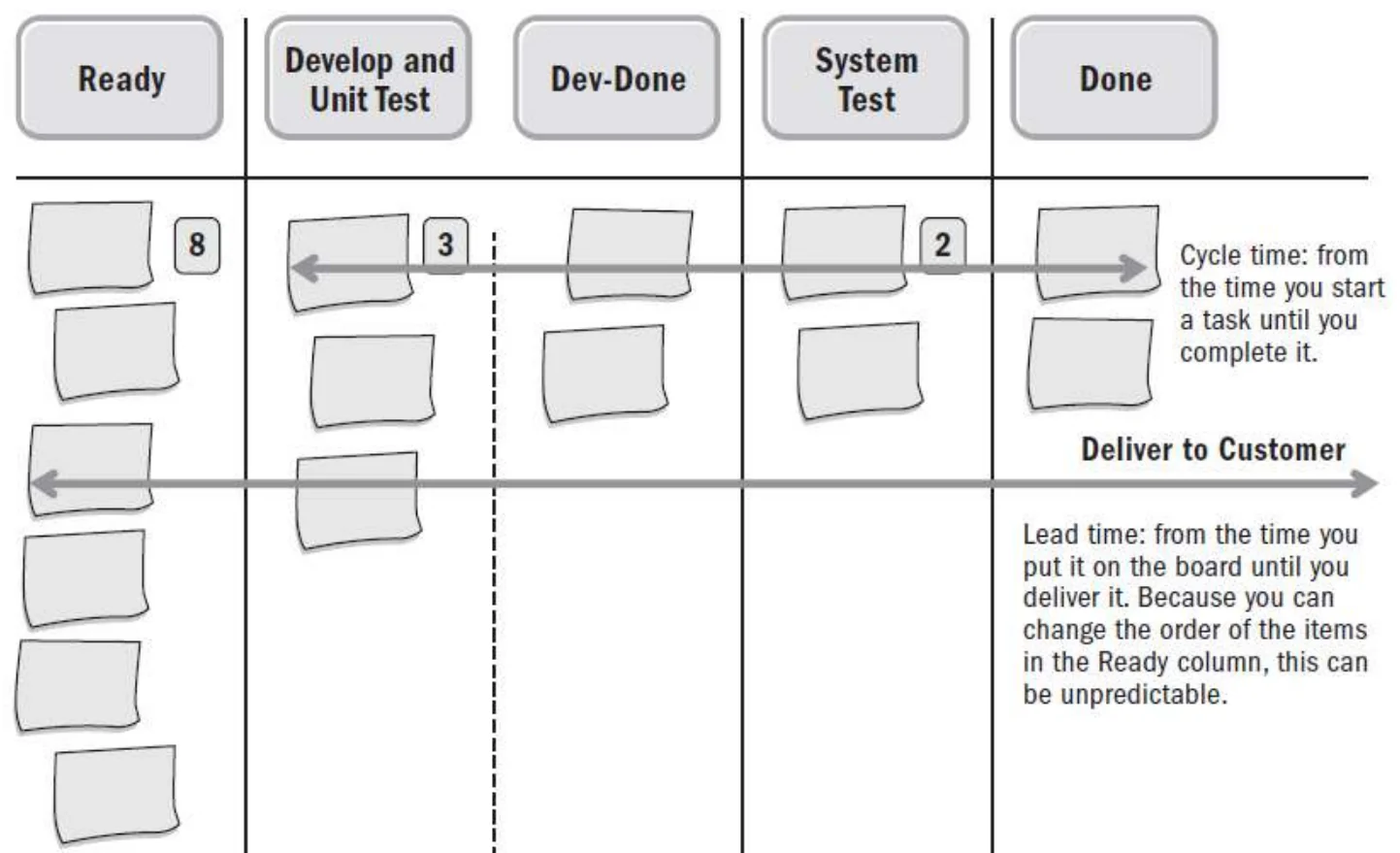
    • Visual Controls
      • Task boards①
      • Burn charts
      • Other types of charts
    Task board: Ready → Develop and unit test → Dev done → System test → Done, with cycle and lead time marked
    86
    Exam weight Medium
    1. A task board makes flow visible. Lead time = whole journey; cycle time = from starting work to done.

    Related real-exam questions

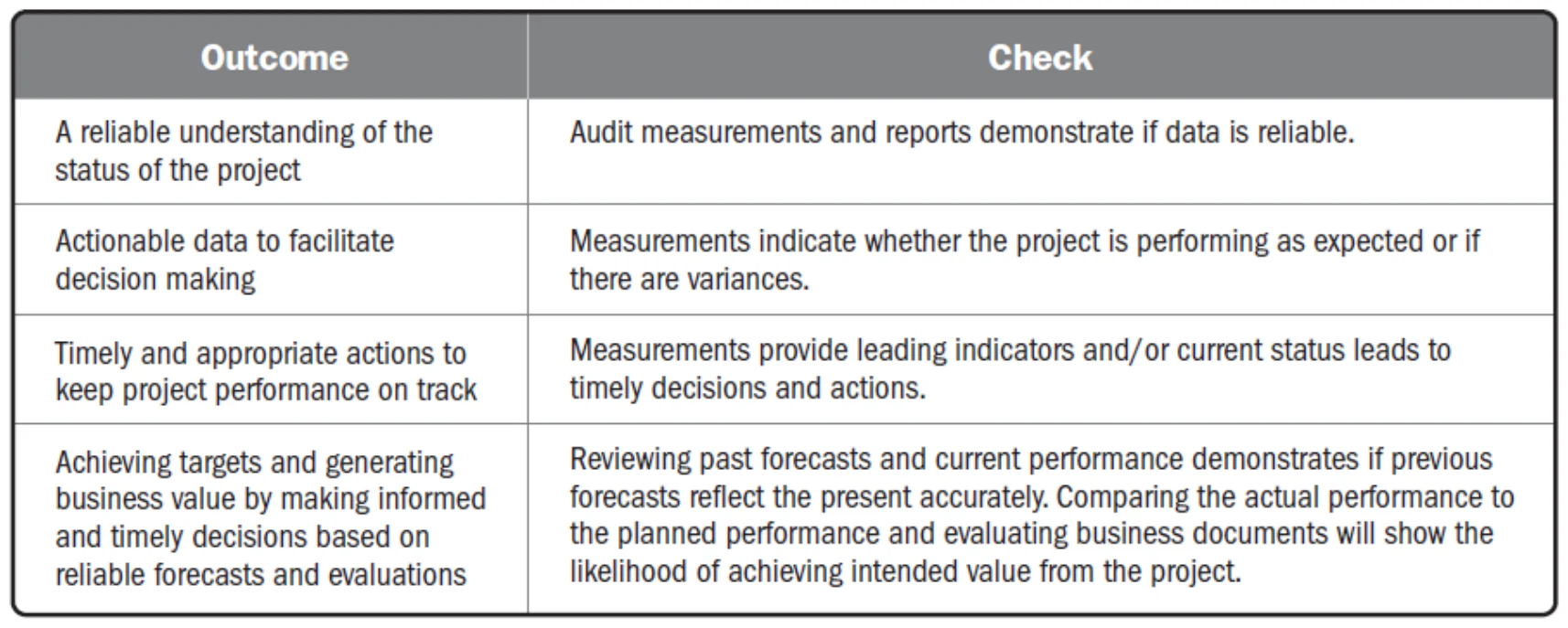
    Checking Outcomes—Measurement Performance Domain

    Checking outcomes for the measurement performance domain
    87
    Exam weight Low
    1. Read the left column as “what success looks like” and the right column as “how you would prove it”. These tables are rarely tested word for word; use them to explain a domain in a written answer.

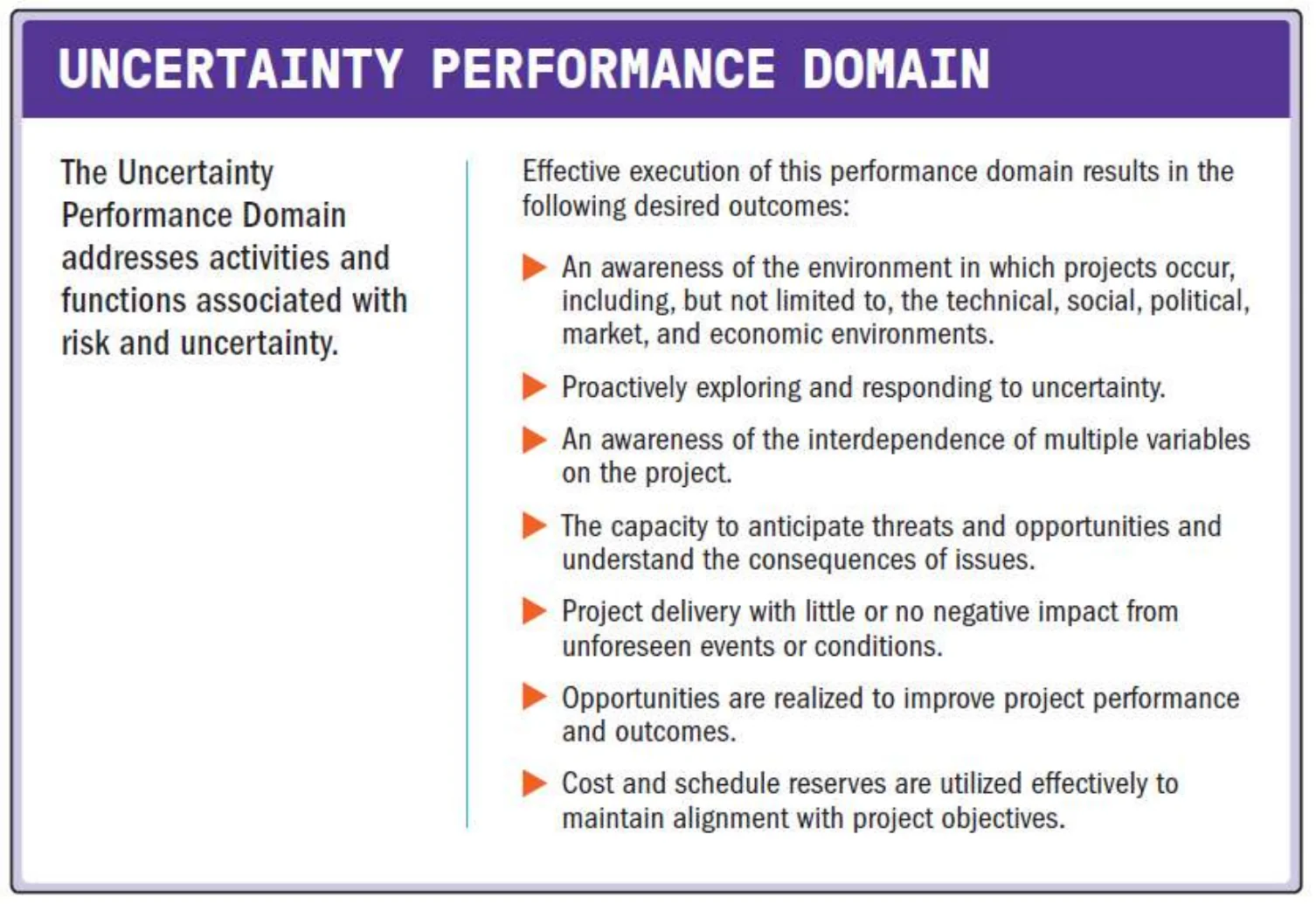
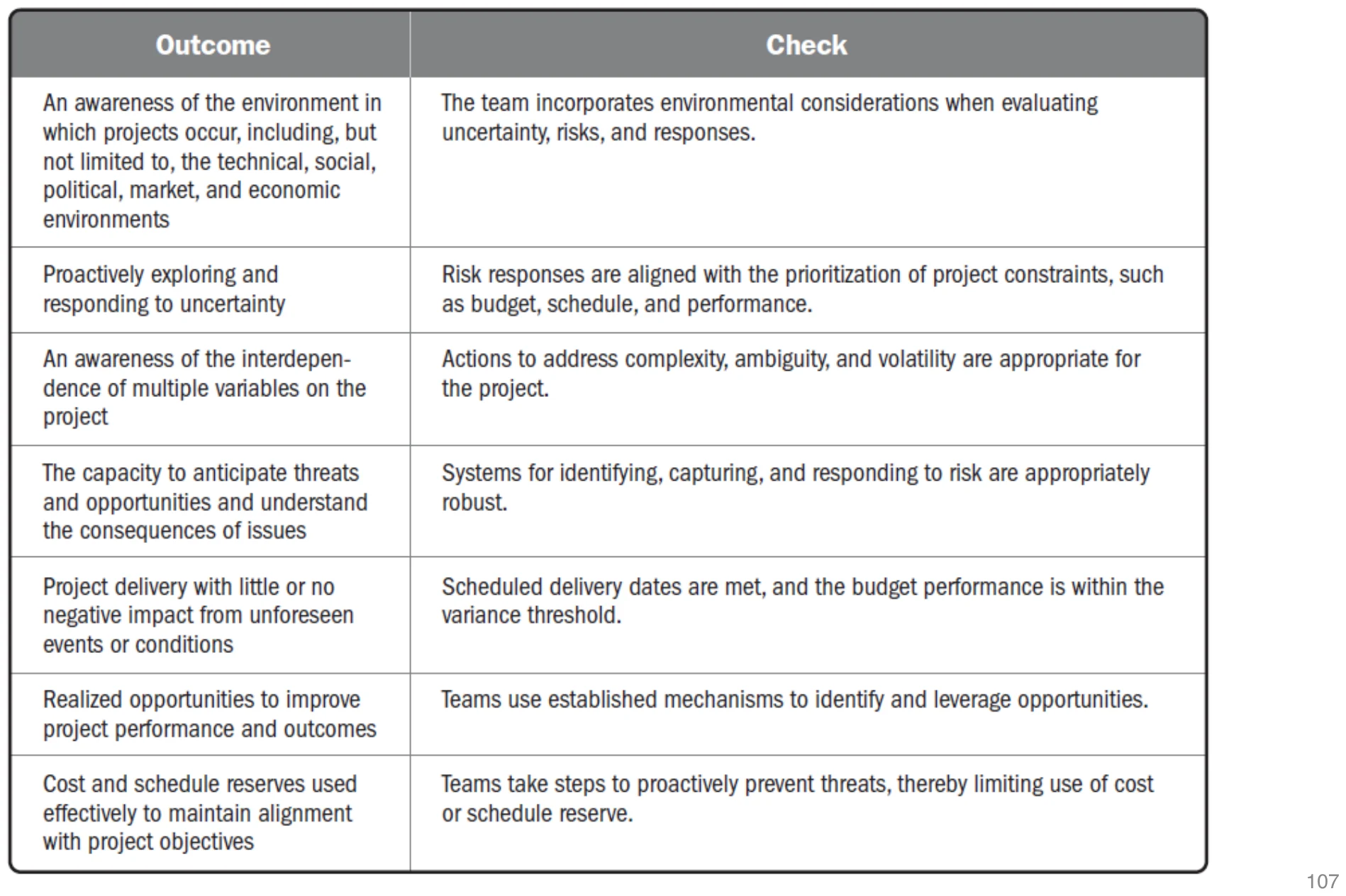
    Uncertainty Performance Domain

    Uncertainty performance domain card
    88
    Exam weight Low
    1. Outcomes: awareness of the environment, proactive responses, understanding interdependencies, anticipating threats and opportunities, little impact from surprises, and effective use of reserves.

    Uncertainty Performance Domain

    • The following definitions are relevant to the Uncertainty Performance Domain:
      • Uncertainty
        • A lack of understanding and awareness of issues, events, paths to follow, or solutions to pursue.
      • Ambiguity
        • A state of being unclear, having difficulty in identifying the cause of events, or having multiple options from which to choose.
      • Complexity
        • A characteristic of a program or project or its environment that is difficult to manage due to human behavior, system behavior, and ambiguity.
      • Volatility①
        • The possibility for rapid and unpredictable change.
      • Risk
        • An uncertain event or condition that, if it occurs, has a positive or negative effect on one or more project objectives.②
    89
    Exam weight High
    1. Five terms: Uncertainty (not knowing), Ambiguity (unclear, multiple options), Complexity (hard to manage), Volatility (rapid change), Risk (an uncertain event with + or − effect).
    2. Risk can be positive (opportunity) or negative (threat).
    Memory trickU.A.C.V.R.: “Unclear And Complex, Very Risky.”
    🎯 How this can come up · 2 questions
    MCQ

    “The possibility for rapid and unpredictable change” defines:

    MCQ

    “Having multiple options from which to choose” is a form of:

    Uncertainty Performance Domain

    • Uncertainty in the broadest sense is a state of not knowing or unpredictability.
    • There are many nuances to uncertainty, such as:
      • Risk associated with not knowing future events,
      • Ambiguity associated with not being aware of current or future conditions, and
      • Complexity associated with dynamic systems having unpredictable outcomes.①
    90
    Exam weight Low
    1. Uncertainty is the umbrella term. Under it: risk (future events), ambiguity (unaware of conditions), complexity (unpredictable systems).

    Uncertainty Performance Domain

    • Successfully navigating uncertainty begins with understanding the larger environment within which the project is operating.
    • Aspects of the environment that contribute to project uncertainty include, but are not limited to:
      • Economic factors such as volatility in prices, availability of resources, ability to borrow funds, and inflation/deflation;
      • Technical considerations such as new or emerging technology, complexity associated with systems, and interfaces;
      • Legal or legislative constraints or requirements;
      • Physical environment as it pertains to safety, weather, and working conditions;
      • Ambiguity associated with current or future conditions;
      • Social and market influences shaped by opinion and media; and,
      • Political influences①, either external or internal to the organization.
    91
    Exam weight Low
    1. Sources of environmental uncertainty, PESTLE-style: Political, Economic, Social/market, Technical, Legal, Physical environment, plus Ambiguity.

    Ambiguity

    • There are two categories of ambiguity:
      • Conceptual ambiguity①
        • The lack of effective understanding—occurs when people use similar terms or arguments in different ways.
        • For example, the statement, “The schedule was reported on track last week,” is not clear.
        • It isn’t clear whether the schedule was on track last week or whether it was reported on last week.
      • Situational ambiguity②
        • Surfaces when more than one outcome is possible.
        • Having multiple options to solve a problem is a form of situational ambiguity.
    92
    Exam weight Medium
    1. Conceptual = the same words mean different things (“reported on track last week”).
    2. Situational = more than one outcome or option is possible.
    🎯 How this can come up · 1 question
    MCQ

    Team members disagree on what “done” means in the status meeting. This is:

    Complexity

    • Complexity is a characteristic of a program, project, or its environment, which is difficult to manage due to human behavior, system behavior, or ambiguity.
    • Complexity exists when there are many interconnected influences that behave and interact in diverse ways.①
    93
    Exam weight Low
    1. Complexity sources: human behavior, system behavior, ambiguity (Chapter 1 adds uncertainty).

    Complexity

    • In complex environments, it is not uncommon to see an aggregation of individual elements leading to unforeseen or unintended outcomes.
    • The effect of complexity is that there is no way of making accurate predictions about the likelihood of any potential outcome or even of knowing what outcomes might emerge.
    • There are numerous ways to work with complexity; some of them are systems-based, some entail reframing, and others are based on process.①
    94
    Exam weight Low
    1. Three ways to work with complexity: Systems-based · Reframing · Process-based. The next three slides give two or three tools each.

    Systems-Based Complexity

    • Examples of working with complexity that is systems based include:
      • Decoupling①
        • Disconnecting parts of the system to both simplify the system and reduce the number of connected variables.
        • Determining how a piece of a system works on its own reduces the overall size of the problem.
      • Simulation②
        • There may be similar though unrelated scenarios that can be used to simulate components of a system.
        • A project to build a new airport that includes an area with shopping and restaurants can learn about consumer buying habits by seeking out analogous information on shopping malls and entertainment establishments.
    95
    Exam weight Medium
    1. Decoupling = separate parts to make the problem smaller.
    2. Simulation = learn from analogous situations (malls → airport shops).
    🎯 How this can come up · 1 question
    MCQ

    Studying shopping malls to predict buying habits in a new airport is which complexity technique?

    Reframing Complexity

    • Examples of working with complexity that entail reframing are:
      • Diversity①
        • Complex systems require viewing the system from diverse perspectives.
        • This can include brainstorming with the project team to open up divergent ways of seeing the system.
        • It can also include Delphi-like processes to move from divergent to convergent thinking.
      • Balance②
        • Balancing the type of data used rather than only using forecasting data or data that report on the past or lagging indicators provides a broader perspective.
        • This can include using elements whose variations are likely to counteract each other's potential negative effects.
    96
    Exam weight Low
    1. Diversity = many perspectives (brainstorming, Delphi).
    2. Balance = mix leading and lagging data.

    Process-Based Complexity

    • Examples of working with complexity that is process based include:
      • Iterate①
        • Build iteratively or incrementally.
        • Add features one at a time. After each iteration, identify what worked, what did not work, customer reaction, and what the project team learned.
      • Engage
        • Build in opportunities to get stakeholder engagement.
        • This reduces the number of assumptions and builds learning and engagement into the process.
      • Fail safe②
        • For elements of a system that are critical, build in redundancy or elements that can provide a graceful degradation of functionality in the event of a critical component failure.
    97
    Exam weight Medium
    1. Iterate = build a bit and learn.
    2. Fail safe = redundancy and graceful degradation for critical parts.
    Memory trickComplexity toolkit: Systems (Decouple, Simulate) · Reframe (Diversity, Balance) · Process (Iterate, Engage, Fail safe).
    🎯 How this can come up · 1 question
    MCQ

    Adding a backup server so a critical system degrades gracefully is which technique?

    Volatility

    • Volatility exists in an environment that is subject to rapid and unpredictable change.
    • Volatility can occur when there are ongoing fluctuations in available skill sets or materials.
    • Volatility usually impacts cost and schedule.①
    98
    Exam weight Low
    1. Volatility usually hits cost and schedule.

    Volatility

    • Alternatives analysis① and use of cost or schedule reserve address volatility.
      • Alternatives analysis
        • Finding and evaluating alternatives, such as looking at different ways to meet an objective, such as using a different mix of skills, resequencing work, or outsourcing work
      • Reserve
        • Cost reserve can be used to cover budget overruns due to price volatility.②
    99
    Exam weight Low
    1. Two answers to volatility: alternatives analysis (different skills mix, resequencing, outsourcing) and reserves.
    2. Cost reserve covers overruns caused by price volatility.

    Risk

    • Risks are an aspect of uncertainty.
    • A risk is an uncertain event or condition that, if it occurs, has a positive or negative effect on one or more project objectives.
    • Negative risks are called threats, and positive risks are called opportunities.①
    • All projects have risks since they are unique undertakings with varying degrees of uncertainty.
    100
    Exam weight Low
    1. Every project has risk because every project is unique.

    Risk

    • Overall risk is often a function of complexity, ambiguity, and volatility. Responses to overall project risk are the same as for individual threats and opportunities, though responses are applied to the overall project rather than to a specific event.
    • If the overall risk on the project is too high, the organization may choose to cancel the project.①
    101
    Exam weight Low
    1. Overall risk = the combined effect of complexity, ambiguity and volatility. If it is too high, cancelling is a valid response.

    Risk (Threat)

    • A threat is an event or condition that, if it occurs, has a negative impact on one or more objectives.
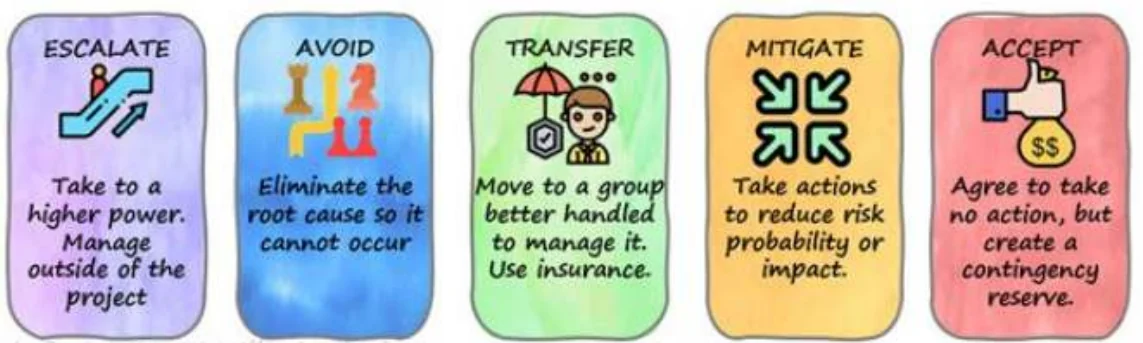
    • Five alternative strategies may be considered for dealing with threats, as follows:
      • Avoid
      • Escalate
      • Transfer
      • Mitigate
      • Accept①
    Threat strategy cards: escalate, avoid, transfer, mitigate, accept
    102
    Exam weight High
    1. Threats: Avoid (eliminate), Escalate (outside the PM’s authority), Transfer (to a third party, e.g. insurance), Mitigate (reduce probability or impact), Accept (live with it, maybe with a reserve).
    Memory trickThreats: “A.E.T.M.A.”. Opportunities swap in Exploit, Share, Enhance. Escalate and Accept appear in both lists.
    🎯 How this can come up · 2 questions
    MCQ

    Buying insurance against a data-centre fire is which threat strategy?

    MCQ

    Which strategy appears for BOTH threats and opportunities?

    Risk Reduction over Time

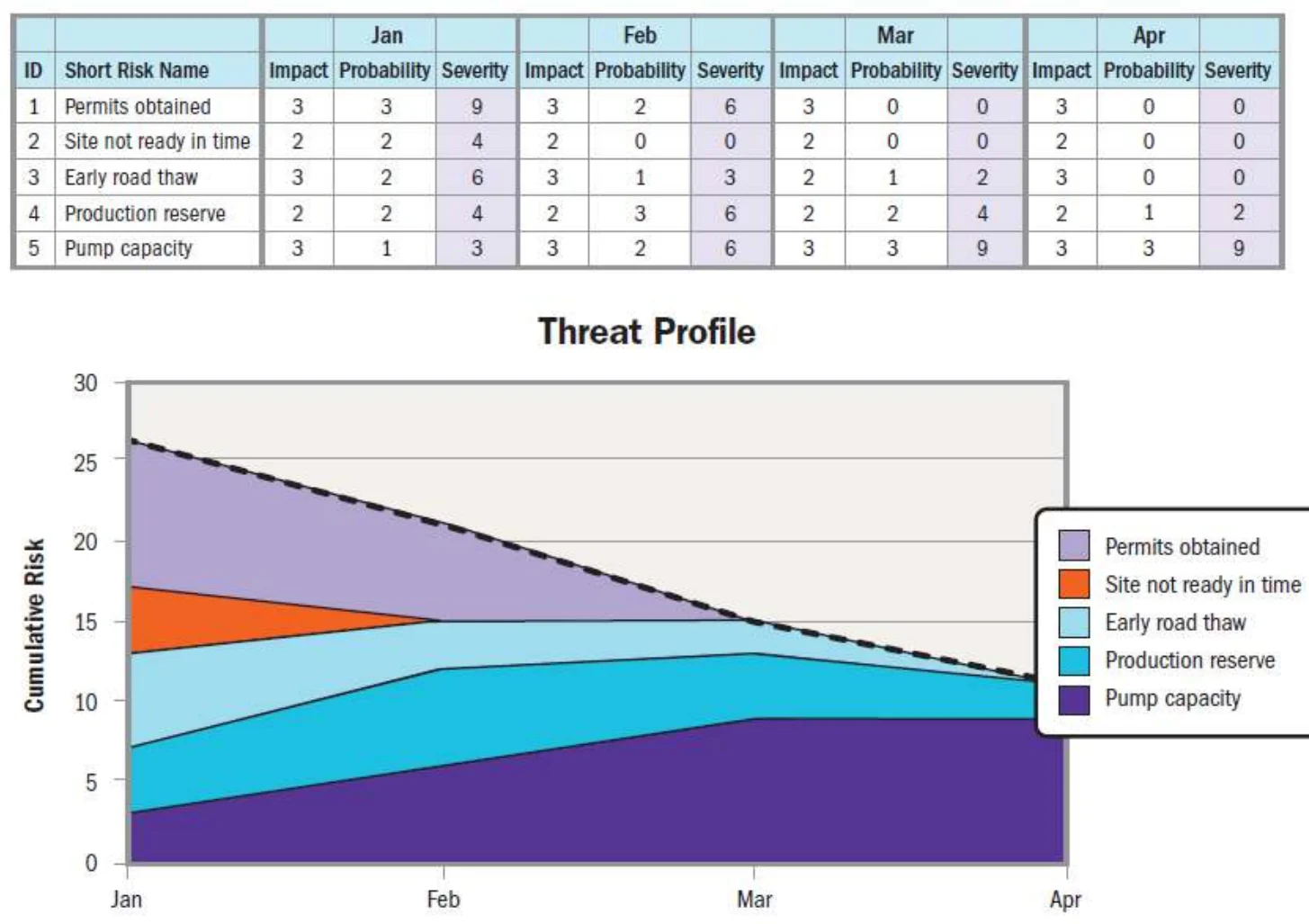
    Threat profile: cumulative risk score falling from January to April as risks are handled
    103
    Exam weight Low
    1. As risks are handled, the cumulative threat score should fall over time. This chart shows it.

    Risk (Opportunities)

    • An opportunity is an event or condition that, if it occurs, has a positive impact on one or more project objectives.
    • An example of an opportunity could be a time and materials-based subcontractor who finishes work early, resulting in lower costs and schedule savings.①
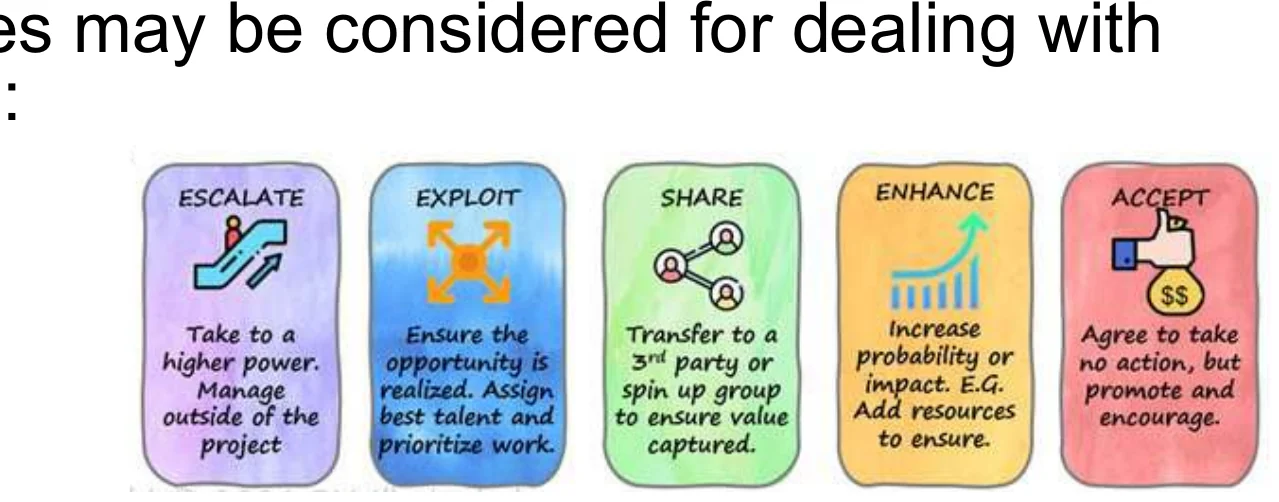
    • Five alternative strategies may be considered for dealing with opportunities, as follows:
      • Exploit
      • Escalate
      • Share
      • Enhance
      • Accept②
    Opportunity strategy cards: escalate, exploit, share, enhance, accept
    104
    Exam weight High
    1. Example opportunity: a subcontractor finishing early.
    2. Opportunities: Exploit (make sure it happens), Escalate, Share (with a partner who can capture it), Enhance (raise probability or impact), Accept.
    🎯 How this can come up · 1 question
    MCQ

    Partnering with another firm so a positive risk can be captured is which opportunity strategy?

    Risk (Management and Contingency Reserve)

    • Reserve is an amount of time or budget set aside to account for handling risks.
    • Contingency reserve is set aside to address identified risks① should they occur.
    • Management reserve is a budget category used for unknown events such as unplanned, in-scope work.②
    105
    Exam weight Medium
    1. Contingency → identified risks.
    2. Management → unknown events.
    🎯 How this can come up · 1 question
    True / False

    Contingency reserve is set aside for unknown, unplanned events.

    Risk (Risk Review)

    • Establishing a frequent rhythm or cadence of review and feedback sessions from a broad selection of stakeholders is helpful for navigating project risk and being proactive with risk responses.
    • Daily standup meetings① can be used in any project and are a source for identifying potential threats and opportunities.
    • Reports of blockers or impediments could become threats if they continue to delay progress.
    • Likewise, reports of progress and breakthroughs might point toward opportunities to be further leveraged and shared.
    • Frequent demonstrations of increments of the product or service, interim designs, or proof of concepts can surface threats and opportunities.②
    106
    Exam weight Low
    1. Stand-ups surface blockers (potential threats) and breakthroughs (potential opportunities).
    2. Demos and proofs of concept also reveal risks early.

    Checking Outcomes—Uncertainty Performance Domain

    Checking outcomes for the uncertainty performance domain
    107
    Exam weight Low
    1. Read the left column as “what success looks like” and the right column as “how you would prove it”. These tables are rarely tested word for word; use them to explain a domain in a written answer.