SE423 · Annotated SlidesChapter 3 — Team
Chapter 3 · Annotated slides

Team

The most examined chapter in SE423. Midterm 251 (both versions) took most of its short questions and its RACI question from here, and both finals have a whole “team-based collaboration” question. Focus on the team pyramid (trust → conflict → commitment → accountability → results), Tuckman, RACI, team models and technical vs. adaptive leadership.
Slide text Instructor’s marks (from the original PDF) Study notes Highlight: key words Tips, tricks & traps Seen again elsewhere How it can come up

Team

SE423: Software Project Management
1
Exam weight Low
  1. Map of the deck: team development and the pyramid (3–24) → team models (25–34) → managing people (35–77).
Memory trickThe pyramid is the spine of this chapter: Trust → Conflict → Commitment → Accountability → Results.

Outline

  • Team Development
  • Building Trust
  • Managing Conflict
  • Embracing Accountability
  • Team Models
  • Managing People
2
Exam weight Low
  1. The first four outline items are the pyramid layers, in order. Then team models and managing people.

Team Development

3
★ Past exam

Team Development - Introduction

  • What are your responsibilities as a team member?
  • As a Project Manager?
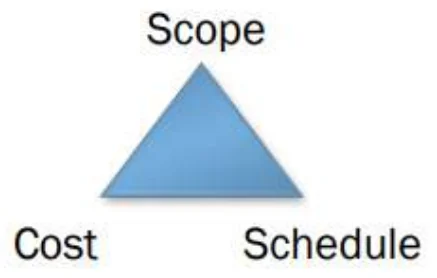
  • How does Team Development relate to the Project Triangle?
  • What’s more important? The strength of individual team members, or the strength of the team?
  • What are some characteristics of a good team?①
Project triangle: scope, cost, schedule
4
Exam weight High
  1. Discussion questions, not content. The triangle links to the constraints idea: a weak team costs you on scope, cost or schedule.
  2. Last question: “characteristics of a good team” was a real midterm short question.
🎯 How this can come up · 1 question
Written

What are key characteristics of a good team?

Quote

“Software projects fail for one of two general reasons: the project team lacks the knowledge to conduct a software project successfully, or the project team lacks the resolve① (determination, commitment, mental toughness) to conduct a project effectively.”

  • Steve C McConnell, Author of “code complete”
5
Exam weight Low
  1. Two reasons projects fail: missing KNOWLEDGE or missing RESOLVE (determination). Training fixes the first; the team culture fixes the second.

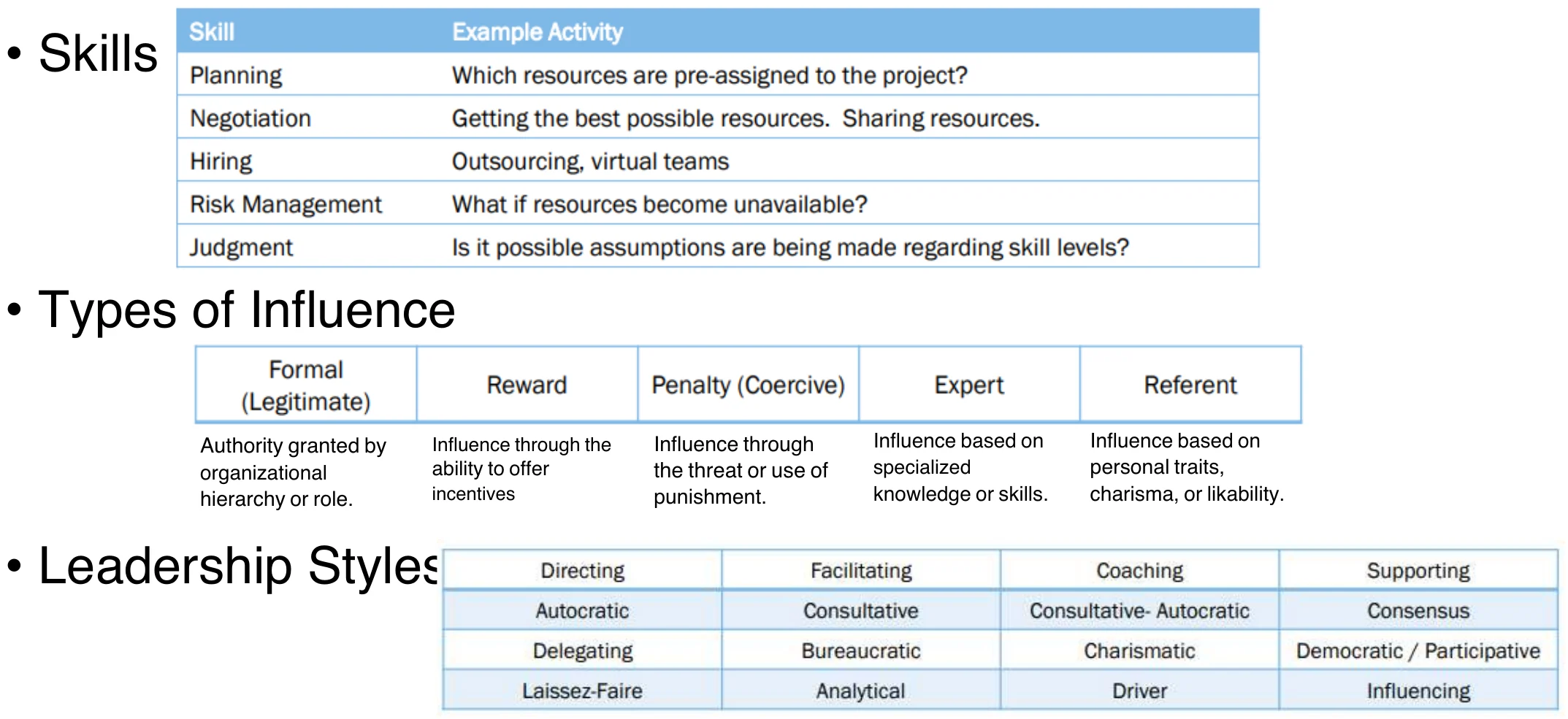
Team Skills, Influence, and Style

Skills table, five types of influence (formal, reward, penalty, expert, referent) and leadership styles
6
Exam weight Medium
  1. Five types of influence: Formal (legitimate, from position), Reward, Penalty (coercive), Expert (knowledge), Referent (charisma, likability).
  2. Expert and referent power come from you; formal, reward and penalty come from your position.
Memory trickF.R.P.E.R.: Formal, Reward, Penalty, Expert, Referent.
🎯 How this can come up · 2 questions
MCQ

A senior developer persuades the team because everyone respects her deep database knowledge. This is:

MCQ

Influence based on charisma or likability is:

★ Past exam

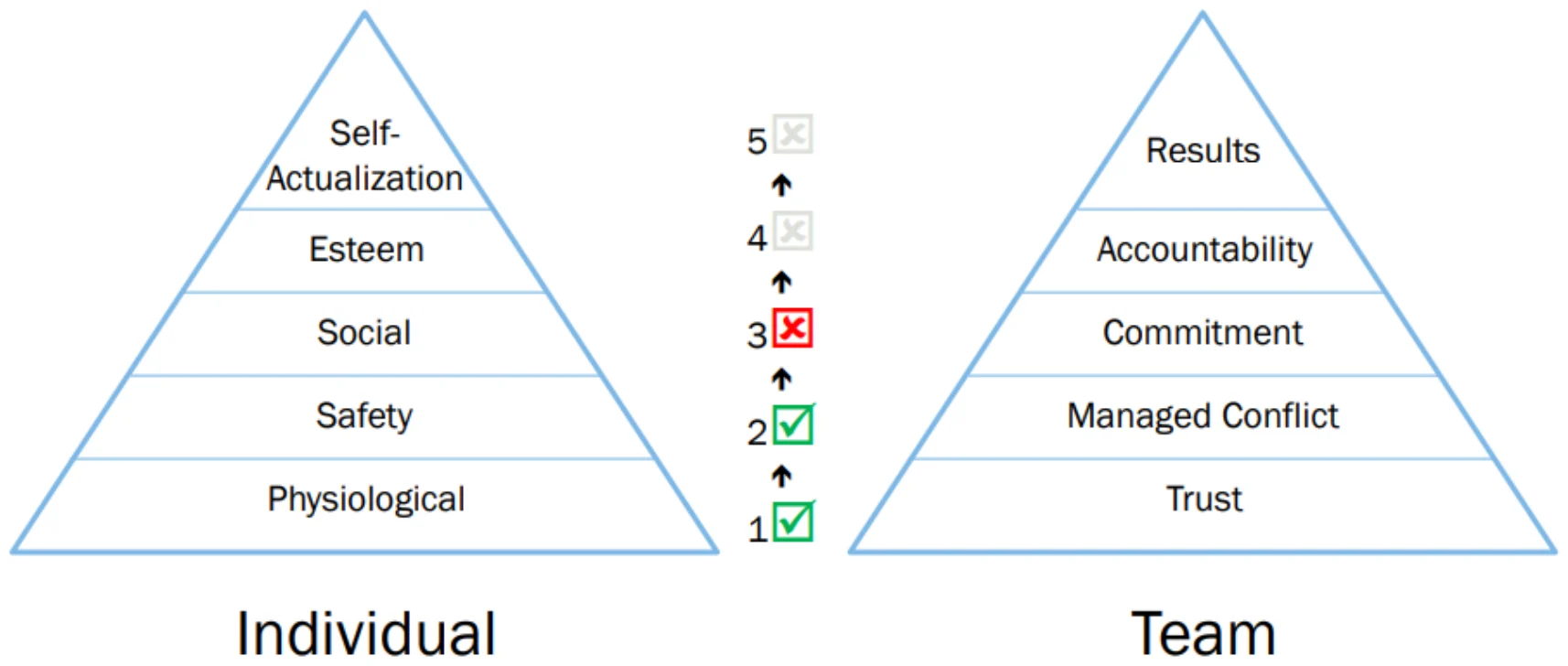
Needs and the Team

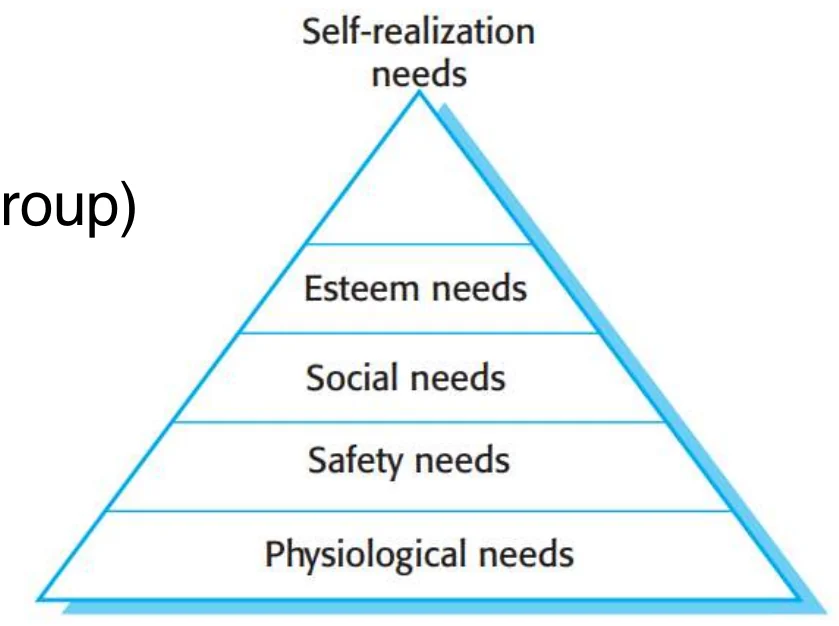
  • Lower level needs must be satisfied before higher level needs can be addressed①
Two pyramids: Maslow for the individual; team pyramid of trust, managed conflict, commitment, accountability, results
Individual (Maslow) beside the team version: Trust → Managed conflict → Commitment → Accountability → Results.
7
Exam weight High
  1. The team pyramid (Lencioni): Trust at the bottom, then Managed conflict, Commitment, Accountability, Results.
  2. Same rule as Maslow: you cannot build a layer until the one below it holds.
Memory trick“Teams Can Commit And Win”: Trust, Conflict, Commitment, Accountability, Results.
Exam trapThe FOUNDATION is trust, not accountability or commitment. This was a real midterm MCQ.
🎯 How this can come up · 2 questions
MCQ

Which of the following is considered the foundation of teamwork?

MCQ

In the team needs pyramid, which layer sits directly above trust?

★ Past exam

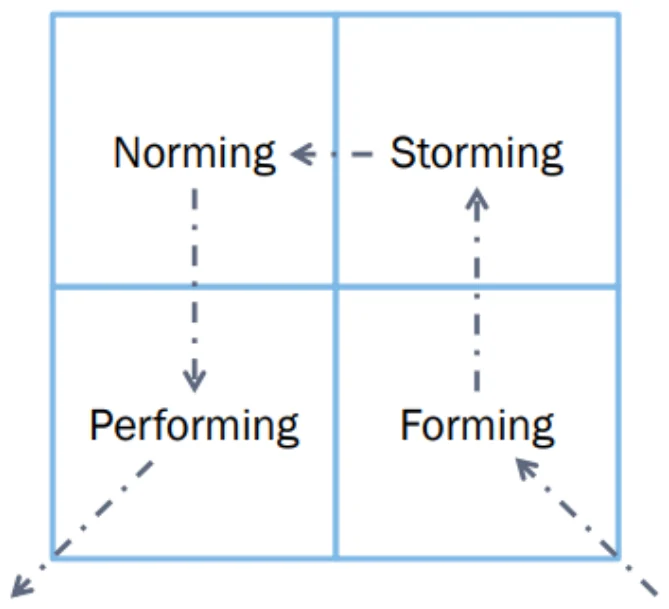
Tuckman's Model for Team Development

  1. Forming: The group comes together and gets to initially know one another and form as a group.
  2. Storming: A chaotic competing for leadership and trials of group processes (compete for influence or control, often without clear structure or authority)①
  3. Norming: Eventually agreement is reached on how the group operates
  4. Performing: The group practices its craft and becomes effective in meeting its objectives
  5. Dissolving/Adjourning②
Tuckman cycle: forming → storming → norming → performing
8
Exam weight High
  1. Storming = competing for leadership and influence, with no clear structure. This exact description was a real MCQ.
  2. Adjourning = the team breaks up at the end of the project.
Memory trickForm → Storm → Norm → Perform → Adjourn: they rhyme, so the order sticks.
🎯 How this can come up · 2 questions
MCQ

According to Tuckman’s model, which stage is characterized by members competing for leadership and struggling with group processes?

MCQ

The stage where the team agrees on how it will operate is:

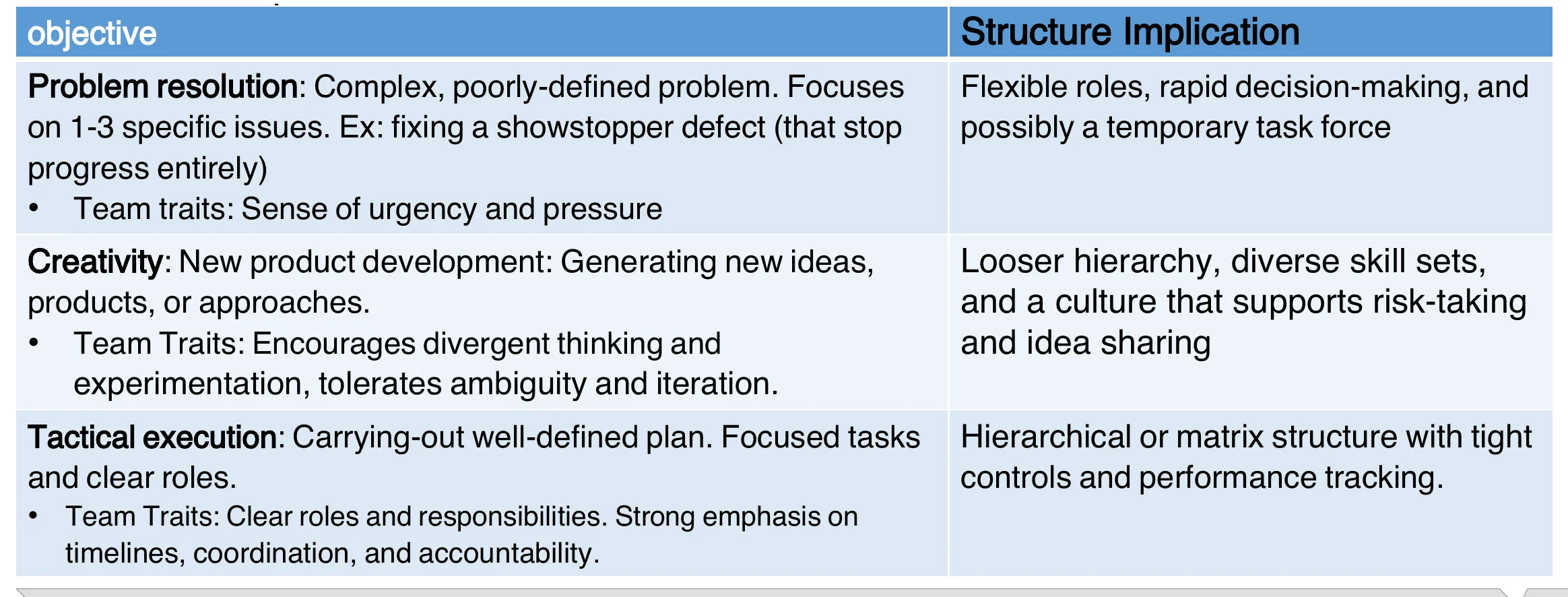
Team Structure

Table: problem resolution, creativity and tactical execution objectives with their structure implications
What’s the team’s objective? Three distinct types of team objectives, each shaping the team’s structure, behavior, and required competencies.
9

Next to the title: “She took her time explaining this.” Expect a question.

Exam weight High
  1. Problem resolution (fix 1–3 issues, urgency) → flexible roles, fast decisions, temporary task force.
  2. Creativity (new products) → looser hierarchy, diverse skills, tolerates risk.
  3. Tactical execution (well-defined plan) → hierarchical or matrix, tight controls, clear roles.
Memory trickP.C.T.: Problem → Flexible · Creativity → Loose · Tactical → Tight.
🎯 How this can come up · 2 questions
MCQ

A team is formed to fix a showstopper defect blocking all progress. Which structure fits?

Scenario

A team must roll out an already-designed ERP module on a fixed timeline. Which objective type and structure?

Building Trust

10
★ Past exam

Building Trust

  • Trust is the foundation of teamwork (Without trust, teams struggle to collaborate, share ideas, or resolve conflict)①
  • Trust is all about vulnerability, which is difficult for most people: Vulnerability-based trust means: Admitting mistakes, Asking for help, Saying “I don’t know”②
  • Takes time (Trust isn’t built overnight. It requires: Consistent behavior, Follow-through on commitments, Shared experiences—especially under pressure)
  • Needs to be maintained over time.
  • Techniques – Behavioral profiling (like Myers-Briggs). Helps to admit strengths & weaknesses: (Ex: Recognize their introverted tendencies, Adjust task assignments to match their strengths, Create a psychologically safe space for participation)③
11
Exam weight High
  1. Trust = the foundation; without it there is no collaboration or healthy conflict.
  2. Vulnerability-based trust = admitting mistakes, asking for help, saying “I don’t know”. This exact list was a real midterm question.
  3. Tool: behavioral profiling (Myers-Briggs) helps people admit strengths and weaknesses.
🎯 How this can come up · 2 questions
Written

What does vulnerability-based trust involve?

True / False

Trust can be established once at project start and then needs no maintenance.

Establishing a basis of trust

  • A solid basis for trust is earned, not granted
    • Most human beings in most situations are inherently wary of others①
  • Maintain open communication within the project team– communication barriers create project risks
  • Be fallible. Take responsibility for making mistakes, correct them, and make it clear how you plan to avoid these mistakes in the future
  • Lead by example rather than by mandate. Show the team what you expect from yourself and from them
  • Complete all your commitments on time. If you cannot do so, give adequate notice and an explanation, not an excuse
  • Don’t confuse friendship with leadership②
12
Exam weight Medium
  1. Trust is earned, never granted with a title.
  2. Being friends with the team is not the same as leading it. Leadership needs clarity and boundaries (repeated on slide 76).
🎯 How this can come up · 1 question
MCQ

Which behavior does the slide recommend for establishing trust?

Managing Conflict

13
★ Past exam

Managing Conflict

  • Good (healthy) conflict among team members requires trust, which is all about engaging in unfiltered, passionate debate around issues.①
  • Even among the best teams, conflict will at times be uncomfortable.
  • Conflict norms will vary in each team, and must be discussed and made clear:
    • Norms = rules of engagement: These define what’s acceptable in debate—tone, language, timing, emotional expression.
  • The fear of occasional personal conflict should not deter a team from having regular, productive debate:
    • Avoidance is costly: Teams that fear conflict often fall into groupthink (psychological phenomenon where a cohesive group prioritizes harmony and consensus over critical thinking and realistic decision-making), suppress dissent (actively prevent or silence disagreement, criticism, or opposition), or make poor decisions.②
14
Exam weight High
  1. Healthy conflict = unfiltered, passionate debate about ISSUES. It needs trust first.
  2. Avoiding conflict leads to groupthink (harmony over critical thinking) and suppressed dissent.
🎯 How this can come up · 2 questions
Written

Why is healthy conflict important in teams?

MCQ

A team that values harmony so much it stops critically evaluating ideas suffers from:

Managing Conflict – How?

  • Conflict Resolution Techniques
    • Confronting (Problem Solving): Resolve the root cause through open, honest dialogue
    • Compromising: Reach a middle ground by mutual concessions
    • Withdrawal (Avoidance): Delay or sidestep the conflict
    • Smoothing (Accommodating): Preserve harmony by downplaying differences
    • Collaborating: Integrate multiple perspectives to find a creative solution
    • Forcing: Impose a solution through authority or pressure①
  • Problem Solving
  1. Define the real/root problem
  2. Analyze the problem
  3. Identify Solutions
  4. Pick a Solution
  5. Implement a solution
  6. Review the solution, and confirm that it solved the problem②
15
Exam weight High
  1. Six techniques: Confronting (root cause; the best for lasting results), Compromising (both give), Withdrawal (delay), Smoothing (downplay), Collaborating (combine views), Forcing (authority).
  2. Problem solving: define → analyze → identify solutions → pick → implement → review.
Memory trickFrom best to worst for lasting results: Collaborate/Confront > Compromise > Smooth > Force/Withdraw.
🎯 How this can come up · 2 questions
MCQ

A PM ends a debate by declaring “we use my design, end of discussion.” Which technique is this?

MCQ

Which technique addresses the ROOT cause through open, honest dialogue?

Managing and resolving con fl ict

  • Every team encounters conflict: successful teams resolve conflicts, while unsuccessful teams force conflict to the background
  • Disagreement is not the same as conflict: conflict involves a hardening of position and associated intractability (insolvability)①
  • Virtually all conflicts can be traced to a clash between two parties
  • To preserve a team’s effectiveness, those outside the conflict must assume a neutral stance, even if they themselves agree with one of the parties to the conflict
  • One of those outside the conflict must take on the role of conciliator②; he or she must mediate between the two parties to defuse the situation
  • The goal is to reduce the conflict to a disagreement which can then be addressed through consensus
  • Strive for reconciliation between the conflicting parties, if possible
16
Exam weight Medium
  1. Disagreement = about the idea. Conflict = positions have hardened.
  2. Others stay neutral; one acts as conciliator; the goal is to turn the conflict back into a disagreement that consensus can solve.
🎯 How this can come up · 1 question
True / False

Disagreement and conflict are the same thing.

★ Past exam

Achieving Commitment

  • Commitment requires clarity & buy-in:
    • Clarity ensures everyone knows exactly what was decided, why it matters, and what’s expected next.①
    • Buy-in means team members support the decision—even if they didn’t fully agree—because they trust the process and feel heard.
  • Clarity requires that teams avoid assumptions and ambiguity, and end discussions with a clear understanding about what they’ve decided upon.
  • Buy-in does not require consensus. Members of great teams learn to disagree with one another and still commit to a decision.②
17
Exam weight High
  1. Commitment = Clarity (everyone knows what was decided) + Buy-in (support it even without full agreement).
  2. “Disagree and commit”: buy-in does NOT need consensus.
Exam trap“Commitment requires everyone to agree” ✗. Buy-in does not require consensus.
🎯 How this can come up · 2 questions
Written

In the context of the team needs pyramid, how can a project manager foster commitment?

True / False

Team buy-in requires that every member agrees with the decision.

Embracing Accountability

18
★ Past exam

Embracing Accountability

  • Accountability on a strong team occurs directly among peers: In high-performing teams, members don’t just rely on the manager to enforce standards—they hold each other accountable.①
  • For a culture of accountability to thrive, a leader must demonstrate a willingness to confront accountability: A project manager should model transparency, follow through on commitments, and address underperformance respectfully but firmly.
  • Best opportunity occurs during meetings and regular review of accomplishments. Example: During a sprint review, the PM might say, “ We committed to five stories but completed three. Let’s explore what happened and how we can improve next sprint.② ”
19
Exam weight High
  1. On strong teams, peers hold each other accountable; they do not wait for the manager.
  2. Best time to reinforce accountability: meetings and regular reviews (e.g. the sprint review). This exact question was on the midterm.
🎯 How this can come up · 2 questions
Written

What is the best time to reinforce accountability?

Scenario

During a sprint, a key feature was released without proper testing and caused issues (real midterm case). What steps do you take to ensure accountability?

★ Past exam

Embracing Accountability

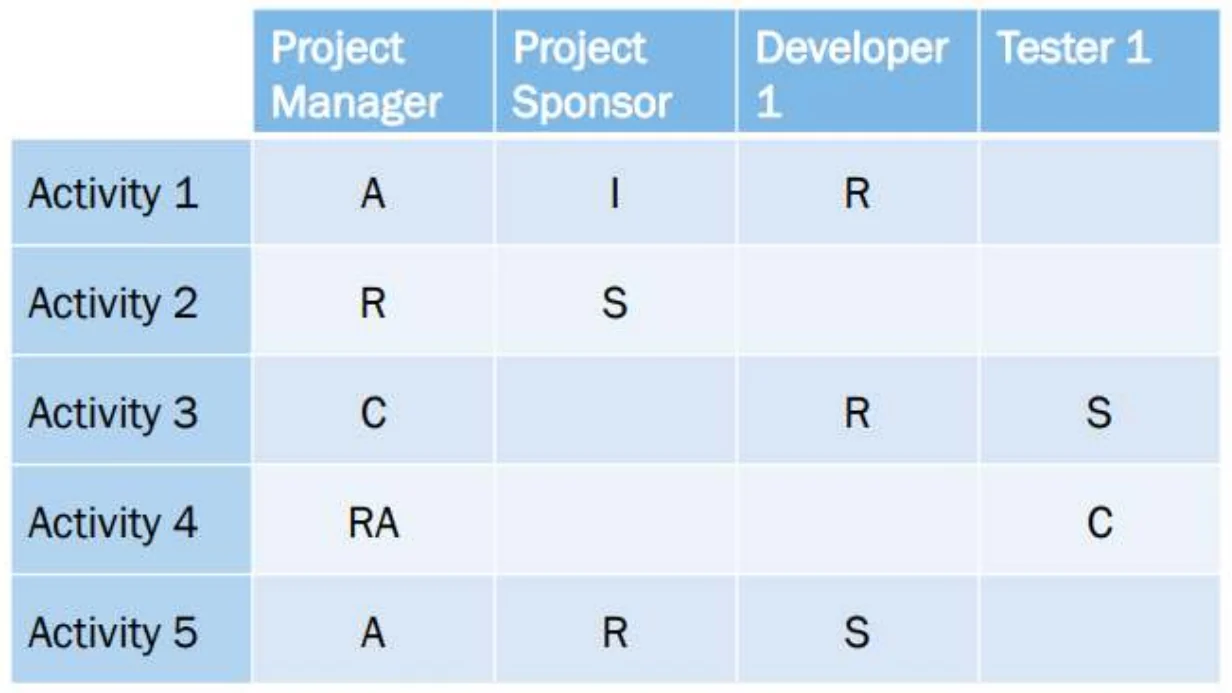
  • RACI – Responsible, Accountable, (Support), Consulted, Informed① Note: “Support” is not part of the original RACI acronym but is sometimes added in variants like RASCI to reflect collaborative roles more accurately.
Example RACI chart: activities 1–5 against project manager, sponsor, developer, tester
20
Exam weight High
  1. R = does the work · A = owns the outcome (only ONE per task) · C = gives input (two-way) · I = kept updated (one-way). S (Support) appears in RASCI variants.
Exam trapExactly one A per activity. Several R’s are fine.
Memory trickConsulted = two-way chat; Informed = one-way update.
🎯 How this can come up · 2 questions
MCQ

In RACI, who “owns the outcome” and signs off on the task?

Scenario

Fitness app (real midterm): who is R and who is A for “Define app requirements”?

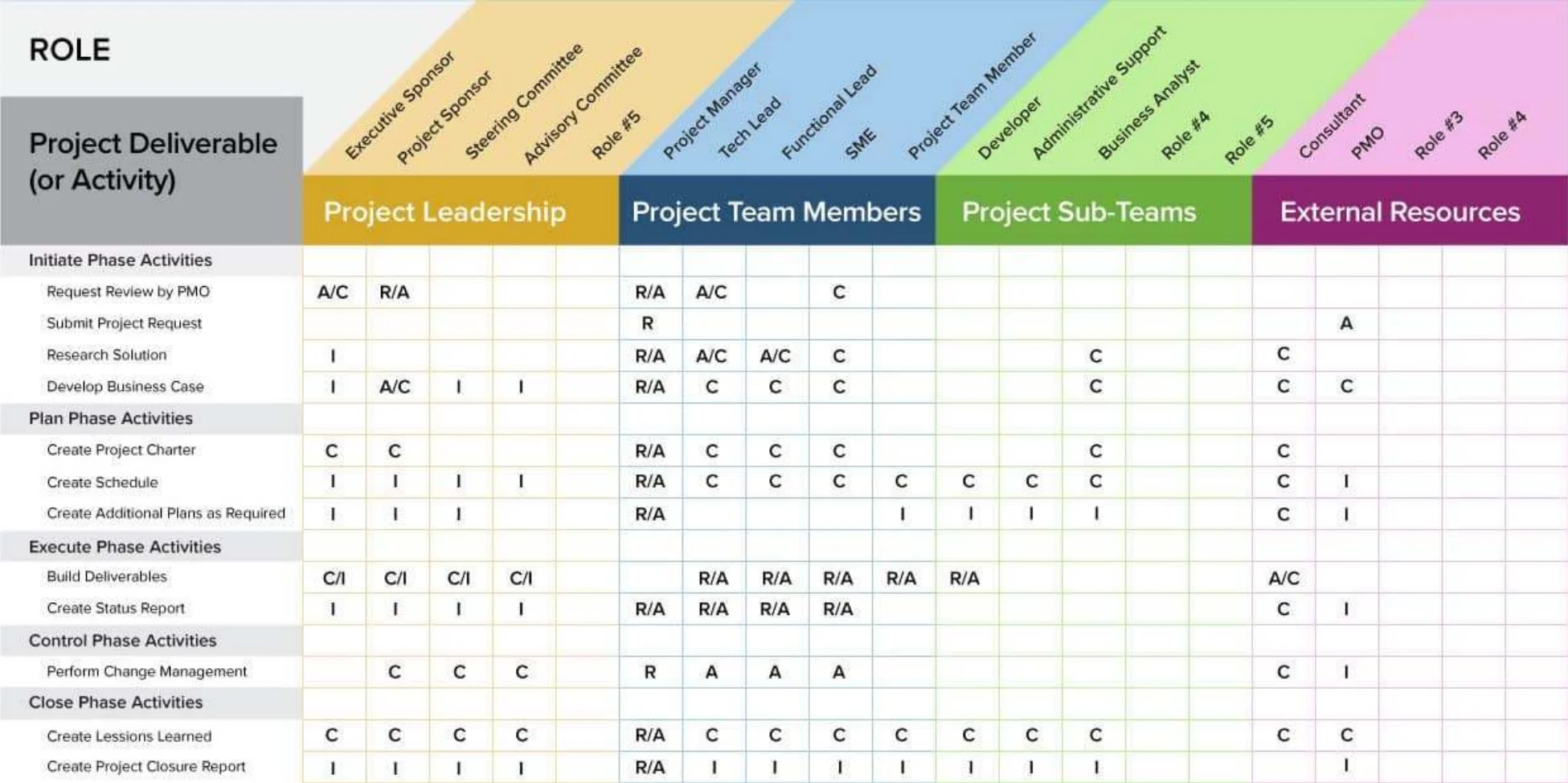
Responsibility Assignment Matrix

  • A resource planning tool
  • Who does What
  • Can be for both planning and tracking
  • Identify authority, accountability, responsibility
  • Who: can be individual, team or department
  • Can have totals/summary at end of row or column (ex: total Contributors on a task)①
21
Exam weight Low
  1. RAM = Responsibility Assignment Matrix (RACI is one type). Rows = tasks, columns = people, teams or departments.

Simple RAM

A larger RACI matrix: project deliverables against leadership, team members, sub-teams and external resources
22
Exam weight Low

    Skills Matrix

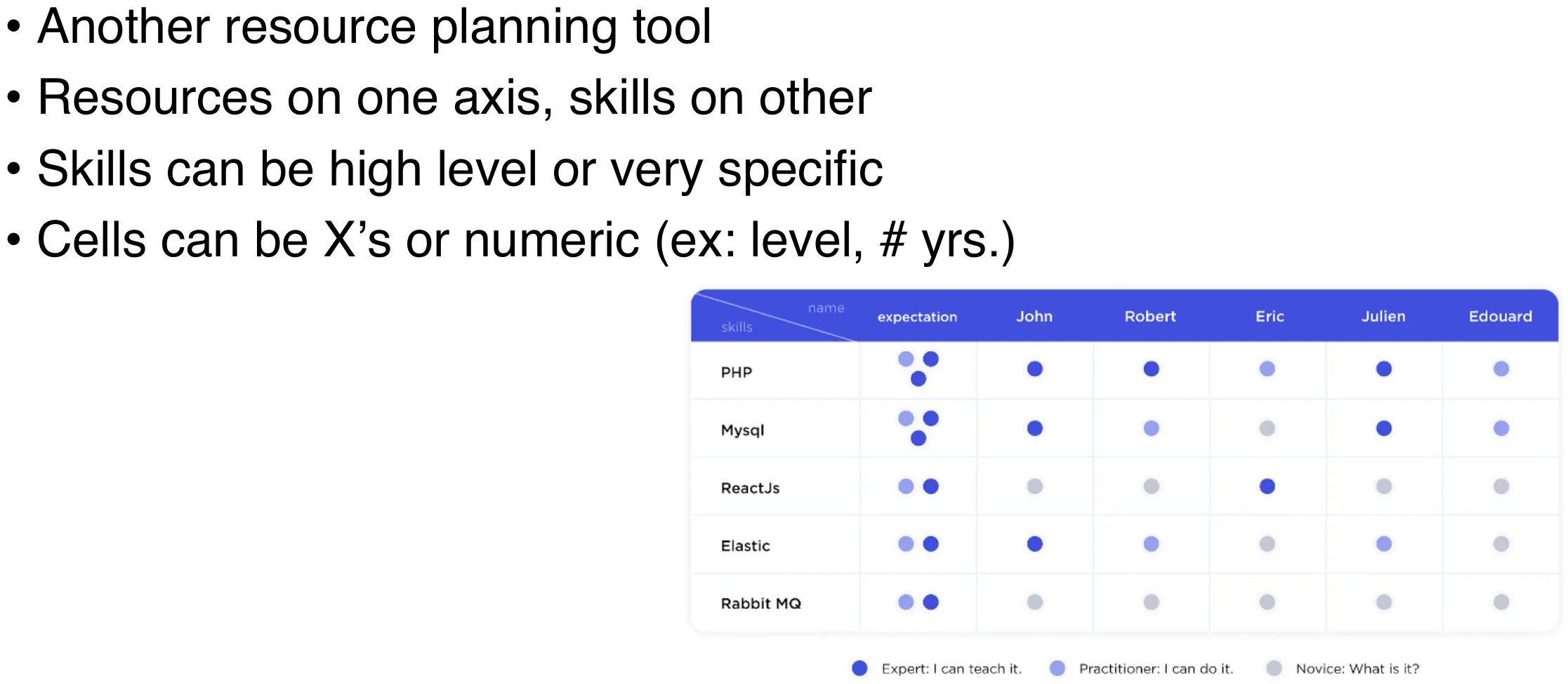
    • Another resource planning tool
    • Resources on one axis, skills on other
    • Skills can be high level or very specific
    • Cells can be X’s or numeric (ex: level, # yrs.)
    Skills matrix: people vs. technologies
    23
    Exam weight Medium
    1. Skills matrix = people × skills. Use it to assign tasks and spot gaps (e.g. only one person knows a key technology = a risk).

    Focusing on Results

    • The true measure of a great team is that it accomplishes the results it sets out to achieve.
    • To avoid distractions, team members must prioritize the results of the team over their individual or organizational (dept) needs.
    • To stay focused, team must publicly clarify their desired results and keep them visible.①
    24
    Exam weight Low
    1. Top of the pyramid: team results come before individual or department goals. Keep the goals public and visible.

    Team Models

    25
    ★ Past exam

    Team Models

    • Business Team : commonly used in software projects and general business environments.
      • Most common model①
      • Technical lead + team (rest of team at equal status)
      • Hierarchical with one principal contact
      • Can be strong (The lead has clear authority and control) or loose hierarchy (The lead facilitates rather than commands—more collaborative)
      • Adaptable and general
      • Variation: Democratic Team
        • All decisions made by whole team
        • The Business Team is often the default starting point—especially in structured environments. But as teams mature, gain trust, and develop shared norms, they may evolve toward a Democratic Team model.②
    27
    Exam weight High
    1. Business team = the most common: a technical lead plus equal-status team, one principal contact. The lead can be strong or loose.
    2. Democratic team = ALL decisions made by the whole team. Teams often evolve from business to democratic as trust grows.
    🎯 How this can come up · 1 question
    Written

    What’s the difference between a Business Team and a Democratic Team?

    Democratic team organization

    • The group acts as a whole and comes to a consensus on decisions affecting the system
    • The group leader serves as the external interface of the group but does not allocate specific work items①
    • Rather, work is discussed by the group as a whole and tasks are allocated according to ability and experience
    • This approach is successful for groups where all members are experienced and competent
    • Sometimes known as self-organizing teams.②
    28
    Exam weight Low
    1. Democratic: the leader is only the external interface and does NOT assign work.
    2. Works only with experienced, competent members; also called self-organizing.

    Agile programming groups

    • Agile programming groups are variants of democratic organization
    • In Agile programming groups, some ‘management’ decisions are delegated to group members
    • In XP, Programmers work in pairs and take a collective responsibility for code that is developed①
    29
    Exam weight Low
    1. Agile groups = democratic variants. XP pair programming = shared ownership of the code.

    Team Models

    Chief-Programmer Team a.k.a. ‘surgical team’, from IBM in the 70’s: puts a superstar at the top. Just as a surgeon performs the critical operation while being supported by anesthetists, nurses, and technicians, the chief programmer writes the core code while being supported by a carefully selected team of specialists.①

    • Backup Programmer/co-pilot (Equally skilled—ready to step in if needed, often reviews or shadows the chief.)
    • Program Clerk (Manages documentation, version control, and technical records.)
    • Administrator (Handles administrative tasks, freeing technical staff to focus on development.)
    • Tool-smith (Builds and maintains development tools and environments.)
    • “Language lawyer” (Deep expert in the programming language(s) used—consulted for tricky syntax or semantics.)
    • Issues: Difficult to achieve, Ego issues: superstar and/or team②
    • Can be appropriate for creative projects or tactical execution
    30
    Exam weight Medium
    1. Surgical team: one star (chief programmer) writes the core code; specialists support (backup, clerk, admin, toolsmith, language lawyer).
    2. Problems: hard to find superstars, ego clashes.
    🎯 How this can come up · 1 question
    MCQ

    In a chief-programmer team, who is equally skilled and ready to step in for the chief?

    Chief programmer teams

    • Consist of a kernel of specialists helped by others added to the project as required
    • The motivation behind their development is the wide difference in ability in different programmers
    • Chief programmer teams provide a supporting environment for very able programmers to be responsible for most of the system development①
    31
    Exam weight Low
    1. Why chief-programmer teams exist: programmers differ hugely in ability, so build the team around the best one.

    Problems

    • This chief programmer approach, in different forms, has undoubtedly been successful
    • However, it suffers from a number of problems
      • Talented designers and programmers are hard to find. Without exceptional people in these roles, the approach will fail
      • Other group members may resent the chief programmer taking the credit for success so may deliberately undermine his/her role.
      • High project risk as the project will fail if both the chief and deputy programmer are unavailable
      • Organizational structures and grades may be unable to accommodate this type of group①
    32
    Exam weight Medium
    1. Problems: talent is rare, resentment over credit, high risk if the chief and the deputy are both unavailable, and HR grades may not fit.
    🎯 How this can come up · 1 question
    True / False

    A chief-programmer team carries high project risk because the project fails if both the chief and deputy are unavailable.

    Team Models

    • Skunk works Team
      • Put a bunch of talented, creative developers away from the mother ship
        • Off-site literally or figuratively
      • Pro: Creates high ownership & buy-in
      • Con: Little visibility into team progress
      • Applicable: exploratory projects needing creativity
        • Not on well-defined or narrow problem①
    • SWAT Team
      • Highly skilled team
      • Skills tightly match goal
      • Members often work together
      • Ex: security swat team, Oracle performance team②
    33
    Exam weight Medium
    1. Skunk works: creative people working off-site. Pro: ownership. Con: little visibility. Use it for exploratory work.
    2. SWAT: highly skilled specialists whose skills match a narrow goal (security, performance).
    🎯 How this can come up · 1 question
    MCQ

    A team of database experts brought in to fix Oracle performance problems is a:

    ★ Past exam

    Team Models

    • Large teams
      • Communication increases multiplicatively
        • Square of the number of people
        • 50 programmers = 1200 possible paths①
        • Communication must be formalized
      • Always use a hierarchy
      • Reduce units to optimal team sizes
        • Always less than 10 (seven plus or minus one)
    • What is the optimal team size?
      • 4-6 developers②
        • Tech lead + developers
      • Small projects inspire stronger identification
      • Increases cohesiveness
      • QA, ops, and design on top of this
    34
    Exam weight High
    1. The exact formula for communication channels is n(n − 1) / 2. 50 people → 1,225 (the slide rounds to 1,200). 7 people → 21.
    2. Optimal team: 4–6 developers plus a tech lead, always under 10.
    Memory trickChannels = n(n−1)/2. For 7 members: 7 × 6 / 2 = 21.
    🎯 How this can come up · 2 questions
    MCQ

    How many communication channels exist in a project team of 7 members?

    MCQ

    According to the slide, the optimal team size is:

    Managing People

    35

    People in the process

    • People are an organization’s most important assets
    • The tasks of a manager are essentially people oriented. Unless there is some understanding of people, management will be unsuccessful①
    36
    Exam weight Low
    1. Management is mostly about people, not technology.

    Management activities (related to people)

    • Problem solving (using available people)
    • Motivating (people who work on a project)
    • Planning (what people are going to do)
    • Estimating (how fast people will work)
    • Controlling (people’s activities)
    • Organizing (the way in which people work)①
    37
    Exam weight Low
    1. Every management activity is about people: solve, motivate, plan, estimate, control, organize.

    Motivation

    • An important role of a manager is to motivate the people working on a project (motivation is needs-based)①
    • Motivation is a complex issue but it there are different types of motivation based on
      • Basic needs (e.g. food, sleep, etc.)
      • Personal needs (e.g. respect, self-esteem)
      • Social needs (e.g. to be accepted as part of a group)
    • Maslow’s hierarchy of needs
    Maslow’s hierarchy: physiological, safety, social, esteem, self-realization
    38
    Exam weight Low
    1. Motivation is needs-based: basic, personal (esteem) and social needs.

    Motivating people

    • People’s Motivations depend on satisfying needs
    • It can be assumed that physiological and safety needs are satisfied
    • Social, esteem and self-realization (self-actualization) needs are most significant from a managerial viewpoint①
    • If a lower set of needs is continually unmet for an extended period of time, the individual will temporarily shift focus downwards those needs – dropping down to that level until those lower needs are reasonably satisfied again.②
    39
    Exam weight Low
    1. At work, assume the basic needs are met. Managers focus on social, esteem and self-realization.
    2. If a lower need stays unmet (e.g. job security), people drop back down to it.

    Need satisfaction

    • Social
      • Provide communal facilities (shared spaces, break rooms, collaborative zones, etc.)
      • Allow informal communications (support casual conversations, team chats, non-work-related exchanges such as during lunch, etc.)
    • Esteem
      • Recognition of achievements
      • Appropriate rewards (bonuses, promotions, certificates, symbolic gestures, etc.)
    • Self-realization
      • Training – people want to learn more
      • Responsibility (empower team members to make decisions)①
    40
    Exam weight Medium
    1. Social → shared spaces, informal chats. Esteem → recognition, rewards. Self-realization → training, responsibility.
    🎯 How this can come up · 1 question
    MCQ

    Sending a developer on a cloud-architecture course mainly satisfies which need?

    Personality types

    • The needs hierarchy is almost certainly an over-simplification
    • Motivation should also take into account different personality types:
      • Task-oriented
        • The motivation for doing the work is the work itself
      • Self-oriented
        • The work is a means to an end which is the achievement of individual goals – e.g. to get rich, to buy a house, to travel etc.
      • Interaction-oriented
        • The principal motivation is the presence and actions of co-workers.
        • People go to work because they like to go to work①
    41
    Exam weight Medium
    1. Task = the work itself · Self = personal goals (money, house) · Interaction = co-workers.
    🎯 How this can come up · 1 question
    MCQ

    A developer who works mainly to save for a house is:

    Motivation balance

    • Individual motivations are made up of elements of each class (from previous slide).
    • Balance can change depending on personal circumstances and external events
    • However, people are not just motivated by personal factors but also by being part of a group and culture.
    • People go to work also because they are motivated by the people that they work with①
    42
    Exam weight Low
    1. Most people are a mix of the three types, and the balance changes with circumstances.

    Group composition: group working

    • Most software engineering is a group activity
      • The development schedule for most non-trivial software projects is such that they cannot be completed by one person working alone
    • Group interaction is a key determinant of group performance
    • Flexibility in group composition is limited
      • Managers must do the best they can with available people①
    43
    Exam weight Low
    1. Software is a group activity; you rarely get to choose the perfect team.

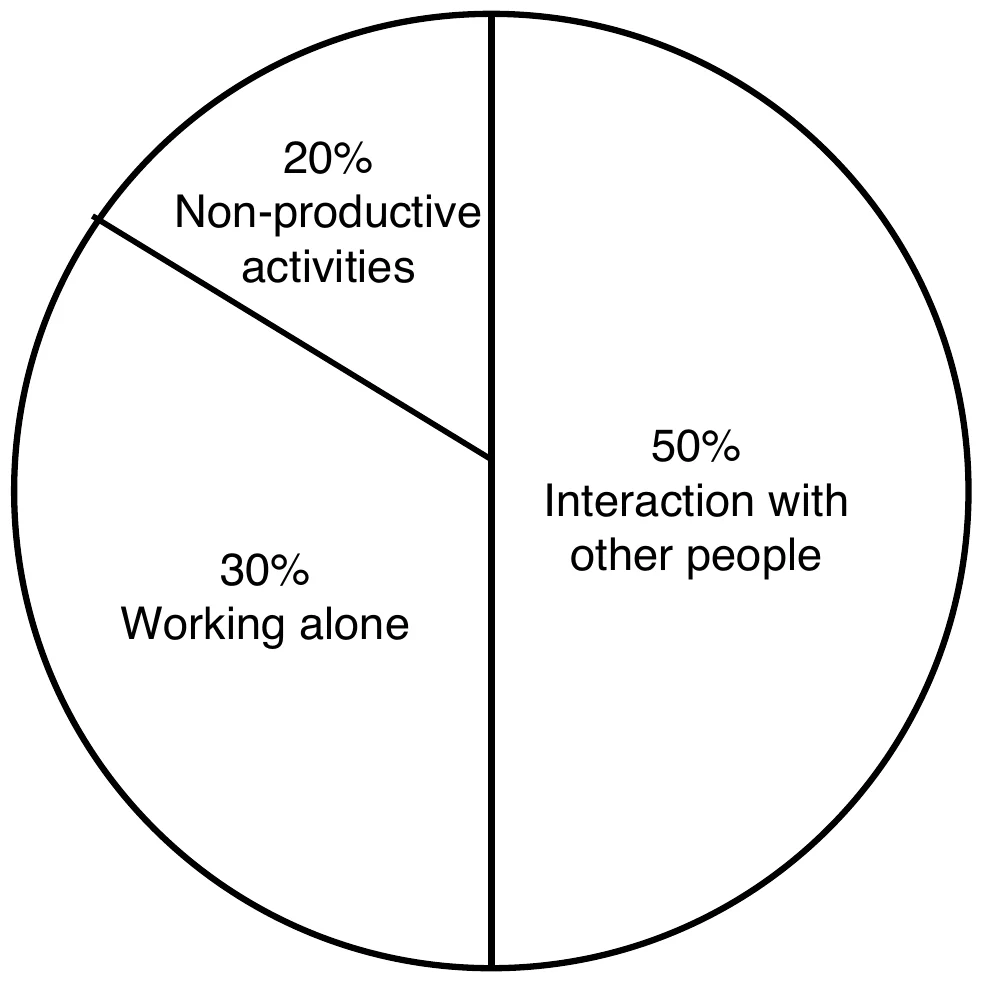
    Time distribution

    Pie chart: 50% interaction with other people, 30% working alone, 20% non-productive
    44
    Exam weight Medium
    1. Half of a developer’s time goes on interacting with others. Communication skills matter more than people expect.
    🎯 How this can come up · 1 question
    MCQ

    According to the time-distribution chart, roughly how much of an engineer’s time is spent interacting with other people?

    Group composition

    • Group composed of members who share the same motivation can be problematic:
      • Task-oriented – everyone wants to do their own thing
      • Self-oriented – everyone wants to be the boss
      • Interaction-oriented – too much chatting, not enough work
    • An effective group has a balance of all types
    • Can be difficult to achieve because most engineers are task-oriented①
    45
    Exam weight Medium
    1. All task-oriented → everyone works alone. All self-oriented → everyone wants to be boss. All interaction-oriented → chatting, no work. Mix them.
    🎯 How this can come up · 1 question
    MCQ

    A team where “everyone wants to be the boss” is dominated by which personality type?

    Group composition: group leadership

    • Leadership depends on respect not titular status (titular = holding a title)①
    • There may be both a technical and an administrative leader
    • Democratic leadership is more effective than autocratic leadership
    • A career path based on technical competence should be supported
    46
    Exam weight Low
    1. Leadership comes from respect, not a title. There can be a technical and an administrative leader.
    ★ Past exam

    Group cohesiveness

    • In a cohesive group, members consider the group to be more important than any individual in it
    • Advantages of a cohesive group are:
      • Group quality standards can be developed
      • Group members work closely together so inhibitions caused by ignorance are reduced
      • Team members learn from each other and get to know each other’s work
      • Egoless programming where members strive to improve each other’s programs can be practiced①
    47
    Exam weight High
    1. Cohesive group: the group matters more than any individual. Advantages: shared quality standards, learning from each other, egoless programming.
    🎯 How this can come up · 1 question
    MCQ

    In a cohesive team, which of the following is an advantage?

    Developing cohesiveness

    • Cohesiveness is influenced by factors such as the organizational culture and the personalities in the group
    • Cohesiveness can be encouraged through
      • Social events, such as team outings
      • Developing a group identity and territory
      • Explicit team-building activities
    • Openness with information is a simple way of ensuring all group members feel part of the group①
    48
    Exam weight Medium
    1. Build cohesiveness with social events, a shared identity and space, team-building, and open information.

    Group loyalties

    • Group members tend to be loyal to cohesive groups
    • 'Groupthink’ is preservation of group irrespective of technical or organizational considerations
    • Management should act positively to avoid groupthink by forcing external involvement with each group①
    49

    Arabic gloss next to groupthink: “العصبية للمجموعة” (group partisanship).

    Exam weight Medium
    1. Groupthink = protecting the group regardless of technical or organizational sense. Fix it by bringing in outside people and reviews.
    🎯 How this can come up · 1 question
    MCQ

    How should management counter groupthink?

    Group communications

    • Good communications are essential for effective group working
    • Information must be exchanged on the status of work, design decisions and changes to previous decisions
    • Good communications also strengthens group cohesion as it promotes understanding

    Notes:

    • Status of group members
      • Higher status members tend to dominate conversations
    • Personalities in groups
      • Too many people of the same personality type can be a problem
    • Communication channels
      • Communications channelled though a central coordinator tend to be ineffective①
    50
    Exam weight Low
    1. Three things affect group communication: status (seniors dominate), personalities (too many alike), and channels (one central hub is ineffective).

    Group organization

    • Software engineering group sizes should be relatively small (< 10 members) optimal is less than seven (see previous slides)
    • Break big projects down into multiple smaller projects
    • Small teams may be organized in an informal, democratic way
    • Chief programmer teams try to make the most effective use of skills and experience①
    51
    Exam weight Low
    1. Keep groups under 10 (ideally under 7). Split big projects into small ones.

    Choosing and keeping people

    • Choosing people to work on a project is a major managerial responsibility
    • Appointment decisions are usually based on
      • information provided by the candidate (their resume or CV)
      • information gained at an interview
      • Interviews with potential co-workers
      • recommendations from other people who know the candidate
    • Some companies use psychological or aptitude tests
      • There is no agreement on whether or not these tests are actually useful①
    52
    Exam weight Low
    1. Selection inputs: CV, interview, interviews with co-workers, recommendations. Aptitude tests are disputed.

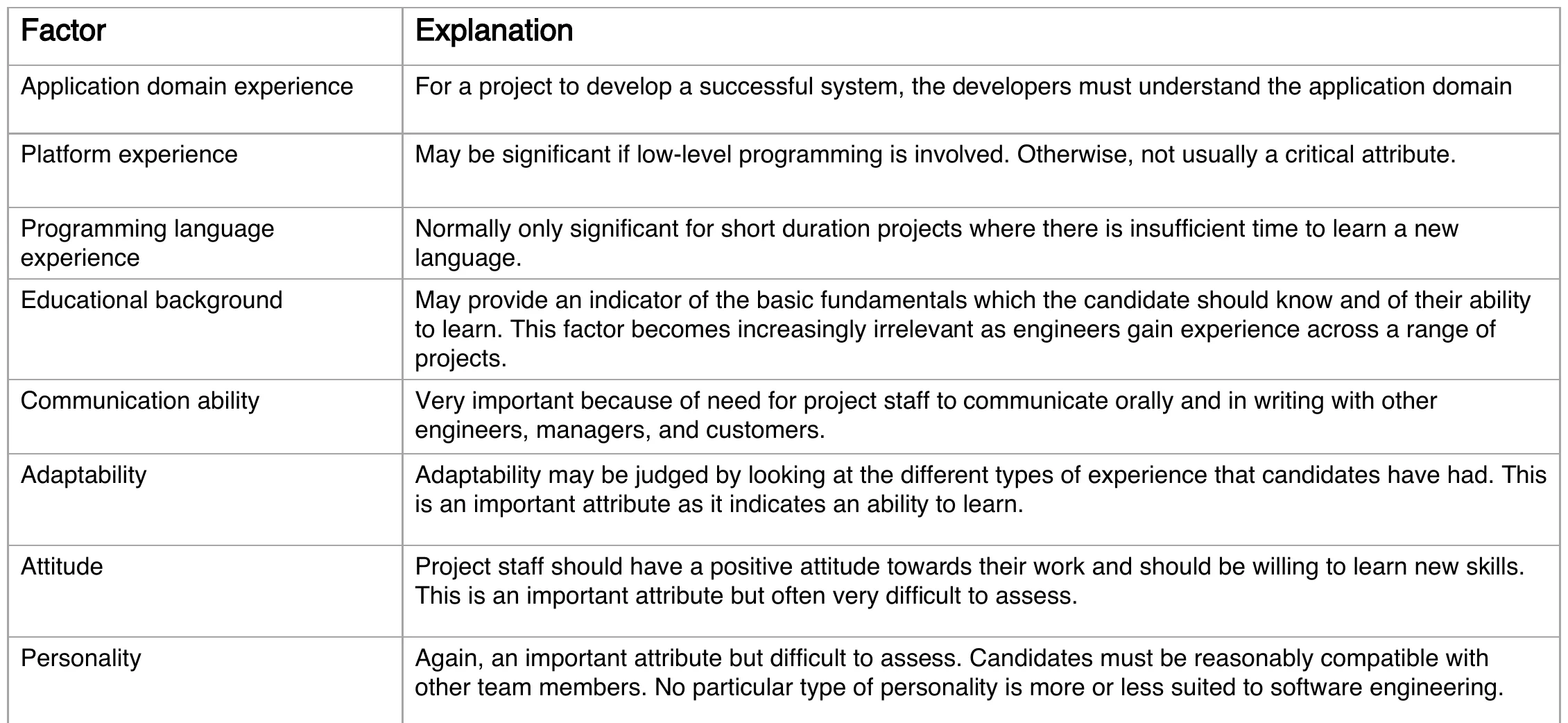
    Staff selection factors

    Staff selection factors table: application domain, platform, language, education, communication, adaptability, attitude, personality
    53
    Exam weight Medium
    1. Most important: application domain experience, communication, adaptability, attitude.
    2. Programming language only matters for short projects (no time to learn). No personality type is better suited to SE.
    Exam trap“Programming language experience is the most critical factor” ✗. It only matters for short projects.
    🎯 How this can come up · 1 question
    MCQ

    According to the table, programming language experience is significant mainly when:

    Working environments

    • Physical workplace provision has an important effect on individual productivity and satisfaction
      • Comfort
      • Privacy [see next slide]
      • Facilities
    • Health and safety considerations must be taken into account
      • Lighting
      • Heating
      • Furniture①
    54
    Exam weight Low
    1. The physical environment affects productivity: comfort, privacy, facilities, plus health and safety.

    Environmental factors

    • Privacy – each engineer requires an area for uninterrupted work (see next slide)
    • Outside awareness – people prefer to work in natural light
    • Personalization – individuals adopt different working practices and like to organize their environment in different ways①
    55
    Exam weight Low
    1. Three environmental factors: Privacy, Outside awareness (natural light), Personalization.

    Workspace organization

    • Workspaces should provide private spaces where people can work without interruption
      • Providing individual offices for staff has been shown to increase productivity①
    • However, teams working together also require spaces where formal and informal meetings can be held
    56
    Exam weight Low
    1. Private space for focus plus shared space for meetings.

    Our perspective about the team members

    • The phrase ‘human resources’ has its origins as an economic and corporate asset term
    • These origins lead to two semantic problems:
      • People are (to some extent) considered in the same light as inanimate resources: “maximizing the ROI in human capital is the goal of HR management”
      • People are considered (to some extent) as being uniform, interchangeable, and expendable①
    • To improve the chances of project success, the project manager should ensure that he views and acts with his team members as “collaborators”, “stakeholders”, “teammates” by recognizing and nurturing their individual talent and fostering psychological safety and team cohesion.②
    57
    Exam weight Low
    1. The problem with “human resources”: it treats people like machines (interchangeable, expendable).
    2. See them as collaborators and teammates instead.

    The project manager’s skills

    • The project manager must develop people skills in a number of related areas:
      • Interpersonal skills
      • Shaping project culture
      • Managing people
      • Making people better
      • Leadership①
    58
    Exam weight Low
    1. Five people-skill areas: interpersonal, shaping culture, managing people, making people better, leadership. The next slides cover each.

    Interpersonal skills

    • The project manager needs a well-developed set of interpersonal skills in order to effectively manage a project
    • Effective communication .
      • Follows a defined protocol: structured channels and formats (e.g., status reports, stand-ups, escalation paths). This ensures clarity and consistency.
      • Reaches all recipients in a timely manner
      • Provides all the information necessary, no more or no less①
    • Influencing the organization . The ability to get a project completed depends on the abilities of and respect for the PM and PM team (influence, negotiate, and build credibility)
    • Leadership: is one of the most misunderstood concepts in project management–leadership has little to do with authority: it’s about inspiring, guiding, and aligning people toward a shared goal②
    59
    Exam weight Medium
    1. Good communication: a defined protocol, reaches everyone on time, exactly the right amount of information.
    2. Leadership ≠ authority (again).

    Interpersonal skills (2)

    • Motivation . Providing people with incentives to act in the interest of the project and overcome inevitable challenges
      • Motivation comes in a number of forms; studies show financial incentives are among the least effective motivators①
    • Negotiation and conflict management . Working with others to come to agreement and overcome differences, real or perceived
      • Reaching consensus and defusing conflict are two elements of these skills
    • Problem solving . Being able to recognize and define problems; formulate, evaluate, and make decisions regarding possible solutions
      • Problem solving is a skill that can be learned but requires practice: progressive elaboration helps manage the complexity of most project problems
    60
    Exam weight Medium
    1. Money is one of the WEAKEST motivators (Herzberg’s hygiene factor).
    🎯 How this can come up · 1 question
    True / False

    Studies show financial incentives are among the most effective motivators for project teams.

    Shaping project culture

    • The project manager must shape the project culture within the broader context of the framework of the organizational culture
    • Understand organizational culture
      • Understanding the attitude of the organization toward the project and toward project management processes is essential (Every organization has its own values, norms, and attitudes toward projects—some embrace structured methodologies, others prefer informal or ad hoc approaches)
      • Organization attitudes toward real– as opposed to fanciful–project management practices varies widely (practices that exist in theory but not in reality )
    • Understand each team member’s engineering and personal background
      • Education, experience, generation, and personality all determine what roles the person may take and how they will fit in with the rest of the team
    • Assess each team member’s cultural role or roles and match this to their project role①
    61
    Exam weight Low
    1. Understand the organization’s real attitude to PM (not just what is on paper) and each member’s background.

    Shaping project culture

    • Match cultural and project roles to people
    • Representative cultural roles include:
      • Leader (Takes initiative, inspires others)
      • Listener/talker (Facilitates communication, bridges gaps)
      • Complainer/naysayer (who habitually expresses negative or skeptical views: Raises concerns, challenges assumptions)
      • Expert (Offers deep knowledge and credibility)
      • Charger/plodder (Pushes forward with energy)①
    • Significant project roles include:
      • Project manager . Guides the team planning and tracks progress against the plan
      • Team leader . Builds and maintains an effective team
      • Development leader . Produces a superior product
    • Remain non-judgmental: every cultural role has potential value for the team②
    62
    Exam weight Low
    1. Five cultural roles: Leader, Listener/talker, Complainer/naysayer, Expert, Charger/plodder.
    2. Every role has value; even the naysayer raises risks.

    Project environments (context: project culture)

    • Cultural and social factors
      • Projects are planned and implemented in a social and cultural context
      • Some factors that will influence a project might be: economic, educational, ethical, ethnic, and religious
      • These factors can affect the authority of the project manager①
    • International and political
      • As globalization expands, familiarity with local laws and customs is essential for effective project management
      • Shifting international, national, and local political factors can have dramatic influences on a project
      • Some mundane factors that will influence a project might be: time zone differences, holidays, travel requirements, teleconferencing capabilities②
    63
    Exam weight Low
    1. Social and cultural factors can affect the PM’s authority.
    2. Global projects: local laws, politics, time zones, holidays.

    Shaping project culture

    • Monitor and manage team culture as you would manage technical issues
      • Make each person’s project role clear
      • Understand each person’s personality and make known your understanding of each person’s social role in a positive way
      • State and maintain your view of the team
        • Example: “we are all equals in this team, but if a critical situation arises, I will make the decision.”①
    • Recognize potential cultural role problems before they have a negative impact on the team (A dominant voice silencing others, A skeptic undermining morale)
    • Solve project role problems before they have a negative impact on the project
    64
    Exam weight Low
    1. State your view of the team clearly: “equals, but in a crisis I decide.”

    Project Culture

    • Monitor team members’ satisfaction with their role.
      • You will need to monitor team role satisfaction throughout the project.
      • It is especially important during project launch when roles can be changed easily.
    • Monitor the engineering task-to-people fit to make sure each person can perform the engineering task.
      • Role mismatches lead to project problems and schedule slip.①
      • If you don’t review task-to-people fit, you will be unaware of each person’s ability, or lack thereof, to perform tasks.
    • Monitor the cultural climate of the team as a whole.
      • Monitor project culture by watching and listening to each team member.
      • Guide the cultural views of the project by your own example.
      • You need to be able to monitor the team culture throughout the project in order to build confident people and a confident team.
    65
    Exam weight Low
    1. Role mismatches cause schedule slip. Check task-to-people fit early, when roles are easy to change.

    Managing People

    • The main problems of our work are not so much technological as sociological in nature①
    • (optional reading) One of the most enlightened sources for information about managing people is: Peopleware: Productive Projects and Teams , Third Edition,
    • Most technical managers come from technical backgrounds and manage that way as if they are solving an engineering problem
    • Most managers do not consider individual idiosyncrasies (personal strange habit), yet these can make or break a project
    66
    Exam weight Low
    1. Peopleware’s main message: most project problems are about people, not technology.

    Managing People

    Guidelines for Managing People:

    • Gain visibility without micromanagement.
    • Review process and products, not people.①
      • Say: “This testing regime allows too many bugs to slip through to the customer; what can we do to correct this?”
      • Not: “You all don’t seem to know how to write unit tests properly.”
    • Coordinate, don’t manipulate.
    • Use your knowledge, not your position of power.
    • Channel people, don’t put dams in front of them.
      • Redirect misplaced energy or effort, don’t cut it off
    • Focus on project and people needs, not your authority as manager.
      • This will maintain your leadership role without explicit effort②
    67
    Exam weight Medium
    1. Criticize the process (“this testing regime lets bugs through”), never the people (“you can’t write tests”).
    2. Lead with knowledge, not position.
    🎯 How this can come up · 1 question
    MCQ

    Which statement follows the guideline “review process and products, not people”?

    How NOT to Manage ‘Thought Workers’: Production Line Efficiency

    • The application of production line efficiency principles to thought workers can be a sign of disaster for a project
    • Common errors include:
      • Squeeze out error – make the ‘machine’ run as smoothly as possible
      • Take a hard line about people goofing off on the job (Assuming that any non-visible output equals laziness: creative people need time to reflect)
      • Treat workers as interchangeable pieces of the machine
      • Optimize the steady state – don’t worry about start up and shut down
      • Standardize procedure – run by the book (rigid processes)
      • Eliminate experimentation (Discouraging trial-and-error or creative risk-taking)①
    • Consider how each of these errors might impact your own work
    68
    Exam weight Low
    1. Treating developers like a factory (no slack, interchangeable people, rigid process, no experiments) is a recipe for disaster.

    Making People Better

    • Make professional development a project goal
    • Recognize long- and short-term development goals
      • Short-term goals focus on skills needed for the project
      • Long-term goals prepare team members for future projects
    • Let each team member specify personal improvement goals
      • Starting point: Competency framework goals such as: Technical, leadership, domain, general/personal, communication, and management
    • For a fixed interval, have team members track their individual time expenditure in detail
      • This concept goes well beyond the weekly timesheet concept
      • This is an awareness-building activity, not a monitoring activity
      • The Personal Software Process (PSP) is a formal application of this idea①
    69
    Exam weight Low
    1. Short-term goals = skills for this project; long-term = future projects.
    2. Time tracking is for self-awareness, NOT monitoring. PSP formalizes it.

    Making People Better

    • Have team members track their individual time
      • Goes beyond the weekly timesheet concept
    • One formal approach to this is the Personal Software Process (PSP) which shows developers how to:
      • Manage the quality of their projects
      • Make commitments they can meet
      • Improve estimating and planning
      • Reduce defects in their products①
    • One element of PSP is to track daily time spent on all project-related tasks: reading, writing, meetings, training, requirements, design, coding, testing, deployment, e-mail, phone.
    70
    Exam weight Low
    1. PSP benefits: quality, realistic commitments, better estimating, fewer defects.
    ★ Past exam

    Leadership

    • Leadership is the capacity to mobilize a group to solve the most challenging problems ( wrong to think that leadership is about authority )①
    • Two types of leadership:
      • Technical leadership (a.k.a. authority ) motivates people when the problem can be solved by known means: the leader directs, instructs and applies best practices.
      • Adaptive leadership motivates people to solve problems that cannot be solved by known means ( needed when the problem is complex or novel )
        • Requires learning on the part of the leader as well as the group (facilitate learning and research)
        • Often involves leading with good questions (provoke thinking, guide inquiry)
        • Requires a deep clarity of purpose (to keep the team anchored toward its goals) : Example: during brainstorming meetings, the leader is the one that needs to stop the conversation from diverging to unimportant arguments, problems and bring the discussion back to the essential questions.②
    71
    Exam weight High
    1. Technical leadership = problems solvable by KNOWN means; the leader directs and applies best practices.
    2. Adaptive leadership = complex or novel problems; the leader learns with the team, asks good questions, keeps a clear purpose.
    ★ Past exam

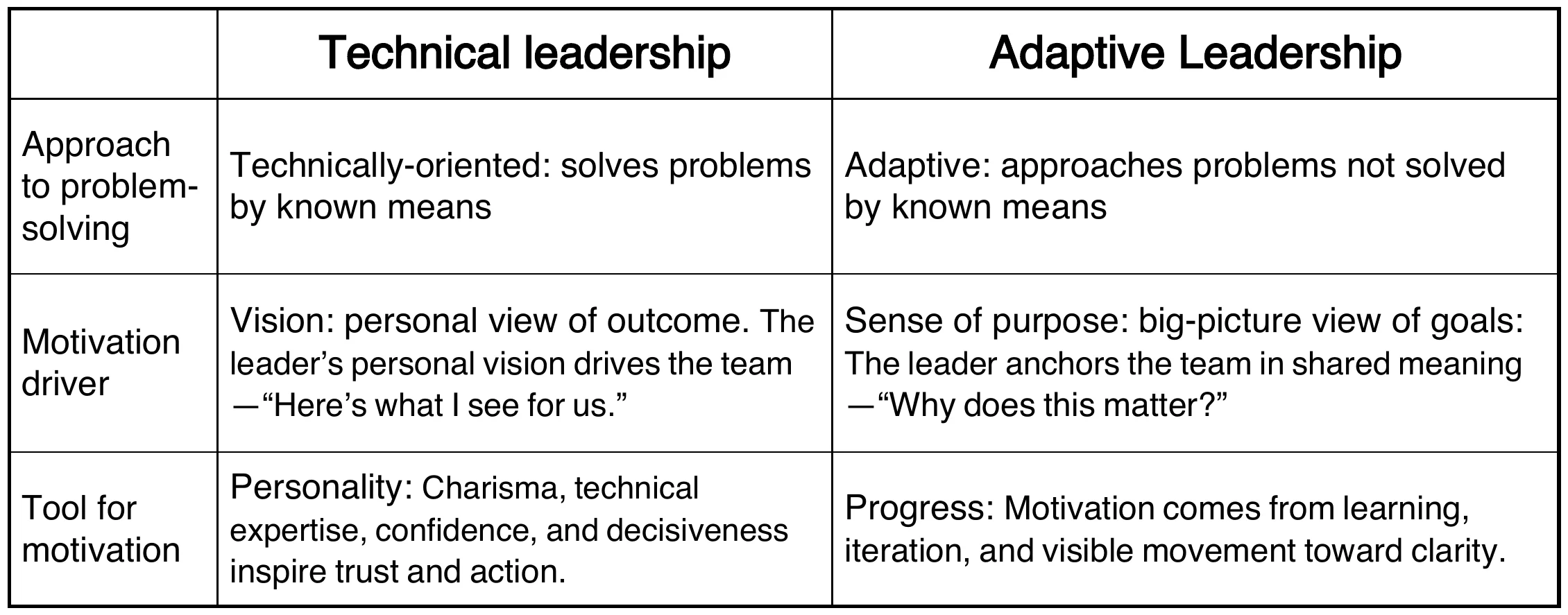
    Technical vs. adaptive leadership

    Table: technical vs. adaptive leadership by approach, motivation driver and tool for motivation
    72
    Exam weight High
    1. Technical: solves known problems, the leader’s personal vision (“here’s what I see”), motivates through charisma and expertise.
    2. Adaptive: unknown problems, shared purpose (“why does this matter?”), motivates through visible progress and learning.
    Memory trickTechnical = “Follow me, I know.” Adaptive = “Let’s figure it out together.”
    🎯 How this can come up · 1 question
    Written

    How can a project manager balance technical leadership with adaptive leadership in a software team?

    Technical vs. adaptive leadership

    • Need to be aware of which kind of leadership is needed and choose between technical leadership and adaptive leadership for a project based on whether the problem can be solved by known means or not.①
    • Most IT projects have a mix of known and unknown problems.
    • An adaptive leader can address known problems by delegation –allow one who can lead the team in solving the problem by known means do so when appropriate②
    73
    Exam weight High
    1. Choose the leadership type by asking: can this be solved by known means?
    2. An adaptive leader handles the known parts by delegating them.
    🎯 How this can come up · 1 question
    True / False

    An adaptive leader should personally solve all known technical problems.

    Working toward consensus

    • Consensus simply means ‘general agreement’. But in the context of project teams, consensus doesn’t mean everyone agrees—it means everyone feels heard, and the group can move forward with a shared commitment.①
    • If possible, reach consensus on all decisions affecting the team
    • Simple majority rule can be detrimental on a small team in which everyone’s commitment is essential
    • To reach that point, leaders must curate the quality of discourse②: Valid argument need to be highlighted, invalid arguments need to constructively disqualified to protect decision quality:
      • Example: In a product design debate, a team member cites user data to support a feature. The leader highlights this as a valuable contribution, reinforcing data-driven thinking.
    74
    Exam weight Medium
    1. Consensus ≠ everyone agrees. It means everyone feels heard and the group moves forward committed.
    2. The leader curates the discussion: highlight valid arguments, constructively drop invalid ones.

    Working toward consensus

    • Steps to reaching consensus:
      • Pose the problem to be solved or decision to be made
      • Solicit input on options for the problem or decision
      • Discuss and weigh pros and cons of each option
      • Work toward the options that have the most benefit for the project
      • When it is clear which option is most suitable, work with its opponents to help them buy in to it–persuade, don’t dictate
      • Consensus takes more time than mandate, but has huge pay-offs①
    • Beware passive/aggressive agreement–this is simply subsumed conflict②
    75
    Exam weight Medium
    1. Steps: pose → solicit options → weigh pros and cons → converge → persuade opponents.
    2. Passive-aggressive agreement = hidden conflict. Watch for it.
    🎯 How this can come up · 1 question
    Scenario

    Your team must choose a CI/CD platform; developers, DevOps and QA want different things (real Final 251 question). How do you reach a decision?

    Leading People

    This is a reprise of our view of establishing a basis of trust

    • Be confident in yourself and the team
    • Maintain open communication within the project team– communication barriers create project risks
    • Be fallible. Take responsibility for making mistakes, correct them, and make it clear how you plan to avoid these mistakes in the future
    • Lead by example rather than by mandate. Show the team what you expect from yourself and from them
    • Utilize all the talents of your team. You can’t make the project succeed all by yourself
    • Complete all your commitments on time. If you cannot do so, give adequate notice and an explanation, not an excuse
    • Don’t confuse friendship with leadership: Warmth and connection are vital—but leadership requires clarity, boundaries, and accountability①
    76
    Exam weight Low
    1. A repeat of slide 12. Warmth matters, but leadership needs clarity, boundaries and accountability.

    Key points

    • Managers must have some understanding of human factors to avoid making unrealistic demands on people
    • Staff selection factors include education, domain experience, adaptability and personality
    • Software development groups should be small and cohesive
    • Group communications are affected by status, group size and the group composition and organization
    • The working environment has a significant effect on productivity
    • Develop methods to monitor the project culture and technical status early so you can continually monitor these issues as the project progresses.①
    77
    Exam weight Low
    1. Summary: understand people, choose staff well, keep groups small and cohesive, mind communication and environment, monitor the culture early.