- This deck = the language of the whole course. Every later chapter assumes these words.
- Heaviest exam zone: slides 21–27 and 39–40. Most of the midterm MCQs came from here.
- Why PM matters: job demand and money wasted.
- Pyramids → Manhattan Project → PMOs in the 1990s.
- What a PM does, which skills they need, and the 14 competencies.
- Biggest and most examined part: the standard, 12 principles, 8 performance domains, key terms and the system for value delivery.
The instructor highlighted the four nouns and circled “guiding”. PM guides the work; it does not do the work.
- Memorize the four nouns exactly: Knowledge, Skills, Tools, Techniques. A wrong option usually swaps one for “budgets” or “contracts”.
- Predictive = plan everything up front (waterfall). Adaptive = agile. Hybrid = a mix. All three are covered properly in Chapter 4.
Seen again
🎯 How this can come up · 2 questions
Project management is the application of ______ to project activities to meet project requirements.
The PMBOK definition uses those exact four nouns.
Project teams must use a predictive approach to achieve project outcomes.
False. The slide lists a broad range of approaches: predictive, hybrid, and adaptive.
- Statistics slide: low priority. If it is tested at all, it is a number-matching MCQ.
🎯 How this can come up · 1 question
According to PMI’s Talent Gap report, how many new project management employees will be needed each year to meet global demand by 2030?
87.7 million is the total number of PM-oriented roles needed by 2027, not a yearly figure.
- Three skills: Teamwork, Problem-solving, Verbal communication. All three are PM skills.
- $97M per $1B is roughly 10% wasted. This is the argument for formal PM (see slide 18).
🎯 How this can come up · 2 questions
According to PMI’s Pulse of the Profession, organizations waste about $97 million for every $1 billion spent on projects.
True. That waste is the motivation for formal project management.
Which set of skills does the slide say employers look for most in new graduates?
Correct: Team-work, problem-solving, verbal communications.
- Three things that explain the profession: its history (next slides), its societies (PMI, slide 12) and its software (tools such as Gantt-chart software, Chapter 6.2).
- First modern PM = the Manhattan Project. The pyramids and the Great Wall are only “arguably” projects.
- Two managers: one for the project, one for the technology. The same split appears as technical vs. adaptive leadership in Chapter 3.
🎯 How this can come up · 2 questions
Which project is generally considered the first to use “modern” project management?
The pyramids and the Great Wall are only argued to be projects. Modern PM starts with the Manhattan Project.
The Manhattan Project had a single manager responsible for both project and technical leadership.
False. It had a separate project manager and a technical manager.
- Learn the PMO definition word for word. It was a full Final 242 question.
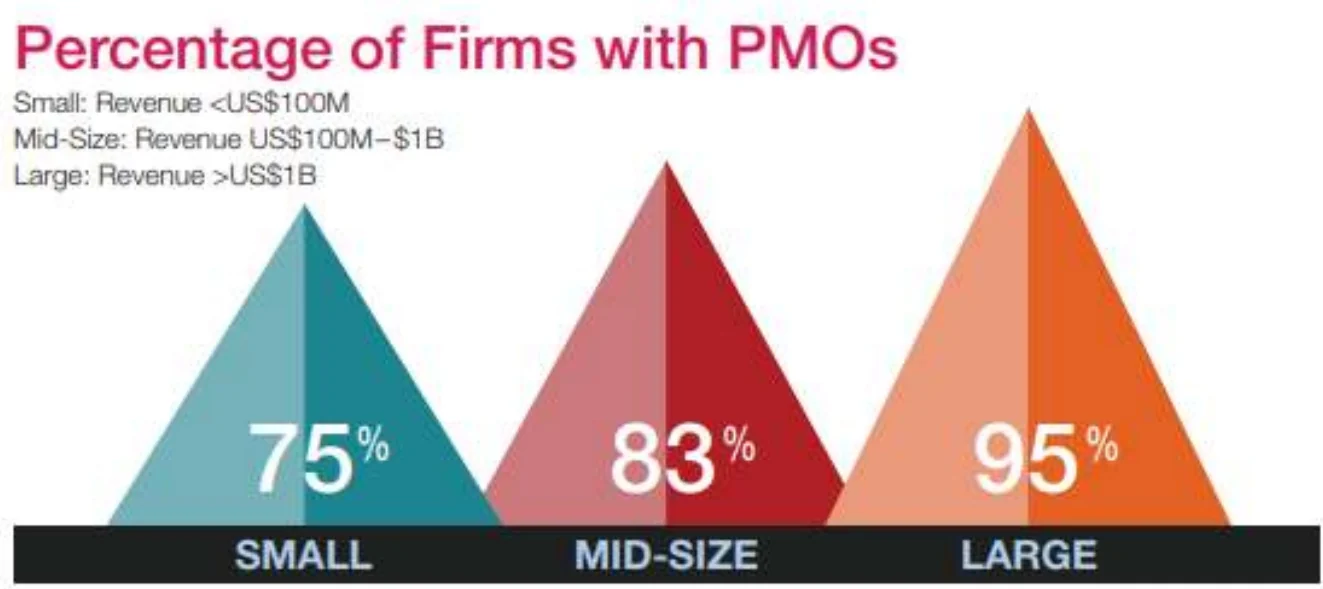
- The bigger the firm, the more likely it has a PMO: 75% → 83% → 95%.
Asked in a real exam
Seen again
🎯 How this can come up · 2 questions
What is a Project Management Office (PMO) and what is its role in an organization?
A PMO is an organizational unit responsible for coordinating the project-management function throughout the organization. Companies created PMOs in the 1990s to cope with the growing number and complexity of projects. Its role is to standardize PM methods and tools, support and coach project managers, coordinate projects, programs and portfolios (including resources and priorities), and monitor and report project performance to senior management.
A company runs 40 projects at once. Each team reports progress in a different format, and senior managers cannot compare them. What organizational unit would you propose, and what would it do?
A Project Management Office (PMO). It would standardize the reporting format and PM process, coordinate projects across the organization, support the project managers, and consolidate status for senior leadership.
- Benefits realization means checking whether the project actually produced the gains it promised. It is the outcome → benefit → value chain on slide 34.
Seen again
🎯 How this can come up · 1 question
Which of the following is NOT listed as a global dynamic forcing organizations to rethink their PM practices?
Correct: Eliminating project managers in favour of automation.
- The chart shows active PMP holders more than doubling, from 510,434 (2012) to 1,245,446 (2022). There is a small dip from 2021 to 2022.
- PMP = Professional. CAPM = Certified Associate, the student/entry-level certificate.
🎯 How this can come up · 1 question
Which PMI certification can students earn at a reduced fee?
CAPM = Certified Associate in Project Management. PMO is an organizational unit and PMBOK is the body of knowledge.
- Ethics = principles guiding decisions, based on personal values of right and wrong.
- The Code rests on four values: Responsibility, Respect, Fairness, Honesty (slide 55).
Seen again
🎯 How this can come up · 1 question
Agreeing to PMI’s Code of Ethics and Professional Conduct is required to earn the PMP® certification.
True.
- Schedule, budget and quality are the classic competing constraints. Use them for the “project constraints” question.
- This is why tracking tools exist: percent complete, earned value and burn-down charts (Chapter 6.2).
Related real-exam questions
Seen again
🎯 How this can come up · 1 question
Define “project constraints” and give three examples.
Project constraints are the limiting factors a project must work within. Examples: schedule (time), budget (cost) and quality/scope; resources are also common. They are interrelated: tightening one, such as a shorter schedule, puts pressure on the others (more cost or less scope/quality). So planning has to balance them, and execution has to trade them off when something changes.
- The 97% figure is the kind of number that turns into a true/false question.
🎯 How this can come up · 1 question
According to the slides, 97% of successful projects were led by experienced project managers.
True.
- 14 competencies. Only one of them (#14) is technical. A PM is mostly a people role.
🎯 How this can come up · 2 questions
Which of the following is NOT one of the listed competencies for project managers?
Technical expertise appears only as “process and technical expertise”, never as writing code.
Two senior developers keep arguing about the architecture in every meeting, and the rest of the team has stopped contributing. Which PM competencies does this situation call for?
Conflict resolution/conflict management (8) and listening (3), backed by building trust (5) and building teams (7). The PM should surface the disagreement, keep it about ideas rather than people, and drive the group to a decision.
- This bullet plus Chapter 2 (projects reflect strategy) answers the Final 251 question on how PM helps an organization reach its strategic objectives.
Related real-exam questions
🎯 How this can come up · 2 questions
How does project management contribute to an organization achieving its strategic objectives?
Projects are how strategy gets carried out (Chapter 2): the organization selects the projects that move its strategic goals forward. Formal PM then makes those projects succeed: better control of financial, physical and human resources, shorter development times, lower costs, higher quality, better internal coordination and a positive impact on meeting strategic goals. Through portfolios and programs, PM also aligns projects with strategy and delivers measurable benefits and value.
Formal project management typically leads to higher worker morale and less overworked personnel.
True.
- A typical T/F trap: “the standard only applies to software / large / predictive projects”. False, it applies to all.
- These parts are exactly the outline of the System for Value Delivery section (slide 30 onwards).
🎯 How this can come up · 1 question
The Standard for Project Management applies only to projects that use a predictive (waterfall) delivery approach.
False. It applies regardless of industry, location, size, or delivery approach.
- Principles describe how to behave. There are 12 of them. Domains (next slide) describe what to manage. There are 8 of those. Keep the two numbers apart.
- Each principle gets a full card on slides 59–70.
Asked in a real exam
Seen again
🎯 How this can come up · 3 questions
Which of the following best reflects the principle of “Stewardship” in project management?
This is the real midterm question. Stewardship = acting responsibly and ethically with integrity, care, trustworthiness and compliance.
“Adapt methods, tools, and approaches to the project” describes which principle?
Adaptability = responding to changing conditions. Tailoring = adapting the approach itself.
The PMBOK v7 principles state that quality should be inspected at the end of the project.
False. Quality: ensure quality is embedded from the start.
- Real midterm MCQ: domains are “distinct areas of focus that guide effective project management”. They are NOT rigid steps done in order, NOT optional, and NOT deliverables.
- Each domain has its own section in Chapter 1.2 (107 slides).
Asked in a real exam
🎯 How this can come up · 2 questions
Which of the following best explains the nature of project performance domains?
The real midterm wording. The slide says “key areas of focus”.
Which of these is NOT one of the 8 project performance domains?
Procurement was a knowledge area in older PMBOK editions. It is not a v7 performance domain.
- Output = the thing produced. Outcome = what changes because of it (benefits and value). Example: an app is an output; customers ordering 30% faster is an outcome.
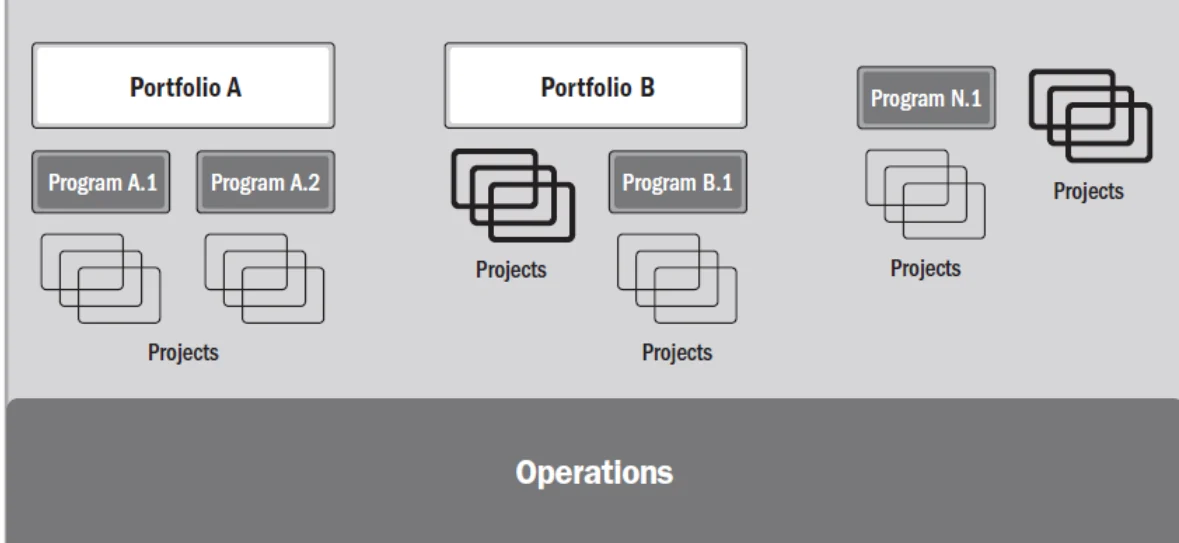
- A portfolio is the only grouping that includes operations, and it is tied to strategy. Its items do not need to be related to each other.
Seen again
🎯 How this can come up · 2 questions
“Projects, programs, subsidiary portfolios, and operations managed as a group to achieve strategic objectives” defines a:
Correct: Portfolio.
An outcome focuses only on the outputs and artifacts a project produces.
False. Outcomes include outputs but focus more broadly on the benefits and value the project was meant to deliver.
- This definition was a midterm MCQ word for word. The phrase that gives it away: “benefits not available from managing them individually”.
- Project = temporary + unique. Temporary means it has a defined start and end, not that it is short. Running payroll every month is an operation, not a project (not unique, not temporary).
Asked in a real exam
🎯 How this can come up · 3 questions
A group of related projects managed in a coordinated manner to obtain benefits not available from managing them individually is called a:
The real midterm question. In version 2 the options were shuffled.
Every project must belong to a program or a portfolio.
False. Projects can stand alone.
A bank runs three related projects (a new mobile app, a new web portal and a new API layer) and coordinates them so customers get one consistent digital experience. What is this grouping called?
A program. They are related projects managed together for a benefit (one consistent customer experience) that managing each one separately would not give.
- The PM is assigned by the performing organization, not elected by the team and not chosen by the customer.
🎯 How this can come up · 1 question
According to the definition, who assigns the project manager?
Correct: The performing organization.
- The project management team is a subset of the project team. Everyone works on the project; only some of them manage it.
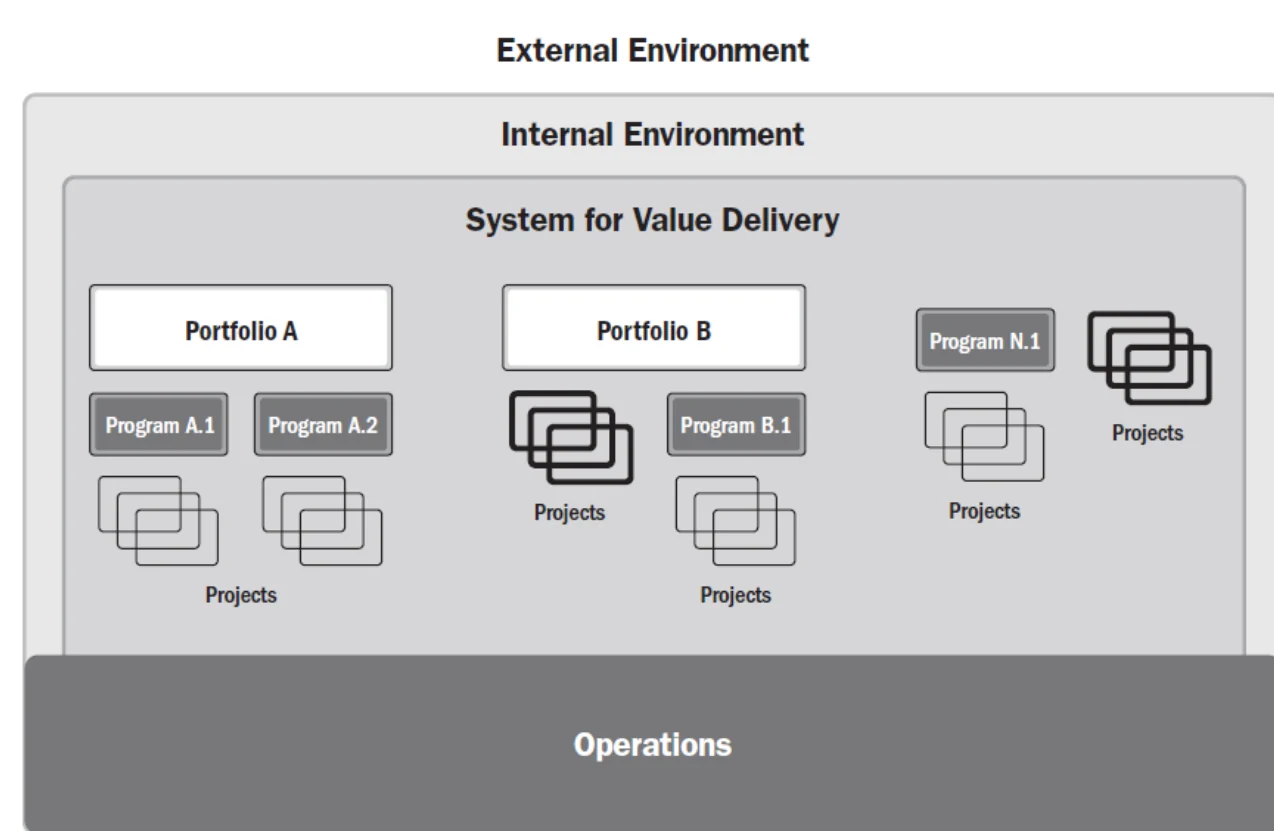
- All five components belong to it. In the real MCQ the wrong options said “only portfolios and programs”, “only large organizations” or “products are the sole contributor”.
Asked in a real exam
🎯 How this can come up · 2 questions
In the context of the “system for value delivery,” which statement is the most accurate?
The real midterm question.
Every member of the project team is part of the project management team.
False. Only the members directly involved in project management activities are.
- Value is relative: the same product can be valuable to one stakeholder and not to another.
- Business value = benefits − cost.
🎯 How this can come up · 1 question
An organization measuring “benefits less the cost of achieving those benefits” is looking at which type of value?
Correct: Business value.
- This slide is the map for the rest of the deck: value 31–36 · governance 37–38 · functions 39–42 · environment 43–45 · product management 46–52.
🎯 How this can come up · 1 question
Which of the following is NOT one of the parts the system for value delivery describes?
Correct: The project’s source-code architecture.
- Five ways projects create value: New, Social, Efficiency, Change, Sustain. A good list for any “how does this project create value?” scenario.
🎯 How this can come up · 1 question
A hospital project replaces paper forms with tablets so nurses spend less time on admin. Which way of creating value does this show?
Improving efficiency, productivity, effectiveness or responsiveness.
The instructor marked all five components.
- Operations are the ongoing work (payroll, HR, customer service). They support projects and receive their deliverables.
🎯 How this can come up · 1 question
Operations can directly support and influence portfolios, programs, and projects.
True.
- Read the picture as nested boxes: system ⊂ internal environment ⊂ external environment. Slides 43–45 list what sits in each.
Above “components”: “Portfolios, Programs.. etc”. At the bottom: “Component → outcome → Benefits → Value”.
- The full chain: Components → Deliverables → Outcomes → Benefits → Value. Ordering questions come from here.
🎯 How this can come up · 2 questions
Which sequence matches the value delivery chain?
Correct: Deliverables → outcomes → benefits → value.
Benefits create outcomes, which in turn create value.
False. Outcomes create benefits, and benefits create value.
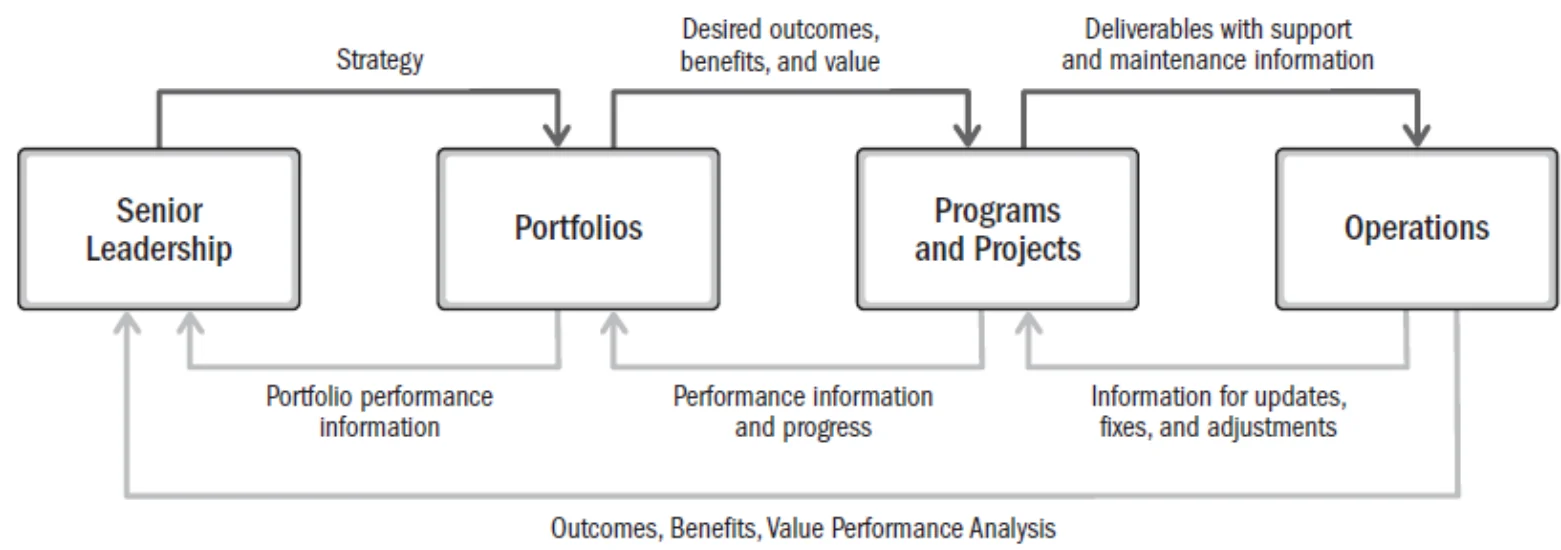
- Forward (top arrows): Strategy → desired outcomes → deliverables. Backward (bottom arrows): performance information → progress → fixes and updates.
Written on the diagram: “Senior share strategy → Portfolios share desired outcomes → Programs share deliverables and maintenance info → Operations give feedback with bugs and fixes, + to seniors with outcomes.”
- Who tells whom:
Senior → Portfolio: strategy
Portfolio → Program/Project: desired outcomes, benefits, value
Program/Project → Operations: deliverables + support info
Operations → Program/Project: fixes, adjustments, updates
Program/Project → Portfolio: performance and progress
Portfolio → Senior: portfolio evaluation
🎯 How this can come up · 2 questions
Information flowing from operations back to programs and projects mainly suggests:
Correct: Adjustments, fixes, and updates to deliverables.
Who shares strategic information with portfolios?
Correct: Senior leadership.
- Governance = the framework (functions + processes) that guides activities. Think of it as the rules and the decision rights.
- Five elements: Oversight, Control, Value assessment, Integration, Decision-making.
🎯 How this can come up · 2 questions
Which of the following is NOT listed as an element of a governance framework?
Correct: Daily coding standards enforcement by developers.
Governance systems provide an integrated structure for evaluating changes, issues, and risks.
True.
- What gets governed at each level: portfolio objectives · program benefits · project deliverables.
- Who can approve a change? That is project governance. In Chapter 9 the change control board does this.
Seen again
🎯 How this can come up · 1 question
Defining who has the authority to approve changes on a project is part of:
Correct: Project governance.
- Decentralized = authority is spread across the team (self-organize, self-manage), as in Scrum teams (Chapter 4). This was a real midterm MCQ.
Asked in a real exam
Seen again
🎯 How this can come up · 2 questions
In decentralized project management, decision-making authority is primarily:
The real midterm question.
A project function must always be fulfilled by exactly one person.
False. Functions can be fulfilled by one person, a group, or combined into defined roles.
- Centralized = one designated leader (a PM) coordinates. This is the wrong option in the decentralized MCQ.
- Hybrid: centralized overall, with self-organized teams for parts of the work.
Asked in a real exam
🎯 How this can come up · 2 questions
A project with centralized coordination cannot use self-organized teams for any part of the work.
False. Centralized projects can include self-organized teams for portions of the work.
A government system has a strict compliance deadline and a designated PM, but the UI team works in two-week sprints and plans its own tasks. What coordination style is this?
Centralized coordination (a designated PM leads the project) with a self-organized team for one portion of the work, which is a hybrid set-up the slide explicitly allows.
- There is no fixed list of functions. The project, organization and environment decide which ones are needed. This is the same idea as tailoring.
Seen again
Next to function 2: objectives = “what we’re aiming for”, feedback = “how far they’ve come”. There are Arabic glosses on several functions.
- Objectives = where we are going. Feedback = how far we have come.
- Match each function to the person who usually does it: sponsor → resources (7) · product owner → business direction (6) · SME → expertise (5) · Scrum master → facilitate (3) · team → perform work (4) · PM → oversight (1) · PMO/governance board → governance (8).
🎯 How this can come up · 3 questions
A Scrum master hosting daily stand-ups and workshops is performing which function?
Correct: Facilitate and support.
A sponsor approving the budget and assigning two extra engineers is performing which function?
Correct: Provide resources and direction.
Your product owner tells the team that customers in a new market now expect Arabic support. Which project function is this?
Provide business direction and insight: identifying market trends and customer needs.
- Environment factors are not always bad. They can help (favorable), hurt (unfavorable) or do nothing (neutral).
🎯 How this can come up · 1 question
Environmental influences on a project are always unfavorable.
False. They can be favorable, unfavorable, or neutral.
- Ask yourself: does the organization own or control it? Then it is internal. Staff skills, our servers, our templates and our lessons learned are all internal.
🎯 How this can come up · 2 questions
Which of the following is an INTERNAL environment factor?
Correct: Employee capability.
Half of your developers have never used the cloud platform the project depends on. Is this an internal or external factor, and which example on the slide does it match?
Internal: it is employee capability (and possibly resource availability) inside the organization.
- Commercial databases and academic research count as EXTERNAL. They come from outside the organization even though the team uses them.
🎯 How this can come up · 2 questions
A new national data-privacy law forces the team to redesign its storage layer. This is which kind of factor?
Correct: External: regulatory environment.
Industry standards are an internal environment factor.
False. They are external.
- Product management itself is outside this course. What you need is how it relates to projects (slides 47–52).
- Four phases: Introduction → Growth → Maturity → Retirement (I.G.M.R.).
🎯 How this can come up · 1 question
Which is the correct order of product life-cycle phases?
Correct: Introduction, growth, maturity, retirement.
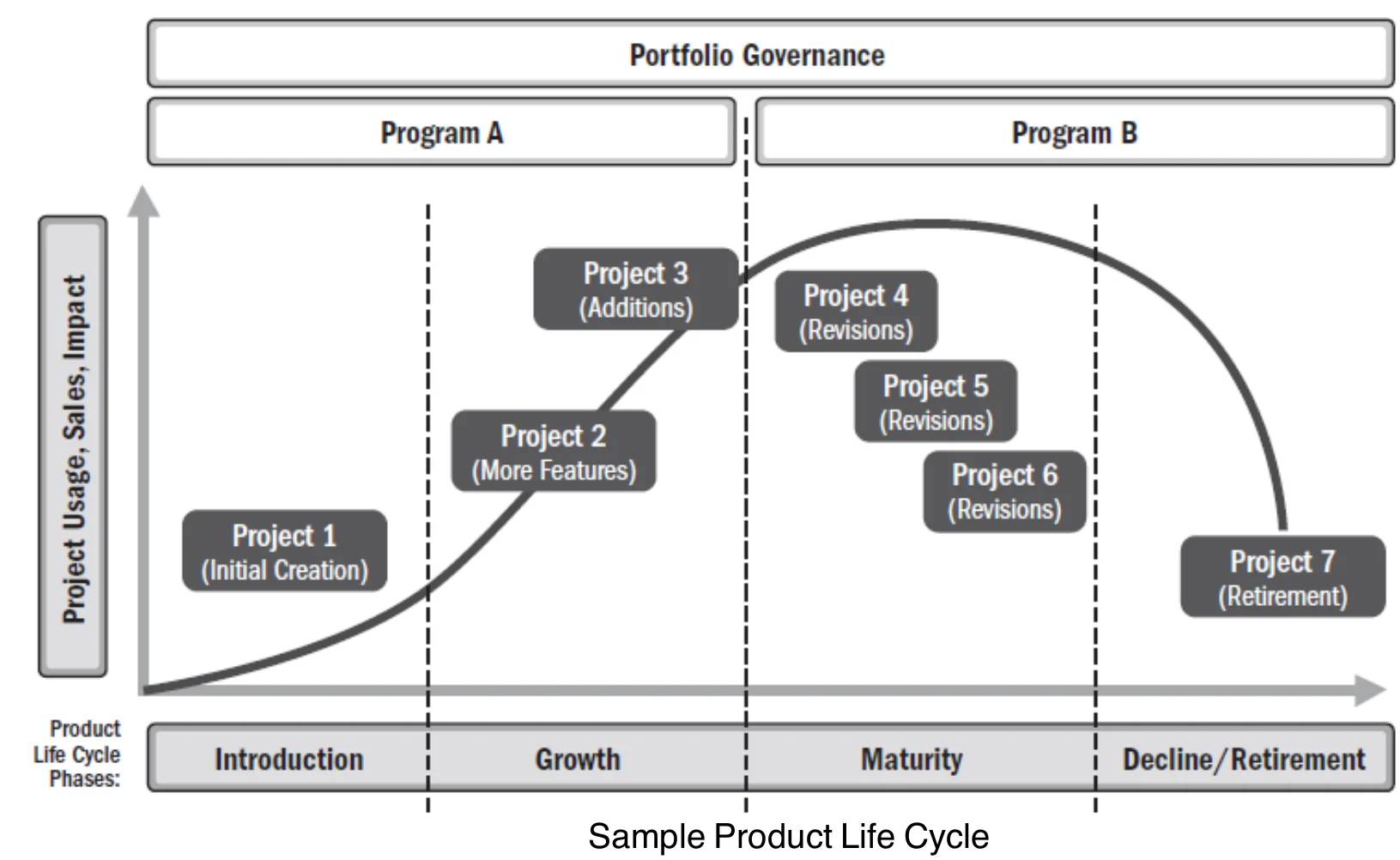
- One product, many projects over time: one to build it, others to add features, others to revise it. The diagram on the next slide shows this.
🎯 How this can come up · 1 question
Product management can only start a project during the introduction phase of a product.
False. It may initiate programs or projects at any point in the product life cycle.
- How to read it: Project 1 creates the product (introduction). Projects 2–3 add features (growth). Projects 4–6 revise it (maturity). Project 7 retires it (decline). Programs A and B group these projects, and everything sits under portfolio governance.
🎯 How this can come up · 1 question
In the sample product life cycle, a project that retires the product falls in which phase?
Correct: Decline/retirement.
- Form 1 of 3. A big, long-lived product needs a whole program. Example: modernizing the entire product.
- Form 2 of 3. The product is run as normal business; individual projects are chartered one at a time for each improvement.
- Form 3 of 3. The whole product lives and dies inside one program. Example: a proof of concept.
🎯 How this can come up · 2 questions
A program to digitize university services builds a small proof-of-concept chatbot, demos it and then shuts it down. Which form of product management is this?
Product management within a program: the product’s whole life cycle happens inside the program’s boundaries (the POC example from the slide).
After five years, a company charters a single project to modernize its app’s user interface. Which form of product management is this?
Project management within a product life cycle: portfolio governance charters an individual project for an enhancement (the slide’s “modernizing the UI” example).
- Not prescriptive means they do not tell you exactly what to do. They guide behavior. Expect a true/false question.
- “Can, but do not necessarily” is the wording a T/F trap will change to “always reflect morals”.
🎯 How this can come up · 2 questions
The principles of project management are prescriptive rules that must be followed exactly.
False. They are not prescriptive. They guide behavior.
Project management principles always reflect morals.
False. They can, but do not necessarily, reflect morals.
- Four values: Responsibility, Respect, Fairness, Honesty.
🎯 How this can come up · 1 question
Which of the following is NOT one of the four values of the PMI Code of Ethics and Professional Conduct?
The four values are Responsibility, Respect, Fairness and Honesty.
- The principles never contradict each other. Real situations can still create dilemmas, such as sharing information vs. keeping it confidential.
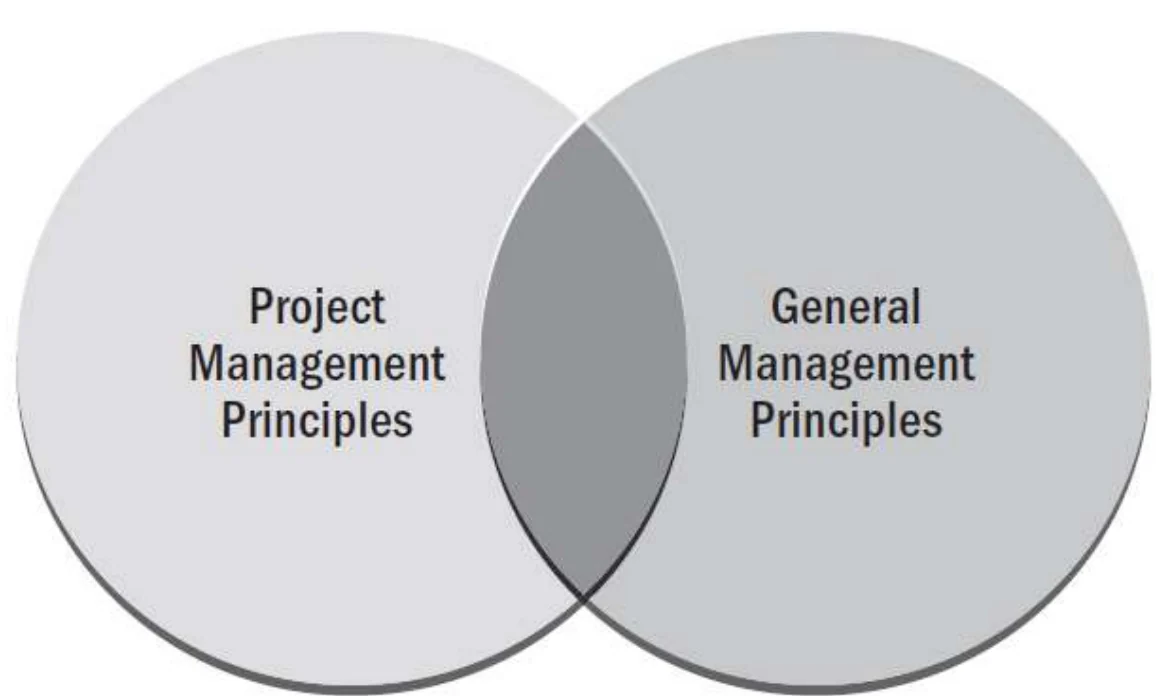
- This overlap (next slide) is the basis of the Final 251 question on project vs. general management.
Related real-exam questions
🎯 How this can come up · 1 question
Some project management principles contradict each other.
False. They are internally consistent. Practical dilemmas can arise, but the principles do not contradict.
- The overlap: both focus on delivering value, leading people and making decisions.
The difference: PM runs temporary, unique work with a start and an end (Chapter 1, slide 25). General management runs the ongoing operations of the business.
Related real-exam questions
🎯 How this can come up · 1 question
What are the key distinctions between project management and general management?
Focus: PM manages temporary, unique endeavors with a defined start, end and scope. General management runs the organization’s ongoing, repetitive operations. Skill sets: PMs need planning, scheduling, risk and stakeholder skills and must lead cross-functional teams without permanent authority; general managers use stable line authority, budgeting and long-term operational control. Teams and resources: a project team is assembled for the project and released at the end; general managers manage permanent staff and resources. Overlap: both rely on leadership and both focus on delivering value.
- These are the same 12 principles as slide 21, written as full PMI statements. An exam can use either the short name or the long statement, so map them: “system interactions” = Systems thinking; “envisioned future state” = Change.
🎯 How this can come up · 1 question
The principle statement “Recognize, evaluate, and respond to system interactions” corresponds to which short name?
Correct: Systems thinking.
- Four parts of stewardship: Integrity, Care, Trustworthiness, Compliance.
Asked in a real exam
🎯 How this can come up · 1 question
Which set lists what stewardship includes?
Option 2 is the PMI Code of Ethics values. Option 3 is the governance elements.
- Teams build their own “local” culture. Chapter 3 covers this in depth: Tuckman stages, trust → conflict → commitment → accountability → results.
Related real-exam questions
Seen again
🎯 How this can come up · 1 question
Project teams often establish their own “local” culture within the organizational culture.
True.
- Engagement is proactive (do not wait for complaints) and “to the degree needed” (not everyone equally). That leads straight to the power/interest grid in Chapter 8.
Related real-exam questions
Seen again
🎯 How this can come up · 1 question
The stakeholder principle says every stakeholder should be engaged equally and as much as possible.
False. Engage them proactively and to the degree needed.
The instructor marked “ultimate indicator of project success”.
- Value is the ULTIMATE indicator of success, more than being on time or on budget. Expect a direct MCQ.
🎯 How this can come up · 2 questions
According to the Value principle, what is the ultimate indicator of project success?
Correct: Value.
Value can only be realized after the project is complete.
False. It can be realized throughout, at the end, or after the project.
- Systems thinking = see the whole picture. A change in one part (for example, a delay in the API) ripples through others (testing, training, launch).
🎯 How this can come up · 1 question
A delay in a third-party payment API pushes back testing, user training and the marketing launch. Which principle helps the PM anticipate this?
Systems thinking (recognize, evaluate and respond to system interactions): the project is a system of interdependent parts, so a change in one part ripples to the others.
- Two classic T/F questions: “only the PM can lead” (false, anyone can) and “leadership = authority” (false).
Related real-exam questions
Seen again
🎯 How this can come up · 2 questions
Only the project manager can demonstrate leadership behaviors on a project.
False. Any project team member can.
Leadership is the same as authority.
False. The card says leadership is different than authority.
- “Just enough” process: not the heaviest process, not none at all.
- Tailoring is not done once at the start. It is iterative and continuous.
🎯 How this can come up · 1 question
Tailoring is a one-time activity performed at project initiation.
False. It is iterative and continuous throughout the project.
- Quality applies to both the product (acceptance criteria) and the process. Chapter 7 develops this as QA (process) vs. QC (product).
🎯 How this can come up · 1 question
According to the Quality principle, quality focuses on meeting:
Correct: Acceptance criteria for deliverables.
Next to “vigilant”: “alert”.
- Four sources of complexity: Human behavior, System interactions, Uncertainty, Ambiguity (H.S.U.A.).
🎯 How this can come up · 1 question
Which of the following is NOT listed as a source of complexity?
Correct: Fixed budgets.
- Risk is not only negative. Opportunities are positive risks. Chapter 5 gives separate response strategies for each.
- Five qualities of a good response: Appropriate, Cost-effective, Realistic, Agreed, Owned.
Related real-exam questions
Seen again
🎯 How this can come up · 2 questions
In PMBOK v7, risk refers only to negative events (threats).
False. Risks can be positive (opportunities) or negative (threats).
Which is NOT a stated quality of a good risk response?
Responses should be agreed to by relevant stakeholders.
- Adaptability = bend with change. Resiliency = bounce back after a hit.
🎯 How this can come up · 2 questions
The ability to absorb impacts and recover quickly from a setback is called:
Correct: Resiliency.
A focus on outputs rather than outcomes facilitates adaptability.
False. It is the reverse: outcomes rather than outputs.
- Too much change too fast → change fatigue and resistance. A typical scenario question.
Seen again
🎯 How this can come up · 1 question
A ministry rolls out a new ERP, a new HR system and a new workflow in the same month. Staff start ignoring announcements and avoiding the new tools. What is happening, and what does the Change principle recommend?
Change fatigue and resistance from attempting too much change in a short time. The principle recommends a structured approach to change, pacing the changes, and stakeholder engagement and motivational approaches to help people adopt them.
No slides match this filter.