CYS401 · Annotated SlidesChapter 2 — Security Foundations and Principles
Chapter 2 · Annotated slides

Security Foundations and Principles

The three pillars, vulnerability vs. threat vs. risk, malware and the threat landscape, social engineering (phishing, spear phishing, tailgating), the C.I.A. triad with the attacks on each and the methods that protect it, the AAA services, and the protection mechanisms. Final 221 A/B, Quiz 1 222 and Majors A–C all draw on this deck.

Slide text Study notes Highlight: key words Tips, tricks & traps Seen again elsewhere How it can come up

Cyber Security Foundations and Principles

CYS401 · Lecture 2
1
TipAAA = five elements: Identification (claim) → Authentication (prove) → Authorization (permissions) → Auditing (record) → Accounting (hold responsible). Phase 1 (getting in): identification, authentication, authorization. Phase 2 (afterwards): auditing, accountability.
★ Past exam

WHAT IS CYBERSECURITY ALL ABOUT?

In order to achieve security we need to combine 3 key elements (CYS pillars):

  • People
  • Policies
  • Technologies
  • People - Users must understand and comply with basic data security principles like choosing strong passwords, being wary of attachments in email, and backing up data.
  • Policies - Organizations must have a framework for how they deal with both attempted and successful cyber attacks.
  • Technology - Technology is essential to giving organizations and individuals the computer security tools needed to protect themselves from cyber attacks.
2
Exam weight High
  1. The three CYS pillars: people, policies (processes), technology.
🎯 How this can come up · 1 question
MCQ

All of the following are cybersecurity pillars EXCEPT:

WHAT IS CYBERSECURITY ALL ABOUT?

THREE MAIN ENTITIES MUST BE PROTECTED:

  • endpoint devices like: computers, smart devices, and routers;
  • networks; and
  • the cloud and data centers

COMMON TECHNOLOGY USED TO PROTECT THESE

ENTITIES

  • next-generation firewalls,
  • DNS filtering,
  • malware protection,
  • antivirus software, and
  • email security solutions.
3
Exam weight Low
  1. Three entities to protect: endpoint devices, networks, and the cloud/data.
★ Past exam

VULNERABILITY, THREAT, COUNTERMEASURE

  • Vulnerability is a weakness in the security system
    • (i.e., in procedures, design, or implementation), that might be exploited to cause loss or harm.
  • Threat - is a set of circumstances that has the potential to cause loss or harm.
    • a potential violation of security
  • Exploit?
  • A human (criminal) who exploits a vulnerability commits an attack on the system.
  • How do we address these problems?
    • We use a control as a protective measure.
    • That is, a control is an action, device, procedure, or technique that removes or reduces a vulnerability.
4
Exam weight High
  1. Vulnerability = a weakness that can be exploited. Threat = circumstances with the potential to cause harm. Countermeasure = a control that removes or reduces the vulnerability.
Exam trap“Data breach” is a threat or an impact, never a vulnerability. A vulnerability is the WEAKNESS (weak passwords, misconfigured buckets).
🎯 How this can come up · 2 questions
MCQ

A misconfigured, publicly accessible storage bucket is a(n):

MCQ

A ransomware attacker who could exploit weak passwords is a(n):

Risk is exist when you have a threats with a vulnerabilty in the system or in one of the security control.

5
Exam weight Medium
  1. Risk exists only when a threat meets a vulnerability.
Memory trickRisk = threat × vulnerability (× impact).
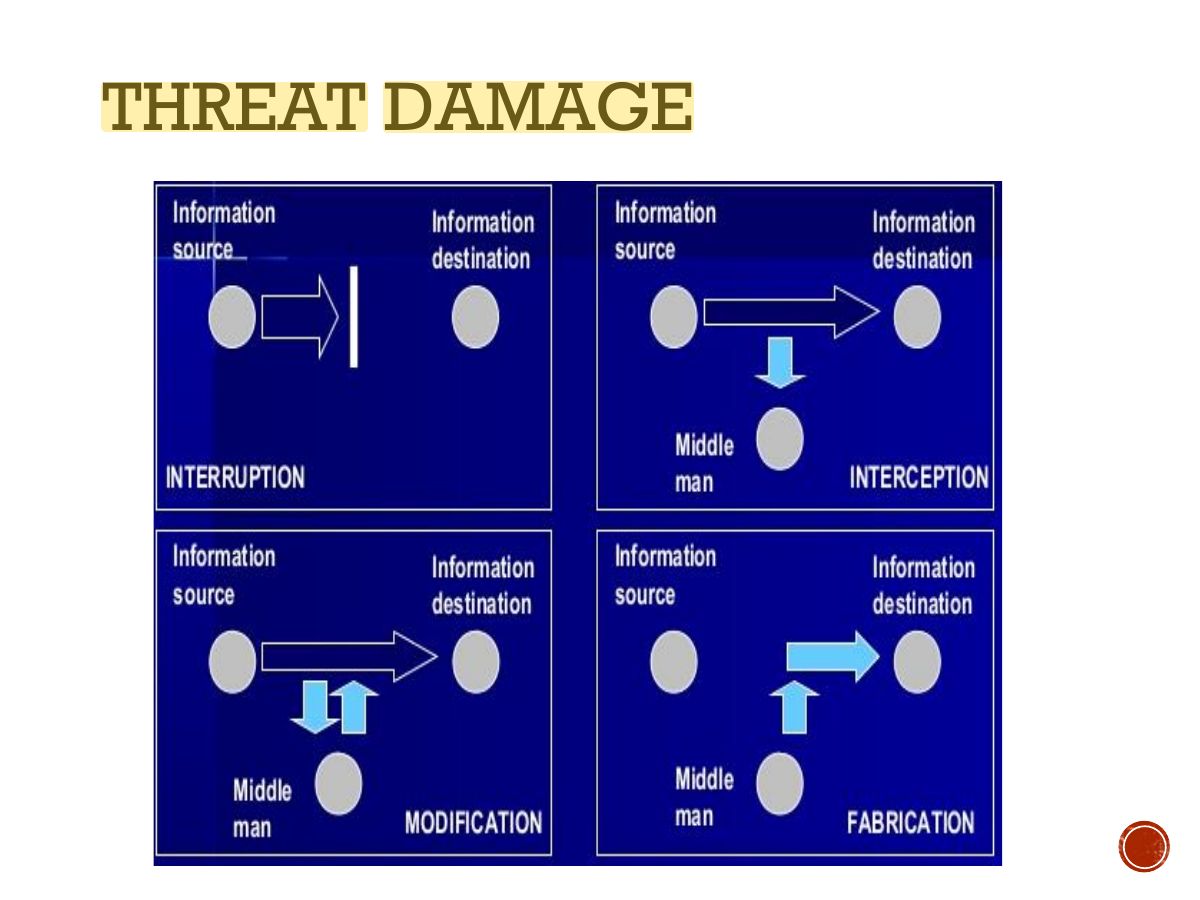
Slide 6: THREAT DAMAGE
Exam weight Low
  1. Types of threat damage.

7
Exam weight Low
  1. Threats overview.

THREATS

https://www.getcybersafe.gc.ca/cnt/rsks/cmmn-thrts-en.aspx

8
Exam weight Low
  1. Common threats (Get Cyber Safe list).

Modern Threat Landscape

  • Supply Chain & Third-Party Threats
    • Compromised vendors, Insecure SaaS providers, or Malicious updates
    • Supply chain threats are external human threats with indirect access.
  • AI-Enabled Threats
    • AI-generated phishing emails, Deepfake voice/video fraud
    • AI increases scale, speed, and realism of attacks
  • Cloud & API Attacks
    • Cloud misconfiguration, Insecure APIs, or Token theft
  • Insider Threat (Intentional vs Unintentional)
    • Malicious Insider or Negligent Insider
  • Hybrid Threats
    • Cyber + Physical
    • Cyber + Psychological
    • Ex: Cyber attacks + fake social media campaigns
9
Exam weight Low
  1. Modern landscape: supply-chain and third-party threats (compromised vendors, malicious updates) are external human threats with indirect access.

Threat Vectors/Techniques

  • Malware: Malicious Software
  • Ransomware: Malware that encrypts files and demands ransom
  • Social Engineering: Tricks users into revealing sensitive information
  • Supply Chain Attacks: Target trusted vendors, software, or hardware to compromise multiple organizations.
  • Advanced Persistent Threats (APTs): Long-term, targeted attacks (often state-sponsored) for espionage or data theft.
  • Zero-Day Exploits: Exploit unknown or unpatched vulnerabilities in software or hardware.
  • AI-Powered Attacks: Use of AI to automate attacks, bypass defenses, or create phishing/deepfake campaigns.
  • IoT & OT Attacks: Target connected devices (IoT) or industrial/operational technology systems.
  • Cloud & API Attacks: Exploit cloud misconfigurations, insecure APIs, or cloud service vulnerabilities.
10
Exam weight Low
  1. Vectors: malware, ransomware, social engineering, phishing, DDoS, insider threats…
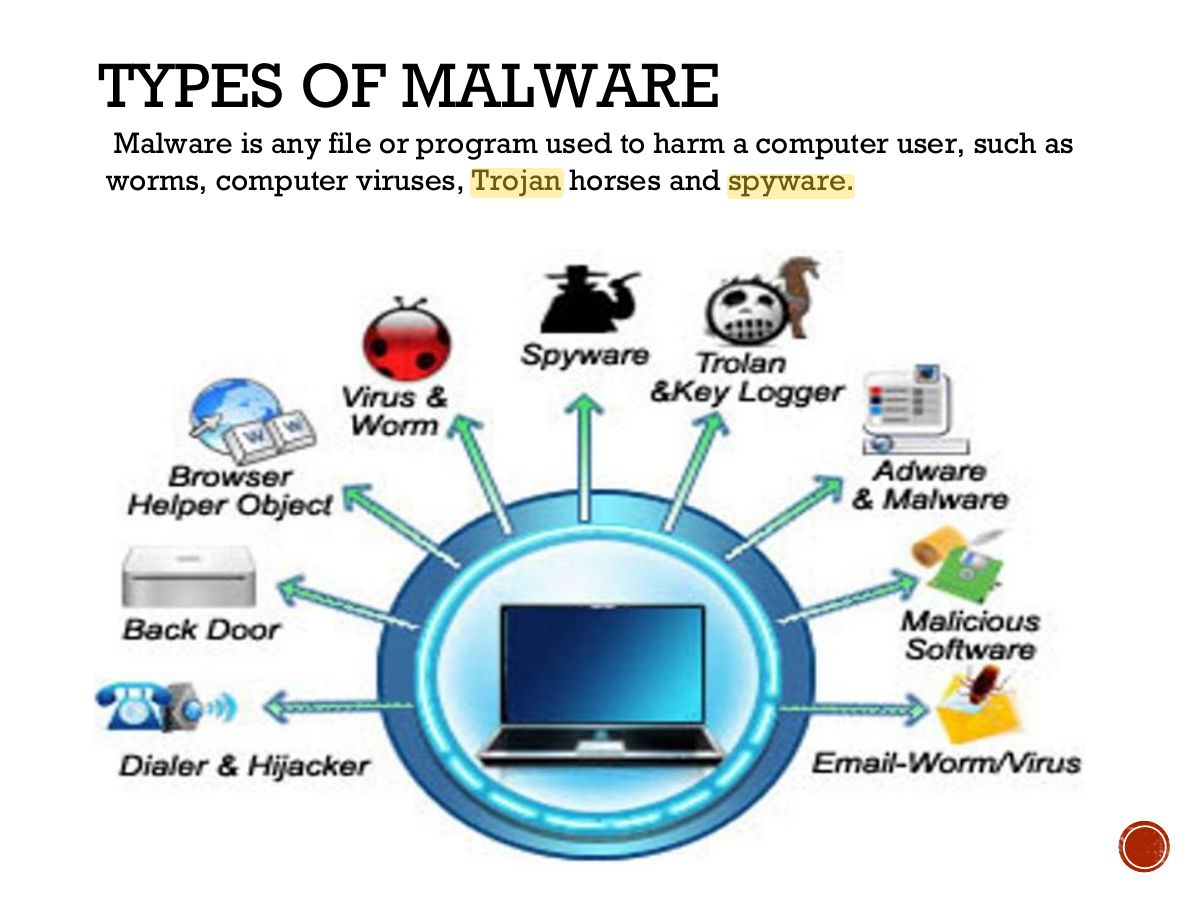
Slide 11: TYPES OF MALWARE
Exam weight Low
  1. Malware types: virus, worm, Trojan, spyware, adware, rootkit, ransomware.

Malware Symptoms

  • Increased CPU usage
  • Slow computer or web browser speeds
  • Problems connecting to networks
  • Freezing or crashing
  • Modified or deleted files
  • Appearance of strange files, programs, or desktop icons
  • Programs running, turning off, or reconfiguring themselves
  • Strange computer behavior
  • Emails/messages being sent automatically and without user’s knowledge
12
Exam weight Low
  1. Symptoms: high CPU, slow browser, network problems, freezing, unknown programs, pop-ups.

Malware Countermeasures

  • Install quality anti-virus software
  • Make sure virus definitions of the scanner are regularly updated
  • Never open an attachment from an untrusted source
  • Taking caution when surfing the internet and downloading files
  • Backup data
13
Exam weight Low
  1. Countermeasures: good antivirus with updated definitions, don’t open untrusted attachments, patch, back up.
★ Past exam
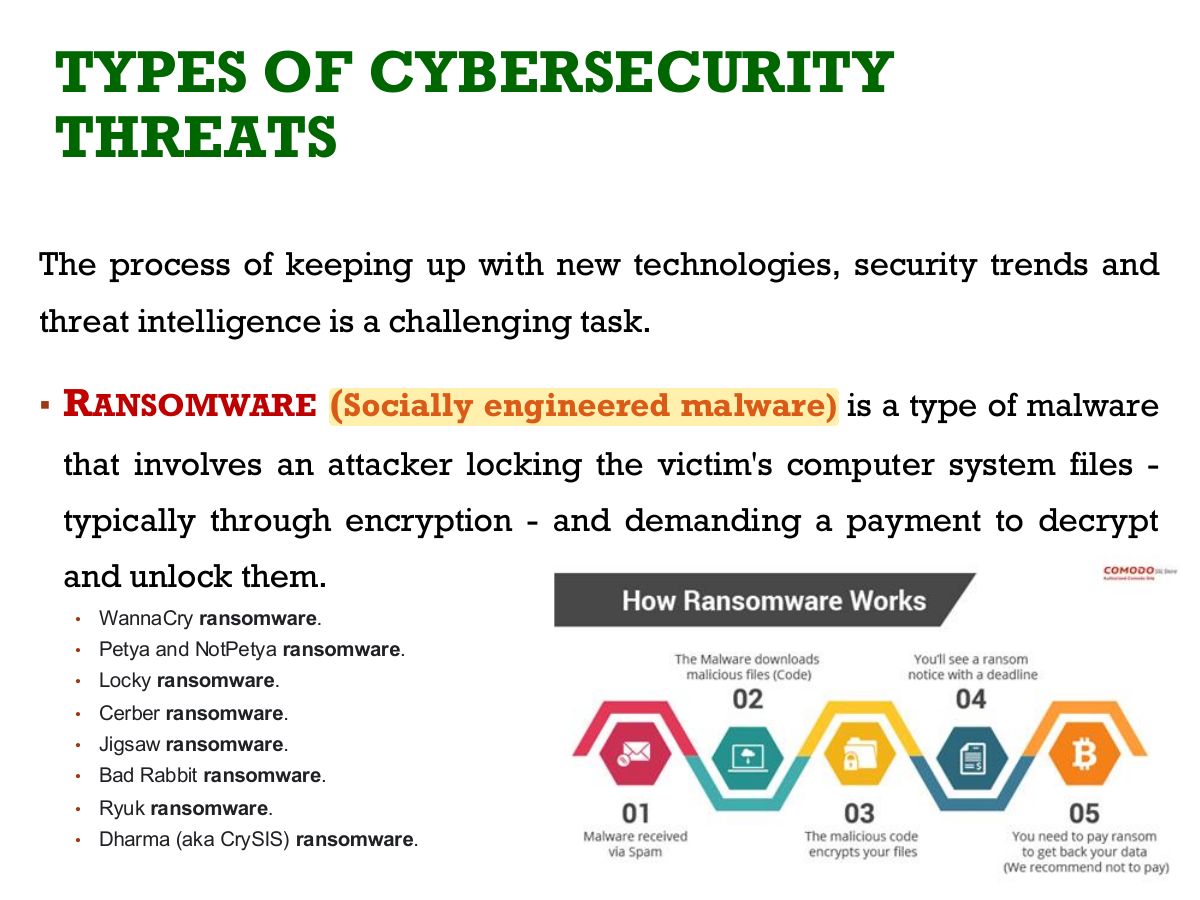
Slide 14: TYPES OF CYBERSECURITY THREATS
Exam weight High
  1. Ransomware: socially engineered malware that locks or encrypts data and demands payment.
🎯 How this can come up · 1 question
MCQ

Social-engineering-based malware that demands payment to unlock or decrypt data is:

★ Past exam

TYPES OF CYBERSECURITY THREATS

  • S OCIAL ENGINEERING is an attack that relies on human interaction to trick users into breaking security procedures in order to gain sensitive information that is typically protected.
    • P HISHING is a form of fraud where fraudulent emails are sent that resemble emails from reputable sources; however, the intention of these emails is to steal sensitive data, such as credit card or login information.
      • Spear phishing/ Whaling: targets a specific individual, group or organization.
      • Angler phishing (latest): targets people on social media sites by taking advantage of the trust that customers have in companies. Attackers trick users into giving up private information by pretending to be customer service
      • Vishing/Smishing: voice phishing & SMS Phishing
    • P HARMING: is a cyberattack that redirects users from a legitimate website to a fraudulent one, even when the correct web address (URL) is entered. Unlike phishing, which lures victims into clicking malicious links, pharming is more technical it poisons DNS or compromises the local — system so the victim lands on a fake site without realizing it.
      • P RETEXTING: Pretexting is use of a fabricated story, or pretext, to gain a victim's trust and trick or manipulate them into sharing sensitive information, downloading malware, sending money to criminals, or otherwise harming themselves or the organization they work for. B AITING: erpetrator lures the victim with attractive offers or rewards.
      • P T AILGATING: An unauthorized person wearing a fake ID, follow an authorized person and
15
Exam weight High
  1. Social engineering tricks people. Phishing: fake emails from reputable-looking sources. Spear phishing/whaling: targeted at a specific person or organization.
🎯 How this can come up · 1 question
MCQ

Frequent emails impersonating your bank, crafted to convince YOU specifically to give your credentials, are:

★ Past exam

16
Exam weight High
  1. More social engineering: vishing, smishing, baiting, pretexting, tailgating.
🎯 How this can come up · 1 question
MCQ

Following an authorised person through a secured door without authenticating is:

Slide 17: TYPES OF
Exam weight Low
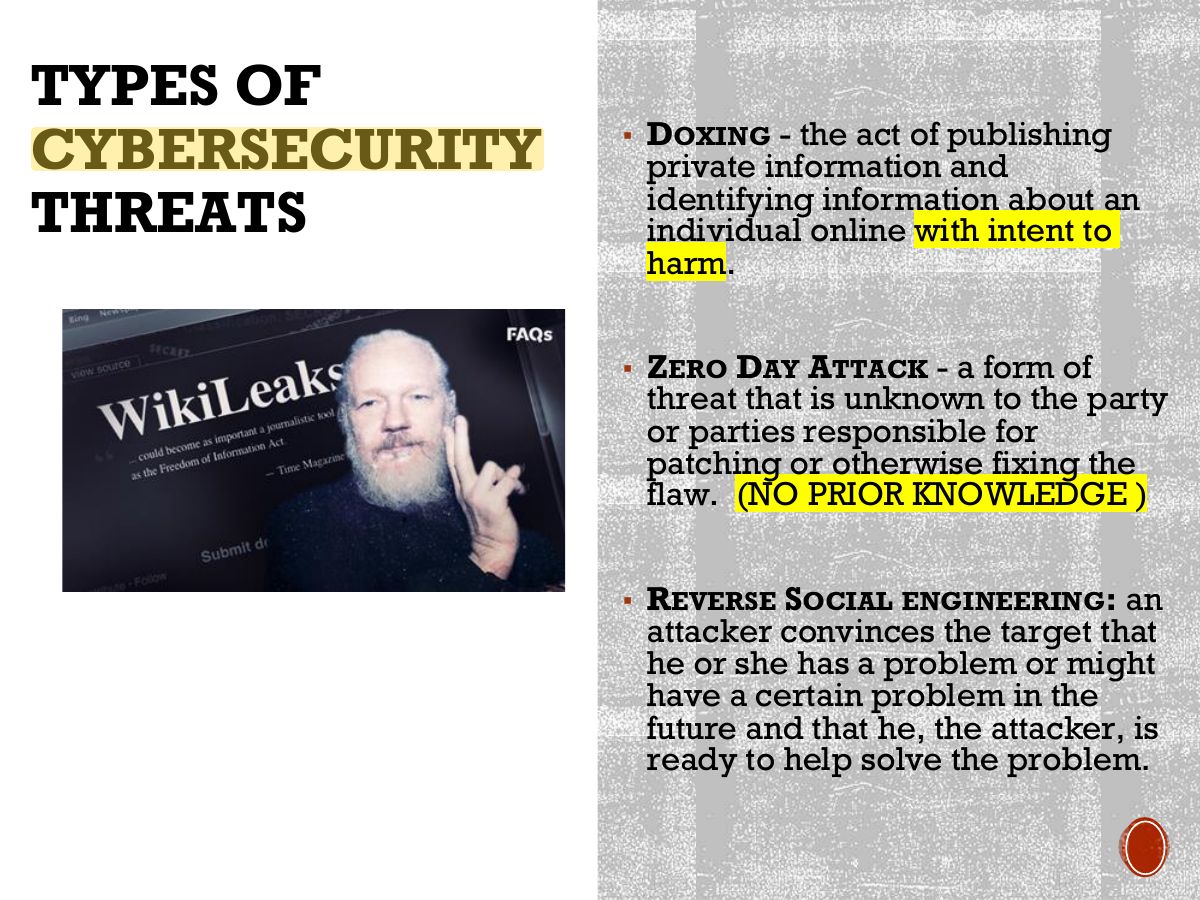
  1. Doxing: publishing private information about someone.
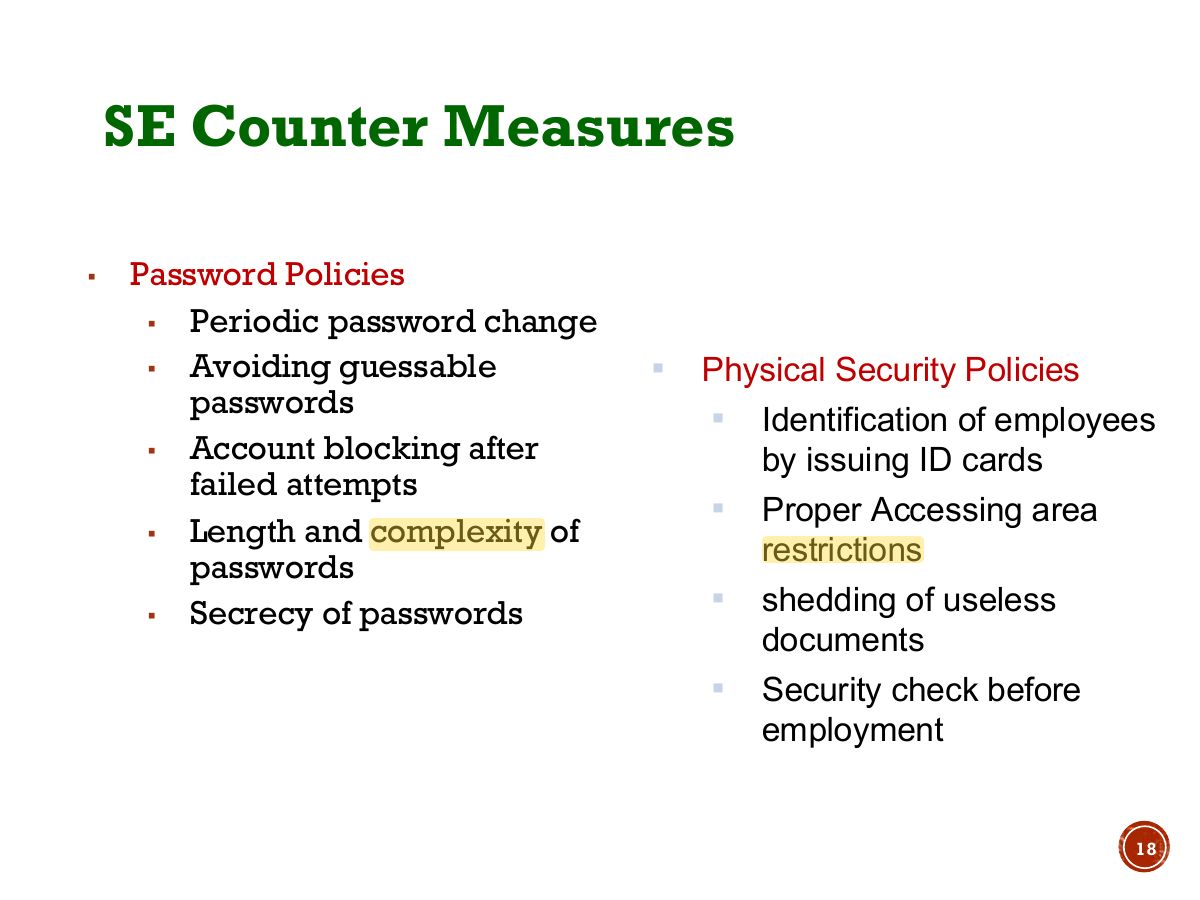
Slide 18: SE Counter Measures
Exam weight Low
  1. Social engineering countermeasures: password policies (change, complexity), physical security, training.

SE Counter Measures

  • Effective Training program consisting of all security policies and methods to increase awareness on social engineering
  • Operational Guidelines to ensure security of the sensitive information and authorized use of resources
  • Classification of Information as top secret, proprietary, for internal use only, for public use
  • Access Privileges - administrator, user and guest accounts with proper authorization
  • Two factor Authentication
19
Exam weight Low
  1. Training, operational guidelines, information classification (top secret, proprietary, internal, public).
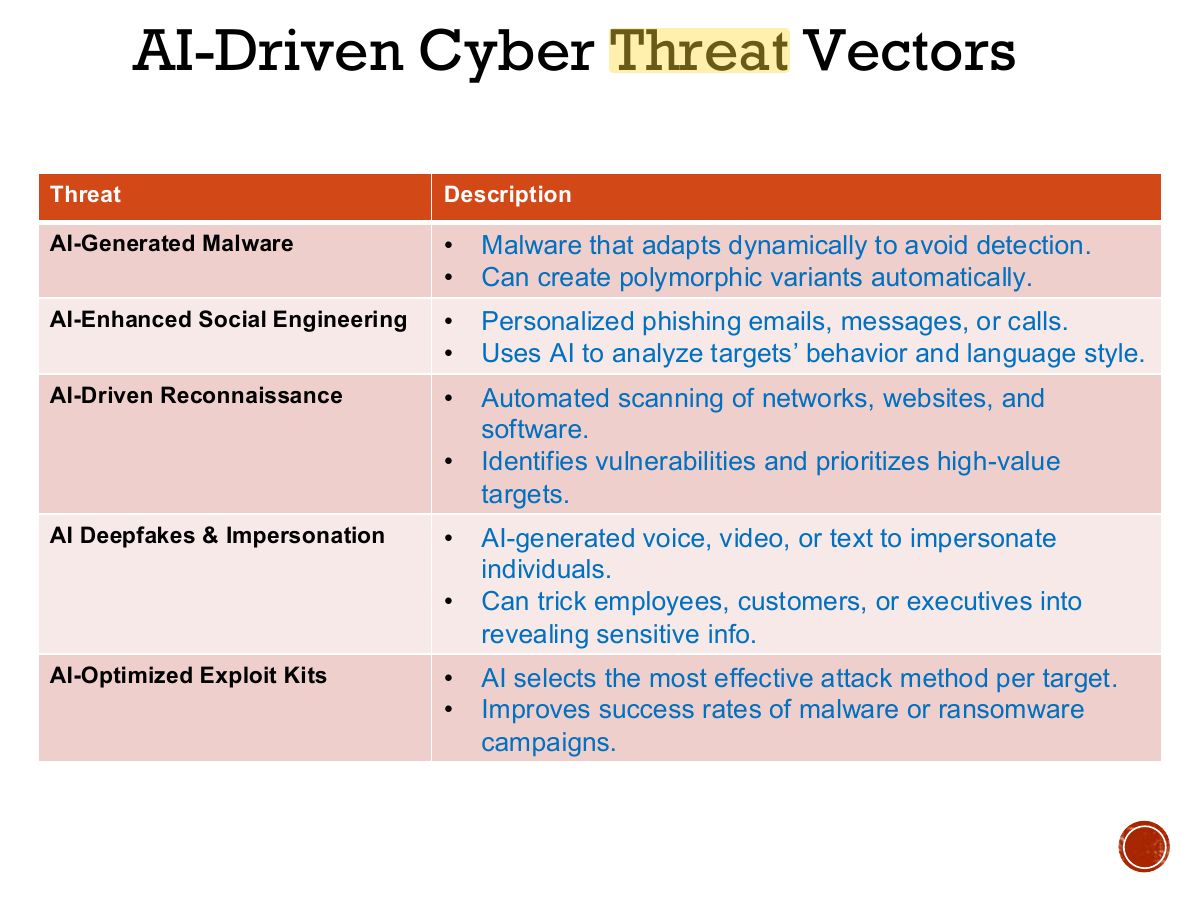
Slide 20: AI-Driven Cyber Threat Vectors
Exam weight Low
  1. AI-driven threats: AI-generated malware, deepfakes, automated phishing.
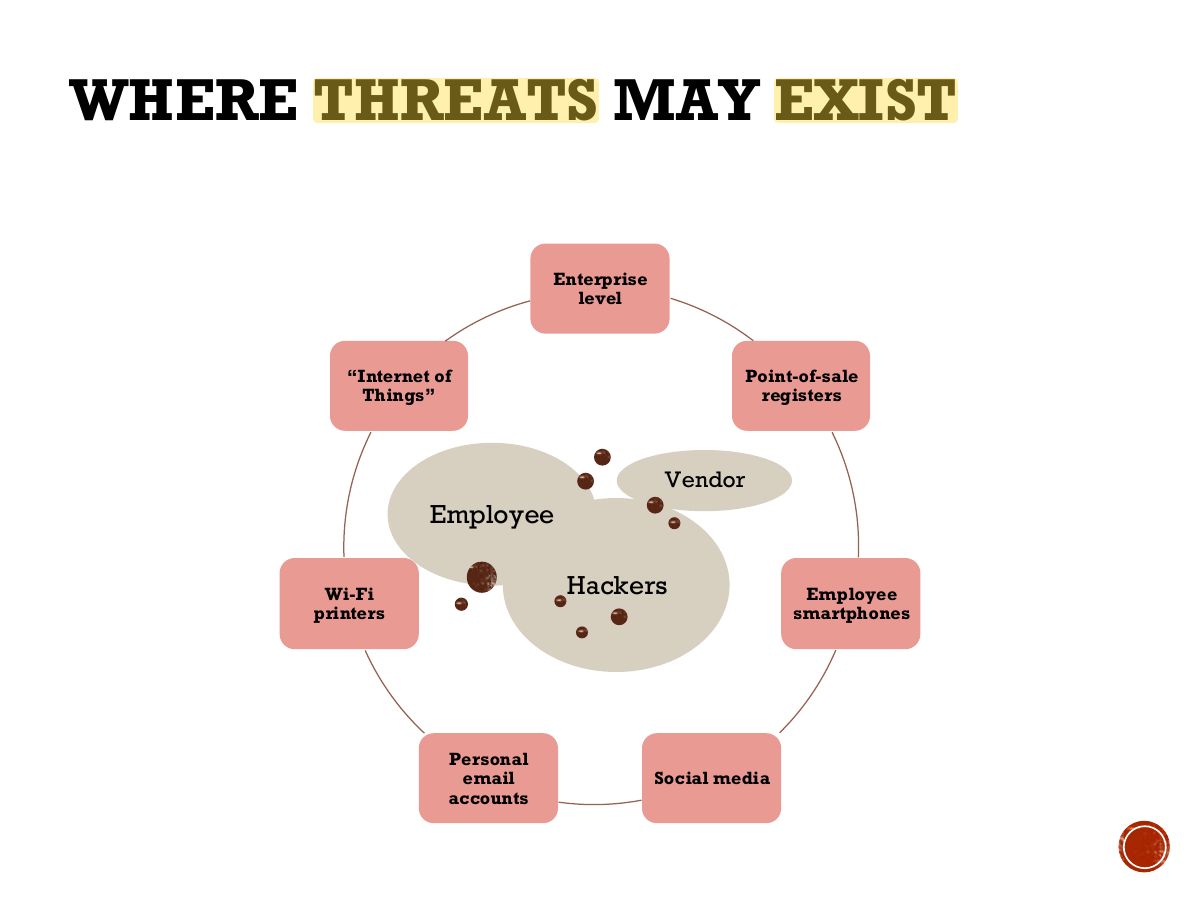
Slide 21: WHERE THREATS MAY EXIST
Exam weight Low
  1. Threats exist at every level: personal, enterprise, Internet of Things, critical infrastructure.
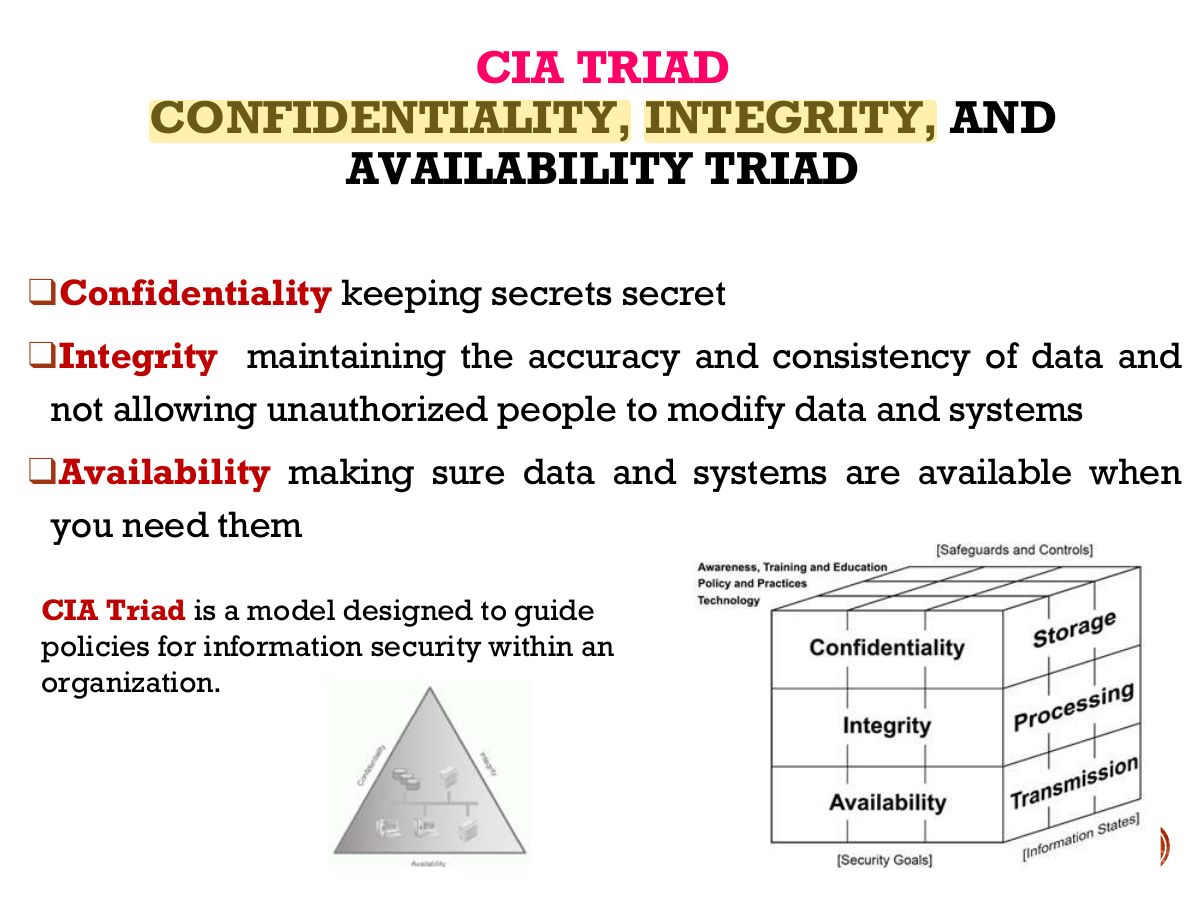
Slide 22: CIA TRIAD CONFIDENTIALITY, INTEGRITY, AND AVAILABILITY TRIAD
Exam weight High
  1. C.I.A.: confidentiality (secrets stay secret), integrity (accurate, unmodified), availability (accessible when needed).
Slide 23: CONFIDENTIALITY
Exam weight Low
  1. Confidentiality controls: encryption, access control, steganography.
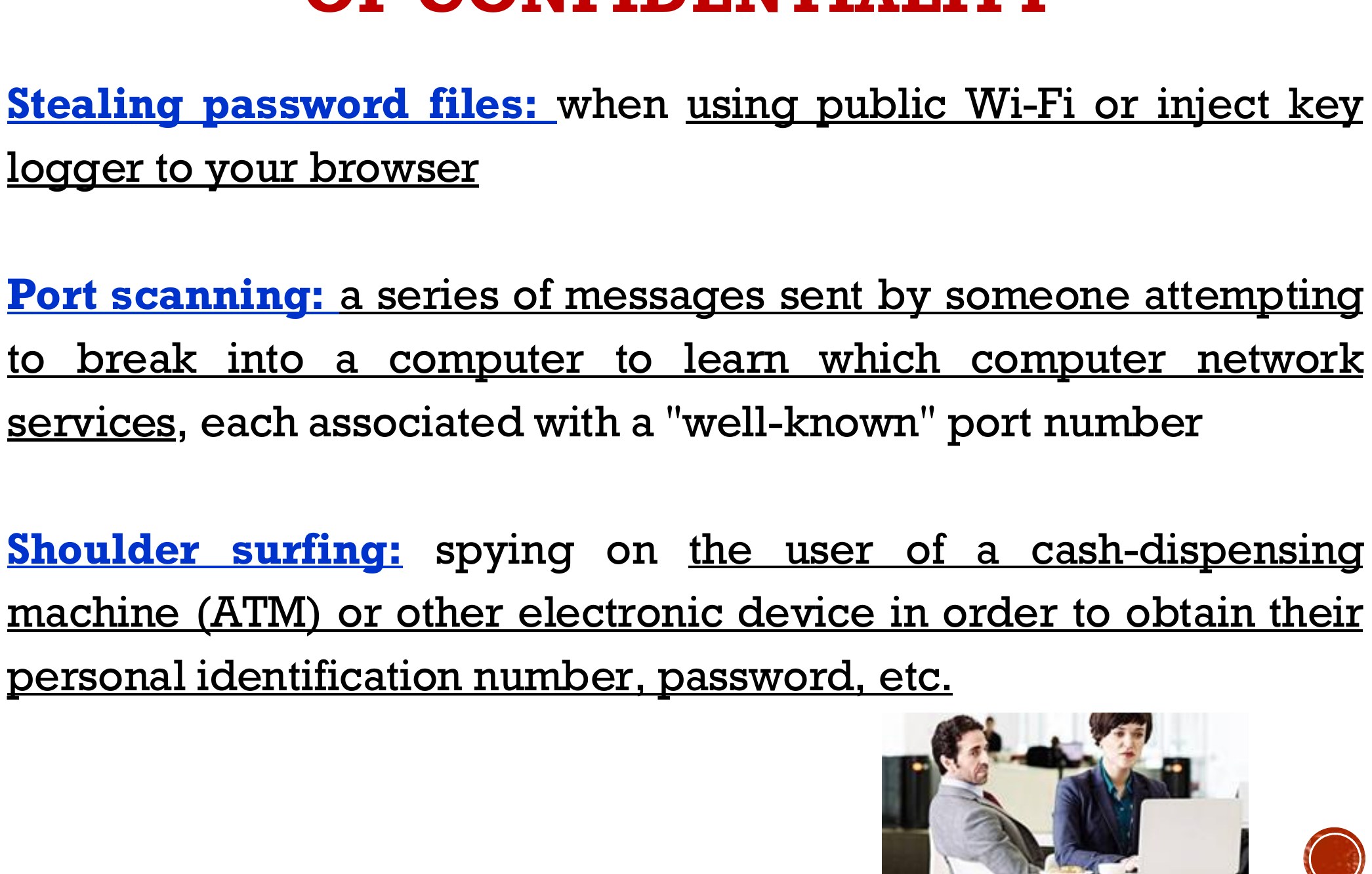
ATTACKS FOCUSES ON THE VIOLATION OF CONFIDENTIALITY

Stealing password files: when using public Wi-Fi or inject key logger to your browser Port scanning: a series of messages sent by someone attempting to break into a computer to learn which computer network services, each associated with a "well-known" port number Shoulder surfing: spying on the user of a cash-dispensing machine (ATM) or other electronic device in order to obtain their personal identification number, password, etc.

ATTACKS FOCUSES ON THE VIOLATION OF CONFIDENTIALITY
24
Exam weight Low
  1. Attacks on confidentiality: stealing password files, port scanning, social engineering.

ATTACKS FOCUSES ON THE VIOLATION OF CONFIDENTIALITY

  • Eavesdropping: Eavesdropping is as an electronic attack where digital communications are intercepted by an individual whom they are not intended (Man in the middle)
    • Sniffing: interception of data by capturing the network traffic using a sniffer (an application aimed at capturing network packets).
  • Privileges escalation: is a type of network intrusion that takes advantage of programming errors or design flaws to grant the attacker elevated access to the network and its associated data and applications.
  • Human Errors/mistakes ( unintentional)
  • Intentional damage/harm
    • .
25
Exam weight Low
  1. Eavesdropping (man in the middle), sniffing, privilege escalation.
METHODS USED TO ENSURE CONFIDENTIALITY

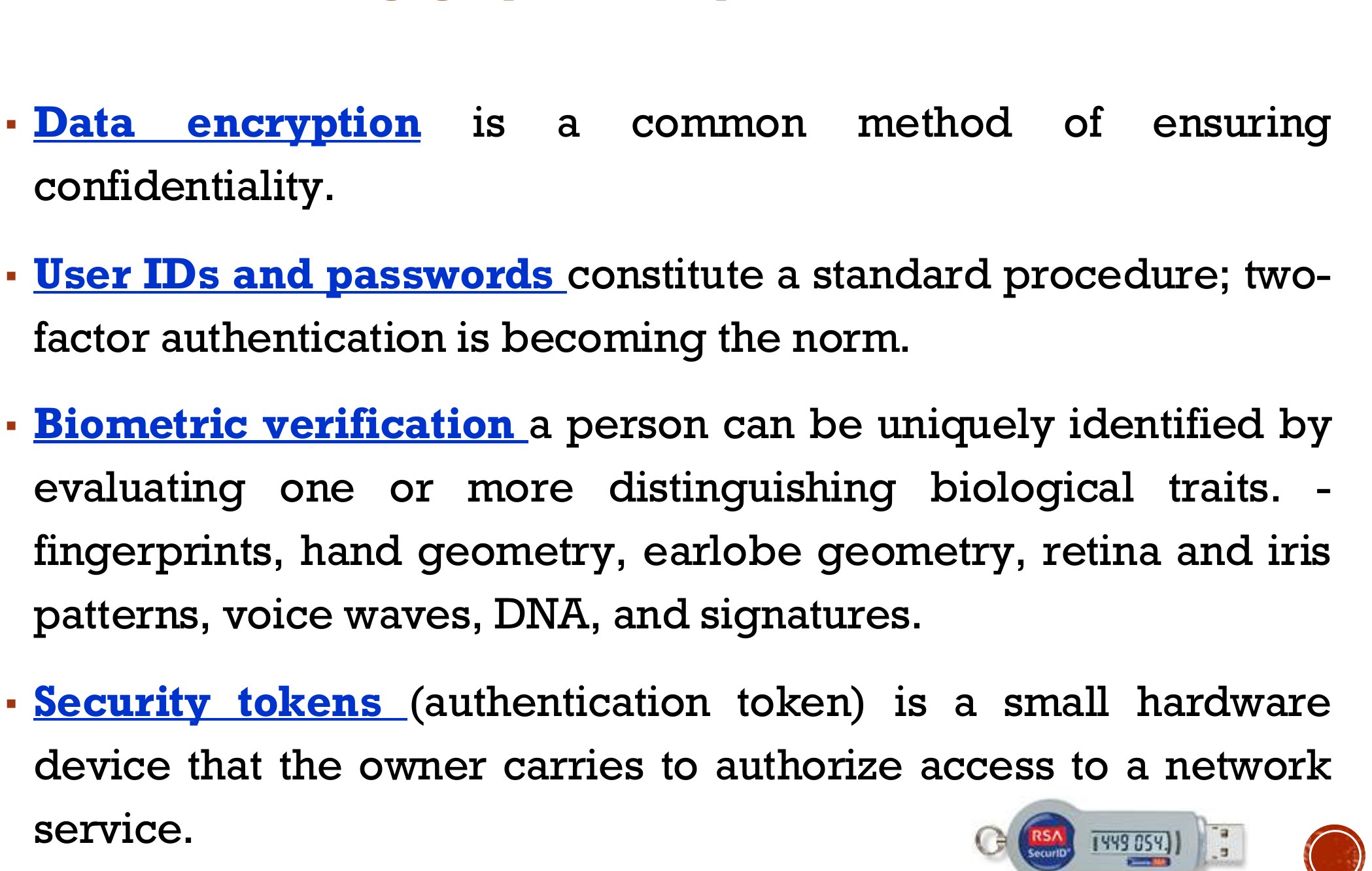
  • Data encryption is a common method of ensuring confidentiality.
  • User IDs and passwords constitute a standard procedure; two-factor authentication is becoming the norm.
  • Biometric verification a person can be uniquely identified by evaluating one or more distinguishing biological traits. - fingerprints, hand geometry, earlobe geometry, retina and iris patterns, voice waves, DNA, and signatures.
  • Security tokens (authentication token) is a small hardware device that the owner carries to authorize access to a network service.
METHODS USED TO ENSURE CONFIDENTIALITY
26
Exam weight Low
  1. Ensure confidentiality: encryption, user IDs and passwords, 2FA, biometrics.
★ Past exam
Slide 27: METHODS USED TO ENSURE CONFIDENTIALITY
Exam weight High
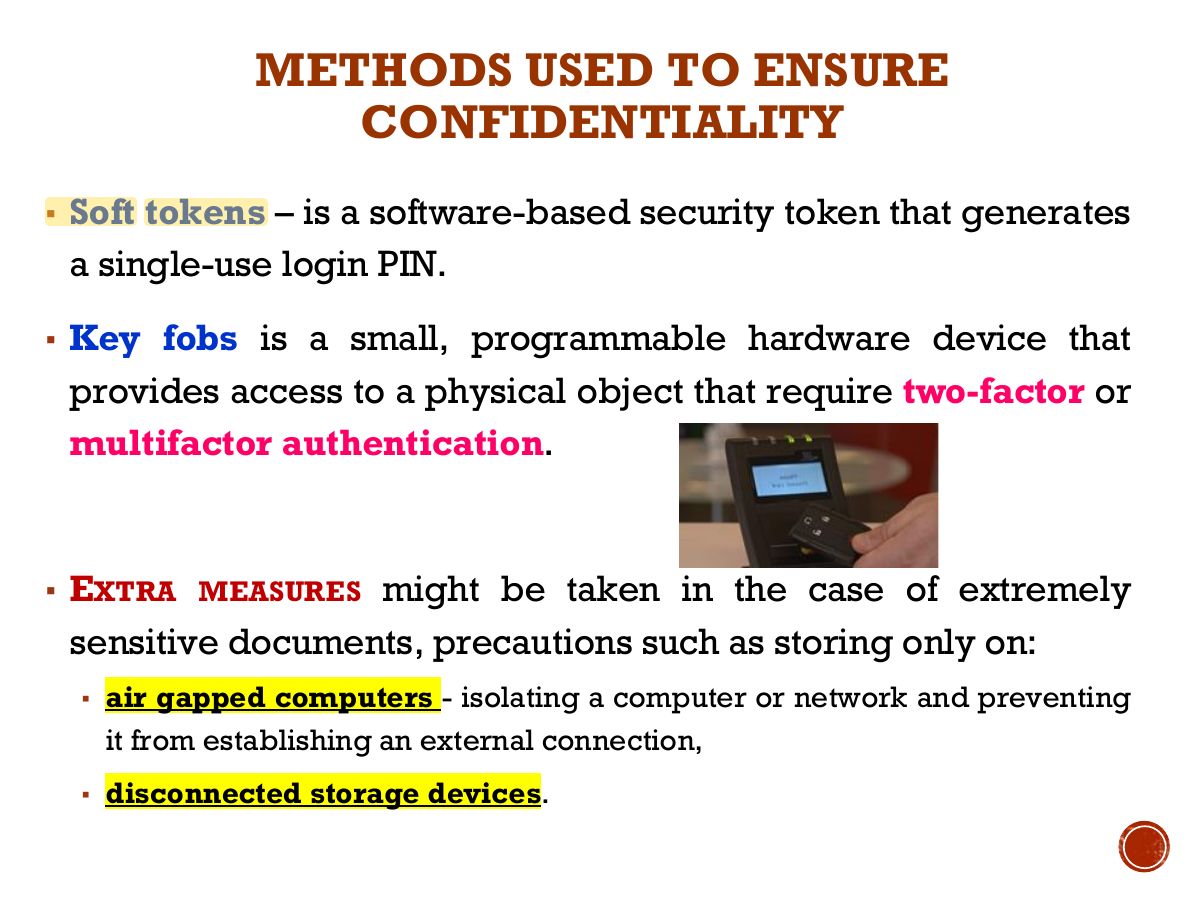
  1. Soft tokens, key fobs (2FA/MFA), and storing sensitive documents offline.
🎯 How this can come up · 1 question
MCQ

Which control still blocks access when a user’s password is stolen?

INTEGRITY

Integrity is the assurance that the information is reliable and accurate. Attacks focus on the violation of integrity: viruses, logic bombs, unauthorized access, errors in coding, system back doors METHODS USED TO ENSURE INTEGRITY OF DATA

  • File permissions and user access controls.
  • Version control maybe used to prevent erroneous changes or accidental deletion by authorized users becoming a problem.
  • Checksums/ Hashing
28
Exam weight Low
  1. Integrity: reliable and accurate information. Attacks: viruses, logic bombs, unauthorised access. Controls: file permissions, user access controls, version control.

INTEGRITY

METHODS USED TO ENSURE INTEGRITY OF

DATA

  • cryptographic checksums - A cryptographic checksum is a

mathematical value (called a checksum) that is assigned to a file and used to "test" the file at a later date to verify that the data contained in the file has not been maliciously changed. Hash value = checksum

HOW TO RESTORE THE AFFECTED DATA?

  • Backups or redundancies must be available to restore the affected data to its correct state.
29
Exam weight Low
  1. Ensure integrity: cryptographic checksums (hashes), digital signatures, backups.
★ Past exam

AVAILABILITY

Ensure all information is readily accessible to all authorized users at all times.

Threats to availability includes device failure, software error and environmental issues (heat, flooding, power loss), denial-of-service (DoS) attacks and network intrusions.

T O PREVENT DATA LOSS

  • A backup copy may be stored in a geographically-isolated location, perhaps even in a fireproof, waterproof safe.
  • Extra security equipment or software such as firewalls and proxy servers can guard against downtime and unreachable data.
  • Web application firewall (CLOUDFLARE)
30
Exam weight High
  1. Availability threats: device failure, software errors, environment (heat, floods, power), DoS. Prevent data loss: backups, redundancy, disaster recovery.
🎯 How this can come up · 2 questions
MCQ

An attack that makes company assets unusable or unavailable is a(n):

Written

A system is offline 2 h 20 min a week for 13 weeks for testing. What is its availability over those 13 weeks (1 d.p.)? (Quiz 1 222 style)

Slide 31: AAA SERVICES
Exam weight Low
  1. Beyond C.I.A.: the AAA services.
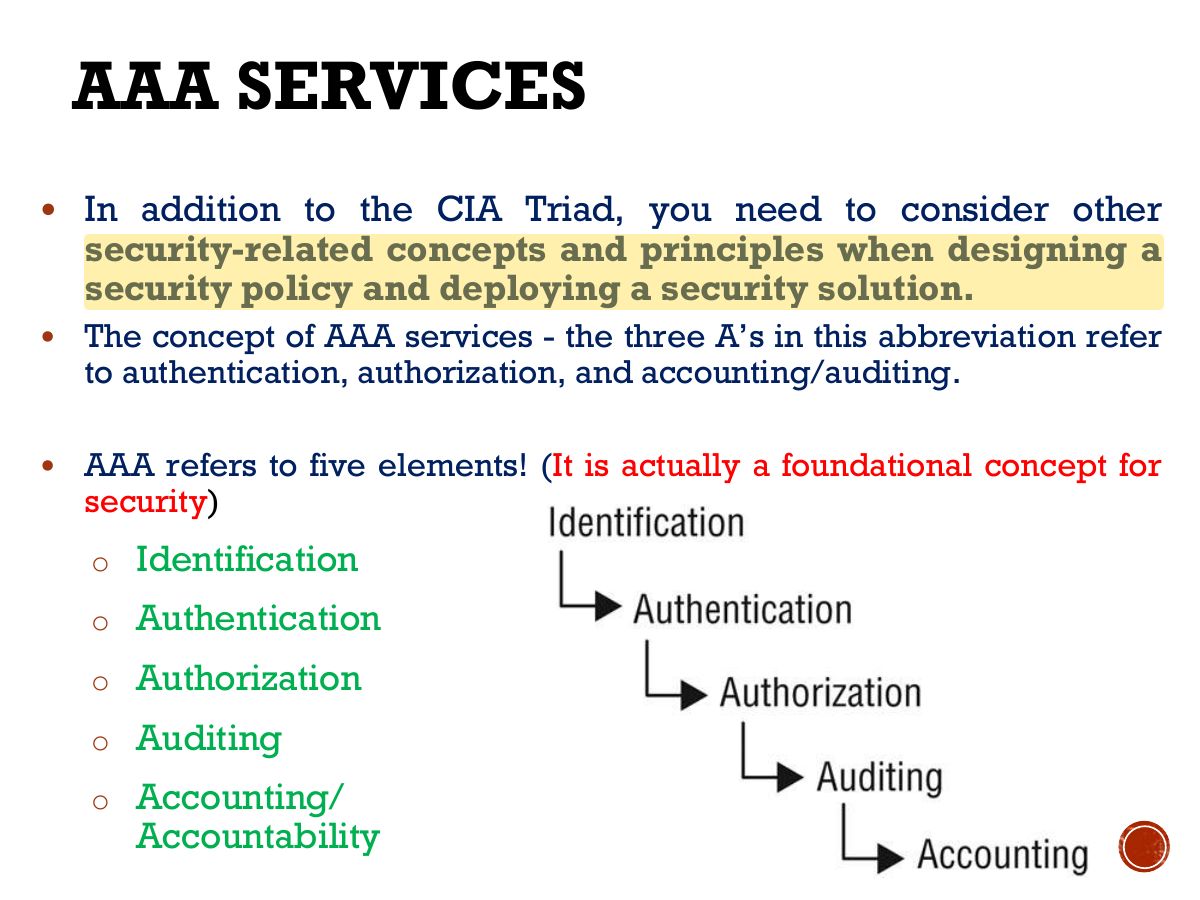
TipAAA = five elements: Identification (claim) → Authentication (prove) → Authorization (permissions) → Auditing (record) → Accounting (hold responsible). Phase 1 (getting in): identification, authentication, authorization. Phase 2 (afterwards): auditing, accountability.
★ Past exam

ACCESS CONTROL (AAA ELEMENTS)

  • Identification: Claiming to be an identity when attempting to access a secured area or system
  • Authentication: Proving that you are that identity
  • Authorization: Defining the permissions (i.e., allow/grant and/or deny) of a resource and object access for a specific identity
  • Auditing: Recording a log of the events and activities related to the system and subjects
  • Accounting (accountability ): Reviewing log files to check for compliance and violations in order to hold subjects accountable for their actions
32
Exam weight High
  1. Identification (claim), authentication (prove), authorization (permissions), auditing (record activity), accounting/accountability (hold responsible).
🎯 How this can come up · 2 questions
Written

Identification, authentication, authorization and accountability are divided into two phases. What are they? (Final 221 B)

MCQ

Proving that you are the identity you claimed is:

Slide 33: PROTECTION MECHANISMS
Exam weight Low
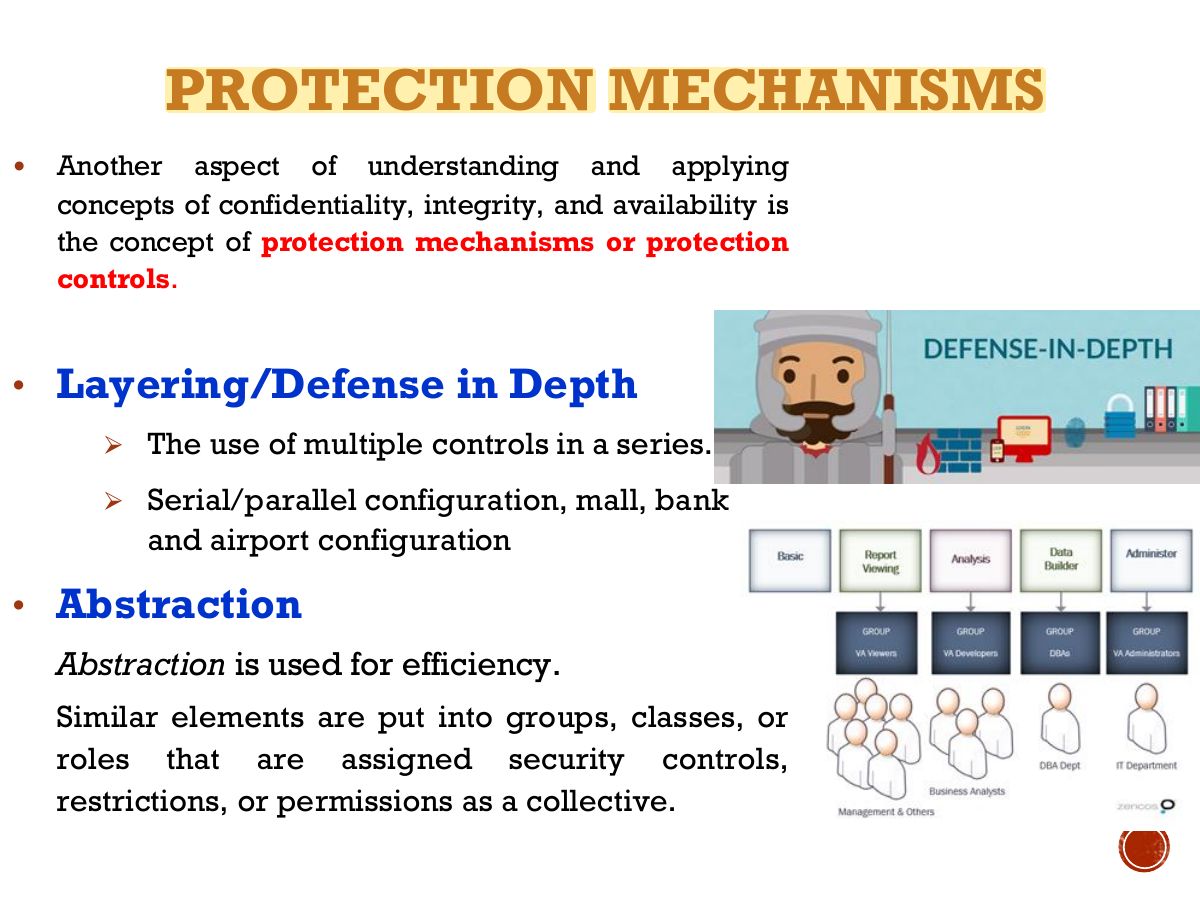
  1. Protection mechanisms: layering (defence in depth), abstraction, data hiding, encryption.

PROTECTION MECHANISMS

  • Data Hiding: Data hiding is the act of intentionally positioning data so that it is not viewable or accessible to an unauthorized subject
  • Encryption Encryption is the art and science of hiding the meaning or intent of a communication from unintended recipients.
34
Exam weight Low
  1. Data hiding: keep data out of reach of unauthorised subjects. Encryption: hide the meaning of a communication.