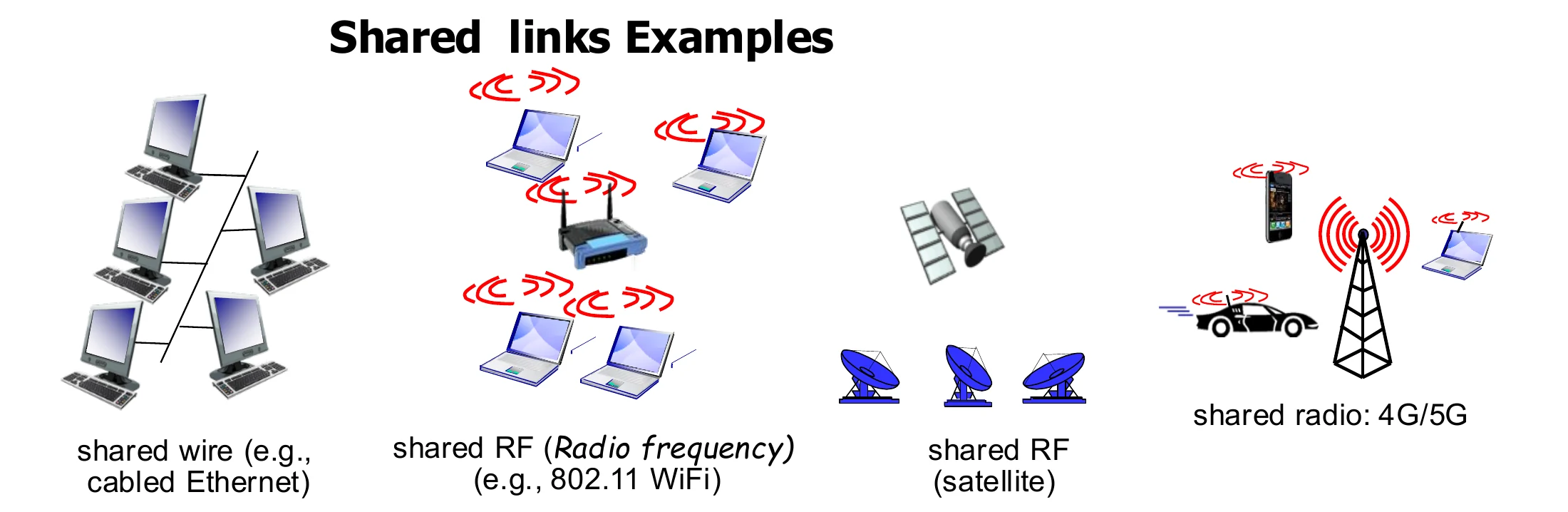
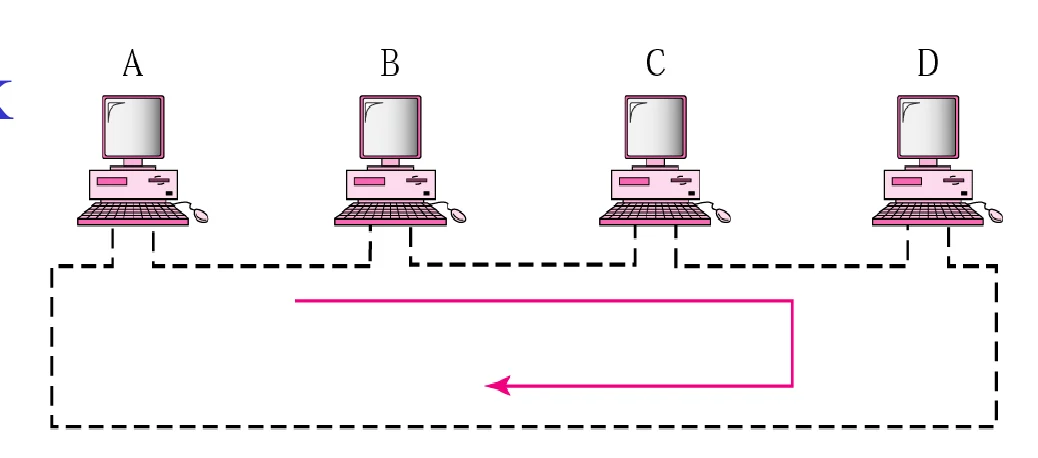
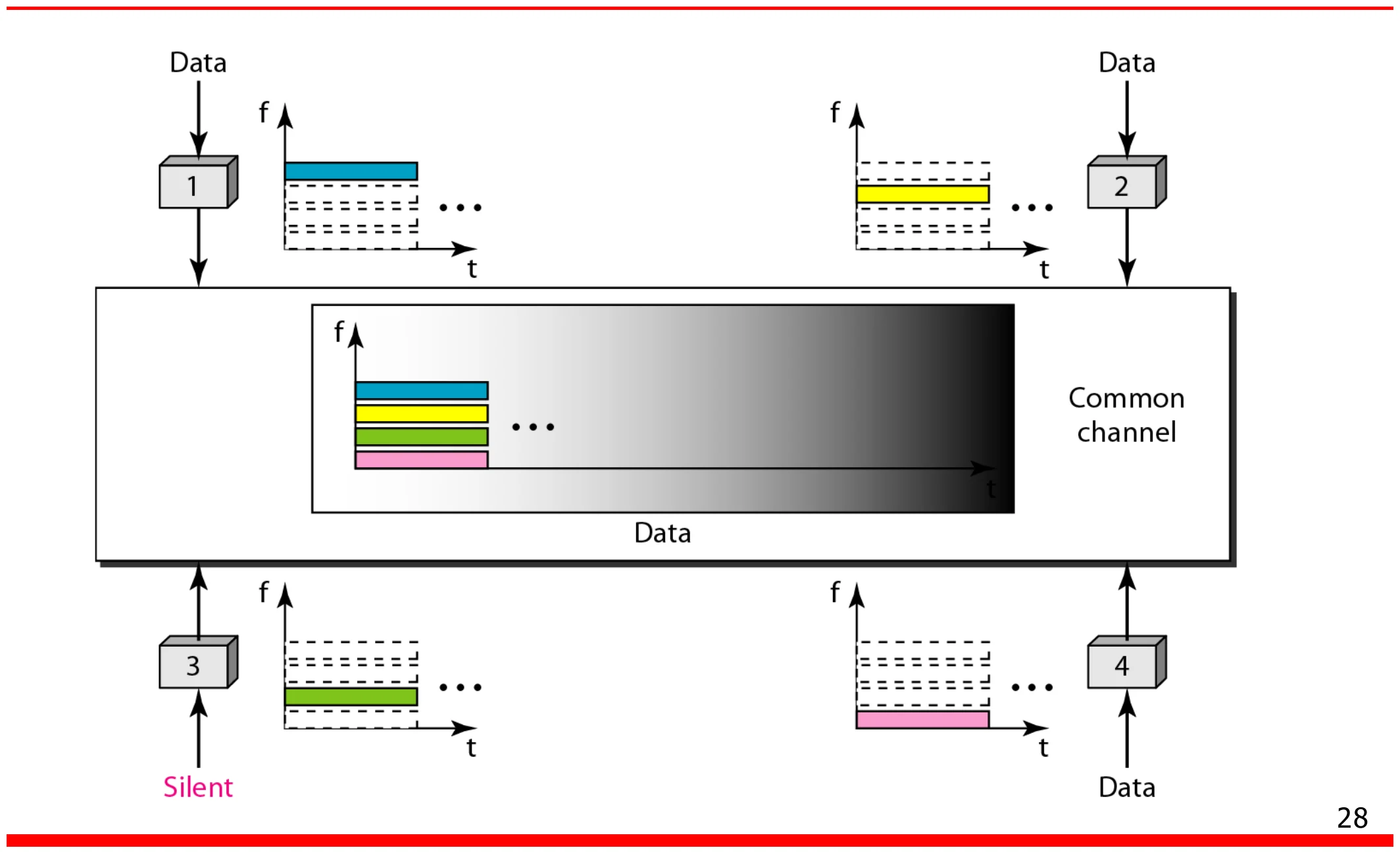
- Shared link → MAC sublayer → random access (CSMA family) → controlled access → channelization.
- Three families of multiple-access protocols.
- Broadcast link = many nodes, ONE medium. Everyone hears every transmission.
- Collision = two frames on the medium at once → both destroyed, bandwidth wasted.
- MAC protocols decide who sends when. They live in the MAC sublayer.
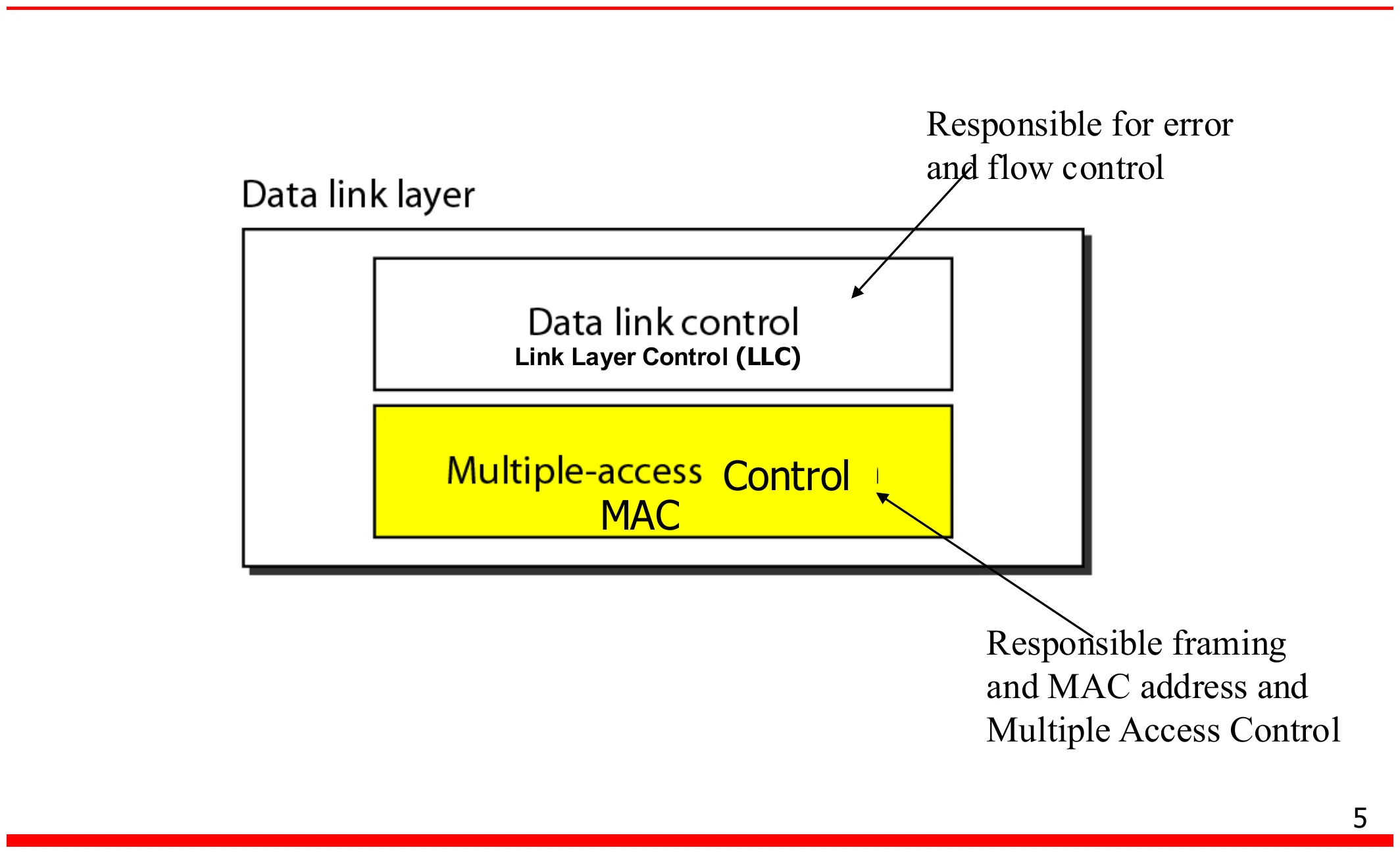
- Upper sublayer LLC: error and flow control. Lower sublayer MAC: framing, MAC address, multiple access.
🎯 How this can come up · 2 questions
Which data link sublayer is responsible for error and flow control?
Correct: LLC (data link control).
The MAC sublayer is responsible for:
Correct: Framing, MAC addressing and multiple access.
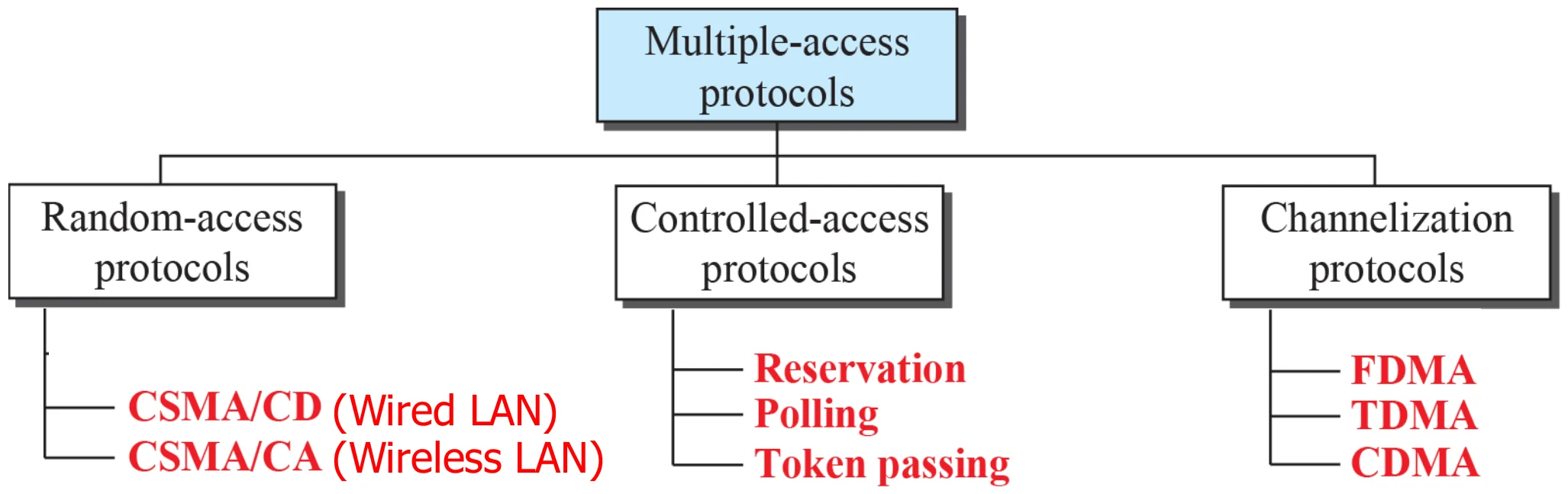
- Random: CSMA/CD (wired), CSMA/CA (wireless). Controlled: reservation, polling, token passing. Channelization: FDMA, TDMA, CDMA.
🎯 How this can come up · 3 questions
Token passing belongs to which family?
Correct: Controlled access.
CSMA/CA is used in:
Correct: Wireless LANs.
Which is a channelization protocol?
Correct: TDMA.
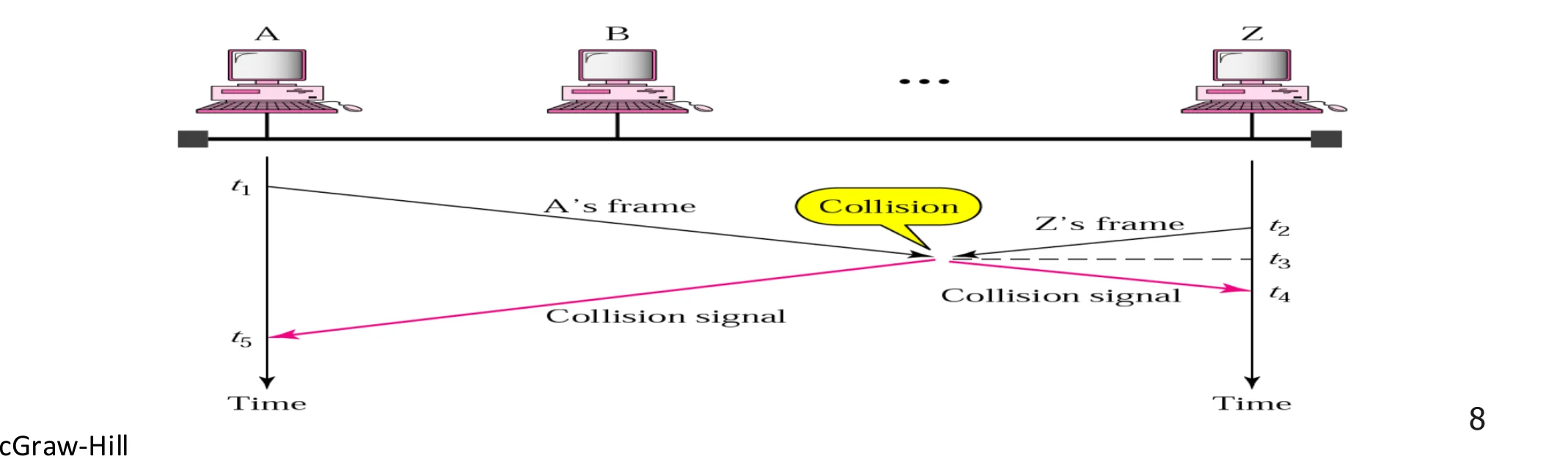
- Random access: no master, no turns. Each station decides for itself when to send, so collisions are possible.
- CSMA = listen before you talk.
- It reduces collisions but can’t eliminate them: a station far away may not hear a frame that already started.
- Collisions only happen within the propagation time window.
🎯 How this can come up · 2 questions
CSMA eliminates collisions completely.
False. Two stations can still start within one propagation time.
In CSMA, a station senses the medium:
Correct: Before transmitting.
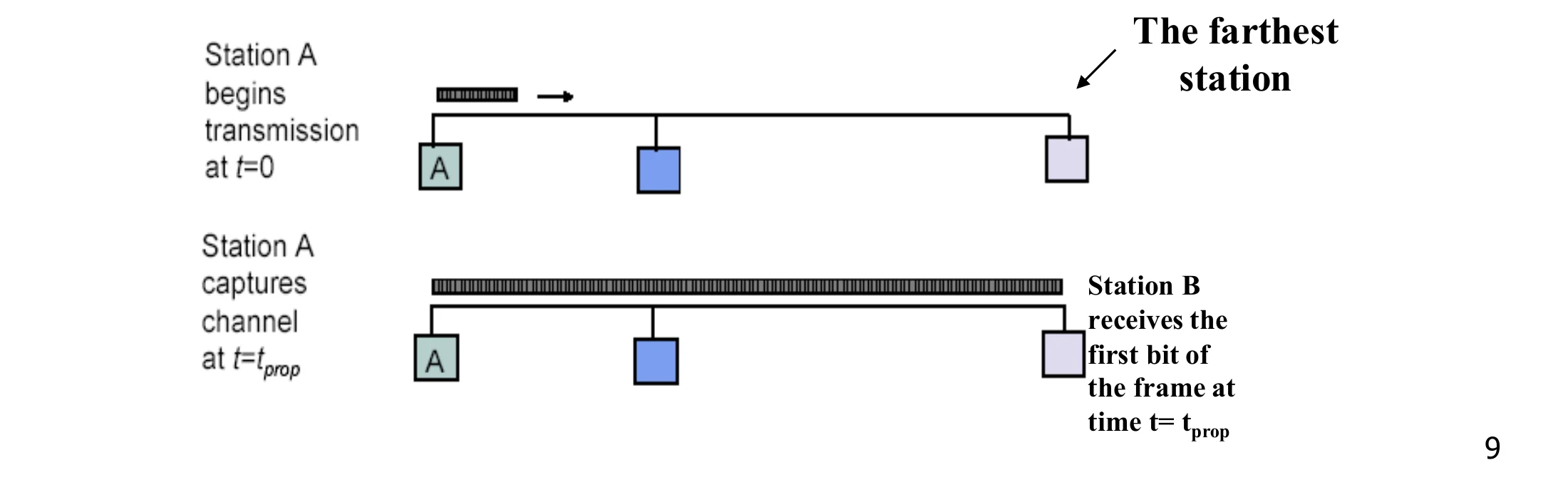
- Vulnerable time = max propagation delay between the two farthest stations.
🎯 How this can come up · 1 question
The vulnerable time of CSMA equals:
Correct: The maximum propagation time.
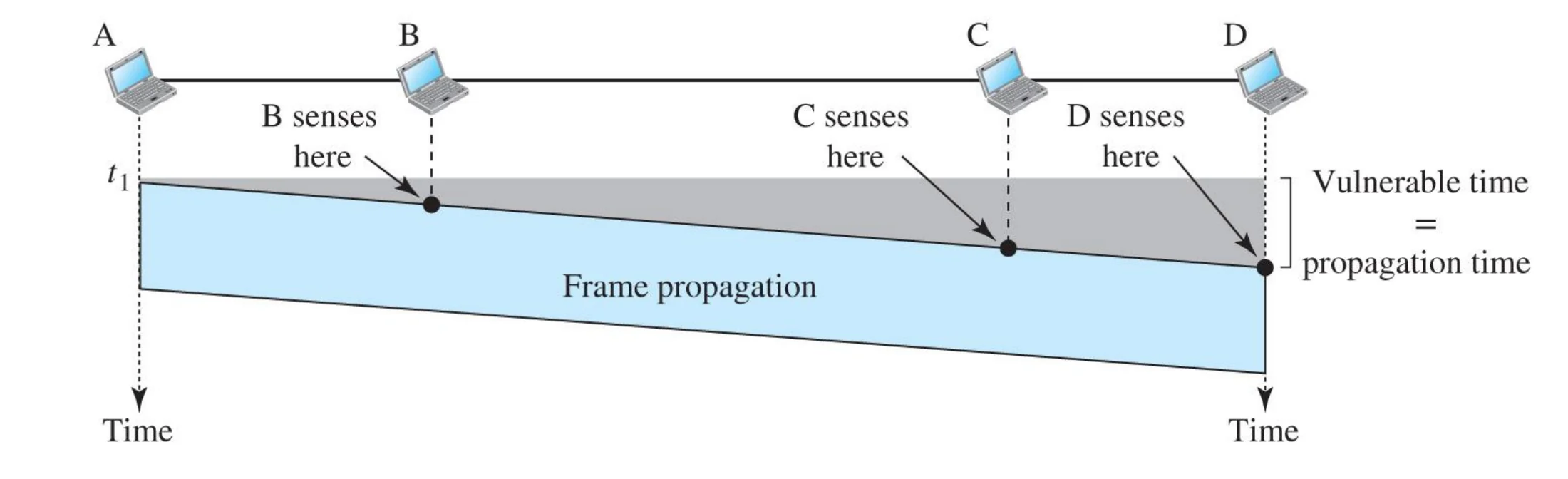
- Long cables = longer window where distant stations wrongly think the line is free.
- Three persistence methods: they differ in what to do when the line is BUSY and when it is IDLE.
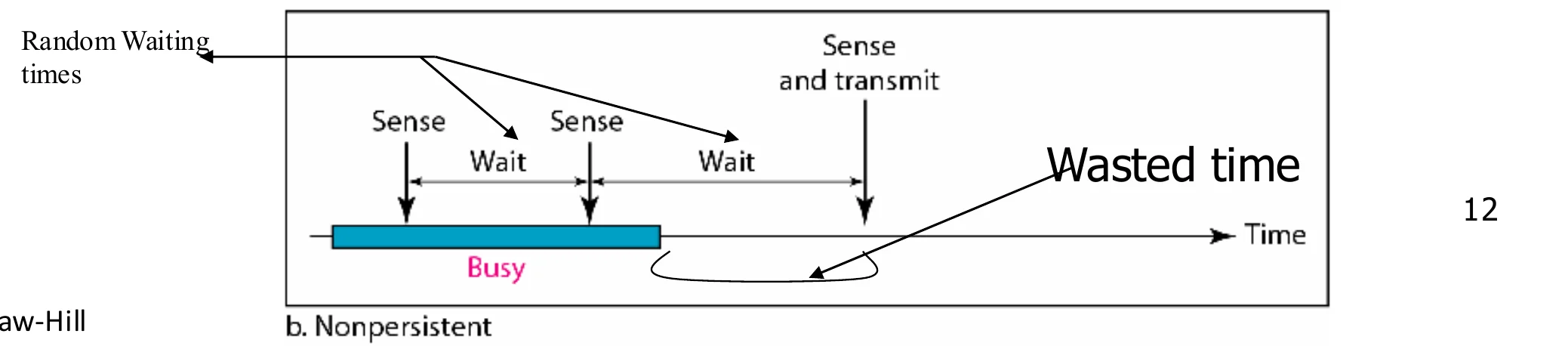
- Non-persistent: busy → walk away for a random time, then check again.
- Fewer collisions, but the line can sit idle (wasted).
🎯 How this can come up · 1 question
In non-persistent CSMA, if the medium is busy the station:
Correct: Waits a random time and senses again.
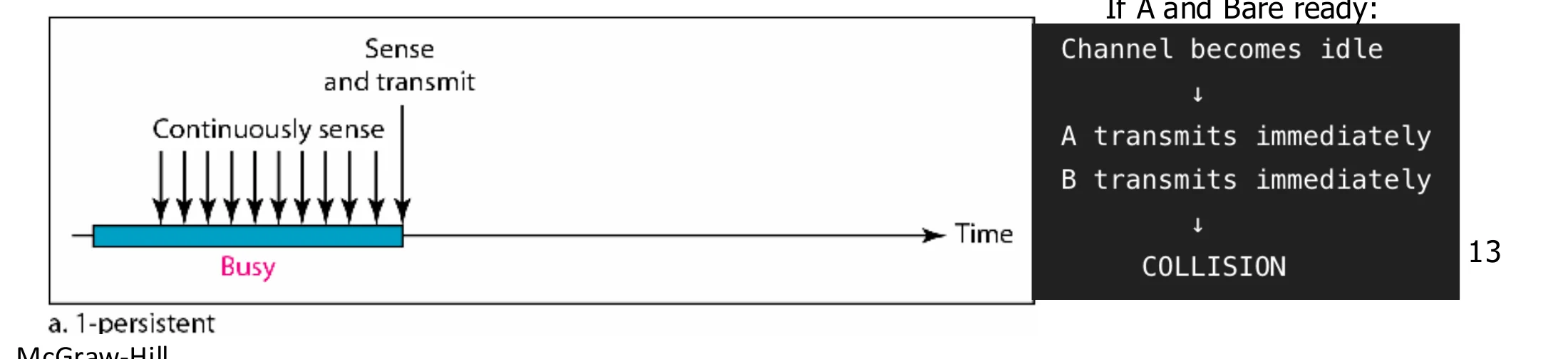
- 1-persistent: busy → keep listening → the instant it’s idle, send (probability 1).
- No idle time, but if two stations were waiting, they BOTH send → guaranteed collision.
🎯 How this can come up · 2 questions
Which persistence method guarantees a collision when two stations wait for the same busy channel?
Correct: 1-persistent.
1-persistent CSMA sends with probability 1 as soon as the channel becomes idle.
True.
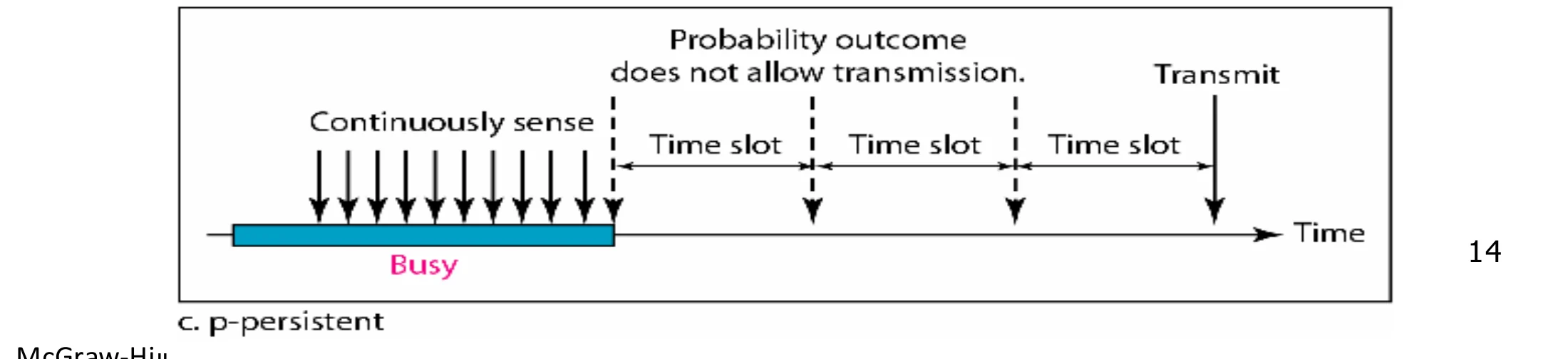
- p-persistent: idle → send with probability p, or wait one slot with probability 1 - p.
- Best of both: fewer collisions (like non-persistent) and less idle time (like 1-persistent).
- Slot = maximum propagation delay.
🎯 How this can come up · 2 questions
In p-persistent CSMA, a time slot equals:
Correct: The maximum propagation delay.
Compare non-persistent, 1-persistent and p-persistent CSMA when the channel is busy and when it becomes idle.
Non-persistent: if busy, wait a random time then sense again (fewer collisions, wasted idle time). 1-persistent: if busy, keep listening and send immediately with probability 1 when idle (no idle time, collisions guaranteed if several are waiting). p-persistent: keep listening; when idle send with probability p or wait a slot with probability 1 - p (reduces both collisions and idle time).
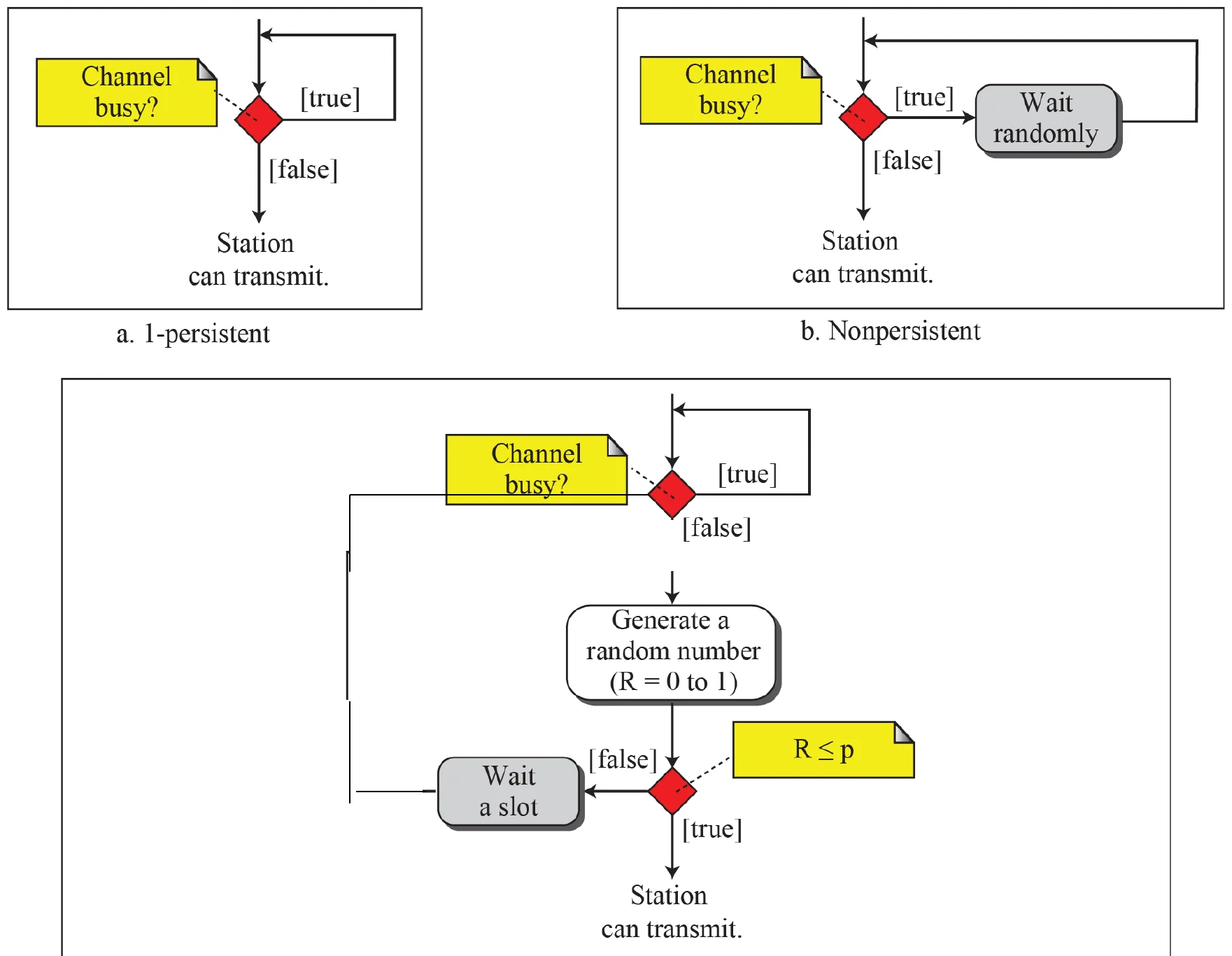
- p-persistent: draw a random R in [0, 1]; if R ≤ p send, otherwise wait a slot.
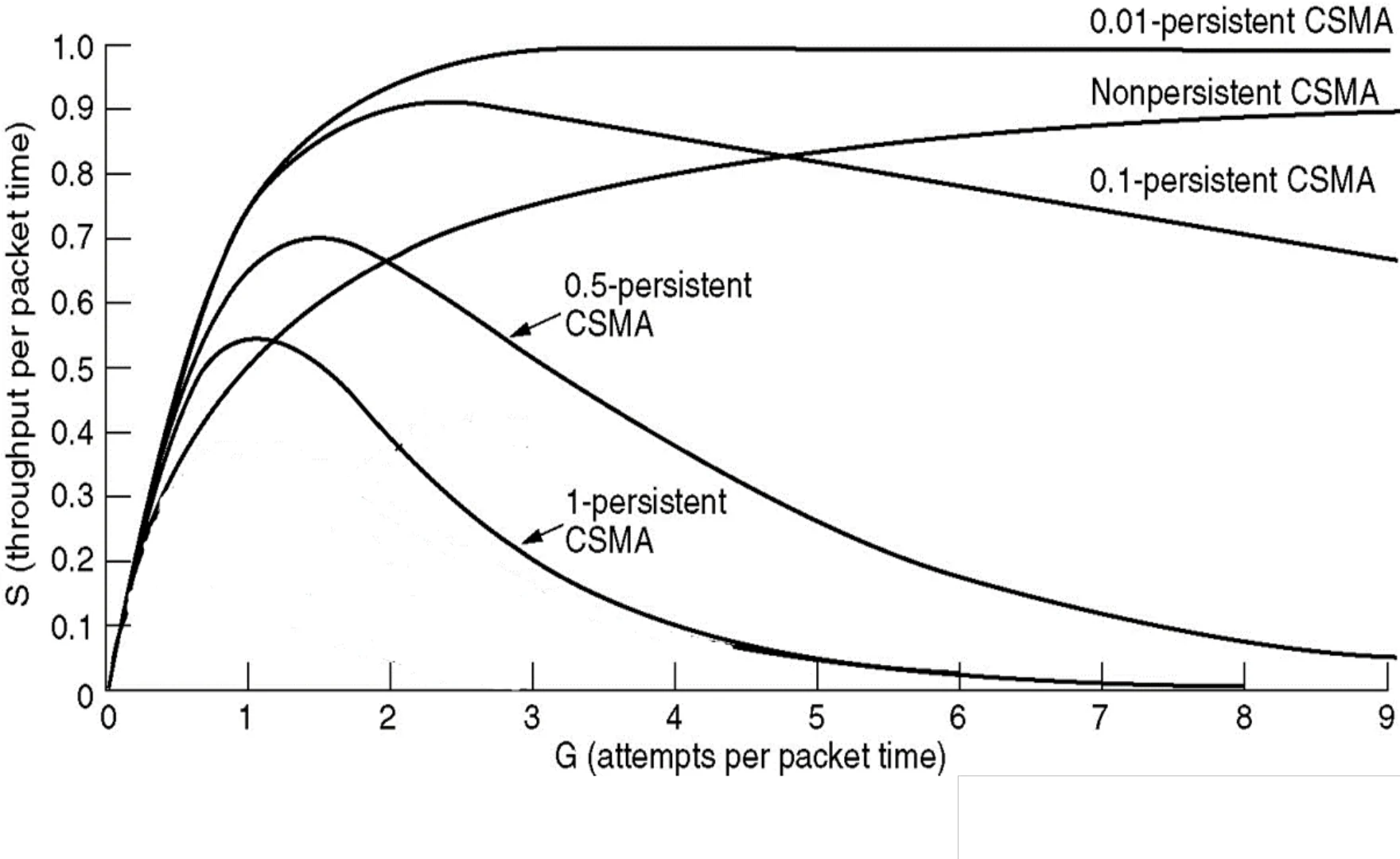
- Under heavy load, 1-persistent does worst (collisions); small p and non-persistent do best.
🎯 How this can come up · 1 question
Under heavy load, which CSMA variant has the lowest throughput on the graph?
Correct: 1-persistent.
- Plain CSMA keeps sending the whole (already ruined) frame. CSMA/CD listens WHILE sending and stops as soon as it detects a collision.
- Used on shared Ethernet (bus or hub).
🎯 How this can come up · 1 question
What does CSMA/CD add to CSMA?
Correct: Listening while transmitting and stopping on a collision.
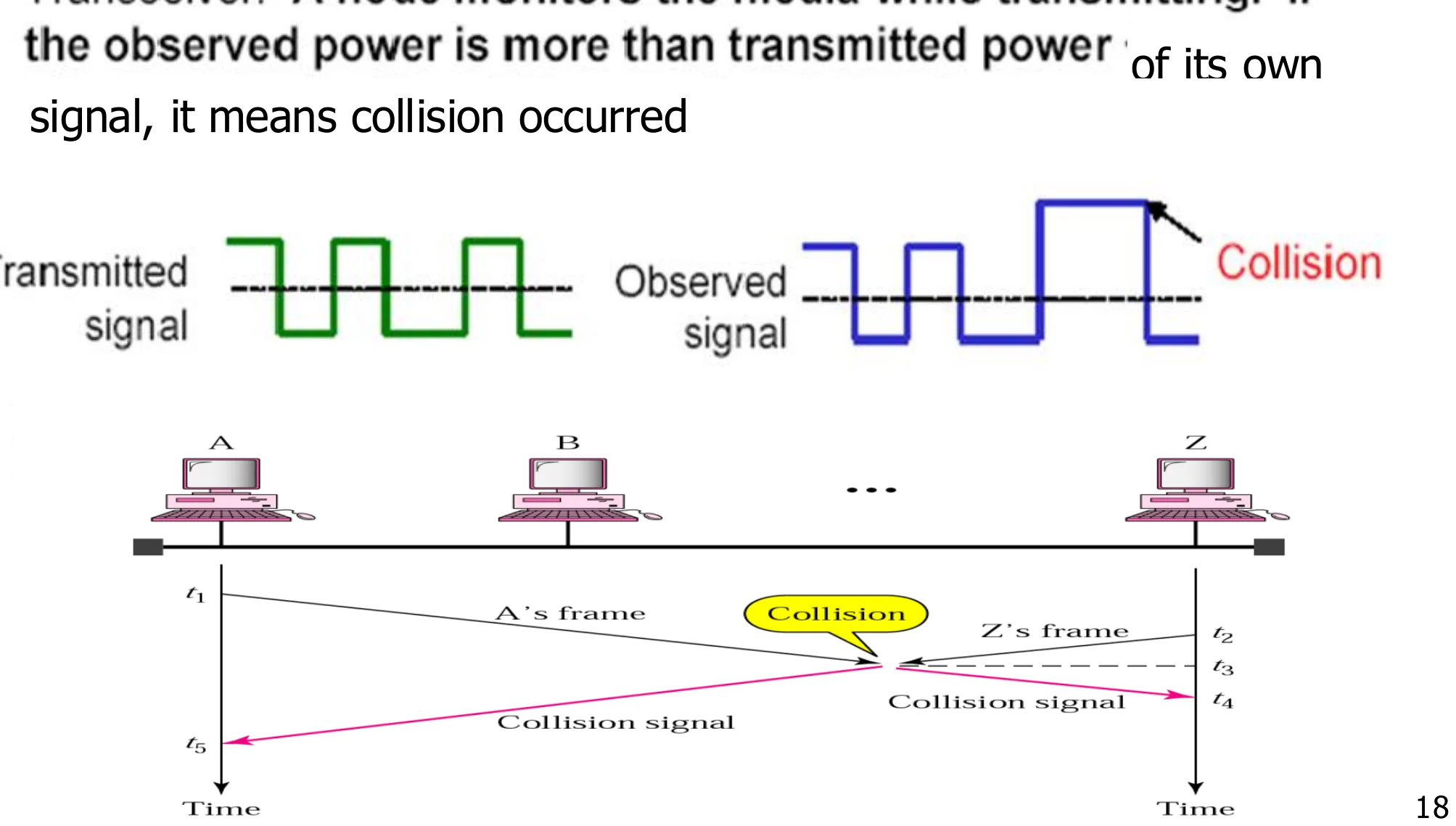
- Detection = the energy on the wire is higher than what I am sending → someone else is sending too.
- On collision: ABORT → send a 48-bit JAM → random BACKOFF → try again with the same persistence method.
🎯 How this can come up · 2 questions
After detecting a collision, a CSMA/CD station first:
Correct: Aborts and sends a jam signal.
The jam signal in the slides is:
Correct: 48 bits.
- Random access: simple, decentralized, great at low load; UNFAIR and unbounded delay at high load.
- Alone on the link → full rate R. Busy link → each node gets less than R/M because of collisions.
🎯 How this can come up · 2 questions
Random access protocols are fair: every station is guaranteed a turn.
False. A station may never get to send.
A single active station using random access can send at:
Correct: The full channel rate R.
- Controlled access: stations take turns → fair, no collisions, but capped at R/M.
🎯 How this can come up · 2 questions
Which family eliminates collisions completely?
Correct: Controlled access.
The three controlled-access methods are:
Correct: Reservation, polling, token passing.

- Each cycle starts with a reservation frame of N minislots (one per station). A station sets its minislot to reserve a turn.
- Everyone hears the reservations, so everyone knows the order. Then the reserved data frames follow.
🎯 How this can come up · 1 question
In the reservation method, a reservation frame contains:
Correct: One minislot per station.
- Centralized polling: a PRIMARY controls everything. SELECT = primary wants to send to a secondary. POLL = primary asks a secondary if it has data (data or NAK back).
- Distributed polling: no primary; stations follow a known order and pass the right to send along. Reservation and token passing are distributed polling.
🎯 How this can come up · 3 questions
In centralized polling, the primary sends a ___ frame when it wants to send data to a secondary.
Correct: Select.
A secondary with nothing to send answers a poll with:
Correct: NAK.
Token passing is an example of distributed polling.
True.
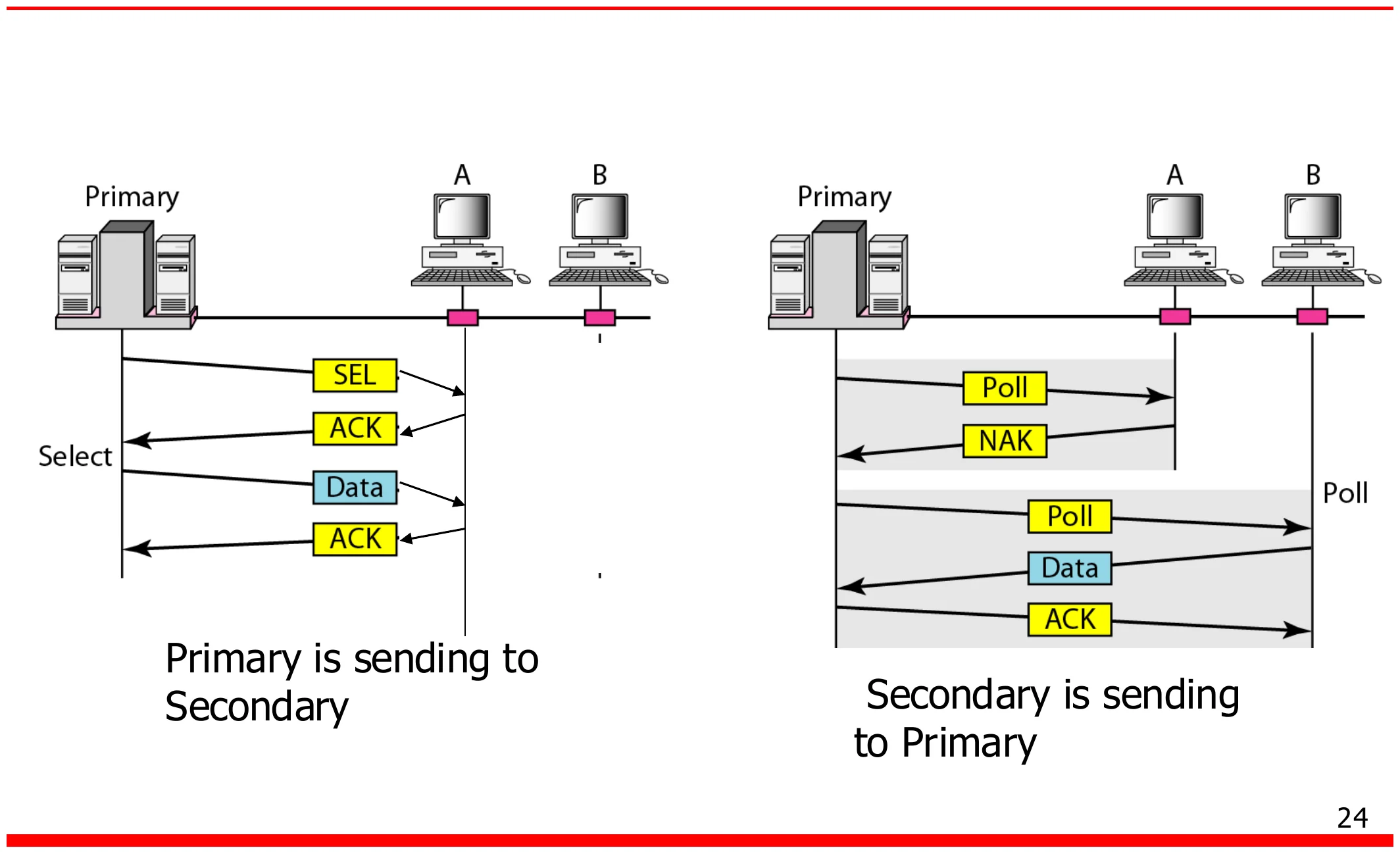
- Left: primary → secondary uses SEL. Right: secondary → primary starts with a POLL.
- Only the station holding the free token may send → no collisions.
🎯 How this can come up · 1 question
In token passing, a station can send when it:
Correct: Captures the free token.
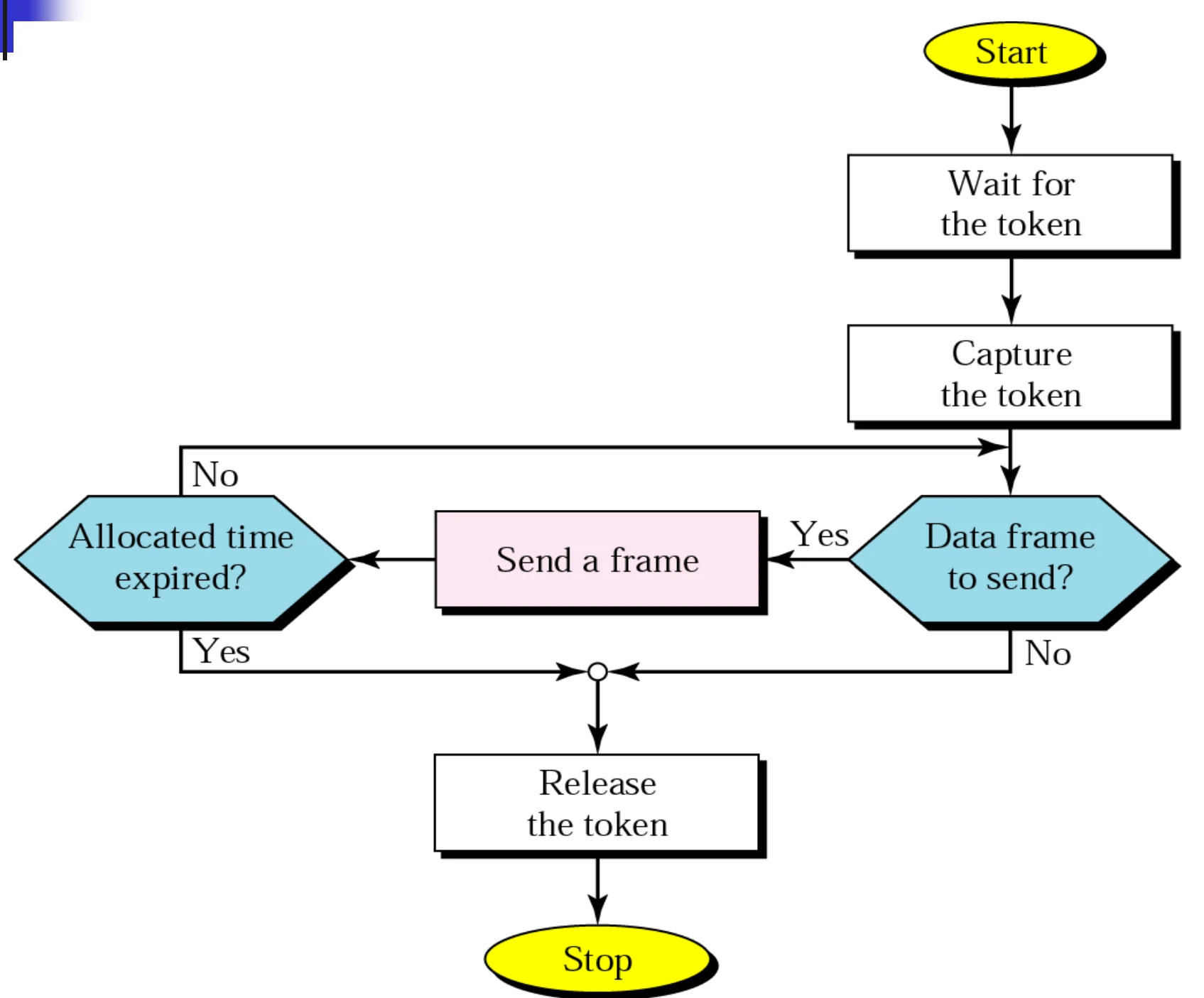
- A station keeps the token only while it has data AND its allocated time hasn’t expired, then releases it.
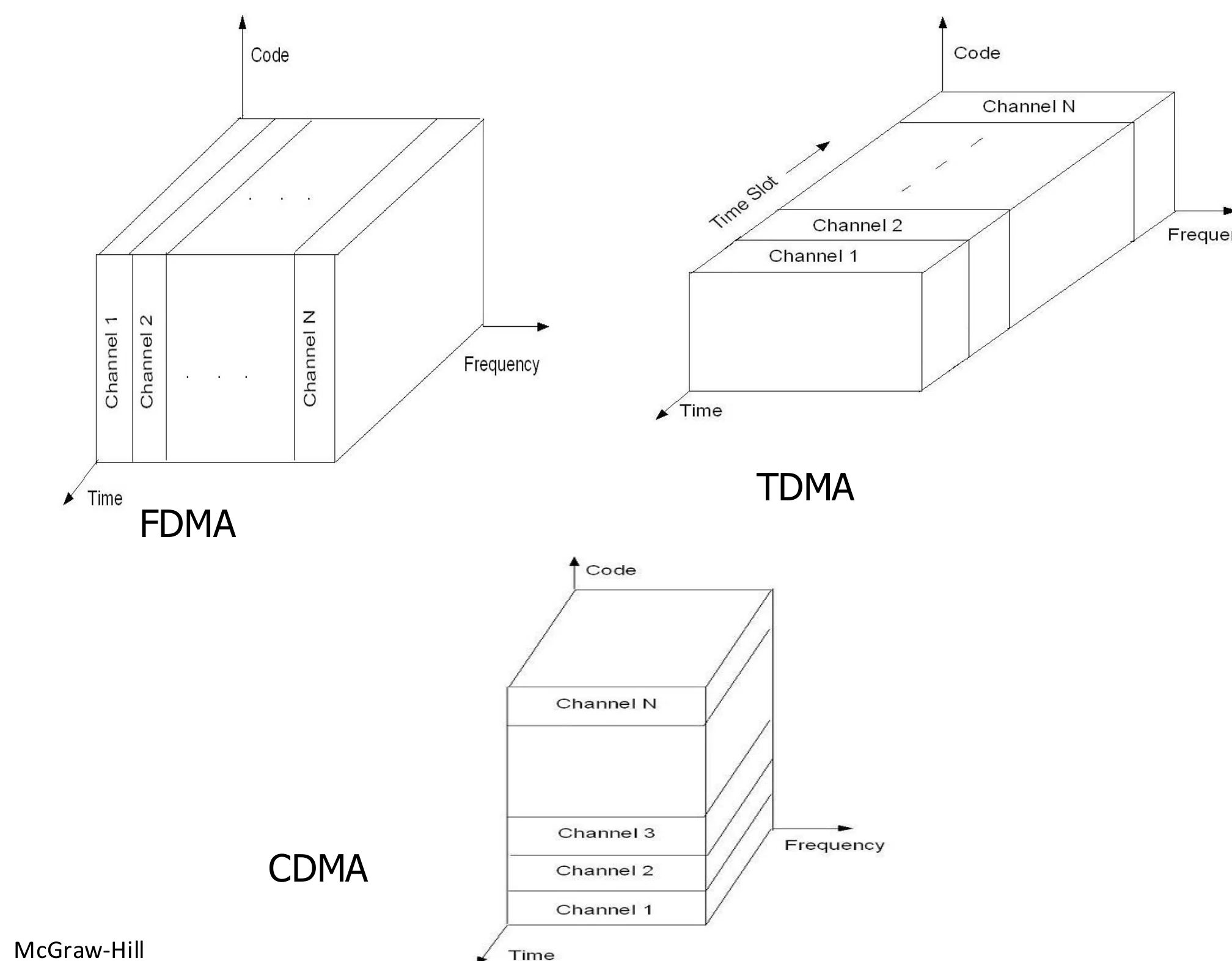
- Split the channel by frequency (FDMA), by time (TDMA) or by code (CDMA).
- Each station has its own frequency band, all the time.
- FDMA: own band, send continuously, R/M even when alone (other bands sit empty).
🎯 How this can come up · 1 question
In FDMA, a station that is the only one with data can send at:
Correct: R/M.
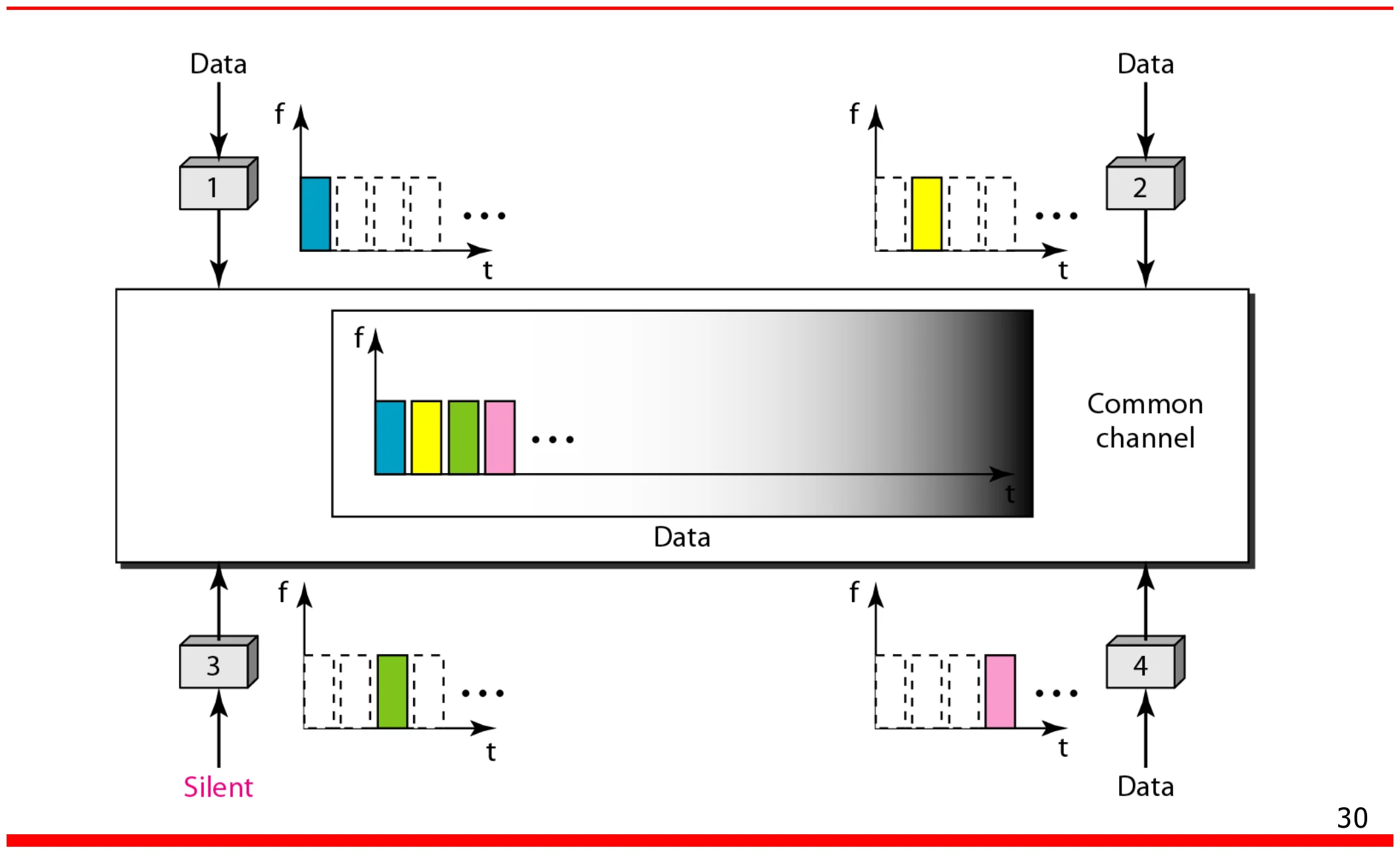
- Each station has its own time slot on the whole bandwidth.
- TDMA: whole bandwidth, but only in your slot. Still R/M on average even when alone.
🎯 How this can come up · 2 questions
In TDMA, a station that is the only one with frames can use every time slot.
False. It must wait for its own slot.
Compare FDMA and TDMA.
FDMA divides the channel by frequency: each station gets its own band and sends continuously. TDMA divides it by time: each station uses the whole bandwidth but only in its own slot. Both limit a station to R/M even when it is the only one sending.
- CDMA: everyone sends at the same time on the same frequency; codes separate them.
🎯 How this can come up · 1 question
In which method do all stations send at the same time over the same channel, separated by codes?
Correct: CDMA.
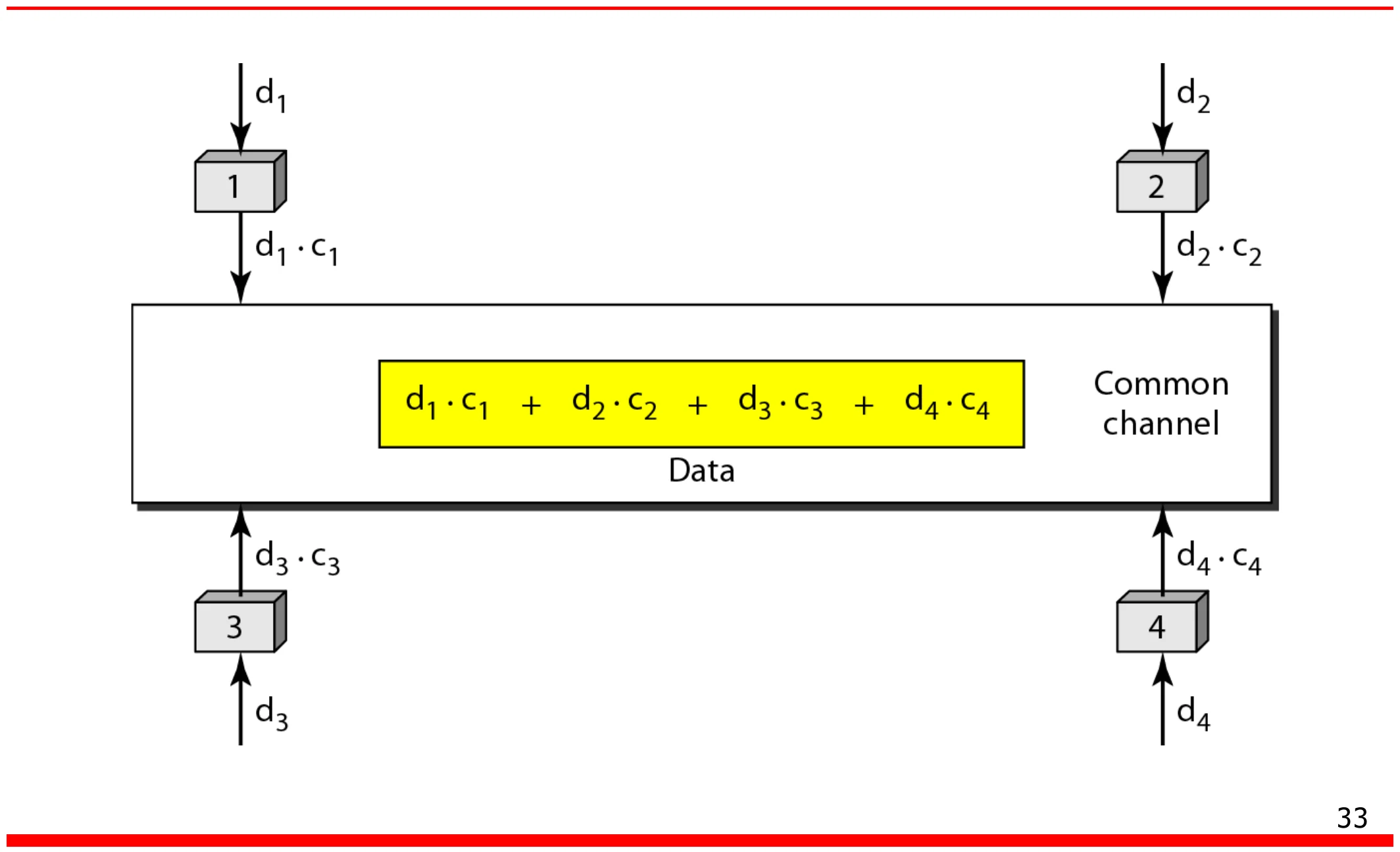
- Each station multiplies its data by its code; the channel carries the SUM; a receiver multiplies by the wanted code to pull its data out.
- FDMA = frequency slices. TDMA = time slices. CDMA = code slices (everyone uses all frequencies all the time).
No slides match this filter.