SE365 · Annotated SlidesLecture 8 — Design Principles and Guidelines
Lecture 8 · Annotated slides

Design Principles and Guidelines

Principles vs. guidelines vs. standards, usability principles (learnability, flexibility, robustness and their sub-principles), and heuristics and golden rules (Shneiderman’s eight golden rules, Nielsen’s heuristics).
Slide text Study notes Highlight: key words Tips, tricks & traps Seen again elsewhere How it can come up
Slide 1: Slide 1
Exam weight Low

    Overview

    • Introduction
    • Usability Principles
    • Heuristic and Golden Rules Based on material from: Sharp, H., Preece, J. and Rogers, Y. (2019). Interaction Design Beyond Human-Computer Interaction. 5th Ed. Sussex: John Wiley & Sons Ltd.
    2
    Exam weight Low

      Learning Outcomes

      • Describe heuristic, golden rules and norman’s 7 principles
      • Enable you to use/follow the rules in order to increase the usability of the system/product
      3
      Exam weight Low
        Slide 4: Slide 4
        Exam weight Low
          Slide 5: 1) Introduction
          Exam weight Low
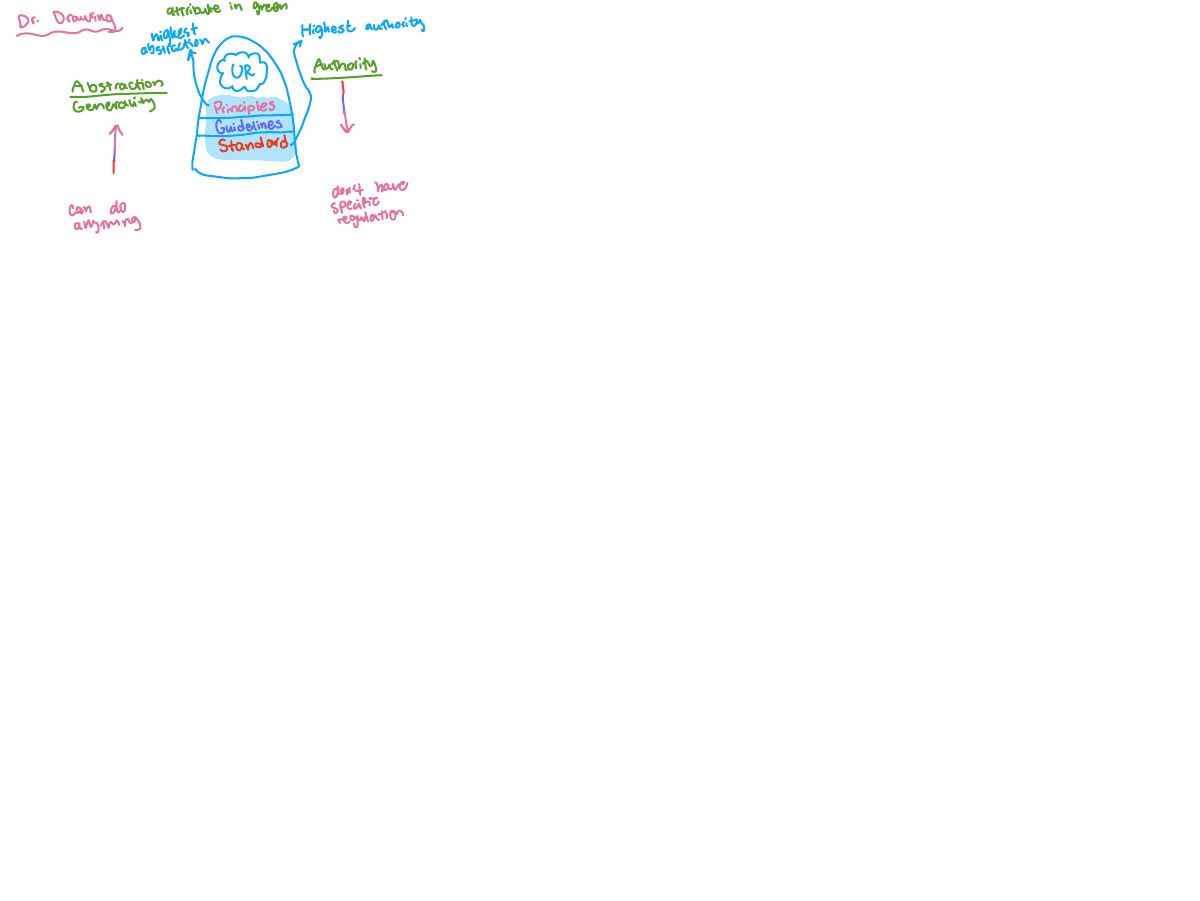
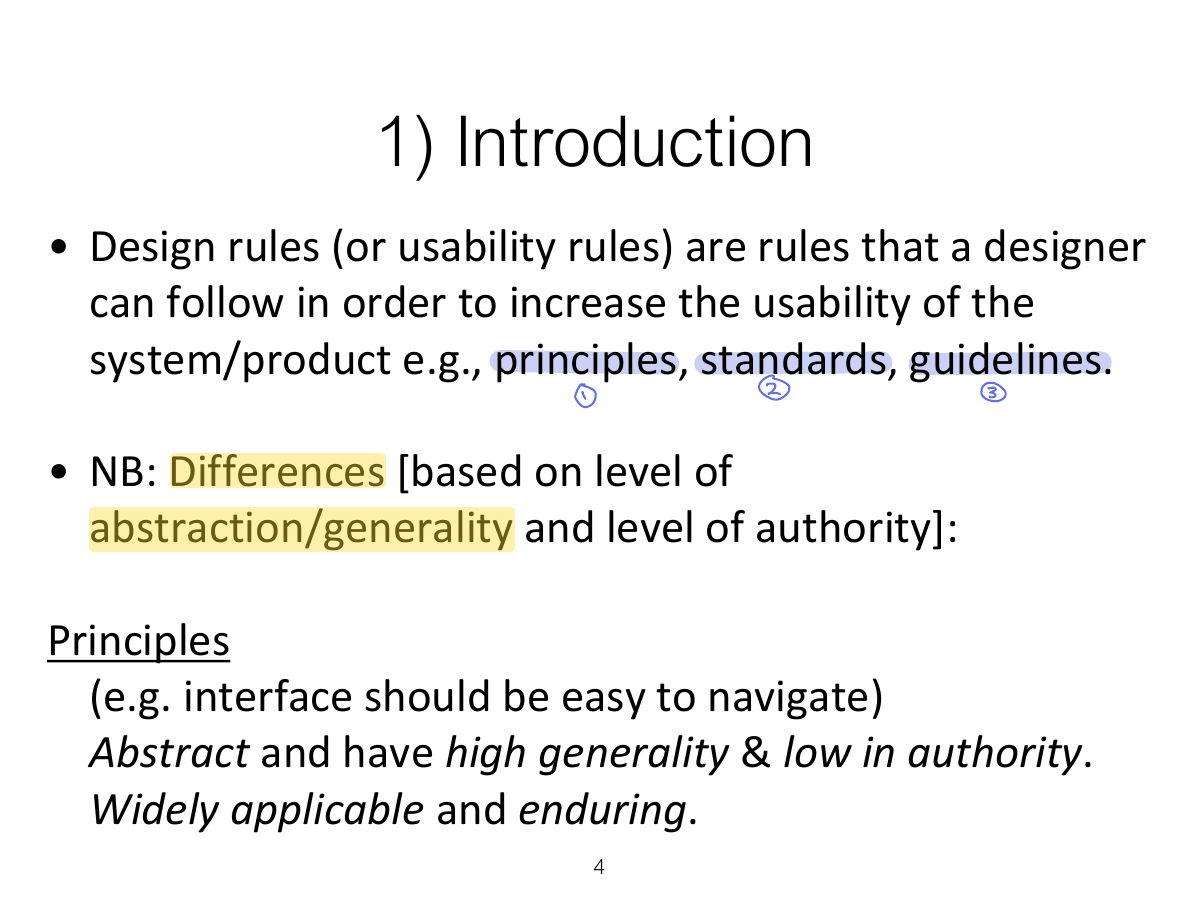
          1. Principles: abstract design rules. Guidelines: more specific advice. Standards: specific and authoritative rules.

          1) Introduction (cont)

          Guidelines

          (e.g. use colour to highlight links) Can guide/advise on how achieve a principle Narrowly focused.

          Can be too specific, incomplete, & hard to apply BUT they are more general and lower in authority than Standards (e.g. use colour RGB #1010D0 on home links) which are very specific & high in authority.

          6
          Exam weight Low

            1) Introduction (cont)

            • Principles: Example - usability principles by Dix et al (HCI book)
            • Standards: They are often set by national (eg British Standards Institution) or international bodies (ISO). Example [of standards] - ISO 9241 "Ergonomic Requirements for Office Work with Visual Display Terminals (VDT)s"
            • Guidelines: Example - Smith and Mosier's "Guidelines for User Interface Software" [MITRE Corporation 1986].
            7
            Exam weight Low

              1) Introduction (cont)

              • Design rules should be used early in the lifecycle [e.g., during the design; note that they can also be used to evaluate the usability of the system]
              • We will:
                • First look at abstract principles for supporting usability
                • Later on, we will look at the most well used and well known sets of heuristics or 'golden rules ‘, which tend to provide a succinct summary of the essential characteristics of good design (Nielsen's heuristics, Shneiderman's golden rules and Norman's principles
              8
              Exam weight Low

                2. Usability Principles

                by Dix et al (HCI book)

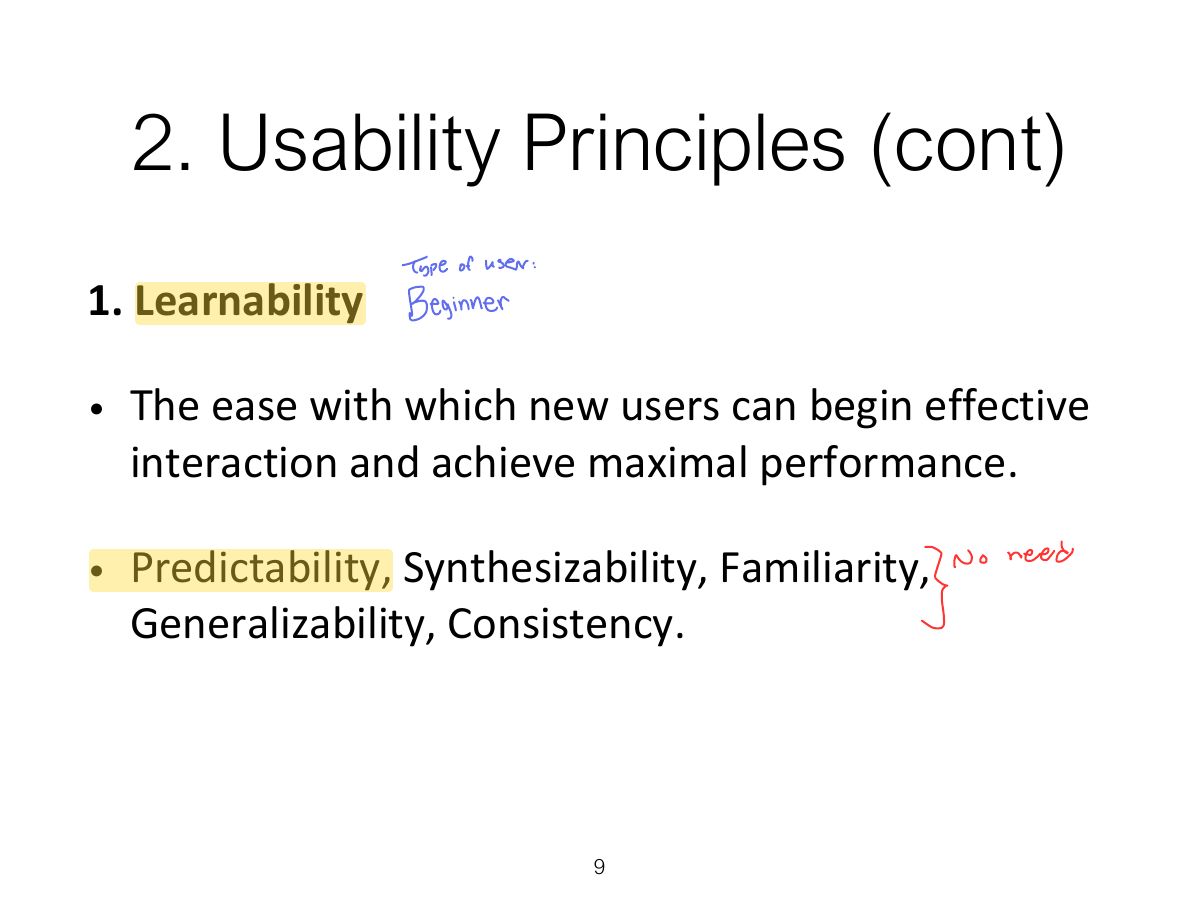
                Learnability - the ease with which new users can

                1.

                begin effective interaction and achieve maximal performance.

                Flexibility - the multiplicity of ways the user and

                2.

                system exchange information.

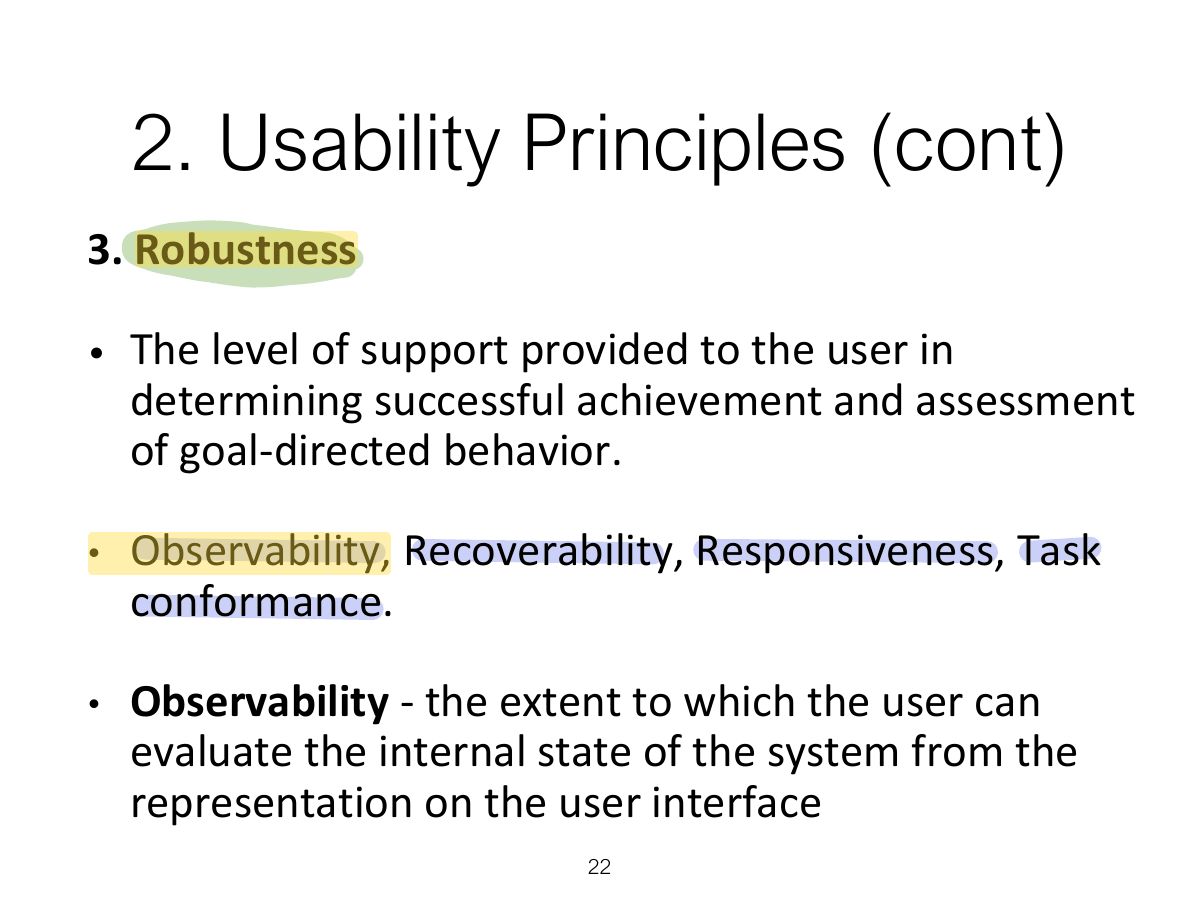
                Robustness - the level of support provided to the

                3.

                user in determining successful achievement and assessment of goal-directed behavior.

                9
                Exam weight High
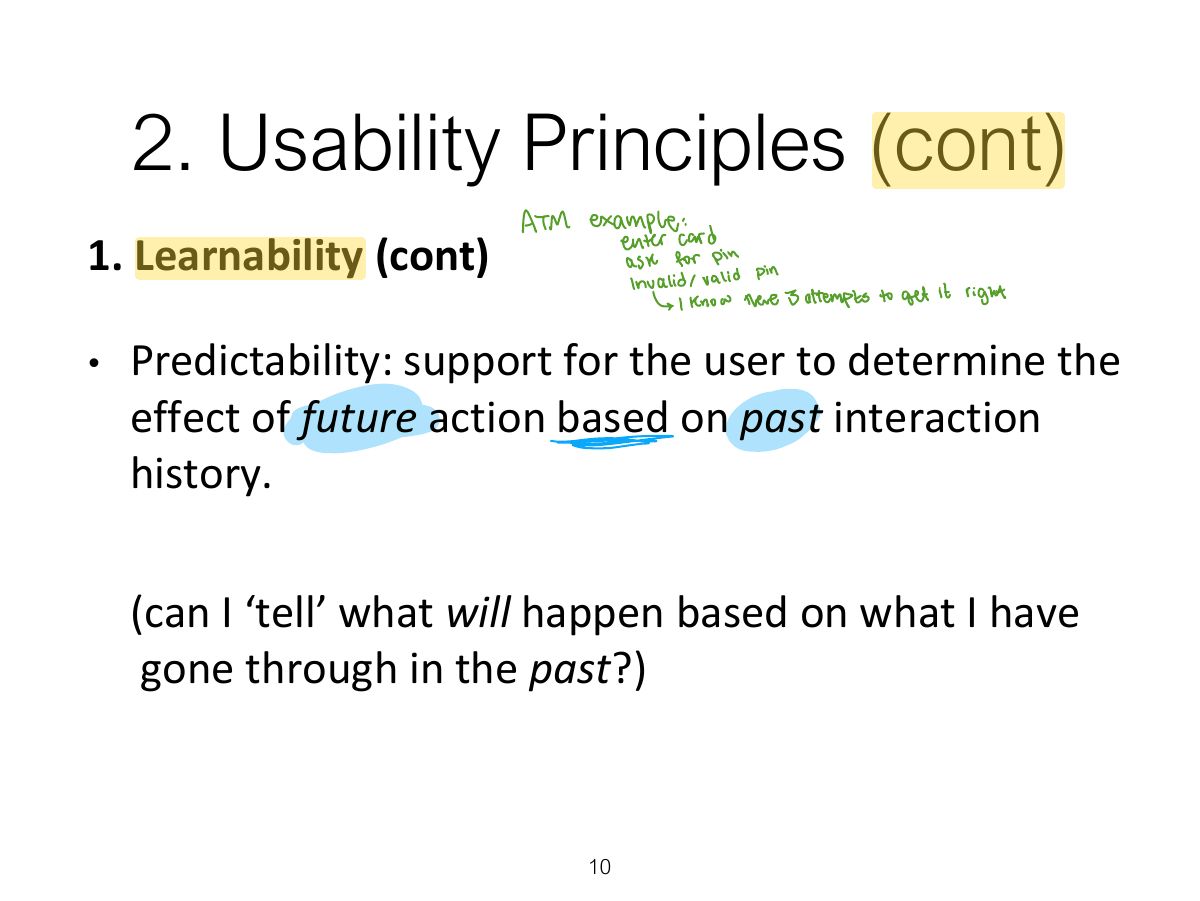
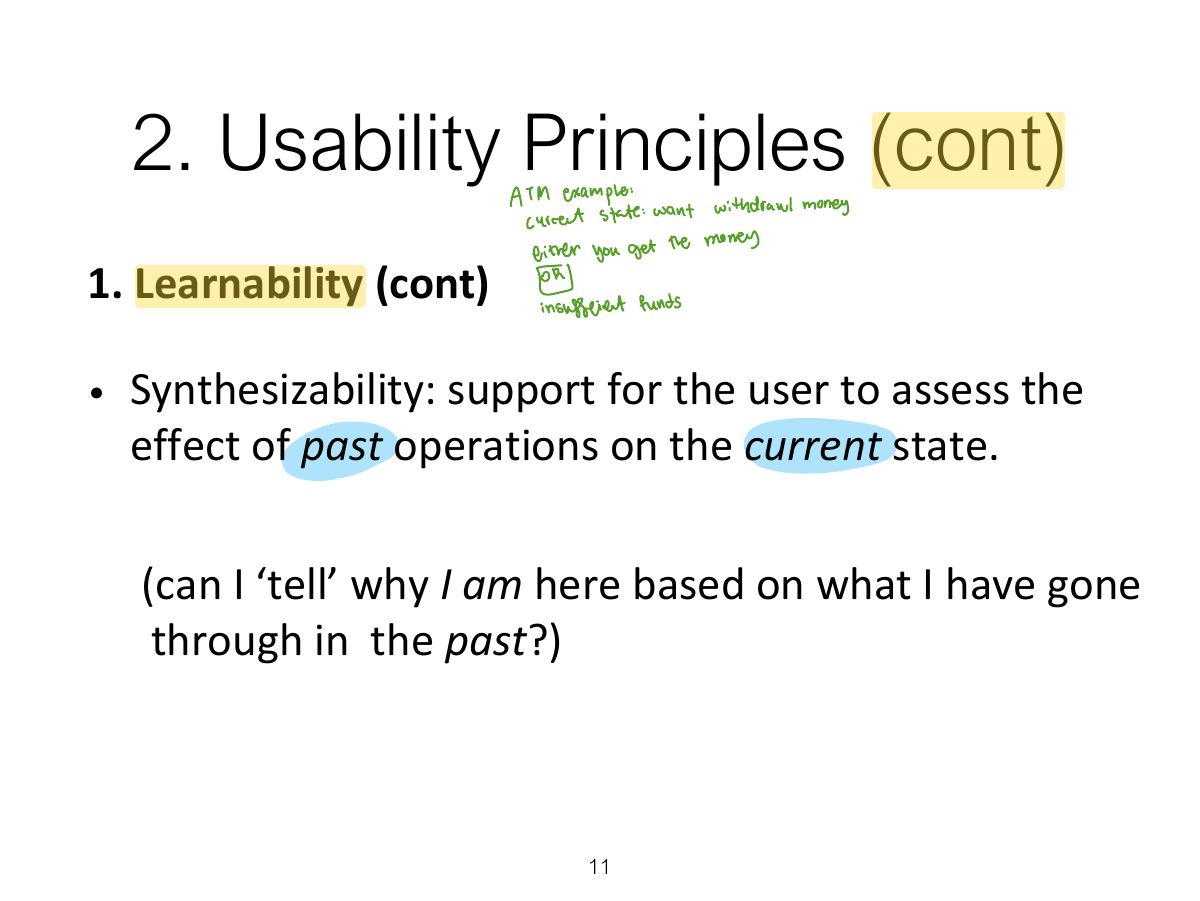
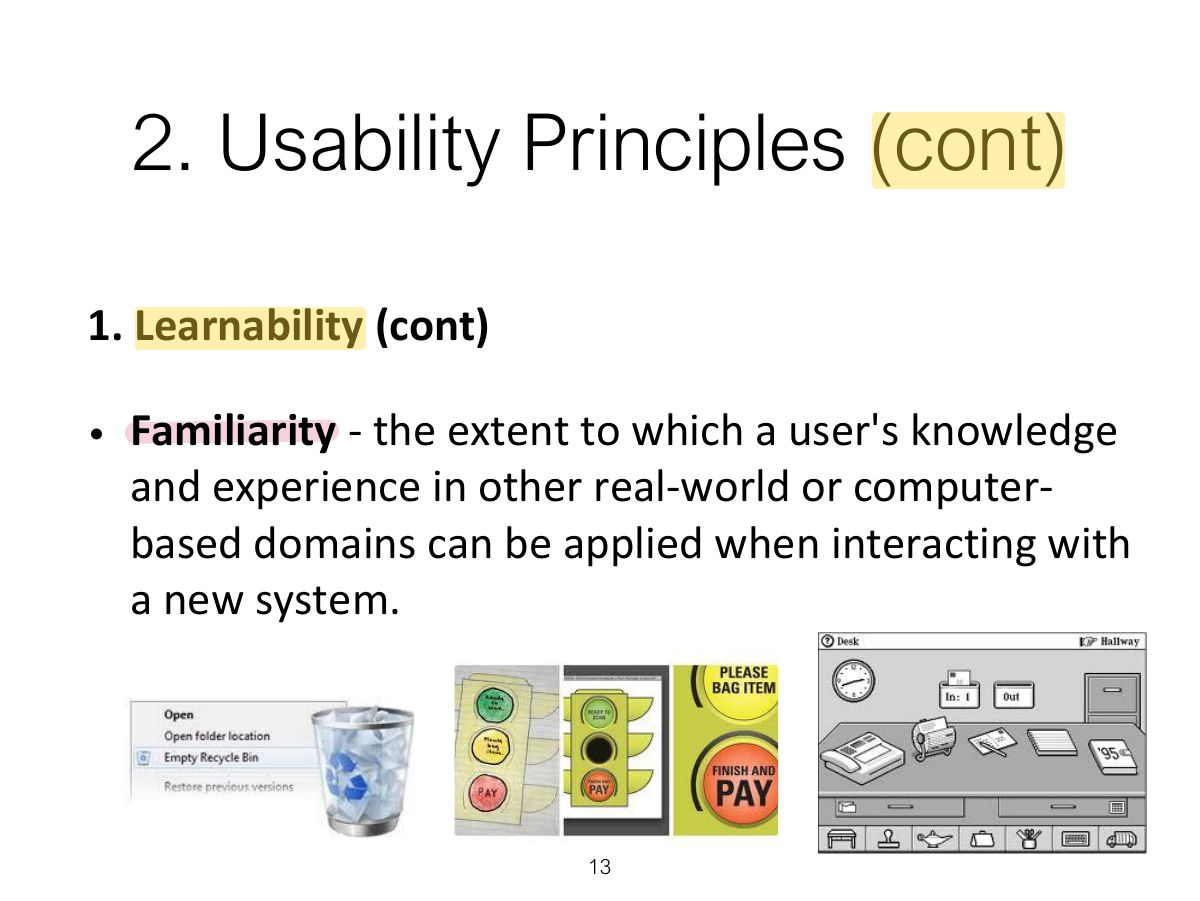
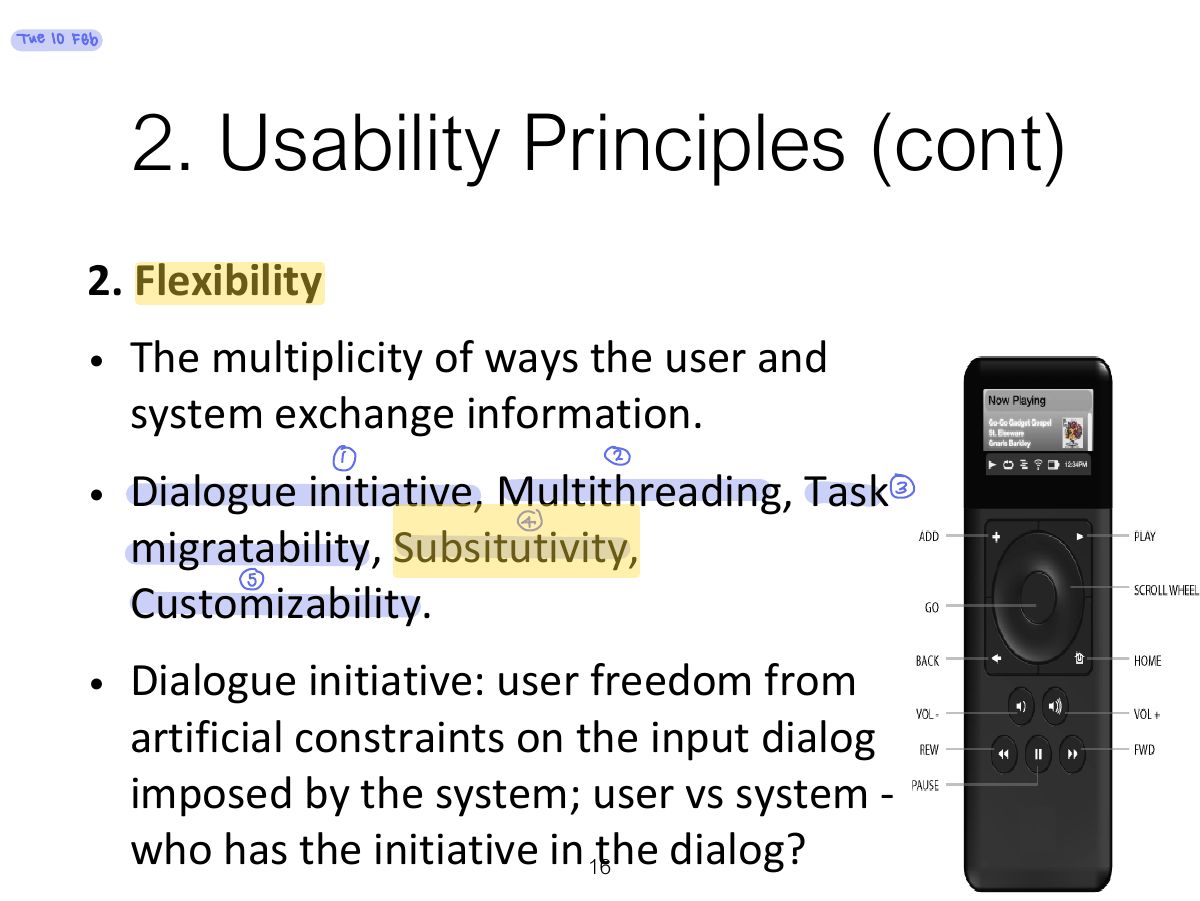
                1. Usability principles in three groups: LEARNABILITY (predictability, synthesizability, familiarity, generalizability, consistency), FLEXIBILITY (dialog initiative, multithreading, substitutivity, customizability), ROBUSTNESS (observability, recoverability, responsiveness, task conformance).
                🎯 How this can come up · 2 questions
                MCQ

                Being able to undo an action belongs to which principle group?

                MCQ

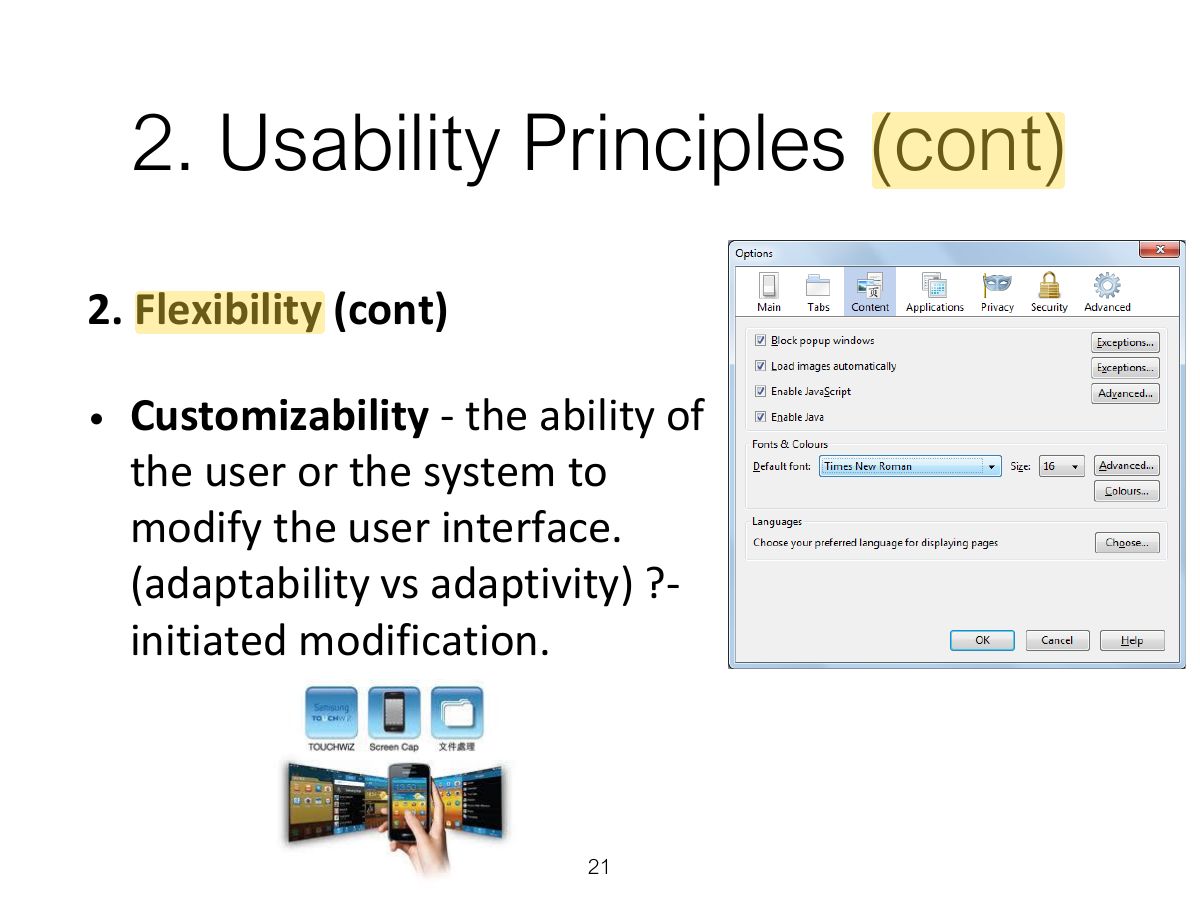
                Letting users customize toolbars belongs to:

                Slide 10: 2. Usability Principles (cont)
                Exam weight Low
                  Slide 11: 2. Usability Principles (cont)
                  Exam weight Low
                    Slide 12: 2. Usability Principles (cont)
                    Exam weight Low

                      13
                      Exam weight Low
                        Slide 14: 2. Usability Principles (cont)
                        Exam weight Low
                          Slide 15: 2. Usability Principles (cont)
                          Exam weight Low
                            Slide 16: 2. Usability Principles (cont)
                            Exam weight Low
                              Slide 17: 2. Usability Principles (cont)
                              Exam weight Low
                                Slide 18: Slide 18
                                Exam weight Low
                                  Slide 19: 2. Usability Principles (cont)
                                  Exam weight Low
                                    Slide 20: 2. Usability Principles (cont)
                                    Exam weight Low
                                      Slide 21: 2. Usability Principles (cont)
                                      Exam weight Low
                                        Slide 22: 2. Usability Principles (cont)
                                        Exam weight Low
                                          Slide 23: 2. Usability Principles (cont)
                                          Exam weight Low
                                            Slide 24: 2. Usability Principles (cont)
                                            Exam weight Low
                                              Slide 25: 2. Usability Principles (cont)
                                              Exam weight Low

                                                2. Usability Principles (cont)

                                                3. Robustness (cont)

                                                • Task conformance - the extent to which the system services support all the tasks the user would wish to perform and in the way the user would wish to perform.
                                                26
                                                Exam weight Low
                                                  Slide 27: 3. Heuristic & Golden Rules
                                                  Exam weight High
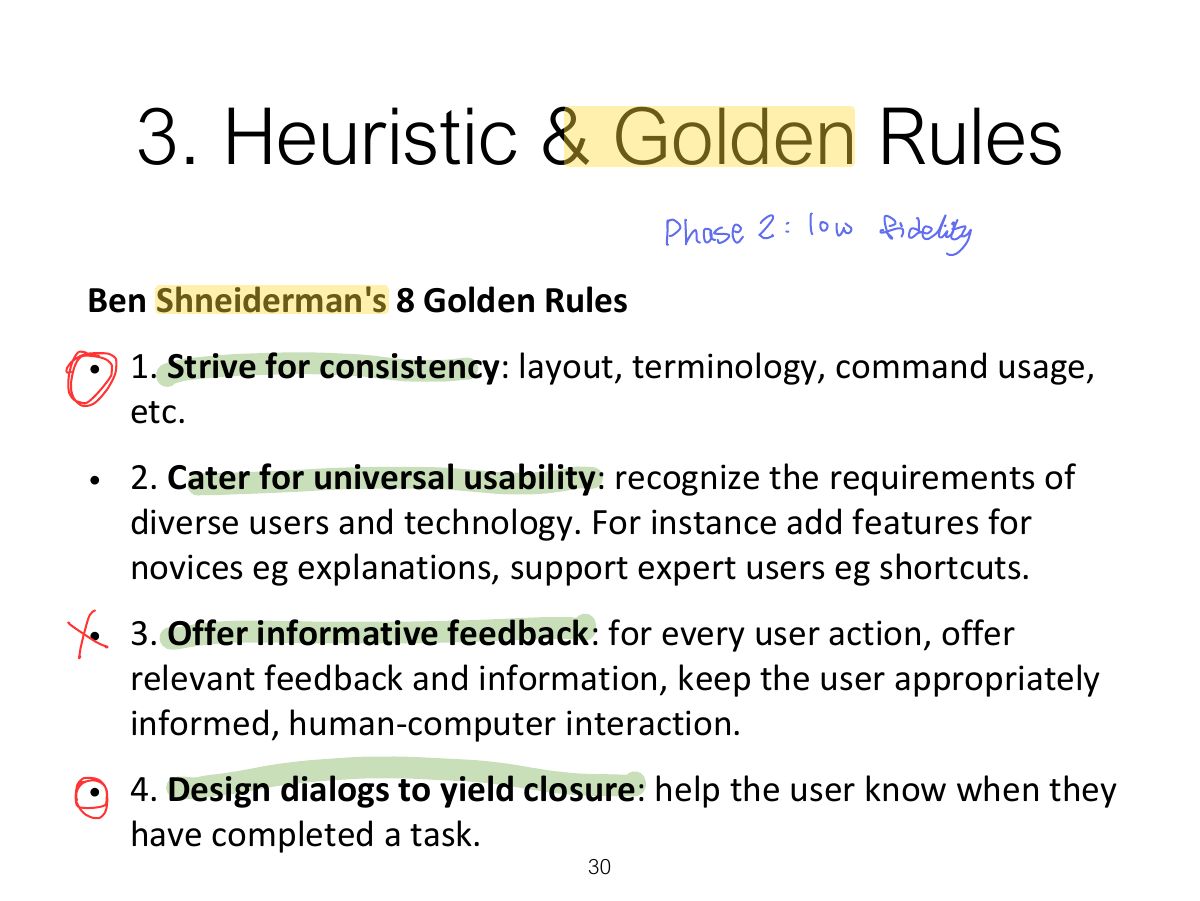
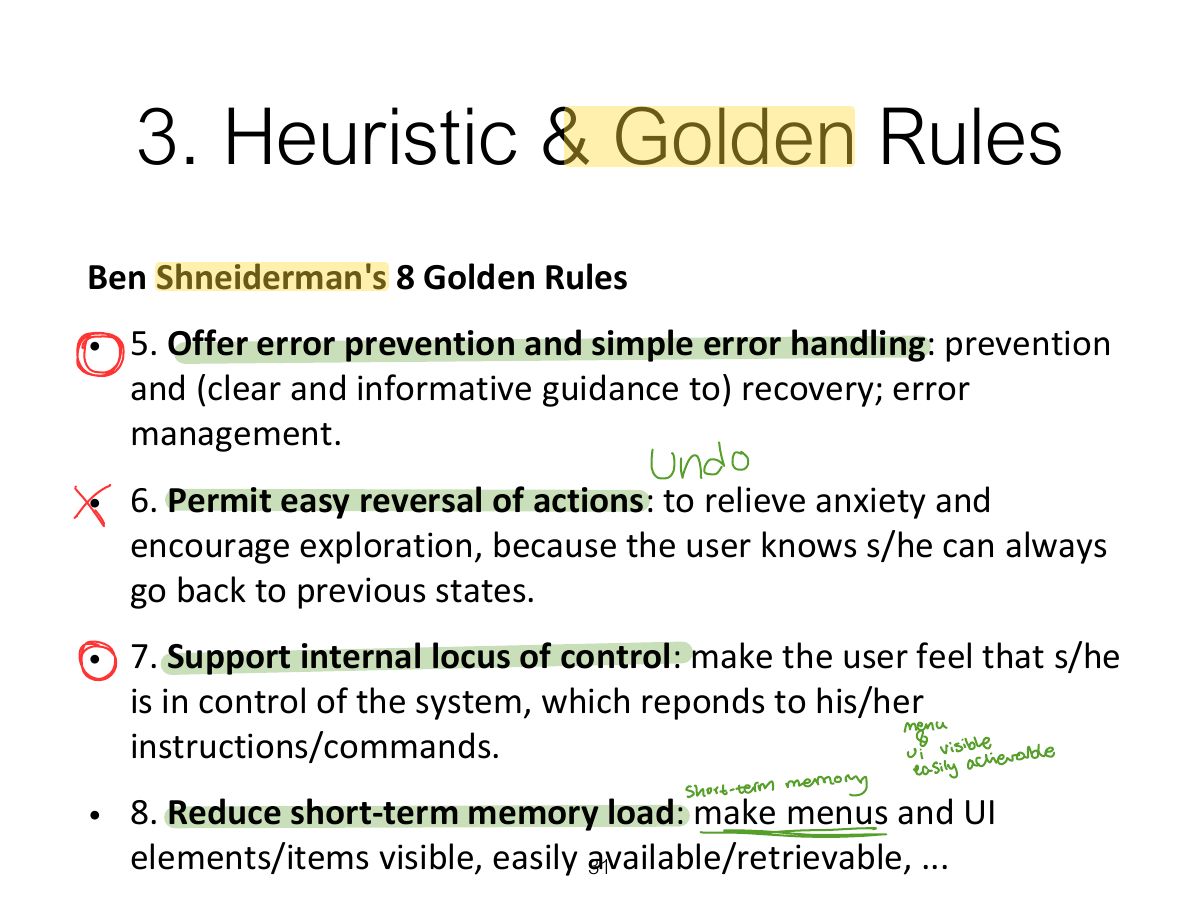
                                                  1. Shneiderman’s 8 golden rules: strive for consistency, universal usability (shortcuts), informative feedback, dialogs that yield closure, prevent errors, permit easy reversal, keep users in control, reduce short-term memory load.
                                                  🎯 How this can come up · 1 question
                                                  MCQ

                                                  Which is one of Shneiderman’s golden rules?

                                                  3. Heuristic & Golden Rules

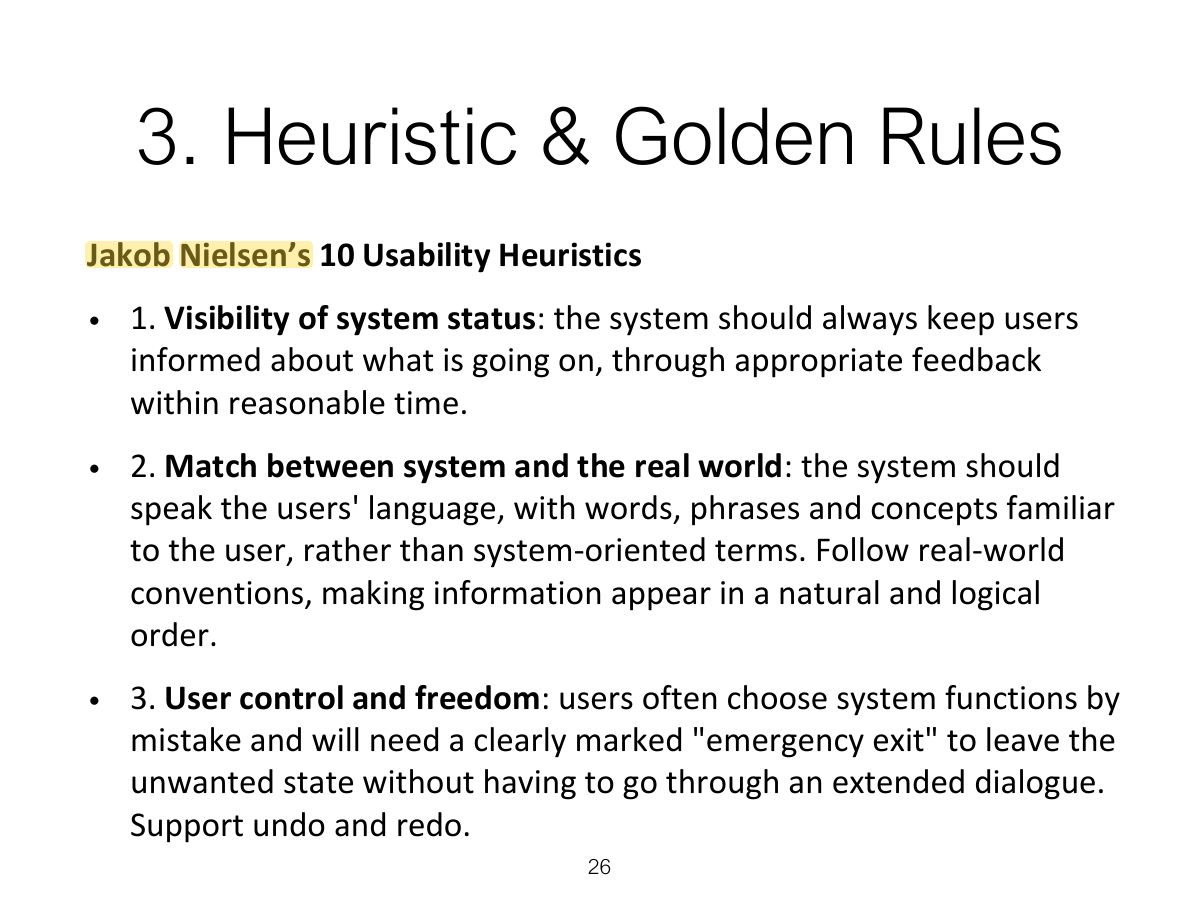
                                                  Jakob Nielsen’s 10 Usability Heuristics

                                                  • 4. Consistency and standards: users should not have to wonder whether different words, situations, or actions mean the same thing. Follow platform conventions.
                                                  • 5. Error prevention: even better than good error messages is a careful design which prevents a problem from occurring in the first place.
                                                  • 6. Recognition rather than recall: make objects, actions, and options visible. The user should not have to remember information from one part of the dialogue to another. Instructions for use of the system should be visible or easily retrievable whenever appropriate.
                                                  28
                                                  Exam weight Low

                                                    3. Heuristic & Golden Rules

                                                    Jakob Nielsen’s 10 Usability Heuristics

                                                    • 7. Flexibility and efficiency of use: accelerators -- unseen by the novice user -- may often speed up the interaction for the expert user such that the system can cater to both inexperienced and experienced users. Allow users to tailor frequent actions.
                                                    • 8. Aesthetic and minimalist design: dialogues should not contain information which is irrelevant or rarely needed. Every extra unit of information in a dialogue competes with the relevant units of information and diminishes their relative visibility.
                                                    29
                                                    Exam weight Low

                                                      3. Heuristic & Golden Rules

                                                      Jakob Nielsen’s 10 Usability Heuristics

                                                      • 9. Help users recognize, diagnose, and recover from errors: error messages should be expressed in plain language (no codes), precisely indicate the problem, and constructively suggest a solution.
                                                      • 10. Help and documentation: even though it is better if the system can be used without documentation, it may be necessary to provide help and documentation. Any such information should be easy to search, focused on the user's task, list concrete steps to be carried out, and not be too large.
                                                      30
                                                      Exam weight Low
                                                        Slide 32: 3. Heuristic & Golden Rules
                                                        Exam weight Low
                                                          Slide 33: 3. Heuristic & Golden Rules
                                                          Exam weight Low
                                                            Slide 34: Summary
                                                            Exam weight Low

                                                              LINKS

                                                              • https://www.nngroup.com/articles/ten-usability-heuristics/
                                                              35
                                                              Exam weight Low