CYS403 · Annotated SlidesChapter 5 — Risk Assessment Approaches
Chapter 5 · Annotated slides

Risk Assessment Approaches

Why risk assessments matter, their critical components, quantitative assessment with SLE, ARO, ALE and cost–benefit analysis, qualitative assessment with likelihood/impact matrices, and the risk assessment report.
Slide text Study notes Highlight: key words Tips, tricks & traps Seen again elsewhere How it can come up
Slide 1: Slide 1
Exam weight Low

    • CLO 2: Synthesize the principles of cyber security risk management and a framework of components: identification, protection, detection, response and recovery.
    • CLO 3: Develop a working knowledge of types of policy, how policy is created, how to implement and manage policy, measurement practices, and audit of policy
    Slide 2
    2
    Exam weight Low

      T VA worksheet

      T VA worksheet
      3
      Exam weight Low

        Class Activity

        • Check LMS
        Class Activity
        4
        Exam weight Low

          • Quiz will be next Sunday 13/09/2026
          Slide 5
          5
          Exam weight Low

            What is next?

            • Risk assessment: Quantitative OR Qualitative
            What is next?
            6
            Exam weight Low

              Risk assessment

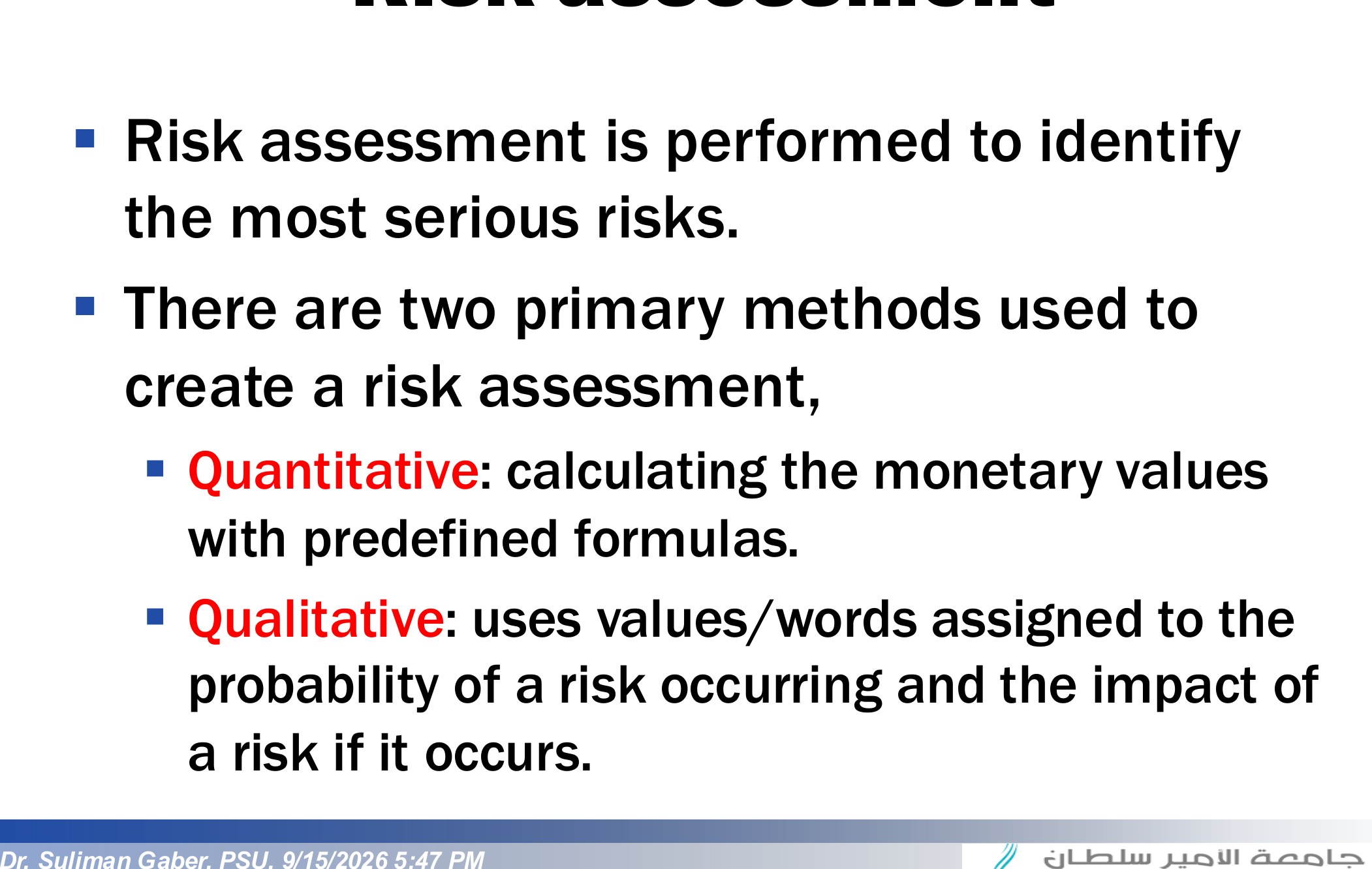
              • Risk assessment is performed to identify the most serious risks.
              • There are two primary methods used to create a risk assessment,
                • Quantitative: calculating the monetary values with predefined formulas.
                • Qualitative: uses values/words assigned to the probability of a risk occurring and the impact of a risk if it occurs.
              Risk assessment
              7
              Exam weight Low

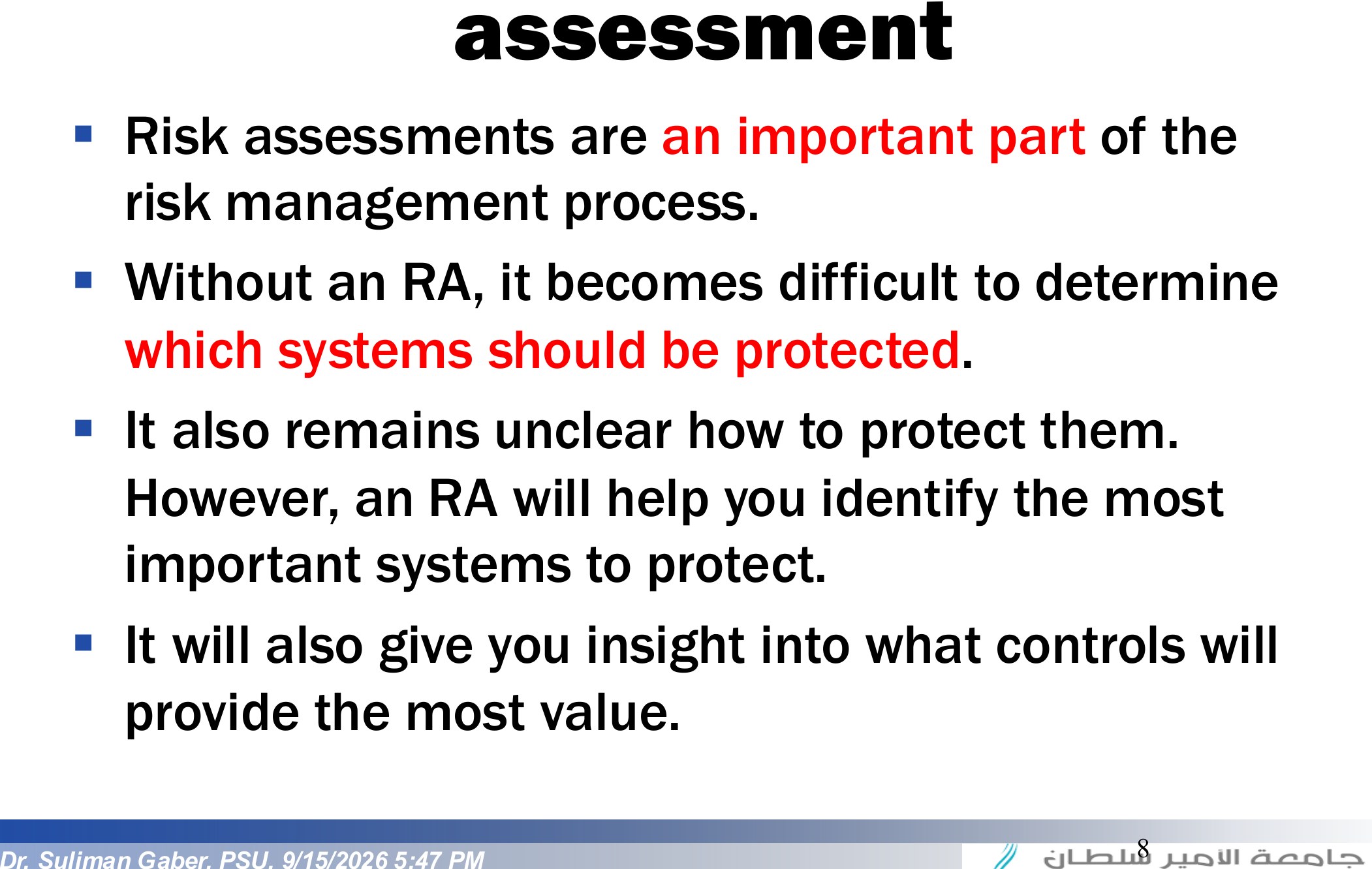
                Importance of Risk assessment

                • Risk assessments are an important part of the risk management process.
                • Without an RA, it becomes difficult to determine which systems should be protected.
                • It also remains unclear how to protect them. However, an RA will help you identify the most important systems to protect.
                • It will also give you insight into what controls will provide the most value.
                Importance of Risk assessment
                8
                Exam weight Low
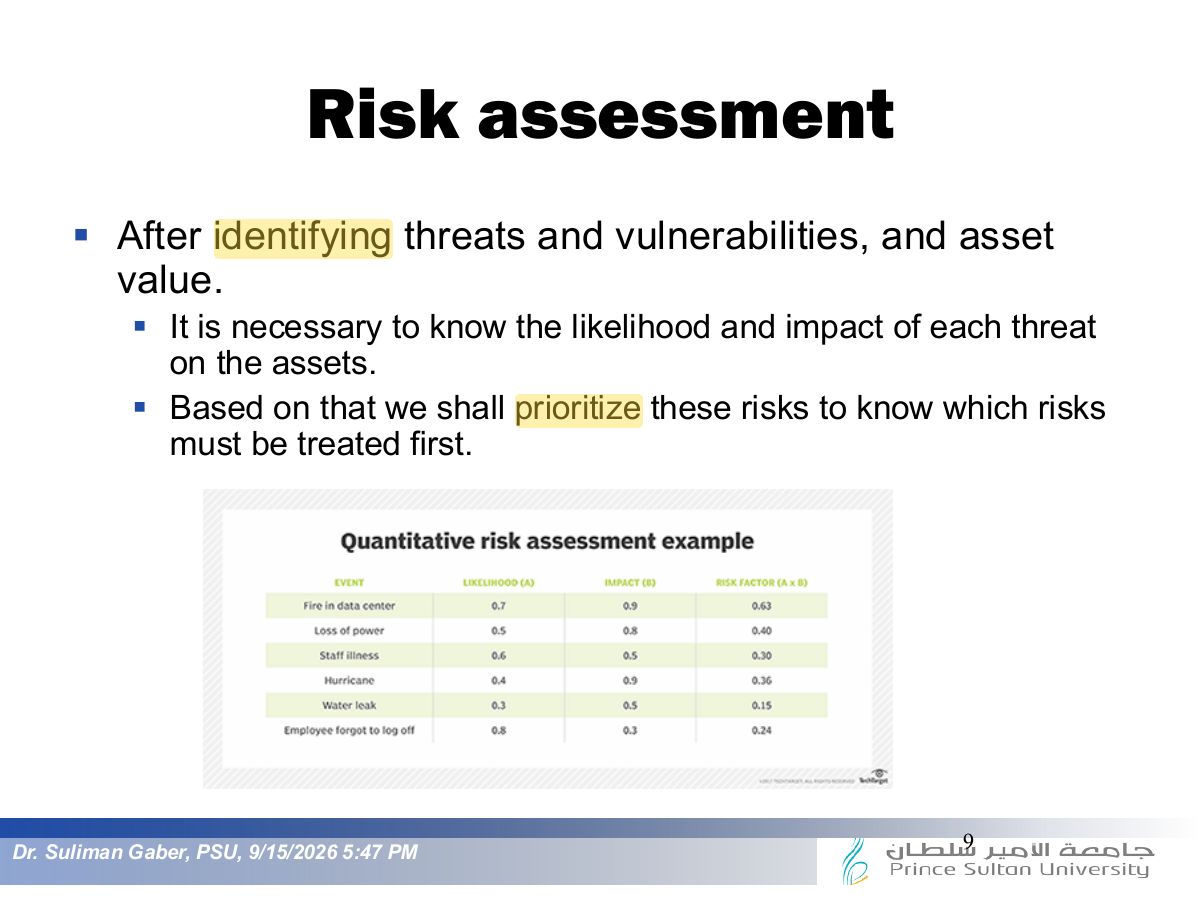
                1. A risk assessment tells management which risks matter most and where to spend money.
                Slide 9: Risk assessment
                Exam weight Low

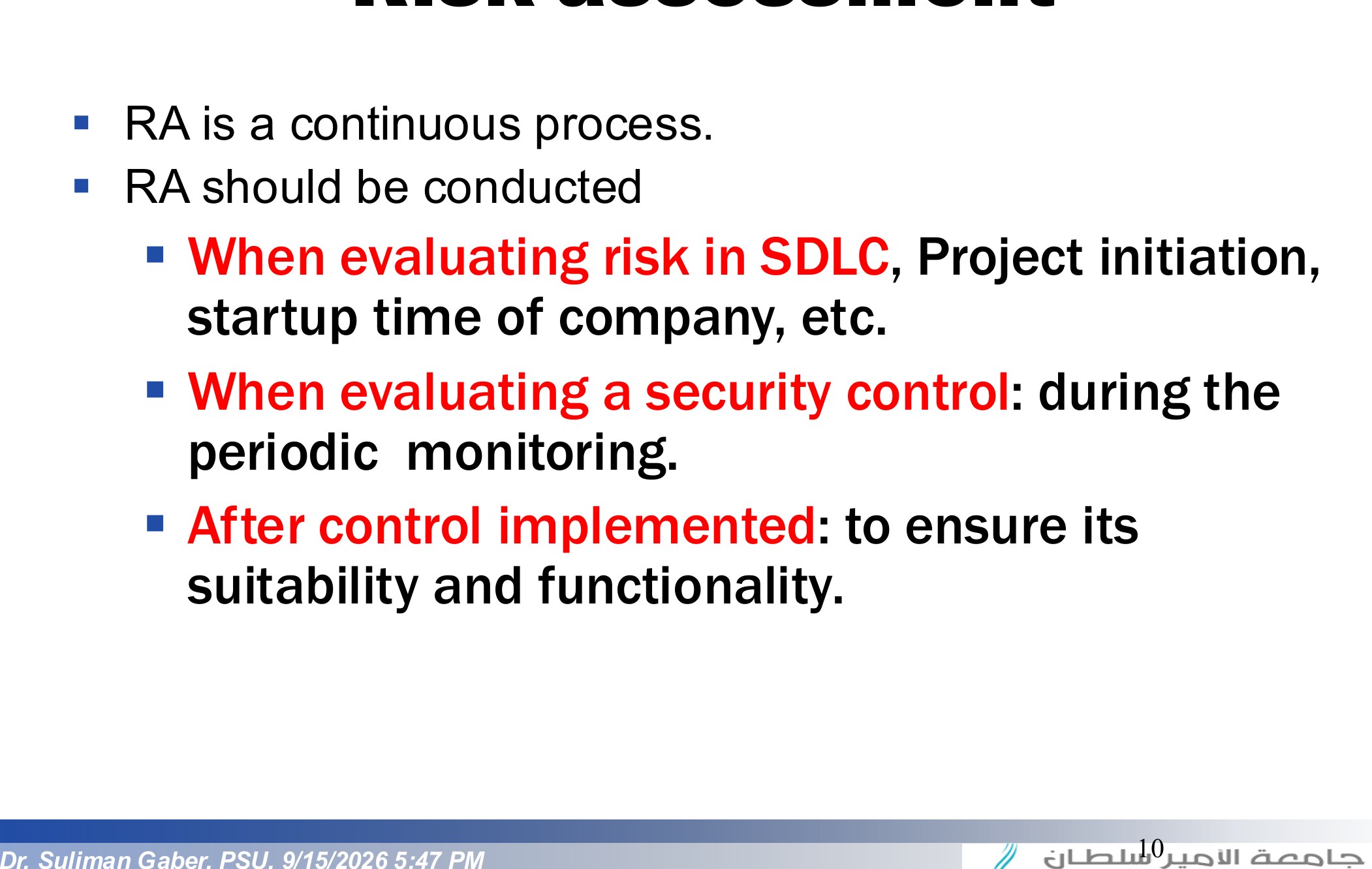
                  Risk assessment

                  • RA is a continuous process.
                  • RA should be conducted
                    • When evaluating risk in SDLC, Project initiation, startup time of company, etc.
                    • When evaluating a security control: during the periodic monitoring.
                    • After control implemented: to ensure its suitability and functionality.
                  Risk assessment
                  10
                  Exam weight Low

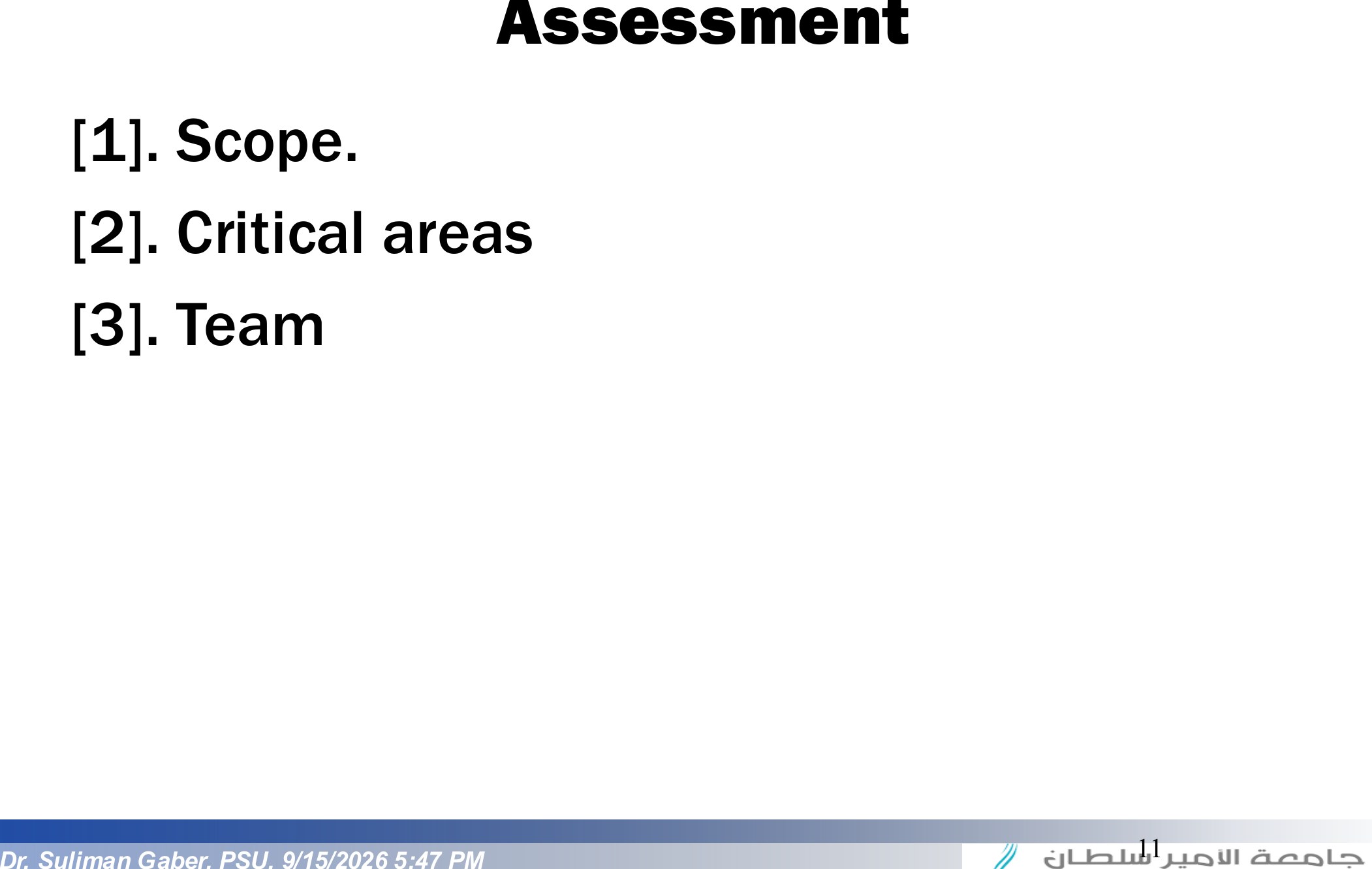
                    Critical Components of a Risk Assessment

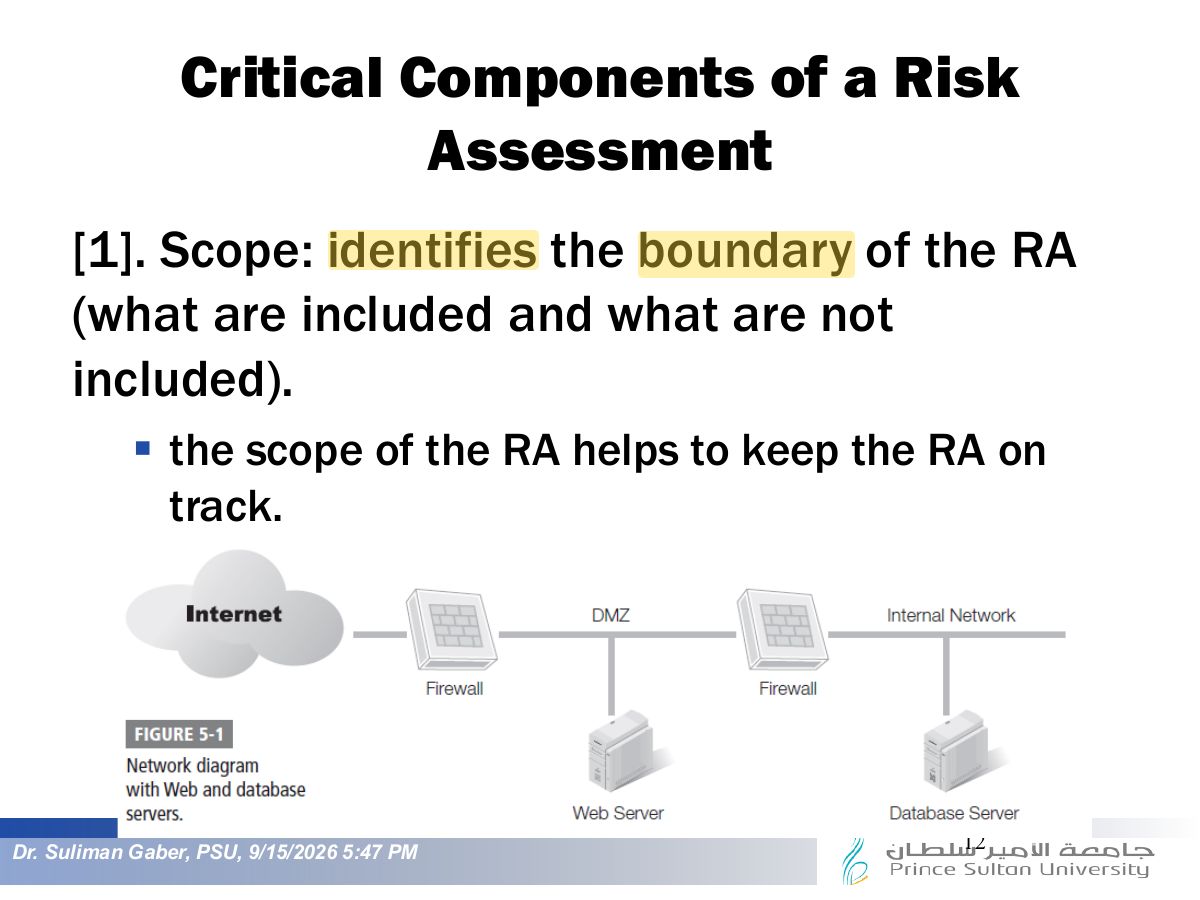
                    [1]. Scope.

                    [2]. Critical areas [3]. Team

                    Critical Components of a Risk Assessment
                    11
                    Exam weight Low
                    1. Critical components: scope, data collection, threats and vulnerabilities, likelihood, impact, risk determination, recommendations, documentation.
                    Slide 12: Critical Components of a Risk Assessment
                    Exam weight Low

                      Critical Components of a Risk Assessment

                      [2]. critical areas: The RA also identifies critical areas that should be included.

                      • For example, a scope could include a Web server, a database server, and a firewall.
                        • Web server: SPOF, OS update batch,
                        • Database server: only data that are exchanged with webserver.
                        • Firewall: inspecting all the traffic
                      • This helps the RA team focus only on what’s important.
                      Critical Components of a Risk Assessment
                      13
                      Exam weight Low

                        Critical Components of a Risk Assessment

                        [3]. Team: RA team personnel should not be the same people who are responsible for correcting deficiencies.

                        • This helps avoid a conflict of interest.
                        • But, the input from the responsible people is very important.
                        Critical Components of a Risk Assessment
                        14
                        Exam weight Low
                          Slide 15: Types of Risk assessment
                          Exam weight Low
                          1. Types: quantitative, qualitative, and hybrid (semi-quantitative).

                          Types of Risk assessment

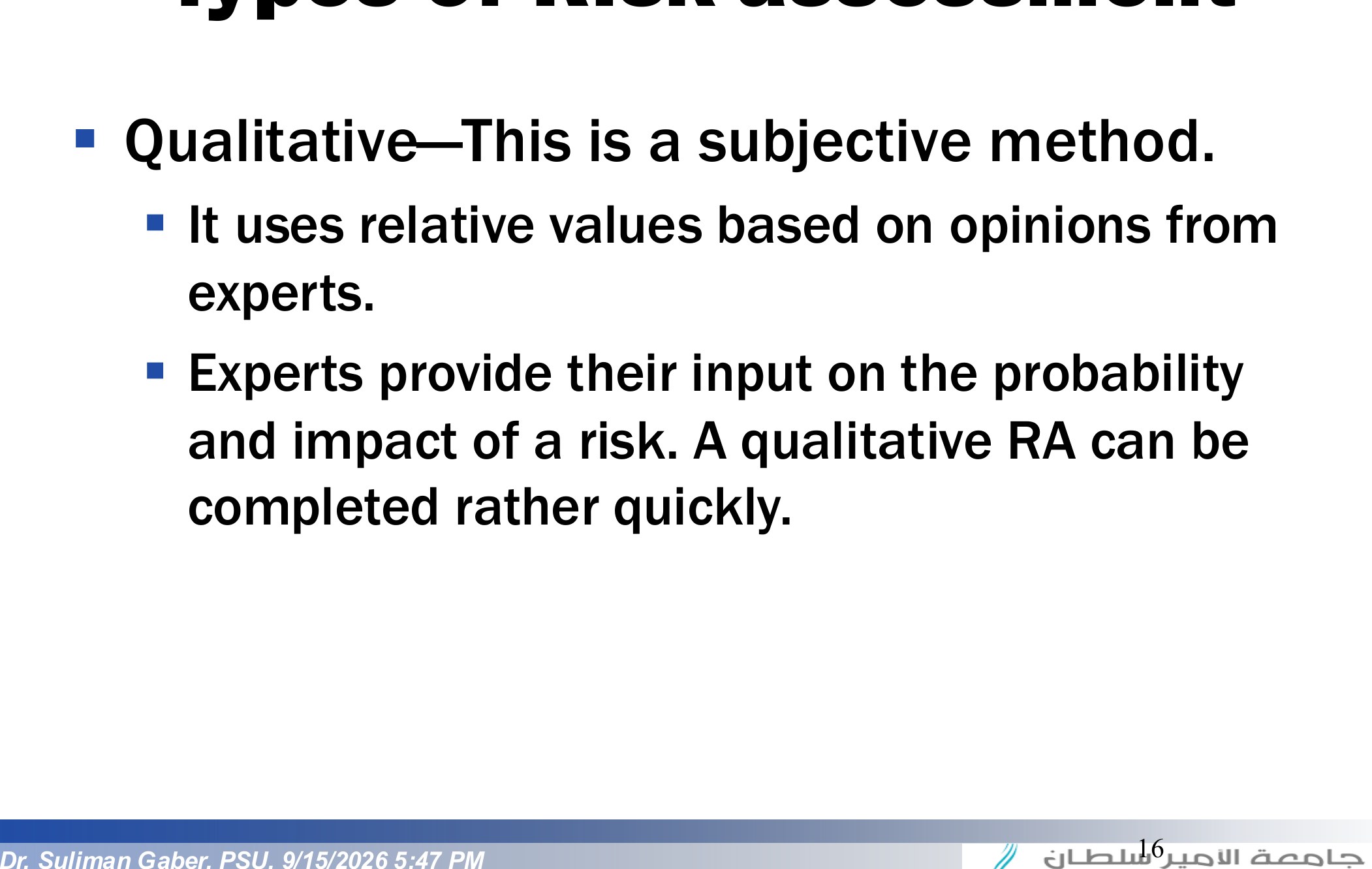
                          • Qualitative — This is a subjective method.
                            • It uses relative values based on opinions from experts.
                            • Experts provide their input on the probability and impact of a risk. A qualitative RA can be completed rather quickly.
                          Types of Risk assessment
                          16
                          Exam weight Low

                            Quantitative Risk Assessments

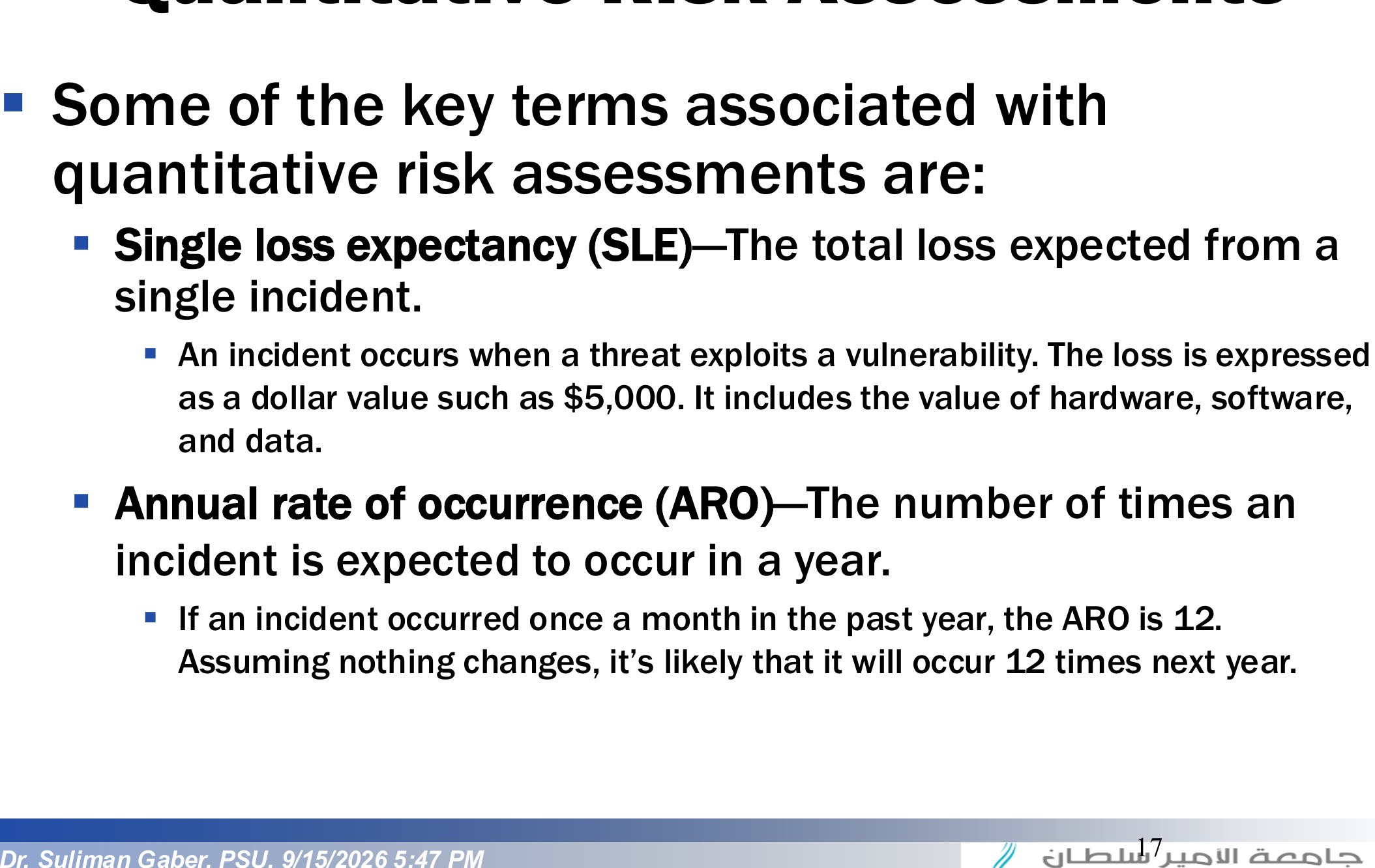
                            • Some of the key terms associated with quantitative risk assessments are:
                              • Single loss expectancy (SLE) — The total loss expected from a single incident.
                                • An incident occurs when a threat exploits a vulnerability. The loss is expressed as a dollar value such as $5,000. It includes the value of hardware, software, and data.
                              • Annual rate of occurrence (ARO) — The number of times an incident is expected to occur in a year.
                                • If an incident occurred once a month in the past year, the ARO is 12. Assuming nothing changes, it’s likely that it will occur 12 times next year.
                            Quantitative Risk Assessments
                            17
                            Exam weight High
                            1. SLE = AV × EF · ARO = how many times a year · ALE = SLE × ARO · Value of a control = ALE(before) − ALE(after) − annual cost of the control.
                            TipSLE = AV × EF · ARO = how many times a year · ALE = SLE × ARO · Value of a control = ALE(before) − ALE(after) − annual cost of the control.
                            🎯 How this can come up · 1 question
                            Written

                            ALE is $64,000 a year. A mitigation service cuts attacks to 80% of the original number and costs $1,000/month + $1,500 installation. What is the control’s value in year one?

                            Quantitative Risk Assessments

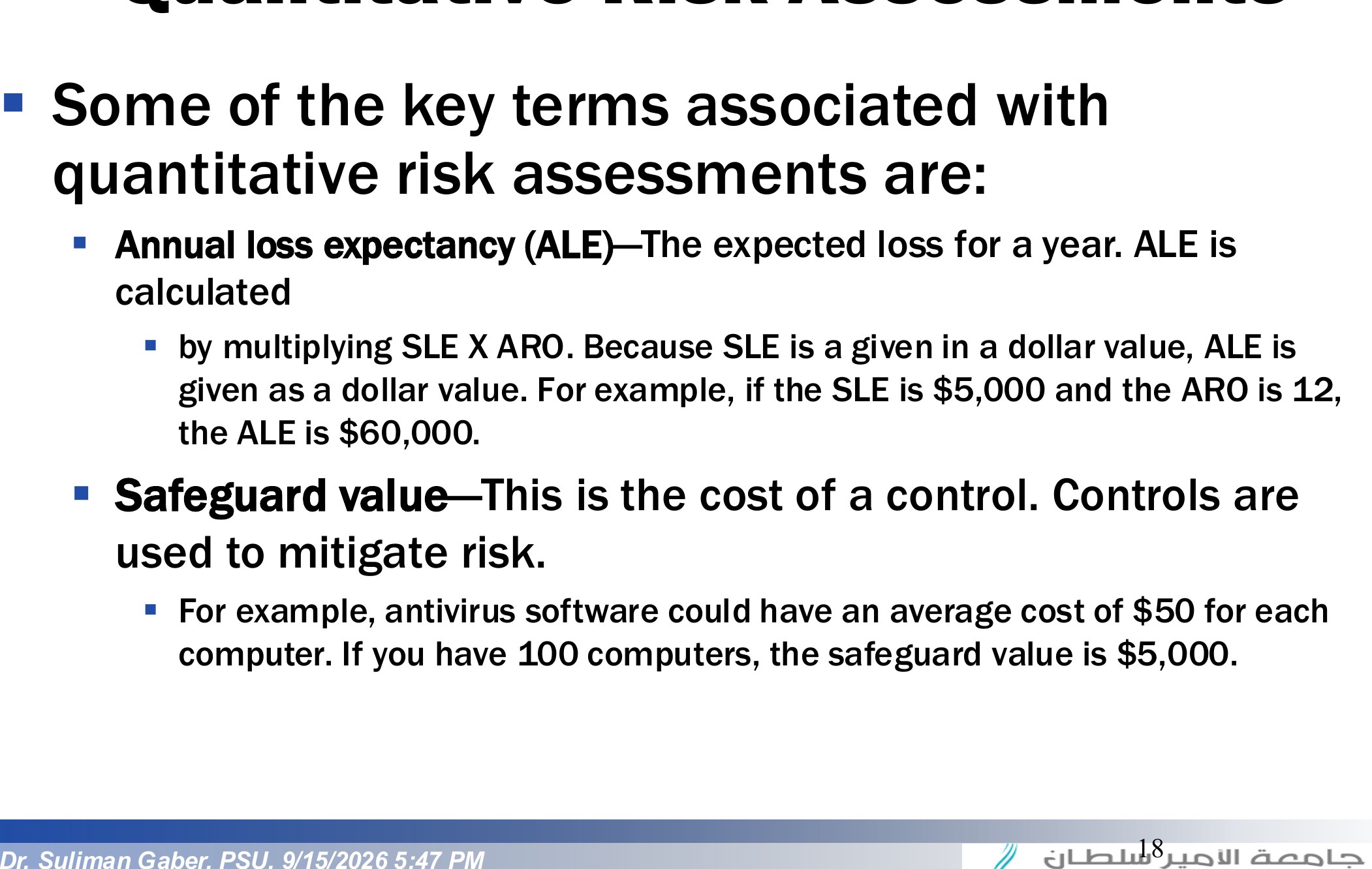
                            • Some of the key terms associated with quantitative risk assessments are:
                              • Annual loss expectancy (ALE) — The expected loss for a year. ALE is calculated
                                • by multiplying SLE X ARO. Because SLE is a given in a dollar value, ALE is given as a dollar value. For example, if the SLE is $5,000 and the ARO is 12, the ALE is $60,000.
                              • Safeguard value — This is the cost of a control. Controls are used to mitigate risk.
                                • For example, antivirus software could have an average cost of $50 for each computer. If you have 100 computers, the safeguard value is $5,000.
                            Quantitative Risk Assessments
                            18
                            Exam weight Low

                              Class activity

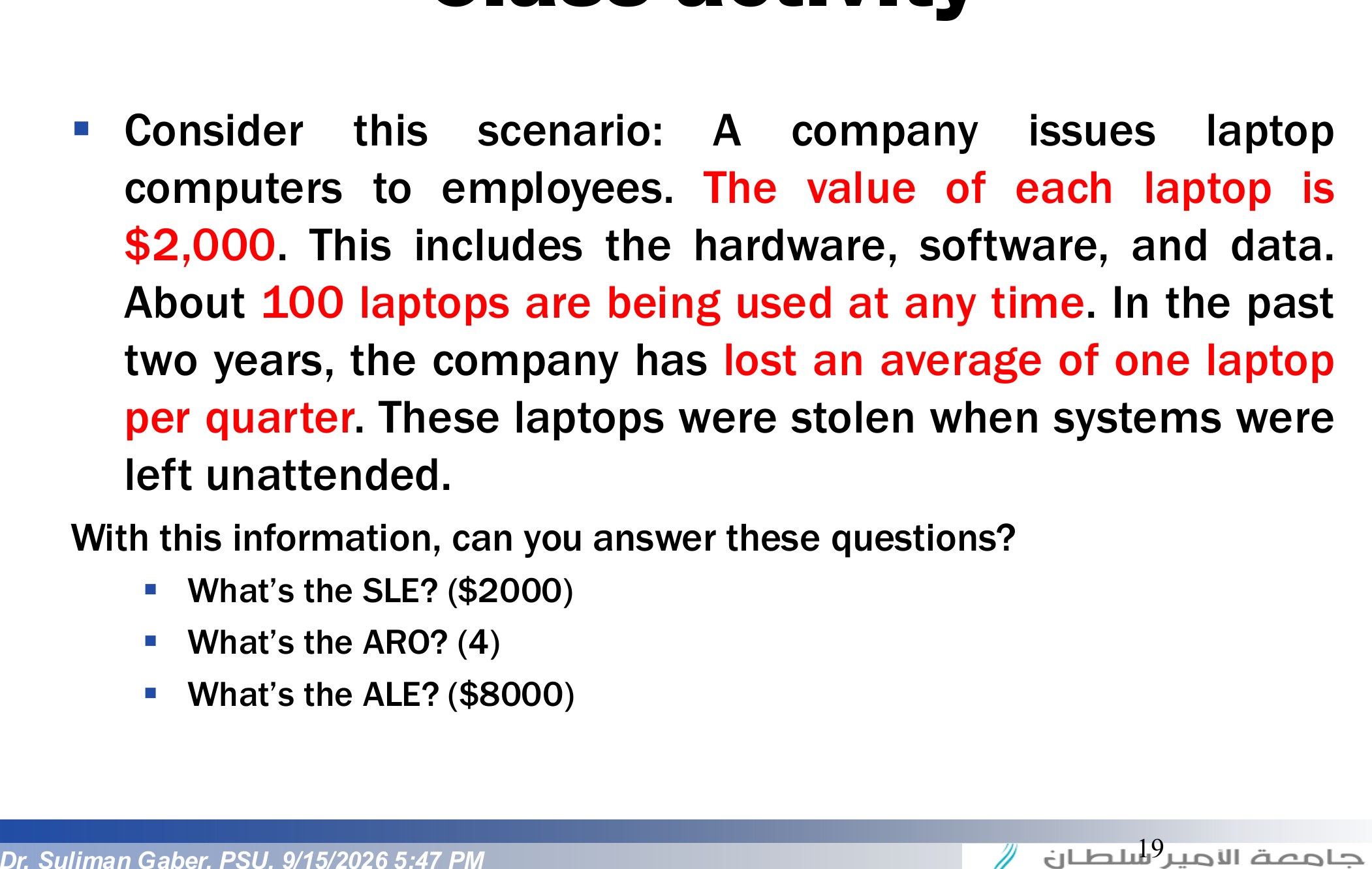
                              • Consider this scenario: A company issues laptop computers to employees. The value of each laptop is $2,000. This includes the hardware, software, and data. About 100 laptops are being used at any time. In the past two years, the company has lost an average of one laptop per quarter. These laptops were stolen when systems were left unattended.

                              With this information, can you answer these questions?

                              • What’s the SLE? ($2000)
                              • What’s the ARO? (4)
                              • What’s the ALE? ($8000)
                              Class activity
                              19
                              Exam weight Low

                                Class activity

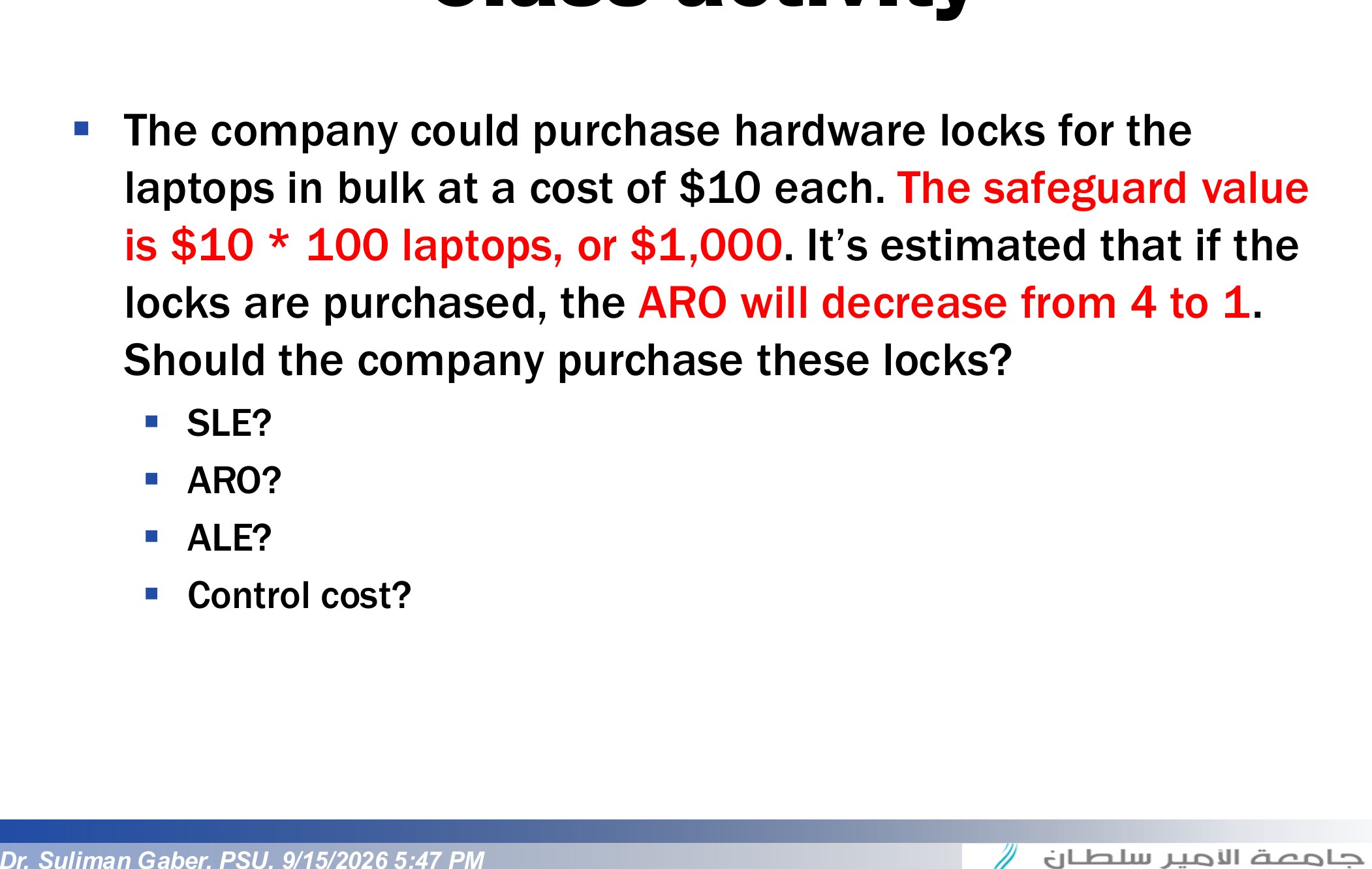
                                • The company could purchase hardware locks for the laptops in bulk at a cost of $10 each. The safeguard value is $10 * 100 laptops, or $1,000. It’s estimated that if the locks are purchased, the ARO will decrease from 4 to 1. Should the company purchase these locks?
                                  • SLE?
                                  • ARO?
                                  • ALE?
                                  • Control cost?
                                Class activity
                                20
                                Exam weight Low

                                  Class activity

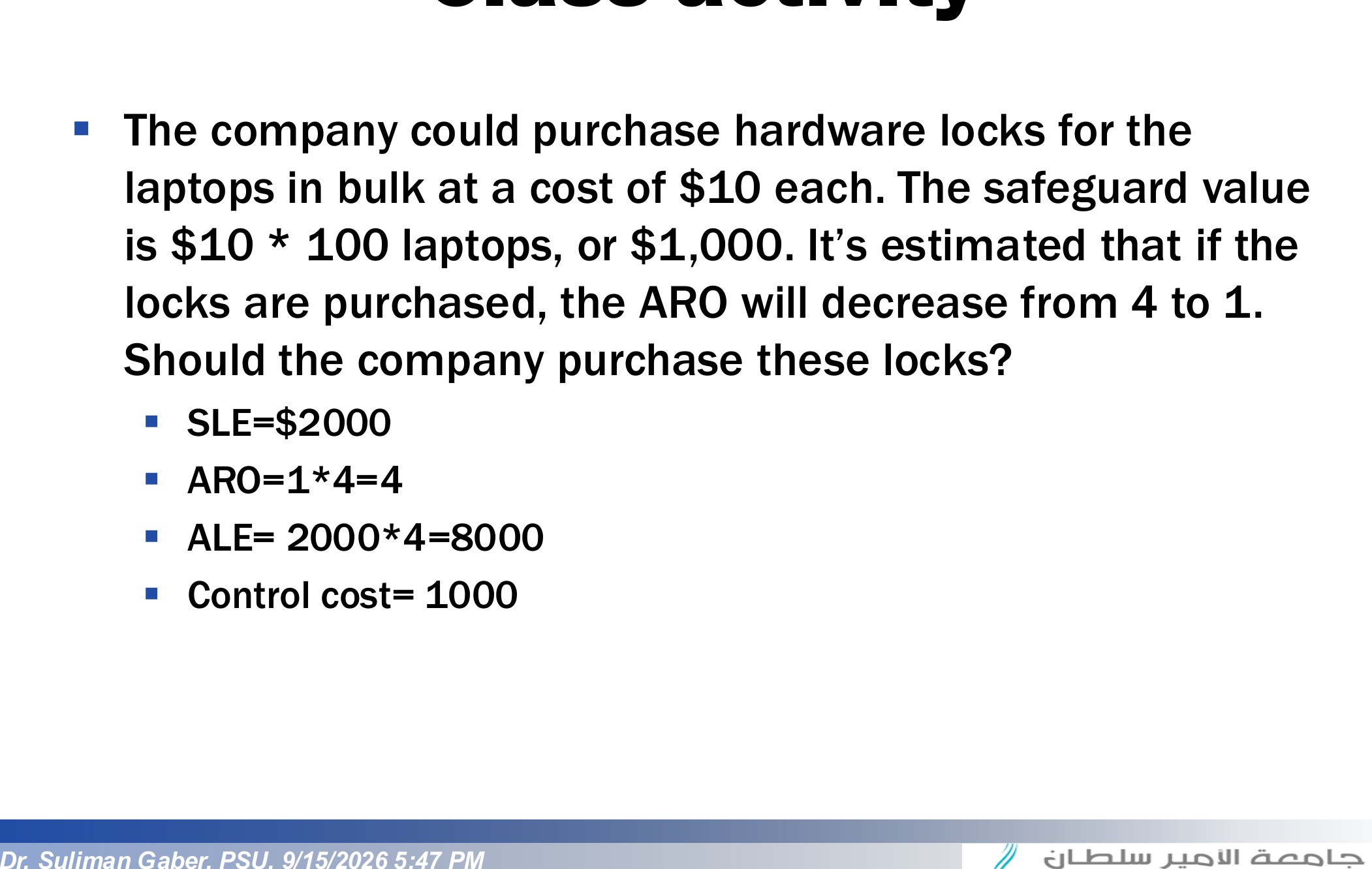
                                  • The company could purchase hardware locks for the laptops in bulk at a cost of $10 each. The safeguard value is $10 * 100 laptops, or $1,000. It’s estimated that if the locks are purchased, the ARO will decrease from 4 to 1. Should the company purchase these locks?
                                    • SLE=$2000
                                    • ARO=1*4=4
                                    • ALE= 2000*4=8000
                                    • Control cost= 1000
                                  Class activity
                                  21
                                  Exam weight Low

                                    Class activity

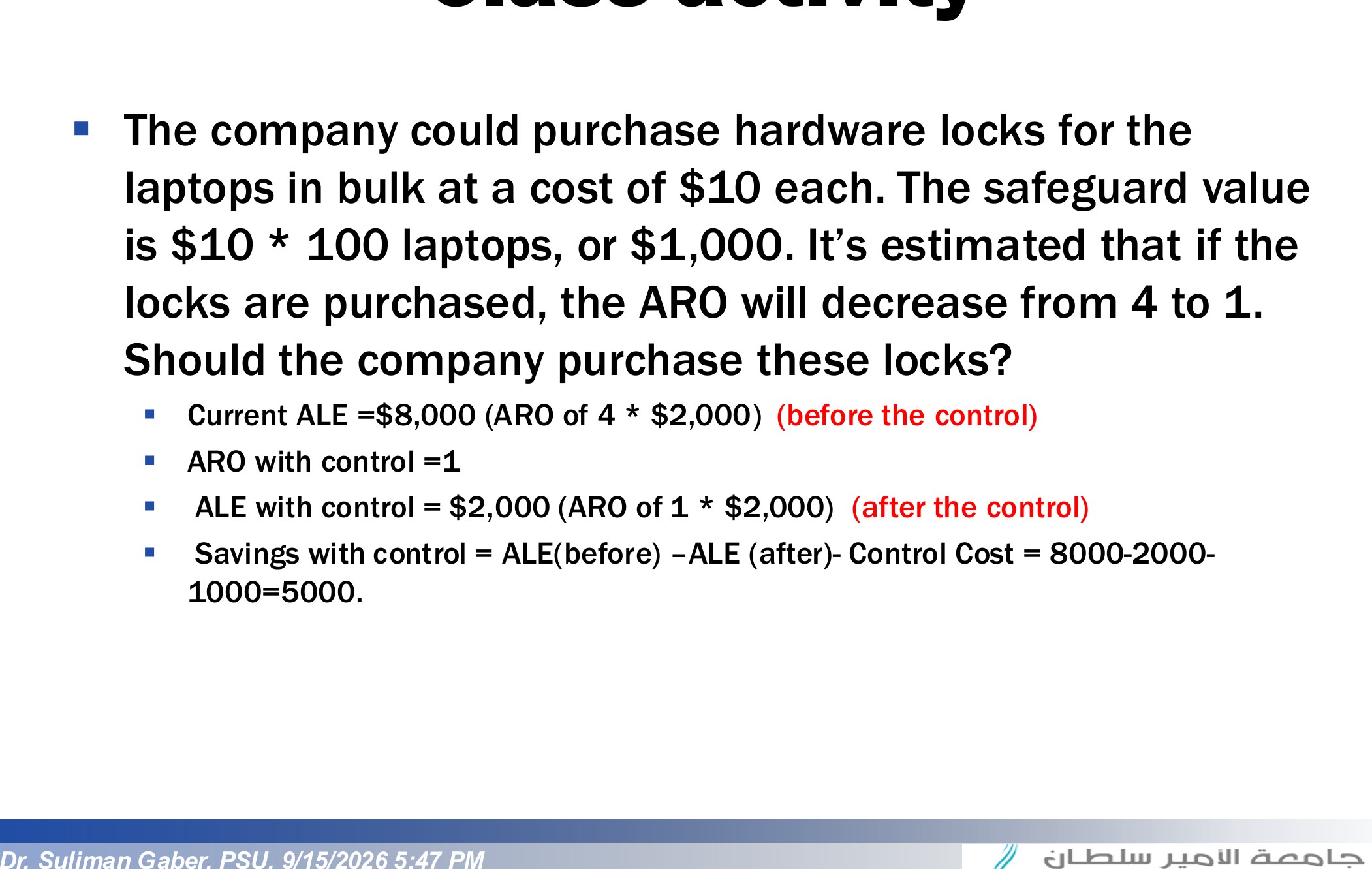
                                    • The company could purchase hardware locks for the laptops in bulk at a cost of $10 each. The safeguard value is $10 * 100 laptops, or $1,000. It’s estimated that if the locks are purchased, the ARO will decrease from 4 to 1. Should the company purchase these locks?
                                      • Current ALE =$8,000 (ARO of 4 * $2,000) (before the control)
                                      • ARO with control =1
                                      • ALE with control = $2,000 (ARO of 1 * $2,000) (after the control)
                                      • Savings with control = ALE(before) – ALE (after)- Control Cost = 8000-2000- 1000=5000.
                                    Class activity
                                    22
                                    Exam weight Low
                                      ★ Past exam

                                      Quantitative Risk assessment

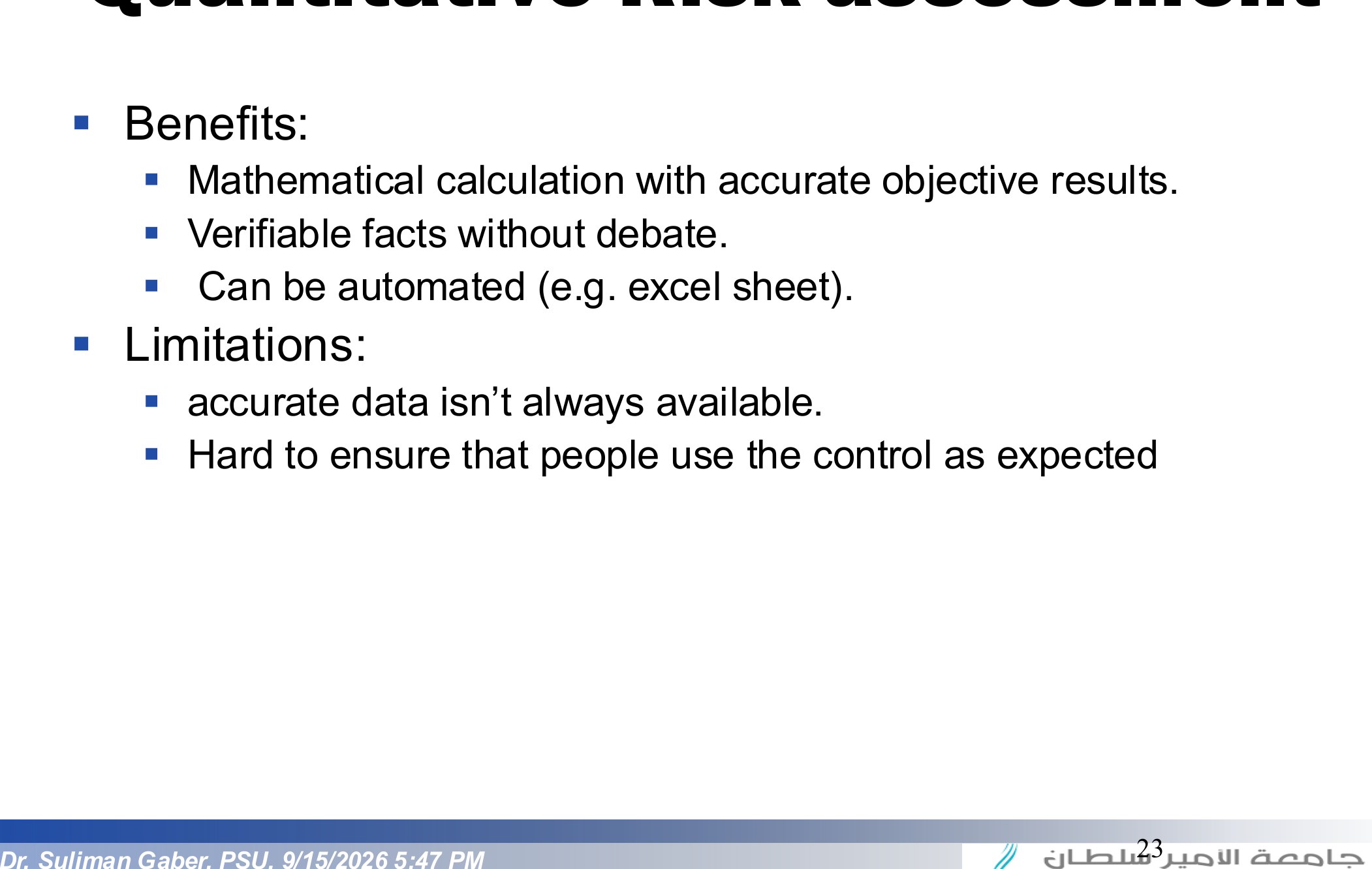
                                      • Benefits:
                                        • Mathematical calculation with accurate objective results.
                                        • Verifiable facts without debate.
                                        • Can be automated (e.g. excel sheet).
                                      • Limitations:
                                        • accurate data isn’t always available.
                                        • Hard to ensure that people use the control as expected
                                      Quantitative Risk assessment
                                      23
                                      Exam weight High
                                      1. Cost–benefit analysis (CBA) is the BEST technique to decide whether a control is cost-effective.
                                      🎯 How this can come up · 1 question
                                      MCQ

                                      The best technique to decide whether a control is cost-effective is:

                                      ★ Past exam

                                      Qualitative Risk Assessments

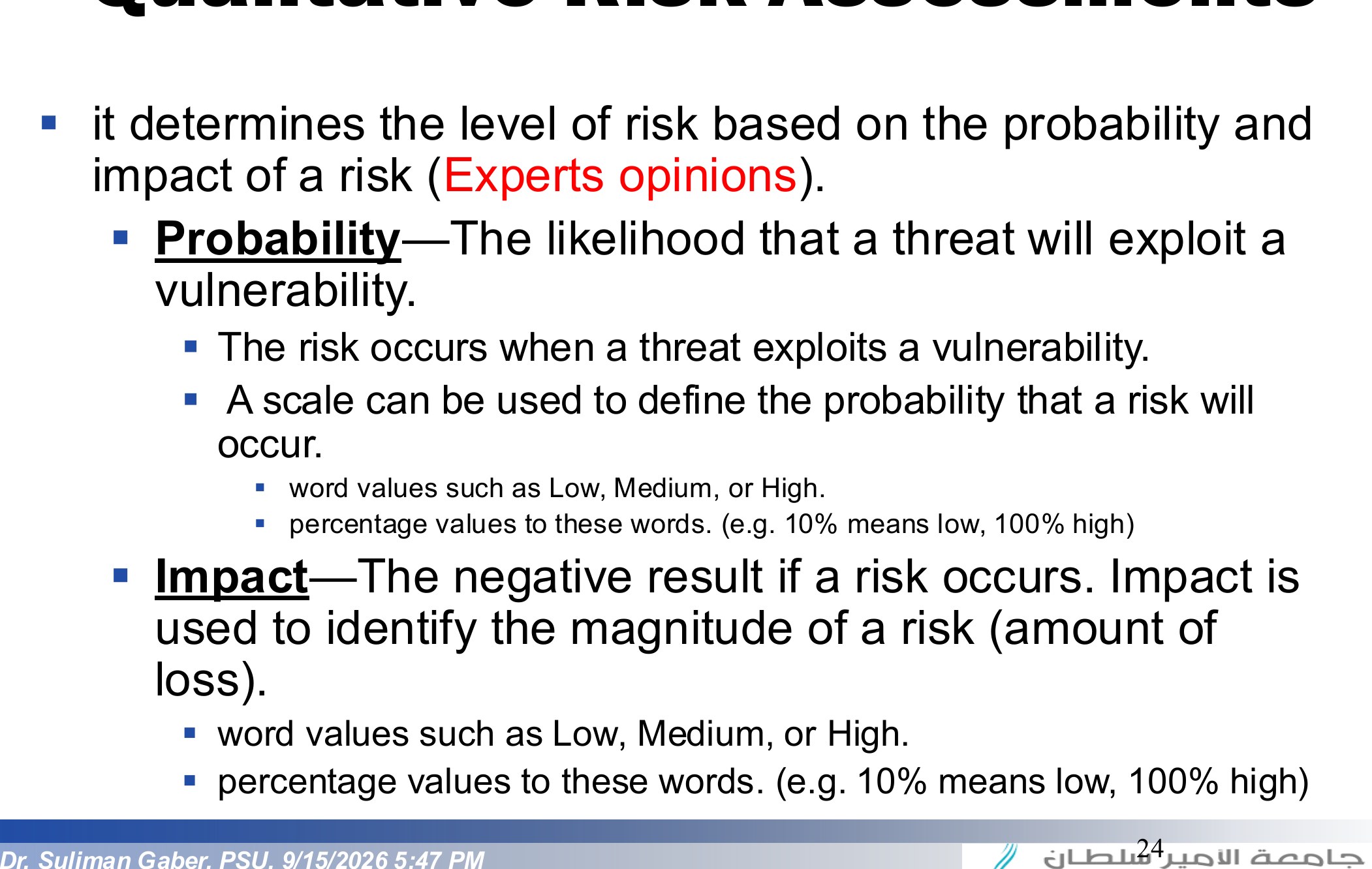
                                      • it determines the level of risk based on the probability and impact of a risk (Experts opinions).
                                        • Probability — The likelihood that a threat will exploit a vulnerability.
                                          • The risk occurs when a threat exploits a vulnerability.
                                          • A scale can be used to define the probability that a risk will occur.
                                            • word values such as Low, Medium, or High.
                                            • percentage values to these words. (e.g. 10% means low, 100% high)
                                        • Impact — The negative result if a risk occurs. Impact is used to identify the magnitude of a risk (amount of loss).
                                          • word values such as Low, Medium, or High.
                                          • percentage values to these words. (e.g. 10% means low, 100% high)
                                      Qualitative Risk Assessments
                                      24
                                      Exam weight Medium
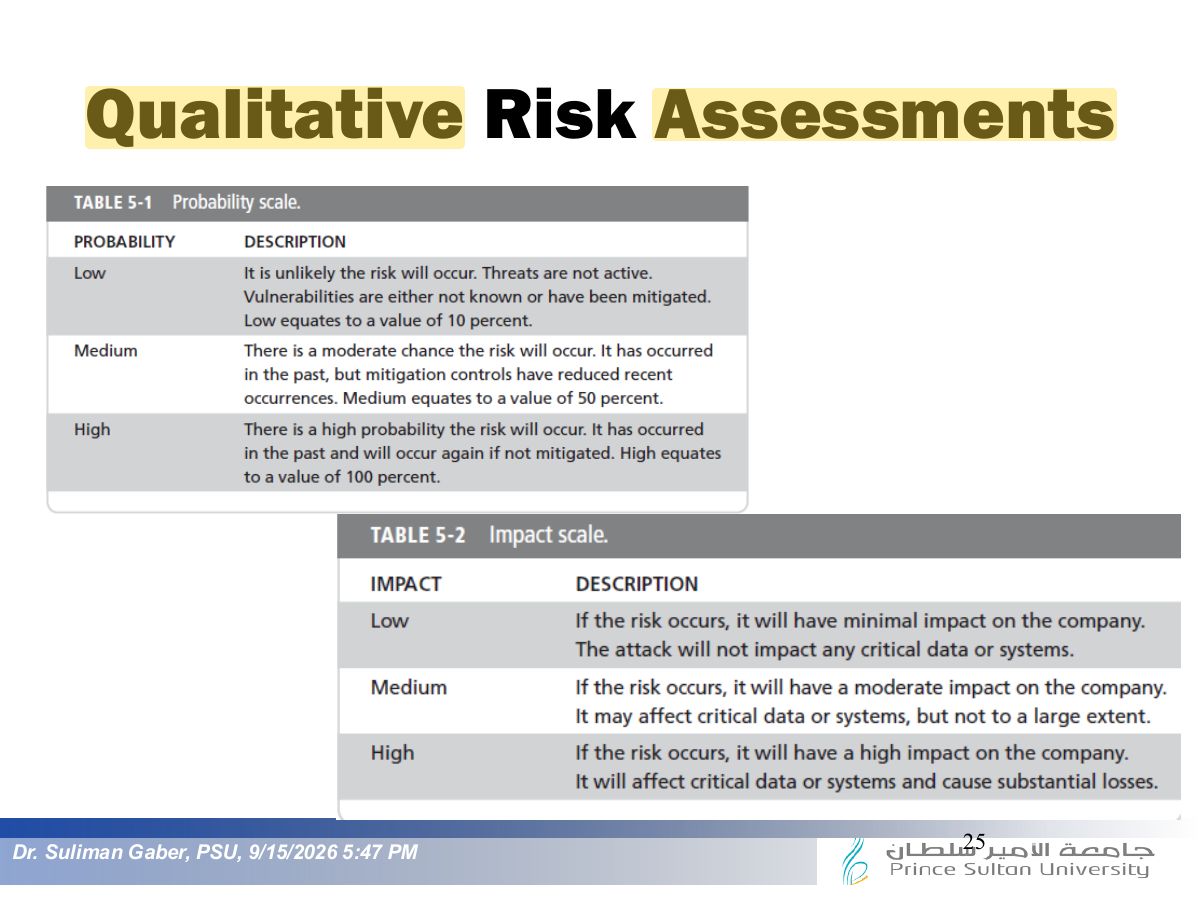
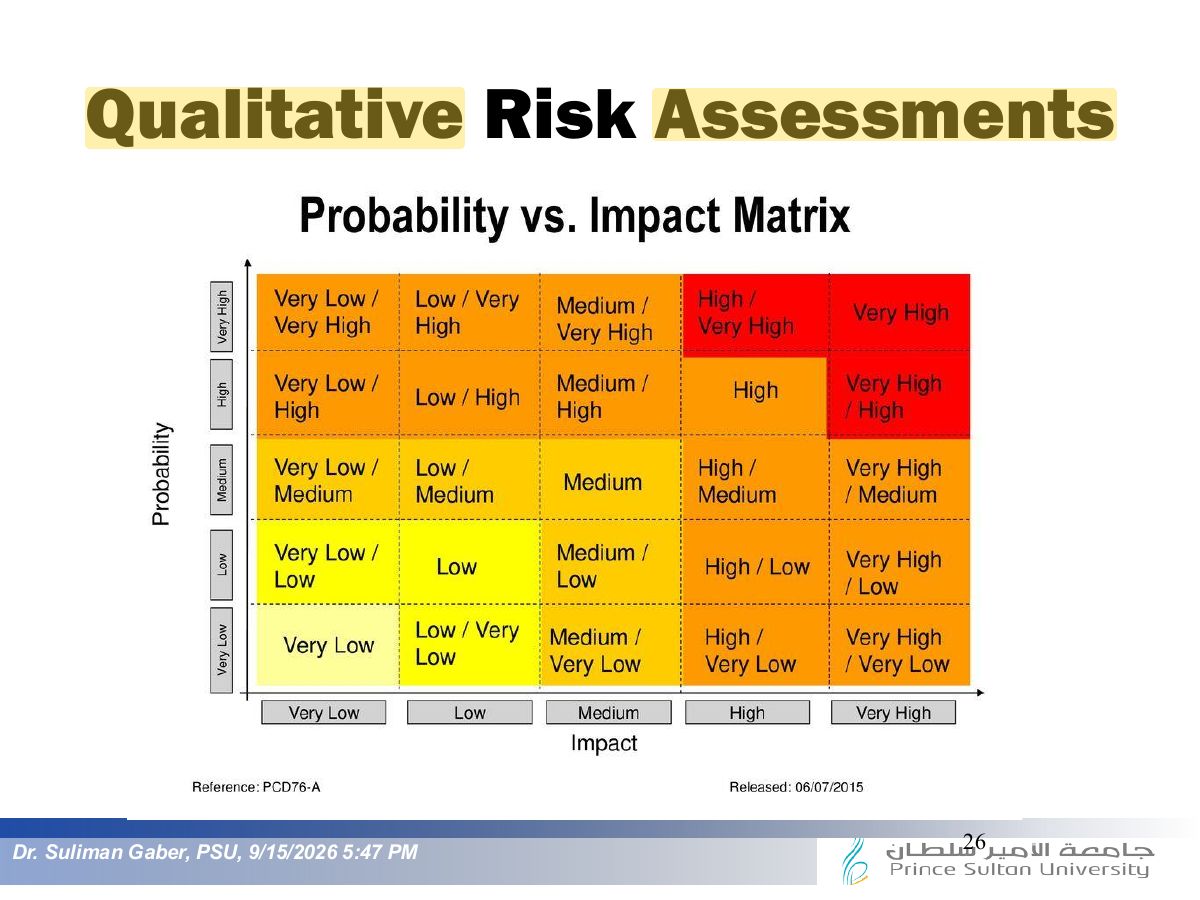
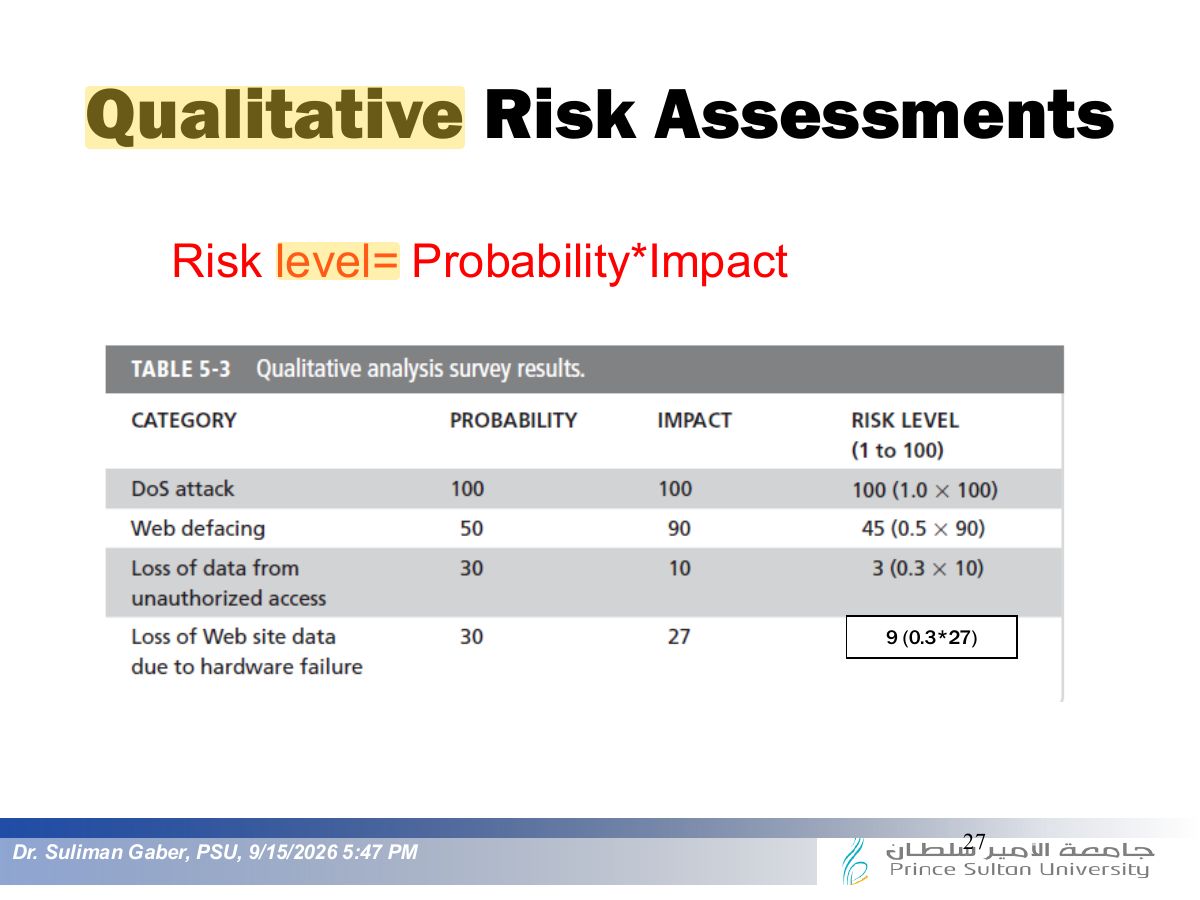
                                      1. Qualitative: rate likelihood and impact (e.g. low/medium/high) and read the risk level from a matrix.
                                      Slide 25: Qualitative Risk Assessments
                                      Exam weight Low
                                        Slide 26: Qualitative Risk Assessments
                                        Exam weight Low
                                          Slide 27: Qualitative Risk Assessments
                                          Exam weight Low
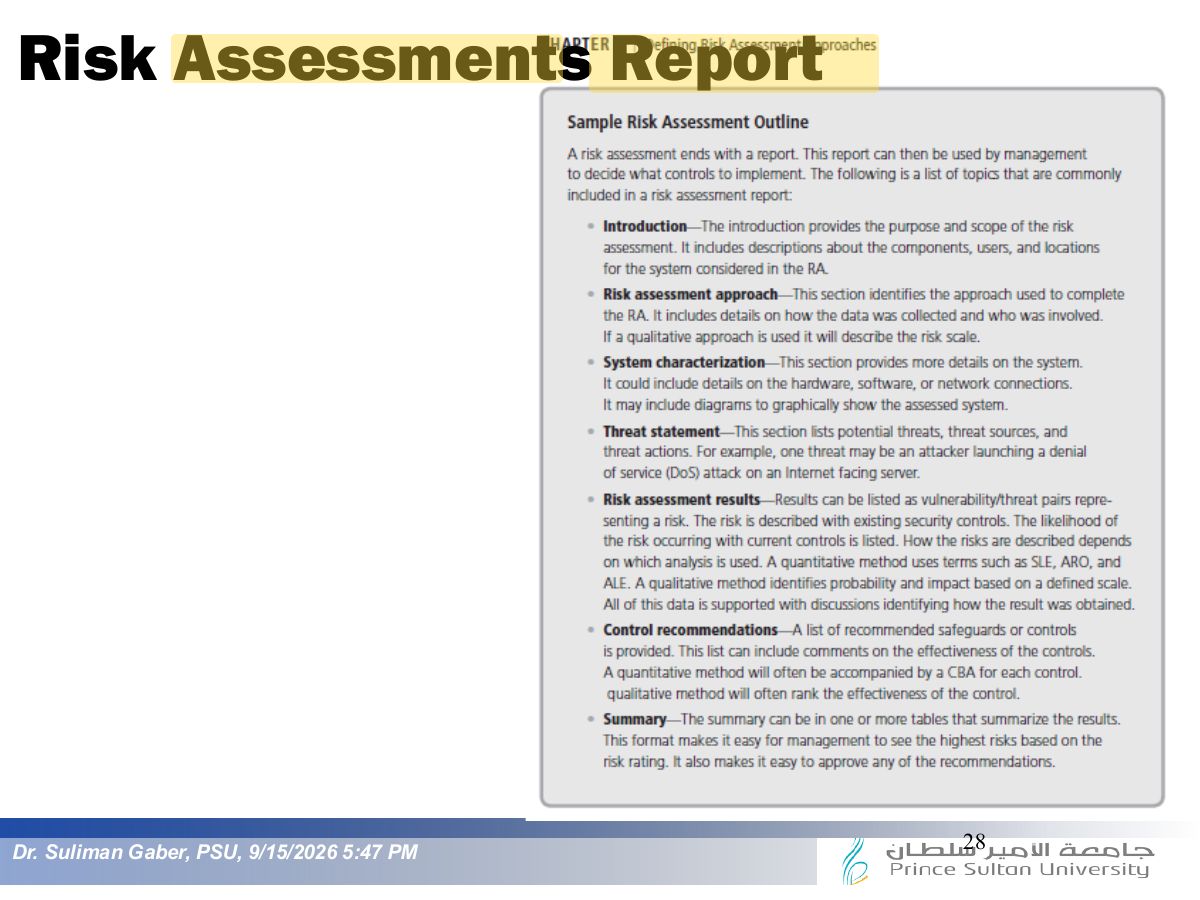
                                            Slide 28: Risk Assessments Report
                                            Exam weight Low
                                            1. The report: findings, risk ratings, recommended controls, residual risk; presented to management for decisions.

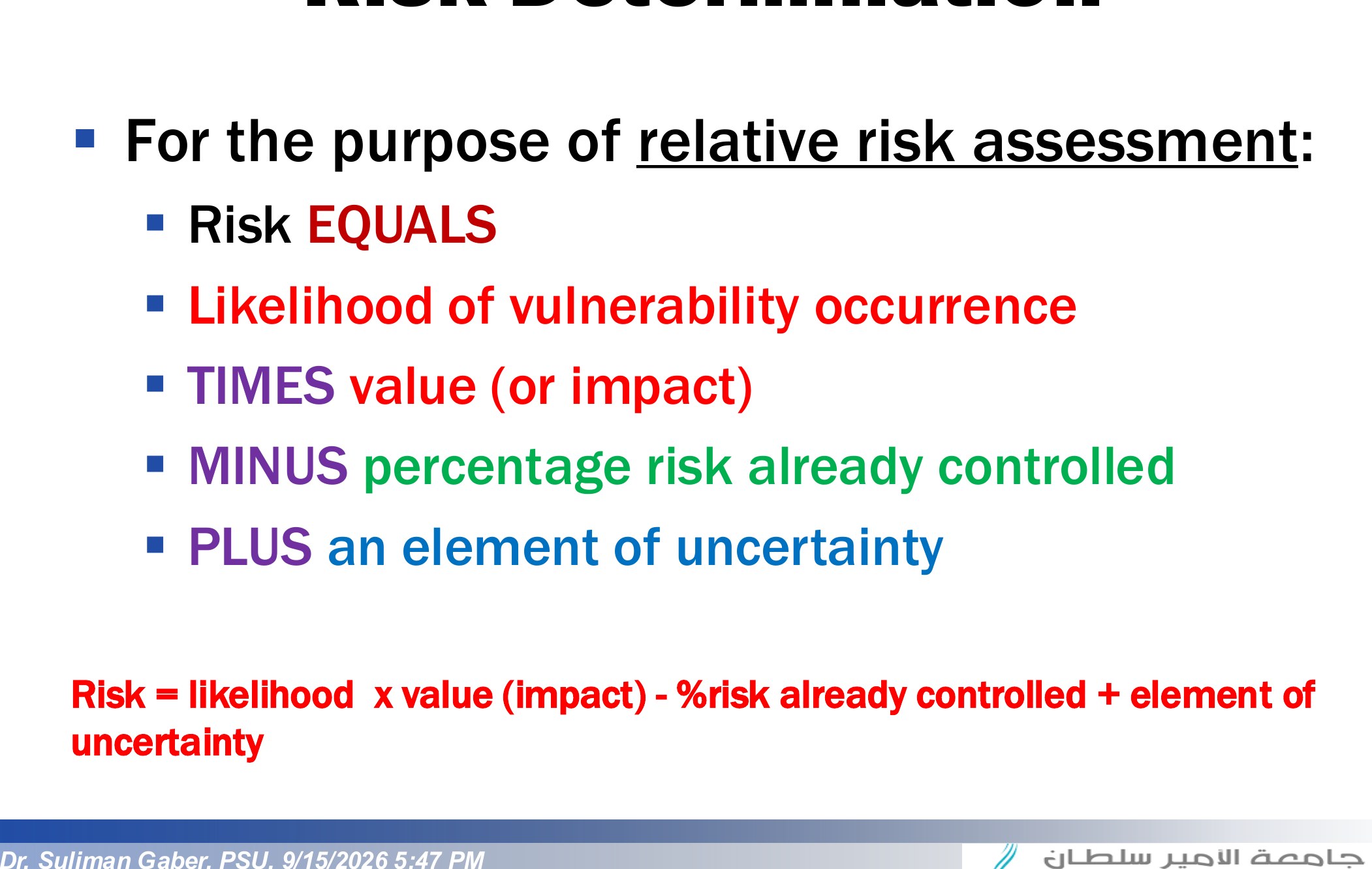
                                            Risk Determination

                                            • For the purpose of relative risk assessment:
                                              • Risk EQUALS
                                              • Likelihood of vulnerability occurrence
                                              • TIMES value (or impact)
                                              • MINUS percentage risk already controlled
                                              • PLUS an element of uncertainty

                                            Risk = likelihood x value (impact) - %risk already controlled + element of uncertainty

                                            Slide 29
                                            29
                                            Exam weight Low

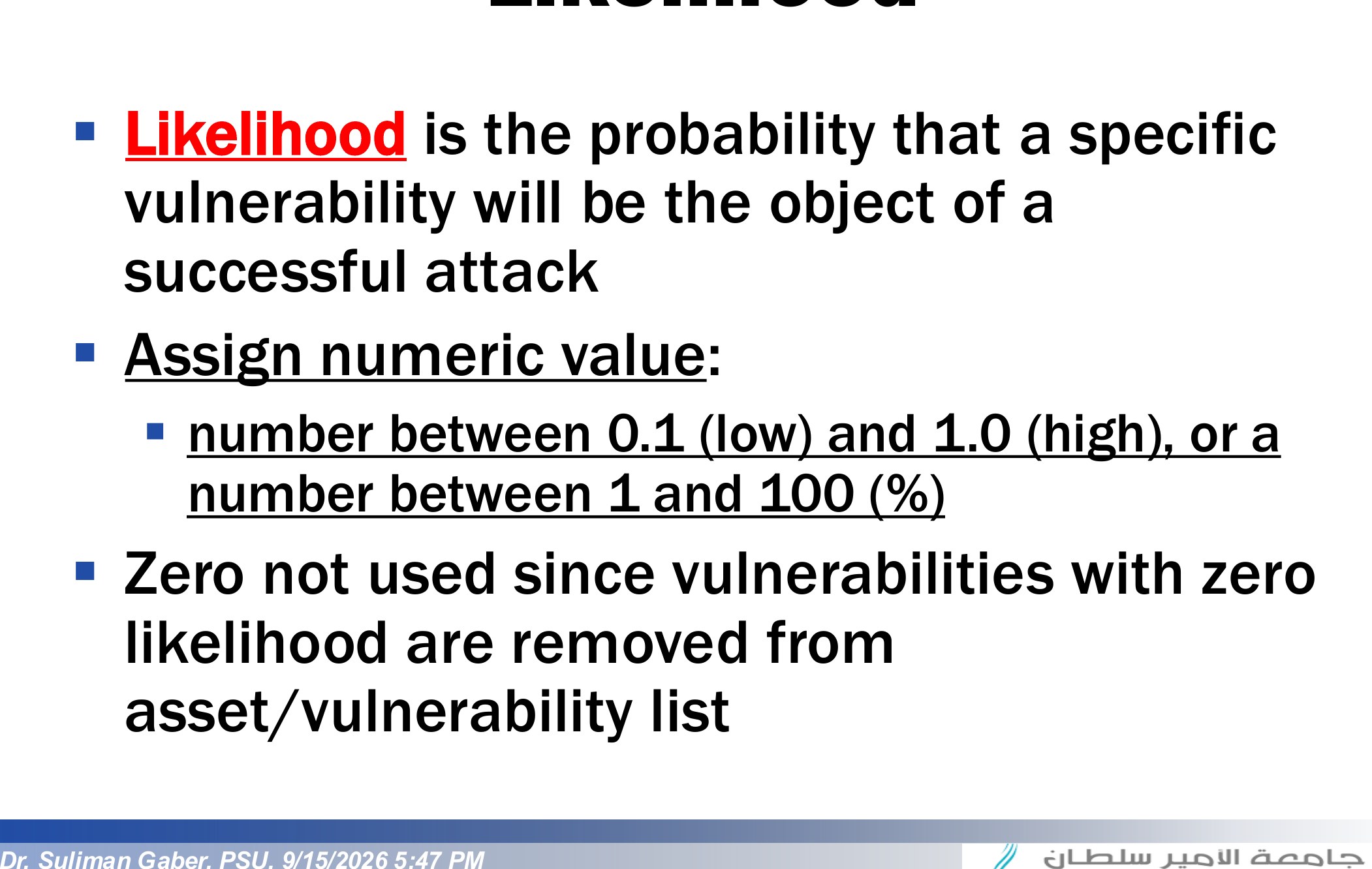
                                              Likelihood

                                              • Likelihood is the probability that a specific vulnerability will be the object of a successful attack
                                              • Assign numeric value:
                                                • number between 0.1 (low) and 1.0 (high), or a number between 1 and 100 (%)
                                              • Zero not used since vulnerabilities with zero likelihood are removed from asset/vulnerability list
                                              Slide 30
                                              30
                                              Exam weight Low

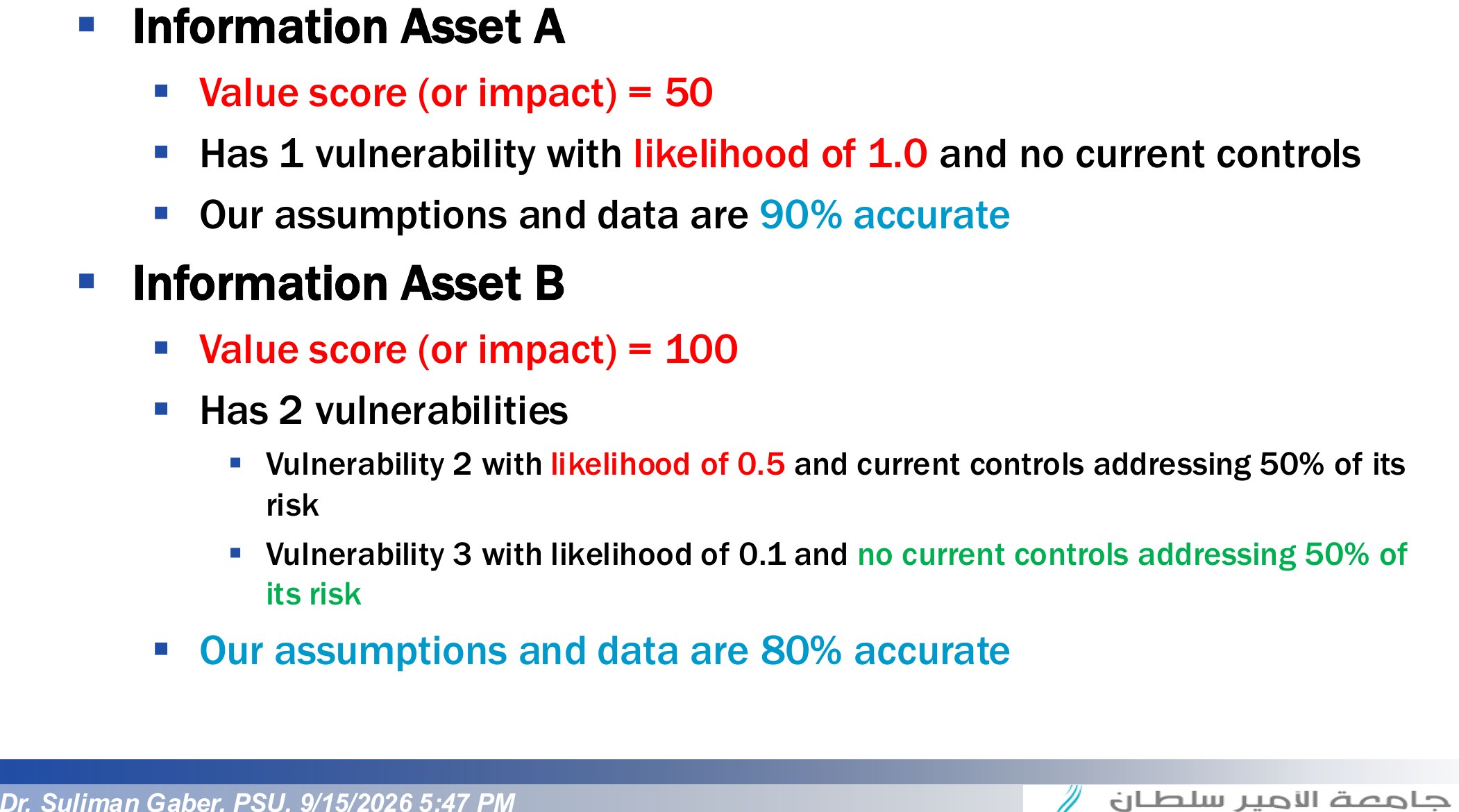
                                                • Information Asset A
                                                  • Value score (or impact) = 50
                                                  • Has 1 vulnerability with likelihood of 1.0 and no current controls
                                                  • Our assumptions and data are 90% accurate
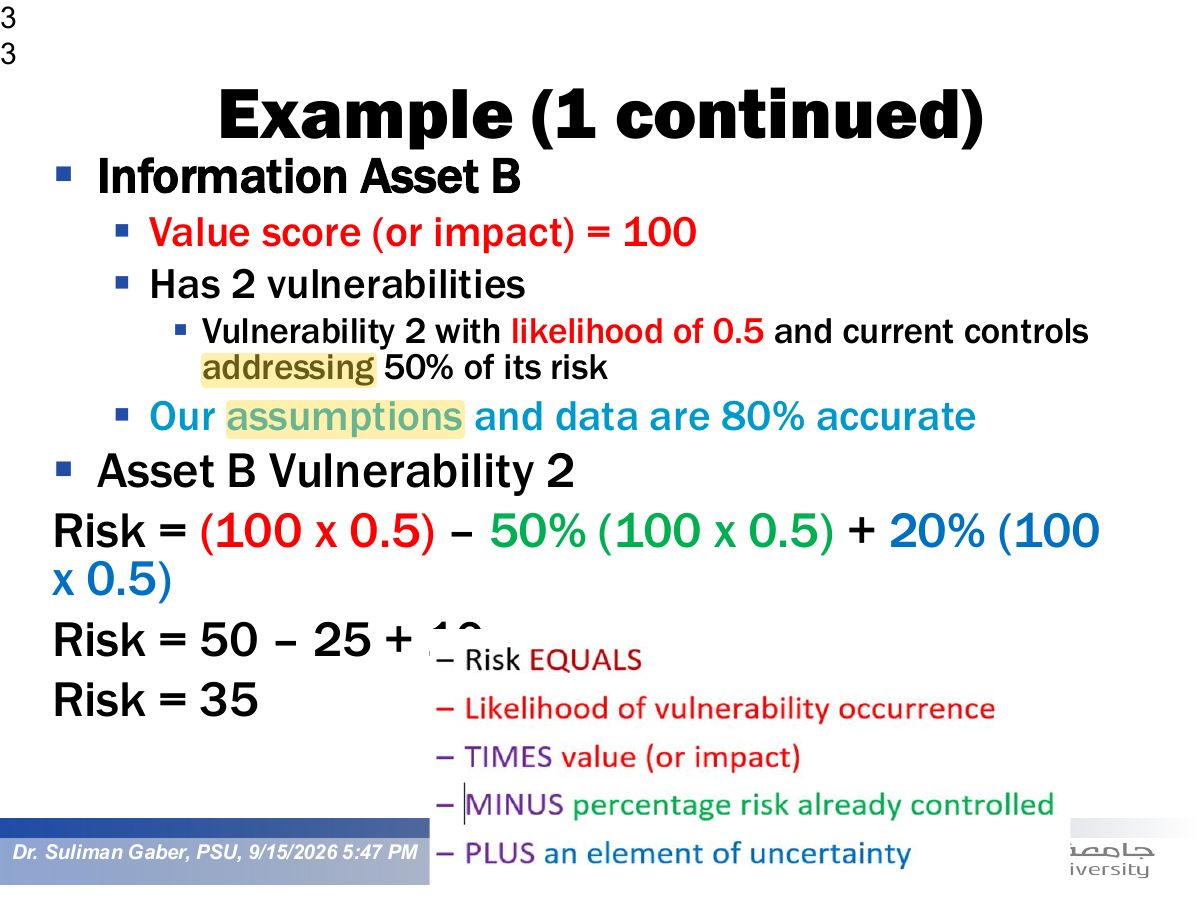
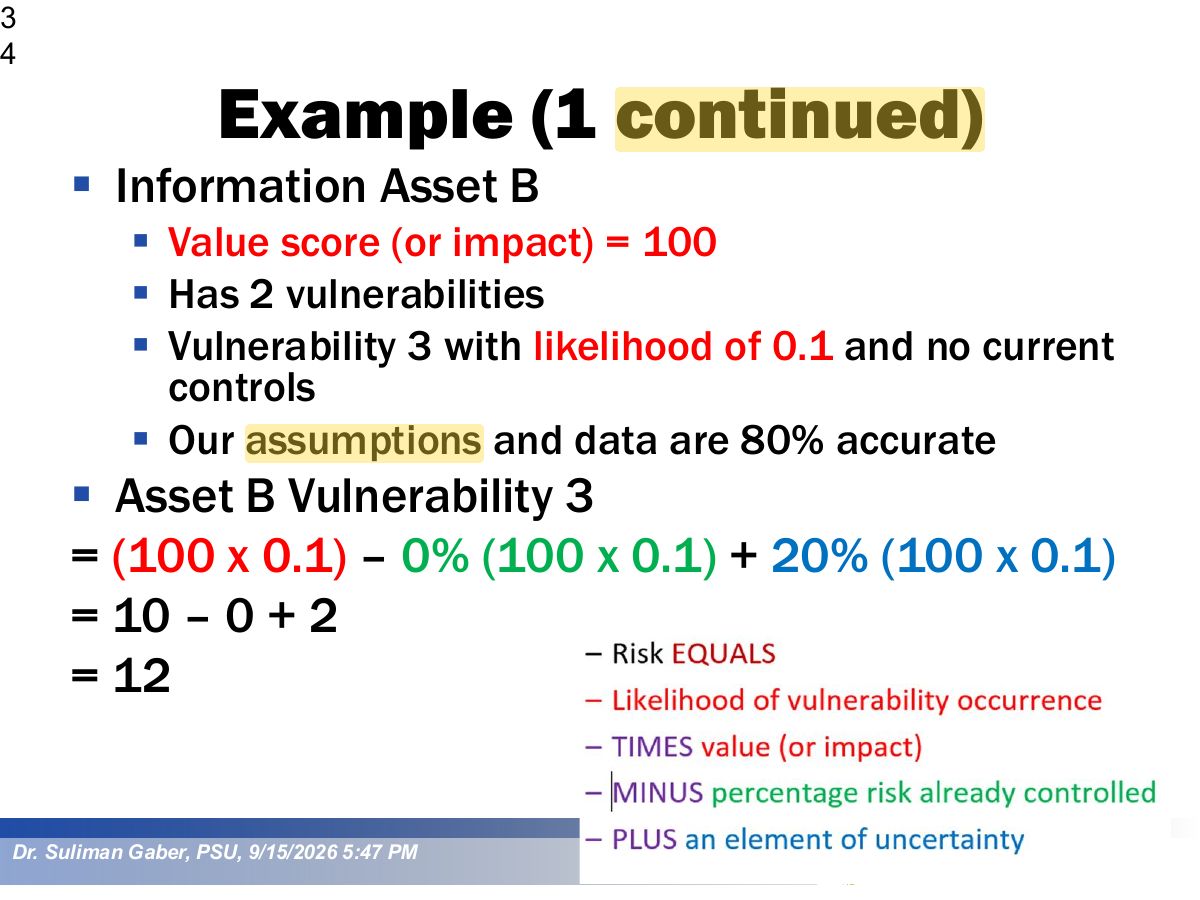
                                                • Information Asset B
                                                  • Value score (or impact) = 100
                                                  • Has 2 vulnerabilities
                                                    • Vulnerability 2 with likelihood of 0.5 and current controls addressing 50% of its risk
                                                    • Vulnerability 3 with likelihood of 0.1 and no current controls addressing 50% of its risk
                                                  • Our assumptions and data are 80% accurate
                                                Slide 31
                                                31
                                                Exam weight Low

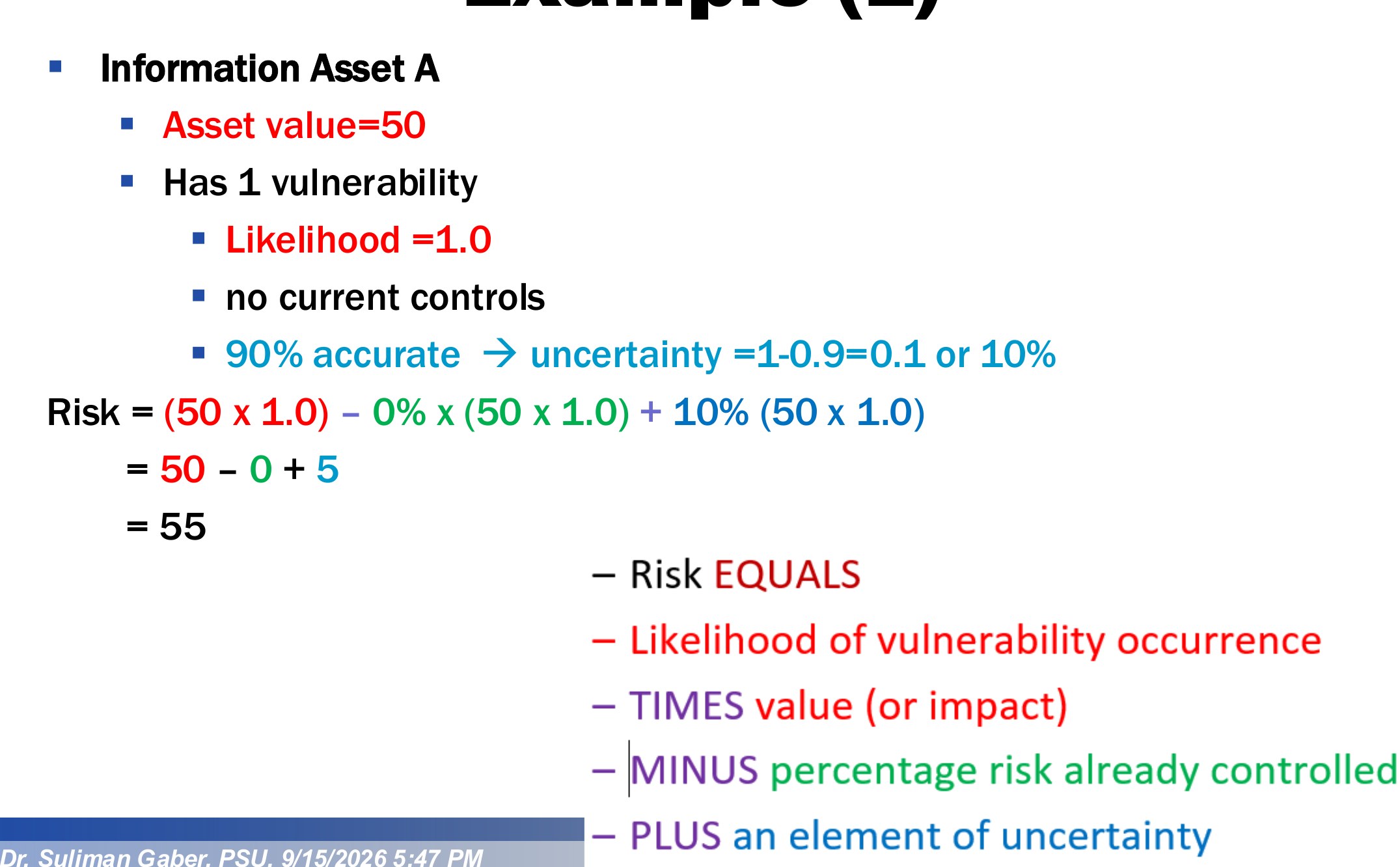
                                                  Example (1)

                                                  • Information Asset A
                                                    • Asset value=50
                                                    • Has 1 vulnerability
                                                      • Likelihood =1.0
                                                      • no current controls
                                                      • 90% accurate uncertainty =1-0.9=0.1 or 10% →

                                                  Risk = (50 x 1.0) – 0% x (50 x 1.0) + 10% (50 x 1.0)

                                                  = 50 – 0 + 5 = 55

                                                  Slide 32
                                                  32
                                                  Exam weight Low
                                                    Slide 33: Slide 33
                                                    Exam weight Low
                                                      Slide 34: Slide 34
                                                      Exam weight Low

                                                        Documenting the Results of Risk

                                                        Assessment

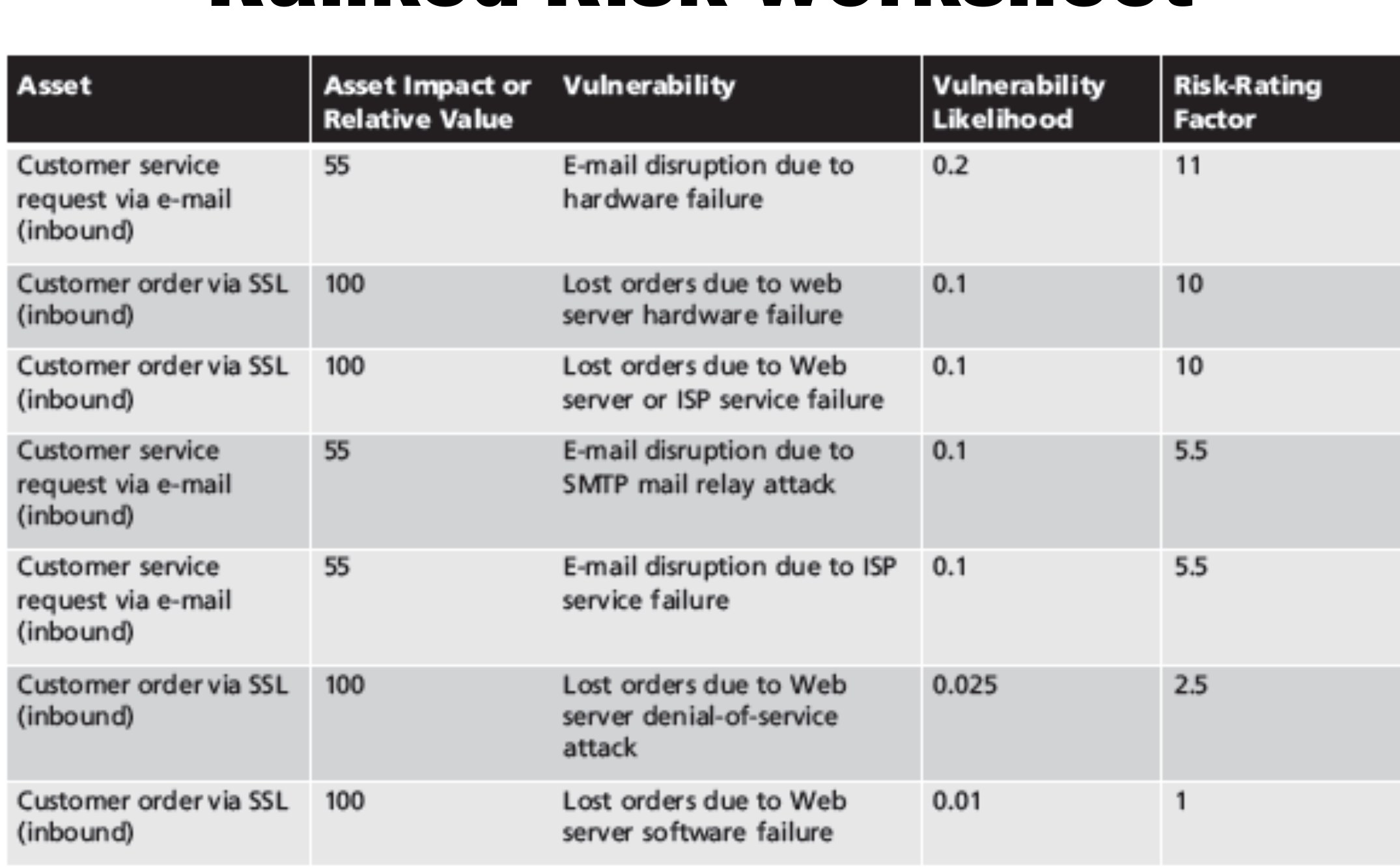
                                                        • Final summary comprised in ranked risk worksheet
                                                        • Ranked risk worksheet is initial working document for next step in risk management process: assessing and controlling risk
                                                        Slide 35
                                                        35
                                                        Exam weight Low

                                                          Ranked Risk Worksheet

                                                          Slide 36
                                                          36
                                                          Exam weight Low
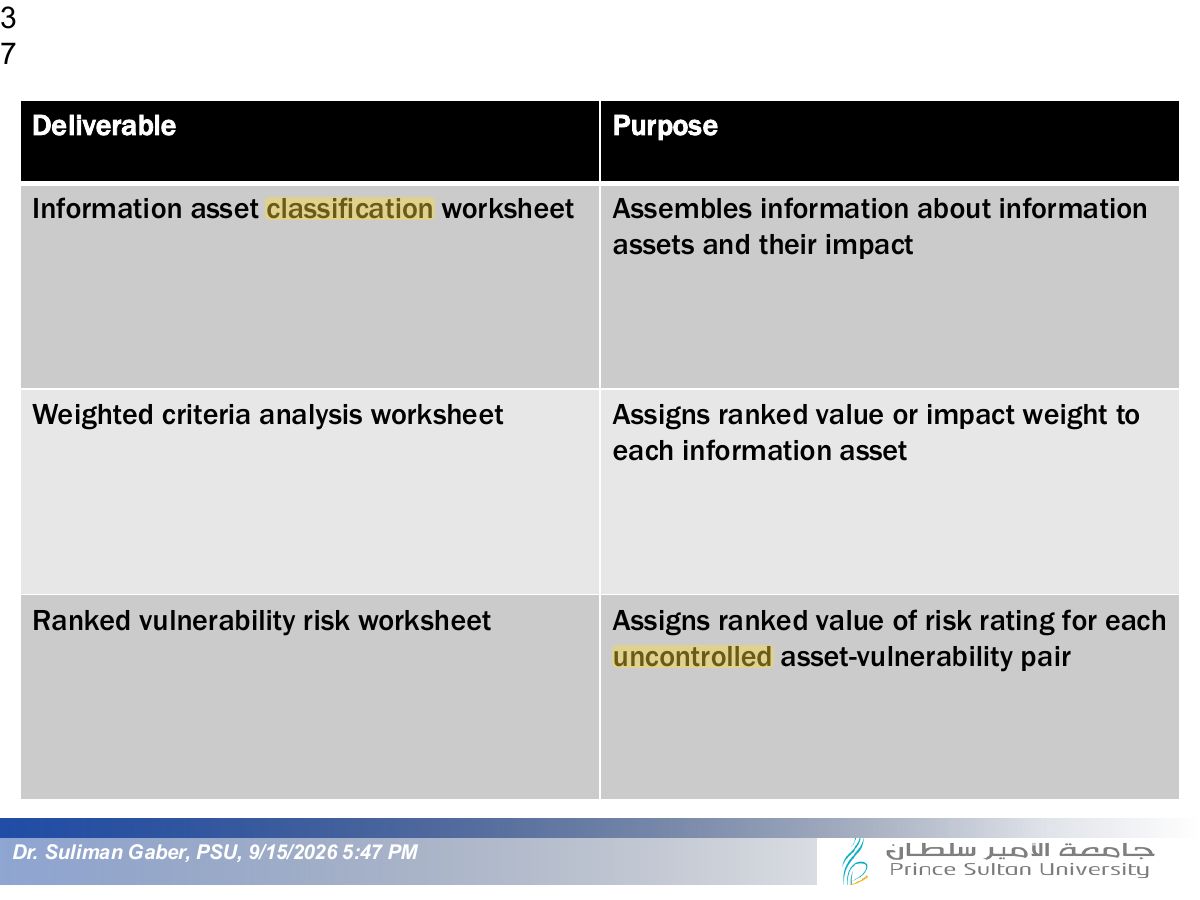
                                                            Slide 37: Slide 37
                                                            Exam weight Low

                                                              Slide 38
                                                              38
                                                              Exam weight Low

                                                                Slide 39
                                                                39
                                                                Exam weight Low