CYS401 · Annotated SlidesChapter 7 — Security Design Models and Capabilities
Chapter 7 · Annotated slides

Security Design Models and Capabilities

Security architecture principles (security by design, least privilege, default deny, separation of duties, zero trust, micro-segmentation…), architecture flaws (covert channels, maintenance hooks), process isolation and protection rings, and the security models: TCB, access control matrix, take-grant, Bell-LaPadula, Biba. Both Final 221 papers asked about least privilege, isolation, take-grant and Bell-LaPadula.

Slide text Study notes Highlight: key words Tips, tricks & traps Seen again elsewhere How it can come up

Security Design Models and Capabilities

CYS401 · Chapter 7
1
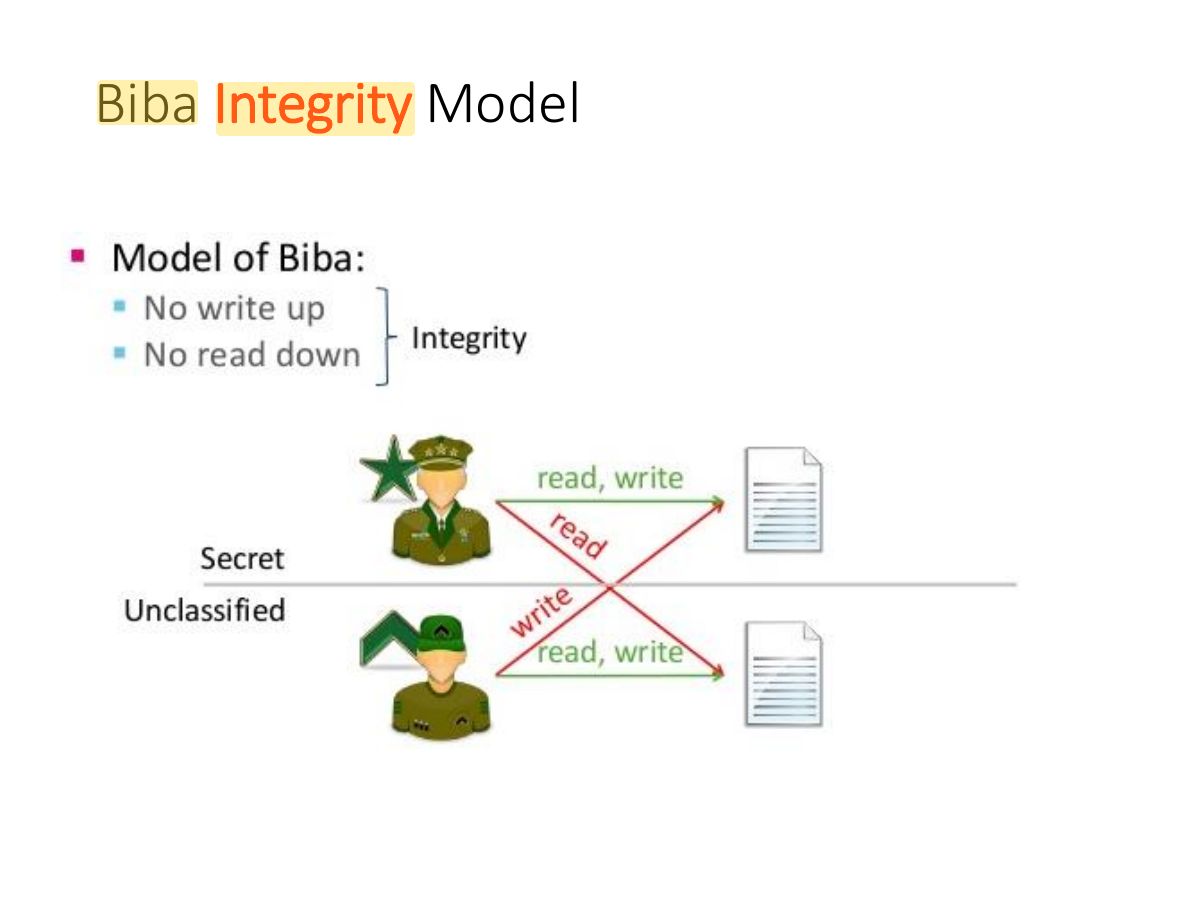
TipBell-LaPadula (CONFIDENTIALITY): no read up (simple), no write down (*-property). Biba (INTEGRITY): no read down, no write up. Mnemonic: BLP protects secrets from leaking down; Biba stops dirt flowing up.
Slide 2: Slide 2
Exam weight Low
  1. Learning objectives.

Security Architecture principles

Security architecture ”: the overall system required to protect

  • “ an organization's IT infrastructure.
    • includes the H/W & S/W specifications, processes, and procedures involved in preventing, mitigating, and investigating different threats.
    • The main goal of having this architecture is to have (Confidentiality, Integrity, and Availability)
  • “Security Architecture principles”
    • fundamental security rules that should be met during the development of a security architecture and applied when the corresponding security controls are implemented.
3
Exam weight Low
  1. Security architecture = the overall system that protects an organization’s IT infrastructure.

Why Security Design Matters

  • Security failures are design failures
  • Retrofitting security is costly
  • Modern systems are:
    • Distributed
    • Cloud-based
    • Continuously evolving
  • Security must be built in not added later —
4
Exam weight Low
  1. Security failures are design failures; retrofitting security is costly.

• Core Security Architecture principles, which are considered fundamental within the information security community are:

  • #1 Security by design.
  • #2 Simplicity.
  • #3 Defense in depth.
  • #4 Least privilege.
  • #5 Default deny.

Security

  • #6 Fail secure.

Architecture

  • #7 Separation of duties
  • #8 Do not trust external systems. principles
  • #9 Zero Trust
  • #10 Micro segmentation
  • #11 Assume breach
  • #12 Continuous monitoring
  • #13 Security Automation
5
Exam weight Low
  1. Core principles: security by design, simplicity, defence in depth, least privilege, default deny, fail securely, separation of duties, zero trust, micro-segmentation, assume breach, automation…

Security Architecture principles

  • #1 Security by design
    • The security requirements of a system or application should be considered as part of its overall requirements (and not as an afterthought),
      • To avoid wasting unnecessary time, money and effort.
      • Reduce cost and vulnerability
  • #2 Simplicity
    • Make it simple: by reducing the complexity and diversity of security controls, less mistakes and errors should occur.
    • Simplicity of security controls should result in better understanding and management of security controls, and the prompt resolution of security-related issues.
6
Exam weight Low
  1. #1 Security by design: security requirements are part of the requirements, not an afterthought. #2 Simplicity: simpler systems have fewer flaws.

Security Architecture principles

  • #3 Defense in depth
    • Using layers of security increases the level of effort required by an attacker to gain unauthorized access to a system or application.
    • In the event one security control fails or is compromised, another security control should prevent the exposure of information or an information system.
  • Example: An enterprise network might have a perimeter firewall, an intrusion detection system (IDS), network segmentation, secure endpoints, and encryption to protect data. Even if the firewall is bypassed, the IDS and other security layers provide additional barriers.
7
Exam weight Low
  1. #3 Defence in depth: layers raise the attacker’s effort.
★ Past exam

Security Architecture principles

  • #4 Least privilege
    • Only the minimum possible privileges should be granted to a user or a process for accessing a resource.
    • Grant the users the privileges they need to accomplish a certain task: No more, No less
    • Limit damage if compromised
  • Example: A database administrator should only have access to databases they manage, and not to applications or files unrelated to their job. Similarly, a user account that typically views records should not have write or delete permissions unless explicitly needed.
8
Exam weight High
  1. #4 Least privilege: grant only the minimum privileges needed.
🎯 How this can come up · 1 question
MCQ

Granting users exactly the privileges they need for a task, nothing more, is:

Security Architecture principles

  • #5 Default deny
    • The default setting for a security control should be to deny access to a resource and require a configuration to specifically grant access.
  • #6 Fail secure
    • One of the most common programming or design errors is forgetting to “ handle a case ”
      • Fail Secure: The control will block accessing the process to avoid system damage. results in denial of service) (
      • Fail Safe: The control will be disabled to ensure the process is (results in the possibility of illegitimate access). accessible
9
Exam weight Medium
  1. #5 Default deny: access is denied unless explicitly granted. #6 Fail securely.

Security Architecture principles

  • #7 Separation of duties
    • no one has sole control over the lifespan of a transaction.
      • Task Shadowing (one works and one monitors)
      • Task splitting (split the task between two persons)
    • Example: In a financial organization, one person might initiate a transaction while another authorizes it. This ensures that fraud is less likely since it requires collusion between two individuals.
  • #8 Do not trust external systems
    • External systems and environments are typically not under the control of an organization. Therefore, it is recommended that external systems are assumed to be insecure until a level of trust is established.
10
Exam weight High
  1. #7 Separation of duties: no single person controls a whole transaction (cashier needs a supervisor to refund).
🎯 How this can come up · 1 question
MCQ

A cashier needs a supervisor’s approval to cancel a bill and refund. This applies:

Security Architecture principles

  • #9 Zero Trust
    • Zero Trust is a security model that assumes no actor, system, or service, inside or outside the perimeter, is trusted. Every interaction must be verified before access is granted.
    • Example: An internal employee trying to access a company file system might still need to undergo multifactor authentication (MFA) and device verification even though they are inside the corporate network.
11
Exam weight High
  1. #9 Zero trust: trust nobody, inside or outside; verify every request.
🎯 How this can come up · 1 question
MCQ

Which model assumes no user or device is trusted, even inside the network?

Slide 12: Security Architecture principles
Exam weight Low
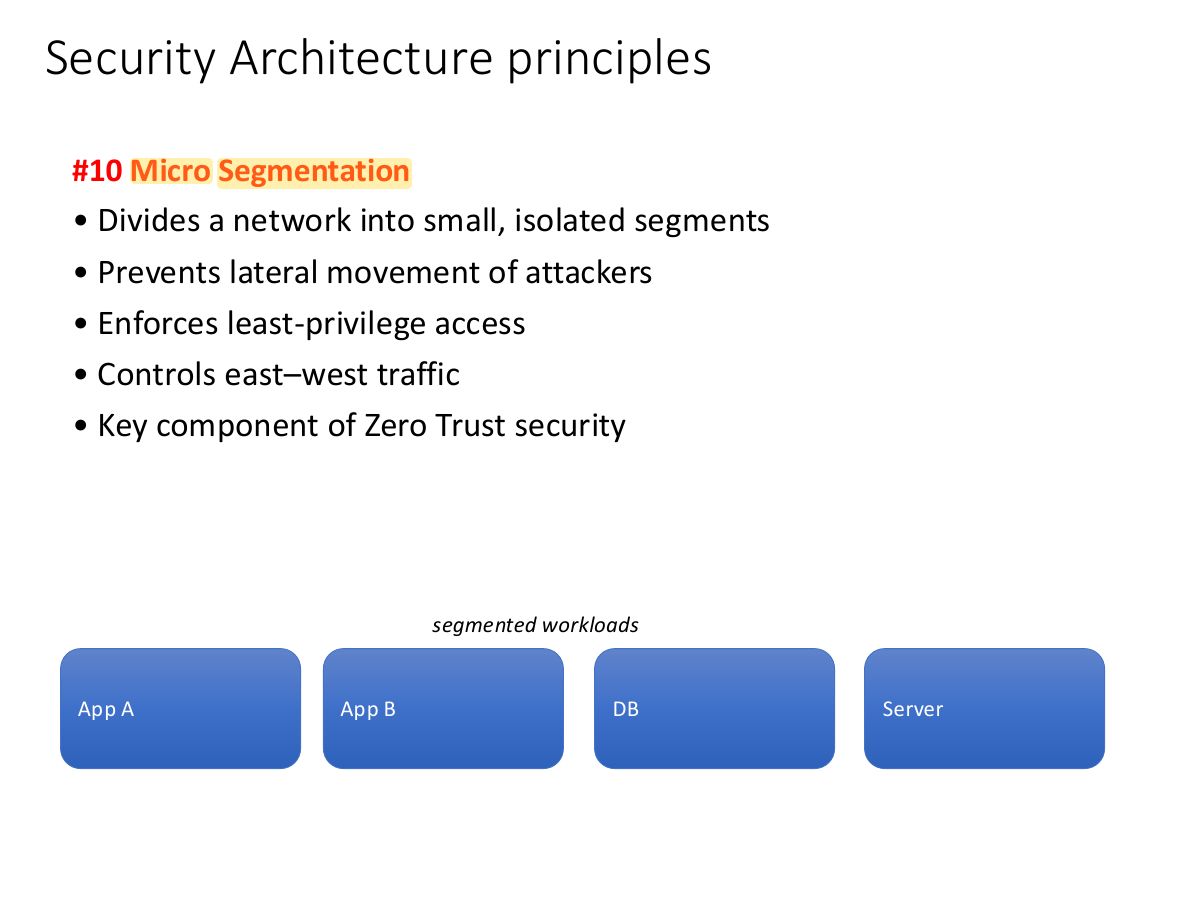
  1. #10 Micro-segmentation: small isolated segments to stop lateral movement.

Security Architecture principles

#10 Micro Segmentation

  • Example: University Network (like CCIS labs)
  • Without micro-segmentation:
  • Student PC → can access:
    • Database server
    • Admin systems
    • Other students' machines
  • With micro-segmentation:
  • Student PC → can access:
    • Only course server
  • Database → only accessible by authorized apps
  • Admin systems → completely isolated trapped
  • Even if one machine is hacked → attacker is
13
Exam weight Low
  1. Example: university lab networks separated from admin networks.

Security Architecture principles

#11 Assume Breach

  • Assume attacker is inside

• Focus on detection and containment

  • Traditional mindset: “We must keep attackers out”
  • Assume breach mindset: “Attackers may already be in—limit the damage” Drives monitoring and segmentation

#12 Continous Monitoring

  • Real-time visibility
  • Logs + alerts + analytics
  • Tools:
    • SIEM, EDR
14
Exam weight Low
  1. #11 Assume breach: design as if the attacker is already inside.

Security Architecture principles

#13 Security Automation

  • Automate detection & response
  • Use AI-driven tools
  • Reduces human error
15
Exam weight Low
  1. #13 Security automation: automate detection and response.

Security Architecture principles

  • Security is a Process
    • Every system has vulnerabilities
      • Impossible to eliminate all of them
      • Goal: assurance
    • Systems change over time
      • Security requirements change over time
      • Context of mechanisms changes over time
    • Secure systems require maintenance
      • Check for obsolete users
      • Update virus software
      • Patch security holes
      • Test firewalls
16
Exam weight Low
  1. Security is a process: every system has vulnerabilities.
Common Architecture Flaws and Security Issues 1/2

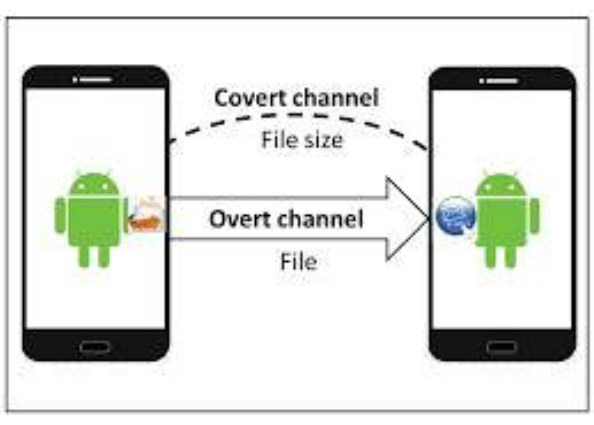
  • Covert Channels
    • an evasion or attack technique that is used to transfer information in a secretive, unauthorized or illicit manner.
    • A covert channel can be used to extract information from or implant information into an organization
  • There are two types:
    • Covert timing channels
      • The process can access the data of another process in a shared resource (RAM, CPU)
    • Covert storage channels
      • The process access the storage media to read or write the data
        • Android permission to access photos
Common Architecture Flaws and Security Issues 1/2
17
Exam weight High
  1. Covert channel: transferring information secretly through an unintended path (timing, storage).
🎯 How this can come up · 1 question
MCQ

Transferring information through an unintended, secret path is a:

Common Architecture Flaws and Security Issues 1/2

  • Attacks based on Design or Coding Flaws and Security Issues
    • Maintenance hook: A trapdoor in software that allows easy maintenance and development of additional features and that may allow entry into the program at unusual points or without the usual checks.
    • privileged programs: one that can give users extra privileges beyond that are already assigned to them.
    • Data diddling is the changing of data before or during entry into the computer system.
    • Salami (aggregation) attack: small attacks add up to one major attack that can go undetected also called Incremental
      • Collecting user data from multiple parties
      • Start with small action and then increase the attack’s coverage
  • How to protect against Attacks Based on Design or Coding Flaws and Security Issues
    • Trusted recovery: refers to mechanisms and procedures necessary to ensure that failures and discontinuities of operation don't compromise a system's secure operation.
    • Input and parameter checking (input validation)
18
Exam weight High
  1. Maintenance hook (backdoor/trapdoor): a hidden entry point left by developers; also TOCTOU, buffer overflows.
🎯 How this can come up · 1 question
MCQ

A hidden entry point left in software for easy maintenance is a:

Techniques for Ensuring Confidentiality, Integrity, and Availability

19

Techniques for Ensuring Confidentiality, Integrity, and Availability

Software designers use different techniques to ensure that programs do only what is required and nothing more.

  • If an affected program is processing sensitive or secret data, that data’s confidentiality is no longer guaranteed.
  • If that data is overwritten or altered in an unpredictable way, there is no guarantee of integrity.
  • if data modification results in corruption or loss, it could become unavailable for future use.
20
Exam weight Low
  1. Design programs to do only what is required.
Slide 21: Techniques for Ensuring Confidentiality, Integrity, and Availability
Exam weight Low
  1. Concepts: confinement, bounds, isolation, controls, trust and assurance.
★ Past exam
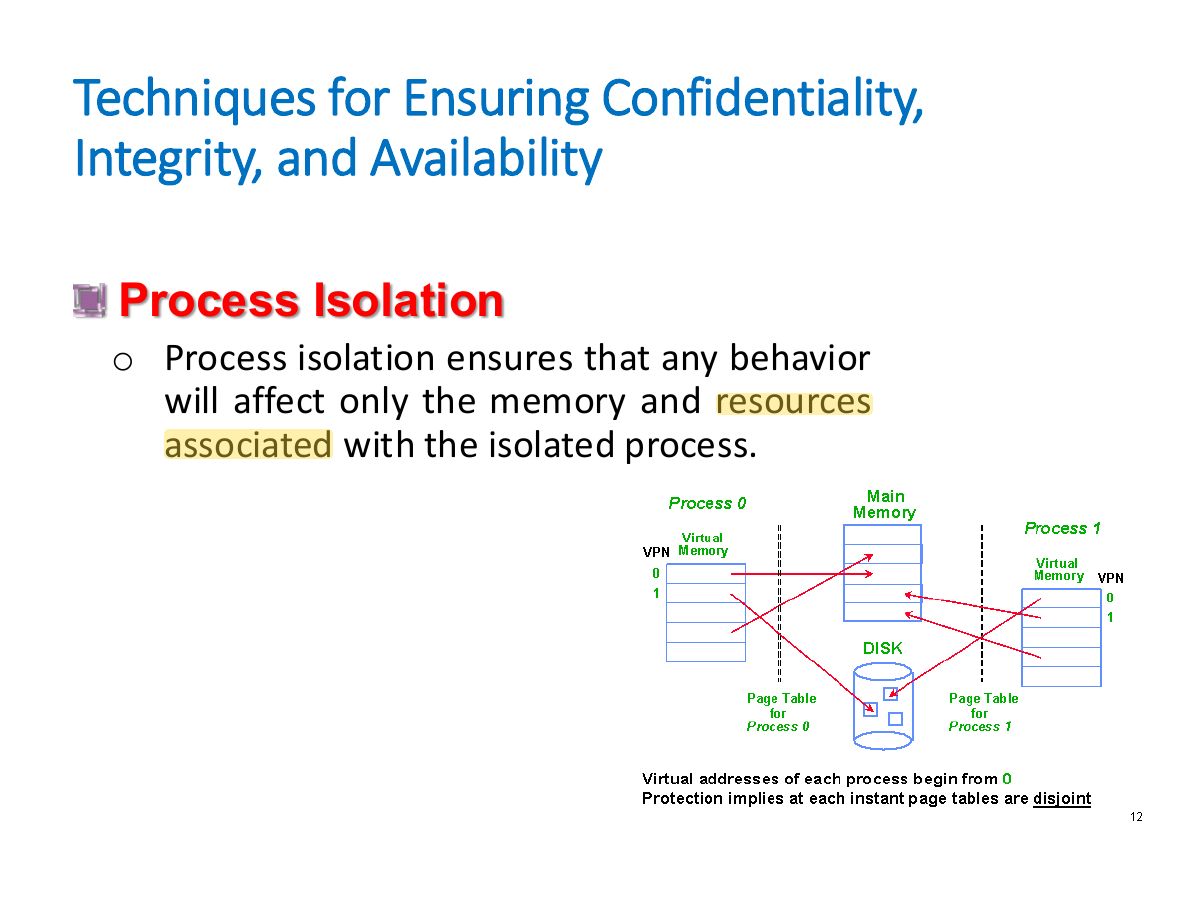
Slide 22: Techniques for Ensuring Confidentiality, Integrity, and Availability
Exam weight High
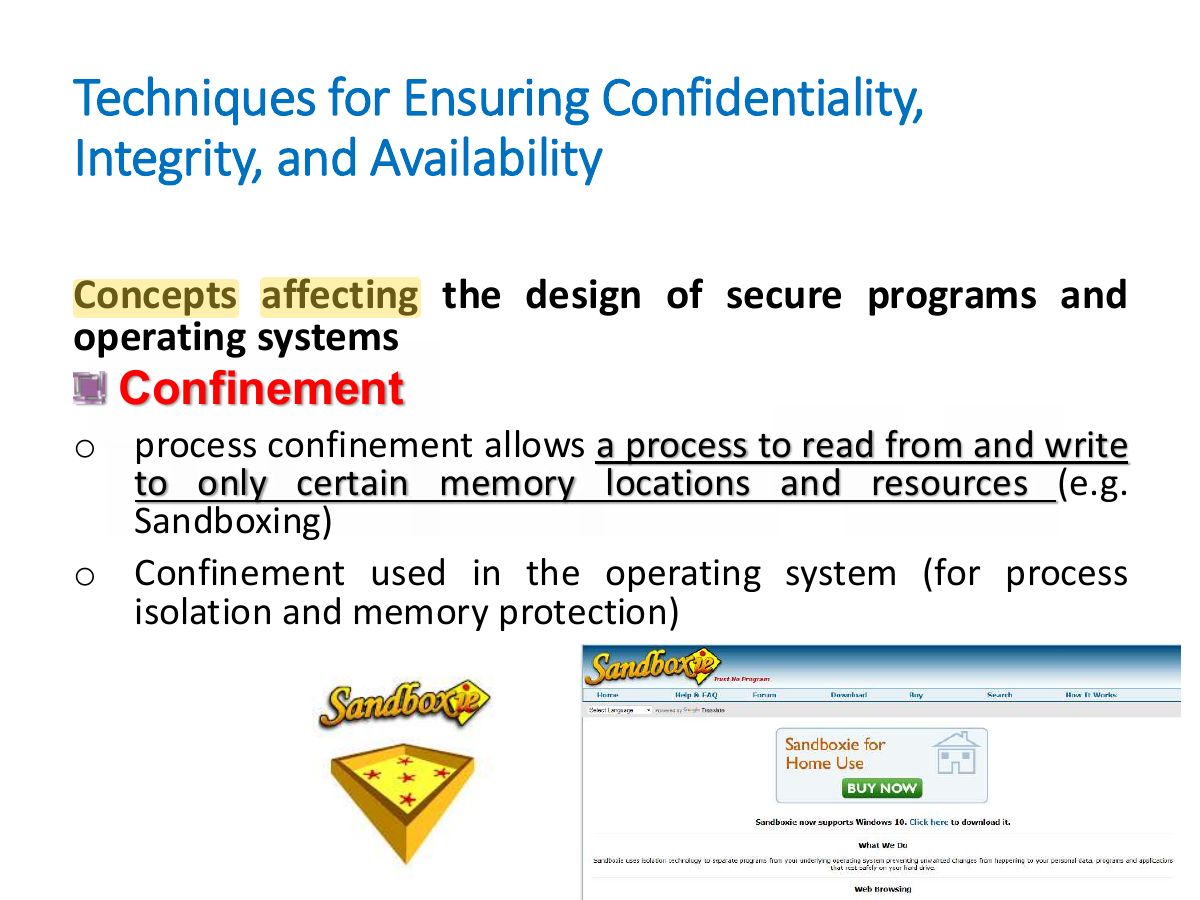
  1. Process isolation: a process may only read and write its own memory locations and resources.
🎯 How this can come up · 1 question
MCQ

Allowing a process to read and write only certain memory locations and resources is:

★ Past exam
Slide 23: Techniques for Ensuring Confidentiality, Integrity, and Availability
Exam weight High
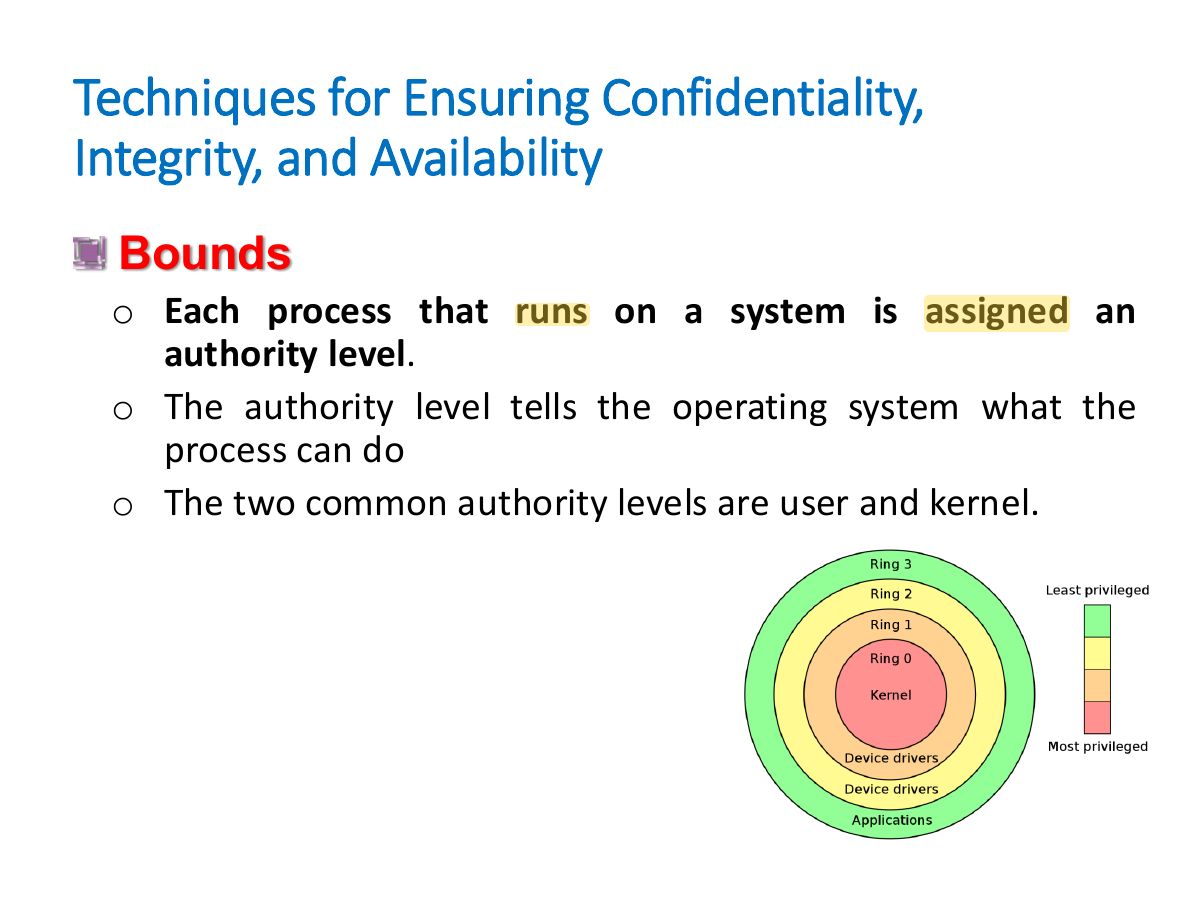
  1. Each process gets an authority level (protection rings): ring 0 = kernel (most privileged); user processes run in outer rings.
🎯 How this can come up · 2 questions
MCQ

Processes in ___ can access more resources and interact with the OS more directly than processes in ___.

MCQ

Operating in the “problem state” means running in:

Security Models

24

Security Models

is a scheme for specifying and enforcing security policies.

A security model may be founded upon a formal model of access rights, a model of computation, a model of distributed computing, or no particular theoretical grounding at all.

overview

25
Exam weight Low
  1. A security model specifies and enforces security policy.
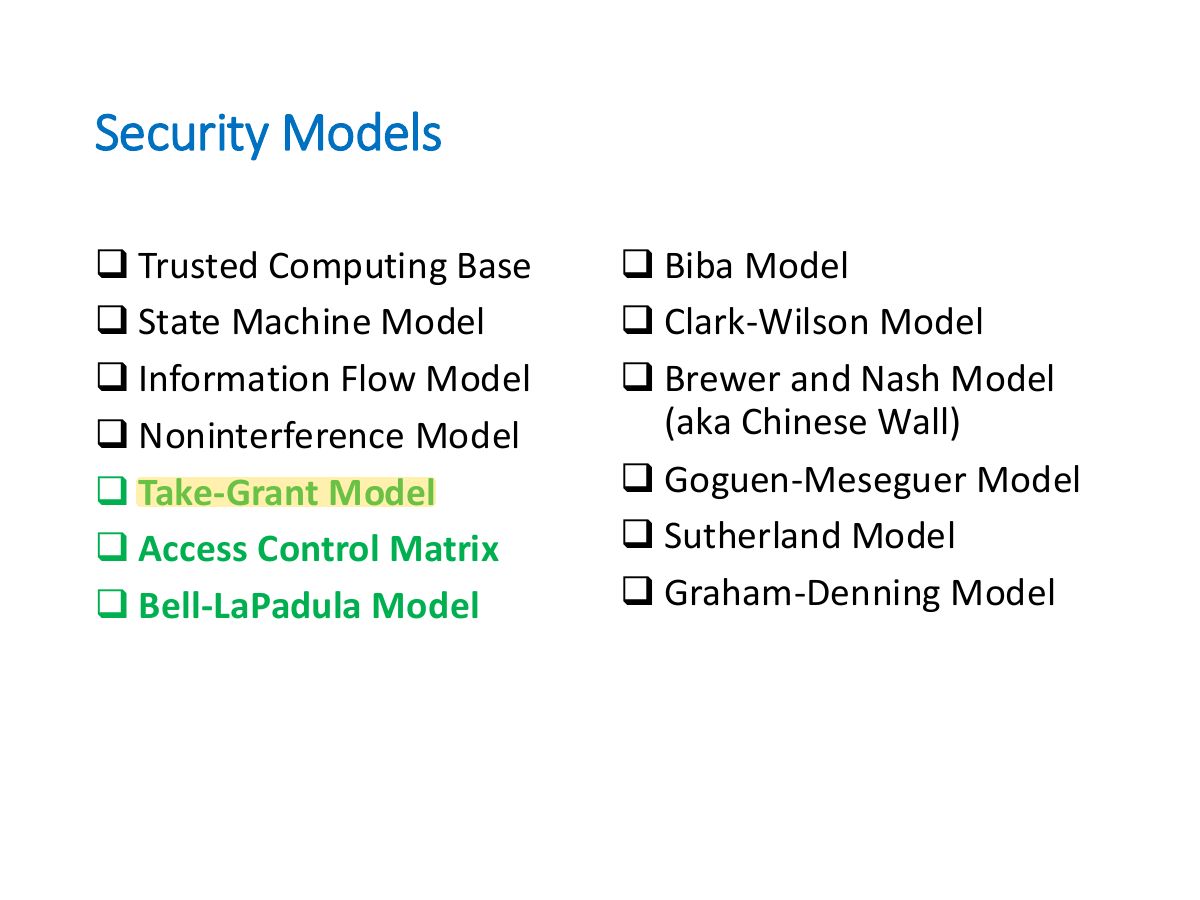
Slide 26: Security Models
Exam weight High
  1. Models: TCB, state machine, information flow, take-grant, access control matrix, Bell-LaPadula, Biba, Clark-Wilson, Brewer-Nash.
🎯 How this can come up · 1 question
MCQ

Which model prevents conflicts of interest (e.g., a consultant serving two competitors)?

Slide 27: Access Control Matrix
Exam weight High
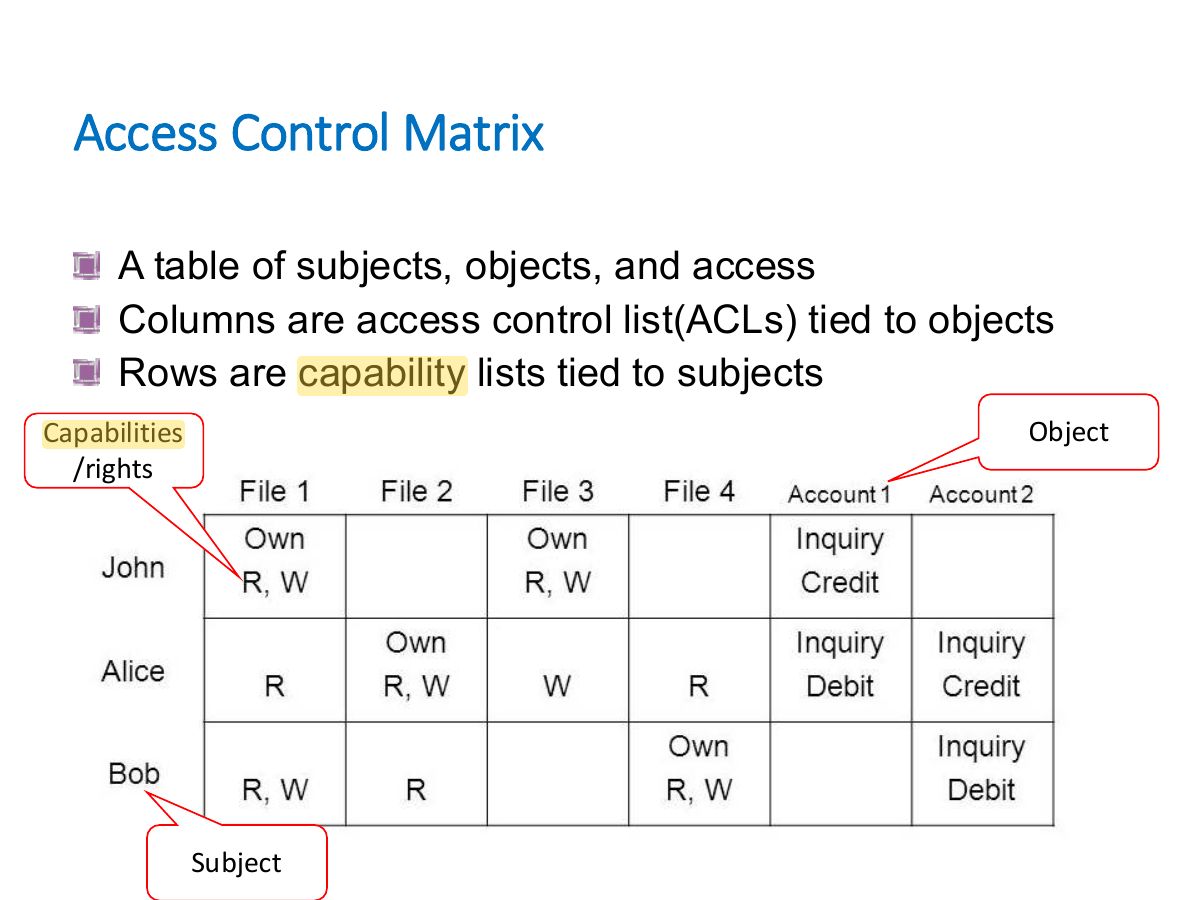
  1. Access control matrix: subjects × objects. Columns = ACLs (per object); rows = capability lists (per subject).
🎯 How this can come up · 1 question
MCQ

In an access control matrix, a column tied to an object is a(n):

★ Past exam
Slide 28: Take-Grant Model
Exam weight High
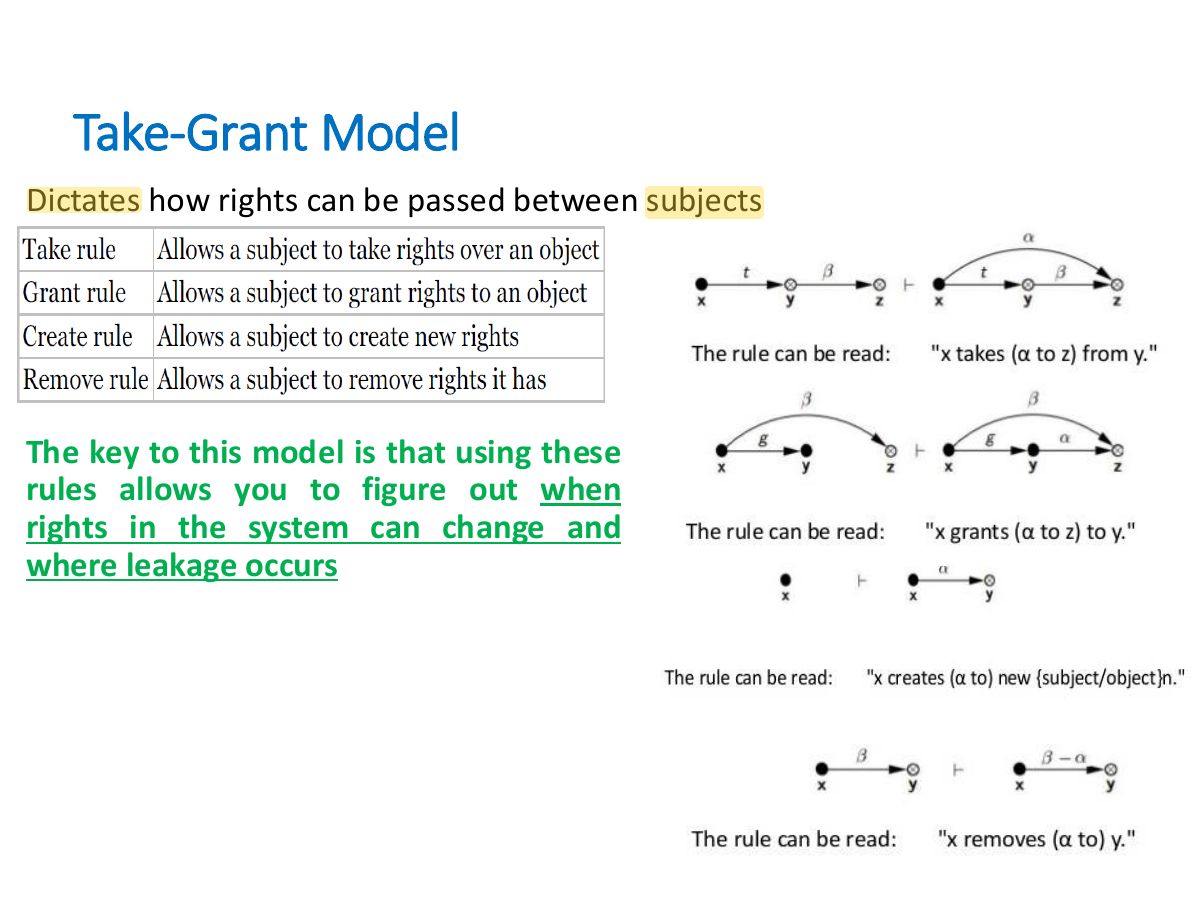
  1. Take-Grant: how rights pass between subjects (take, grant, create, remove); lets you find where rights can leak.
🎯 How this can come up · 1 question
MCQ

Which access-control model lets you reason about rights and find whether a leakage of rights can occur?

★ Past exam

Bell-LaPadula Confidential Model

29
Exam weight High
  1. Bell-LaPadula (confidentiality): no read up, no write down.
TipBell-LaPadula (CONFIDENTIALITY): no read up (simple), no write down (*-property). Biba (INTEGRITY): no read down, no write up. Mnemonic: BLP protects secrets from leaking down; Biba stops dirt flowing up.
🎯 How this can come up · 2 questions
MCQ

Under Bell-LaPadula, a SECRET user may NOT:

MCQ

Bell-LaPadula’s *-property forbids:

Slide 30: Biba Integrity Model
Exam weight High
  1. Biba (integrity): no read down, no write up.
TipBell-LaPadula (CONFIDENTIALITY): no read up (simple), no write down (*-property). Biba (INTEGRITY): no read down, no write up. Mnemonic: BLP protects secrets from leaking down; Biba stops dirt flowing up.
🎯 How this can come up · 1 question
MCQ

The Biba model protects:

31
Exam weight Low
  1. End.