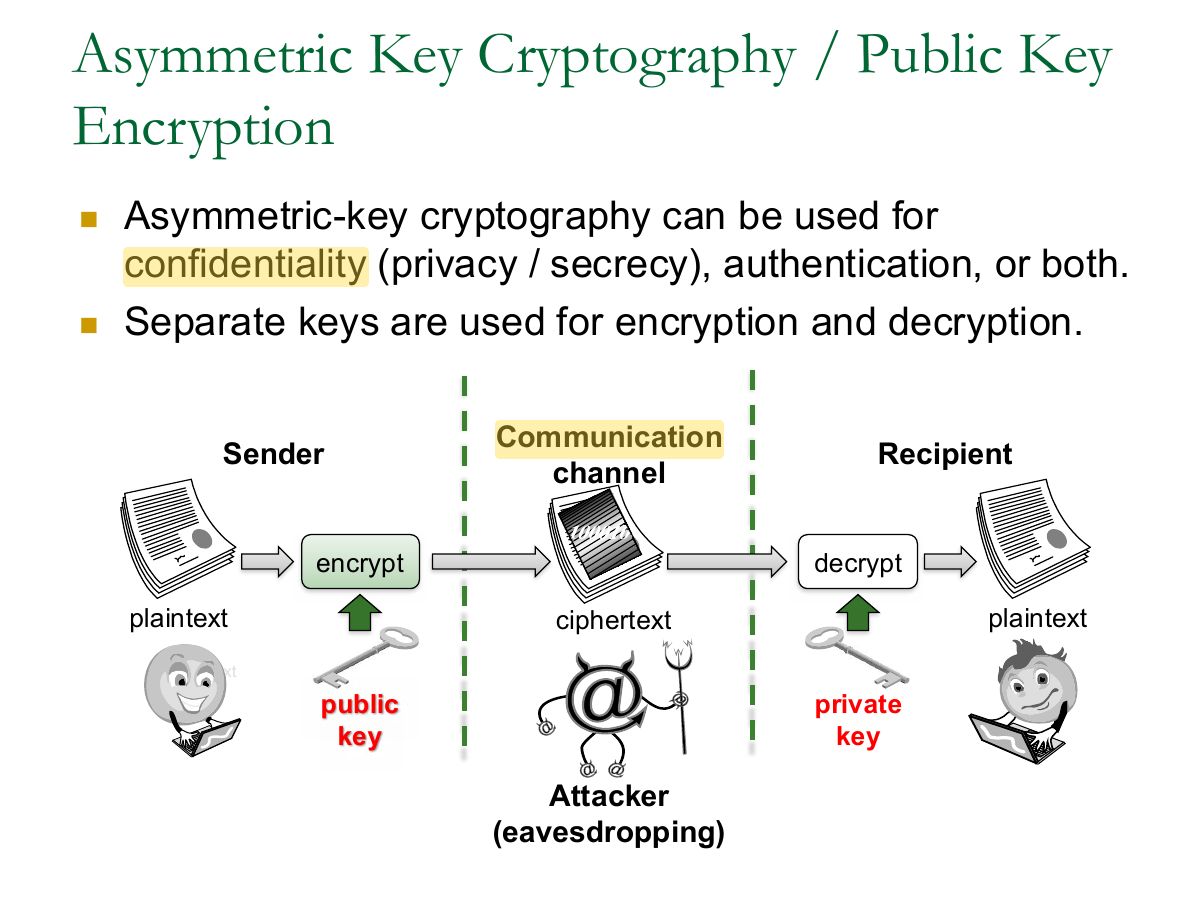
TipWhich key? ENCRYPT for confidentiality with the
RECEIVER’s public key (receiver decrypts with their private
key). SIGN with the SENDER’s private key (anyone verifies with
the sender’s public key).
Exam weight Low
- Symmetric vs. asymmetric → RSA → hashes.
Exam weight Low
- Objectives.
Exam weight
High
- Symmetric: one shared key, fast, key distribution problem. Asymmetric: key pair, slower, solves key exchange and enables signatures.
🎯 How this can come up · 1 question
MCQ
Compared with symmetric encryption, asymmetric encryption is:
Correct: Slower but solves key distribution.
Exam weight Low
- Comparison table, continued.
Exam weight Low
- Asymmetric crypto gives confidentiality, authentication, or both; separate keys for encryption and decryption.
★ Past exam
Exam weight
High
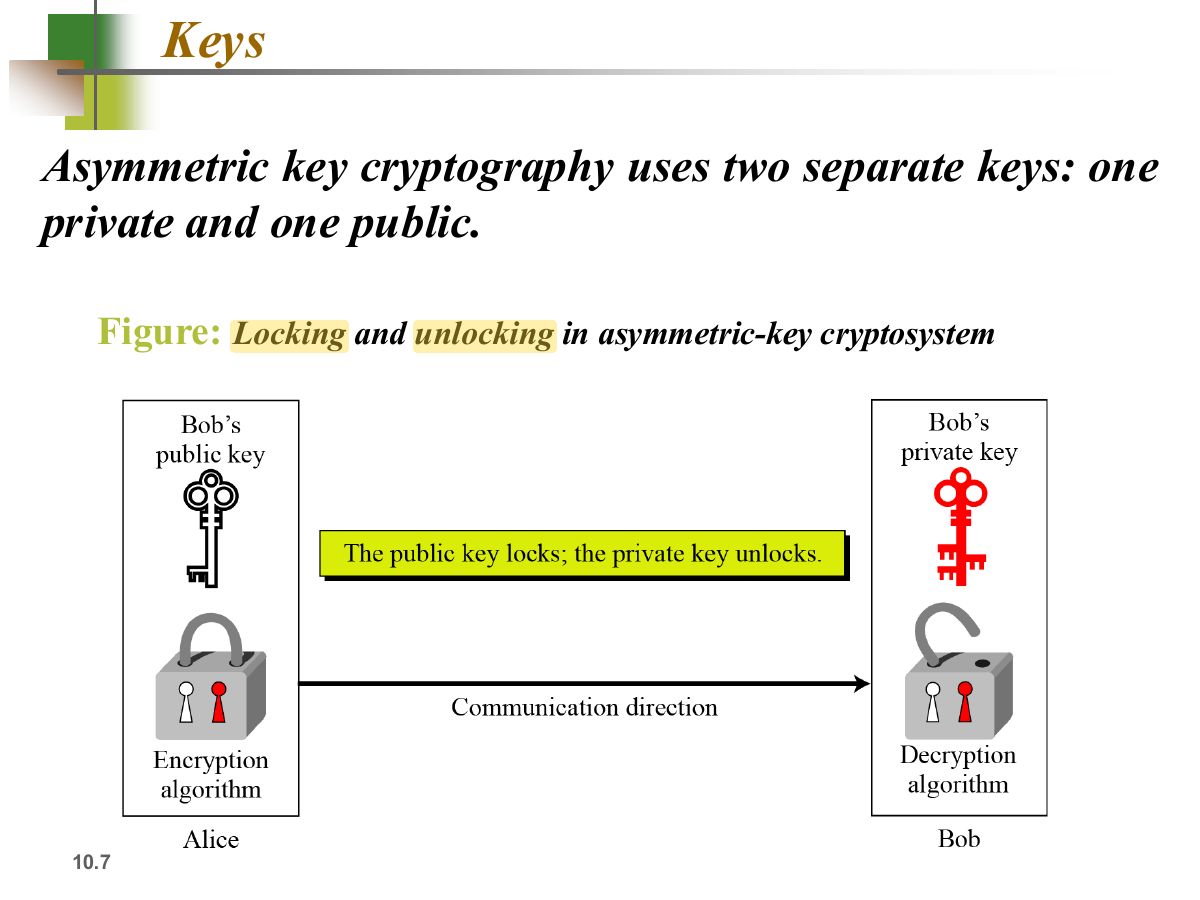
- Two keys: the public key (shared) and the private key (secret).
TipWhich key? ENCRYPT for confidentiality with the
RECEIVER’s public key (receiver decrypts with their private
key). SIGN with the SENDER’s private key (anyone verifies with
the sender’s public key).
Asked in a real exam
🎯 How this can come up · 1 question
MCQ
Which statement about an asymmetric key pair is correct?
Major 181.
Exam weight Low
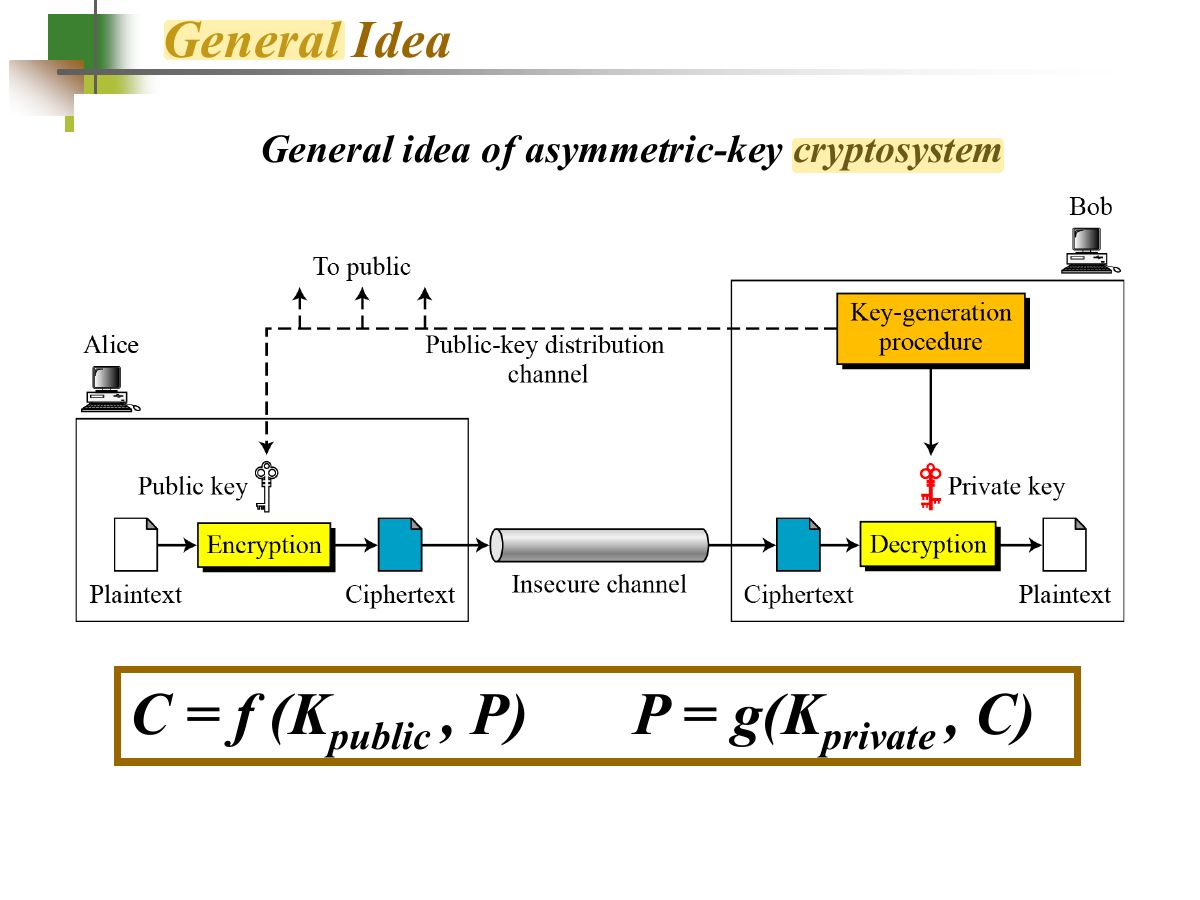
- General idea: C = f(K_public, P); P = g(K_private, C).
Exam weight
Medium
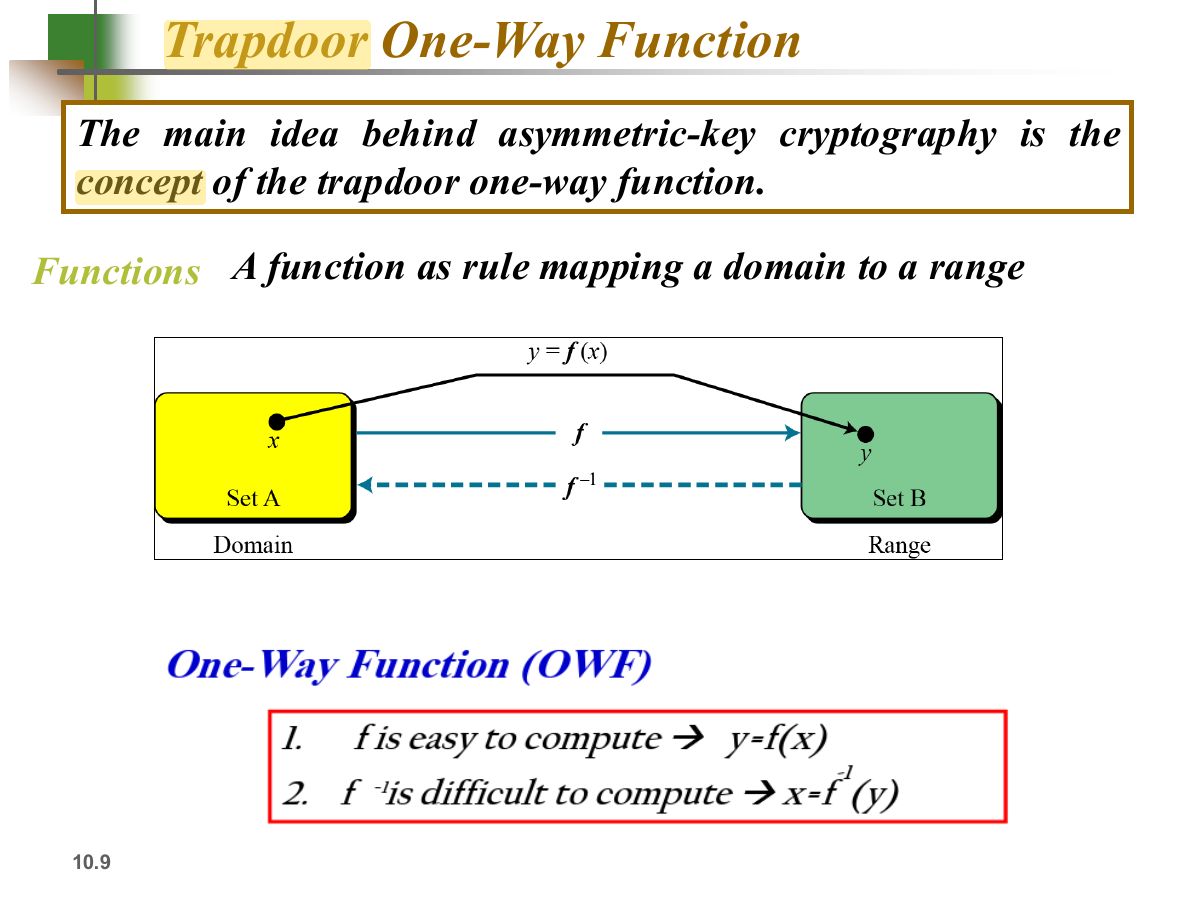
- Trapdoor one-way function: easy to compute, infeasible to invert without the trapdoor (the private key).
🎯 How this can come up · 1 question
MCQ
The core idea behind public-key cryptography is the:
Correct: Trapdoor one-way function.
Exam weight Low
- RSA (Rivest, Shamir, Adleman), the most common public-key algorithm, based on factoring large primes.
Exam weight Low
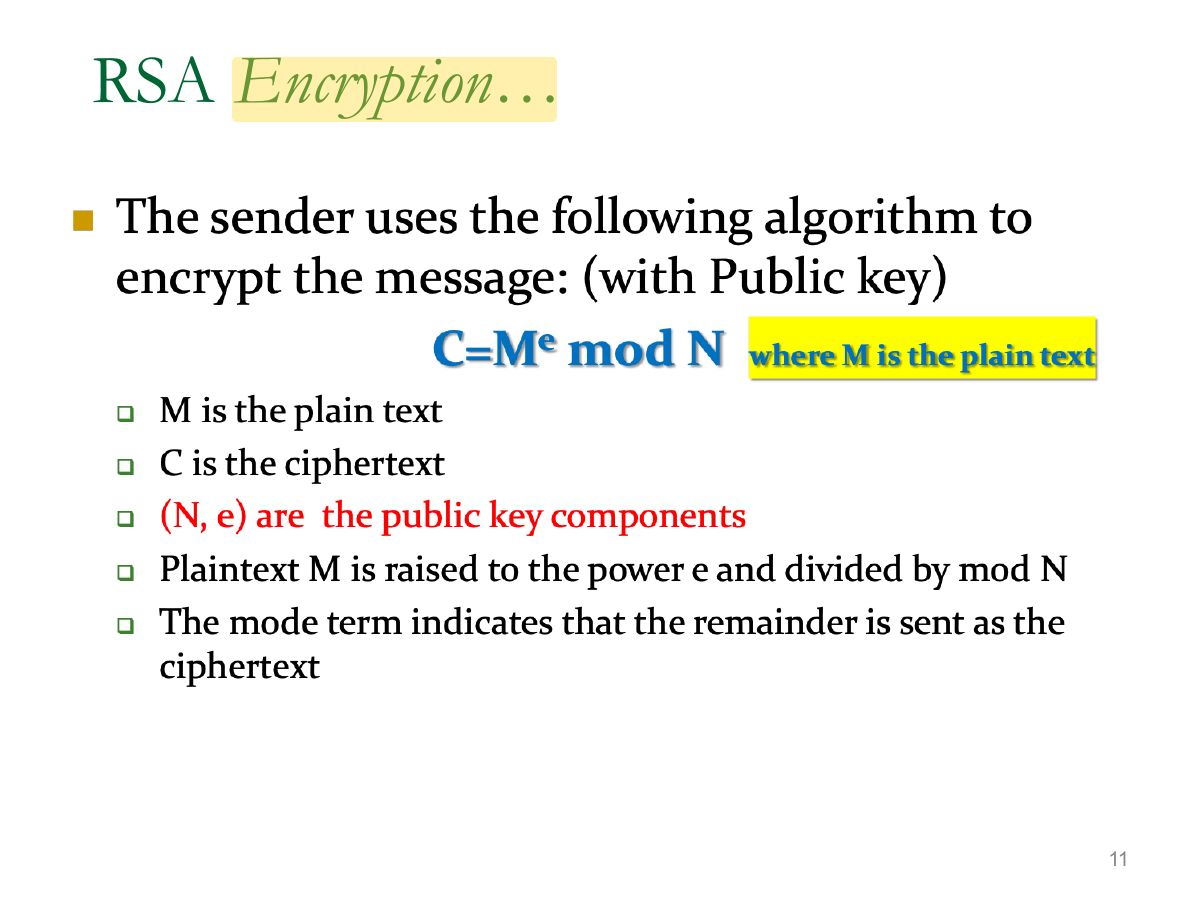
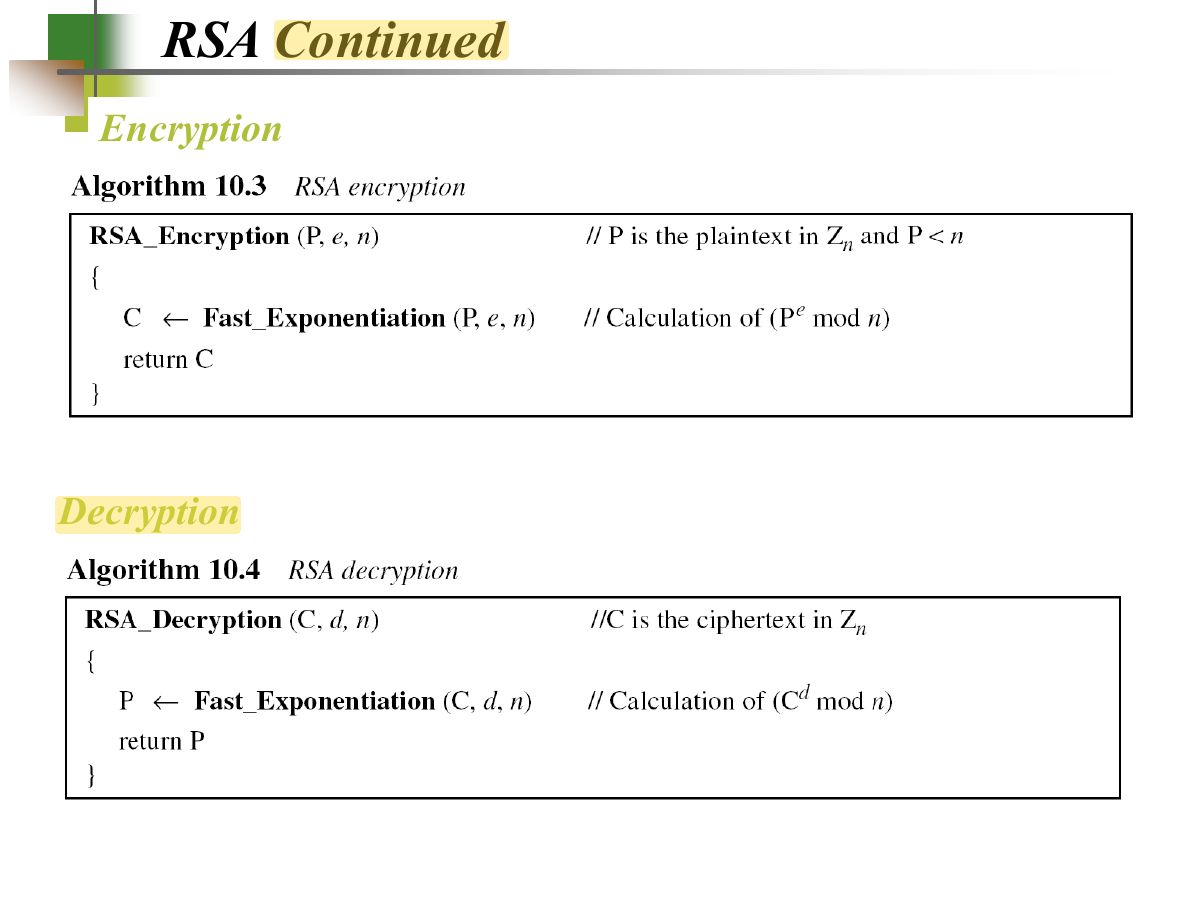
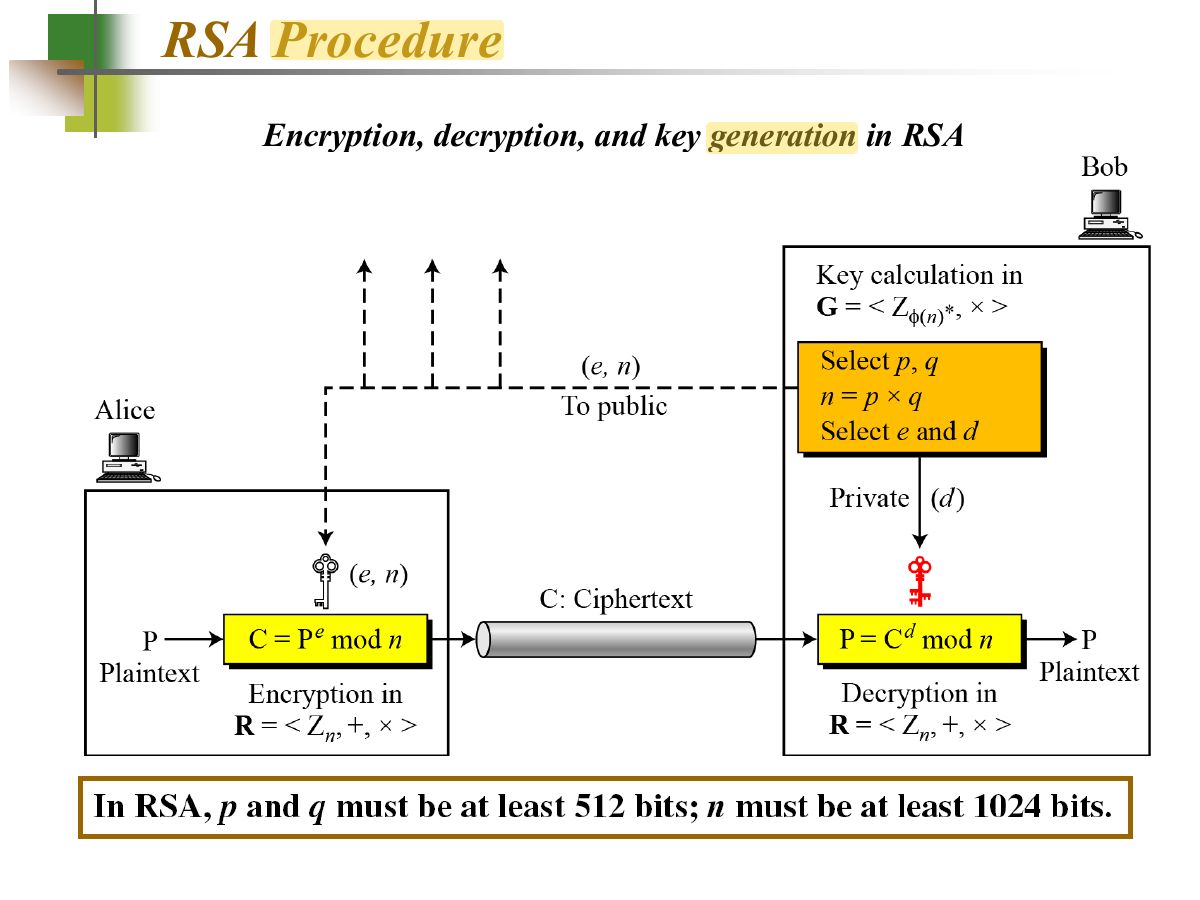
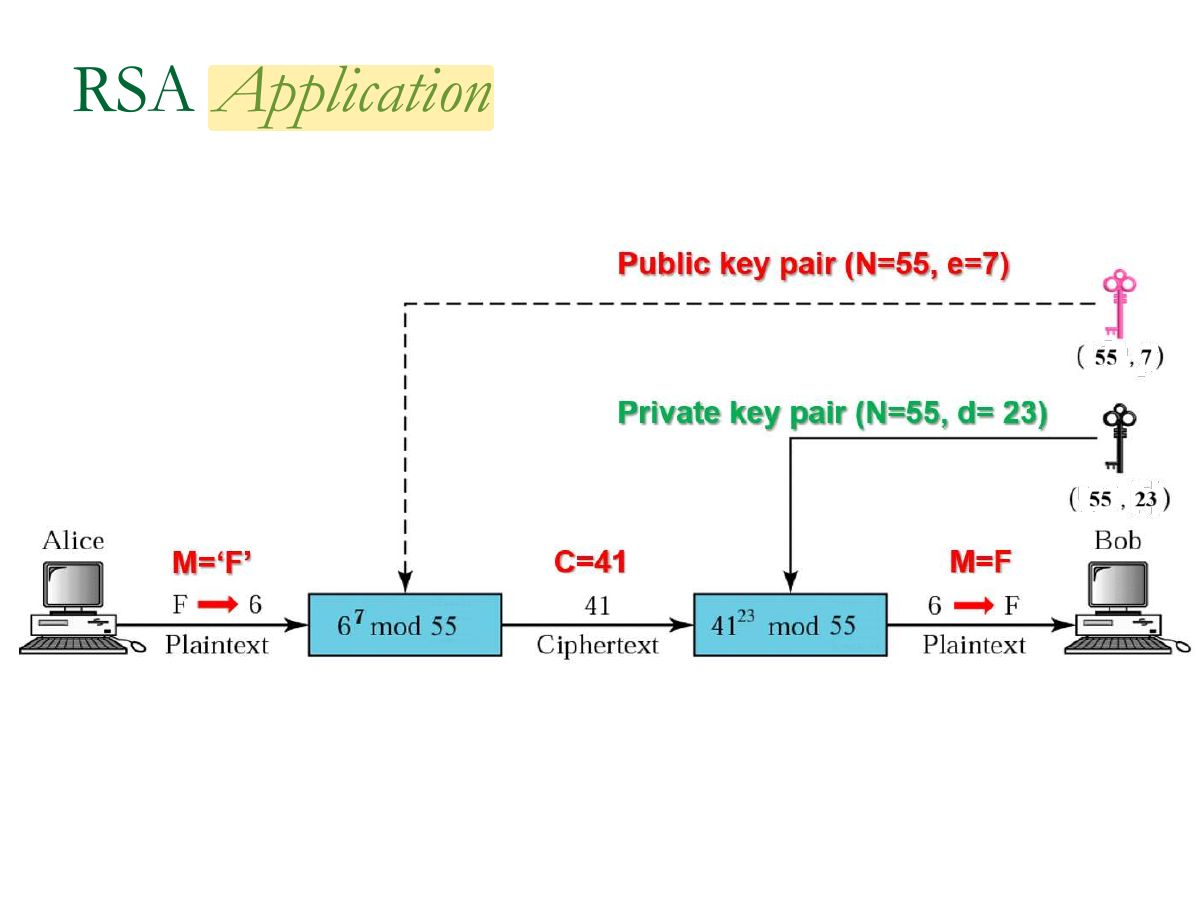
- RSA encryption: C = Mᵉ mod n (public key e, n).
Exam weight Low
- RSA decryption: M = Cᵈ mod n (private key d).
Exam weight Low
- Encryption and decryption together.
Exam weight
High
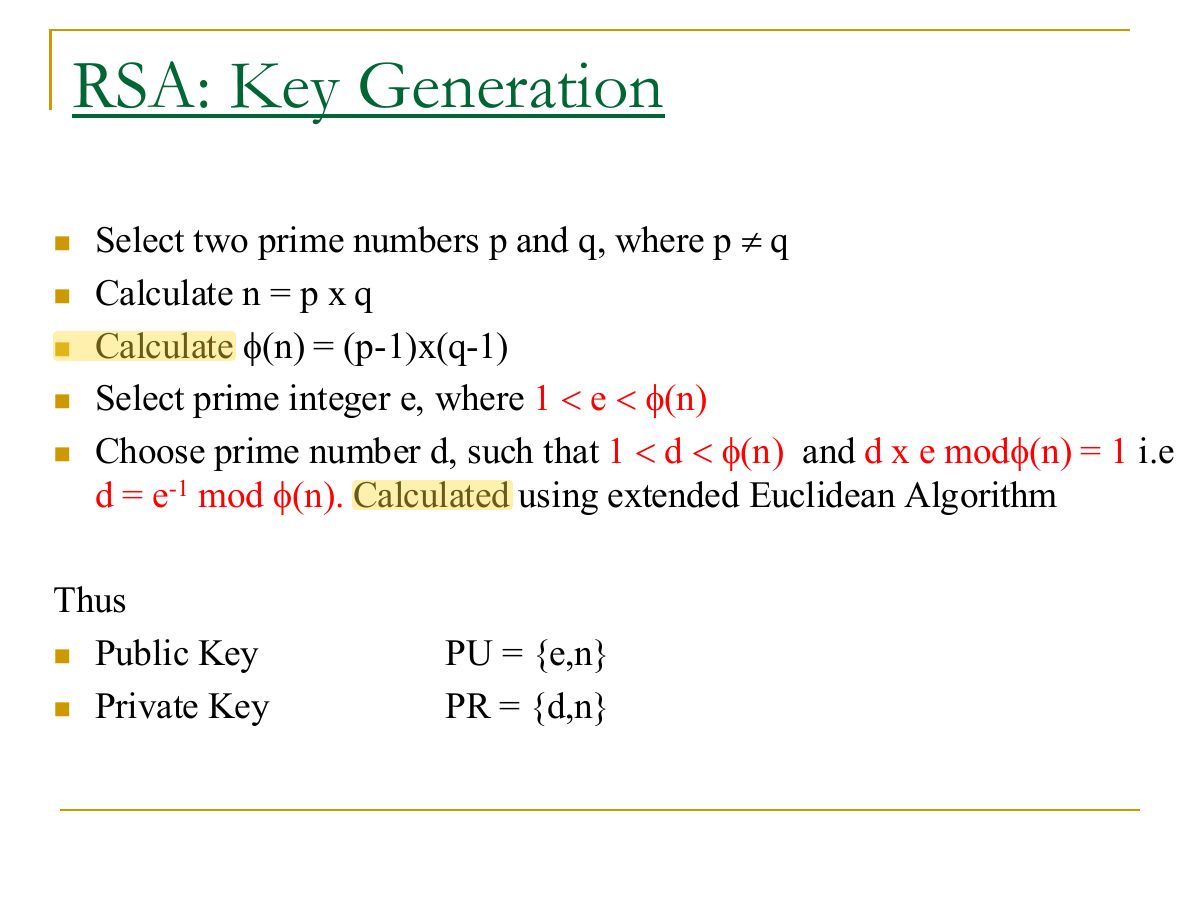
- Key generation steps.
TipRSA in 5 lines: pick primes p, q · n = p·q · φ(n) =
(p−1)(q−1) · pick e coprime with φ(n) · d = e⁻¹ mod φ(n).
Encrypt C = Mᵉ mod n; decrypt M = Cᵈ mod n.
🎯 How this can come up · 2 questions
MCQ
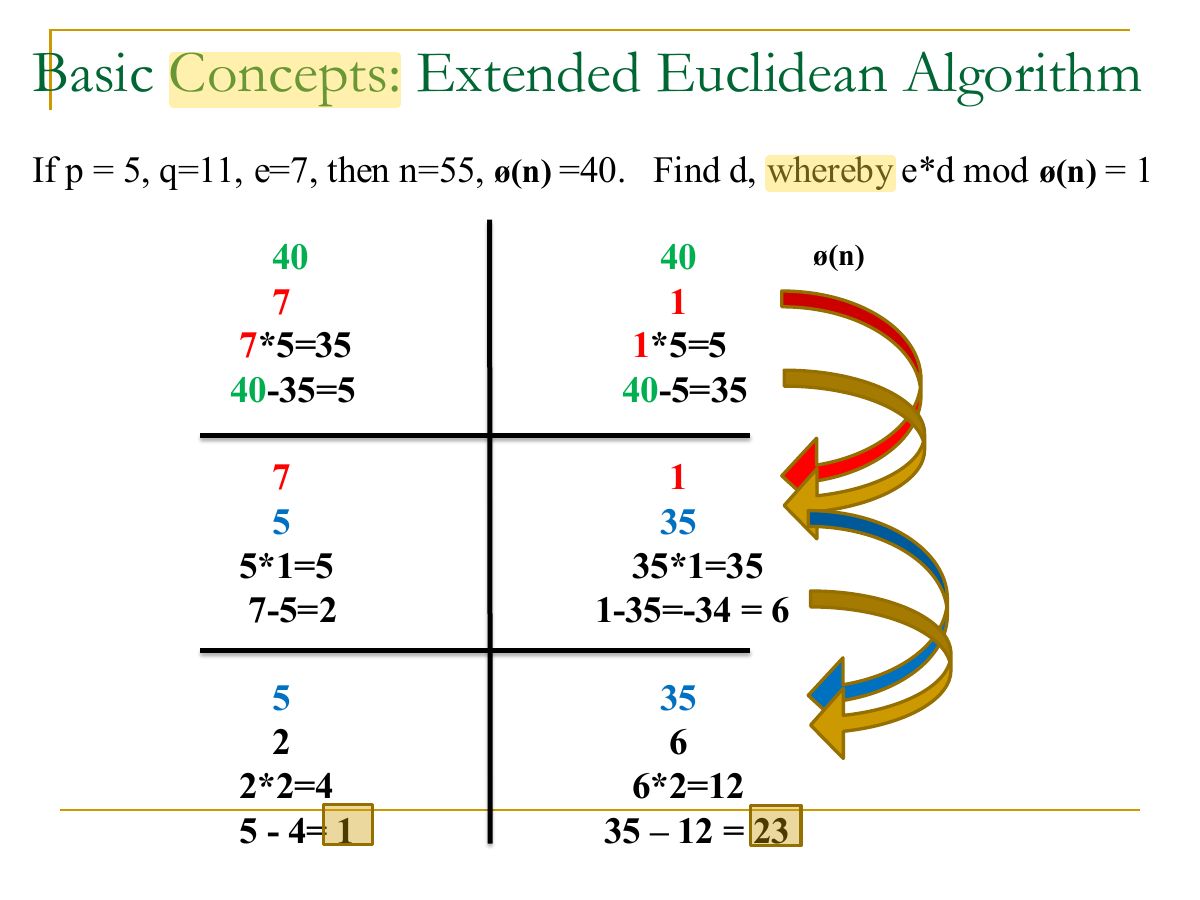
With p = 5, q = 11, φ(n) equals:
(5 − 1)(11 − 1) = 40.
MCQ
With p = 5, q = 11 and e = 7, the private exponent d is:
7 × 23 = 161 = 4 × 40 + 1.
Exam weight Low
- RSA procedure figure.
Exam weight Low
- Extended Euclid to find d with e·d mod φ(n) = 1. Example p = 5, q = 11, e = 7 → n = 55, φ = 40, d = 23.
Exam weight Low
- RSA application.
Exam weight Low
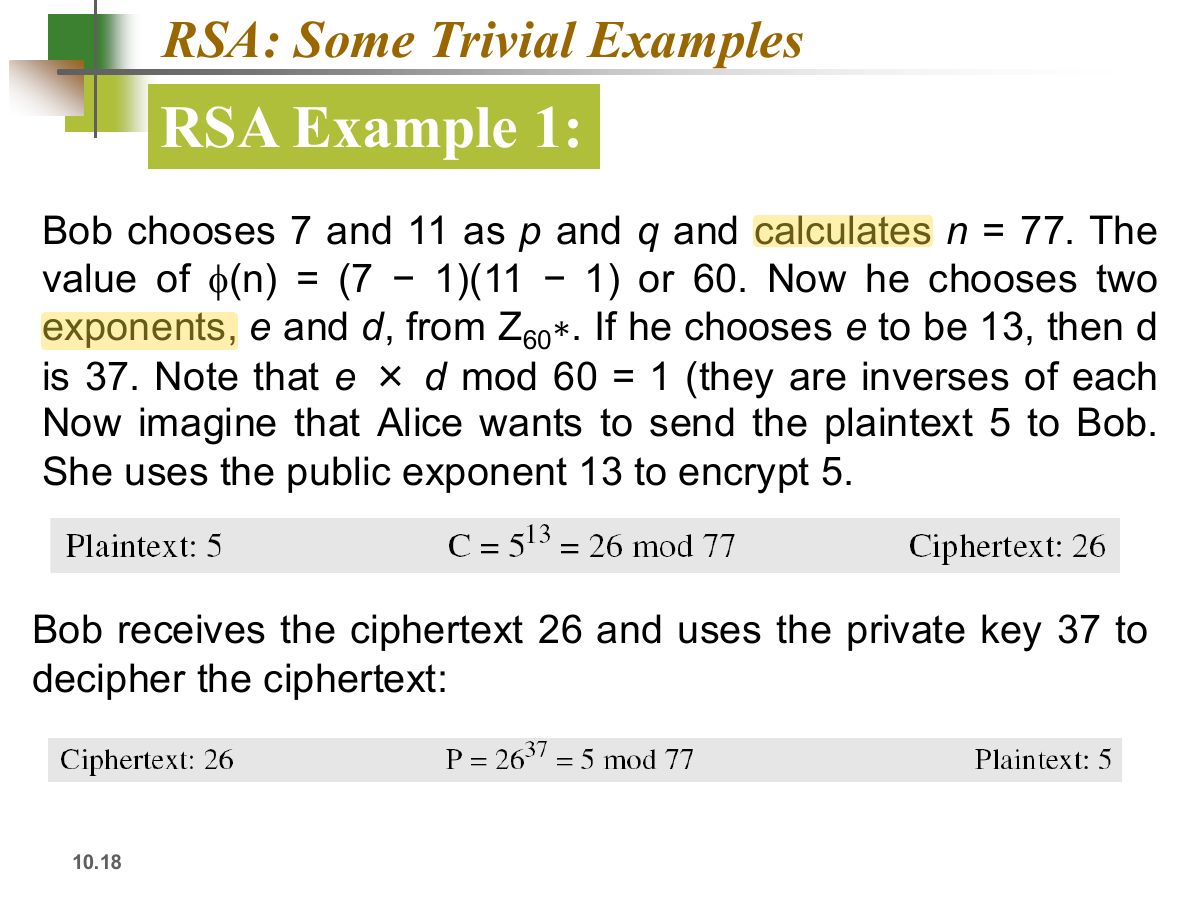
- Example 1: p = 7, q = 11 → n = 77, φ = 60, e = 13, d = 37.
Exam weight
High
- Example 2: p = 3, q = 11 → n = 33, φ = 20, e = 7, d = 3.
🎯 How this can come up · 1 question
Written
RSA with p = 3, q = 11, e = 7. Find n, φ(n), d, and encrypt M = 2.
n = 33, φ(n) = 20, d = 3 (7 × 3 = 21 ≡ 1 mod 20). C = 2⁷ mod 33 = 128 mod 33 = 29. Check: 29³ mod 33 = 2.
Exam weight Low
- Homework: find the key pair for given factors.
Exam weight Low
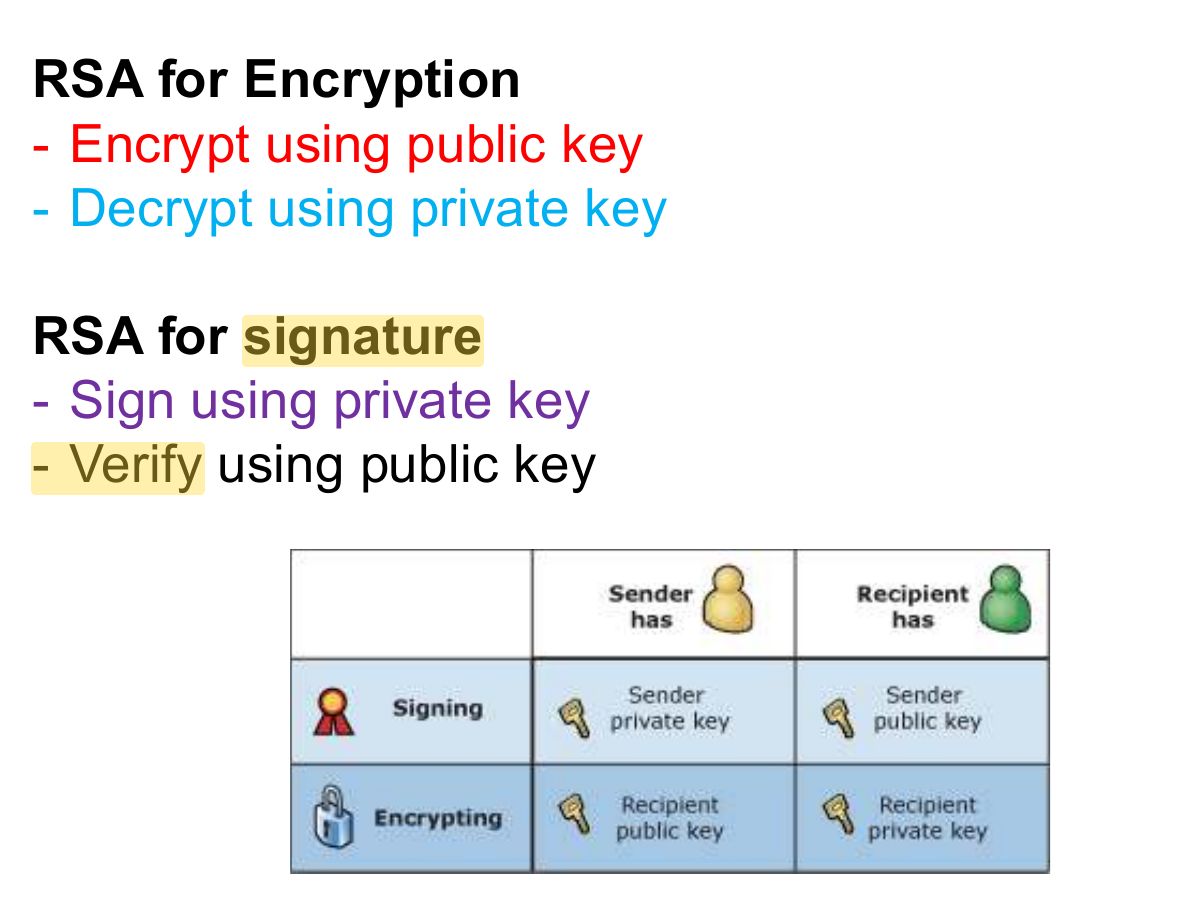
- Encryption vs. signature.
Exam weight Low
- Encryption vs. signature, continued.
★ Past exam
Exam weight
High
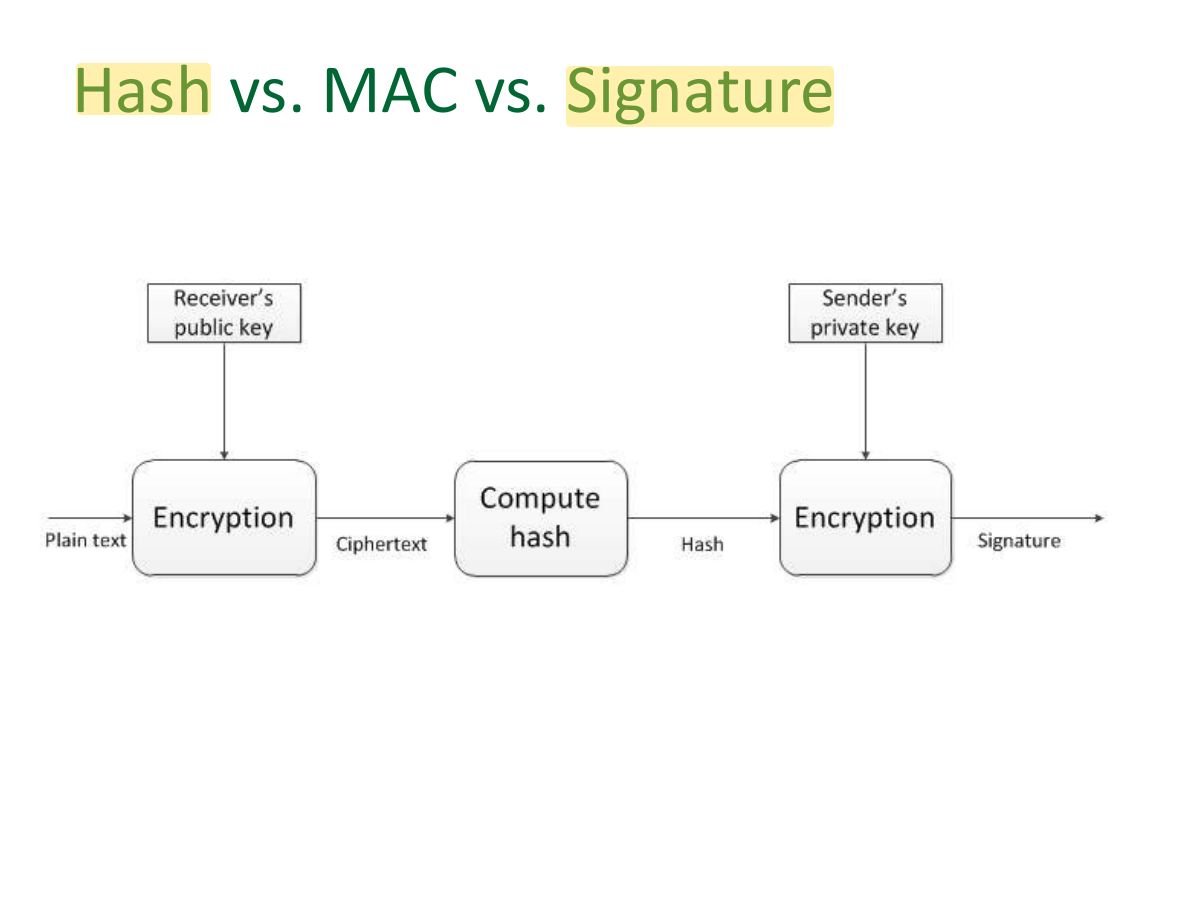
- Encrypt with the public key, decrypt with the private key. Sign with the private key, verify with the public key.
TipWhich key? ENCRYPT for confidentiality with the
RECEIVER’s public key (receiver decrypts with their private
key). SIGN with the SENDER’s private key (anyone verifies with
the sender’s public key).
Asked in a real exam
🎯 How this can come up · 1 question
MCQ
A digital signature is created by encrypting the message digest with:
Major 181.
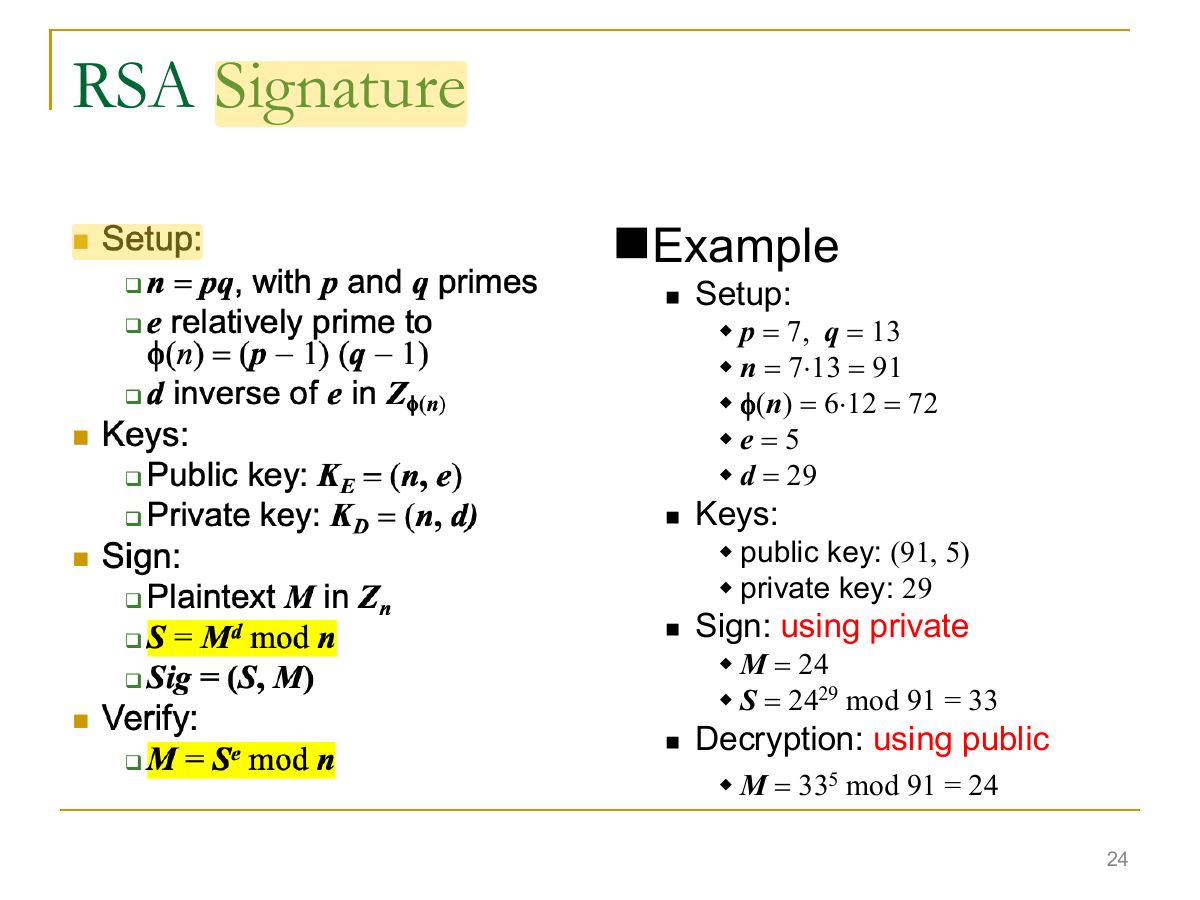
Exam weight Low
- Signature example: p = 7, q = 13, n = 91, φ = 72, e = 5, d = 29.
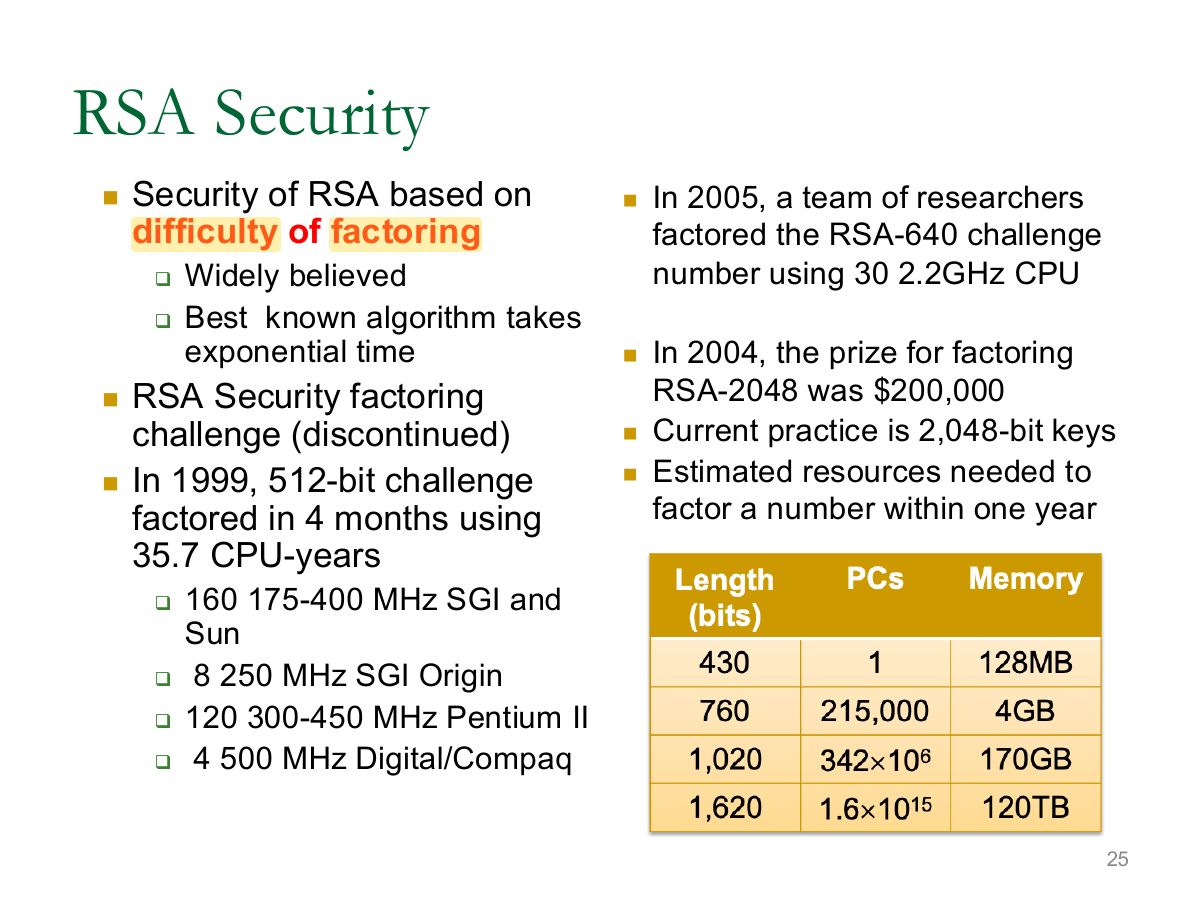
Exam weight Low
- RSA security rests on how hard it is to factor n; key sizes keep growing (2048+ bits).
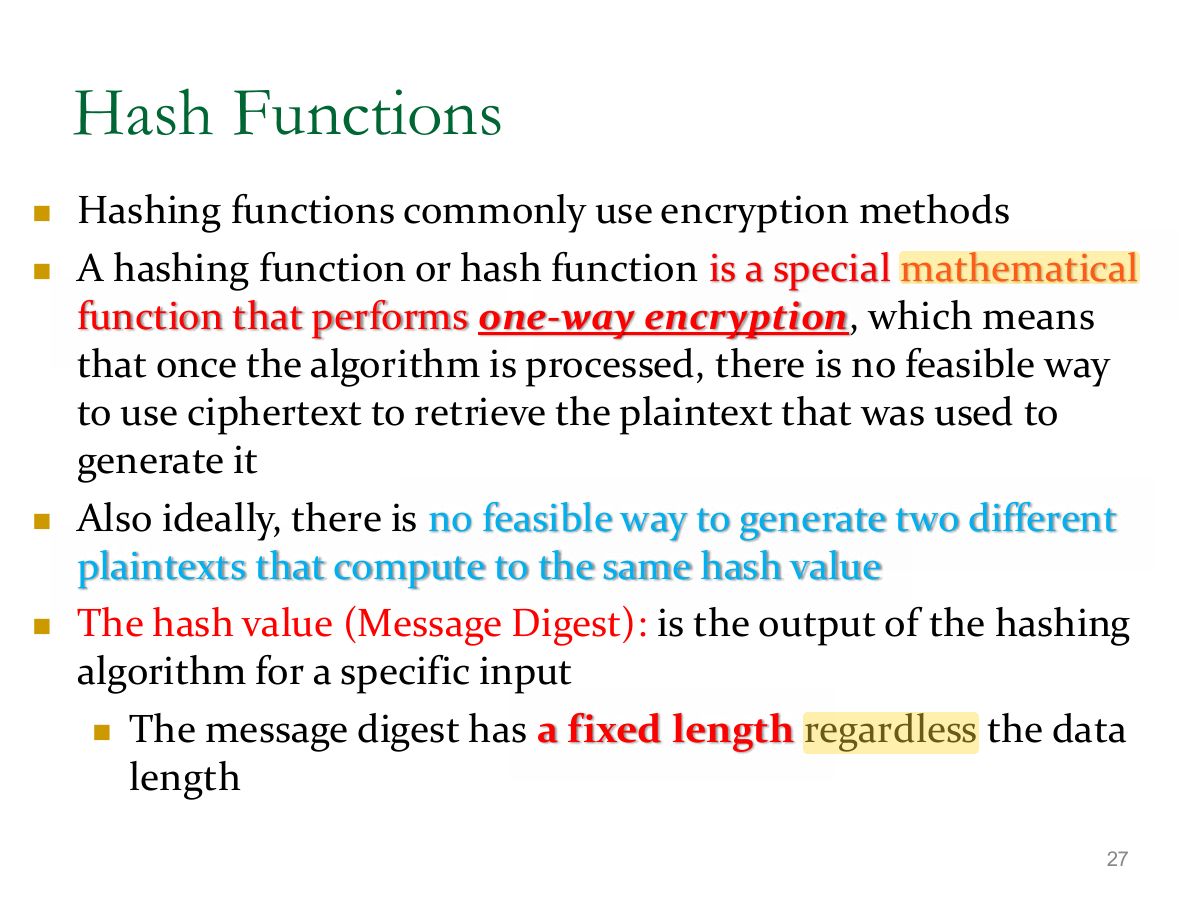
Exam weight Low
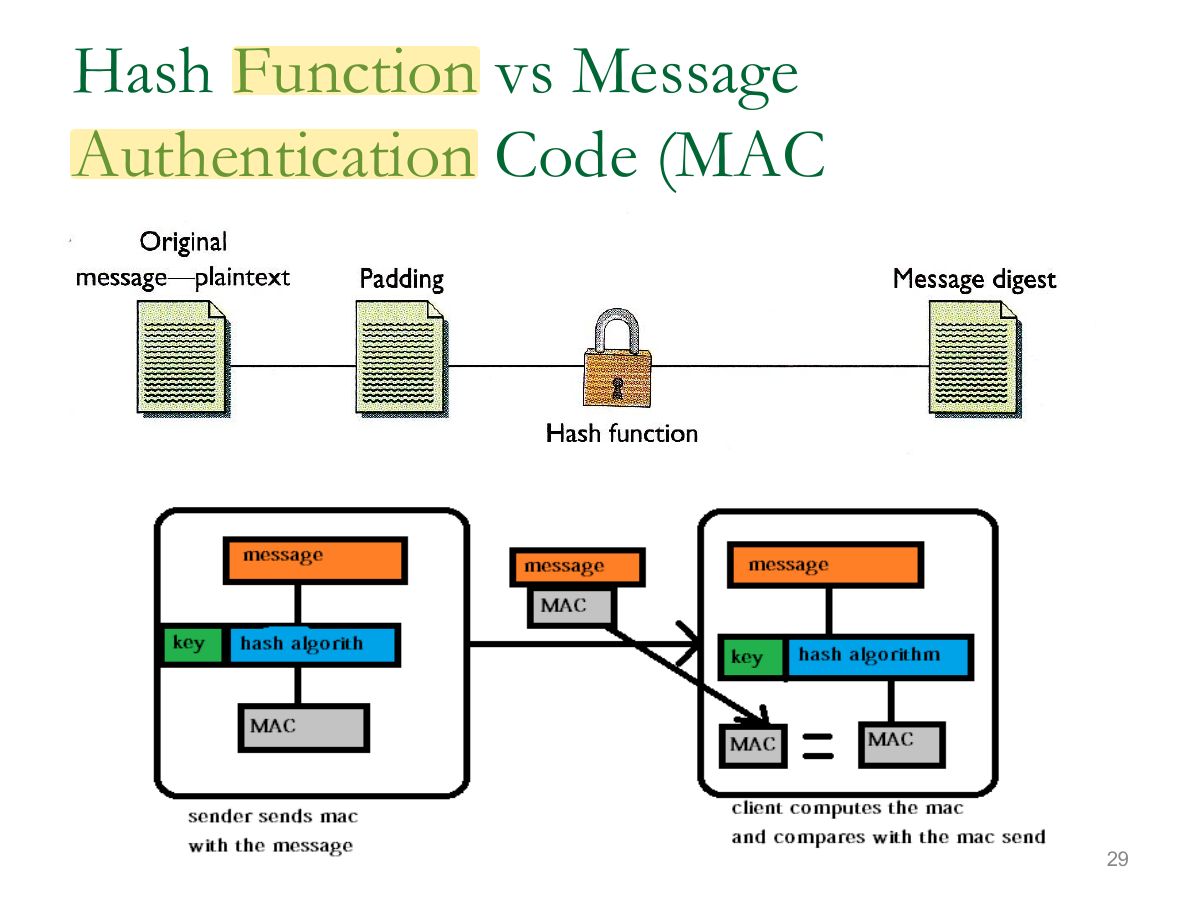
- A hash maps any input to a fixed-length digest; one-way (you can’t get the plaintext back).
Exam weight
High
- Uses: storing passwords, integrity checks, signatures.
Asked in a real exam
🎯 How this can come up · 1 question
Written
How is hashing different from encryption? Give two differences. (Final 221 B)
Hashing is one-way (no key, cannot be reversed) while encryption is reversible with a key; a hash always has a fixed-length output, while ciphertext length depends on the input.
Exam weight Low
- Hash (no key, integrity only) vs. MAC (shared key: integrity + authenticity).
Exam weight Low
- Collision attack: two different messages with the same hash.
★ Past exam
Exam weight
High
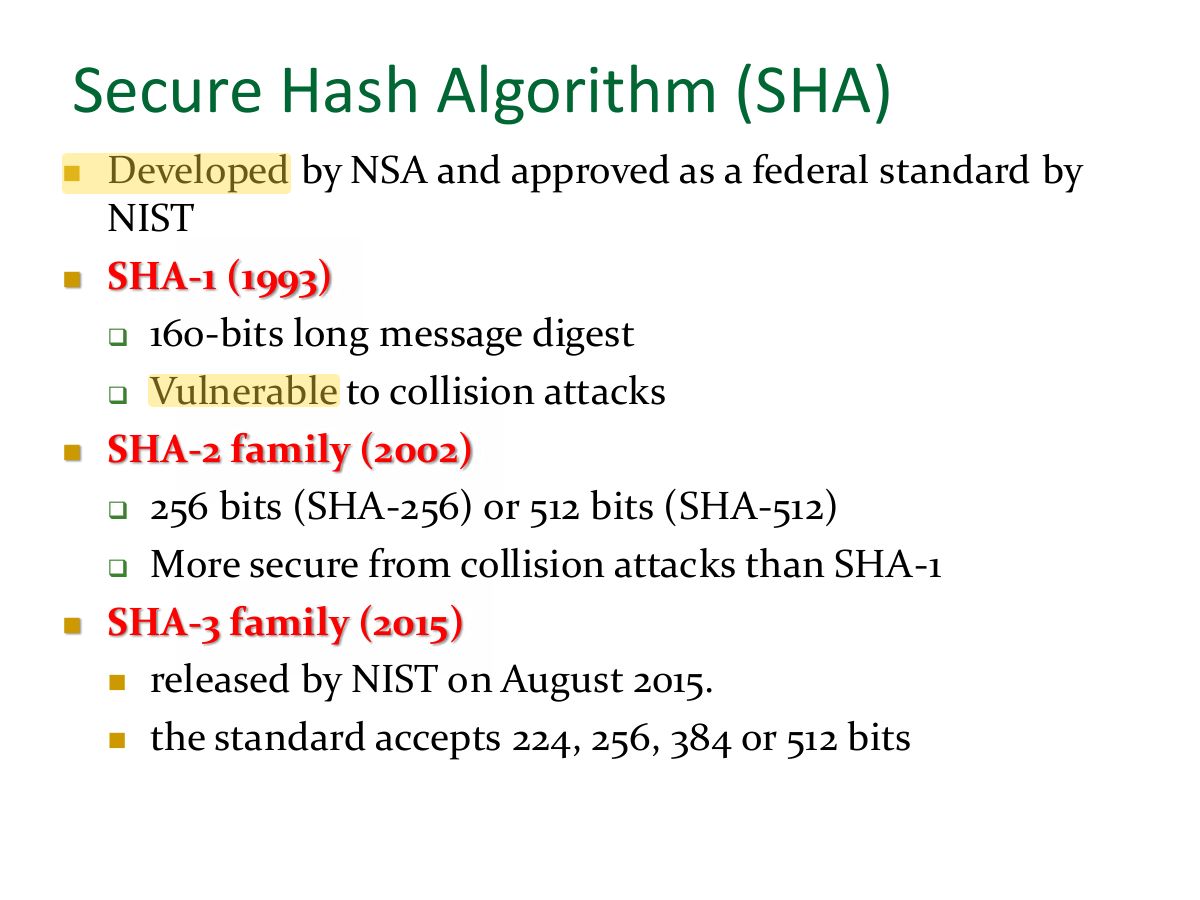
- SHA (NSA, NIST standard). SHA-1: 160-bit digest. SHA-2: 224–512. SHA-3: 224, 256, 384, 512 with a different internal structure (Keccak).
Asked in a real exam
🎯 How this can come up · 1 question
MCQ
SHA-1 produces a digest of:
Correct: 160 bits.
★ Past exam
Exam weight
High
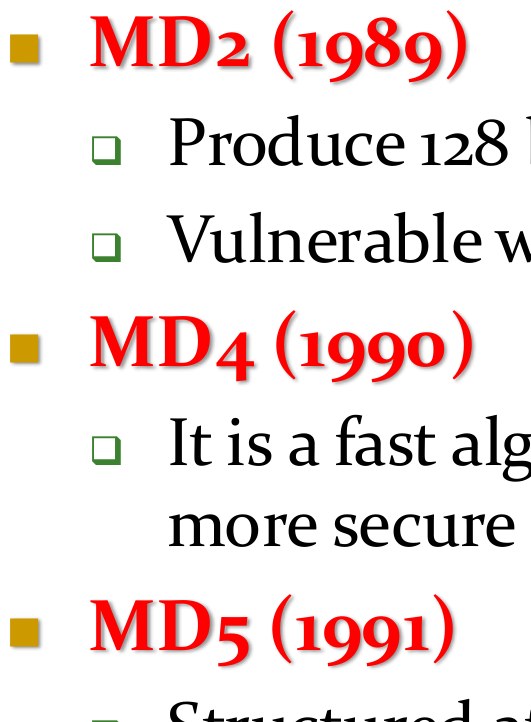
- MD (Message Digest) family: 128-bit hashes. MD4 is older and LESS secure than MD5.
Asked in a real exam
🎯 How this can come up · 1 question
MCQ
MD5 produces a hash of:
Correct: 128 bits.
Exam weight Low
- Try hashing text online.
Exam weight
High
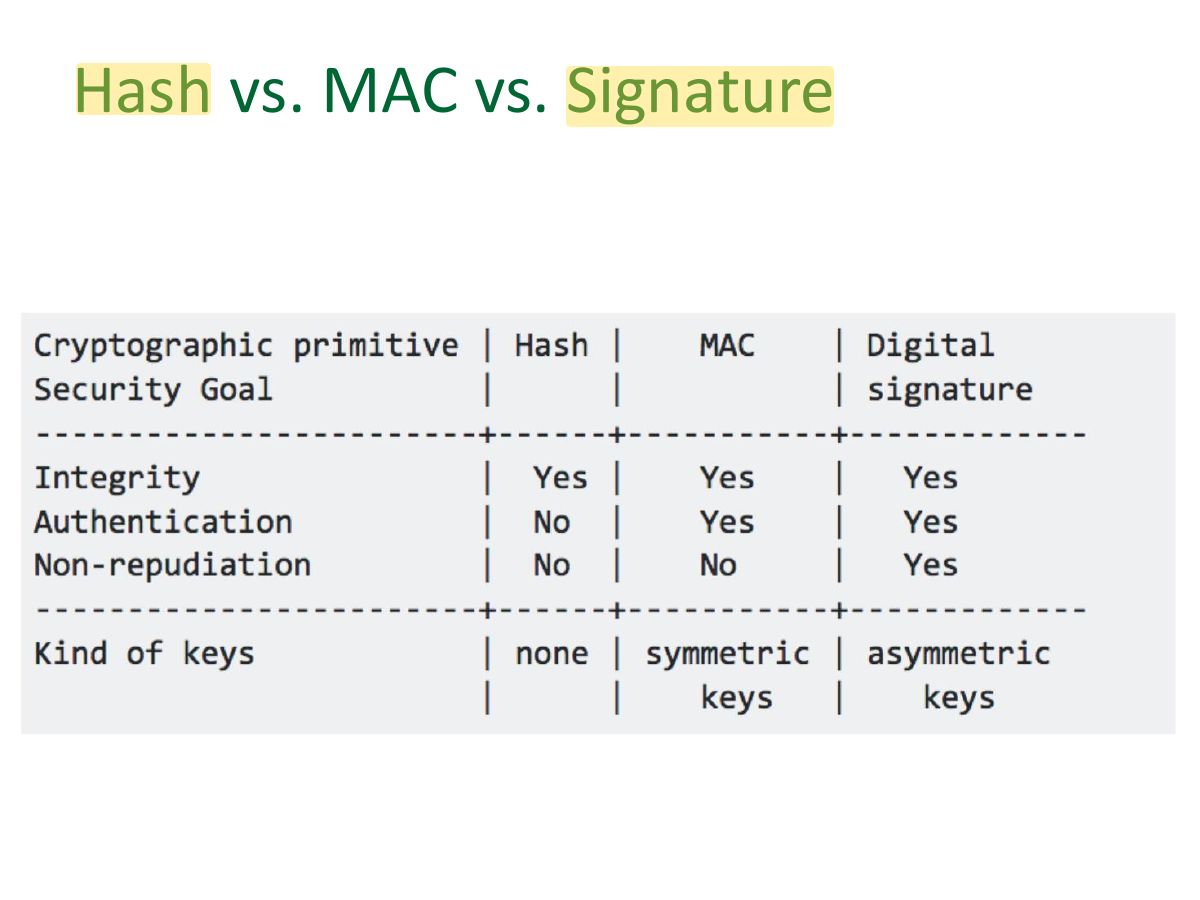
- Hash = integrity. MAC = integrity + authentication (shared key). Signature = integrity + authentication + non-repudiation (private key).
🎯 How this can come up · 1 question
MCQ
Which provides non-repudiation?
Correct: A digital signature.
Exam weight Low
- Comparison continued.
Exam weight Low
- Summary.
Exam weight Low
- End.
No slides match this filter.