CYS401 · Annotated SlidesChapter 4 — Protection of Information Assets
Chapter 4 · Annotated slides

Protection of Information Assets

Information assets, security governance vs. management, third parties and ASPs, due care vs. due diligence, classification (government and commercial) and its criteria, marking and handling, data at rest/in transit/in use, retention and destruction (erasing, clearing, purging, destruction), privacy laws (GDPR, CCPA, PDPL), ownership roles, and strategic/tactical/operational plans. Majors A, B and C each had a due-care question and a destruction or classification question from here.

Slide text Study notes Highlight: key words Tips, tricks & traps Seen again elsewhere How it can come up

Protection of Information Assets

CYS401 · Chapter 4
1
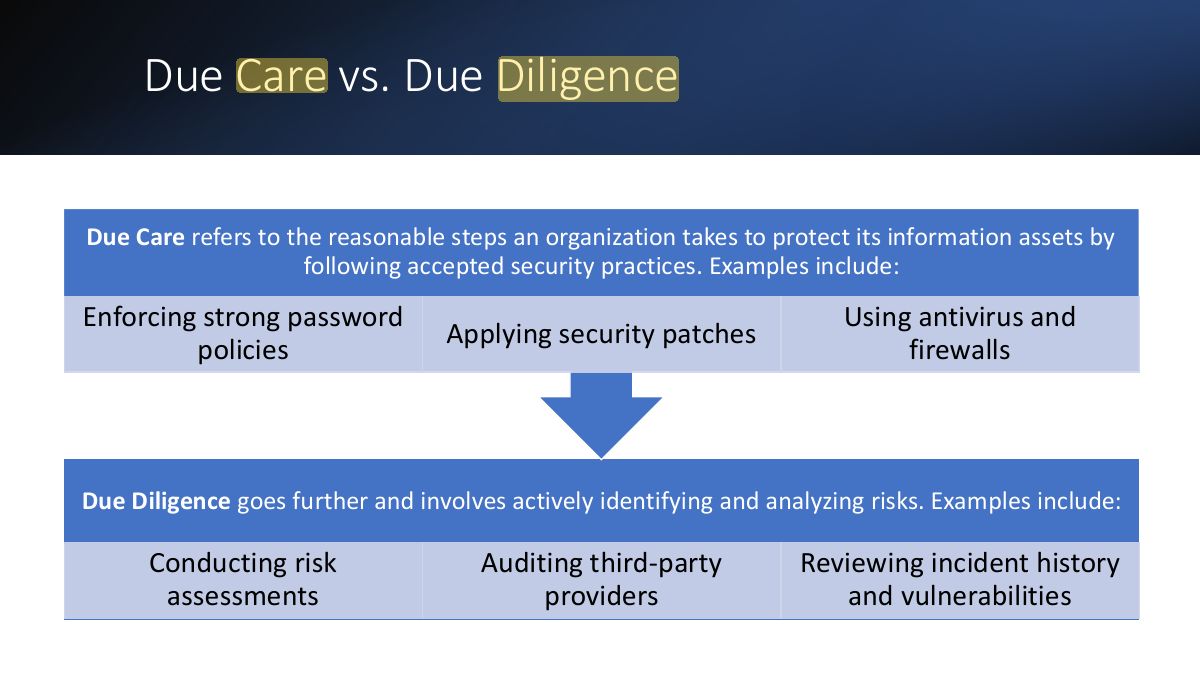
TipDue care = DOING the right thing (the protective action: training, patching, responding to a breach). Due diligence = RESEARCHING and checking (risk assessments, investigating threats, auditing vendors before access).

Learning Objectives

  • By the end of this chapter, students will be able to:
    • Explain what information assets are and why they are critical to organizations
    • Describe the role of security governance in protecting information assets
    • Classify information assets based on sensitivity, value, and impact
    • Identify ownership roles and responsibilities for information assets
    • Apply appropriate security controls across different data states
    • Understand data retention, sanitization, and disposal requirements
    • Explain how laws and regulations influence information asset protection
2
Exam weight Low
  1. Assets → governance → due care/diligence → classification → handling → destruction → laws → ownership → planning.
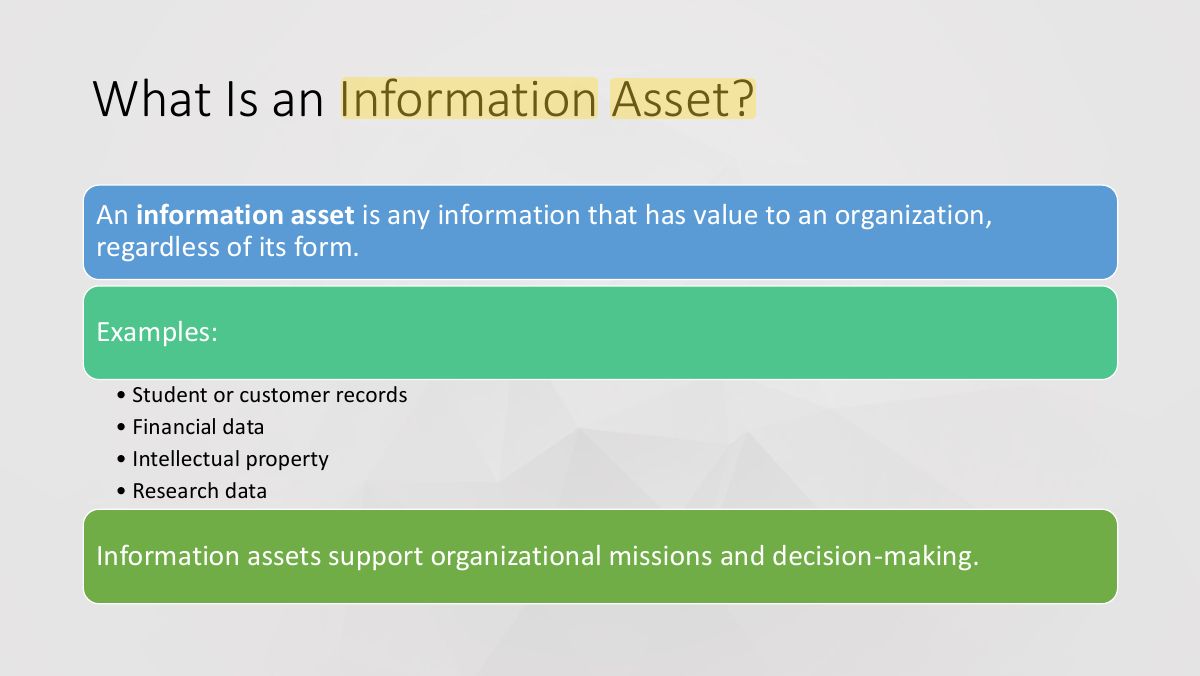
Slide 3: What Is an Information Asset?
Exam weight Low
  1. An information asset = any information of value to the organization, in any form (records, IP, financial data).
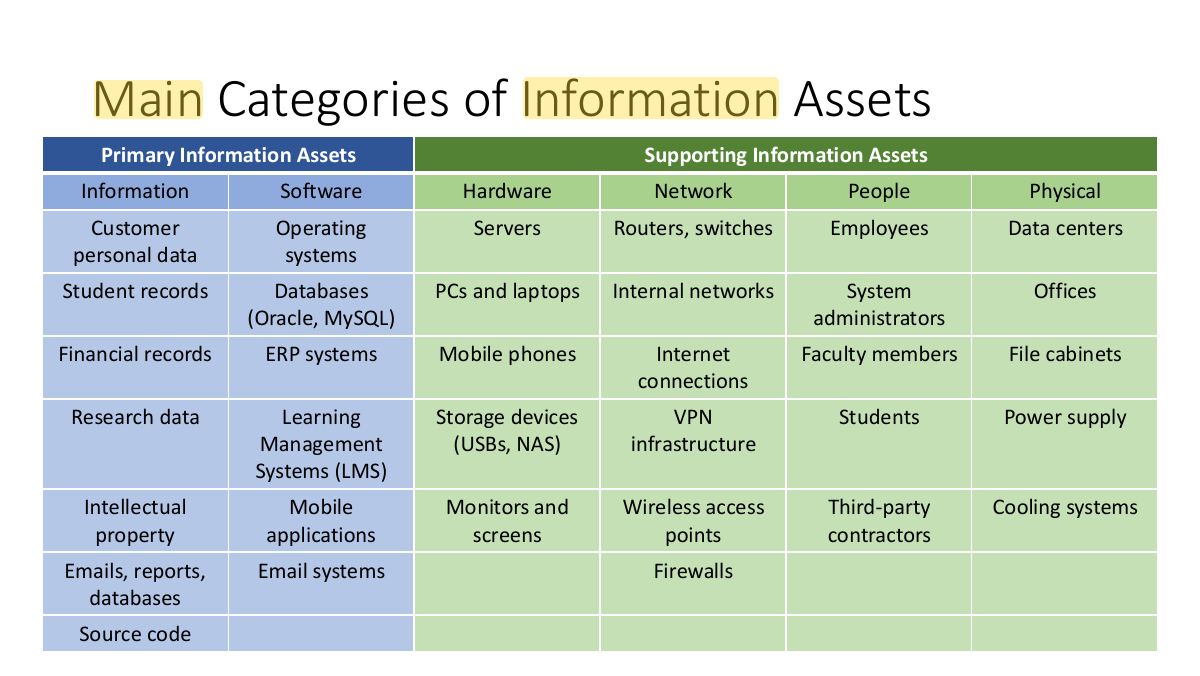
Slide 4: Main Categories of Information Assets
Exam weight Low
  1. Primary assets (the information and business processes) vs. supporting assets (hardware, software, networks, people, sites).

  • Organizations must protect information assets because:
    • Information is a core business resource that enables operations and decision-making

Why Protect

  • Loss of confidentiality can lead to privacy violations and legal penalties

Information

  • Loss of integrity can result in incorrect decisions and operational

Assets?

failures

  • Loss of availability can disrupt services and business continuity
  • Data breaches damage organizational reputation and stakeholder trust
  • Protecting information assets is therefore a strategic, legal, and governance requirement, not only a technical concern.
5
Exam weight Low
  1. Protect assets because information drives operations and decisions, and loss means financial, legal and reputational damage.
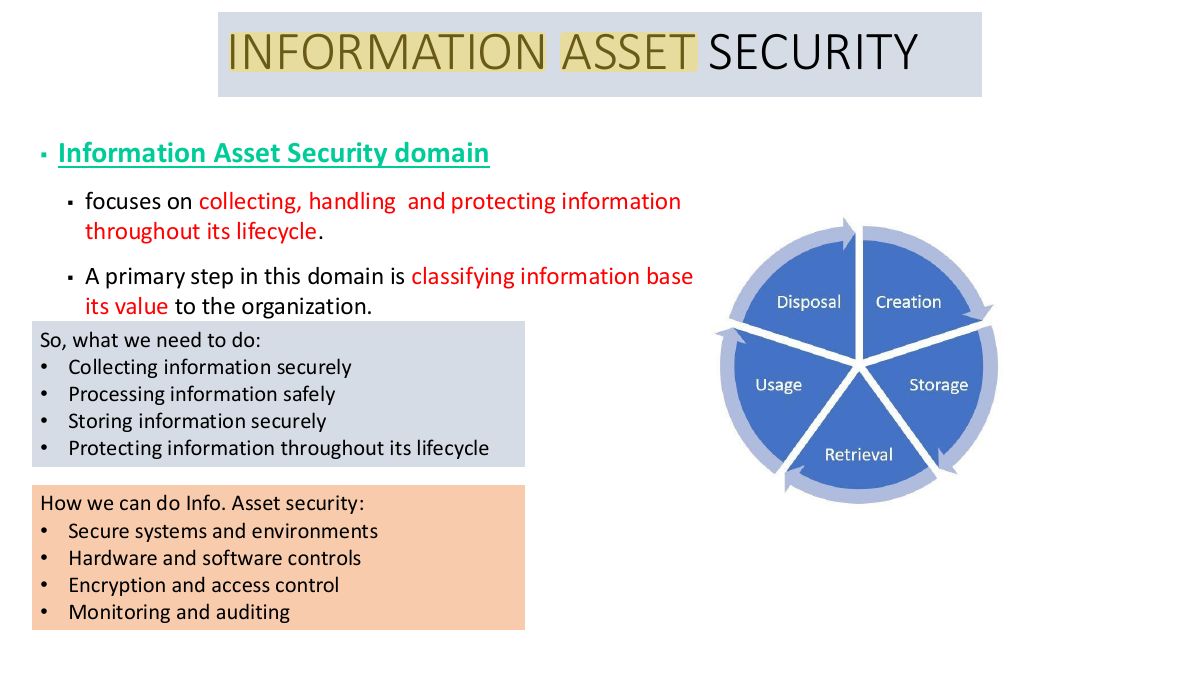
Slide 6: INFORMATION ASSET SECURITY
Exam weight Low
  1. Asset security domain: protect information through its whole lifecycle; first step = classify by value.

Security Governance and Information Assets

  • Security governance defines how information assets are protected and controlled.
  • It ensures:
    • Clear accountability
    • Consistent security practices
    • Compliance with laws and standards
    • Oversight and continuous improvement
  • Asset protection is enforced through policies, standards, procedures, and audits.
7
Exam weight Low
  1. Security governance defines how assets are protected: accountability, alignment with business, compliance, risk-based decisions.

SECURITY GOVERNANCE PRINCIPLES

Security governance is the collection of practices related to supporting, defining, and directing the security efforts of an organization.

Security governance principles are often closely related to and often twisted with corporate and IT governance.

Corporate governance is Doing the right things for the

“

organization and doing things the right way independent of personal interests. ”

8
Exam weight Low
  1. Governance = supporting, defining and directing security efforts; tied to corporate and IT governance.
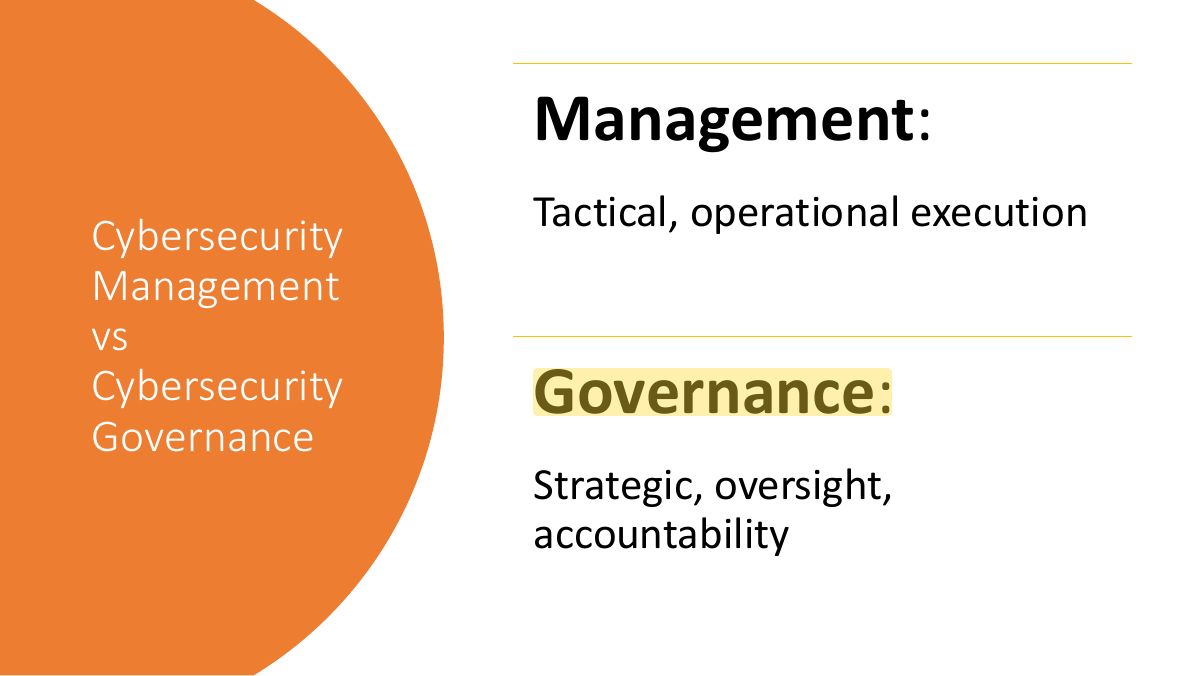
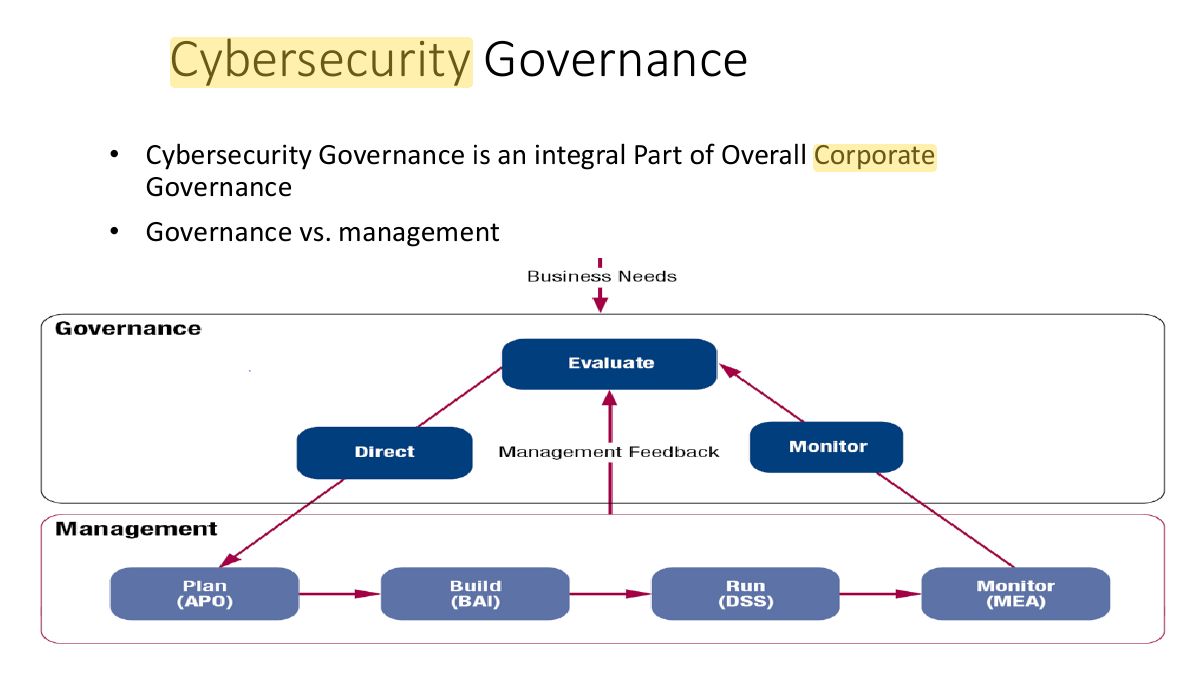
Slide 9: Management :
Exam weight High
  1. Governance = “doing the right things” (direction, oversight). Management = “doing things right” (tactical, operational execution).
Memory trickGovernance decides WHAT and WHY; management does HOW.
🎯 How this can come up · 1 question
MCQ

Which describes cybersecurity MANAGEMENT rather than governance?

Slide 10: Cybersecurity Governance
Exam weight Low
  1. Cybersecurity governance is part of corporate governance.

Cybersecurity Governance

  • The strategic oversight function that ensures the cybersecurity program aligns with business goals and complies with laws, regulations, and policies.
  • Focus: Direction, accountability, oversight, and control. : Senior leadership, board of directors, governance committees.
  • Who’s Involved
  • Key Questions Addressed:
    • Are we doing the right things ?
    • Are our cybersecurity investments aligned with business risk and value?
    • Are roles, responsibilities, and reporting structures clearly defined?
  • Examples:
    • Approving enterprise security policies.
    • Defining acceptable risk levels.
11
Exam weight Low
  1. Governance: strategic oversight; senior leadership, board, committees.

Cybersecurity Management

  • The operational and tactical activities performed to implement and maintain cybersecurity controls.
  • Focus: Execution, operations, monitoring, and incident response. : CISOs, security managers, security analysts, technical staff.
  • Who’s Involved
  • Key Questions Addressed:
    • Are we doing the things right ?
    • Are controls properly implemented and maintained?
    • Are we responding effectively to threats and vulnerabilities?
  • Examples:
    • Deploying firewalls and endpoint protection.
    • Monitoring for cyber incidents.
    • Conducting vulnerability scans and risk assessments.
12
Exam weight Low
  1. Management: operations; CISO, security managers, analysts.

13
Exam weight Low
  1. Governance vs. management compared.
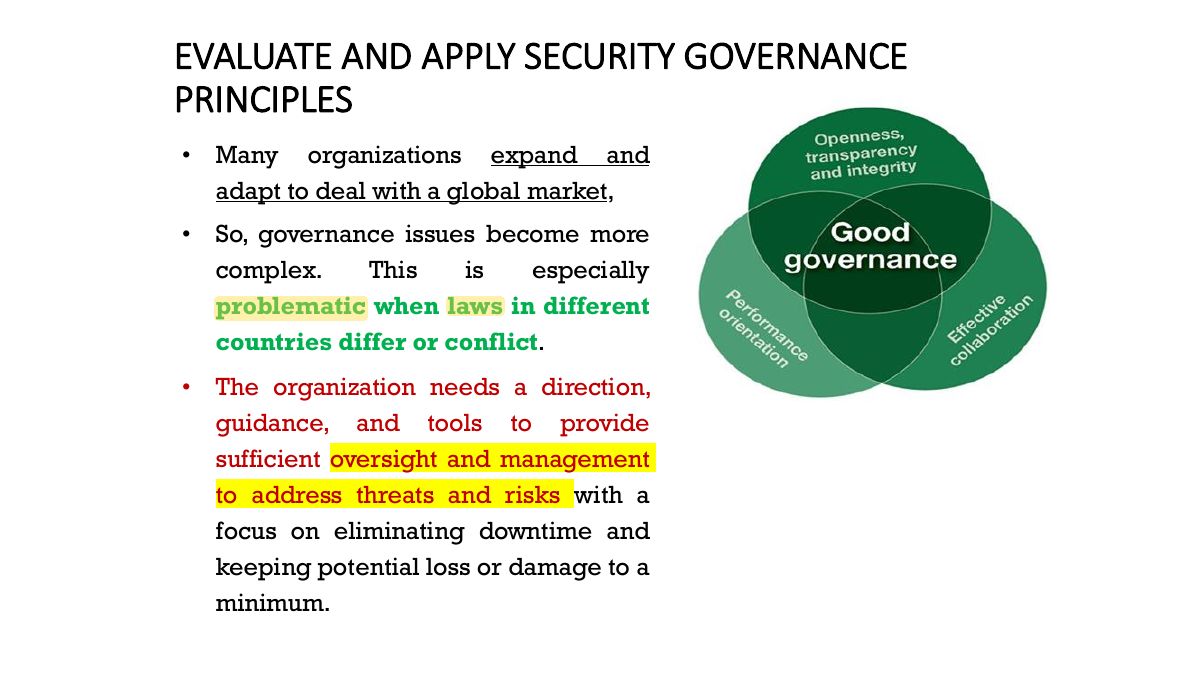
Slide 14: EVALUATE AND APPLY SECURITY GOVERNANCE PRINCIPLES
Exam weight Low
  1. Global organizations face conflicting laws across countries; governance gives direction and oversight.
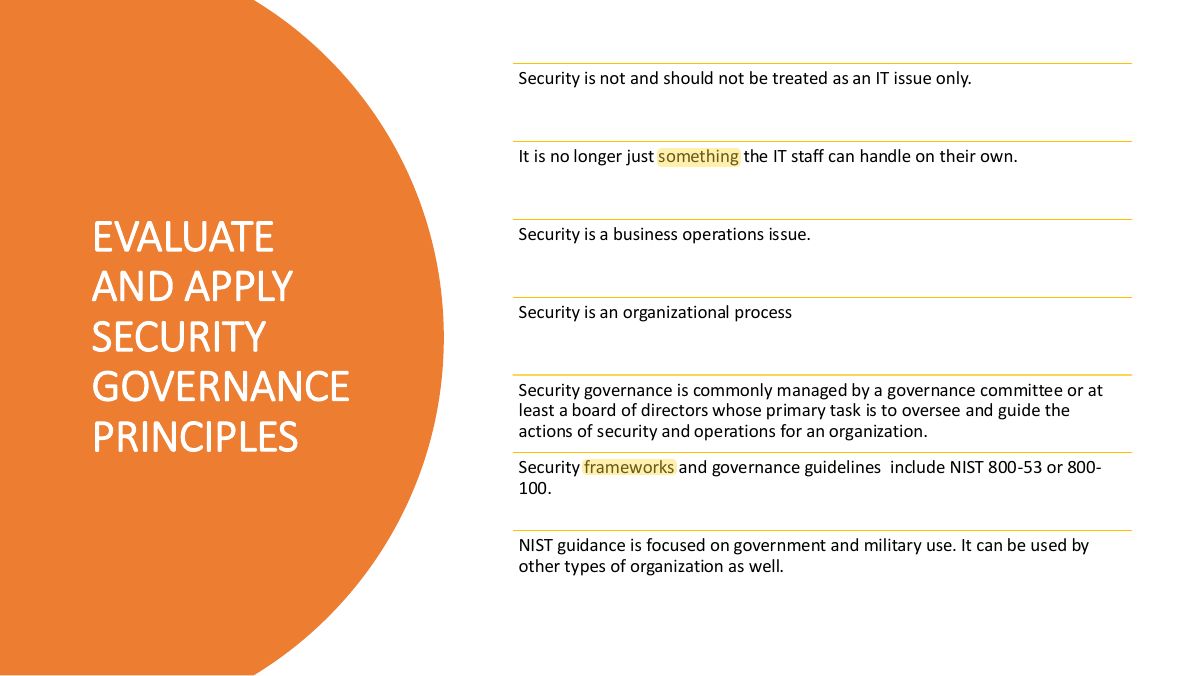
Slide 15: Security is not and should not be treated as an IT issue only.
Exam weight Low
  1. Security is a business operations issue, not only an IT issue.
★ Past exam

ASP: An Application Service Provider (ASP) is a company that delivers software applications over the internet. Instead of hosting the software on your own servers, the ASP hosts and maintains it on their servers.

When using ASPs or cloud providers:

Third-Party

and Cloud

  • Organizations remain accountable for data protection

Governance

  • Due diligence must be performed before engagement
  • Contracts and SLAs must define security responsibilities

Governance ensures third-party risks are managed effectively.

16
Exam weight High
  1. ASP (Application Service Provider): delivers applications over the internet from its own servers. The organization stays accountable for its data → review the provider’s security and set an SLA with security requirements, responsibilities and breach notification.
🎯 How this can come up · 1 question
Written

What is an ASP, and what should be done to protect data when using one? (Major C)

★ Past exam
Slide 17: Due Care vs. Due Diligence
Exam weight High
  1. Due care: the reasonable steps taken to protect assets (enforce passwords, patch, train). Due diligence: the research and assessment that finds what is needed (risk assessments, audits).
TipDue care = DOING the right thing (the protective action: training, patching, responding to a breach). Due diligence = RESEARCHING and checking (risk assessments, investigating threats, auditing vendors before access).
🎯 How this can come up · 4 questions
MCQ

A company runs workshops on security practices to comply with NCA standards. This is:

MCQ

A company conducts risk assessments every two months to identify threats. This is:

MCQ

A company requires vendors to sign a data protection agreement and pass security audits before access. This is:

Scenario

Ransomware encrypts a company’s files. It had not updated its antivirus for a year and ignored its vendors’ security advice. Which failures does this show? (Major C)

Due Care vs. Due Diligence

  • From a governance perspective:
    • Due care demonstrates responsible operation
    • Due diligence demonstrates proactive risk management
  • Both are essential to avoid negligence and legal liability.
18
Exam weight Low
  1. Due care shows responsible operation; due diligence shows proactive risk management.

Information Classification

  • Information classification organizes information assets based on sensitivity and impact.
  • Classification helps:
    • Apply appropriate security controls
    • Control access and handling
    • Reduce risk of data exposure
19
Exam weight Low
  1. Classification organizes assets by sensitivity and impact so the right controls are applied.
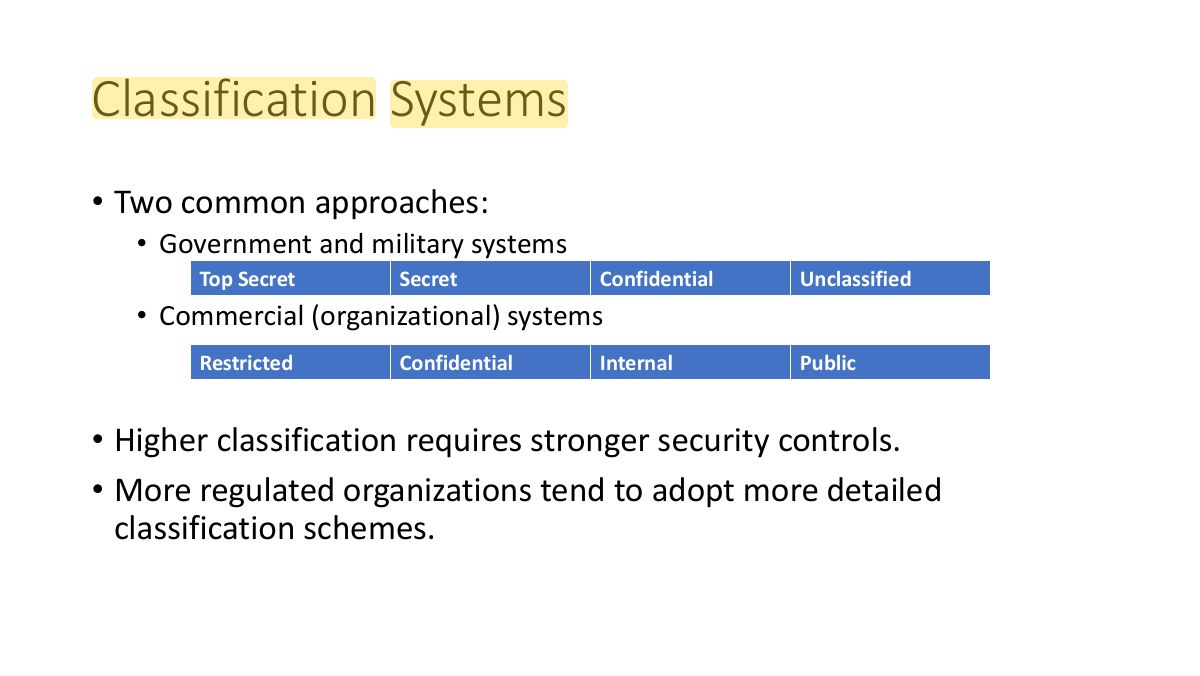
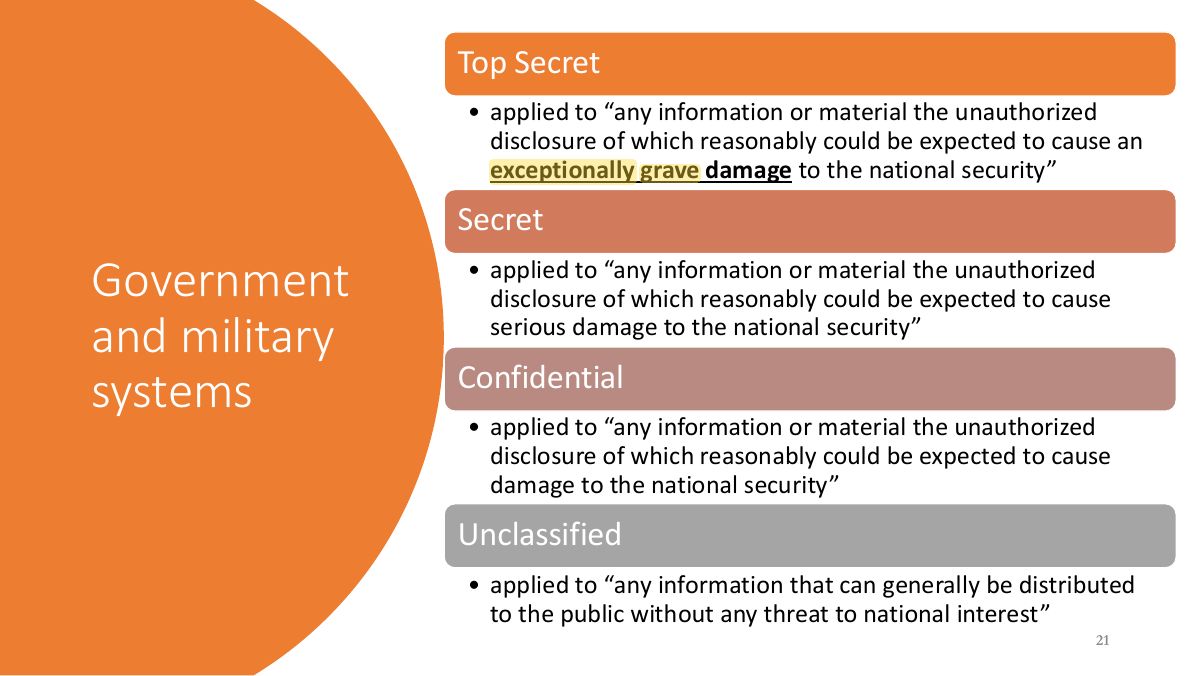
Slide 21: Top Secret
Exam weight High
  1. Top secret: exceptionally grave damage if disclosed. Secret: serious damage. Confidential: damage. Unclassified: none.
🎯 How this can come up · 1 question
MCQ

Unauthorized disclosure that could cause “exceptionally grave damage” to national security defines:

Slide 22: Commercial classification systems
Exam weight Low
  1. Commercial systems: no standard, simpler than government, more complex in regulated industries.
★ Past exam

Classification Criteria

  • Information classification is based on evaluating multiple factors, including:
    • Business Value: How critical the information is to operations or competitiveness
    • Legal and Regulatory Impact: Laws requiring protection (e.g., PDPL, GDPR)
    • Reputational Damage: Loss of customer or public trust if disclosed
    • Operational Impact: Disruption caused by unauthorized modification or loss
  • A common guiding question is: What is the worst possible impact if this information is disclosed, altered, or destroyed?
  • The higher the impact, the higher the classification level and required controls.
23
Exam weight High
  1. Criteria: business value, legal/regulatory impact, sensitivity, impact if disclosed/altered/lost, age/useful life.
Exam trapStrategic/tactical/operational are kinds of PLANS, not classification criteria.
🎯 How this can come up · 1 question
Written

Give three criteria used to classify information in commercial systems. (Major C)

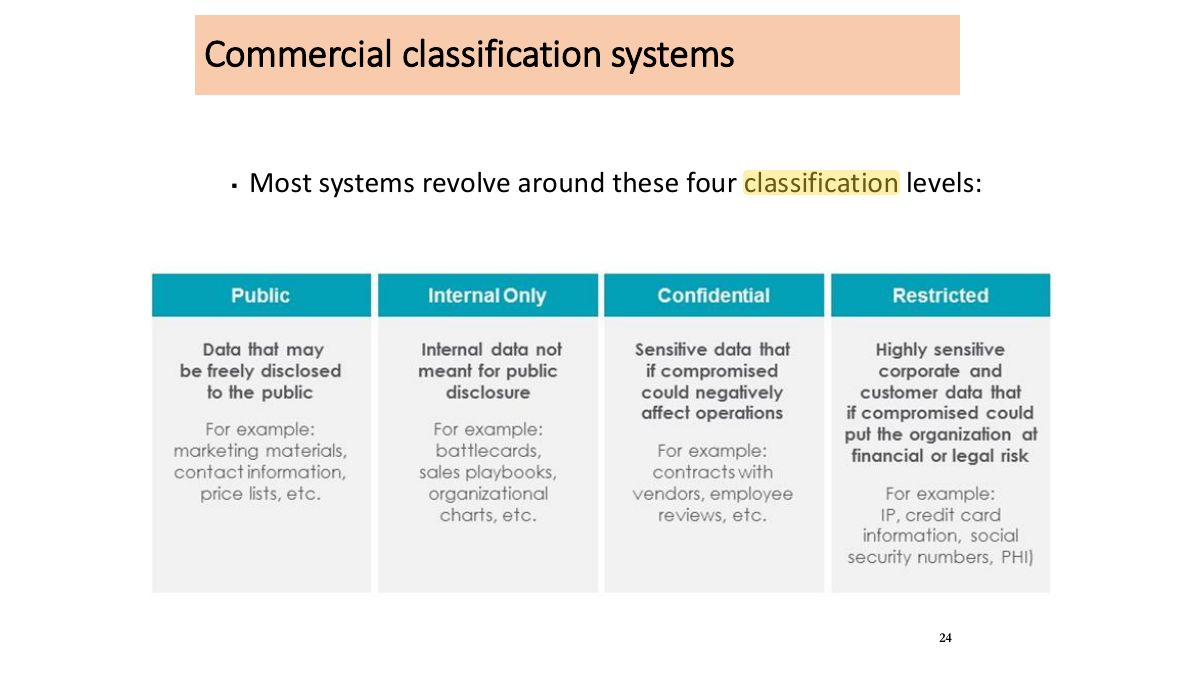
Slide 24: Commercial classification systems
Exam weight Low
  1. The four common commercial levels.

EXAMPES OF RESTRICTED DATA

(PII) is any information that can identify an individual.

PERSONALLY IDENTIFIABLE INFORMATION

  • any information that can be used to distinguish or trace an individual s identity, such as ’ name, social security number, date and place of birth, mother s maiden name, or biometric ’ records; (PHI) is any health-related information that can be related to

PROTECTED HEALTH INFORMATION a specific person.

  • received by a health care provider, health plan, public health authority, employer, life insurer, school or university, or health care clearinghouse;

PROPRIETARY DATA

refers to any data that helps an organization maintain a competitive edge.

  • software code, technical plans for products, internal processes, Copyrights, patents, and trade secret laws provide a level of protection for proprietary data etc.
25
Exam weight Low
  1. Restricted data example: PII (name, ID number, date of birth, mother’s maiden name, biometrics…).
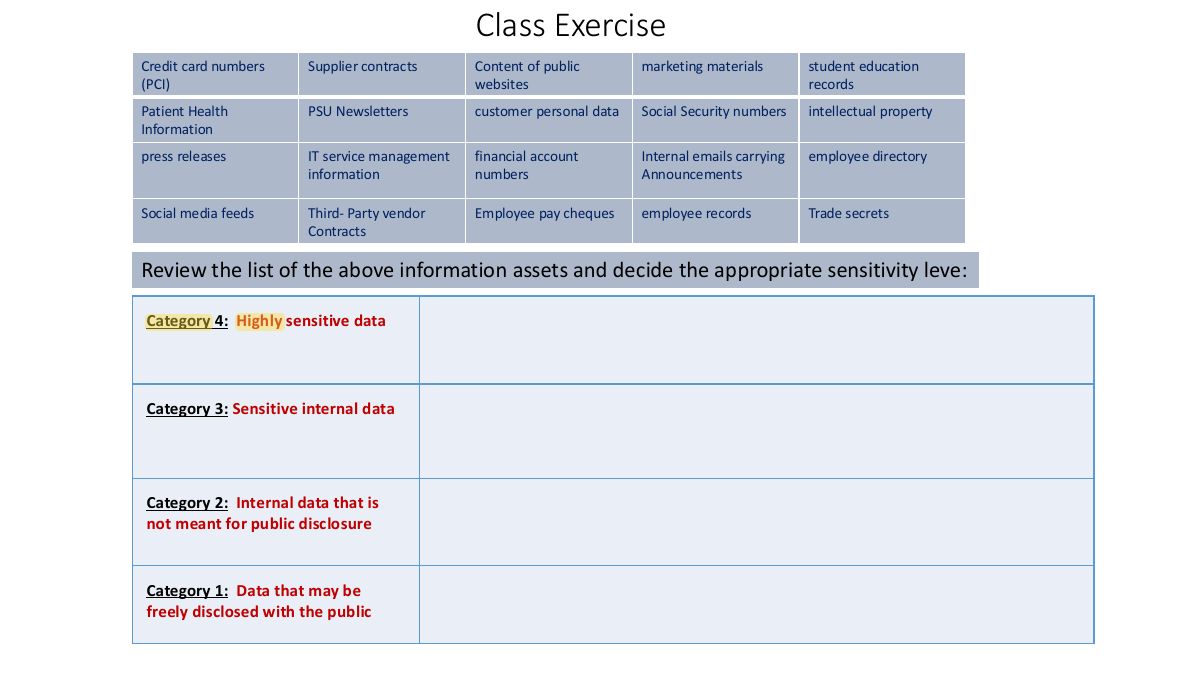
Slide 26: Class Exercise
Exam weight Low
  1. Class exercise: classify credit cards, supplier contracts, marketing material, education records.
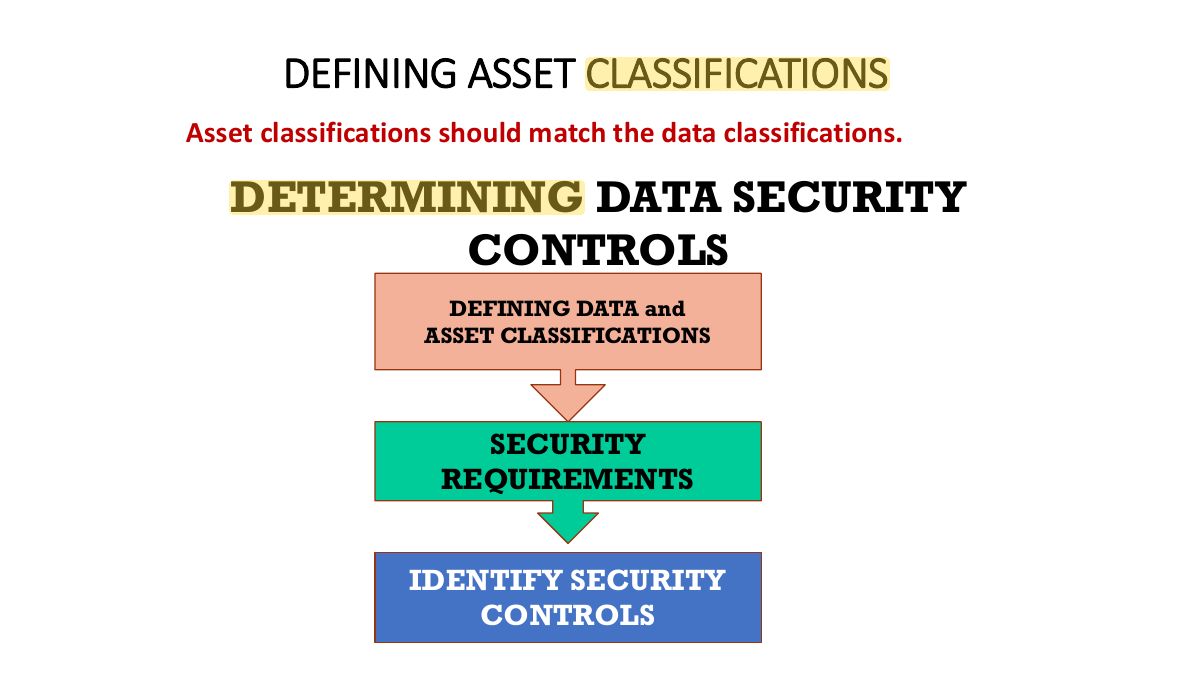
Slide 27: DEFINING ASSET CLASSIFICATIONS
Exam weight Low
  1. Asset classification should match the data it holds.
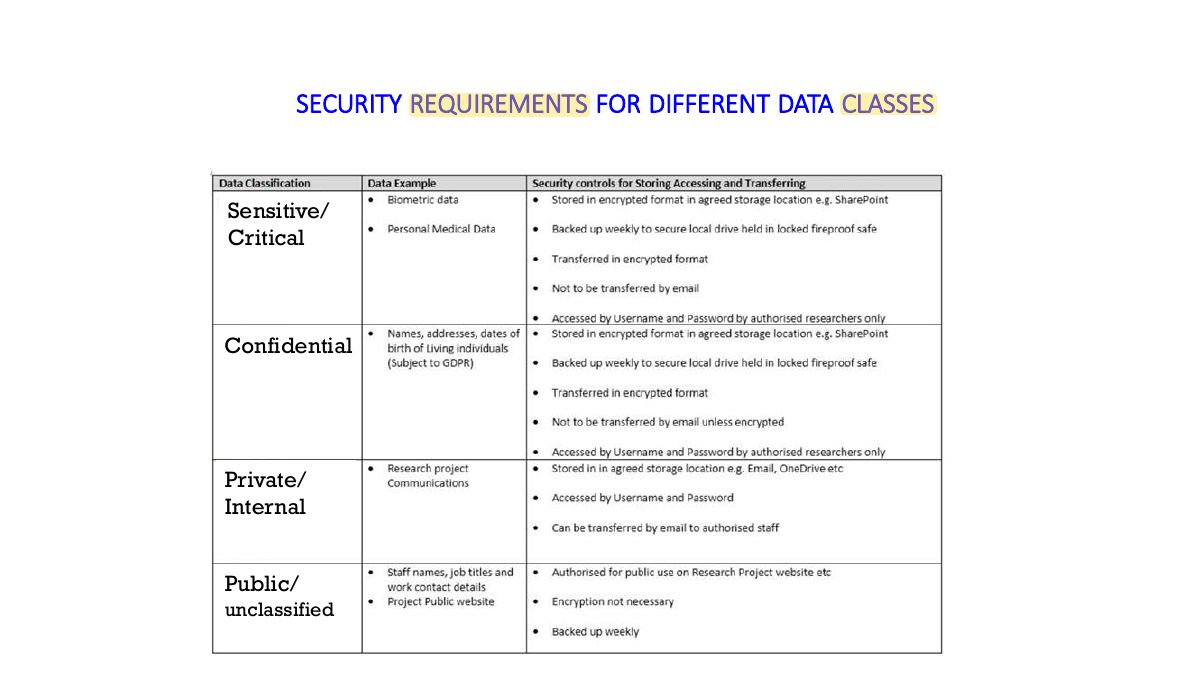
Slide 28: SECURITY REQUIREMENTS FOR DIFFERENT DATA CLASSES
Exam weight Low
  1. Security requirements for each data class.

Marking Sensitive Data and Assets

MARKING (often called labeling) sensitive information ensures that users can easily identify the classification level of any data.

Marking includes both physical and electronic marking and labels.

P HYSICAL LABELS

indicate the security classification for the

data stored on assets such as media or processed on a system.

E LECTRONIC LABELS

  • as a header and/or footer in a

document, or embed it as a watermark.

  • A benefit of these methods is that they also appear on printouts.
29
Exam weight Low
  1. Marking (labeling): physical and electronic labels so users recognise the classification.
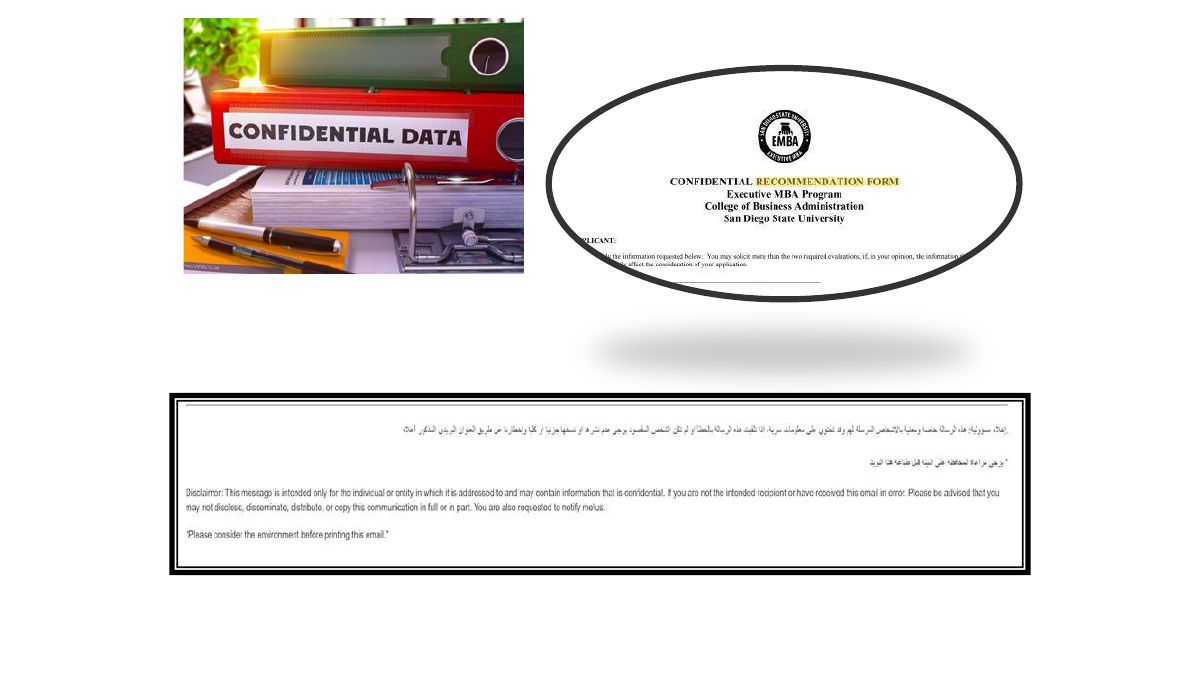
Slide 30: Slide 30
Exam weight Low
  1. Examples of labels.

HANDLING INFORMATION AND ASSETS

  • A key goal of managing sensitive data is to prevent data breaches.
  • A DATA BREACH is any event in which an unauthorized entity can view or access classified data.
31
Exam weight Low
  1. Handling aims to prevent data breaches (any unauthorised view or access).
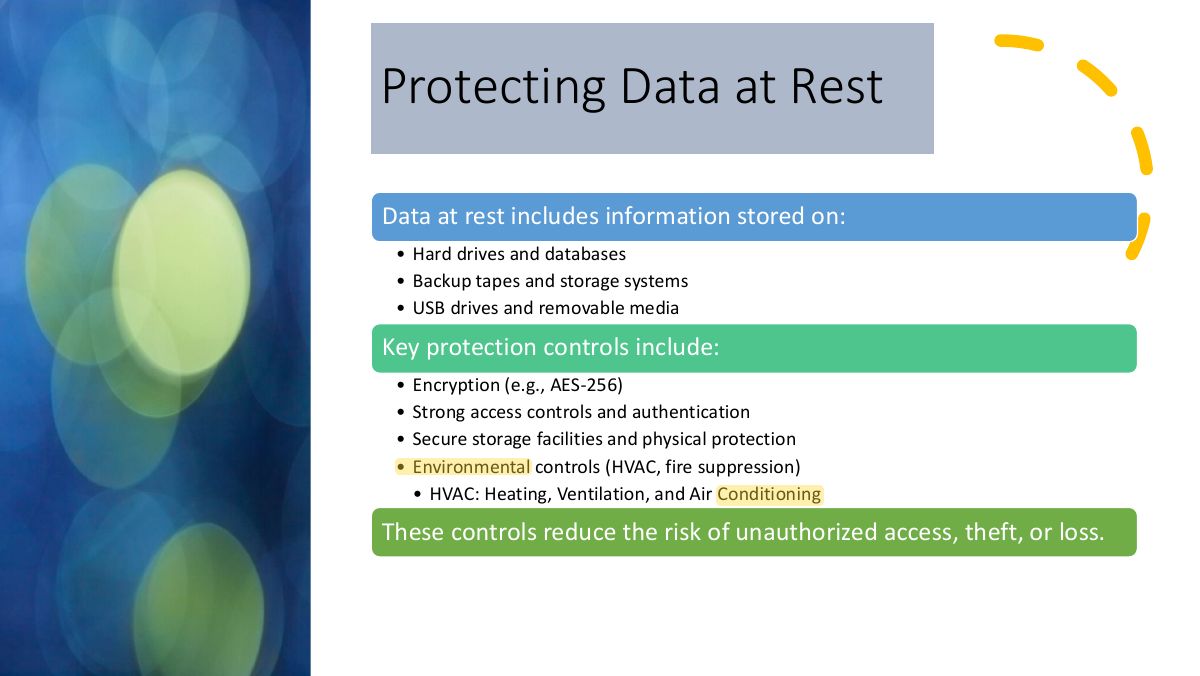
Slide 32: Protecting Data at Rest
Exam weight Low
  1. Data at rest: encryption, access control, backups.
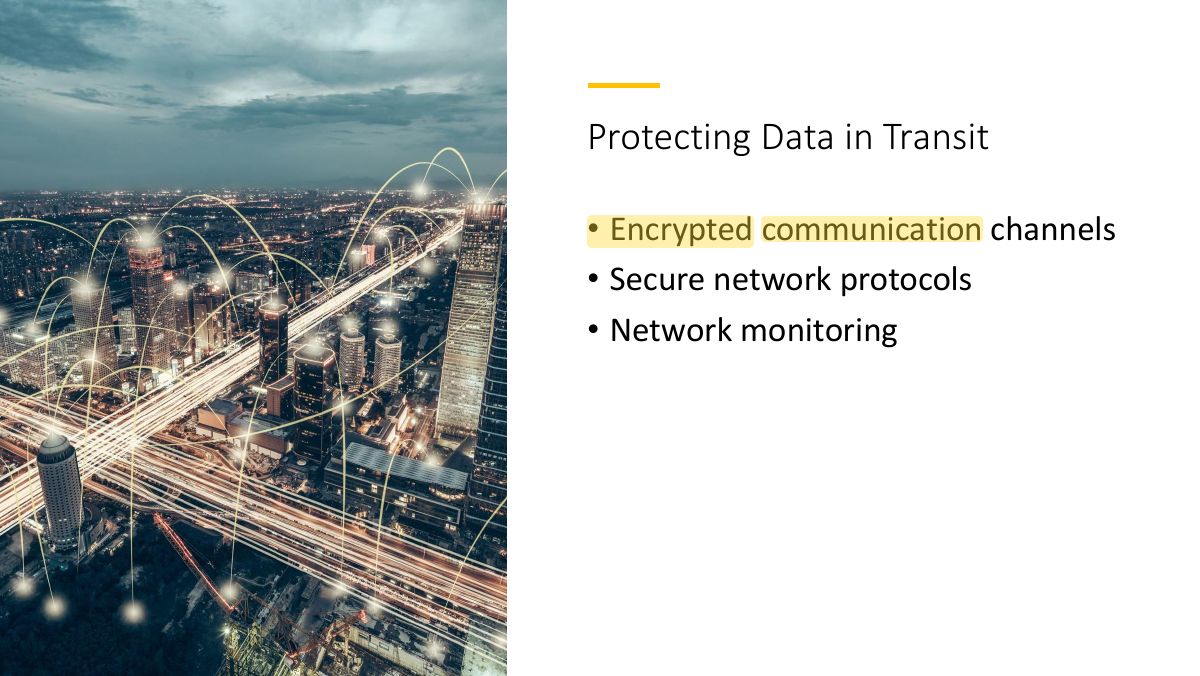
Slide 33: Protecting Data in Transit
Exam weight Low
  1. Data in transit: encrypted channels (TLS, VPN), secure protocols, monitoring.
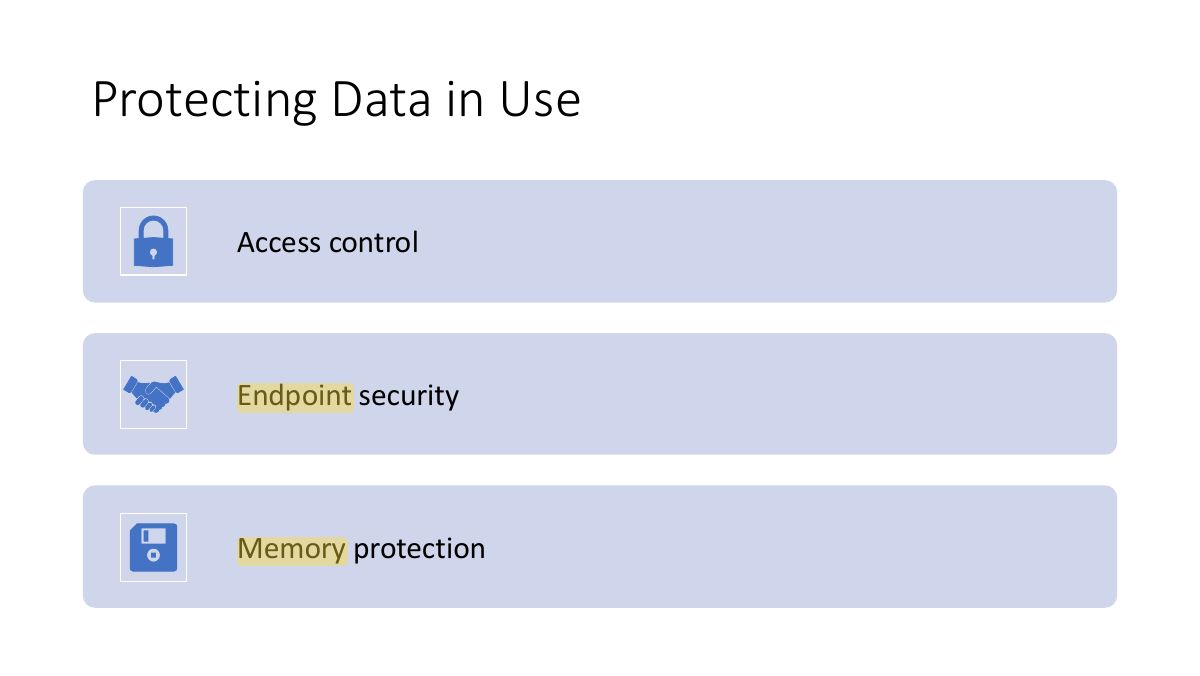
Record and Asset Retention

  • Record and asset retention refers to keeping information for as long as it is needed for:
    • Business operations
    • Legal and regulatory compliance
    • Audit and accountability purposes
  • Retention periods may be defined by:
    • Organizational policies
    • Industry standards
    • Laws and regulations (e.g., 3 years, 7 years, or indefinitely)
  • Once the retention period expires, information must be securely destroyed to reduce risk.
35
Exam weight Low
  1. Retention: keep records as long as needed for business and law, then destroy.

Secure Data Destruction

  • Deleting files is not sufficient.
  • Secure destruction prevents:
    • Data recovery
      • A process of retrieving lost, deleted, corrupted, or inaccessible data from storage devices when normal access is no longer possible.
    • Data remanence
      • The data that remains on media after the data was supposedly erased.
36
Exam weight Low
  1. Deleting is not enough: secure destruction prevents recovery and breaches.

Destroying Sensitive Data

  • When we no longer need a certain media, we must dispose of it in a manner that ensures that data can't be retrieved. This pertains to both electronic media and paper copies of data.
  • Paper Disposal: It is highly encouraged to dispose of any paper with any sensitive data on it in a secure manner. This also has a standard and cross shredding is recommended.
  • Digital disposal: The digital disposal procedures are determined by the type of media containing data.
37
Exam weight Low
  1. Paper: cross-cut shredding. Digital: depends on the media.
★ Past exam
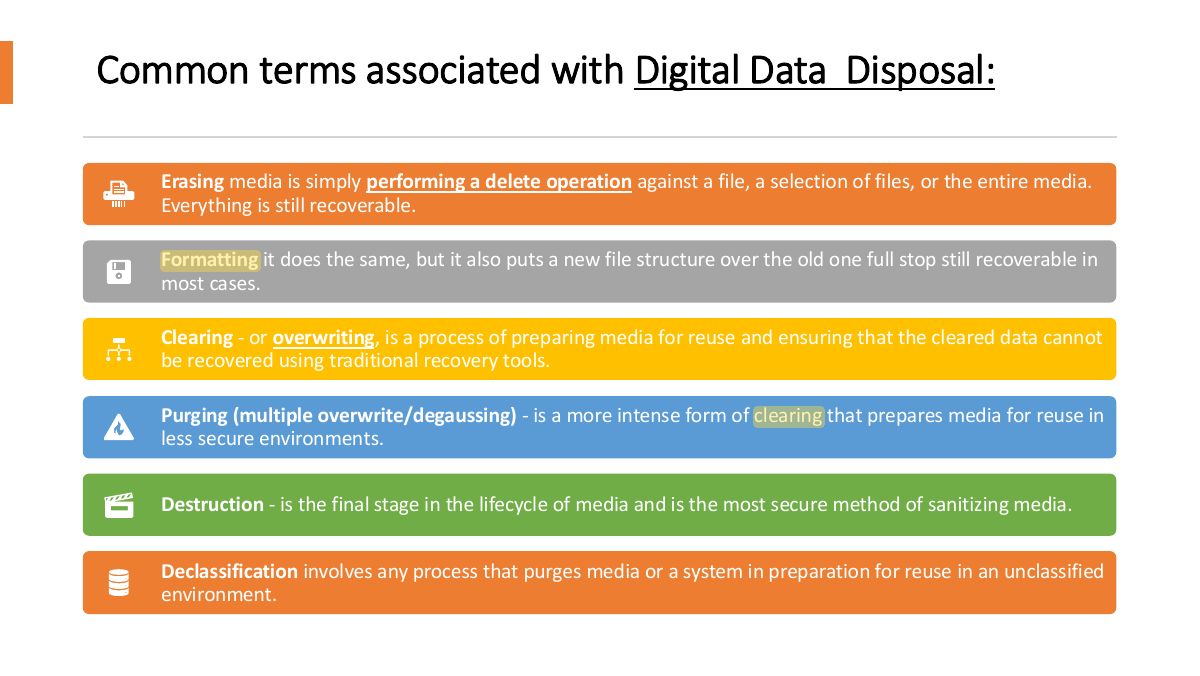
Slide 38: Common terms associated with Digital Data Disposal:
Exam weight High
  1. Erasing = delete (recoverable). Formatting = new file structure (mostly recoverable). Clearing/overwriting = beats normal recovery tools (media can be reused). Purging = stronger (degaussing, crypto-erase). Destruction = most secure.
TipWeakest → strongest: erasing (delete, recoverable) · formatting · clearing/overwriting (beats normal recovery tools) · purging (degaussing, crypto-erase) · destruction (shred, incinerate, disintegrate, pulverize).
🎯 How this can come up · 3 questions
MCQ

Overwriting media so traditional recovery tools can’t recover the data, allowing reuse, is:

MCQ

Simply performing a delete operation against files is:

MCQ

The most secure method of sanitizing media is:

Slide 39: DEGAUSSER MACHINES
Exam weight High
  1. A degausser realigns magnetic fields on HDDs and tapes. It does NOT work on SSDs.
🎯 How this can come up · 1 question
True / False

Degaussing reliably removes data from SSDs.

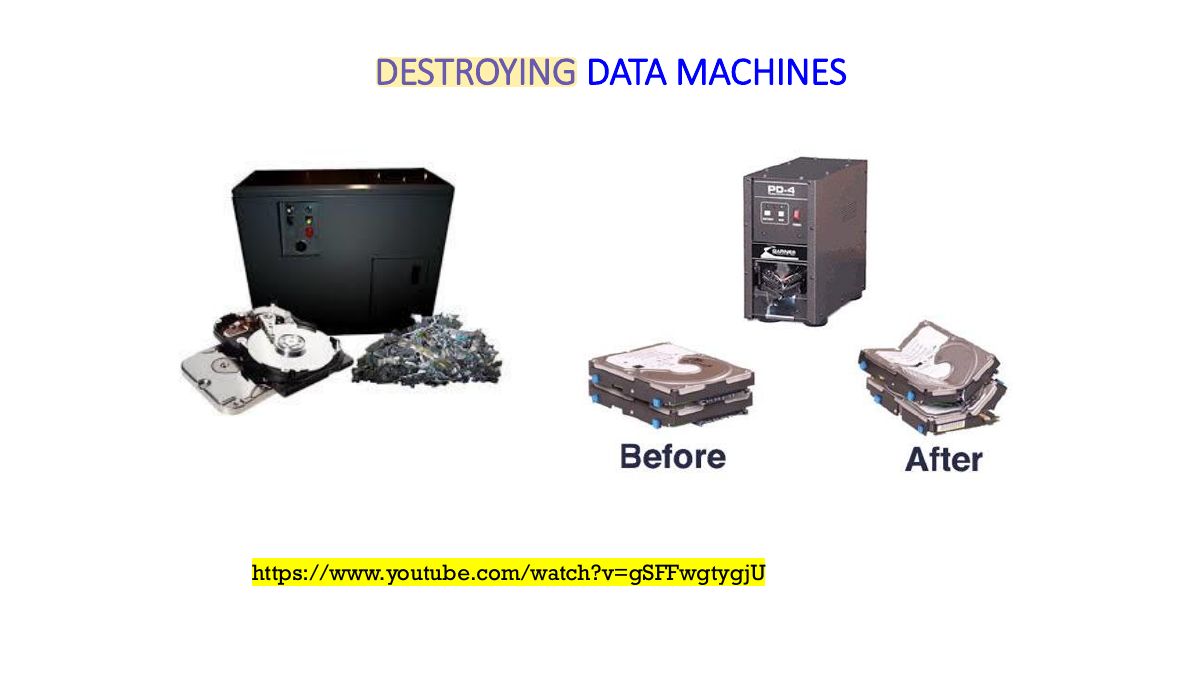
Slide 40: DESTROYING DATA MACHINES
Exam weight Low
  1. Destruction machines (shredders, disintegrators).
Slide 41: Slide 41
Exam weight Low
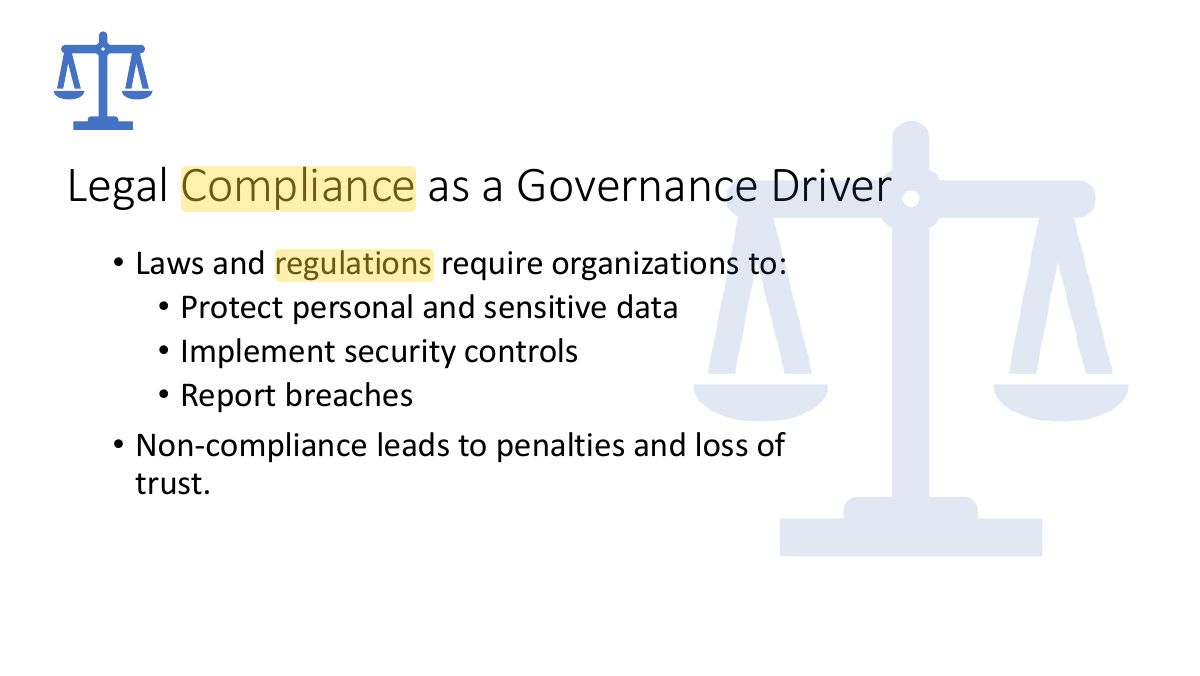
  1. Legal compliance figure.
Slide 42: Slide 42
Exam weight Low
  1. Laws require organizations to protect personal data, report breaches and respect rights.
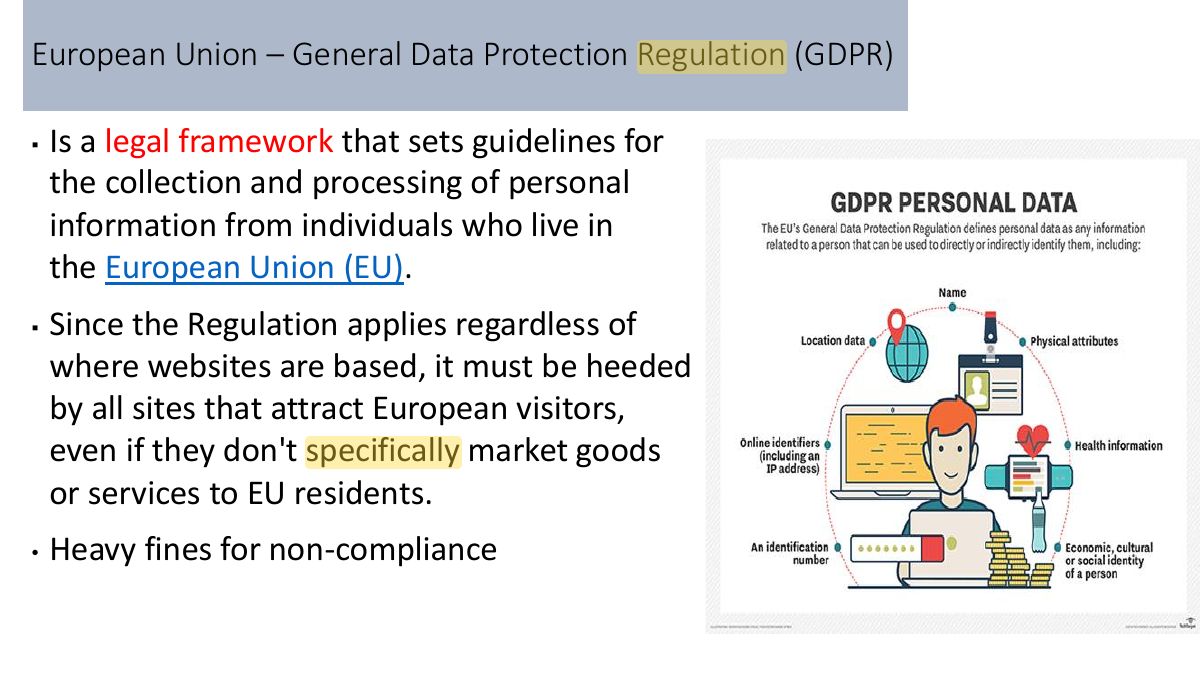
Slide 43: European Union – General Data Protection Regulation (GDPR)
Exam weight Medium
  1. GDPR (EU): applies to anyone processing EU residents’ data, wherever the site is based; heavy fines.
🎯 How this can come up · 1 question
MCQ

The GDPR applies to:

United States – Sectoral & State-Based

  • No single federal data protection law
  • Key Laws:
    • CCPA ( California Consumer Privacy Act) / CPRA (California Privacy Rights Act) - gives consumers more control over the personal information that businesses collect about them
    • HIPAA (Health Insurance Portability and Accountability Act) establishing national standards to protect sensitive patient health information (PHI) from unauthorized disclosure.
    • GLBA (Gramm-Leach-Bliley Act) - requires financial institutions, companies that offer consumers financial products or services like loans, financial, investment advice, insurance – to explain their information-sharing practices to their customers and to safeguard sensitive data.
    • Generally, more business-friendly than GDPR
44
Exam weight Low
  1. US: no single federal law; sector laws (HIPAA, GLBA…) and state laws (CCPA/CPRA).
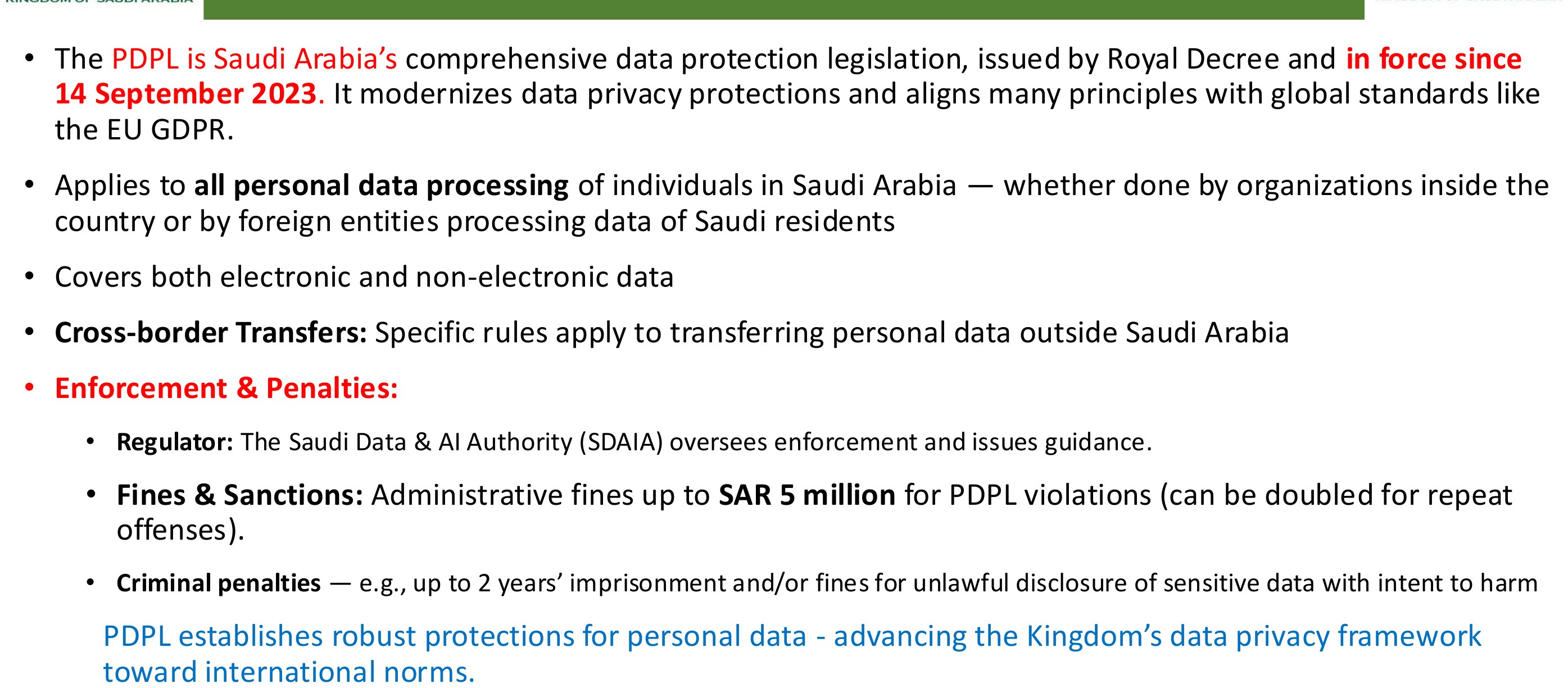
Saudi Arabia - Personal Data Protection Law (PDPL)

The PDPL is Saudi Arabia’s

comprehensive data protection legislation, issued by Royal Decree and in force since

  • 14 September 2023. It modernizes data privacy protections and aligns many principles with global standards like the EU GDPR.
  • Applies to all personal data processing of individuals in Saudi Arabia whether done by organizations inside the — country or by foreign entities processing data of Saudi residents
  • Covers both electronic and non-electronic data
  • Cross-border Transfers: Specific rules apply to transferring personal data outside Saudi Arabia
  • Enforcement & Penalties:
    • Regulator: The Saudi Data & AI Authority (SDAIA) oversees enforcement and issues guidance.
    • Fines & Sanctions: Administrative fines up to SAR 5 million for PDPL violations (can be doubled for repeat offenses).
    • Criminal penalties — e.g., up to 2 years’ imprisonment and/or fines for unlawful disclosure of sensitive data with intent to harm PDPL establishes robust protections for personal data - advancing the Kingdom’s data privacy framework toward international norms.
Saudi Arabia - Personal Data Protection Law (PDPL)
45
Exam weight Medium
  1. PDPL (Saudi Arabia): in force since 14 September 2023; aligned with GDPR principles.
🎯 How this can come up · 1 question
MCQ

Saudi Arabia’s comprehensive personal data law is the:

ASSET OWNERSHIP

  • Information ownership means assigning clear responsibility and authority for a specific information asset to a person or role in the organization.
  • The information owner is accountable for how the information is:
    • Classified
    • Protected
    • Used
    • Shared
    • Retained and disposed of
  • Example: Student Records at a University:
    • Information asset: Student education records
    • Information owner: Registrar’s Office (or Registrar role)
46
Exam weight Low
  1. Information ownership: clear responsibility and authority for an asset; the owner decides classification, access and protection.

ASSET OWNERSHIP

  • Why Ownership Matters:
    • Effective protection requires:
      • Clear accountability
      • Defined decision-making authority
    • Without ownership, security controls cannot be enforced properly.
47
Exam weight Low
  1. Ownership gives accountability and consistent protection.

ASSET OWNERSHIP

  • Information Ownership (who is the owner)
    • CISO is accountable for the protection of the organizational data.
      • Information owner: Typically a business or department head
        • Determines data classification
        • Approves access rights
        • Ensures appropriate protection
      • Information steward: owns the technical accountability for how information supports business process (Data analytics). Ensures data quality and business usage
      • Information custodian Handles the technical environment and implements measures to protect data. Ensure data is accessible to users as per the guidelines set by the data owner and steward. Implements technical controls
      • Information user is responsible for using the information in accordance with its classification level
48
Exam weight Low
  1. The CISO is accountable for protecting organizational data; information owners are business/department heads.

Example:

  • Student Records at a University:
    • Information asset: Student education records
    • Information owner: Registrar’s Office (or Registrar role)
    • System custodian: IT Department
    • Users: Faculty members and academic advisors
  • What the owner decides:
    • Who is allowed to access student records
    • Whether the data is confidential or highly sensitive
    • How long records must be kept
    • When data can be shared (e.g., with accreditation bodies)
  • What IT does (not the owner):
    • Manages servers and databases
    • Applies access controls
    • Performs backups and security updates
49
Exam weight Low
  1. University example: student records owned by the Registrar.
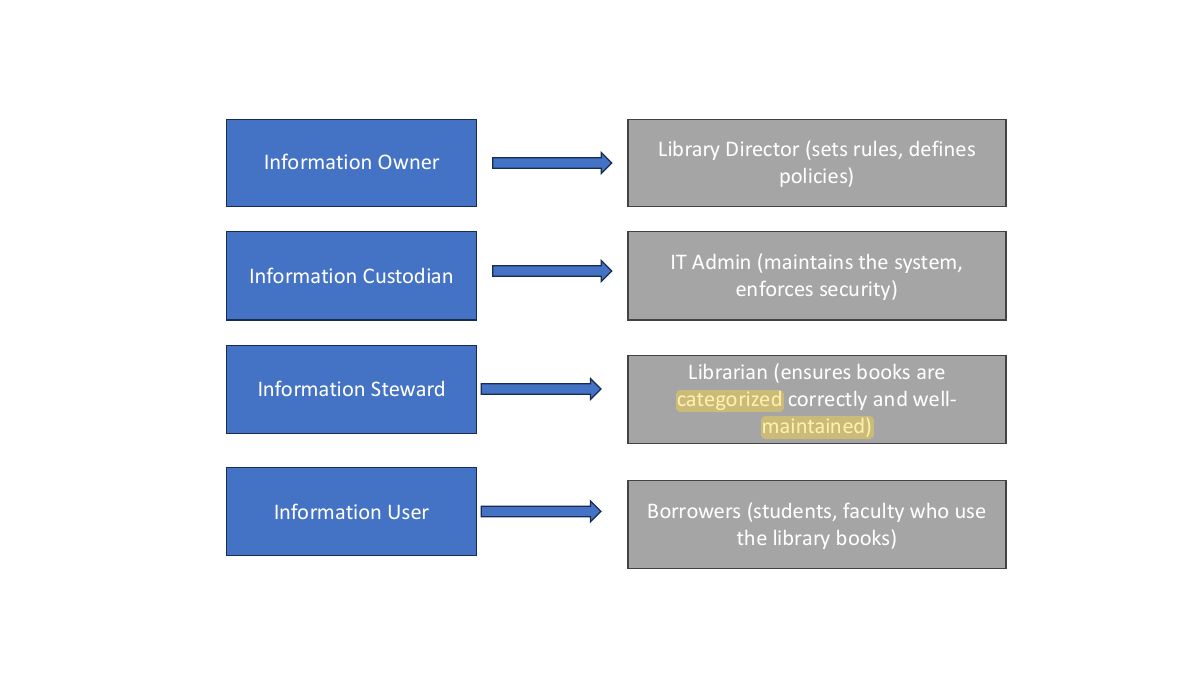
Slide 50: Slide 50
Exam weight Low
  1. Library example: director = owner, IT = custodian, staff = users.

DETERMINING OWNERSHIP

  • Many people within an organization manage, handle, and use data, and they have different requirements based on their roles.
  • One of the most important concepts here is ensuring that personnel know who owns information and assets.
  • The owners have a primary responsibility of protecting the data and assets.
51
Exam weight Low
  1. Everyone must know who owns each asset; owners are primarily responsible for protecting it.
★ Past exam
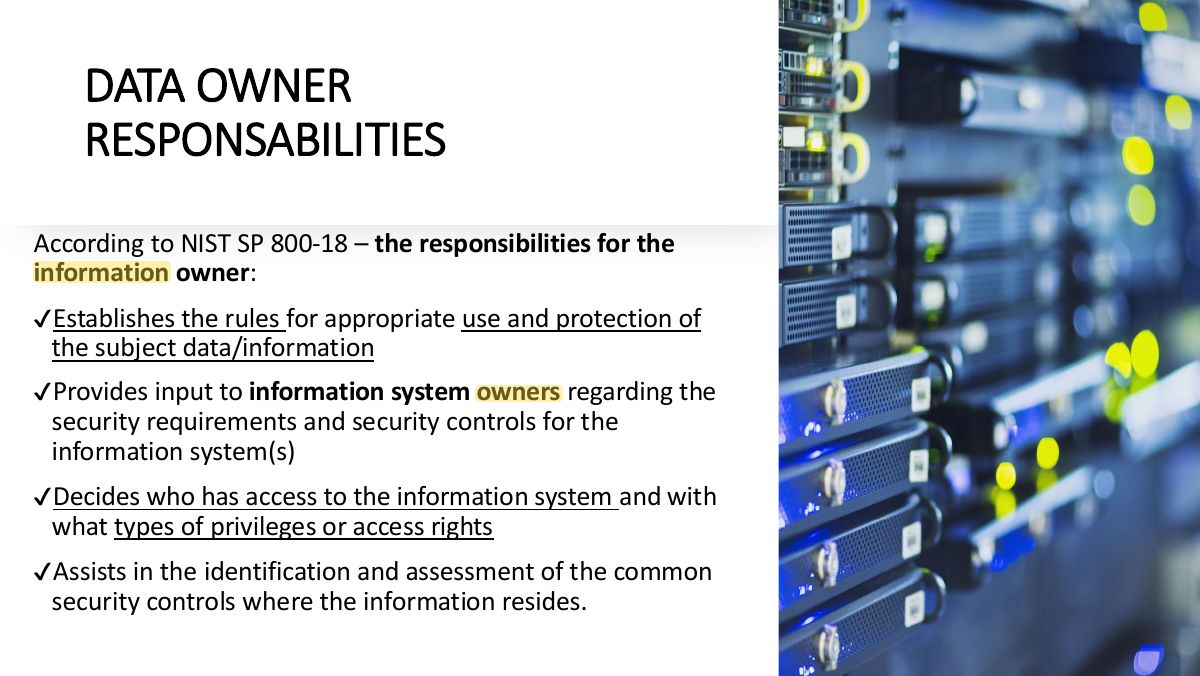
Slide 52: Slide 52
Exam weight High
  1. NIST SP 800-18 data owner: sets rules for use and protection, decides WHO gets access and with what privileges.
Exam trapThe data OWNER decides access; the CUSTODIAN only implements it.
🎯 How this can come up · 1 question
MCQ

According to NIST SP 800-18, who decides who has access to an information system and with what privileges?

ASSET OWNERS

  • The asset owner (or system owner) is the person who owns the asset or system that processes sensitive data.

NIST SP 800-18 - responsibilities for the system owner:

  • Develops a system security plan in coordination with information owners, the system administrator, and functional end users
  • Maintains the system security plan and ensures that the system is deployed and operated according to the security requirements
  • Ensures that system users and support personnel receive appropriate security training
  • Updates the system security plan whenever there is a significant change
  • Assists in the identification, implementation, and assessment of the common security controls
53
Exam weight Low
  1. System owner: owns the system that processes the data; writes the system security plan.

Best Practices for Information Asset Protection

  • Identify and classify data & assets correctly
  • Apply Principle of least privilege
  • Strong Authentication and Identity Security
  • Encrypt sensitive data
  • Monitor & log access
  • Data Loss Prevention (DLP)
  • Regular audits and user awareness training
54
Exam weight Low
  1. Best practices: classify correctly, least privilege, strong authentication, encryption, monitoring, training.

ALIGNMENT OF SECURITY FUNCTION

TO

BUSINESS STRATEGY,

GOALS, MISSION, AND OBJECTIVES

55
Exam weight Low
  1. Align the security function with business strategy, goals, mission and objectives.

BUSINESS/MISSION OWNERS

  • The business/mission owner role is viewed differently in different organizations.
  • NIST SP 800-18 refers to the business/mission owner as a program manager or an information system owner.
  • The responsibilities of the business/mission owner can overlap with the responsibilities of the system owner or be the same role.
  • In businesses, business owners are responsible for ensuring that systems provide value to the organization.
56
Exam weight Low
  1. Business/mission owner (program manager) may overlap with the system owner.

ALIGNMENT OF SECURITY FUNCTION

  • Security management planning ensures the proper creation, implementation, and enforcement of security policies within an organization.
  • The main objective of security management planning is to align security functions with the organization s strategy, goals, mission, ’ and objectives.
  • Effective security does not operate in isolation; it supports business priorities and enables safe operations.
  • One of the most effective approaches to security management planning is the Top-Down Approach.
57
Exam weight Low
  1. Security management planning creates, implements and enforces policy, aligned with the business.

Top-Down Approach

  • Senior (upper) management is responsible for:
    • Initiating security policies
    • Approving security objectives
    • Defining acceptable risk
  • Security policies provide direction and authority for all levels of the organization.
  • Top-down support is essential for policy enforcement and accountability.
58
Exam weight Medium
  1. Top-down approach: senior management initiates and approves policy; it flows down.
🎯 How this can come up · 1 question
MCQ

In the top-down approach, security policy is initiated by:

THE INFORMATION SECURITY (INFOSEC) TEAM

  • The team or department responsible for security within an organization should be autonomous.
  • Chief information security officer (CISO) – the leader of Cybersecurity team, must report directly to senior management.

The security management plan include

security roles;

  • defining
  • prescribing how security will be managed,
  • who will be responsible for security.
  • how security will be tested for ; effectiveness
  • developing security policies ;
  • performing ; and risk analysis
  • requiring security for employees. education
  • These efforts are guided through the development of management plans.
59
Exam weight Low
  1. The InfoSec team should be autonomous; the CISO reports directly to senior management.
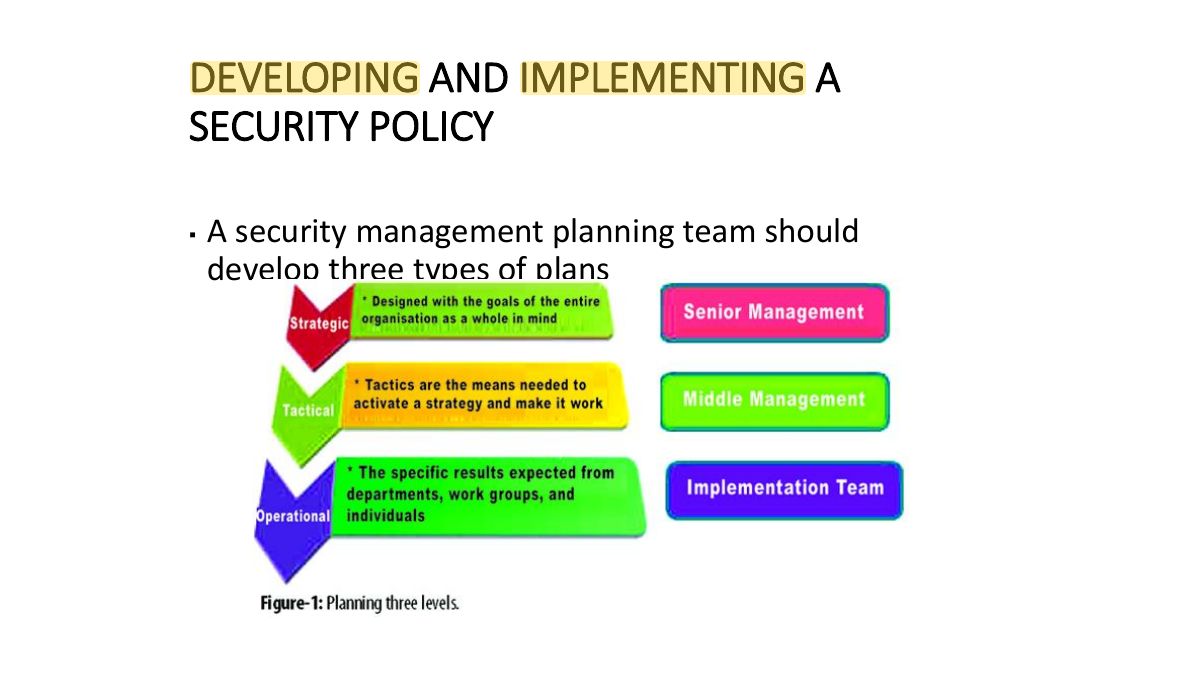
Slide 60: DEVELOPING AND IMPLEMENTING A SECURITY POLICY
Exam weight Low
  1. Three plans: strategic, tactical, operational.
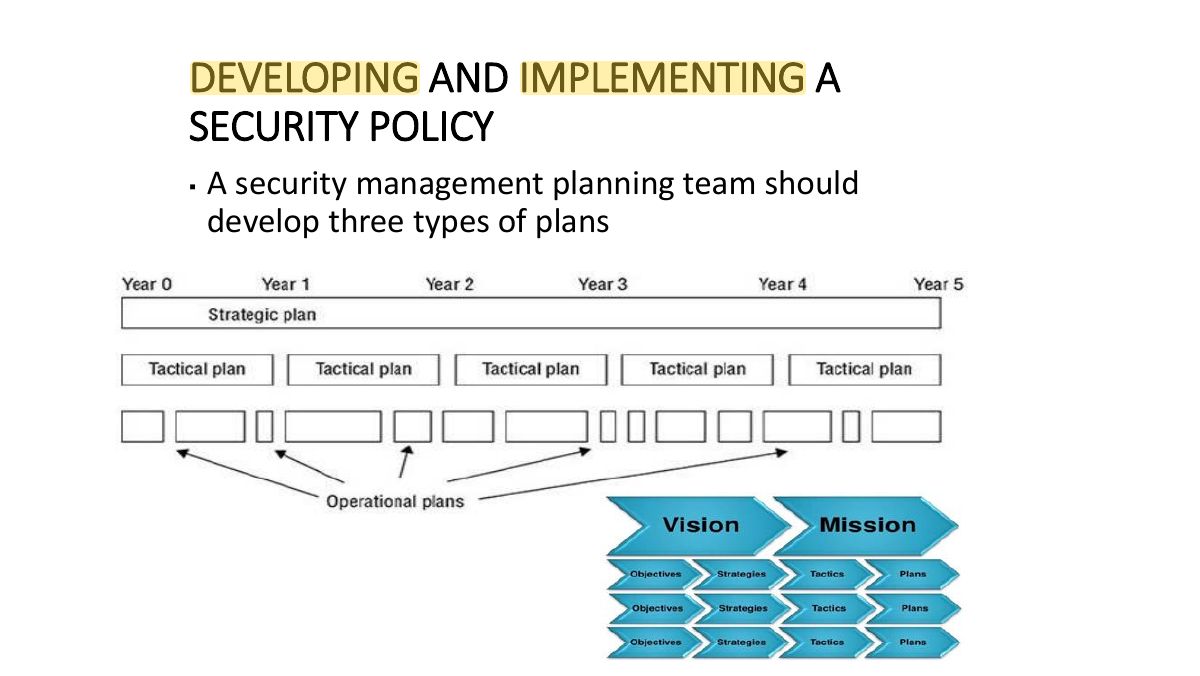
Slide 61: DEVELOPING AND IMPLEMENTING A SECURITY POLICY
Exam weight Low
  1. The three plans, continued.
★ Past exam
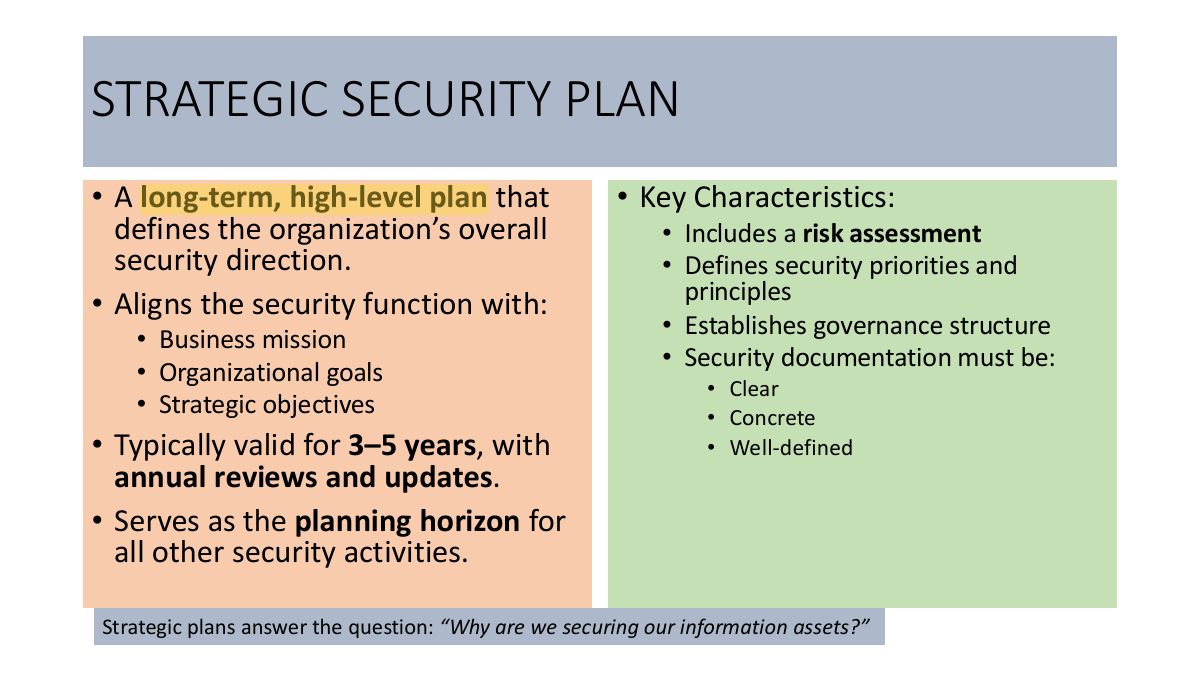
Slide 62: STRATEGIC SECURITY PLAN
Exam weight High
  1. Strategic: long-term (~5 years), high-level direction, includes risk assessment.
🎯 How this can come up · 1 question
True / False

A strategic plan is a short-term plan with many details.

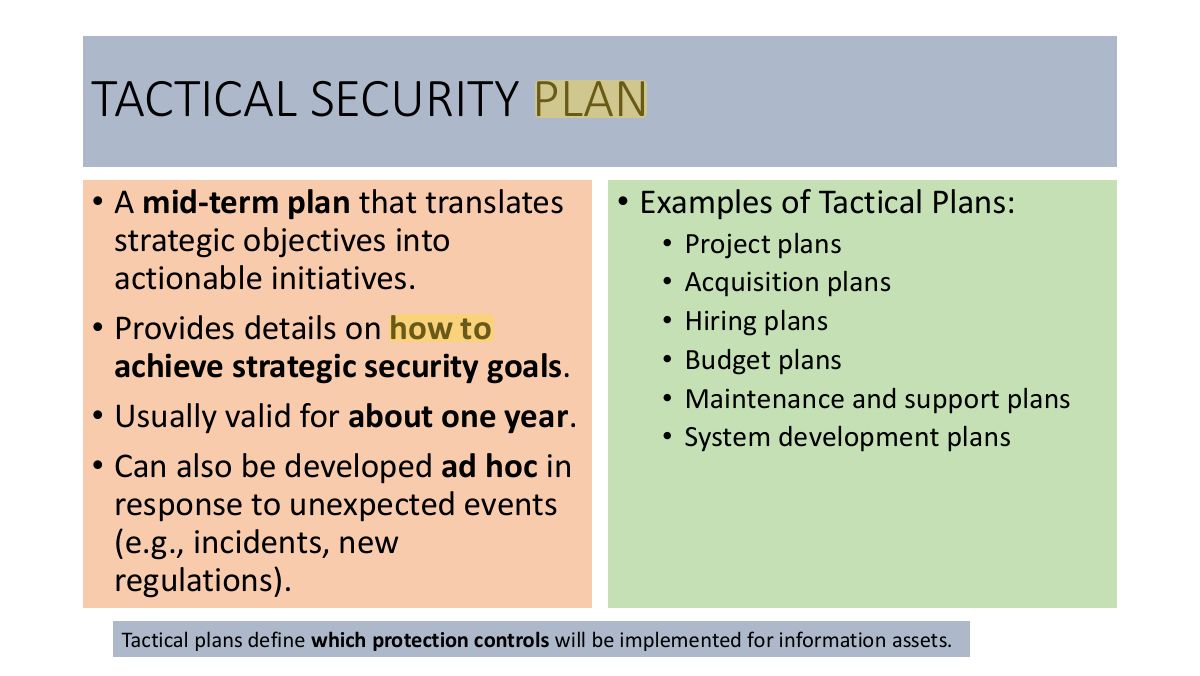
Slide 63: TACTICAL SECURITY PLAN
Exam weight Low
  1. Tactical: mid-term (~1 year): project plans, acquisition plans, hiring, budget.
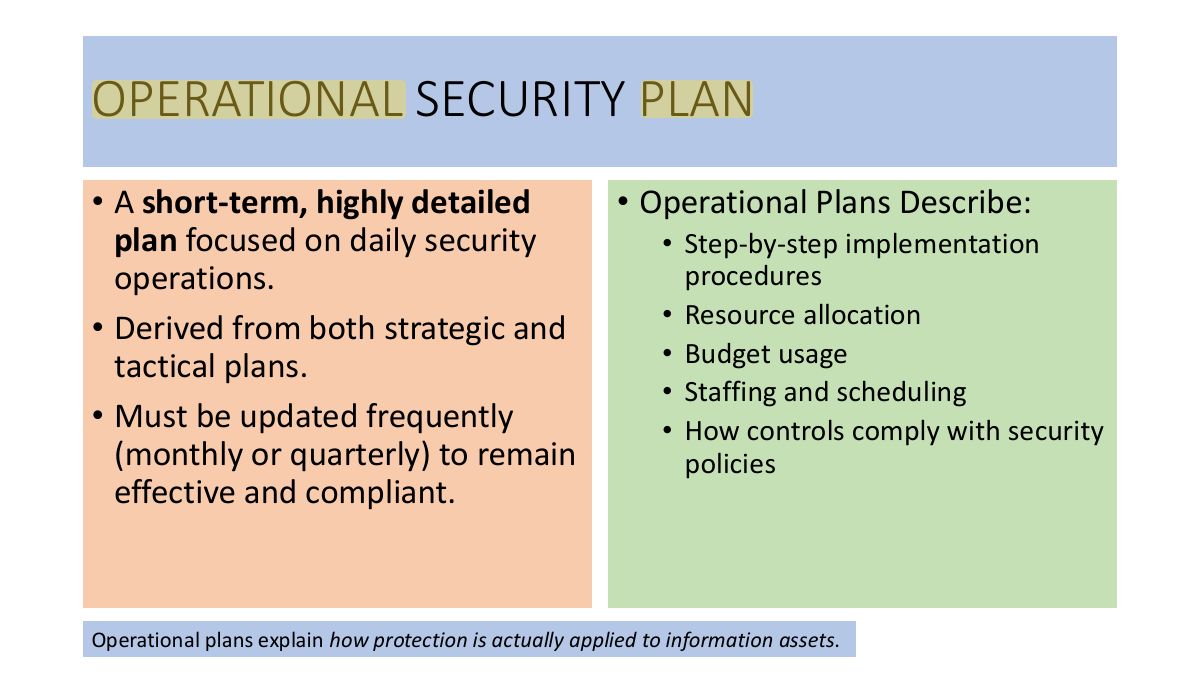
Slide 64: OPERATIONAL SECURITY PLAN
Exam weight High
  1. Operational: short-term, highly detailed: daily procedures, updated often.
🎯 How this can come up · 1 question
MCQ

Which plan is short-term, highly detailed and updated often?

Slide 65: Planning Levels vs Asset Protection
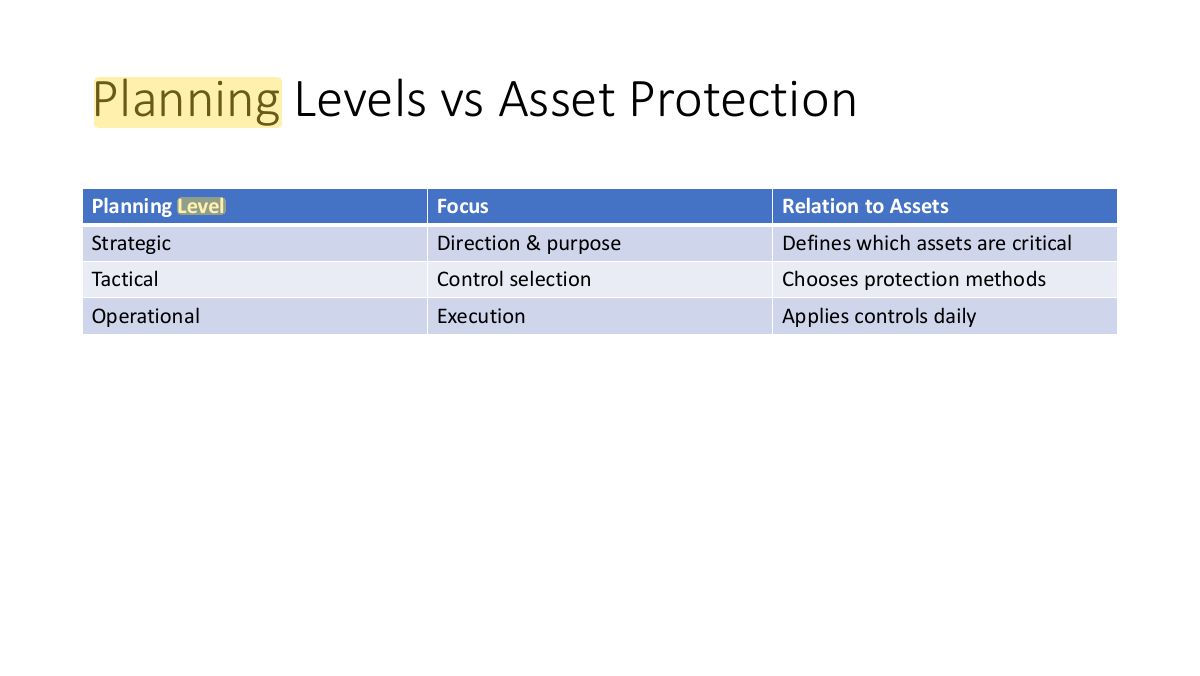
Exam weight Low
  1. Planning levels vs. asset protection table.

Example

  • Online Banking System (Financial Institution)
  • A bank provides online and mobile banking services to customers. Its critical information assets include:
    • Customer personal data (PII)
    • Account balances and transaction records
    • Online banking platform
    • Authentication credentials
66
Exam weight Low
  1. Online banking example.
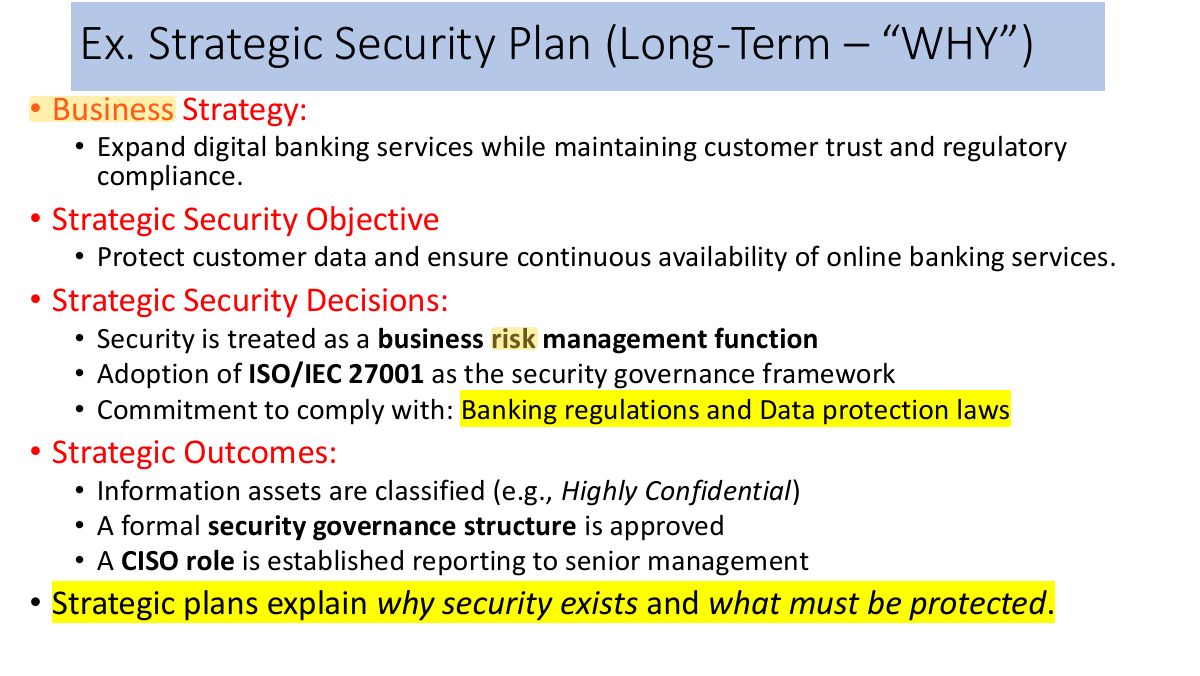
Slide 67: Ex. Strategic Security Plan (Long-Term WHY ) – “ ”
Exam weight Low
  1. Strategic (WHY): protect customer trust and comply.

Ex. Tactical Security Plan (Mid-Term – “WHAT ”)

  • Translating Strategy into Actions:
    • To support the strategic goal, the bank develops tactical security plans for the coming year.
  • Tactical Security Decisions:
    • Implement multi-factor authentication (MFA) for online banking
    • Deploy encryption for customer data at rest and in transit
    • Introduce Security Information and Event Management (SIEM)
    • Develop an incident response plan
    • Allocate budget for:
      • Security tools, Staff training , and Penetration testing
  • Example Tactical Plans:
    • Project plan for MFA deployment
    • Hiring plan for SOC analysts
    • Training plan for employees on phishing awareness
  • Tactical plans define which controls will be used to protect information assets.
68
Exam weight Low
  1. Tactical (WHAT): projects for the year (MFA rollout, SOC).
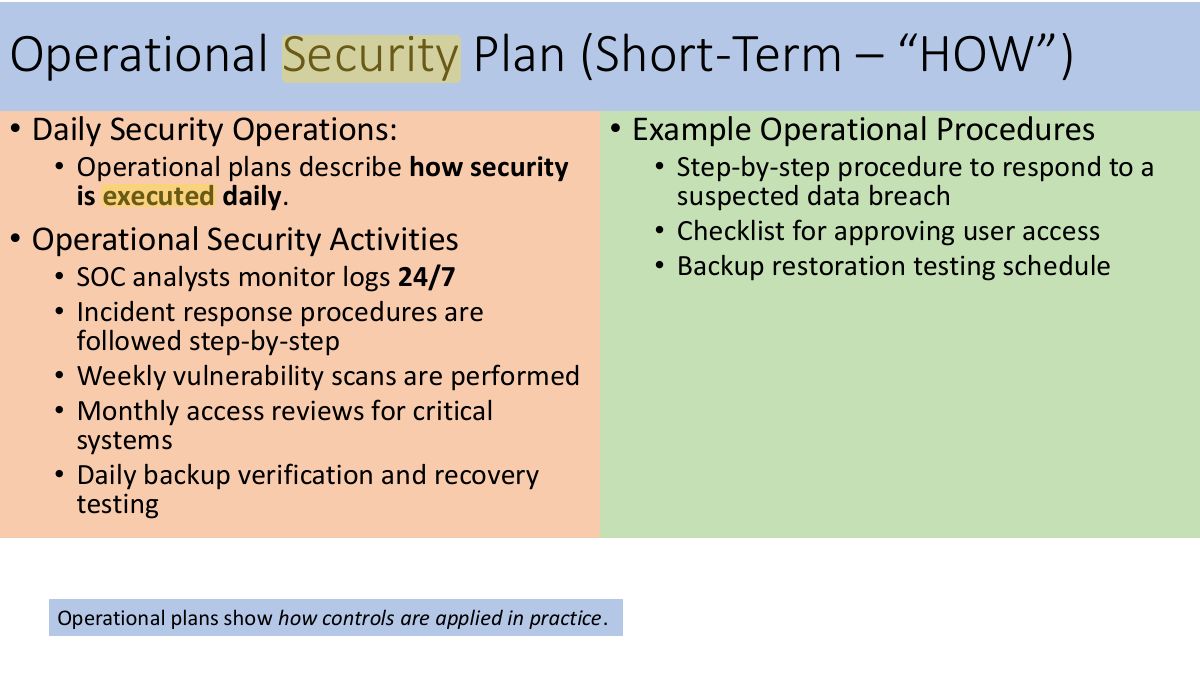
Slide 69: Operational Security Plan (Short-Term – “HOW”)
Exam weight Low
  1. Operational (HOW): daily procedures (log review, patching).
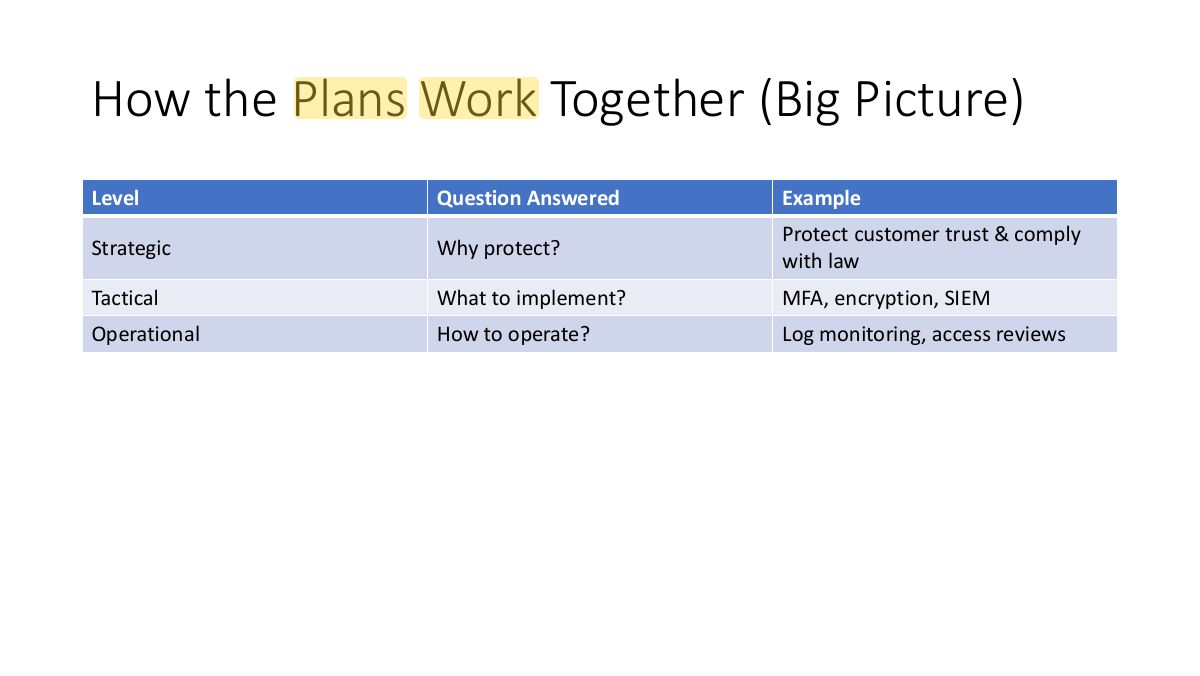
Slide 70: How the Plans Work Together (Big Picture)
Exam weight Low
  1. WHY → WHAT → HOW.
Memory trickStrategic = WHY, Tactical = WHAT, Operational = HOW.

Thank you

71
Exam weight Low
  1. End of chapter.