- Signals → analog vs. digital → frequency, period, bit rate → impairments → delays → bandwidth-delay product.
- Calculation deck: practise every example with units (ms, µs, Mbps vs. MB).
- This part covers 2.1 signals and 2.2 impairment, plus the delay definitions. Media (2.6) is in Part 2.
Related tutorial questions
- Same list as Ch 1 Part 2: interfaces, media, connectors, voltages, duplex mode.
- Plus: encoding bits into signals, the data rate, and keeping sender and receiver clocks in sync.
- Layer-1 devices: network card, hub, repeater.
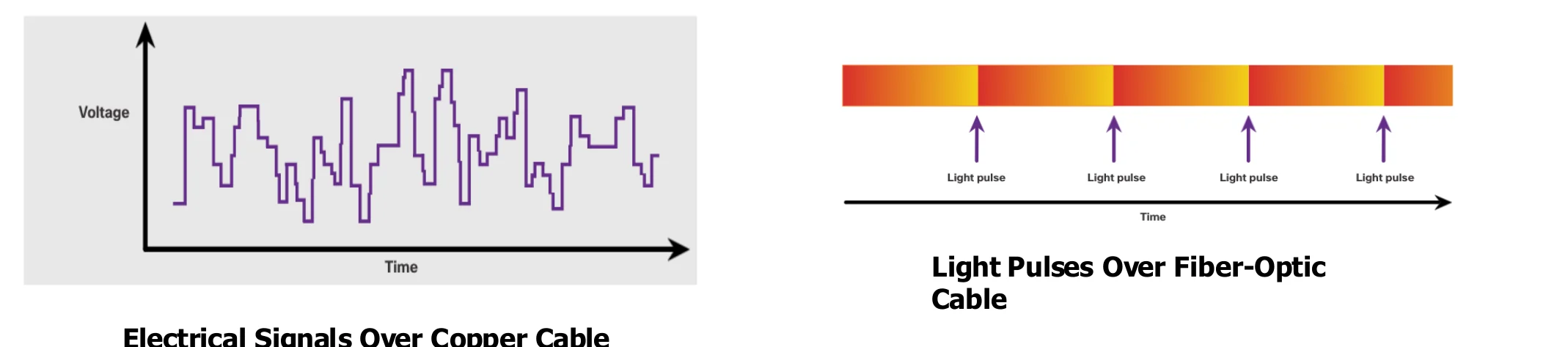
- Data can’t travel as-is: it must be turned into an electromagnetic signal (voltage on copper, light in fiber, radio in air).
🎯 How this can come up · 1 question
To be transmitted, data must be transformed to electromagnetic signals.
True.
- Signal = electromagnetic energy carrying information.
- The NIC is both: transmitter (bits → current/light) and receiver (current/light → bits).
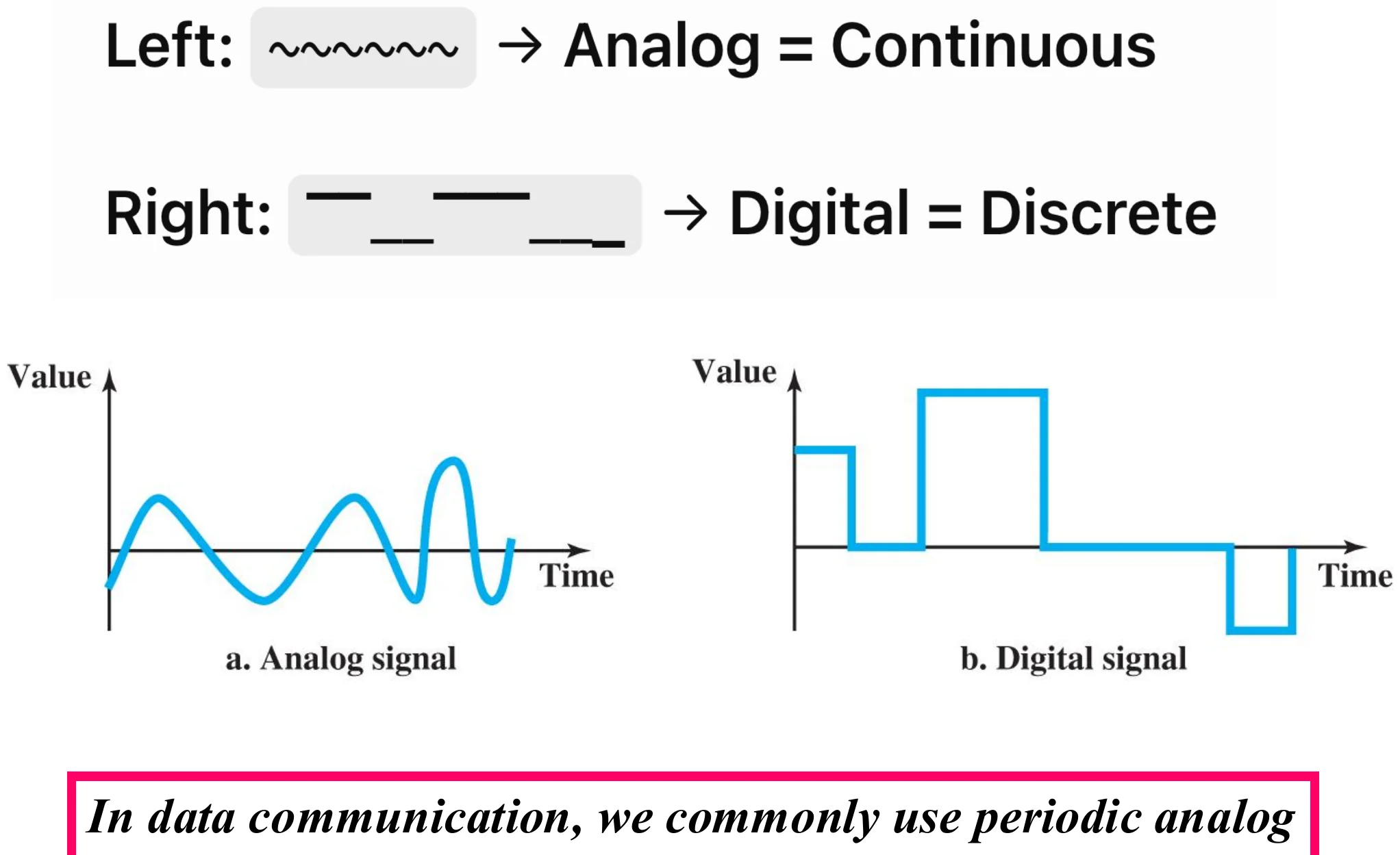
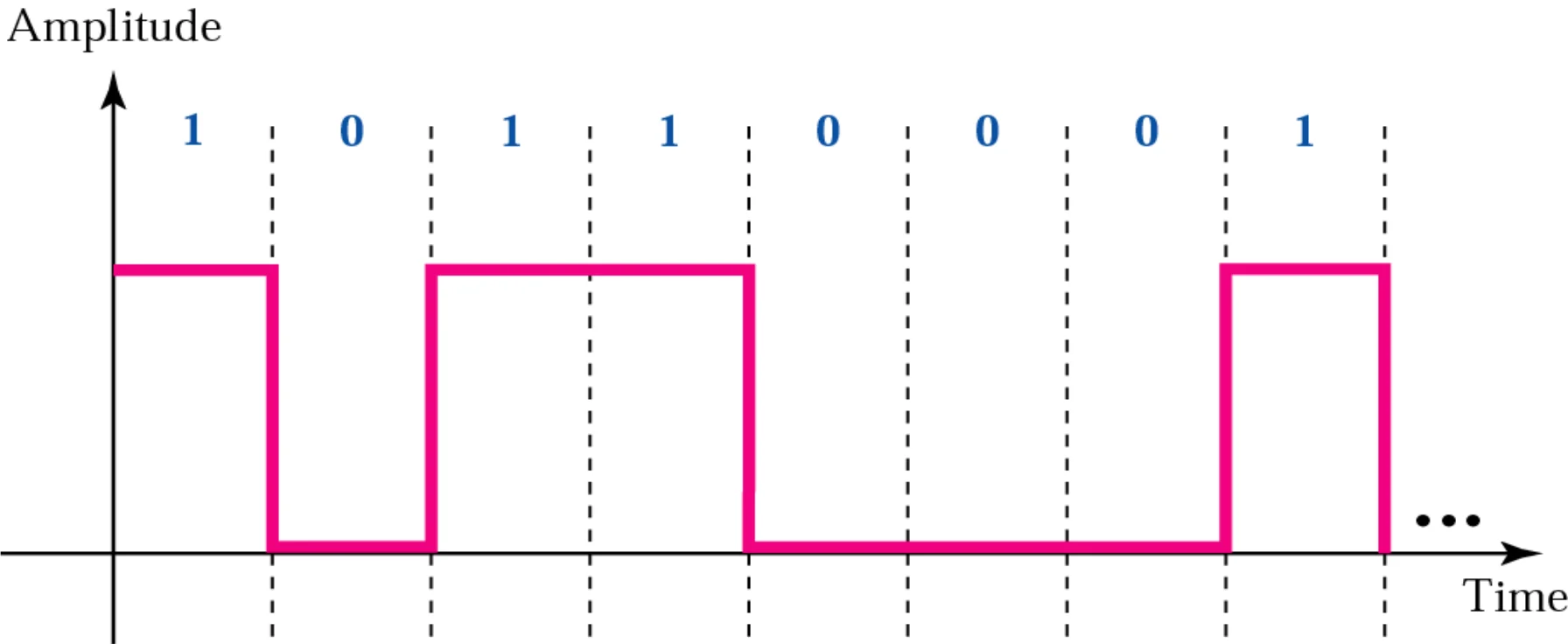
- Analog = infinitely many values (continuous). Digital = a limited set of levels (discrete, square wave).
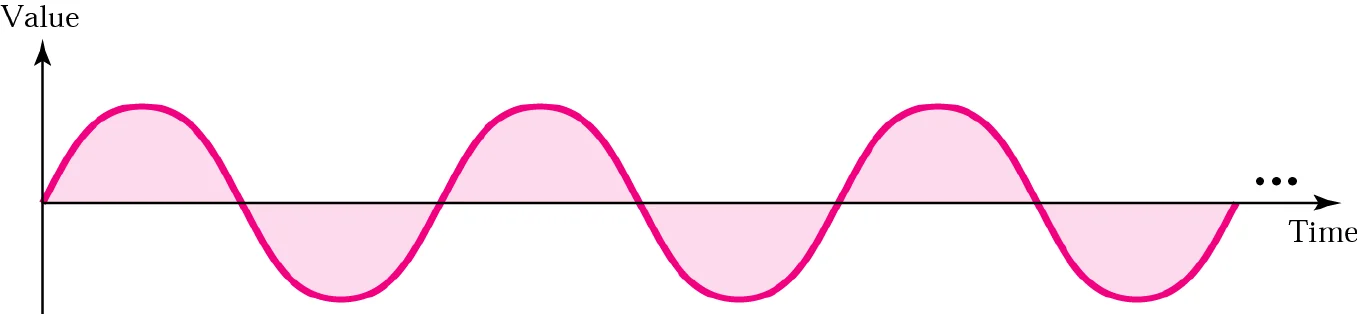
- Periodic = repeats in identical cycles. Aperiodic = no repeating pattern.
🎯 How this can come up · 2 questions
A signal that can have an infinite number of values in a range is:
Correct: Analog.
A periodic signal repeats its pattern over identical periods called cycles.
True.
- Rule from the slide: data communication uses PERIODIC ANALOG and APERIODIC DIGITAL signals.
🎯 How this can come up · 1 question
In data communication we commonly use:
Correct: Periodic analog and aperiodic digital signals.
- Repeated on purpose: periodic analog + aperiodic digital is a classic MCQ.
- Fast changes = high frequency. Slow changes = low frequency.
- A signal that never changes has frequency 0.
- f in hertz (cycles per second), T in seconds.
Asked in a course tutorial
🎯 How this can come up · 2 questions
An analog signal has a frequency of 5 kHz. Its period is:
Tutorial 3, Q5: T = 1/5000 = 0.0002 s = 200 µs.
An analog signal has a frequency of 5 kHz. What is its period, and how are frequency and period related?
They are inverses: T = 1/f. T = 1/5000 Hz = 0.0002 s = 200 µs.
- Multiply seconds by 1000 to get ms.
- Always convert to base units (s, Hz) first, then to the unit asked.
🎯 How this can come up · 1 question
A signal has a period of 4 ms. Its frequency is:
1 / 0.004 s = 250 Hz.
- Simple = one sine wave = one frequency. Composite = many sine waves added together.
Asked in a course tutorial
🎯 How this can come up · 1 question
What is the key difference between a simple and a composite signal?
A simple signal is a single sine wave, so it has one frequency. A composite signal is several sine waves with different frequencies, amplitudes or phases combined.
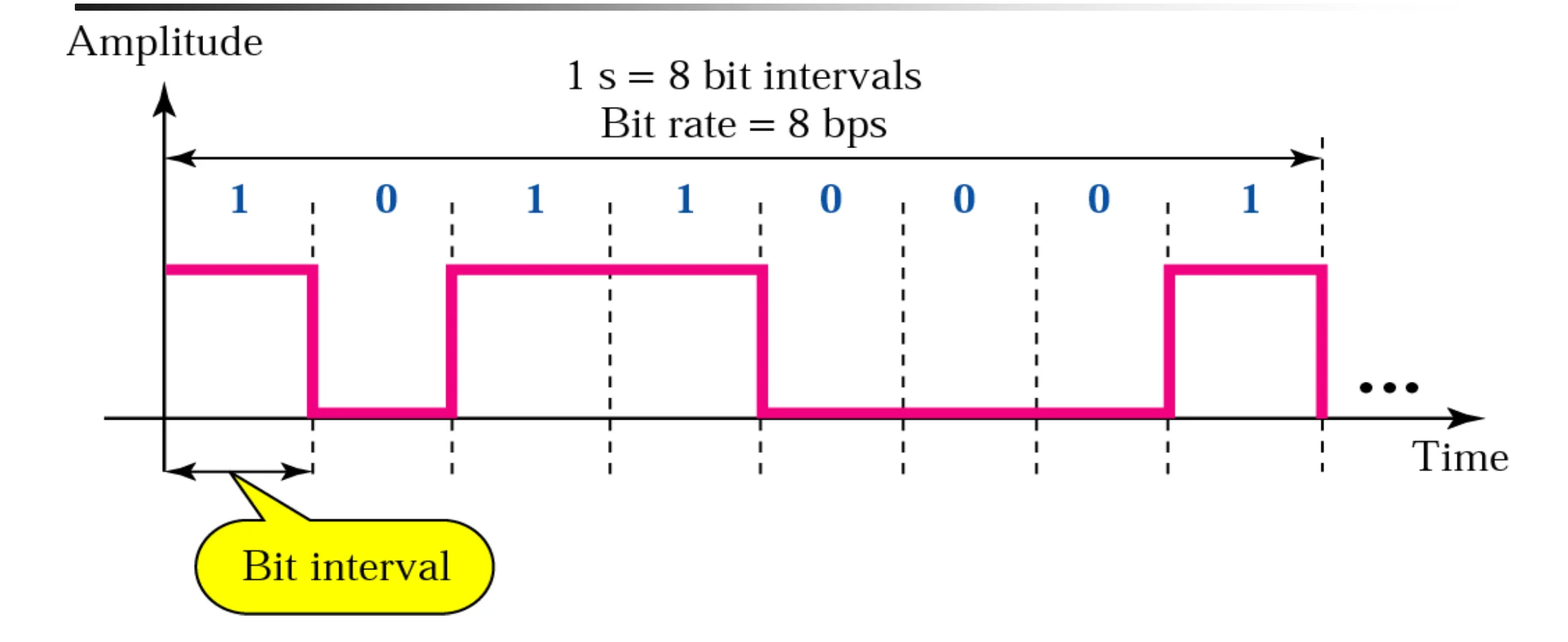
- For digital signals we use bit rate and bit interval instead of frequency and period.
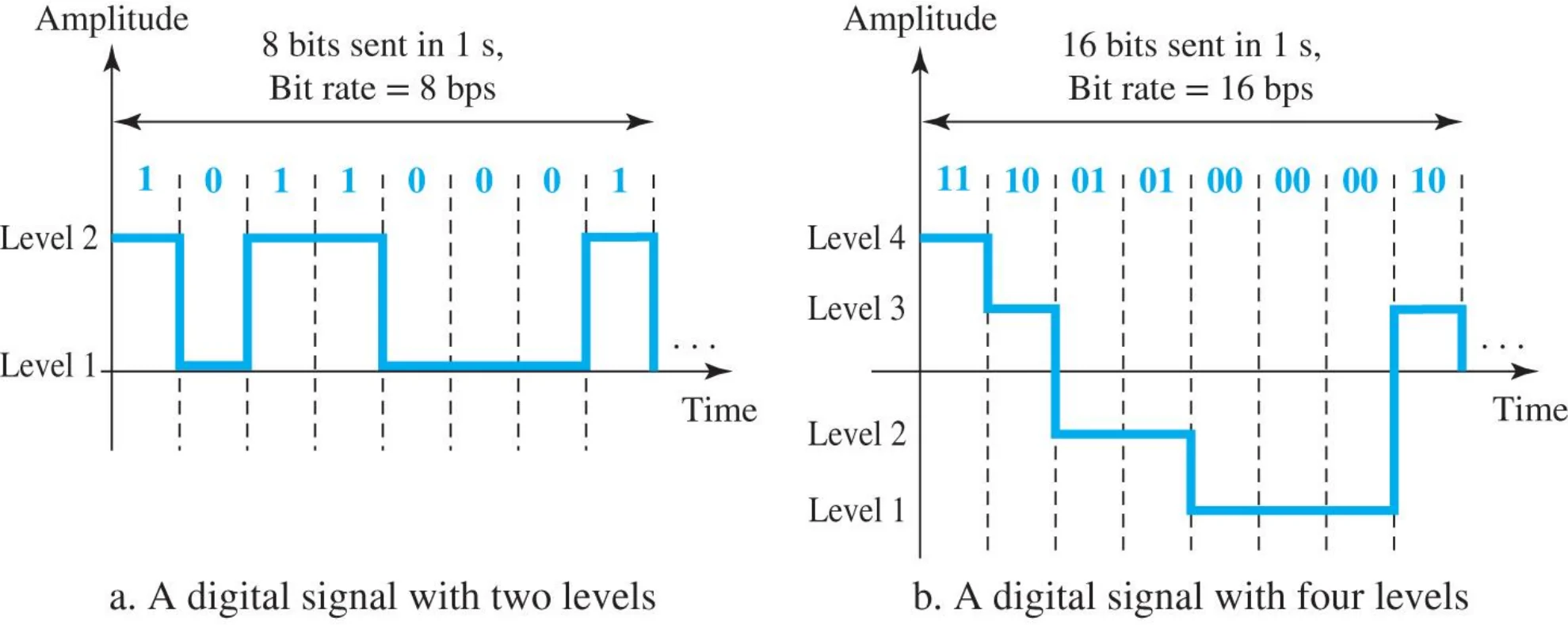
- With L levels, each level carries log₂L bits: 2 levels → 1 bit, 4 levels → 2 bits, so twice the bit rate.
🎯 How this can come up · 1 question
A digital signal has 8 levels. How many bits does each level carry?
log₂8 = 3.
- Bit interval = time for ONE bit. Bit rate = bits per second. Bit rate = 1 / bit interval.
Asked in a course tutorial
🎯 How this can come up · 1 question
A digital signal has a bit interval of 50 µs. Its bit rate is:
Tutorial 3, Q1: 1 / 0.00005 s = 20,000 bps = 20 Kbps.
- Seconds × 10⁶ = µs.
🎯 How this can come up · 1 question
A signal has a bit rate of 4000 bps. Each bit lasts:
1/4000 = 0.00025 s = 250 µs.
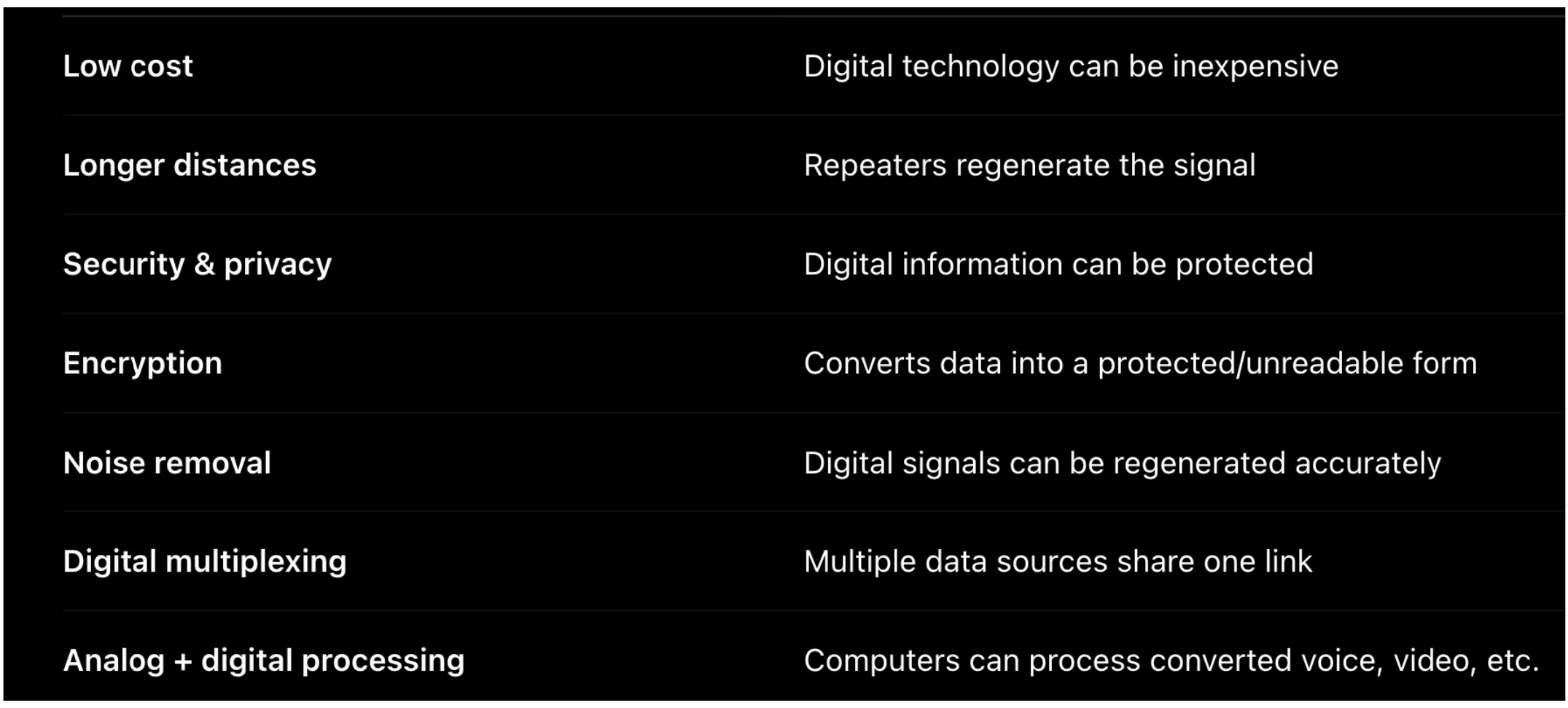
- Digital wins on: cost, distance (repeaters regenerate), security/encryption, noise removal, multiplexing, processing.
Related tutorial questions
- A medium passes some frequencies, blocks others and weakens others, so the output never equals the input exactly.
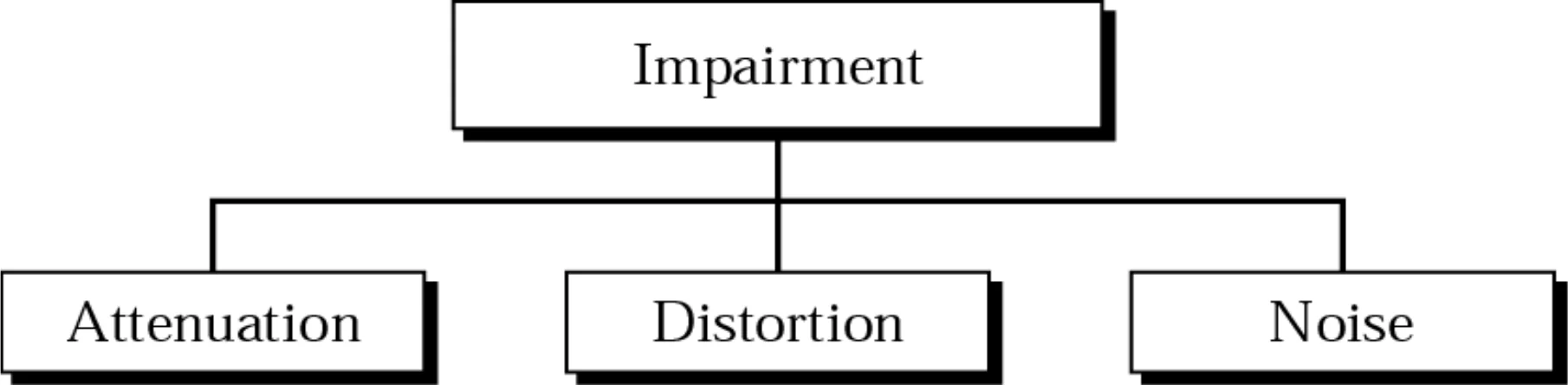
- Three impairments: attenuation, distortion, noise.
🎯 How this can come up · 1 question
Which is NOT a transmission impairment?
Correct: Multiplexing.
- Attenuation = LOSS OF ENERGY (the wire heats up). Worse with distance and with higher frequency.
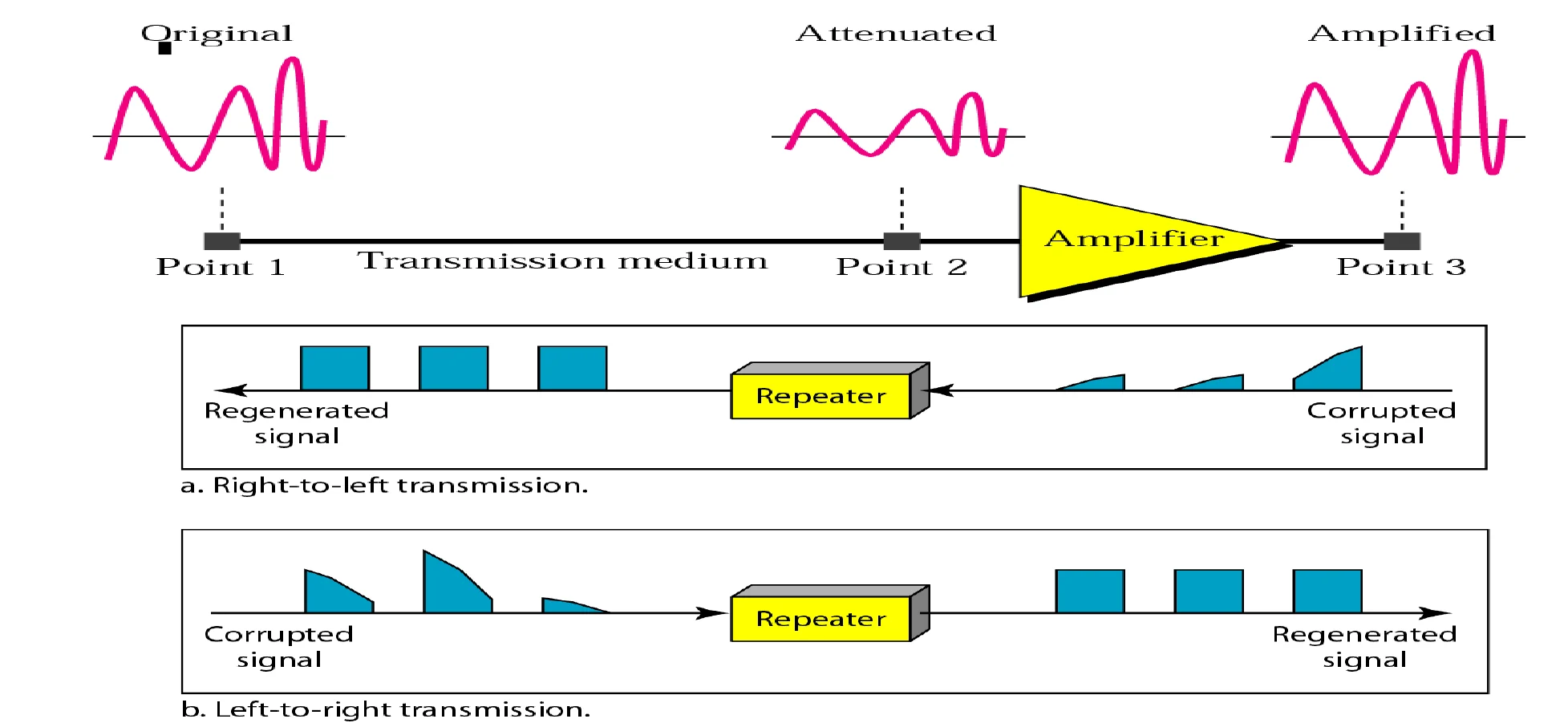
- Fix: amplifiers for analog, repeaters for digital (they regenerate a clean copy).
Asked in a course tutorial
🎯 How this can come up · 2 questions
Loss of signal energy due to the resistance of the medium is called:
Correct: Attenuation.
What does a repeater do and why is it needed in digital transmission?
It receives a weakened or distorted digital signal, regenerates it and sends a clean copy on. Signals lose strength over distance (attenuation), so repeaters let digital data travel further without losing its form.
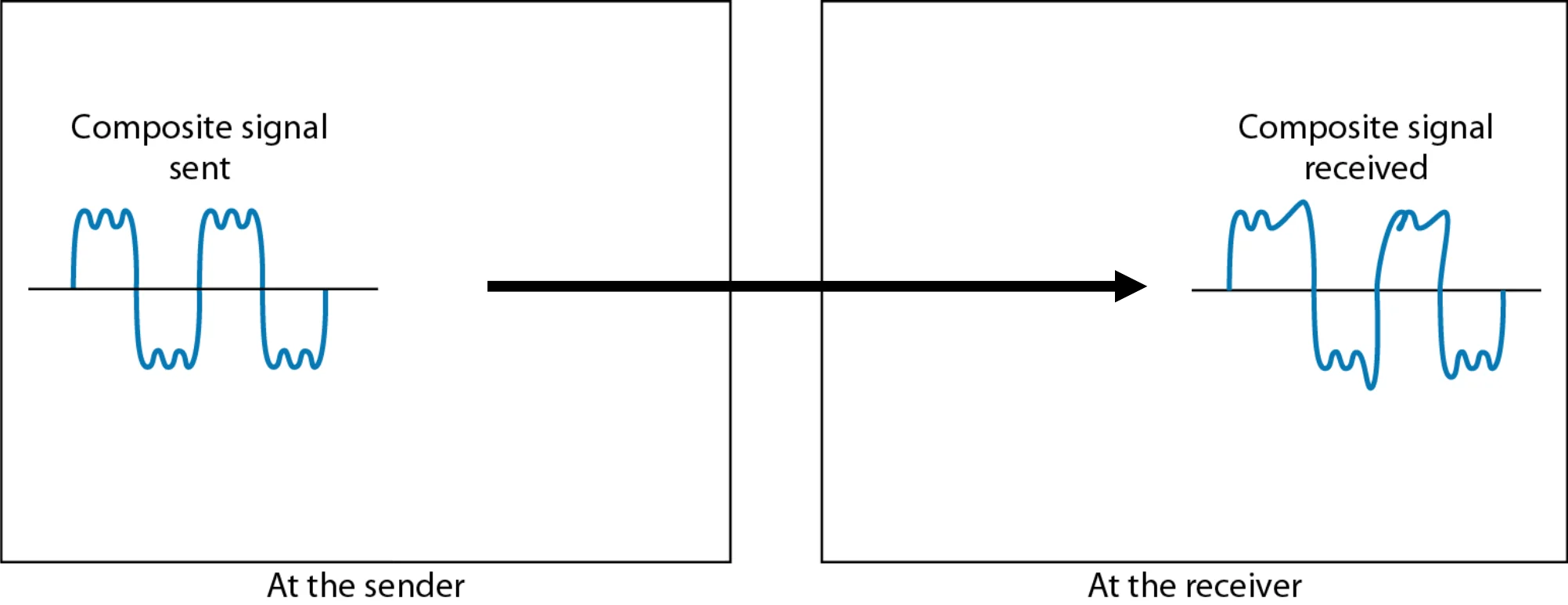
- Distortion = the signal changes SHAPE (its frequency components arrive with different delays). Typical for composite signals.
🎯 How this can come up · 1 question
A composite signal arrives with a changed shape. This impairment is:
Correct: Distortion.
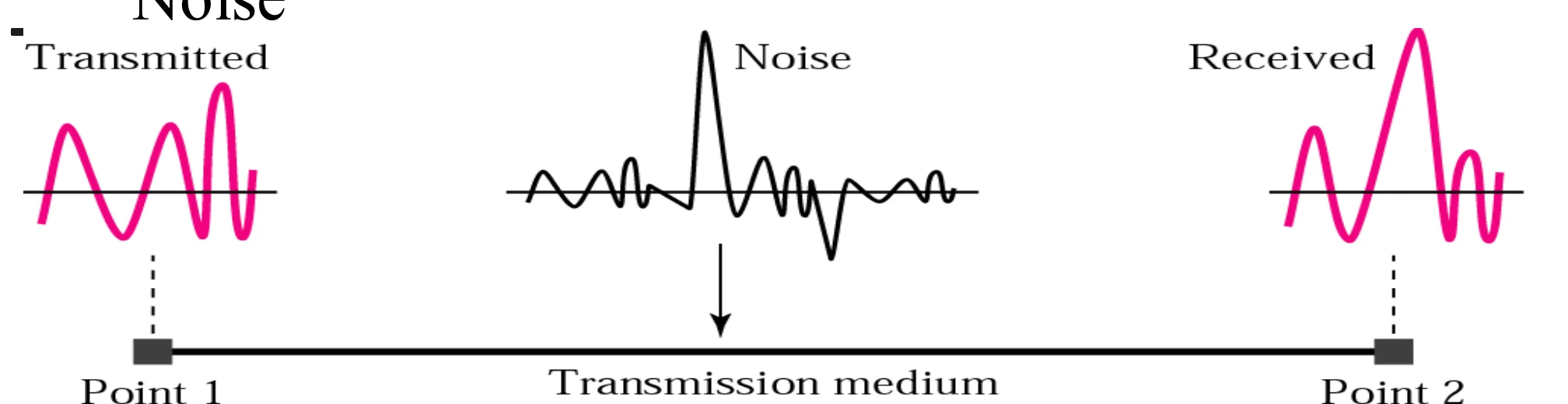
- Thermal: random motion of electrons. Induced: motors and electrical equipment.
- Crosstalk: one wire picks up a neighbour’s signal (hearing another call).
- Impulse: short high spikes from power lines or lightning; the main error source for digital data.
Asked in a course tutorial
🎯 How this can come up · 3 questions
On a phone call you hear a faint conversation from another call. Which impairment is this, and under which category?
Crosstalk, which is a kind of noise: a signal from one line leaking into another nearby line.
A long-distance link has many errors because of nearby electrical equipment. Which impairment, and how would you reduce it?
Induced noise (electromagnetic interference), a kind of noise. Reduce it with shielded or twisted-pair cable, by moving cables away from the equipment, by using fiber, and with error detection.
Which noise is the primary source of error in digital data communication?
Correct: Impulse noise.
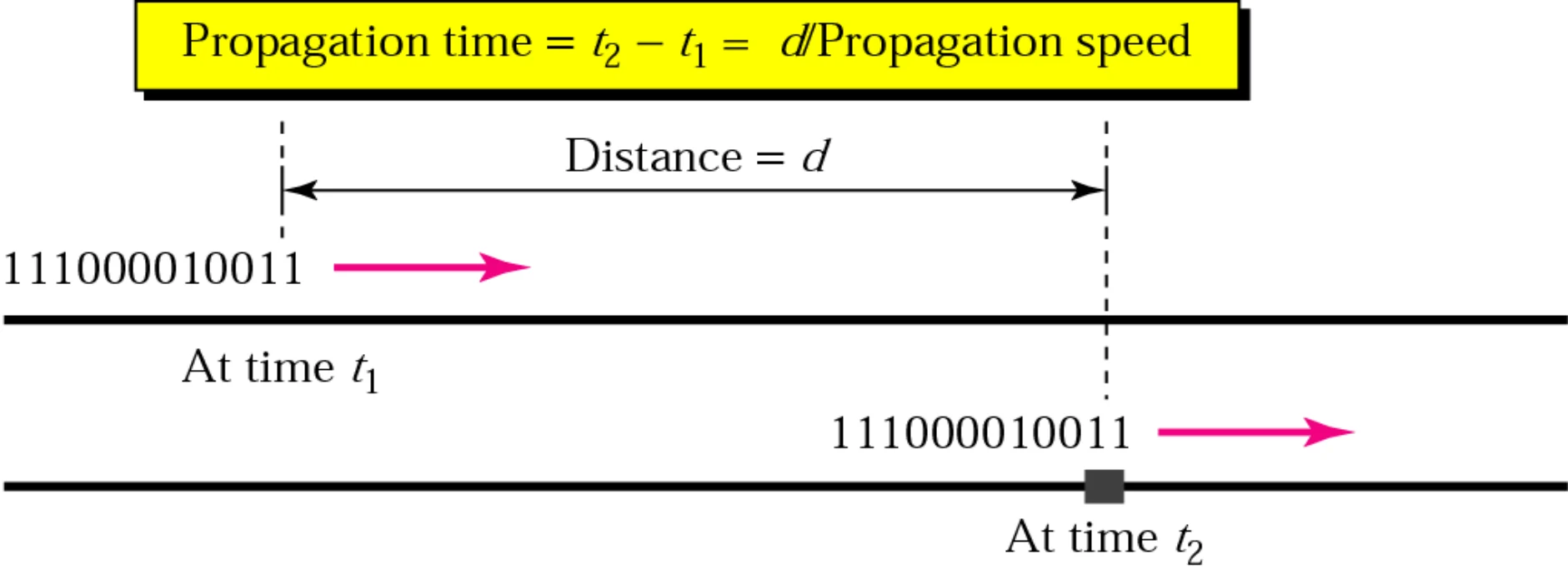
- Propagation time = distance / speed. It does NOT depend on the message size.
- Speed: 3 × 10⁸ m/s in vacuum, about 2 × 10⁸ m/s in cable.
Asked in a course tutorial
🎯 How this can come up · 1 question
Sender and receiver are 2,000 km apart and the signal travels at 2 × 10⁸ m/s. Propagation time?
Tutorial 3, Q4: 2,000,000 m / 2 × 10⁸ = 0.01 s = 10 ms.
- Transmission time = size / bandwidth: depends on message size, not distance.
- Latency = propagation + transmission + queuing + processing.
Asked in a course tutorial
🎯 How this can come up · 3 questions
A 1 MB file is sent over a 1 Mbps link (ignore propagation). Transmission time?
Tutorial 3, Q7: 8 Mb / 1 Mbps = 8 s.
Which delay depends on the size of the message?
Correct: Transmission time.
List the four components of latency.
Propagation time + transmission time + queuing time + processing time.
- Short message + fast link: guess which delay wins before you calculate.
- Small message on a fast link: propagation dominates.
🎯 How this can come up · 1 question
For a short e-mail on a 1 Gbps link across 12,000 km, the transmission time dominates.
False. Propagation (50 ms) dominates; transmission is only 0.02 ms.
- Same distance, same 50 ms propagation. Big message on a slow link: transmission dominates.
🎯 How this can come up · 1 question
A 5 MB image is sent on a 1 Mbps link over 12,000 km (2.4 × 10⁸ m/s). Which delay dominates?
Correct: Transmission (40 s).
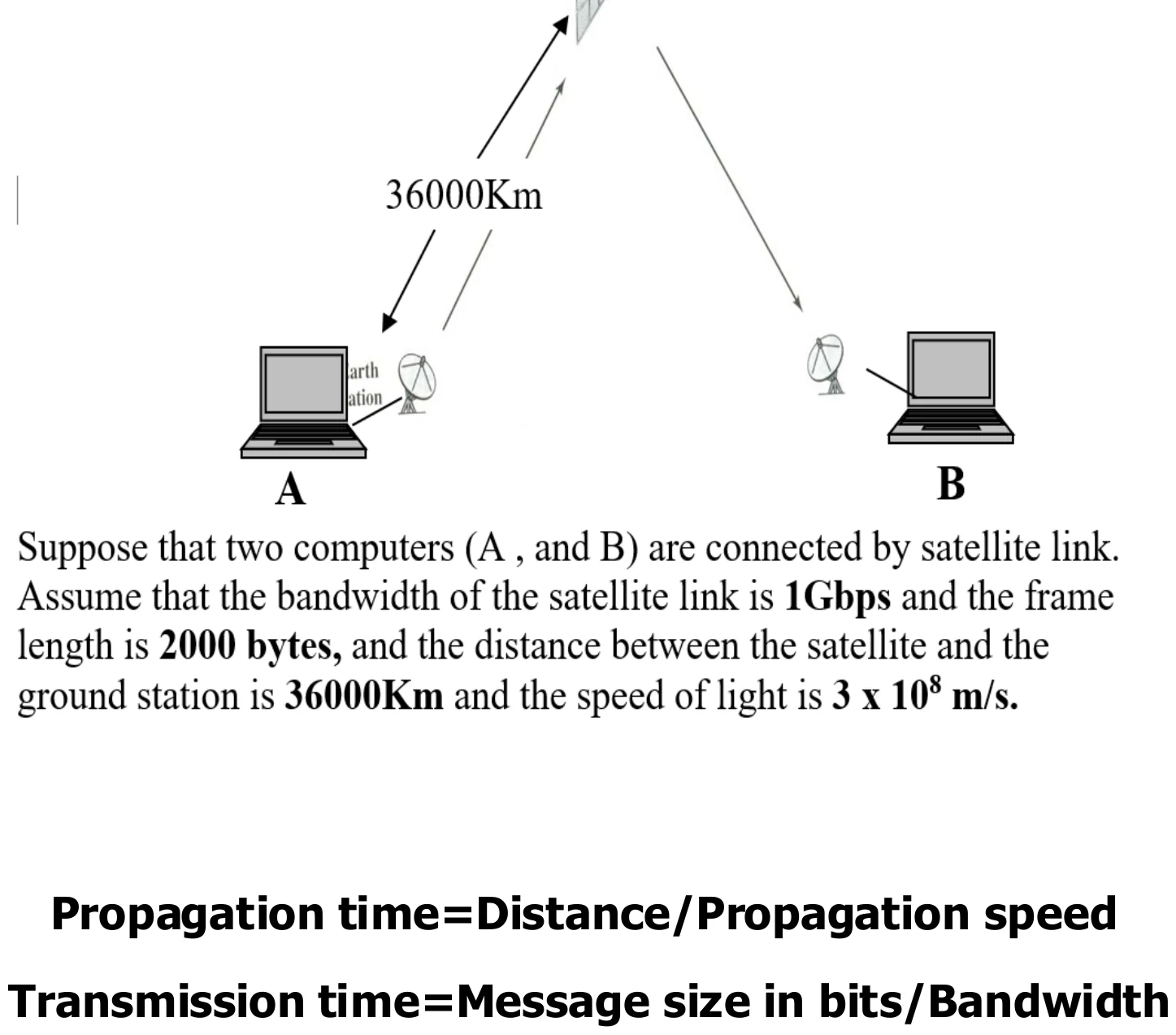
- A → satellite → B is 2 × 36,000 = 72,000 km: propagation = 72 × 10⁶ / 3 × 10⁸ = 0.24 s (0.12 s for one leg).
- Transmission = 2000 × 8 / 10⁹ = 16 µs. Propagation dominates by far.
🎯 How this can come up · 1 question
In the satellite example (36,000 km up, 36,000 km down, 3 × 10⁸ m/s), the propagation time from A to B is:
72,000,000 m / 3 × 10⁸ m/s.
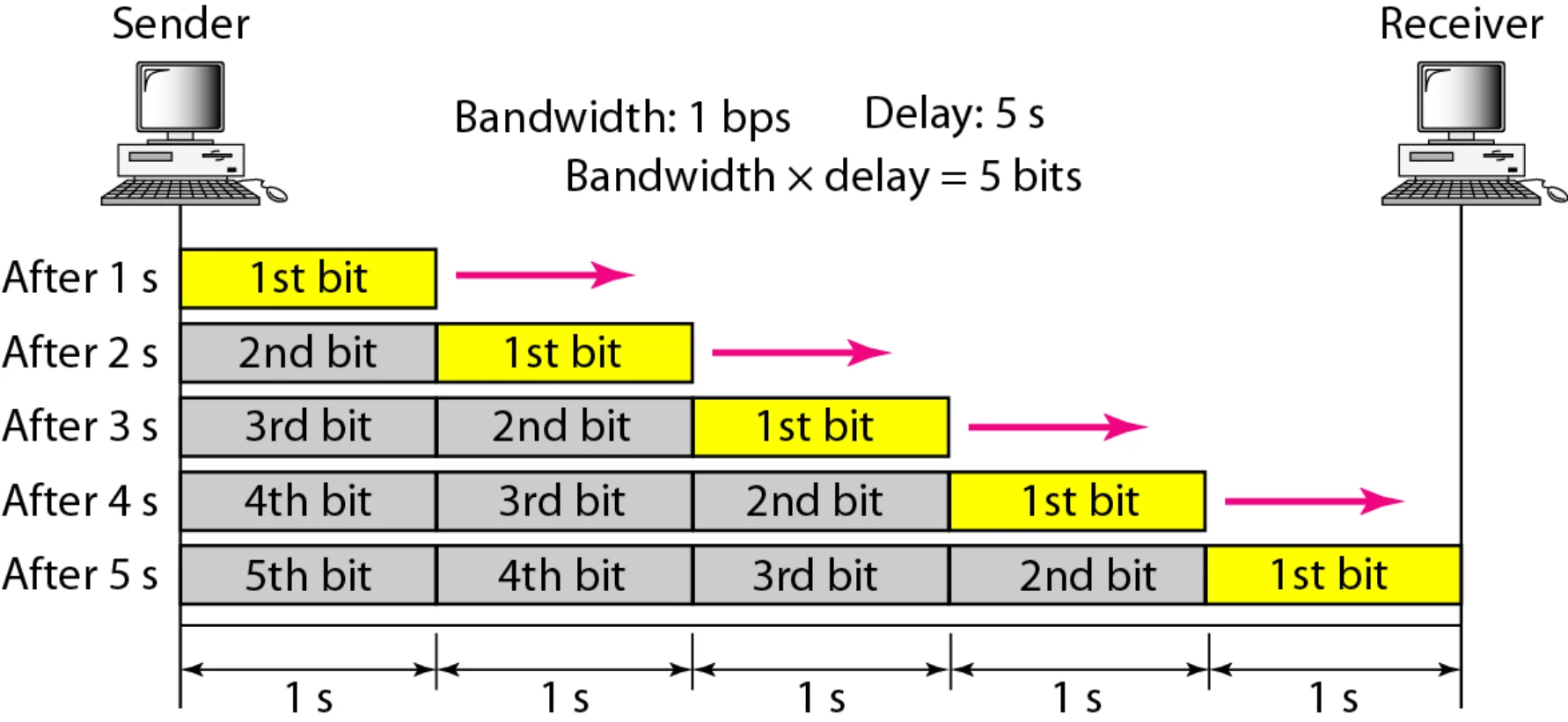
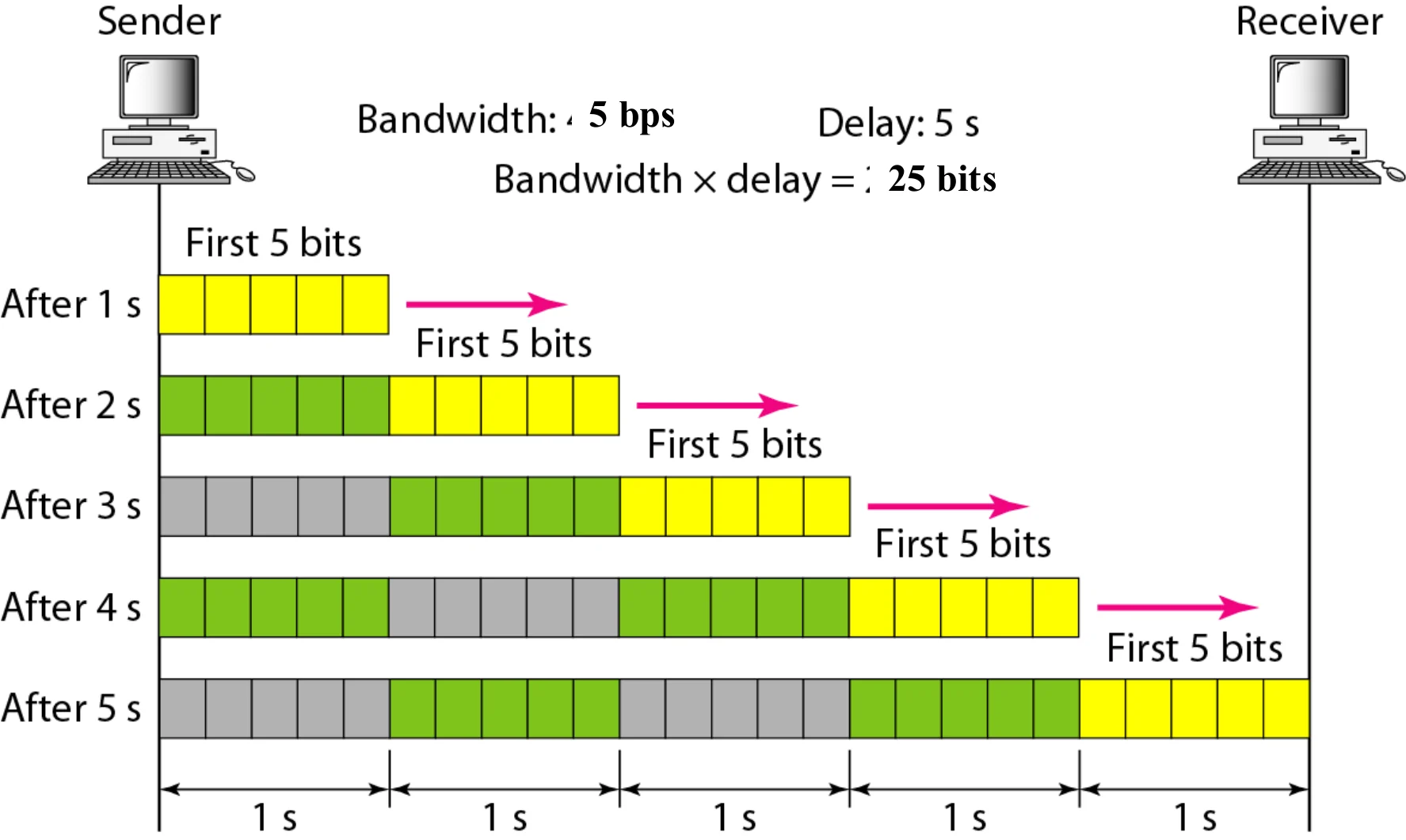
- BDP = bandwidth × delay = how many bits are “in the pipe” at once.
Asked in a course tutorial
🎯 How this can come up · 2 questions
A link has a bandwidth of 5 bps and a delay of 5 s. Its bandwidth-delay product is:
Tutorial 3, Q10.
A 10 Mbps link has a 2 ms delay. How many bits fill the link?
10⁷ × 0.002 = 20,000 bits.
- 1 bps × 5 s = 5 bits in the pipe.
- 5 bps × 5 s = 25 bits: the Tutorial 3 numbers.
Asked in a course tutorial
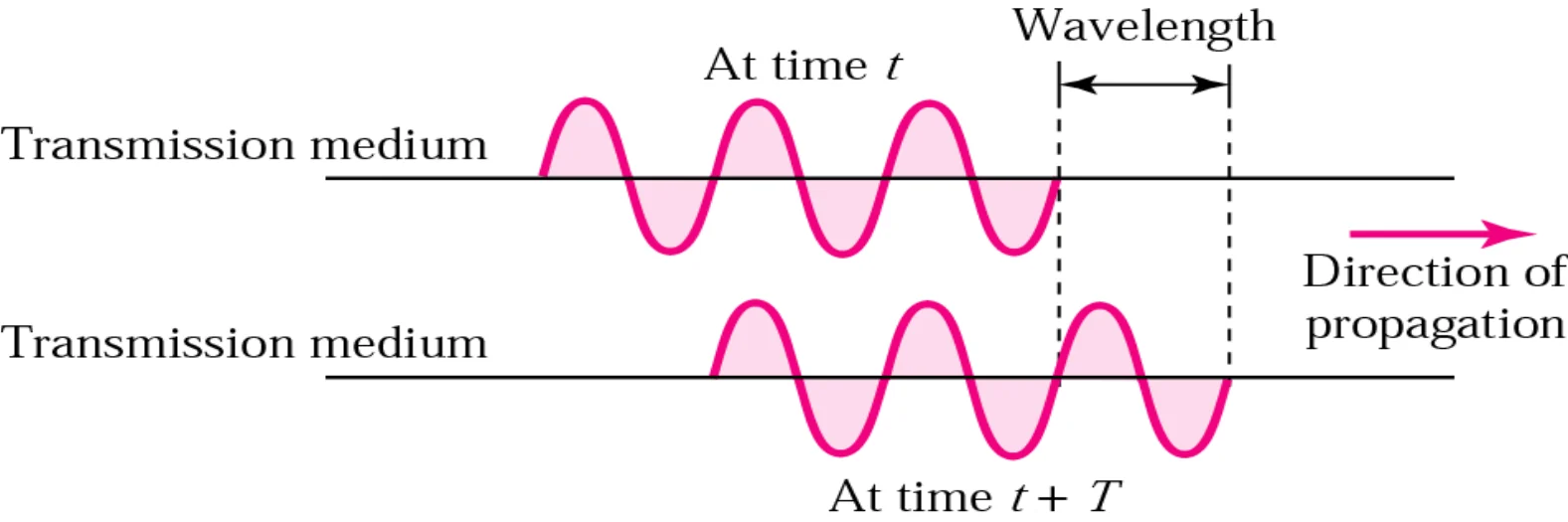
- Wavelength = speed × T = speed / f. It depends on the frequency AND the medium.
🎯 How this can come up · 1 question
A 1 MHz signal travels at 2 × 10⁸ m/s. Its wavelength is:
2 × 10⁸ / 10⁶ = 200 m.
No slides match this filter.