SE365 · Annotated SlidesLecture 11 — Evaluation Foundations
Lecture 11 · Annotated slides

Evaluation Foundations

Why, what, where and when to evaluate, the types of evaluation (controlled settings with users, natural settings, settings without users), usability and living labs, an airline-booking usability case study, evaluation methods, participants’ rights and interpreting data.
Slide text Study notes Highlight: key words Tips, tricks & traps Seen again elsewhere How it can come up
Slide 1: Slide 1
Exam weight Low

    Overview

    • Introduction
    • Why, What, Where & When of evaluation
    • Types of Evaluation
    • Evaluation case study
    • What did we learn from the case study? Based on material from: Sharp, H., Preece, J. and Rogers, Y. (2019). Interaction Design Beyond Human-Computer Interaction. 5th Ed. Sussex: John Wiley & Sons Ltd.
    2
    Exam weight Low

      Learning Outcomes

      • Explain the key concepts and terms used in evaluation
      • Introduce range of different types of evaluation methods.
      • Show how different evaluation methods are used for different purposes at different stages of the design process and in different contexts of use.
      • Show how evaluators mixed and modified to meet the demands of evaluating novel systems.
      • Discuss some of the practical challenges of doing evaluation.
      3
      Exam weight Low
        Slide 4: 1) Introduction
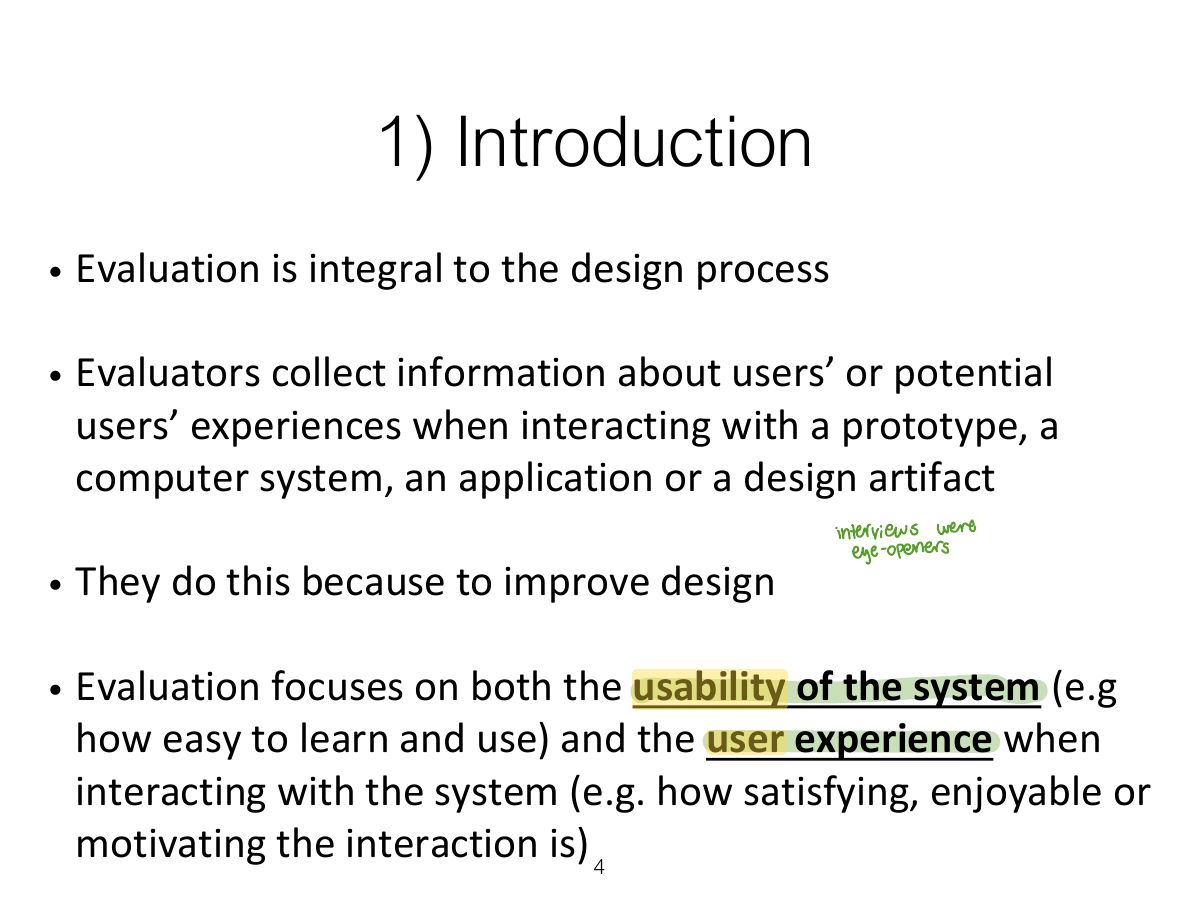
        Exam weight Low

          1) Introduction (cont)

          “User experience (UX) is an approach to product development that incorporates direct user feedback throughout the development cycle (human-centered design) in order to reduce costs and create products and tools that meet user needs and have a high level of usability (are easy to use)” User experience Professionals Association (UXPA) http://uxpa.org/resources/about-ux

          5
          Exam weight Low

            2. Why, what, where & when to evaluate

            Iterative design & evaluation is a continuous process that examines:

            • Why: to check users’ requirements and that users can use the product and they like it.
            • What: a conceptual model, early prototypes of a new system and later, more complete prototypes.
            • Where: in natural and laboratory settings.
            • When: throughout design; finished products can be evaluated to collect information to inform new products.
            6
            Exam weight High
            1. Why: check users can use the product and like it. What: prototypes to full systems. Where: lab, field, remotely. When: formative (during design) and summative (to assess a finished product).
            🎯 How this can come up · 1 question
            MCQ

            Evaluation during design to improve the product is:

            3. Types of evaluation

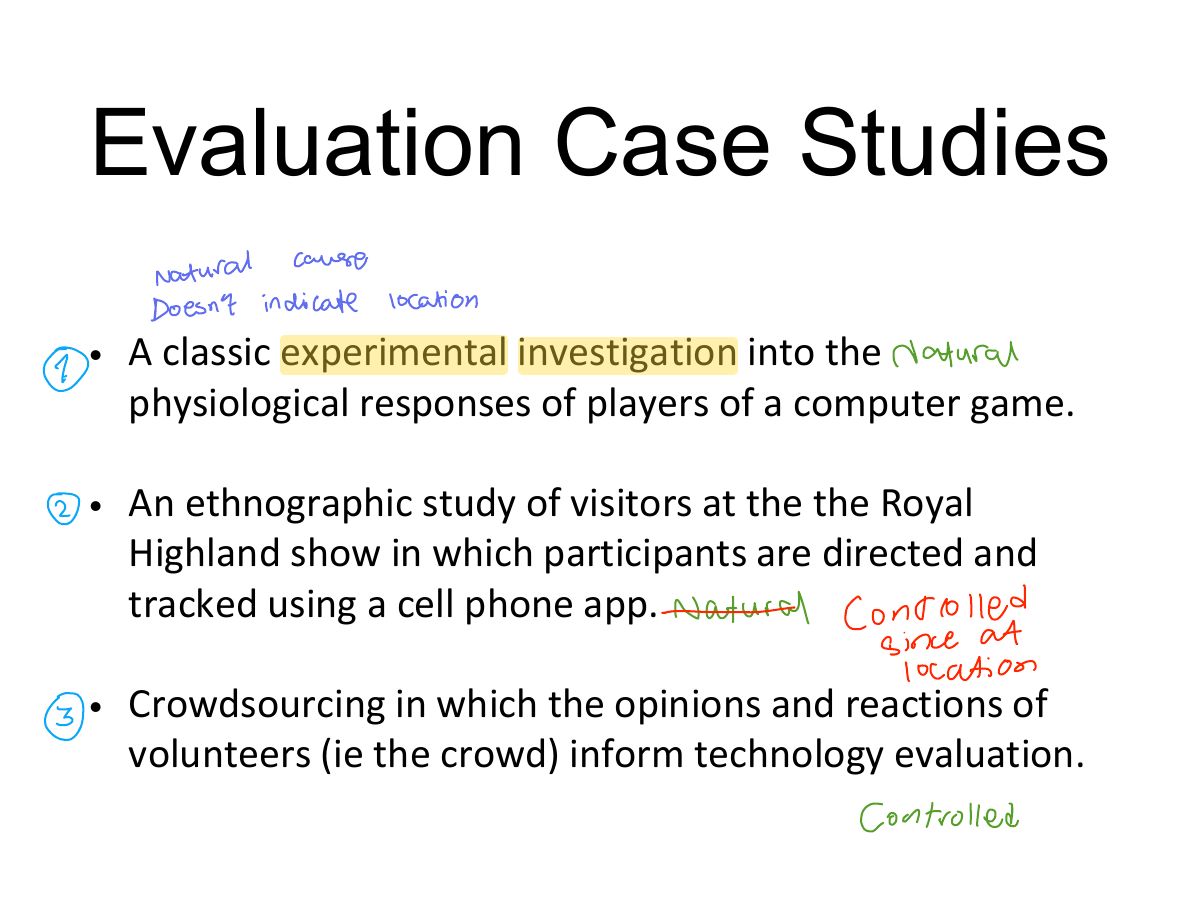
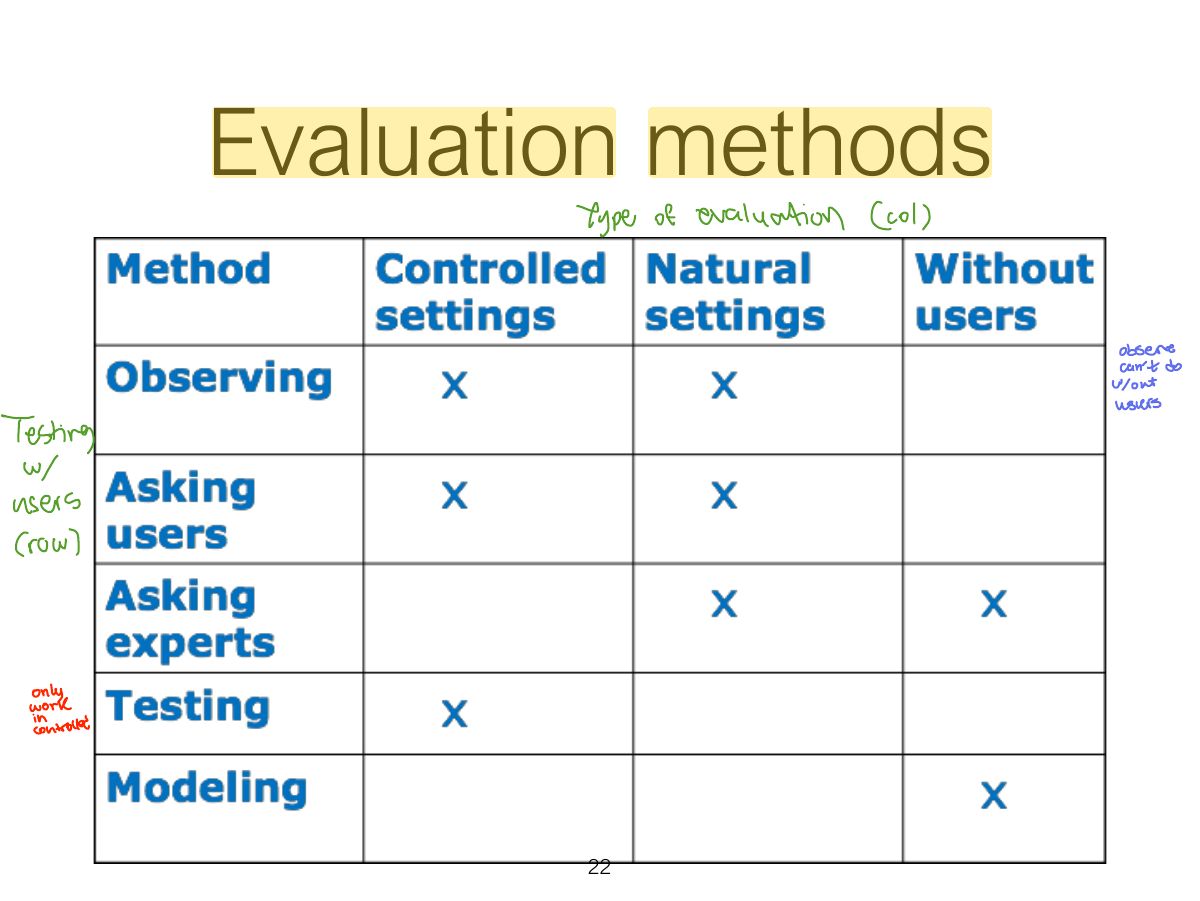
            • Controlled settings that directly involve users (eg. usability and research labs).
            • Natural settings involving users (eg online communities and products that are used in public places). Often there is little or no control over what users do, especially in in-the-wild settings.
            • Any setting that doesn’t directly involve users (eg consultants and researchers critique the prototypes, and may predict and model how successful they will be when used by users.
            7
            Exam weight High
            1. Types: controlled settings with users (usability testing, experiments), natural settings with users (field studies), any setting without users (inspections, heuristics, walkthroughs, models, analytics).
            🎯 How this can come up · 1 question
            MCQ

            Heuristic evaluation is done:

            Usability Lab

            8
            Exam weight Low
            1. Usability lab: controlled environment with recording equipment; living lab: real everyday environment instrumented for study.

            Living Lab

            • People’s use of technology in their everyday lives can be evaluated in living labs.
            • Such evaluations are too difficult to do in a usability lab.
            • Eg: the Aware Home was embedded with a complex network of sensors and audio/video recording devices (Abowd et al., 2000).
            • More recent examples include whole blocks and cities that house hundreds of people, eg Verma et al’s, 2017 research in Switzerland.
            • Many citizen science projects can also be thought of as living labs eg iNaturalist.com
            • These examples illustrate how the concept of a lab is changing to include other spaces where people’s use of technology can be studied in realistic environments .
            9
            Exam weight Low
              Slide 10: Evaluation Case Studies
              Exam weight Low

                3.1 Usability testing & field studies can compliment

                11
                Exam weight Low
                1. Usability testing: users do typical tasks; measure time, errors, satisfaction. Field studies: real use in context.
                Slide 12: 4. Case study: Airline booking system
                Exam weight Low

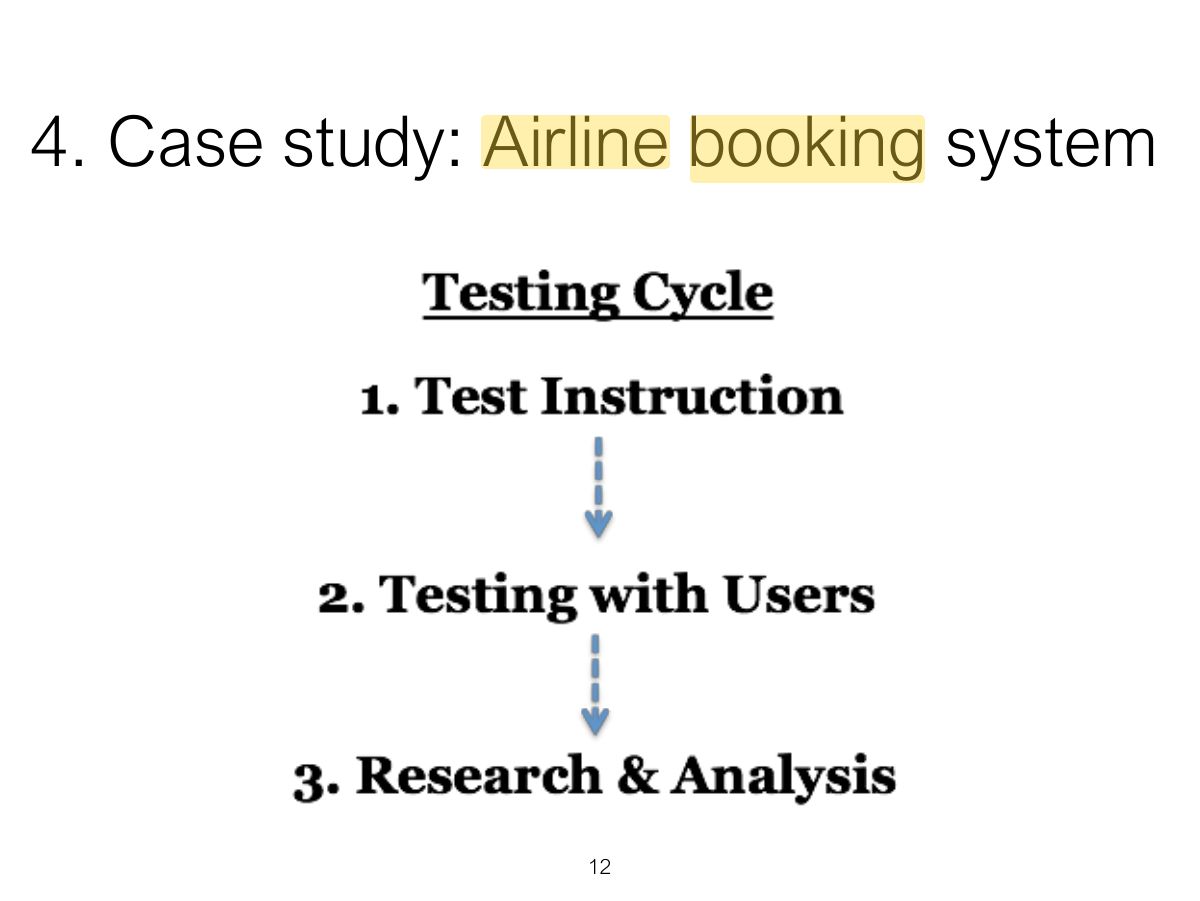
                  4.1 Task Instruction

                  Task Oriented

                  • E.g. XXX booking system
                  • Typical instruction such as:
                    • Get a ticket to London on certain date

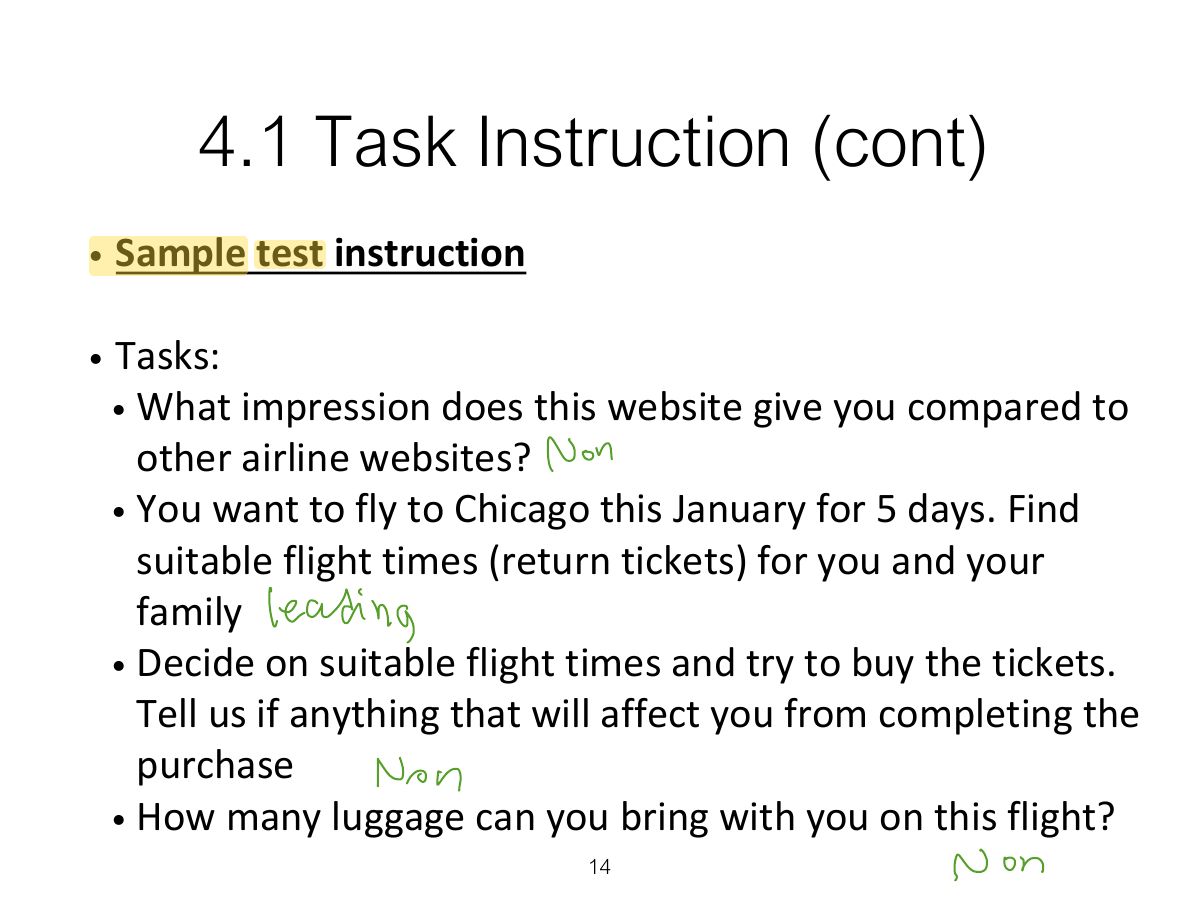
                  Non-leading questions

                  • Non-leading: Try to buy plane tickets for your family vacation st
                  • Leading: Press the red button and then click the 1 top right button with an airplane icon..
                  13
                  Exam weight Low
                    Slide 14: 4.1 Task Instruction (cont)
                    Exam weight Low
                      Slide 15: 4.2 Testing with users
                      Exam weight Low

                        4.2 Testing with users (cont)

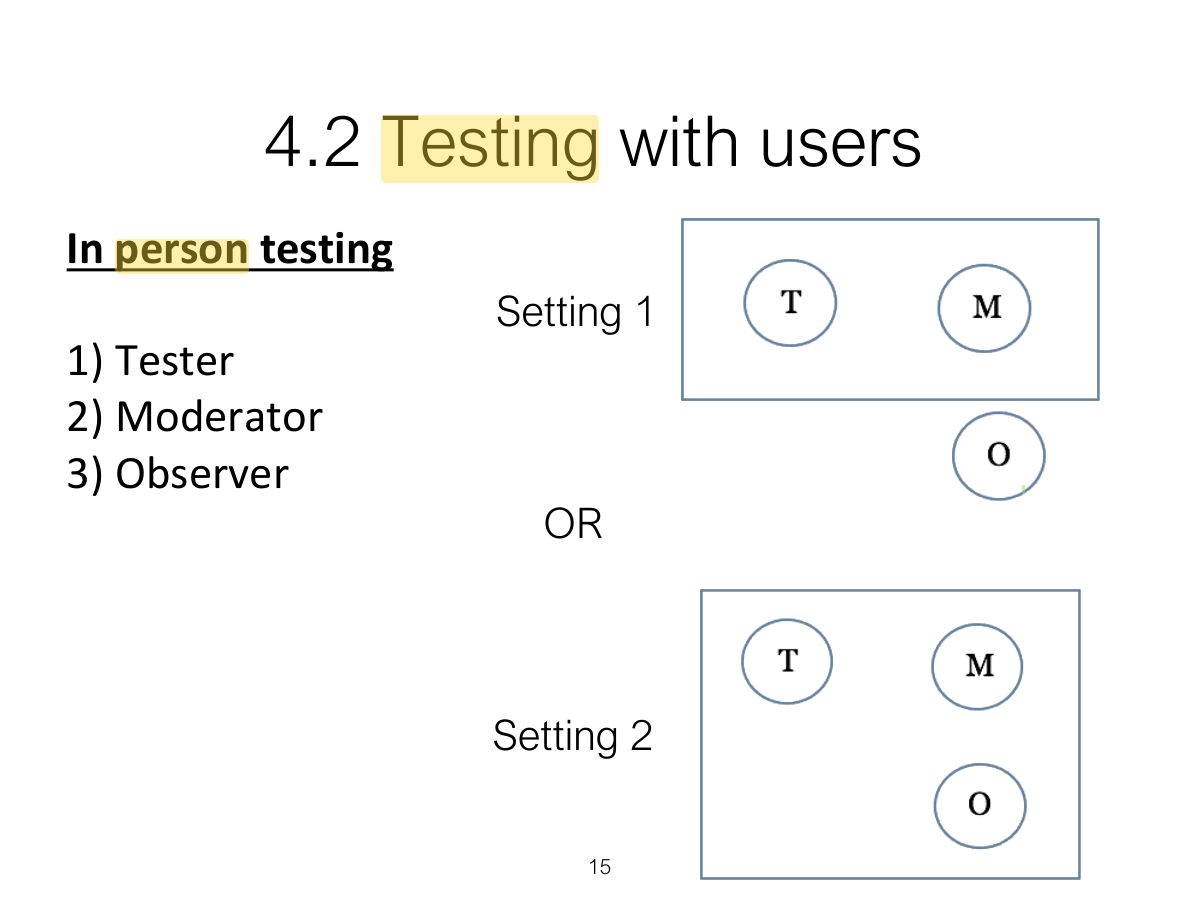
                        Tester

                        1. Think Aloud
                        2. Be >100% honest (likes/dislikes; difficult/easy)
                        3. It is not IQ test
                        4. Give suggestion
                        16
                        Exam weight Low

                          4.2 Testing with users (cont)

                          Moderator

                          1. Tour guide
                          2. Interrupt only when necessary
                          3. Dont answer questions for tester
                          4. Ask questions starting with “What” or “How” if tester becomes quiet
                          17
                          Exam weight Low

                            4.2 Testing with users (cont)

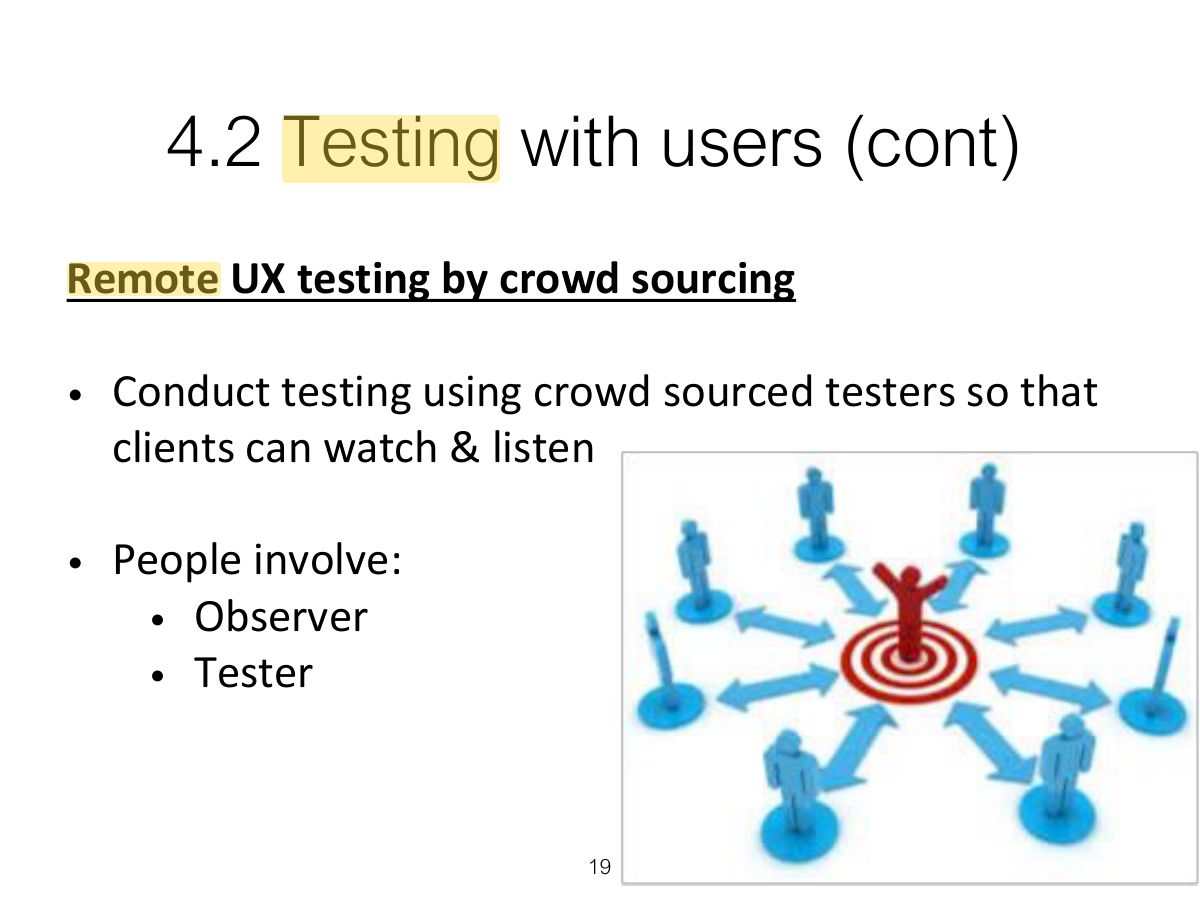
                            Observer

                            1. Watch
                            2. Listen
                            3. Take notes
                            18
                            Exam weight Low
                              Slide 19: 4.2 Testing with users (cont)
                              Exam weight Low

                                5. Research & Analysis

                                How to analyze results?

                                1. Quantitative - expressed as numbers
                                2. Qualitative - an inquiry into the reasoning behind human behavior (as discussed in the previous lecture)
                                20
                                Exam weight Low

                                  5. Research & Analysis (cont)

                                  Common practice for data analysis process:

                                  1. Transcribe the evaluation sessions (verbal and actions both from the tester & the moderator)
                                  2. Analyze the transcript based on the objective of the evaluation (e.g usability, user behavior etc)
                                  3. Highlight other issues observed from the sessions
                                  4. Report findings
                                  21
                                  Exam weight Low
                                    Slide 22: Evaluation methods
                                    Exam weight Low

                                      Participants’ rights and getting their consent

                                      • Participants need to be told why the evaluation is being done, what they will be asked to do and their rights.
                                      • Informed consent forms provide this information and act as a contract between participants and researchers.
                                      • The design of the informed consent form, the evaluation process, data analysis and data storage methods are typically approved by a high authority, eg. Institutional Review Board.
                                      23
                                      Exam weight Low
                                      1. Participants’ rights: informed consent, privacy, the right to stop at any time.

                                      Things to consider when interpreting data

                                      • Reliability: does the method produce the same results on separate occasions?
                                      • Validity: does the method measure what it is intended to measure?
                                      • Ecological validity: does the environment of the evaluation distort the results?
                                      • Biases: Are there biases that distort the results?
                                      • Scope: How generalizable are the results?
                                      24
                                      Exam weight High
                                      1. Interpreting data: reliability (consistent), validity (measures what it should), ecological validity (environment affects results), biases, scope.
                                      🎯 How this can come up · 1 question
                                      MCQ

                                      A lab study’s results may not reflect real-world use. This concerns:

                                      Key points

                                      • Evaluation & design are closely integrated in user-centered design.
                                      • Some of the same techniques are used in evaluation as for establishing requirements but they are used differently (e.g. observation interviews & questionnaires).
                                      • Three types of evaluation: laboratory based with users, in the field with users, studies that do not involve users
                                      • The main methods are: observing, asking users, asking experts, user testing, inspection, and modeling users’ task performance, analytics.
                                      • Dealing with constraints is an important skill for evaluators to develop.
                                      25
                                      Exam weight Low

                                        Summary

                                        • Test instruction: goal oriented
                                        • Usability testing can be done easily
                                        • User’s action speaks louder than words
                                        • Testing can be done in any stages
                                        • You are not your user
                                        • Testing with one user better than none
                                        26
                                        Exam weight Low

                                          Link

                                          Japan's technology leads the way in caring for the

                                          elderly - YouTube

                                          27
                                          Exam weight Low