SE365 · Annotated SlidesLectures 6–7 — Establishing Requirements
Lectures 6–7 · Annotated slides

Establishing Requirements

Data gathering (interviews, questionnaires, observation, ethnography, contextual inquiry), recording and guidelines, kinds of requirements, personas and scenarios, use cases and hierarchical task analysis, then data analysis: quantitative and qualitative, grounded theory and activity theory.
Slide text Study notes Highlight: key words Tips, tricks & traps Seen again elsewhere How it can come up
Slide 1: Slide 1
Exam weight Low

    Overview

    • The importance of requirements
    • Data gathering for requirements
    • Techniques in data gathering
    • Data gathering guidelines
    • Establishing requirements
    • Different kinds of requirements
    • Data interpretation and presentation Based on material from:
    1. Preece, J., Rogers, Y. and Sharp, H. (2015). Interaction Design Beyond Human-Computer Interaction. 4th Ed. Sussex: John Wiley & Sons Ltd.
    2
    Exam weight Low

      Learning Outcomes

      • Explain and describe the process of data gathering (how to plan and run a successful data gathering program)
      3
      Exam weight Low

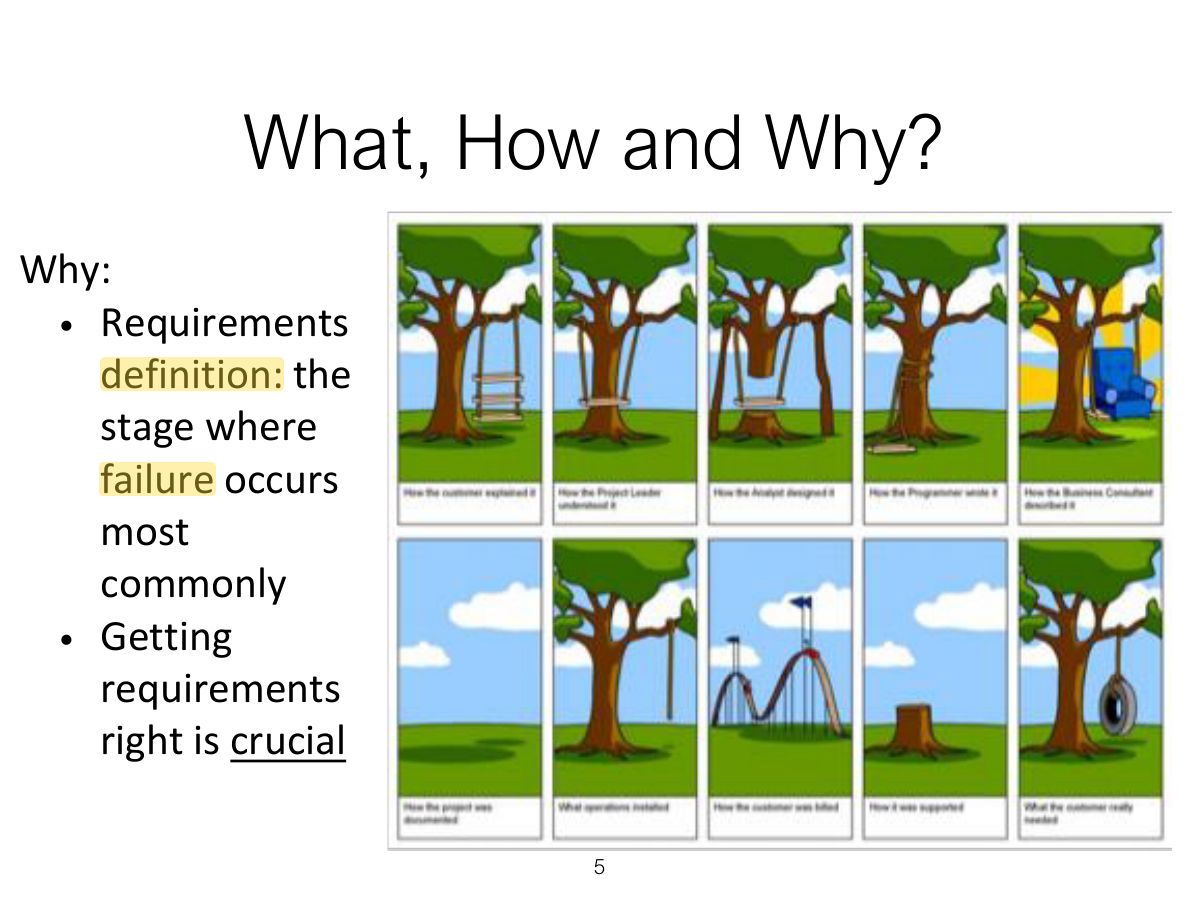
        Requirement: What, How and Why?

        • What
          • Two aims:
        1. Understand as much as possible about users, task, context
        2. Produce a stable set of requirements
        • How:
          • Data gathering activities
          • Data analysis activities
          • Expression as ‘requirements’
          • All of this is iterative
        4
        Exam weight Low
          Slide 5: What, How and Why?
          Exam weight Low

            Data gathering: Five key issues

            1. Setting goals
              • Decide how to analyze data once collected
            2. Identifying participants
              • Decide who to gather data from
            3. Relationship with participants
              • Clear and professional
              • Informed consent when appropriate
            4. Triangulation
              • Look at data from more than one perspective
            5. Pilot studies
              • Small trial of main study
            6
            Exam weight High
            1. Five key issues in data gathering: setting goals, identifying participants, relationship with participants (consent), triangulation, pilot studies.
            🎯 How this can come up · 1 question
            MCQ

            Using more than one data-gathering technique to confirm findings is:

            Data gathering for requirements

            1. Interviews:
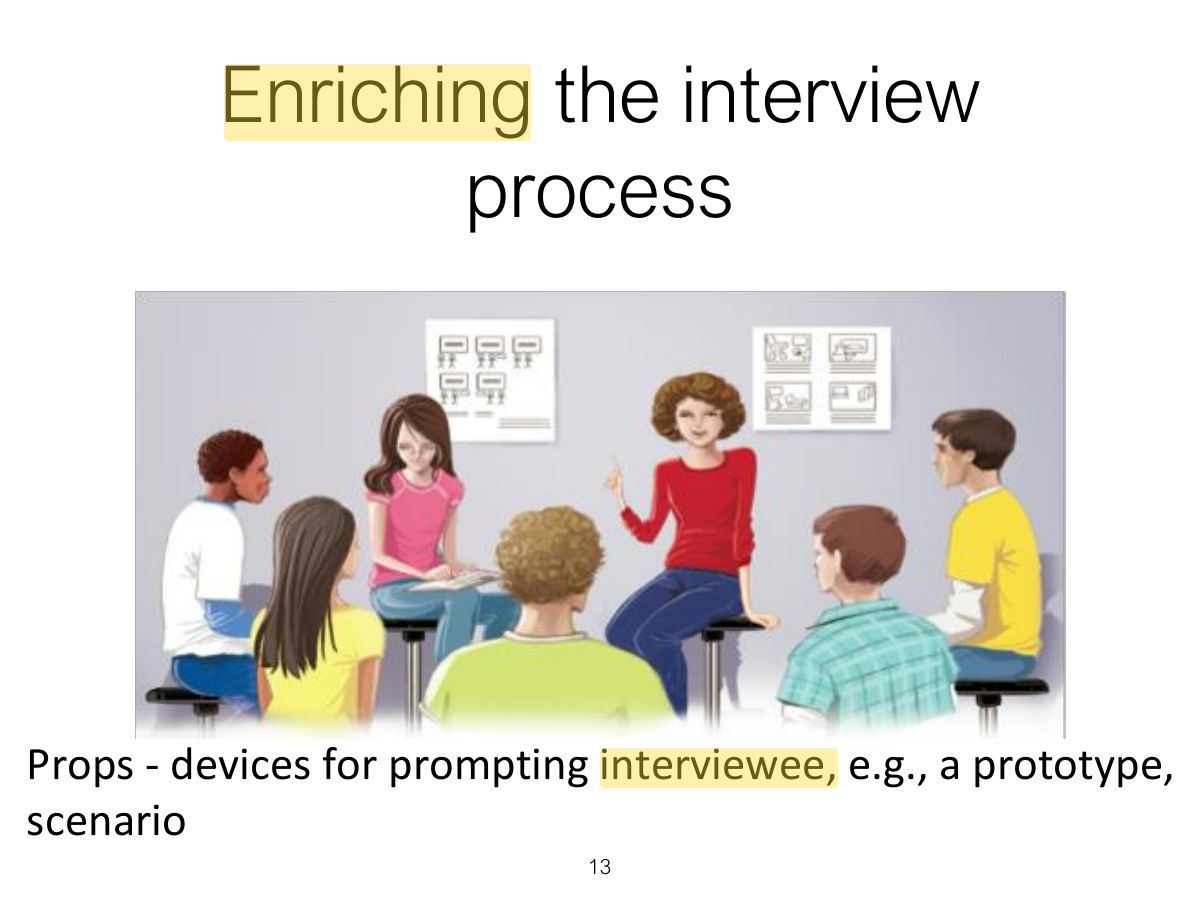
            • Props, e.g. sample scenarios of use, prototypes, can be used in interviews
            • Good for exploring issues
            • But are time consuming and may be infeasible to visit everyone

            Focus groups:

            • Group interviews
            • Good at gaining a consensus view and/or highlighting areas of conflict
            • But can be dominated by individuals
            7
            Exam weight Low

              Interviews

              • Unstructured/open-ended - are not directed by a script. Rich but not replicable
              • Structured - are tightly scripted, often like a questionnaire. Replicable but may lack richness
              • Semi-structured - guided by a script but interesting issues can be explored in more depth. Can provide a good balance between richness and replicability
              • Group interviews – small group guided by a facilitator
              8
              Exam weight High
              1. Interviews: unstructured (open), structured (fixed questions), semi-structured (mix), group interviews / focus groups.
              🎯 How this can come up · 1 question
              MCQ

              An interview with a script of set questions plus probing follow-ups is:

              Interview questions

              • Two types:
                • ‘closed questions’ have a predetermined answer format, e.g., ‘yes’ or ‘no’
                • ‘open questions’ do not have a predetermined format
              • Closed questions are easier to analyze
                • Given similar questions to all participants (standardized)
                • Short and worded exactly the same to all participants
                • Consists pre-determined options
                • Eg: Which of the following web sites do you visit most frequently: amazon.com, MPH.com,?
                • How often do you visit this web site: every day, once a week?
              9
              Exam weight Low

                Interview questions (cont)

                Open questions eg:

                Which music websites do you visit most

                frequently?<answer......stresses on particular web site)

                Why?<Answer> Tell me more......

                10
                Exam weight Low

                  Interview questions (cont)

                  Avoid:

                  • Long questions
                  • Compound sentences - split them into two
                  • Jargon and language that the interviewee may not understand
                  • Leading questions that make assumptions e.g., why do you like ...?
                  • Unconscious biases e.g., gender stereotypes
                  11
                  Exam weight Low

                    Running the interview

                    • Introduction – introduce yourself, explain the goals of the interview, reassure about the ethical issues, ask to record, present any informed consent form.
                    • Warm-up – make first questions easy and non-threatening.
                    • Main body – present questions in a logical order
                    • A cool-off period – include a few easy questions to defuse tension at the end
                    • Closure – thank interviewee, signal the end, e.g, switch recorder off.
                    12
                    Exam weight Low
                      Slide 13: Enriching the interview process
                      Exam weight Low
                        Slide 14: Data gathering for requirements (cont)
                        Exam weight Low
                          Slide 15: Questionnaires
                          Exam weight Low
                          1. Questionnaires: reach many people; closed (easy to analyse) vs. open questions; Likert scales.

                          Questionnaire design

                          • The impact of a question can be influenced by question order.
                          • Do you need different versions of the questionnaire for different populations?
                          • Provide clear instructions on how to complete the questionnaire.
                          • Strike a balance between using white space and keeping the questionnaire compact.
                          • Decide on whether phrases will all be positive, all negative or mixed.
                          16
                          Exam weight Low
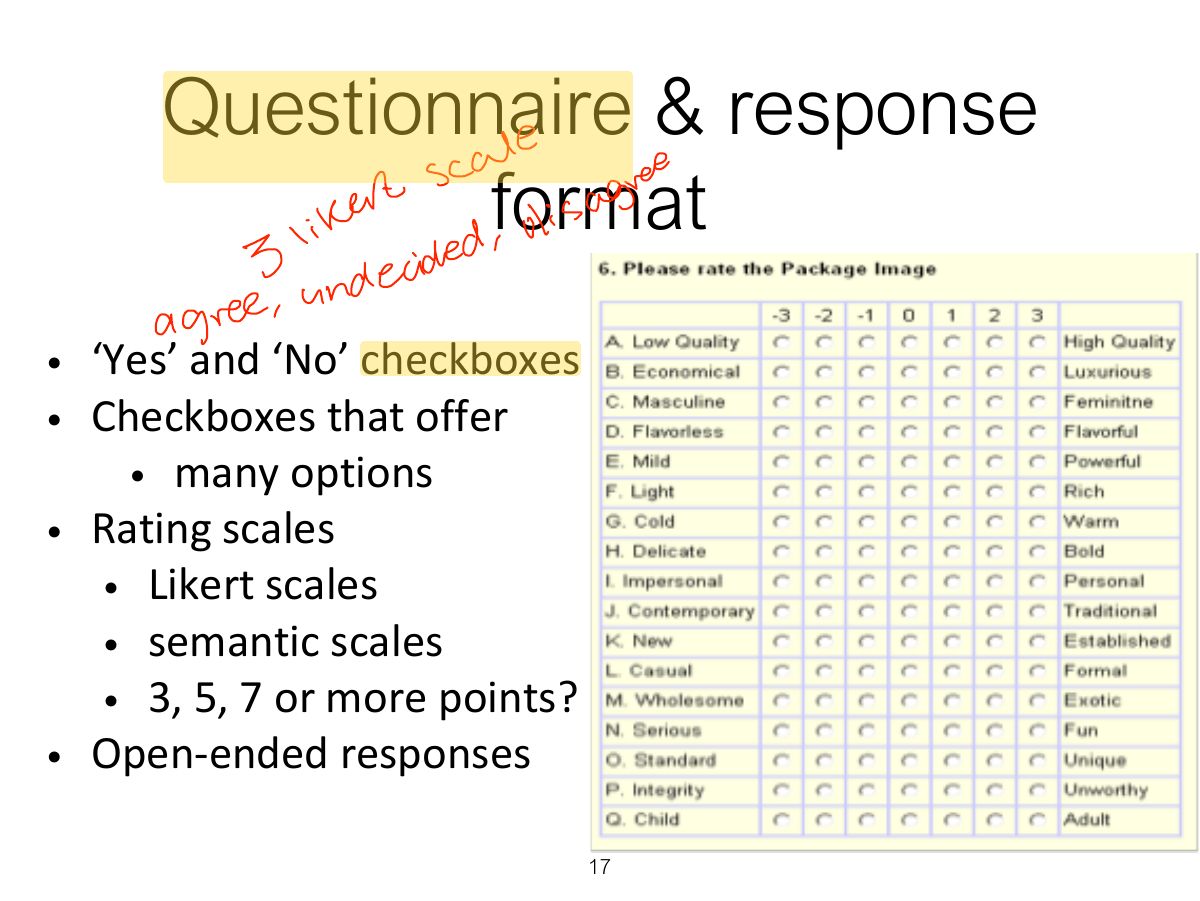
                            Slide 17: Questionnaire & response format
                            Exam weight Low

                              Encouraging a good response

                              • Make sure purpose of study is clear
                              • Promise anonymity
                              • Ensure questionnaire is well designed
                              • Offer a short version for those who do not have time to complete a long questionnaire
                              • If mailed, include a stamped addressed envelope
                              • Follow-up with emails, phone calls, letters
                              • Provide an incentive
                              • 40% response rate is high, 20% is often acceptable
                              18
                              Exam weight Low

                                Example of an online questionnaire

                                19
                                Exam weight Low

                                  Advantages of online questionnaires

                                  • Responses are usually received quickly
                                  • No copying and postage costs
                                  • Data can be collected in database for analysis
                                  • Time required for data analysis is reduced
                                  • Errors can be corrected easily
                                  20
                                  Exam weight Low

                                    Problems with online questionnaires

                                    • Sampling is problematic if population size is unknown
                                    • Preventing individuals from responding more than once
                                    • Individuals have also been known to change questions in email questionnaires
                                    21
                                    Exam weight Low

                                      Data gathering for requirements (cont)

                                      1. Researching similar products:
                                      • Good for prompting requirements
                                      1. Observation:
                                      • the action or process of observing something in order to gain information
                                      22
                                      Exam weight Low
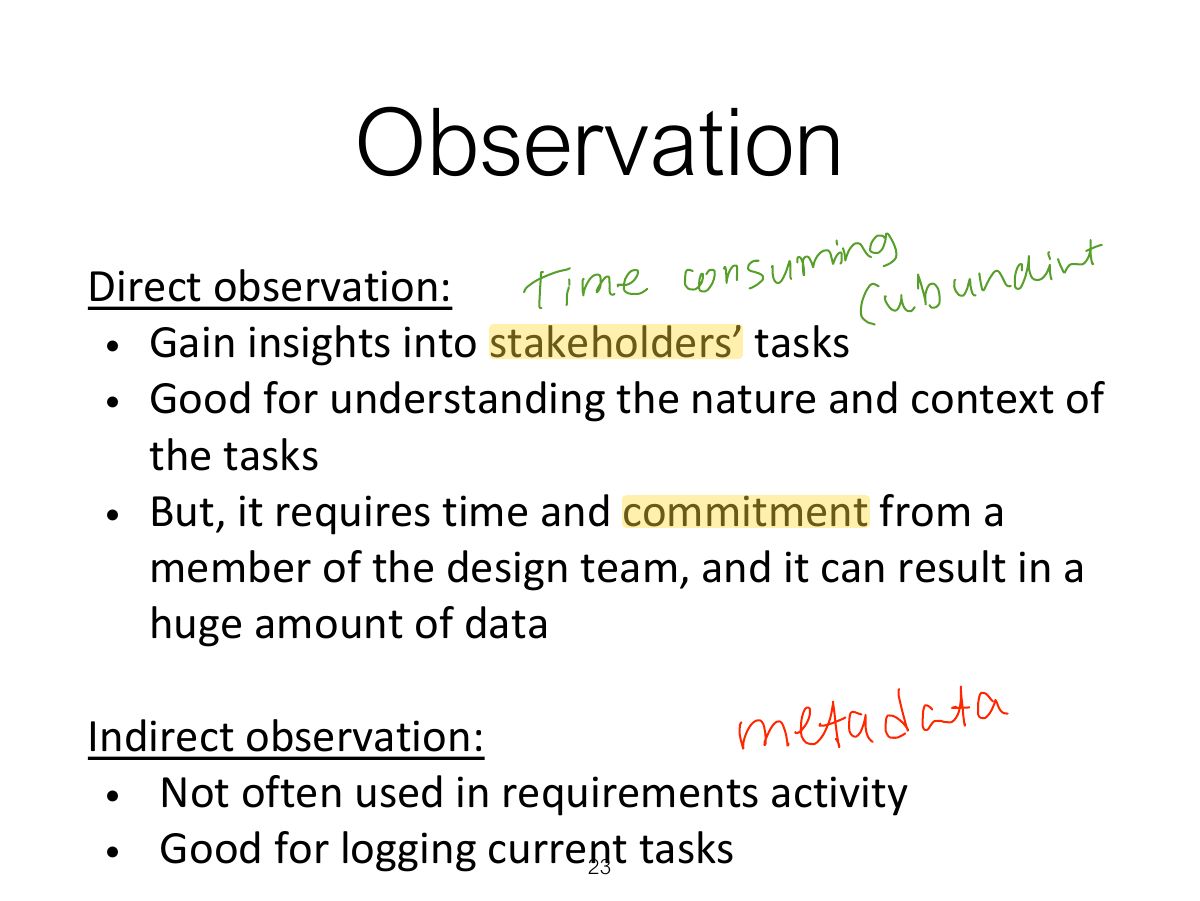
                                        Slide 23: Observation
                                        Exam weight Low
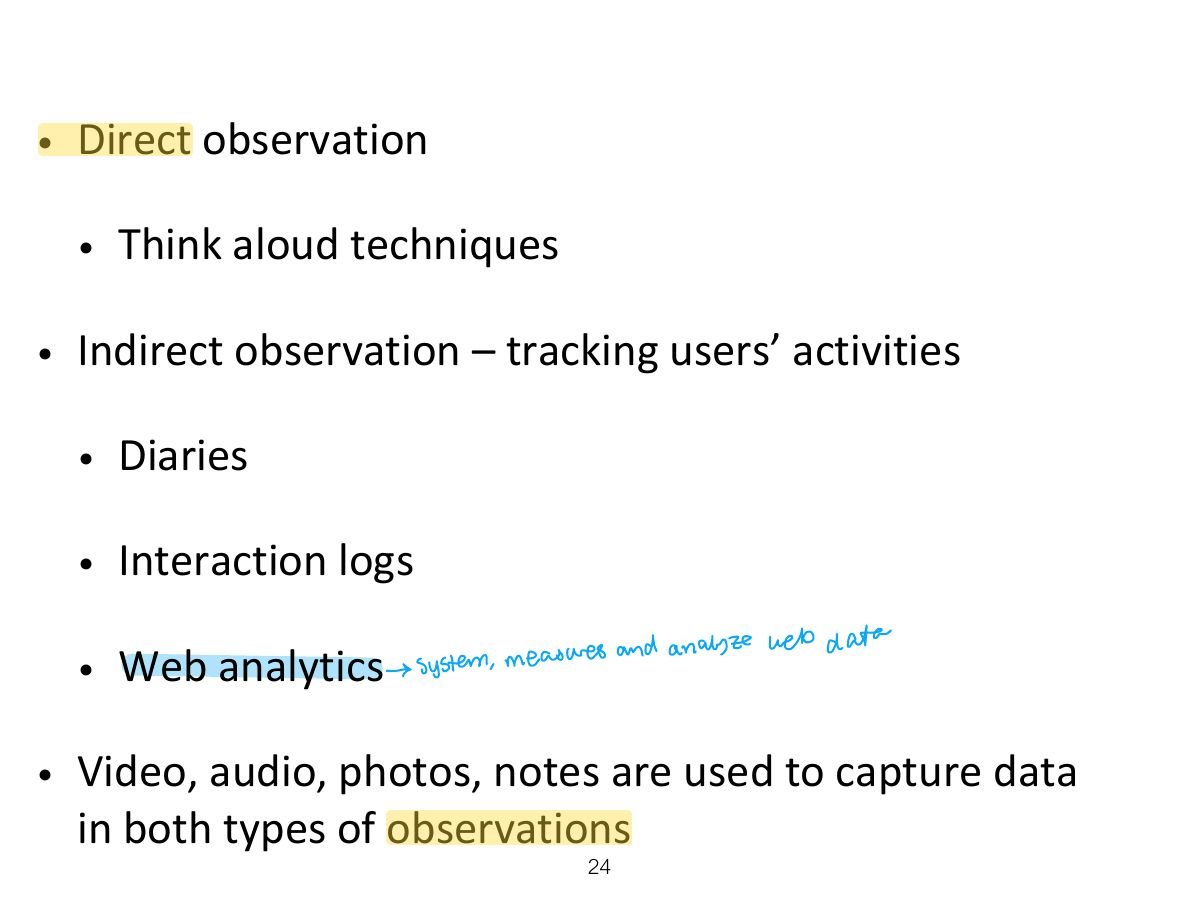
                                        1. Observation: direct (in the field or controlled) or indirect (diaries, logs, web analytics).
                                        Slide 24: • Direct observation
                                        Exam weight Low
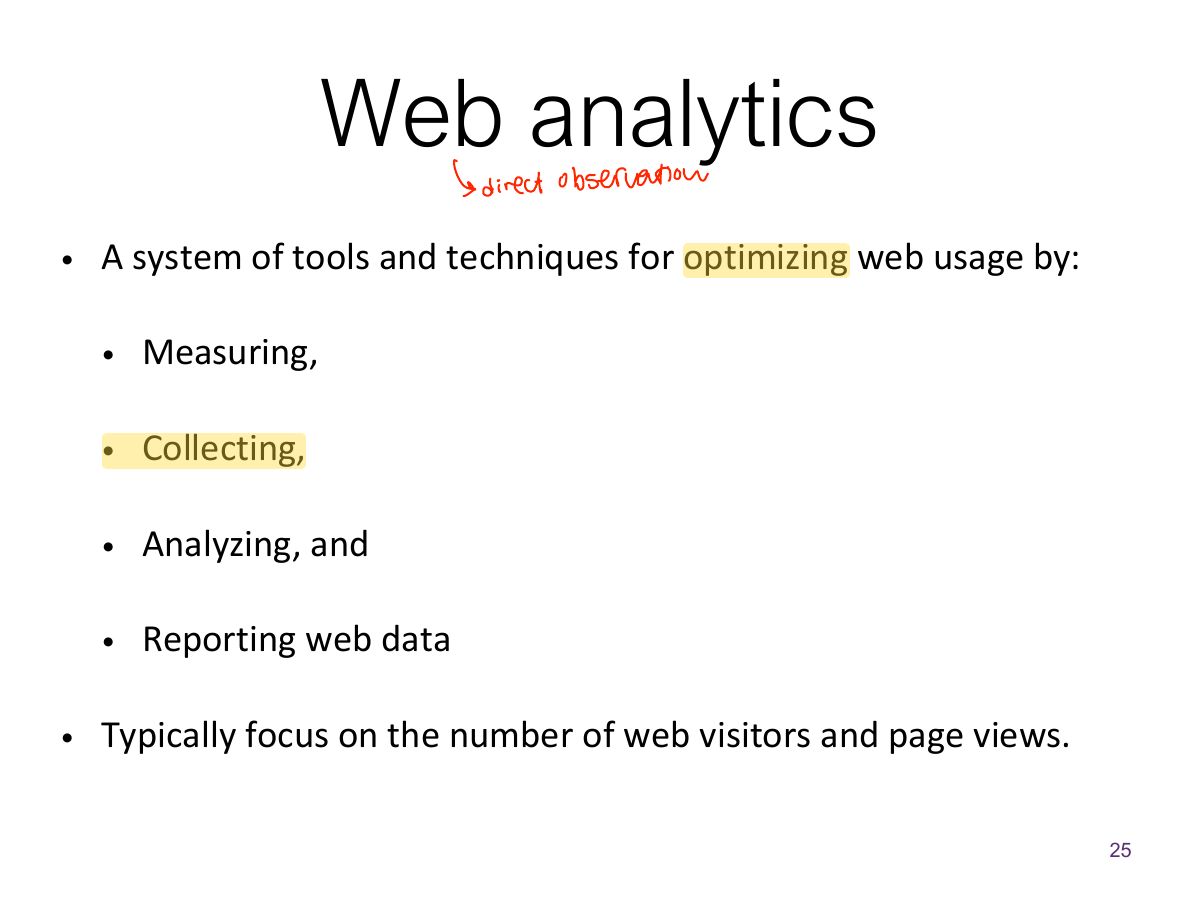
                                          Slide 25: Web analytics
                                          Exam weight Low

                                            26
                                            Exam weight Low
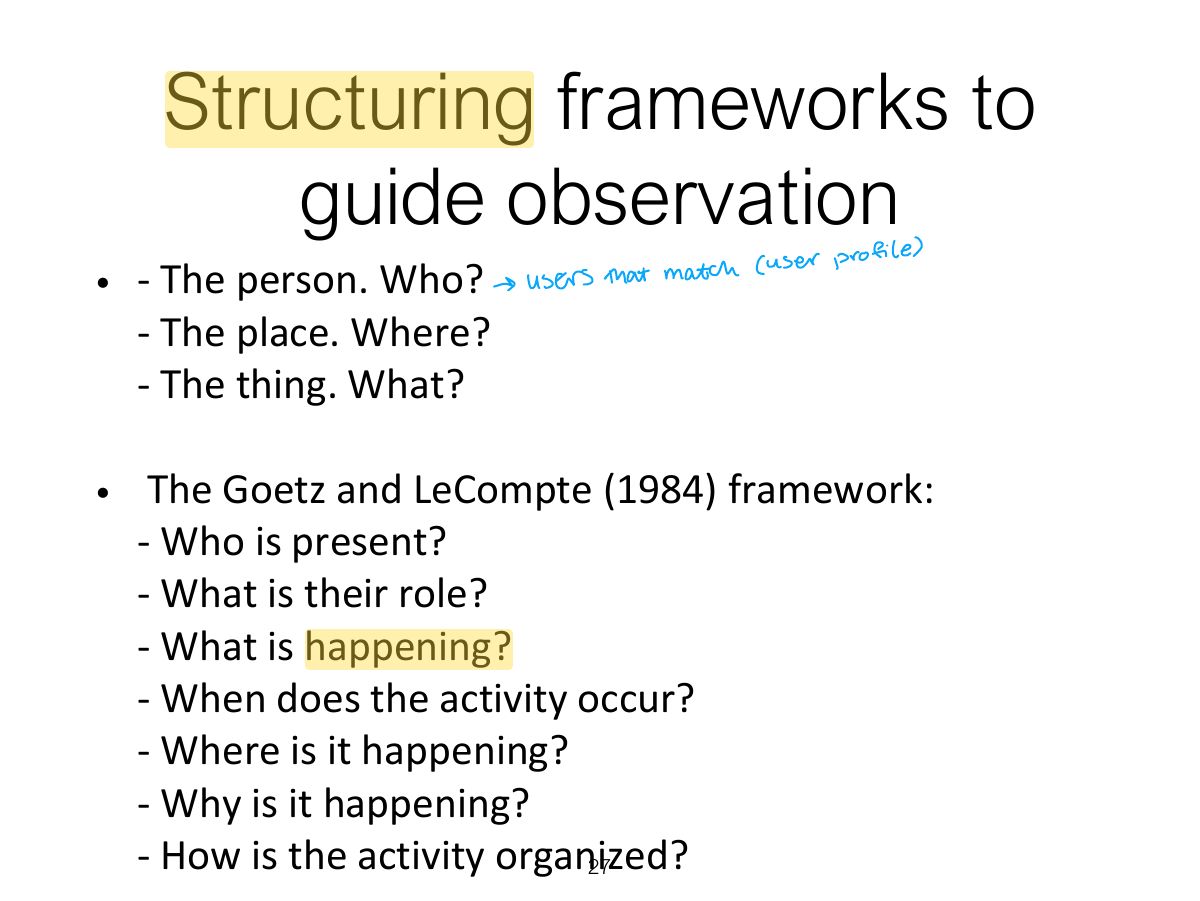
                                              Slide 27: Structuring frameworks to guide observation
                                              Exam weight Low
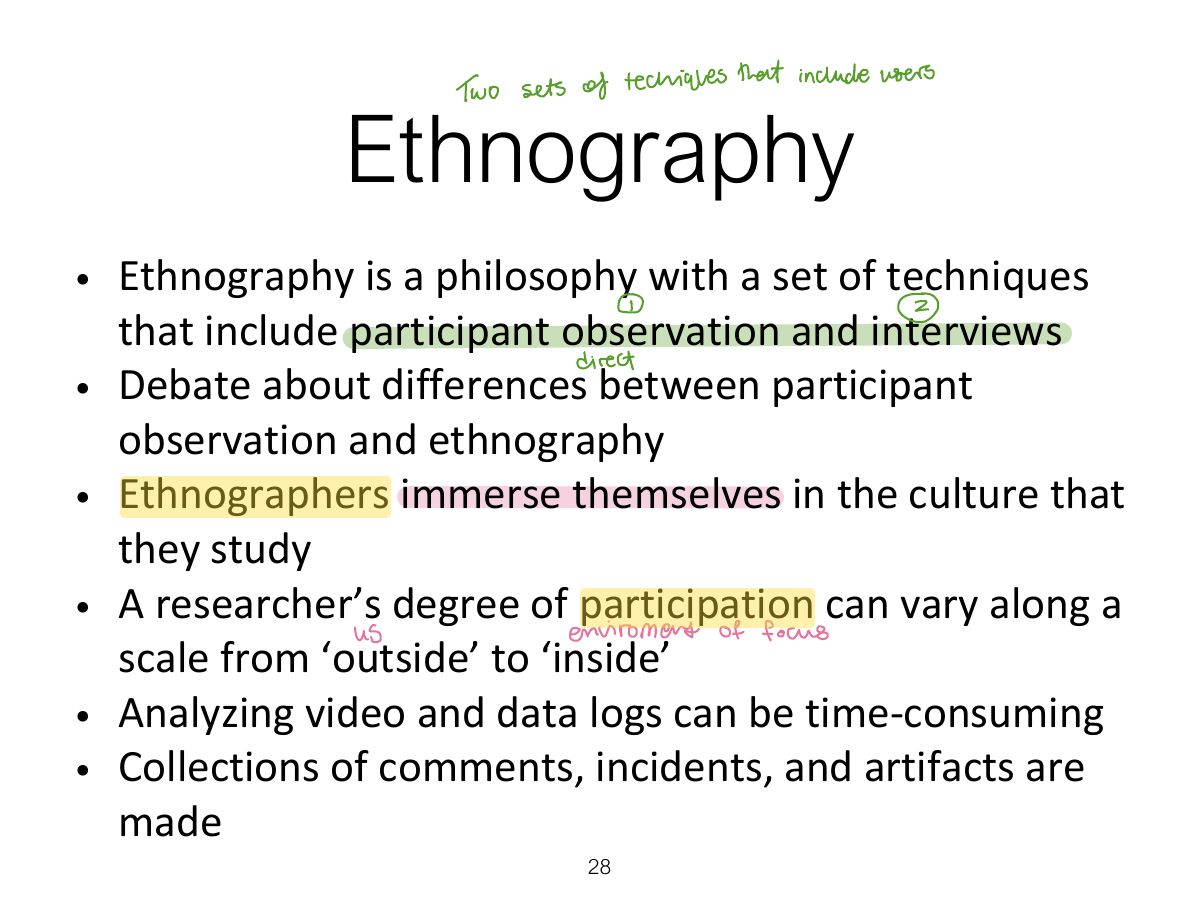
                                                Slide 28: Ethnography
                                                Exam weight Low
                                                1. Ethnography: observing and taking part in a group’s everyday life over time.

                                                Ethnography (cont)

                                                • Co-operation of people being observed is required
                                                • Informants are useful
                                                • Data analysis is continuous
                                                • Interpretivist technique
                                                • Questions get refined as understanding grows
                                                • Reports usually contain examples
                                                29
                                                Exam weight Low

                                                  Ethnography

                                                  30
                                                  Exam weight Low

                                                    Online Ethnography

                                                    • Virtual, Online, Netnography
                                                    • Online and offline activity
                                                    • Interaction online differs from face-to-face
                                                    • Virtual worlds have a persistence that physical worlds do not have
                                                    • Ethical considerations and presentation issues are different
                                                    31
                                                    Exam weight Low

                                                      An Ethnography project for you..

                                                      • Join www.ActiveWorlds.com or go to another chat room of your choice
                                                      • ActiveWorlds is a 3-D chatroom environment in which you can visit different environments and chat with the people that you meet there
                                                      • To use ActiveWorlds you will need to check the instructions that they provide and download the appropriate software to run on your computer
                                                      32
                                                      Exam weight Low

                                                        An Ethnography project for you.. (cont)

                                                        • Select one of the worlds to visit and choose an avatar (a graphical personification) to represent you.
                                                        • Spend one to two hours doing an ethnographic study.
                                                        • Use one of the frameworks discussed in the previous slides to guide you and write a one or two page report about your study.
                                                        • Also notice and report on any usability issues you encounter and on user experiences in this environment.
                                                        33
                                                        Exam weight Low
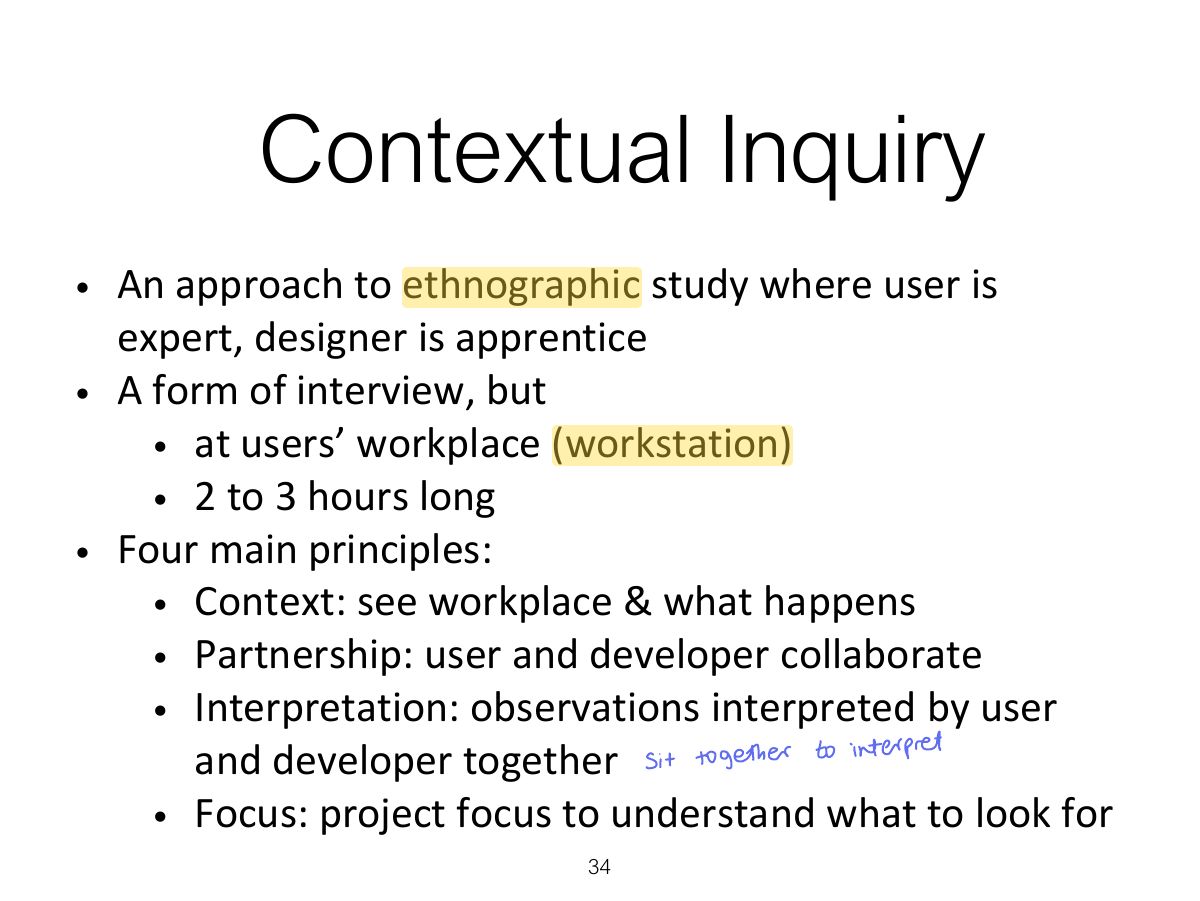
                                                          Slide 34: Contextual Inquiry
                                                          Exam weight Low
                                                          1. Contextual inquiry: interviewing users in their own work environment while they work (master–apprentice).
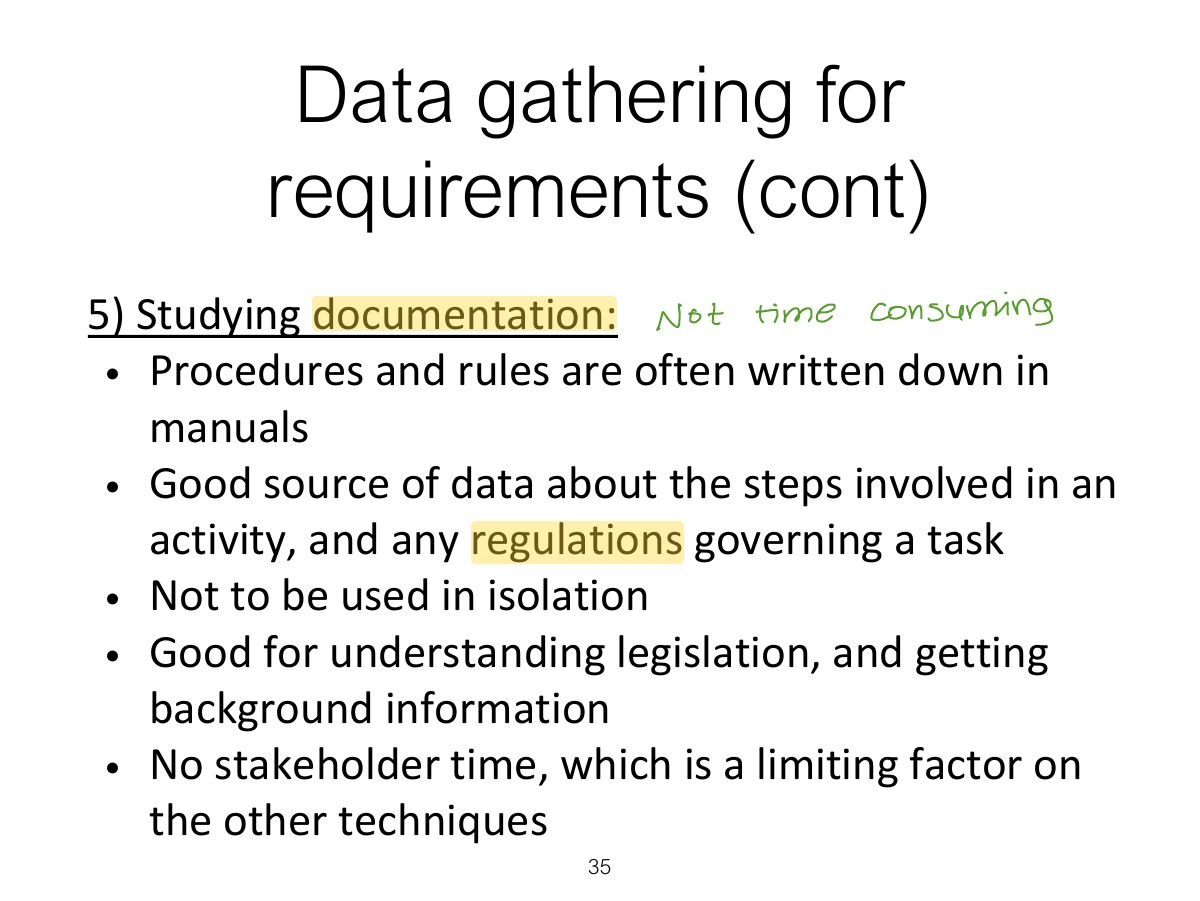
                                                          Slide 35: Data gathering for requirements (cont)
                                                          Exam weight Low
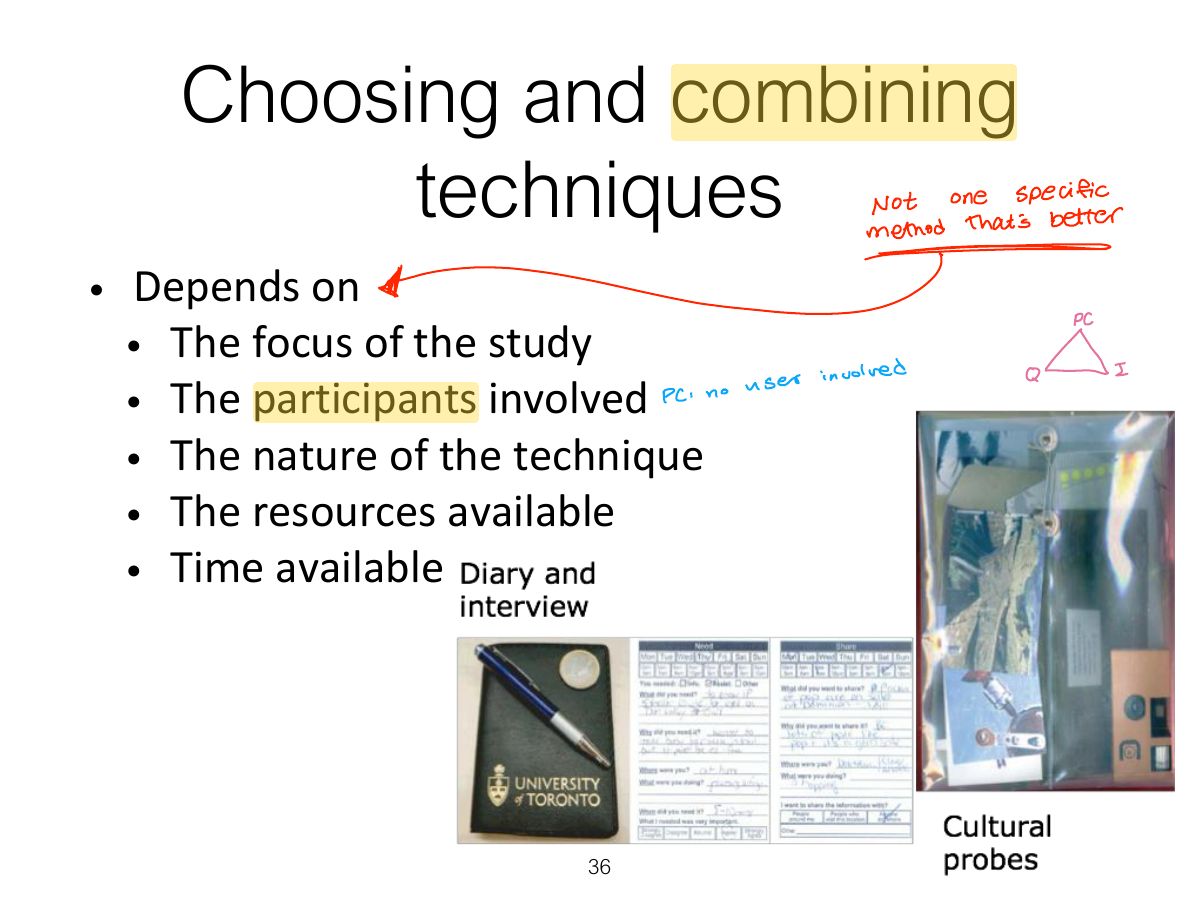
                                                            Slide 36: Choosing and combining techniques
                                                            Exam weight Low

                                                              Summary

                                                              • The observation main data gathering methods: interviews, questionnaires,
                                                              • Five key issues of data gathering: goals, choosing participants, triangulation, participant relationship, pilot
                                                              • Interviews may be structured, semi-structured or unstructured
                                                              • Questionnaires may be on paper, online or telephone
                                                              • Observation may be direct or indirect, in the field or in controlled setting
                                                              • Techniques can be combined depending on study focus, participants, nature of technique and available resources
                                                              37
                                                              Exam weight Low
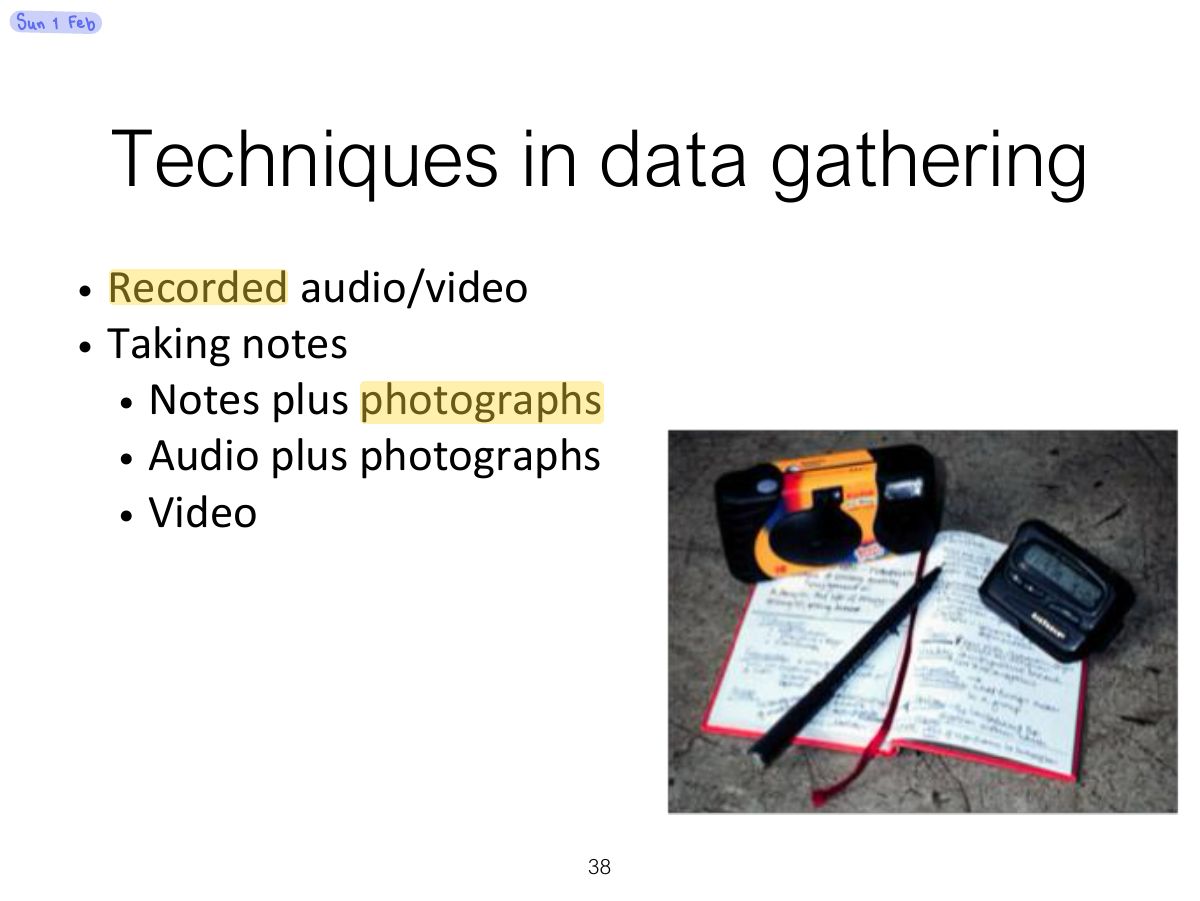
                                                                Slide 38: Techniques in data gathering
                                                                Exam weight Low
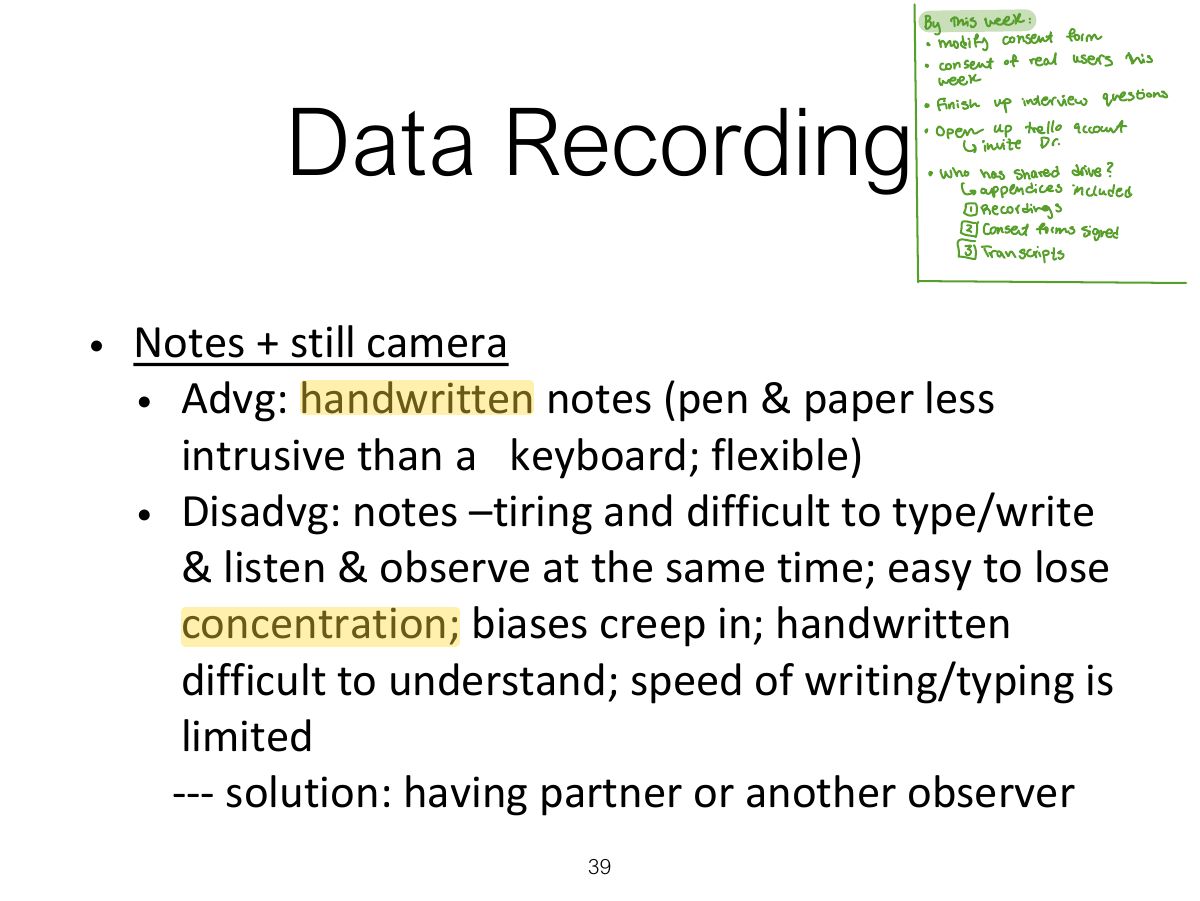
                                                                  Slide 39: Data Recording
                                                                  Exam weight Low
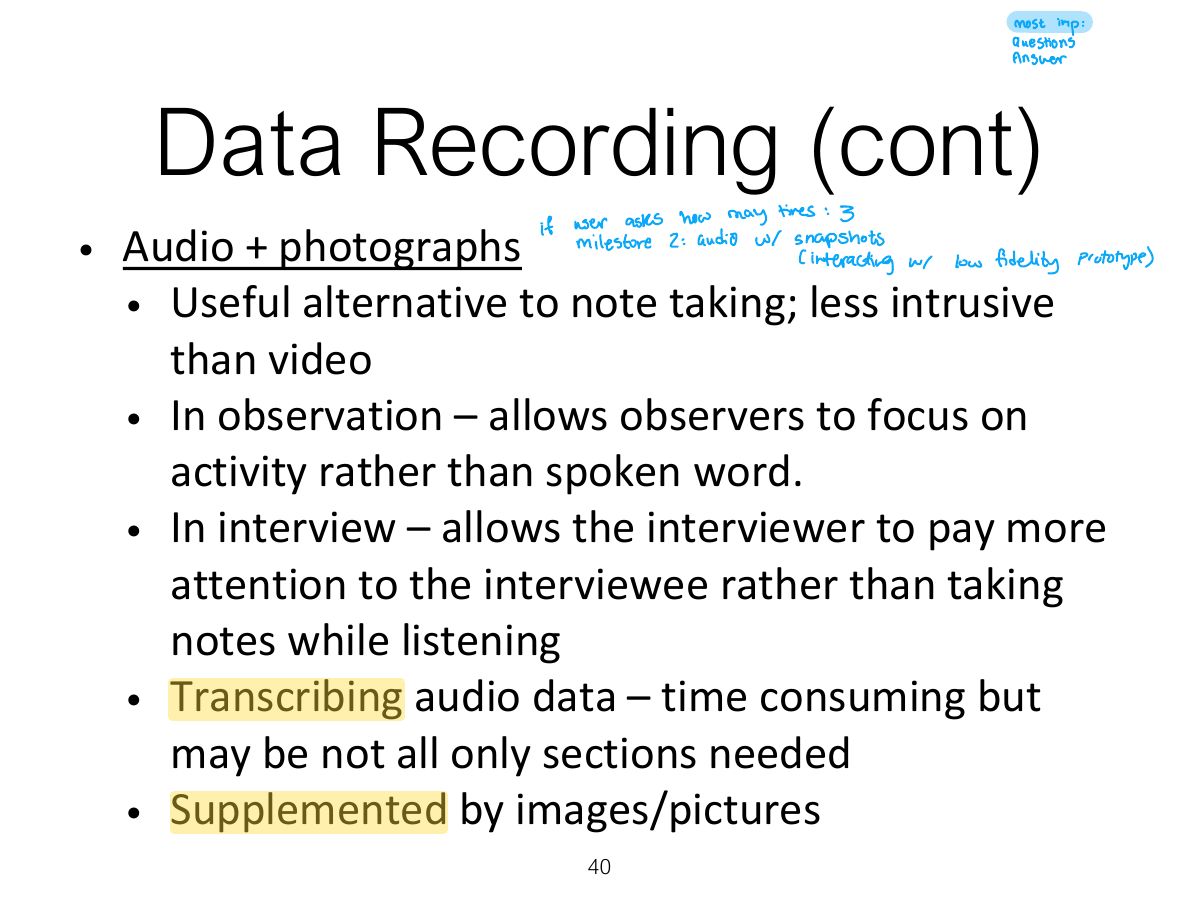
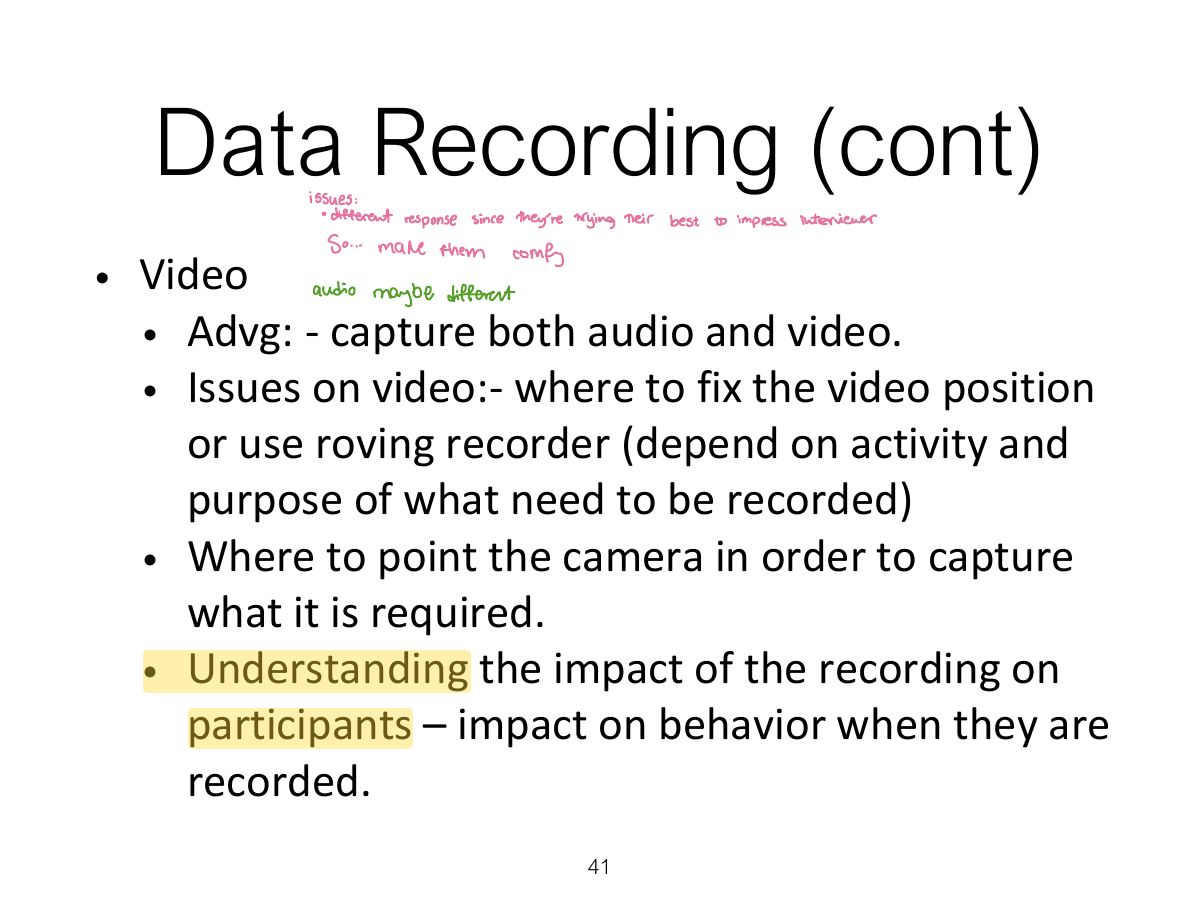
                                                                  1. Recording: notes, audio, video, photographs.
                                                                  Slide 40: Data Recording (cont)
                                                                  Exam weight Low
                                                                    Slide 41: Data Recording (cont)
                                                                    Exam weight Low
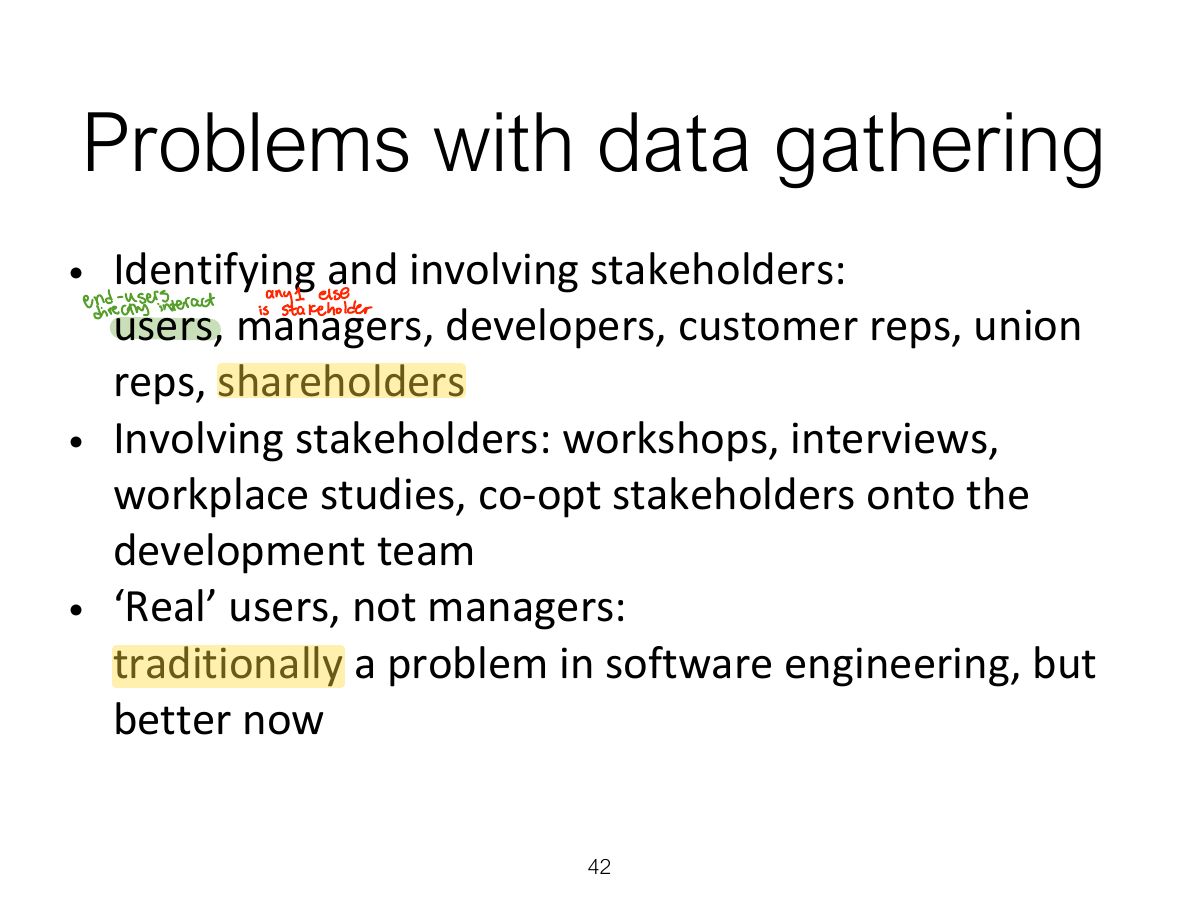
                                                                      Slide 42: Problems with data gathering
                                                                      Exam weight Low
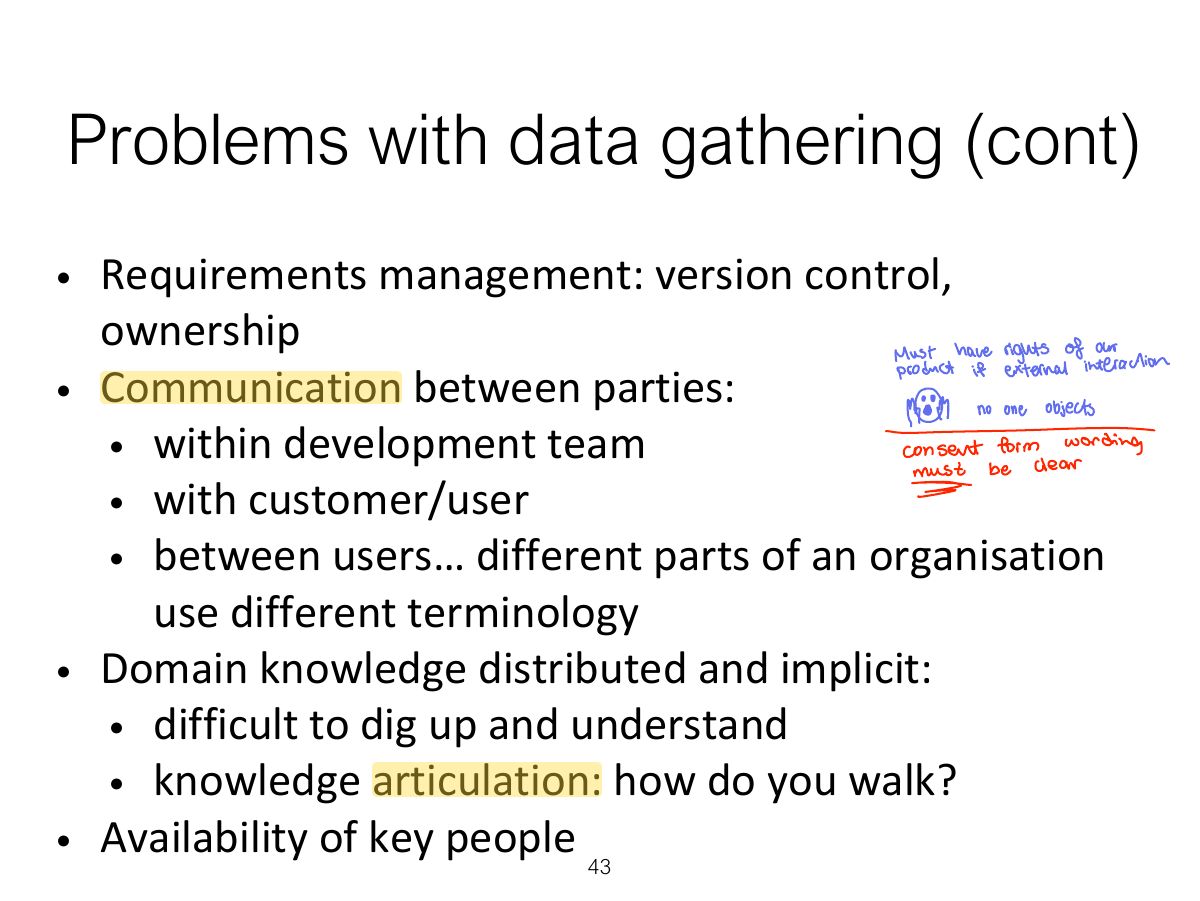
                                                                        Slide 43: Problems with data gathering (cont)
                                                                        Exam weight Low
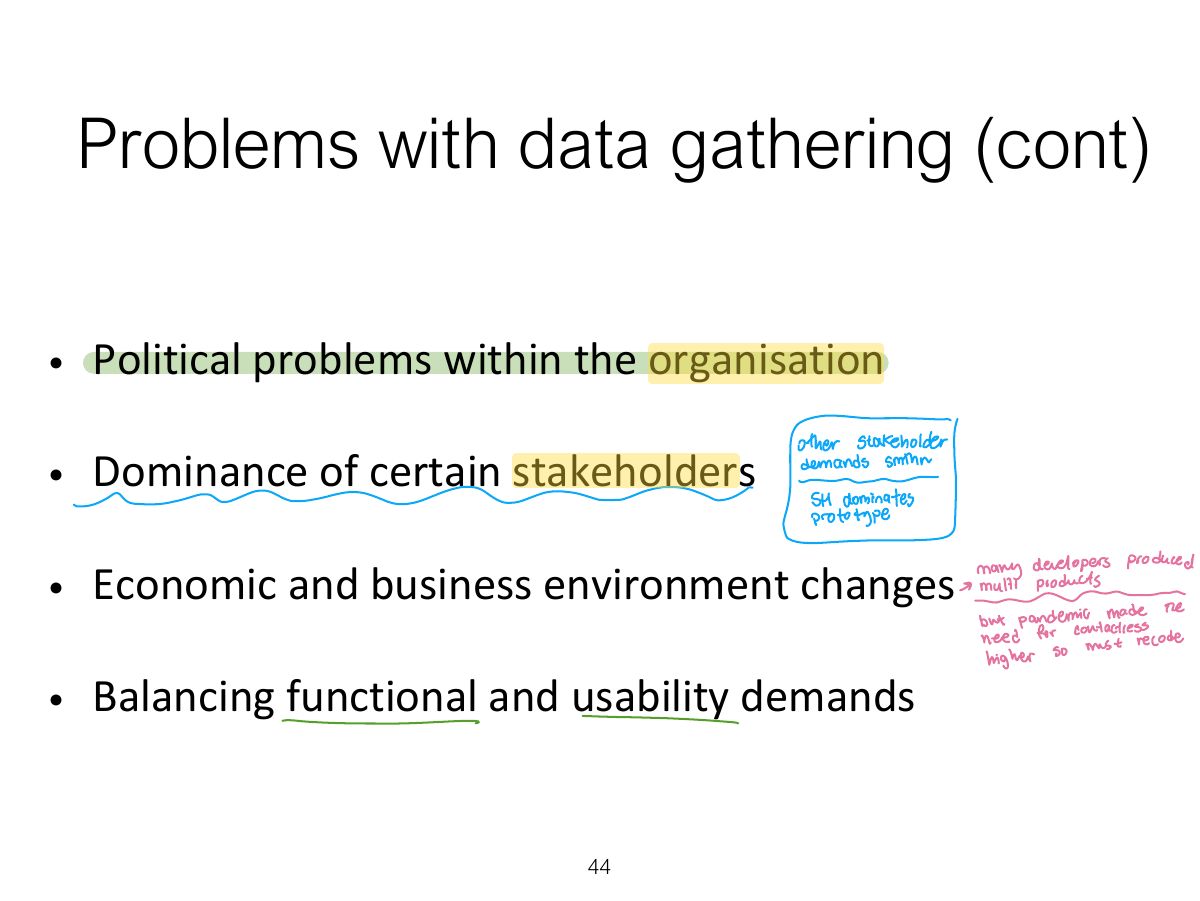
                                                                          Slide 44: Problems with data gathering (cont)
                                                                          Exam weight Low
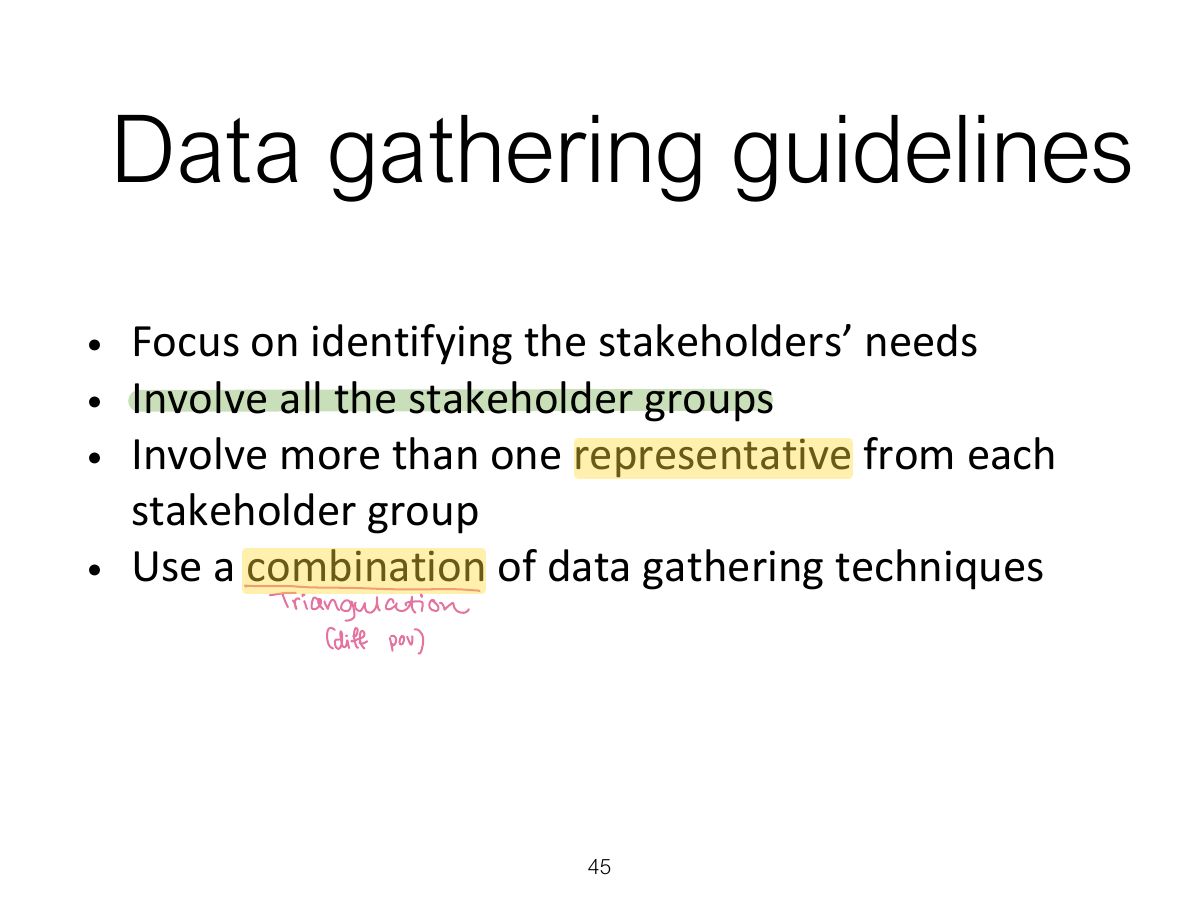
                                                                            Slide 45: Data gathering guidelines
                                                                            Exam weight Low
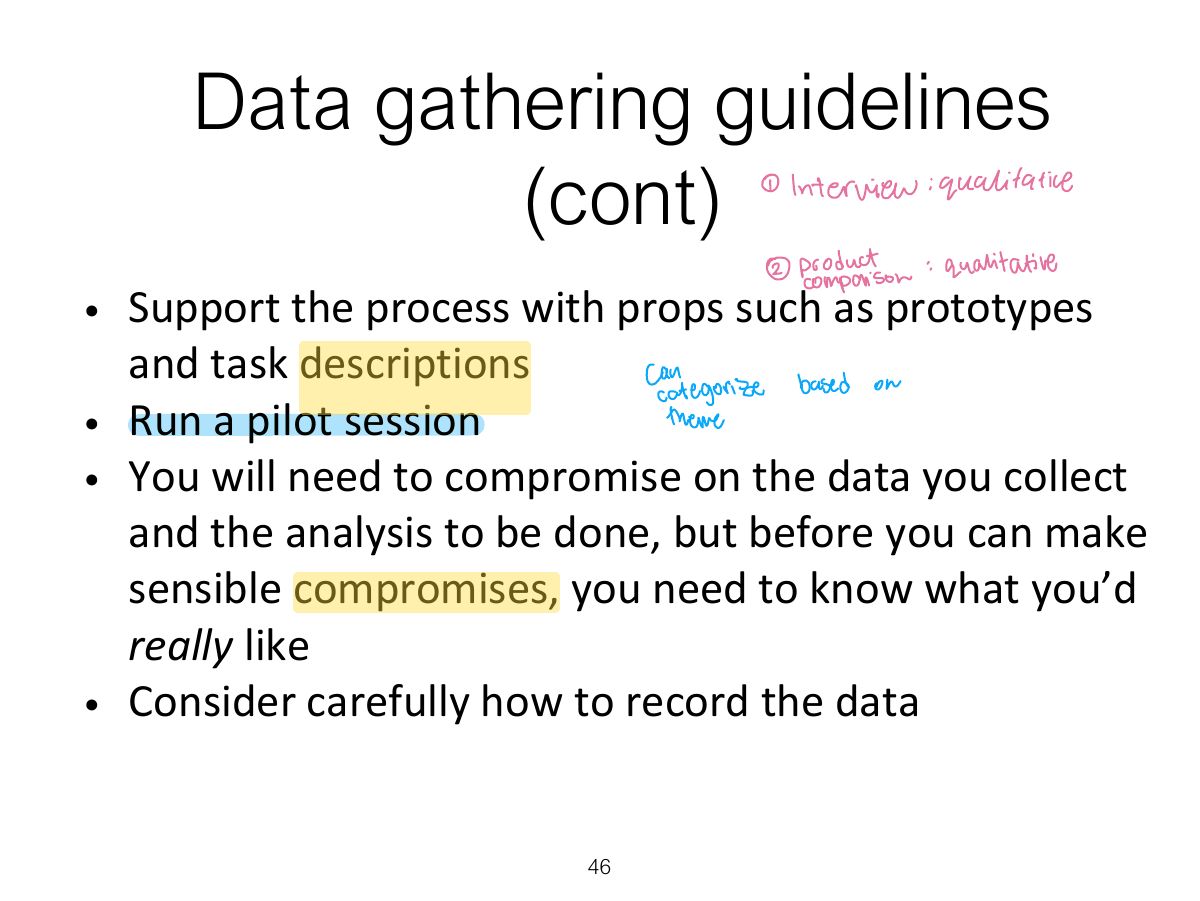
                                                                              Slide 46: Data gathering guidelines (cont)
                                                                              Exam weight Low

                                                                                Establishing requirements

                                                                                • What do users want? What do users ‘need’?
                                                                                  • Requirements need clarification, refinement, completion, re-scoping
                                                                                  • Input: requirements document (maybe)
                                                                                  • Output: stable requirements
                                                                                • Why ‘establish’?
                                                                                  • Requirements arise from understanding users’ needs
                                                                                  • Requirements can be justified & related to data
                                                                                47
                                                                                Exam weight Low

                                                                                  Different kinds of requirements

                                                                                  • Functional:
                                                                                    • What the system should do
                                                                                    • Historically the main focus of requirements activities
                                                                                  • (Non-functional: memory size, response time...)
                                                                                  • Data:
                                                                                    • What kinds of data need to be stored?
                                                                                    • How will they be stored (e.g. database)?
                                                                                  48
                                                                                  Exam weight Low
                                                                                  1. Kinds of requirements: functional, data, environment/context (physical, social, organizational, technical), user characteristics, usability and UX goals.
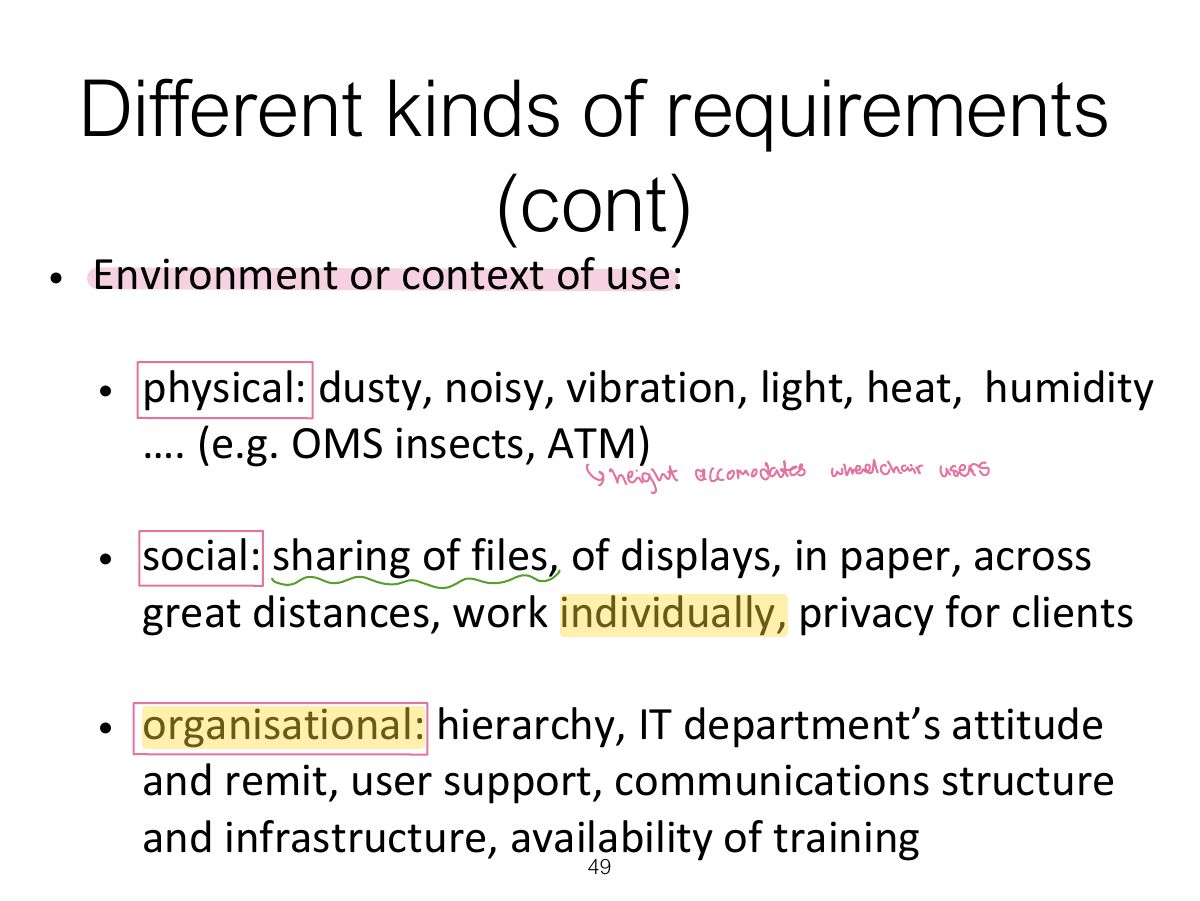
                                                                                  Slide 49: Different kinds of requirements (cont)
                                                                                  Exam weight Low
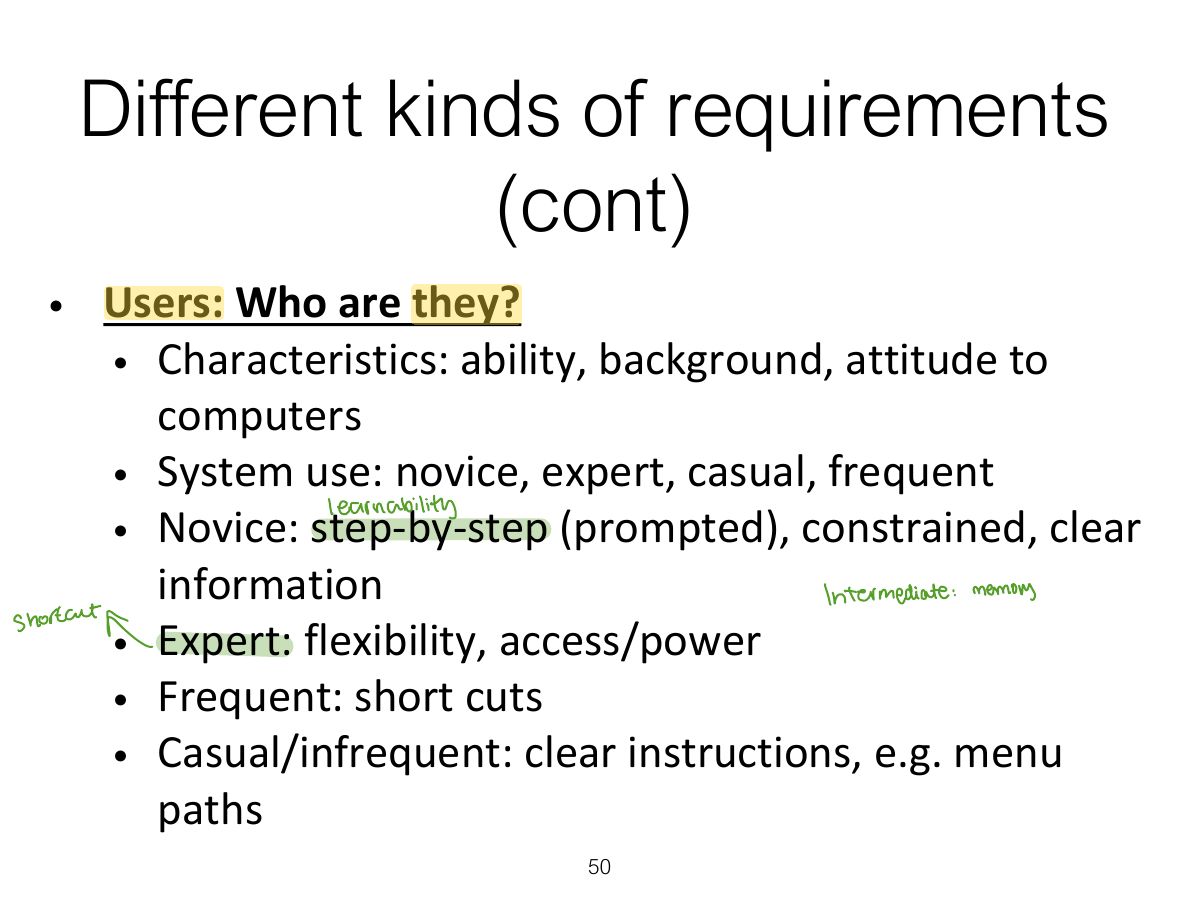
                                                                                    Slide 50: Different kinds of requirements (cont)
                                                                                    Exam weight Low
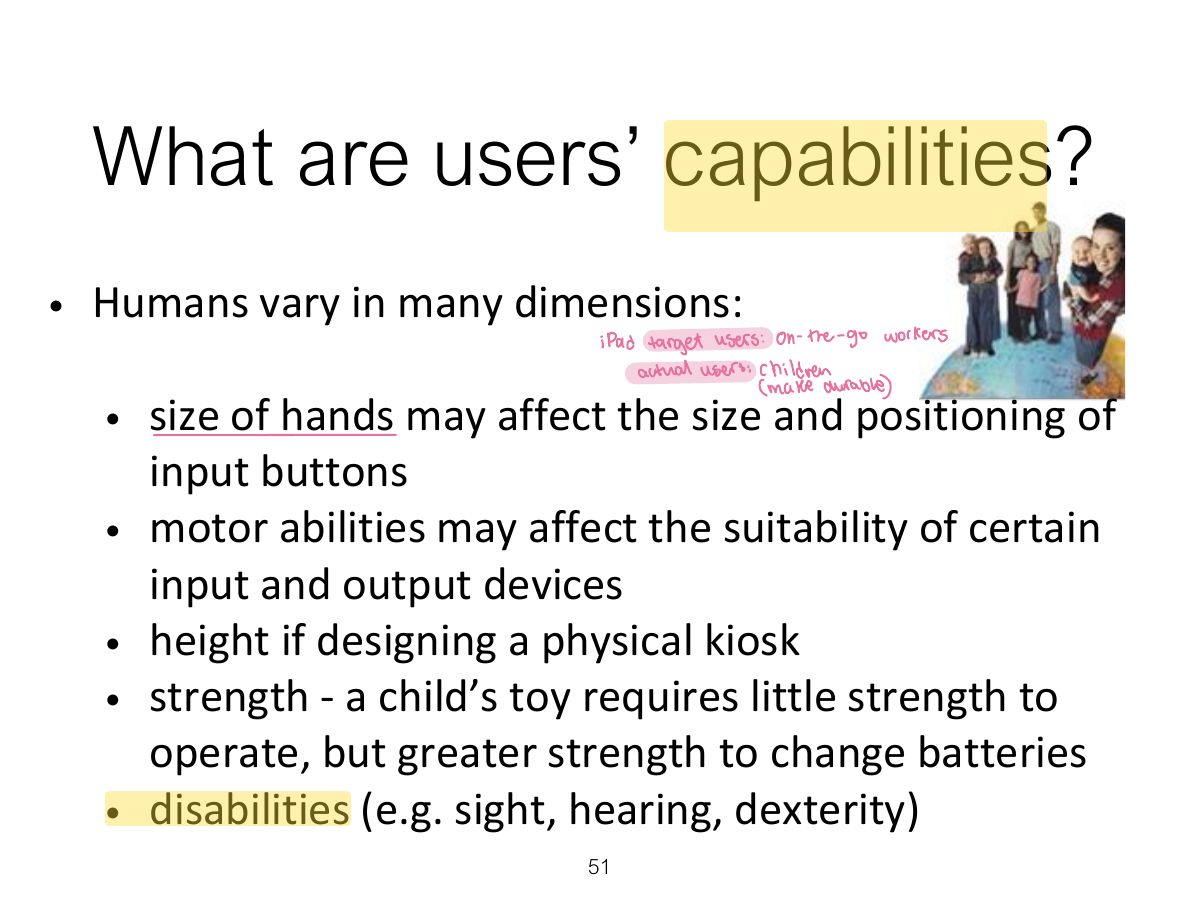
                                                                                      Slide 51: What are users’ capabilities?
                                                                                      Exam weight Low

                                                                                        Kinds of requirements

                                                                                        • What factors (environmental, user, usability) would affect the following systems?
                                                                                        • Self-service filling and payment system for a petrol (gas) station
                                                                                        • On-board ship data analysis system for geologists searching for oil
                                                                                        • Fashion clothes website
                                                                                        52
                                                                                        Exam weight Low
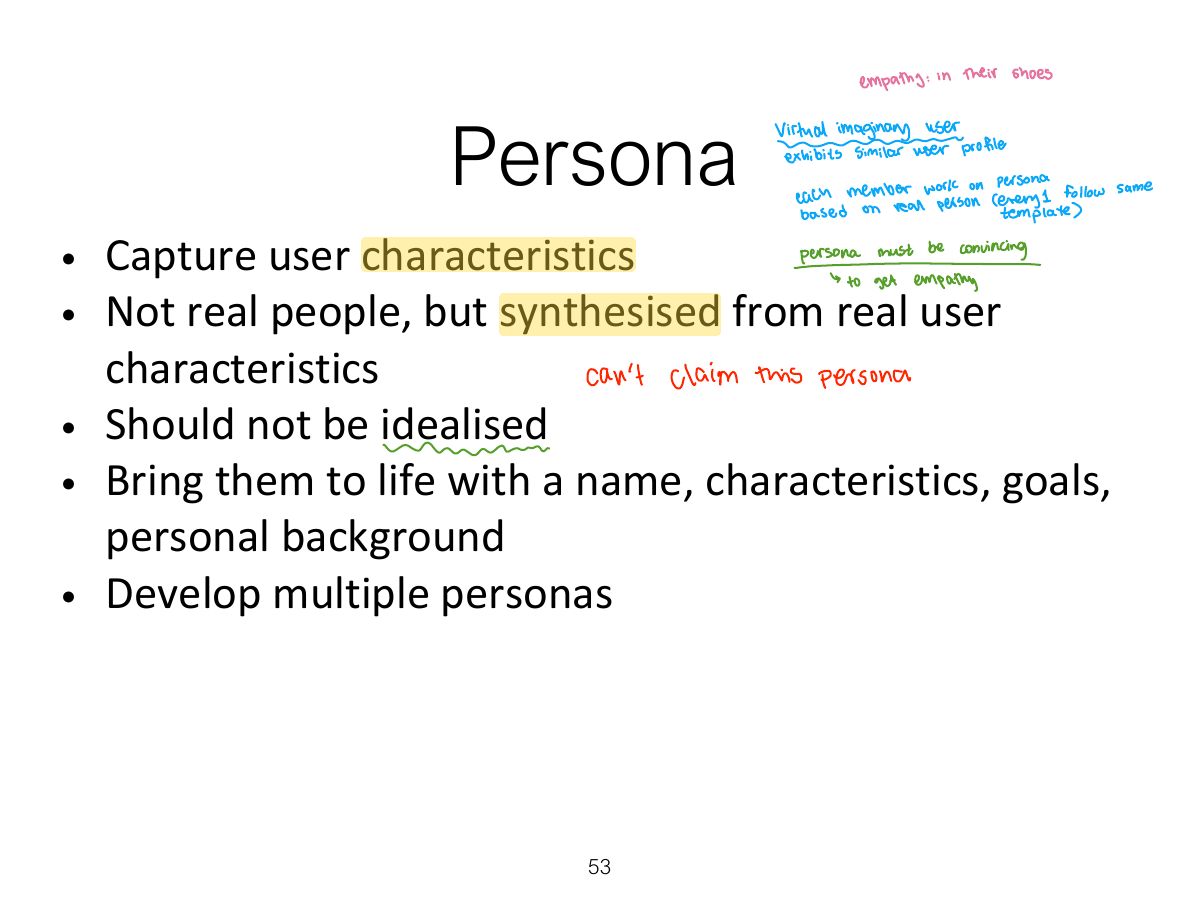
                                                                                          Slide 53: Persona
                                                                                          Exam weight High
                                                                                          1. Persona: a rich, fictional but realistic description of a typical user, built from research data.
                                                                                          🎯 How this can come up · 1 question
                                                                                          MCQ

                                                                                          A fictional, data-based description of a typical user with a name and goals is a:

                                                                                          Persona

                                                                                          54
                                                                                          Exam weight Low
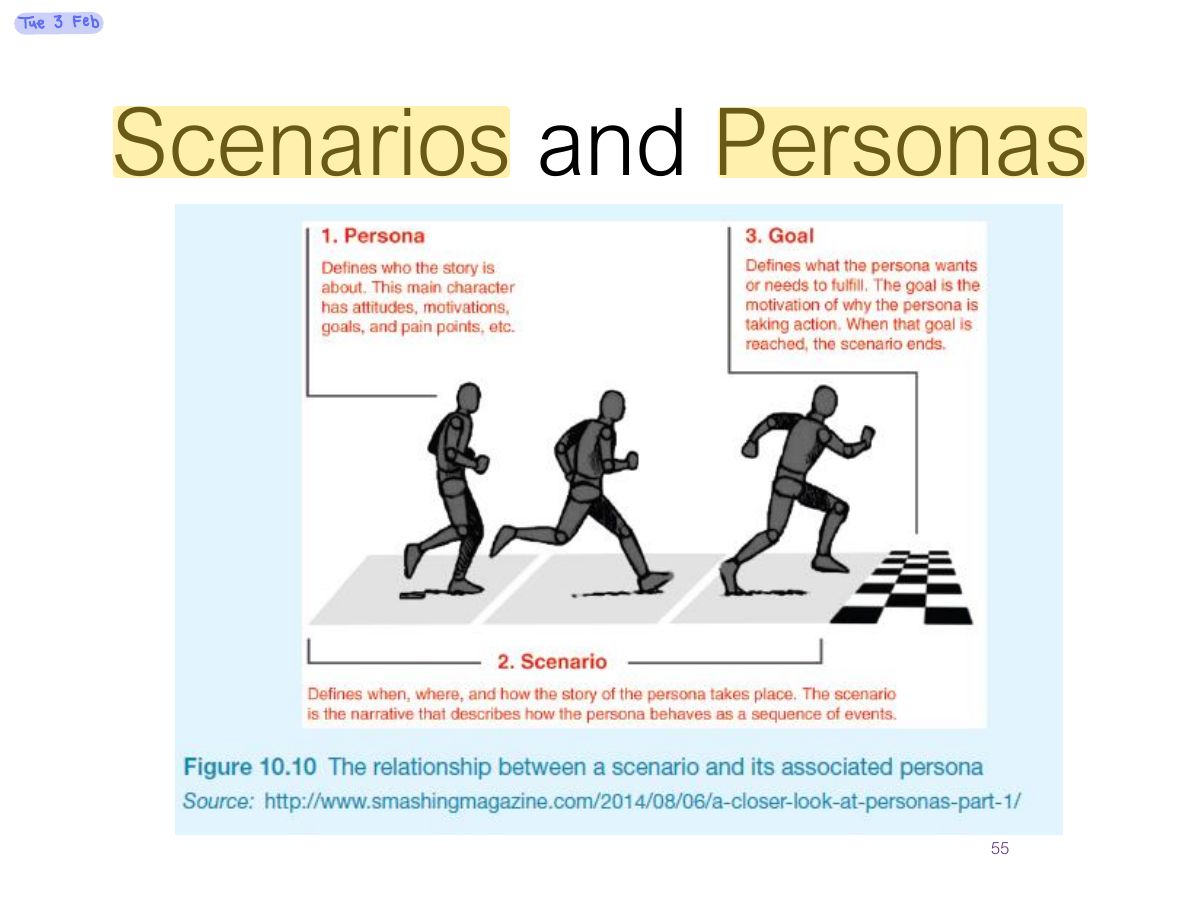
                                                                                            Slide 55: Scenarios and Personas
                                                                                            Exam weight Low

                                                                                              Task descriptions

                                                                                              Scenarios

                                                                                              an informal narrative story, simple, ‘natural’, personal, not generalisable

                                                                                              Use cases

                                                                                              assume interaction with a system assume detailed understanding of the interaction

                                                                                              Essential use cases

                                                                                              abstract away from the details does not have the same assumptions as use cases

                                                                                              56
                                                                                              Exam weight Low

                                                                                                Scenario

                                                                                                “The Thomson family enjoy outdoor activities and want to try their hand at sailing this year. There are four family members: Sky (10 years old), Eamonn (15 years old), Claire (35), and Will (40). One evening after dinner they decide to start exploring the possibilities. They all gather around the travel organizer and enter their initial set of requirements – a sailing trip for four novices in the Mediterranean. The console is designed so that all members of the family can interact easily and comfortably with it. The system’s initial suggestion is a flotilla, where several crews (with various levels of experience) sail together on separate boats. Sky and Eamonn aren’t very happy at the idea of going on vacation with a group of other people, even though the Thomsons would have their own boat. The travel organizer shows them descriptions of flotillas from other children their ages and they are all very positive, so eventually, everyone agrees to explore flotilla opportunities. Will confirms this recommendation and asks for detailed options. As it’s getting late, he asks for the details to be printed so everyone can consider them tomorrow. The travel organizer prints out a summary of the different options available.”

                                                                                                57
                                                                                                Exam weight Low
                                                                                                1. Scenario: an informal narrative story about how people use a product to carry out a task.
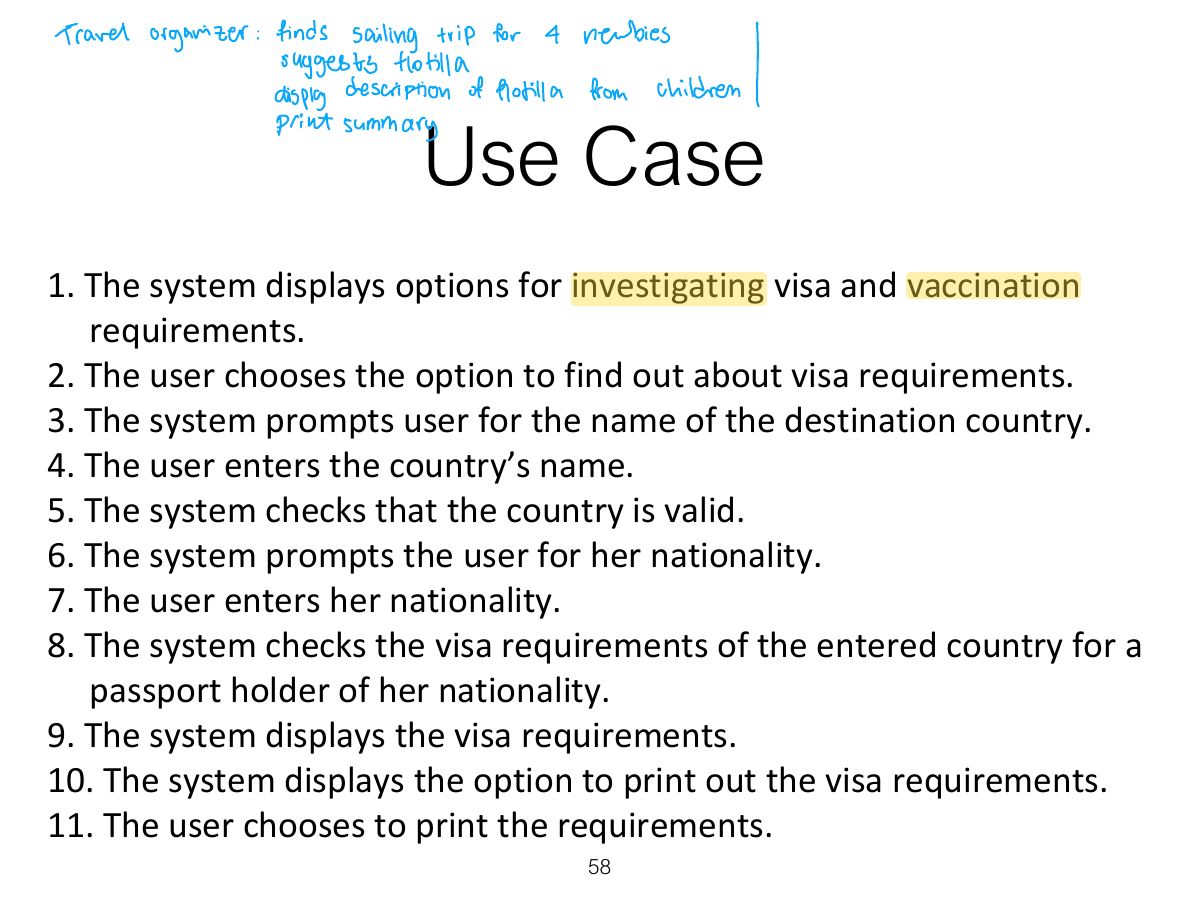
                                                                                                Slide 58: Use Case
                                                                                                Exam weight Low
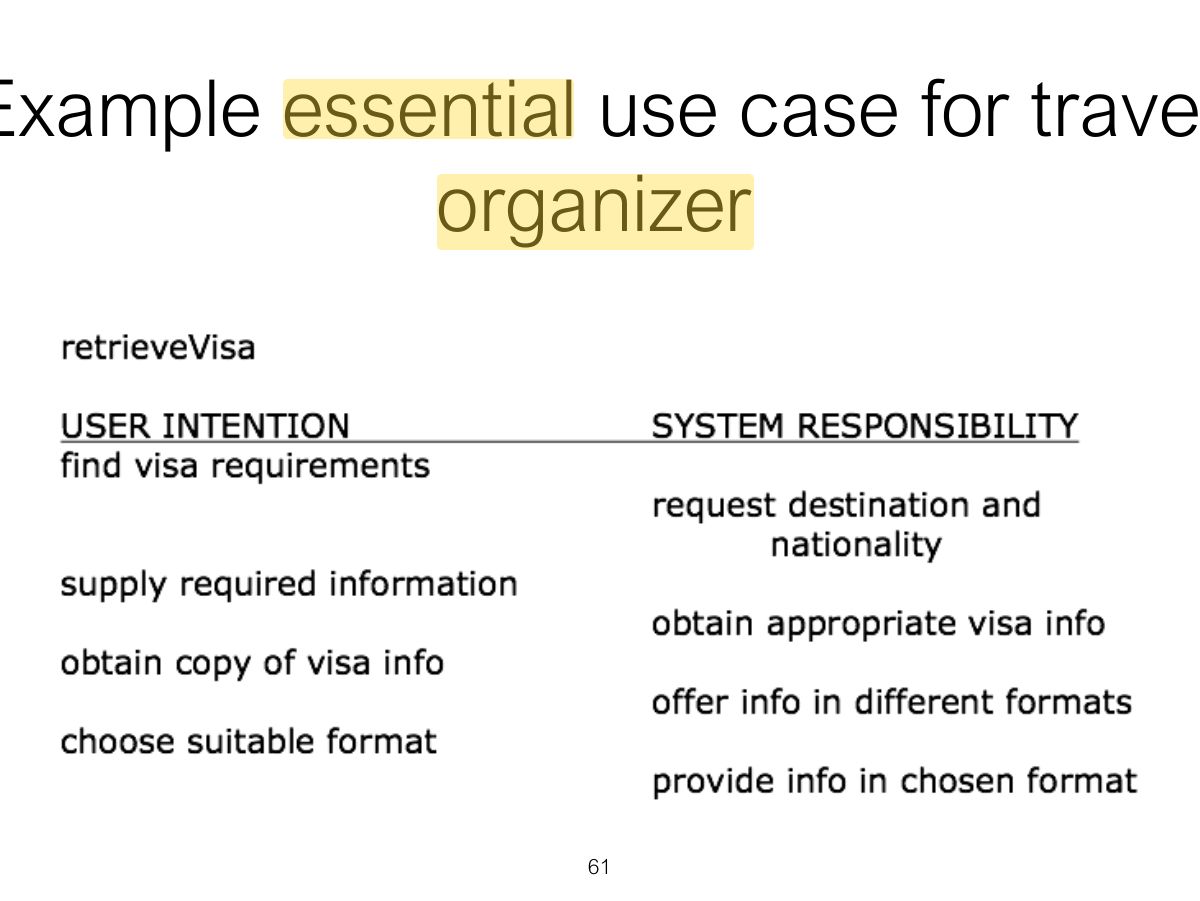
                                                                                                1. Use case: actor–system interaction for one goal; essential use case: abstract user intention vs. system responsibility.

                                                                                                Alternative courses for travel organizer

                                                                                                Some alternative courses:

                                                                                                1. If the country name is invalid:

                                                                                                6.1 The system displays an error message.

                                                                                                6.2 The system returns to step 3.

                                                                                                1. If the nationality is invalid:

                                                                                                8.1 The system displays an error message.

                                                                                                8.2 The system returns to step 6.

                                                                                                1. If no information about visa requirements is found:

                                                                                                9.1 The system displays a suitable message.

                                                                                                9.2 The system returns to step 1.

                                                                                                59
                                                                                                Exam weight Low

                                                                                                  Example use case diagram for travel organizer

                                                                                                  60
                                                                                                  Exam weight Low
                                                                                                    Slide 61: Example essential use case for travel organizer
                                                                                                    Exam weight Low

                                                                                                      Task Analysis

                                                                                                      • Task descriptions are often used to envision new systems or devices
                                                                                                      • Task analysis is used mainly to investigate an existing situation
                                                                                                      • It is important not to focus on superficial activities
                                                                                                        • What are people trying to achieve?
                                                                                                        • Why are they trying to achieve it?
                                                                                                        • How are they going about it?
                                                                                                      • Many techniques, the most popular is Hierarchical Task Analysis (HTA)
                                                                                                      62
                                                                                                      Exam weight Low

                                                                                                        Hierarchical Task Analysis

                                                                                                        • Involves breaking a task down into subtasks, then sub-sub-tasks and so on. These are grouped as plans which specify how the tasks might be performed in practice
                                                                                                        • HTA focuses on physical and observable actions, and includes looking at actions not related to software or an interaction device
                                                                                                        • Start with a user goal which is examined and the main tasks for achieving it are identified
                                                                                                        • Tasks are sub-divided into sub-tasks
                                                                                                        63
                                                                                                        Exam weight High
                                                                                                        1. Hierarchical task analysis (HTA): break a task into subtasks and plans (in what order).
                                                                                                        🎯 How this can come up · 1 question
                                                                                                        MCQ

                                                                                                        Breaking "borrow a book" into numbered subtasks with plans is:

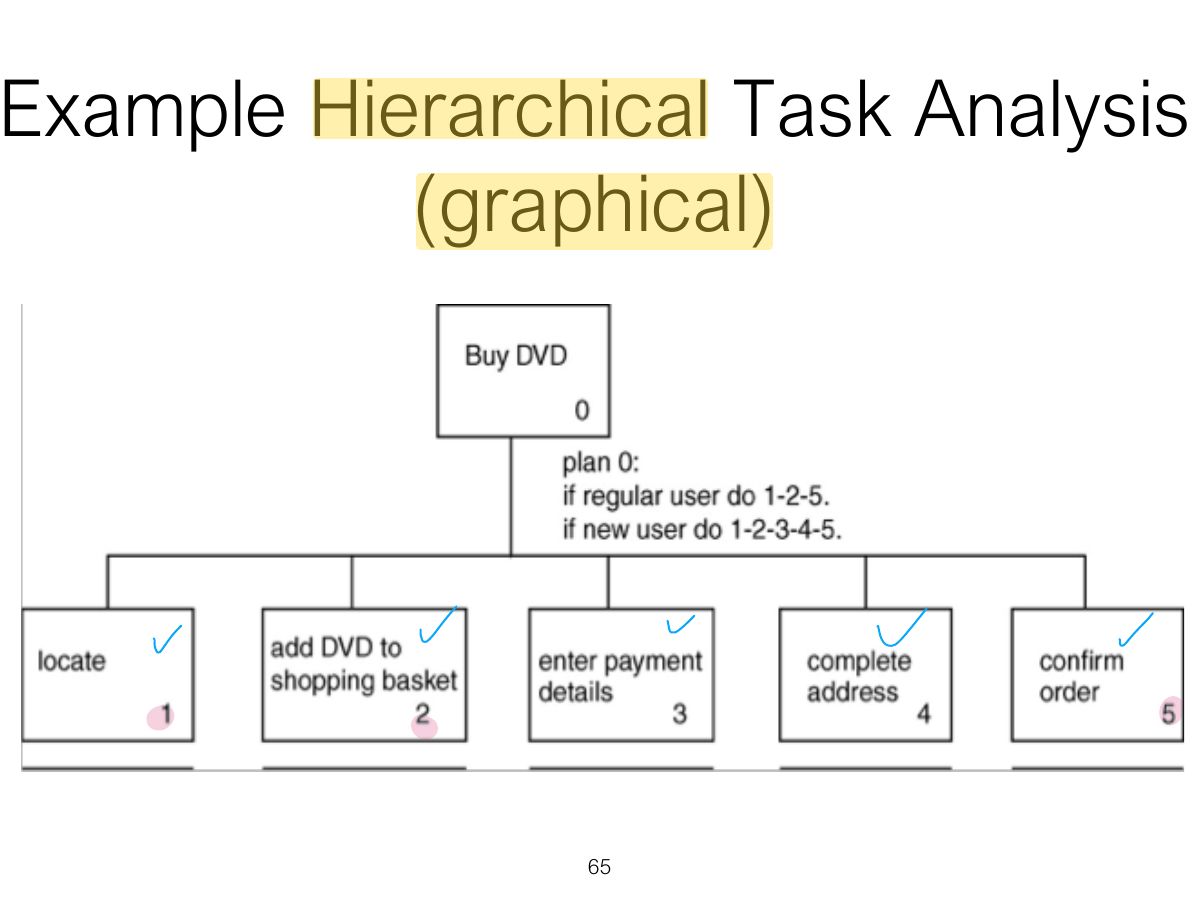
                                                                                                        Example Hierarchical Task Analysis

                                                                                                        1. In order to buy a DVD
                                                                                                        2. locate DVD
                                                                                                        3. add DVD to shopping basket
                                                                                                        4. enter payment details
                                                                                                        5. complete address
                                                                                                        6. confirm order plan 0: If regular user do 1-2-5. If new user do 1-2-3-4-5.
                                                                                                        64
                                                                                                        Exam weight Low
                                                                                                          Slide 65: Example Hierarchical Task Analysis (graphical)
                                                                                                          Exam weight Low

                                                                                                            Summary

                                                                                                            • Getting requirements right is crucial
                                                                                                            • There are different kinds of requirement, each is significant for interaction design
                                                                                                            • The most commonly-used techniques for data gathering are: questionnaires, interviews, focus groups, direct observation, studying documentation and researching similar products
                                                                                                            • Scenarios, use cases and essential use cases can be used to articulate existing and envisioned work practices.
                                                                                                            • Task analysis techniques such as HTA help to investigate existing systems and practices
                                                                                                            66
                                                                                                            Exam weight Low
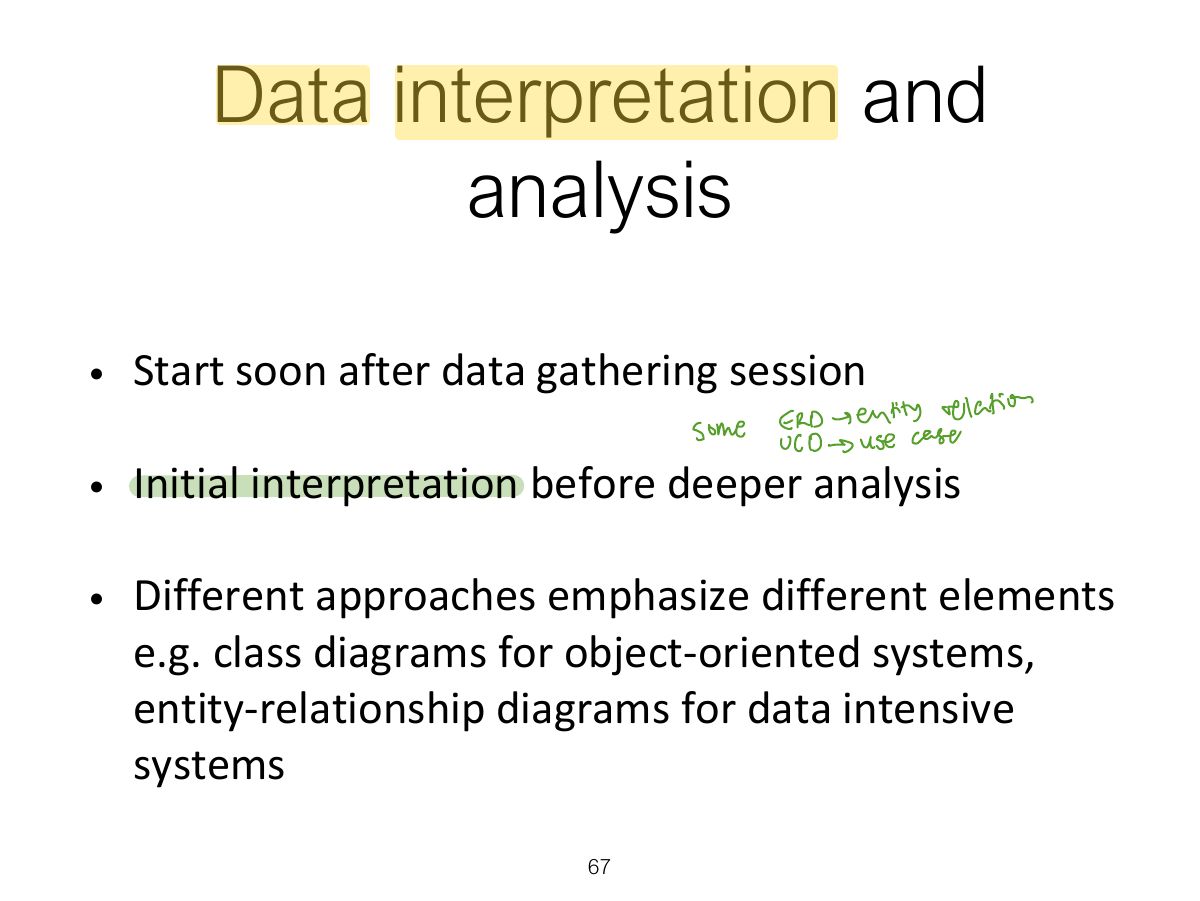
                                                                                                              Slide 67: Data interpretation and analysis
                                                                                                              Exam weight Low

                                                                                                                Quantitative and Qualitative

                                                                                                                • Quantitative data – expressed as numbers
                                                                                                                • Qualitative data – difficult to measure sensibly as numbers, e.g. count number of words to measure dissatisfaction
                                                                                                                • Quantitative analysis – numerical methods to ascertain size, magnitude, amount
                                                                                                                • Qualitative analysis – expresses the nature of elements and is represented as themes, patterns, stories
                                                                                                                • Be careful how you manipulate data and numbers!
                                                                                                                68
                                                                                                                Exam weight Low
                                                                                                                1. Quantitative data: numbers (averages, percentages). Qualitative: words and themes.
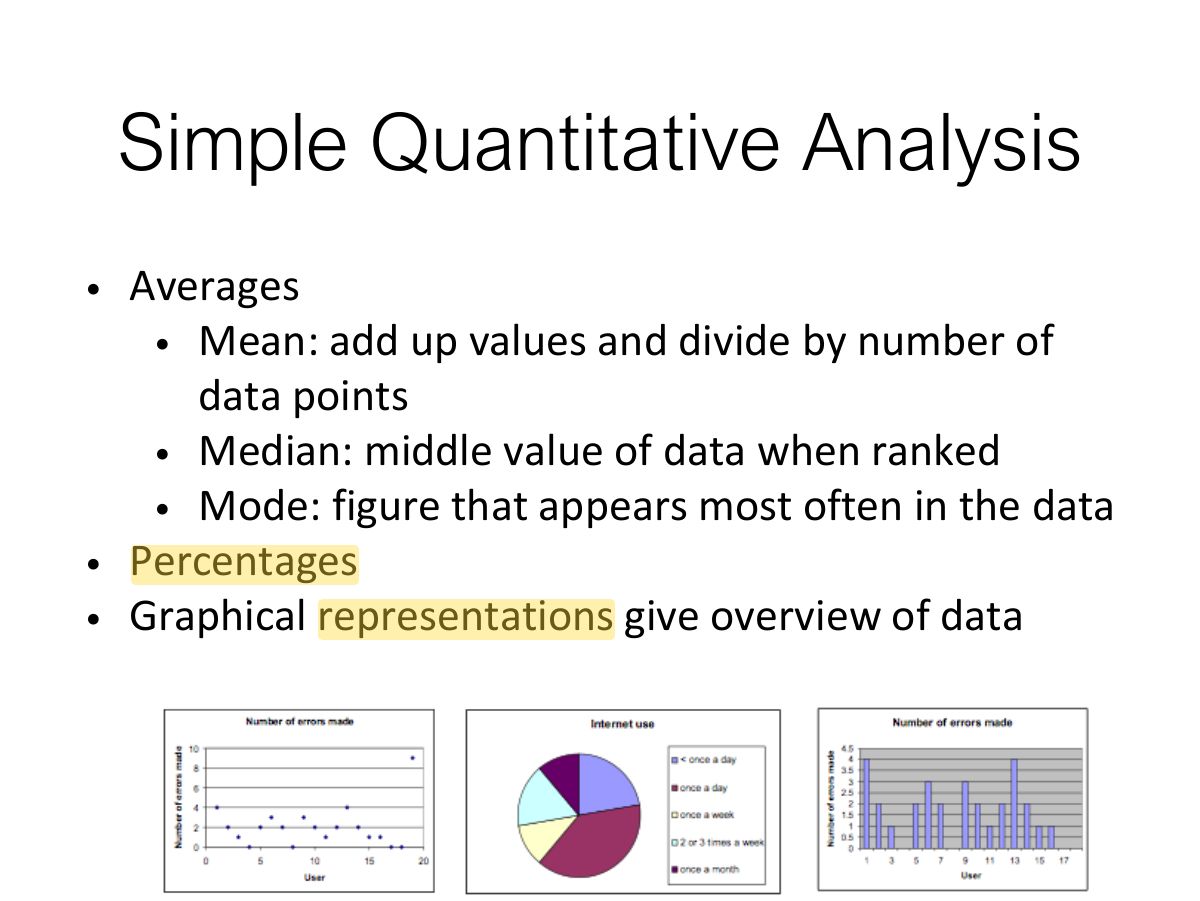
                                                                                                                Slide 69: Simple Quantitative Analysis
                                                                                                                Exam weight Low
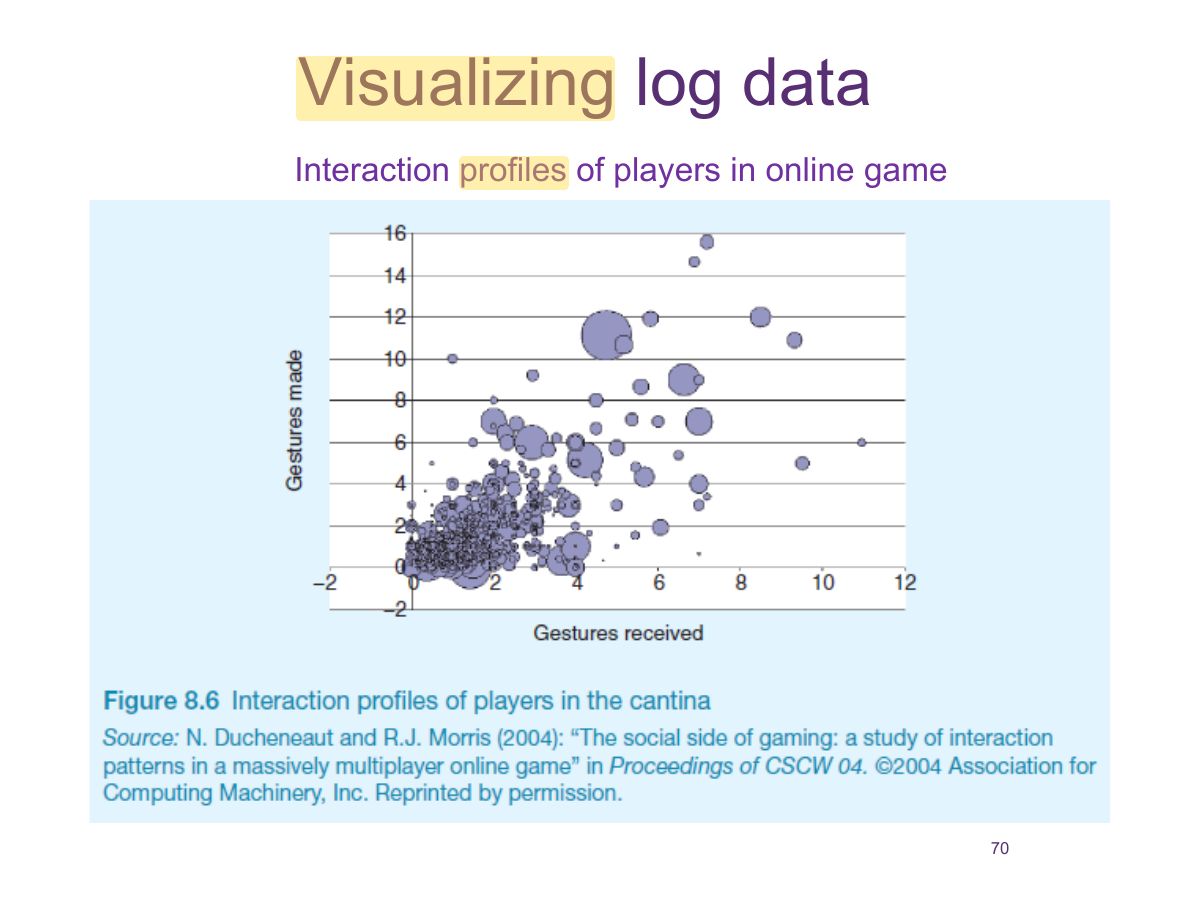
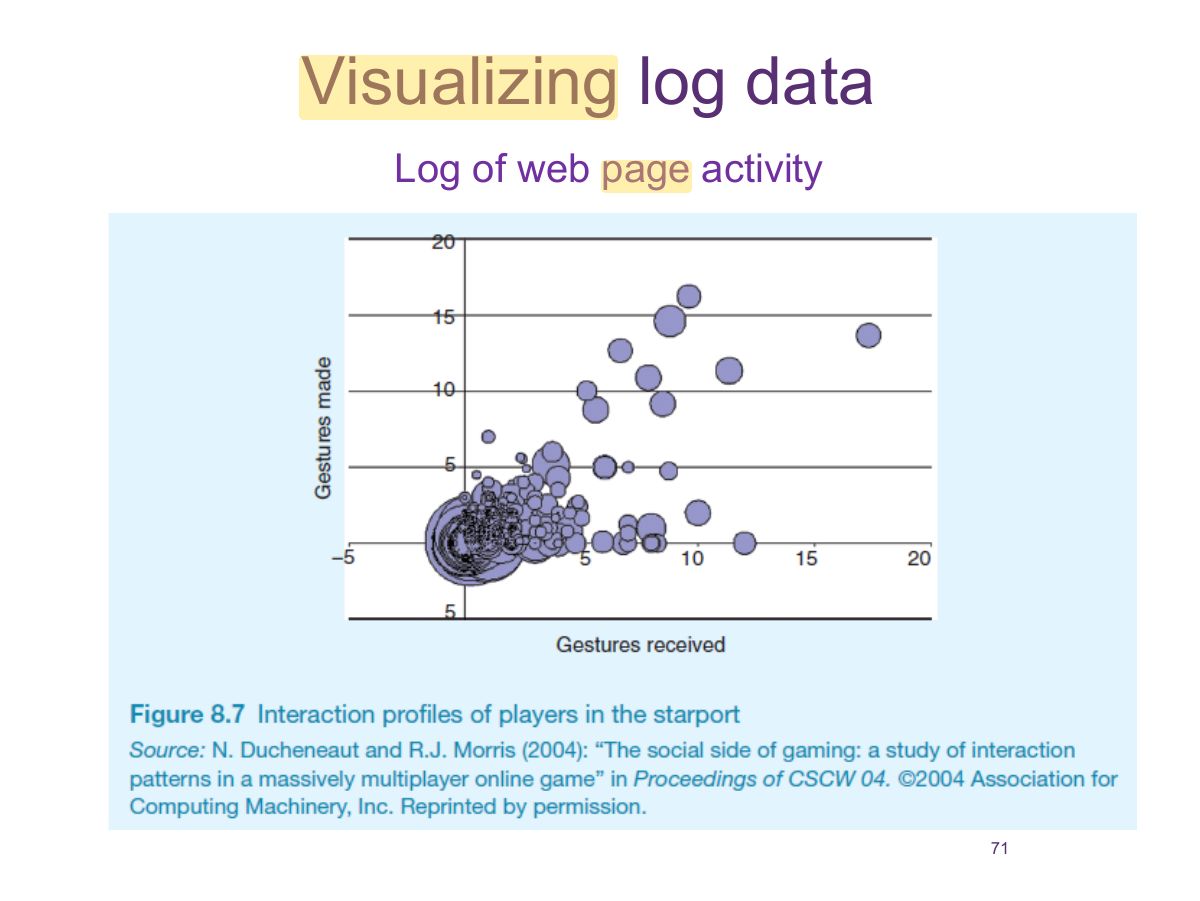
                                                                                                                  Slide 70: Visualizing log data
                                                                                                                  Exam weight Low
                                                                                                                    Slide 71: Visualizing log data
                                                                                                                    Exam weight Low

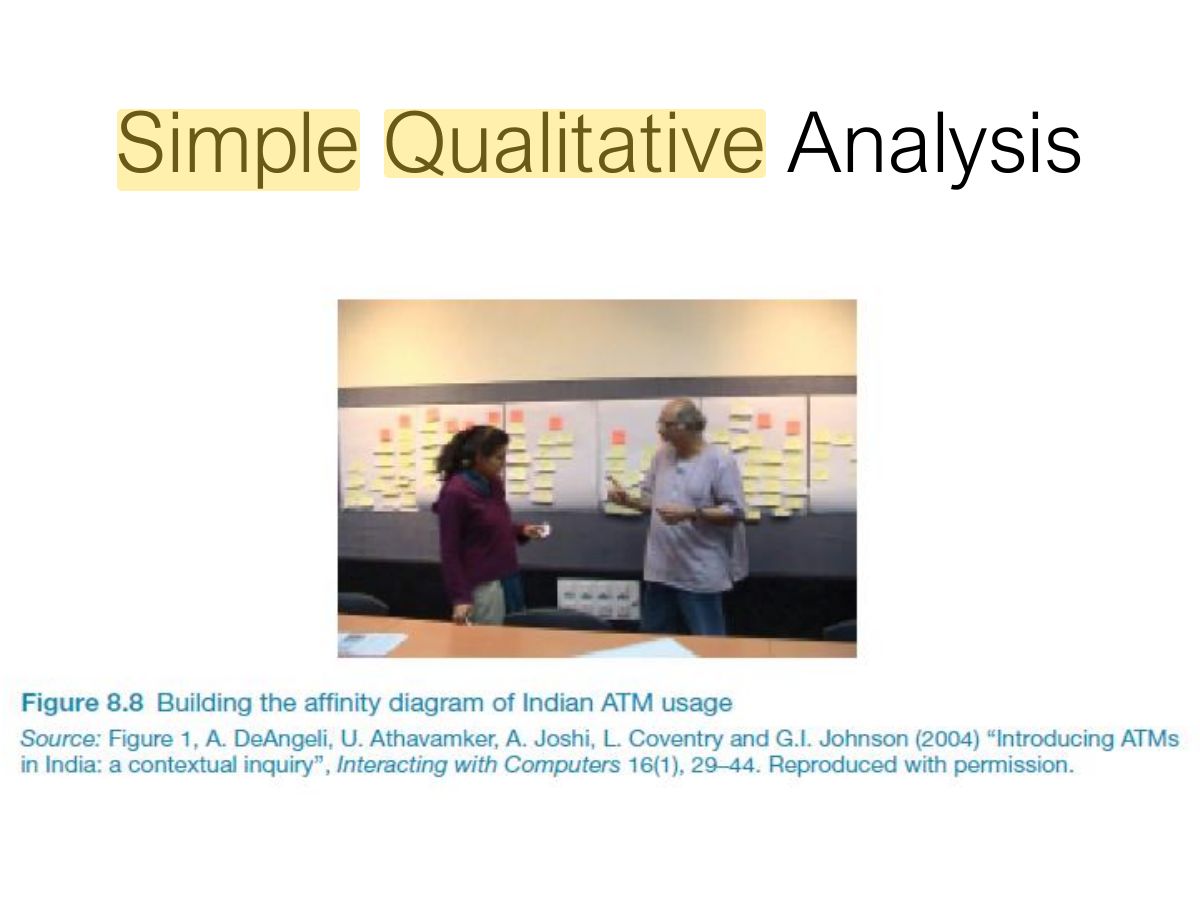
                                                                                                                      Simple Qualitative Analysis

                                                                                                                      • Recurring patterns or themes
                                                                                                                        • Emergent from data, dependent on observation framework if used
                                                                                                                      • Categorizing data
                                                                                                                        • Categorization scheme may be emergent or pre-specified
                                                                                                                      • Looking for critical incidents
                                                                                                                        • Helps to focus in on key events
                                                                                                                      72
                                                                                                                      Exam weight Low
                                                                                                                        Slide 73: Simple Qualitative Analysis
                                                                                                                        Exam weight Low

                                                                                                                          Tools to support data analysis

                                                                                                                          • Spreadsheet – simple to use, basic graphs
                                                                                                                          • Statistical packages, e.g. SPSS
                                                                                                                          • Qualitative data analysis tools
                                                                                                                            • Categorization and theme-based analysis, e.g. N6
                                                                                                                            • Quantitative analysis of text-based data
                                                                                                                          • CAQDAS Networking Project, based at the University of Surrey (http://caqdas.soc.surrey.ac.uk/)
                                                                                                                          74
                                                                                                                          Exam weight Low

                                                                                                                            Theoretical frameworks for qualitative analysis

                                                                                                                            • Basing data analysis around theoretical frameworks provides further insight
                                                                                                                            • Three such frameworks are:
                                                                                                                              • Grounded Theory
                                                                                                                              • Distributed Cognition
                                                                                                                              • Activity Theory
                                                                                                                            75
                                                                                                                            Exam weight Low

                                                                                                                              Grounded Theory

                                                                                                                              • Aims to derive theory from systematic analysis of data
                                                                                                                              • Based on categorization approach (called here ‘coding’)
                                                                                                                              • Three levels of ‘coding’
                                                                                                                                • Open: identify categories
                                                                                                                                • Axial: flesh out and link to subcategories
                                                                                                                                • Selective: form theoretical scheme
                                                                                                                              • Researchers are encouraged to draw on own theoretical backgrounds to inform analysis
                                                                                                                              76
                                                                                                                              Exam weight Low
                                                                                                                              1. Grounded theory: develop theory from the data through open, axial and selective coding.

                                                                                                                              Code book used in grounded theory analysis

                                                                                                                              www.id-book.com

                                                                                                                              77
                                                                                                                              Exam weight Low

                                                                                                                                Excerpt showing axial coding

                                                                                                                                78
                                                                                                                                Exam weight Low

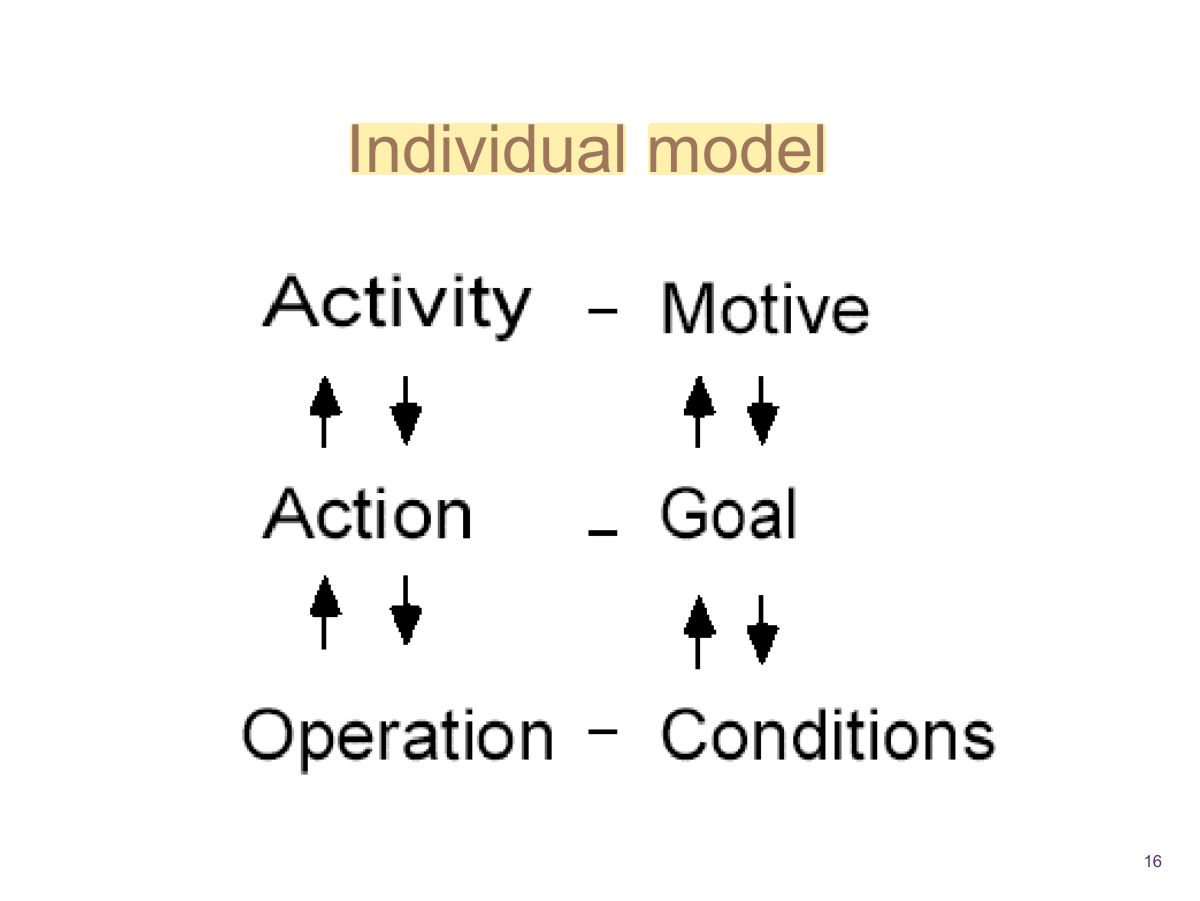
                                                                                                                                  Activity Theory

                                                                                                                                  • Explains human behaviour in terms of our practical activity in the world
                                                                                                                                  • Provides a framework that focuses analysis around the concept of an ‘activity’ and helps to identify tensions between the different elements of the system
                                                                                                                                  • Two key models: one outlines what constitutes an ‘activity’ ; one models the mediating role of artifacts
                                                                                                                                  79
                                                                                                                                  Exam weight Low
                                                                                                                                  1. Activity theory: subject, object, tools, rules, community, division of labour.
                                                                                                                                  Slide 80: Individual model
                                                                                                                                  Exam weight Low

                                                                                                                                    Presenting the findings

                                                                                                                                    • Only make claims that your data can support
                                                                                                                                    • The best way to present your findings depends on the audience, the purpose, and the data gathering and analysis undertaken
                                                                                                                                    • Graphical representations (as discussed above) may be appropriate for presentation
                                                                                                                                    • Other techniques are:
                                                                                                                                      • Rigorous notations, e.g. UML
                                                                                                                                      • Using stories, e.g. to create scenarios
                                                                                                                                      • Summarizing the findings
                                                                                                                                    81
                                                                                                                                    Exam weight Low
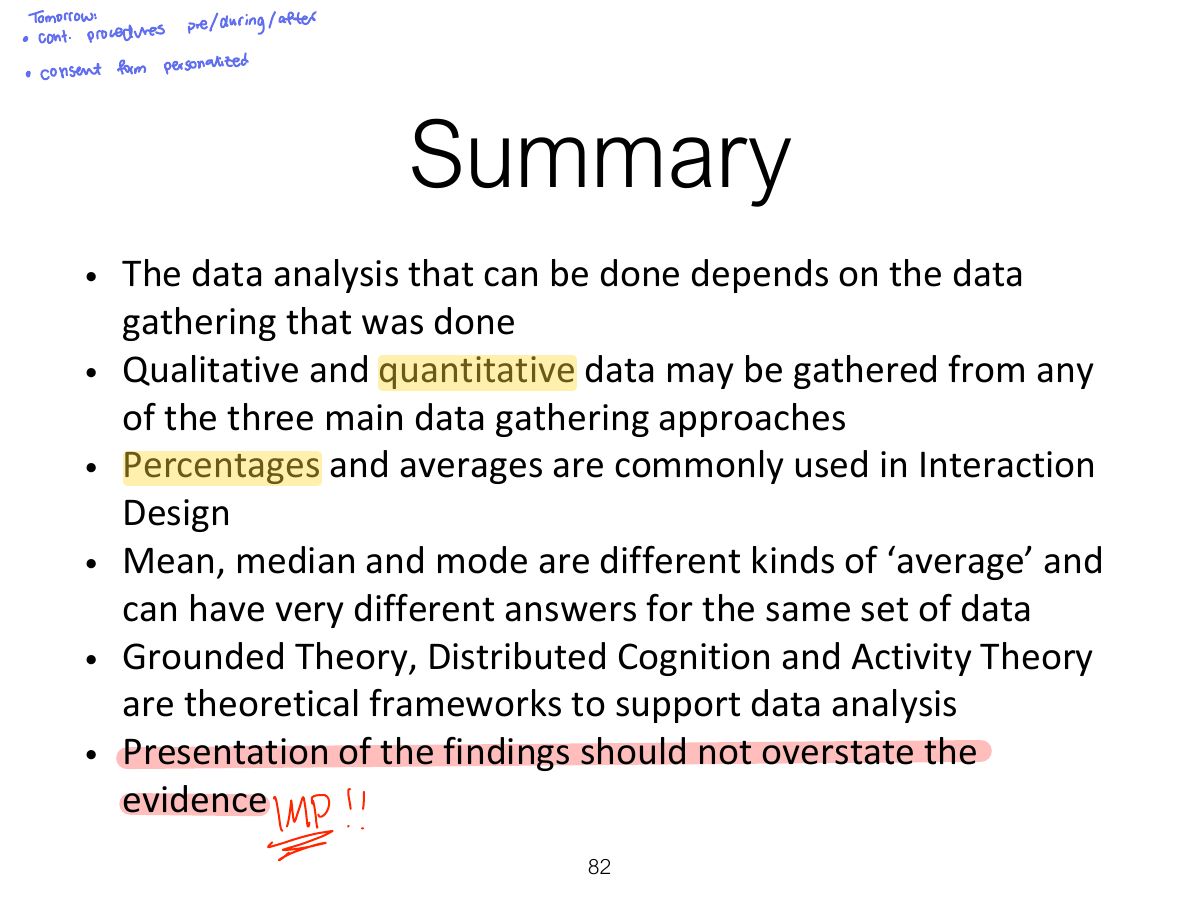
                                                                                                                                      Slide 82: Summary
                                                                                                                                      Exam weight Low