SE365 · Annotated SlidesLecture 2 — Cognitive Aspects
Lecture 2 · Annotated slides

Cognitive Aspects

What cognition is (fast vs. slow thinking), the cognitive processes (attention, perception, memory, learning, reading/speaking/listening, problem-solving) with design implications, and cognitive frameworks: mental models, the gulfs of execution and evaluation, information processing, distributed, external and embodied cognition.
Slide text Study notes Highlight: key words Tips, tricks & traps Seen again elsewhere How it can come up
Slide 1: Slide 1
Exam weight Low
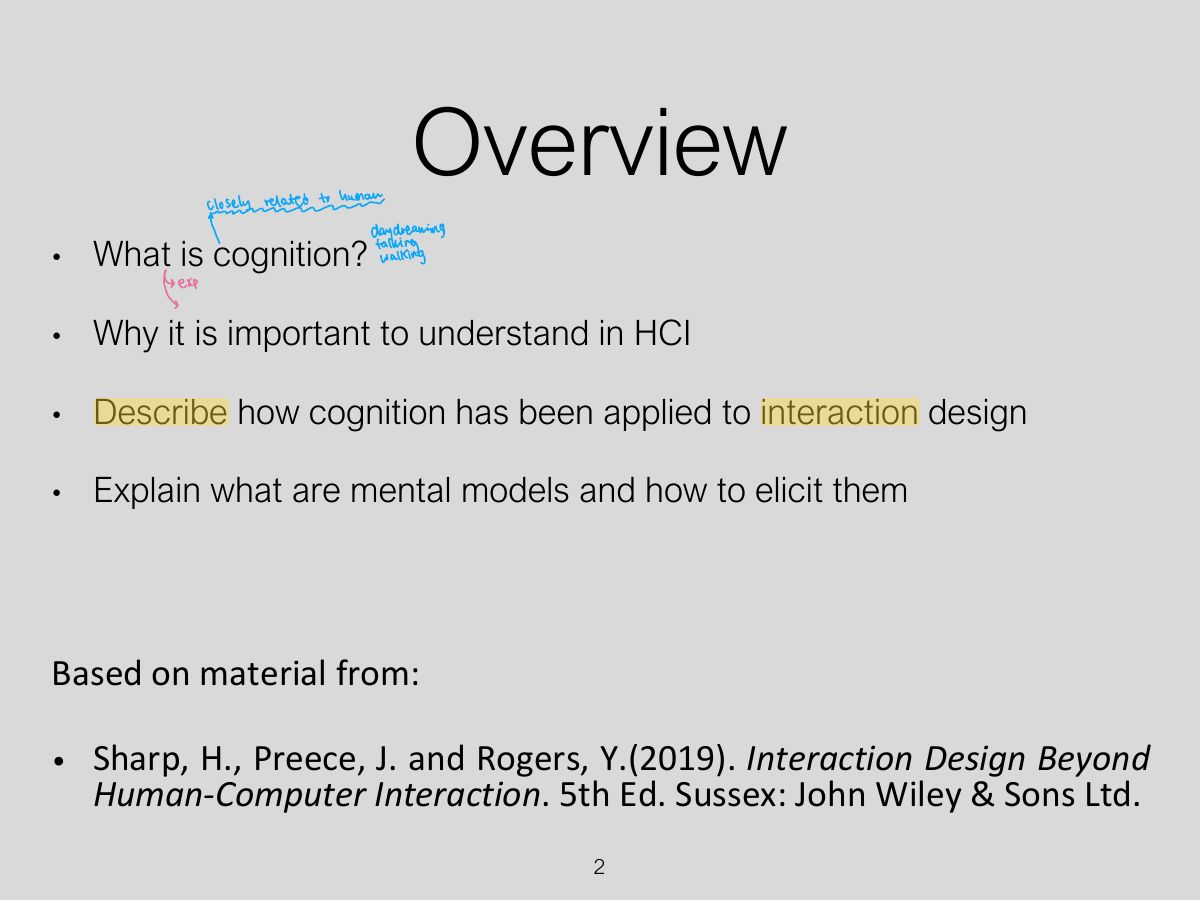
    Slide 2: Overview
    Exam weight Low

      Learning Outcomes

      • Explain the important of understanding users
      • Discuss the main elements of cognitive process
      3
      Exam weight Low
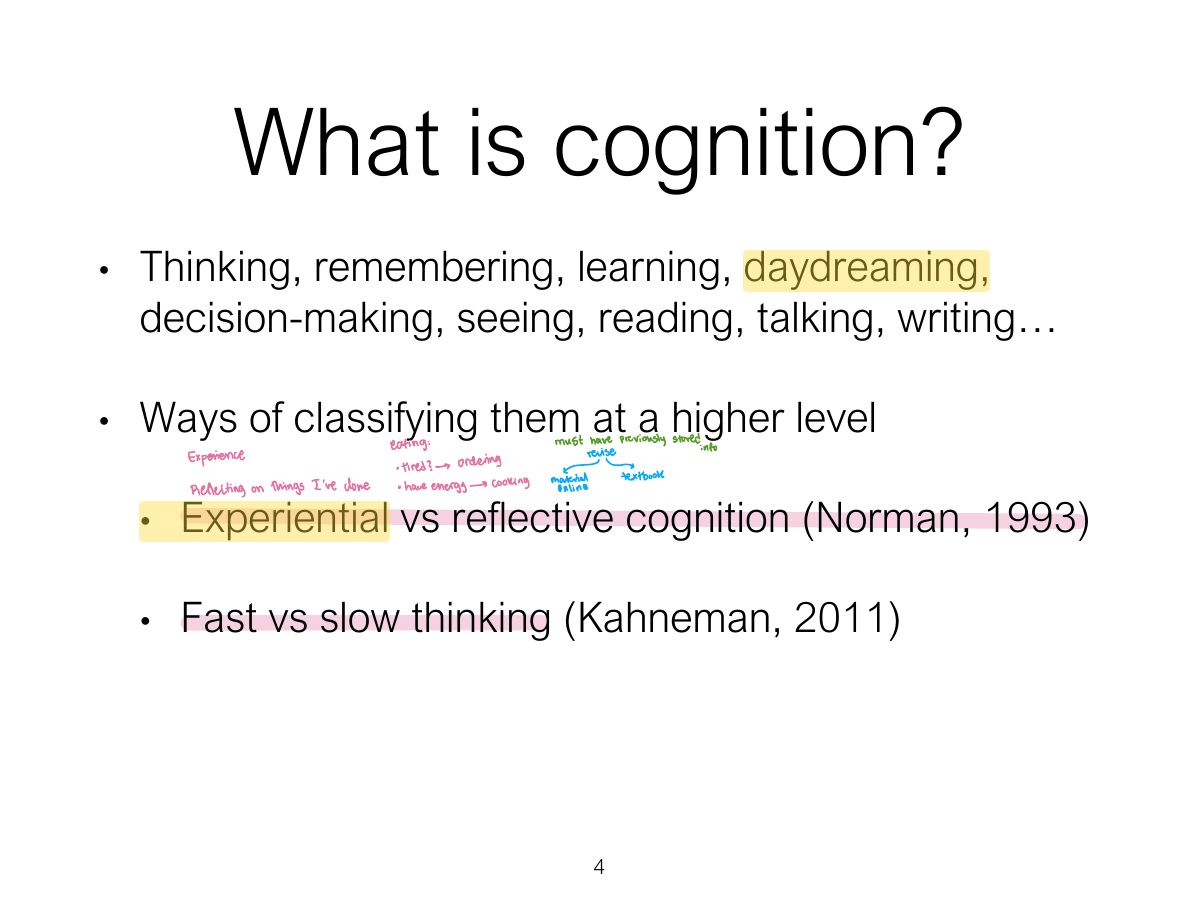
        Slide 4: What is cognition?
        Exam weight Low
        1. Cognition: what goes on in our heads when we carry out everyday activities: thinking, remembering, learning, deciding, seeing, reading…
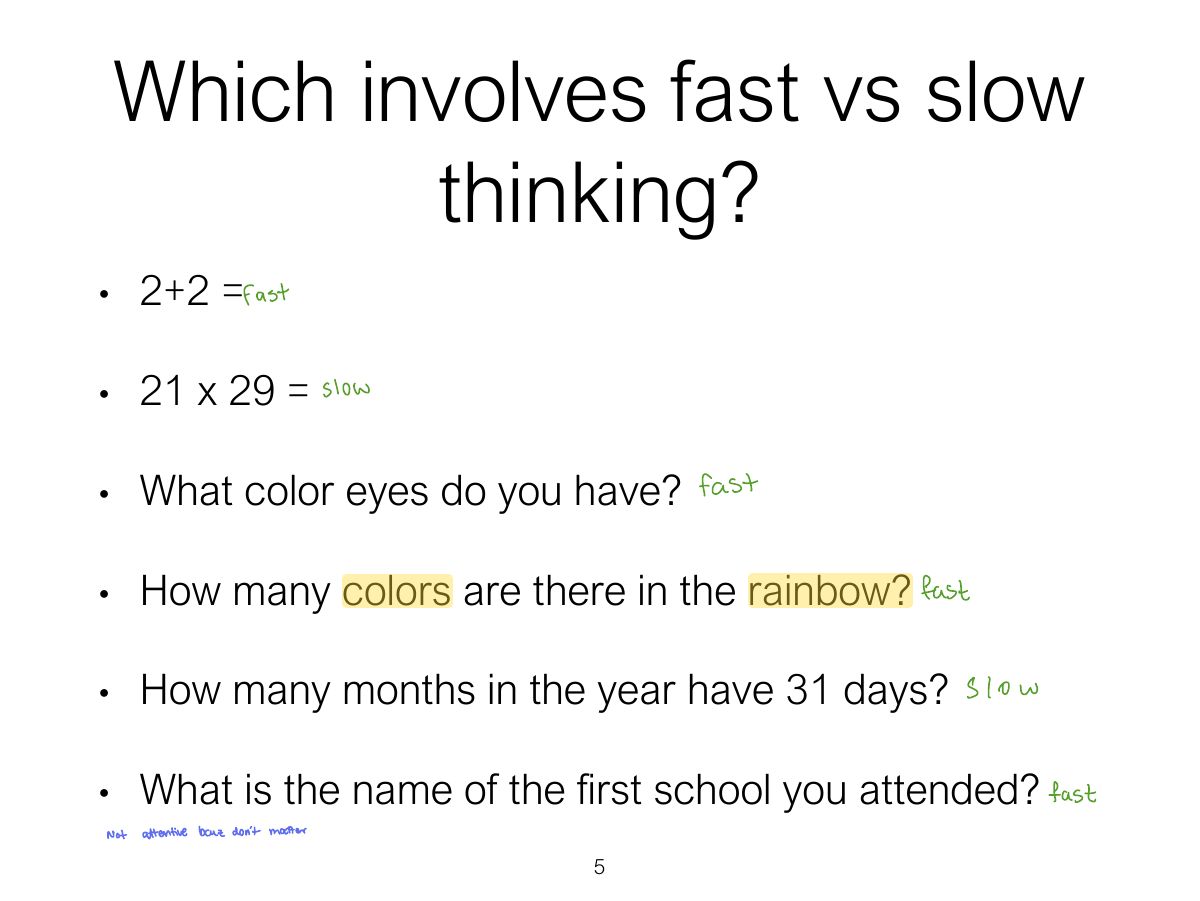
        Slide 5: Which involves fast vs slow thinking?
        Exam weight Low
        1. Fast thinking (experiential, automatic) vs. slow thinking (reflective, effortful).
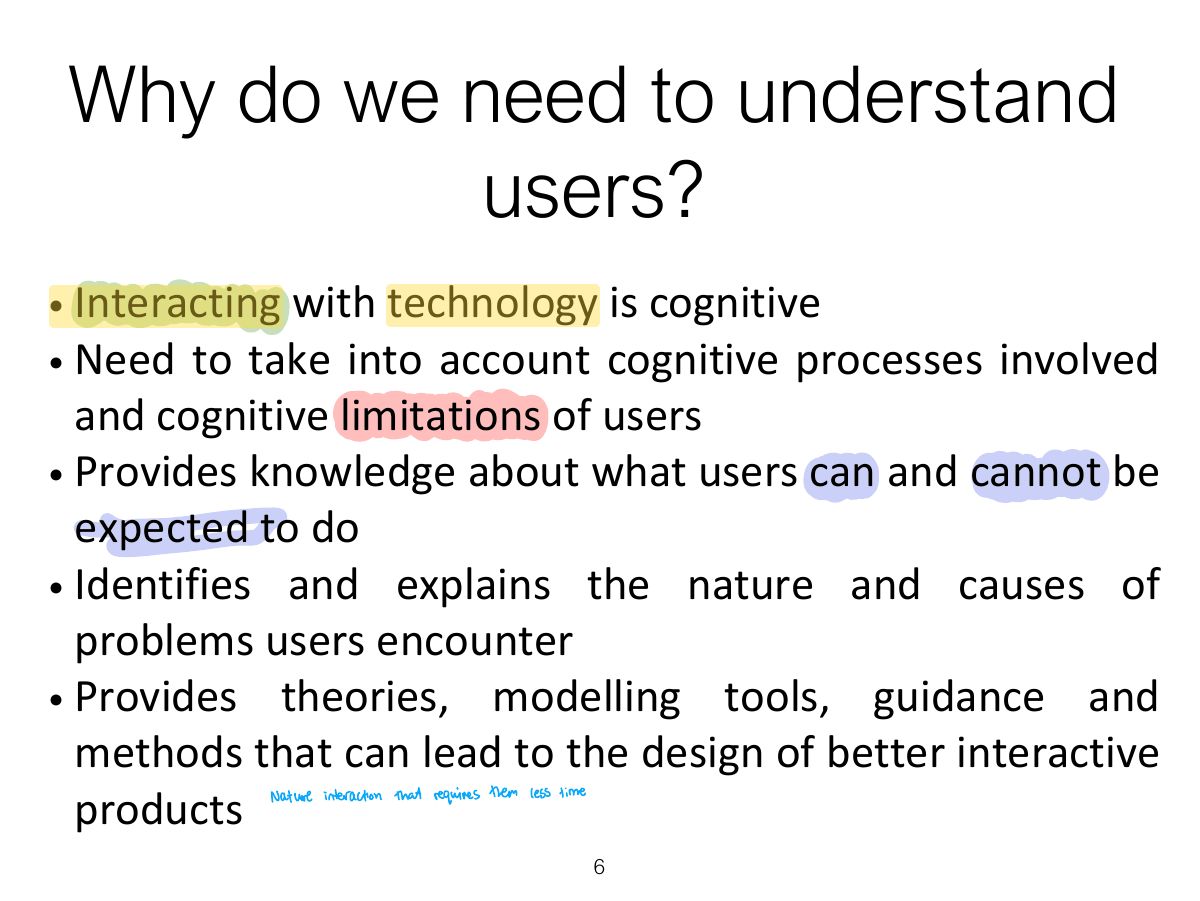
        Slide 6: Why do we need to understand users?
        Exam weight Low
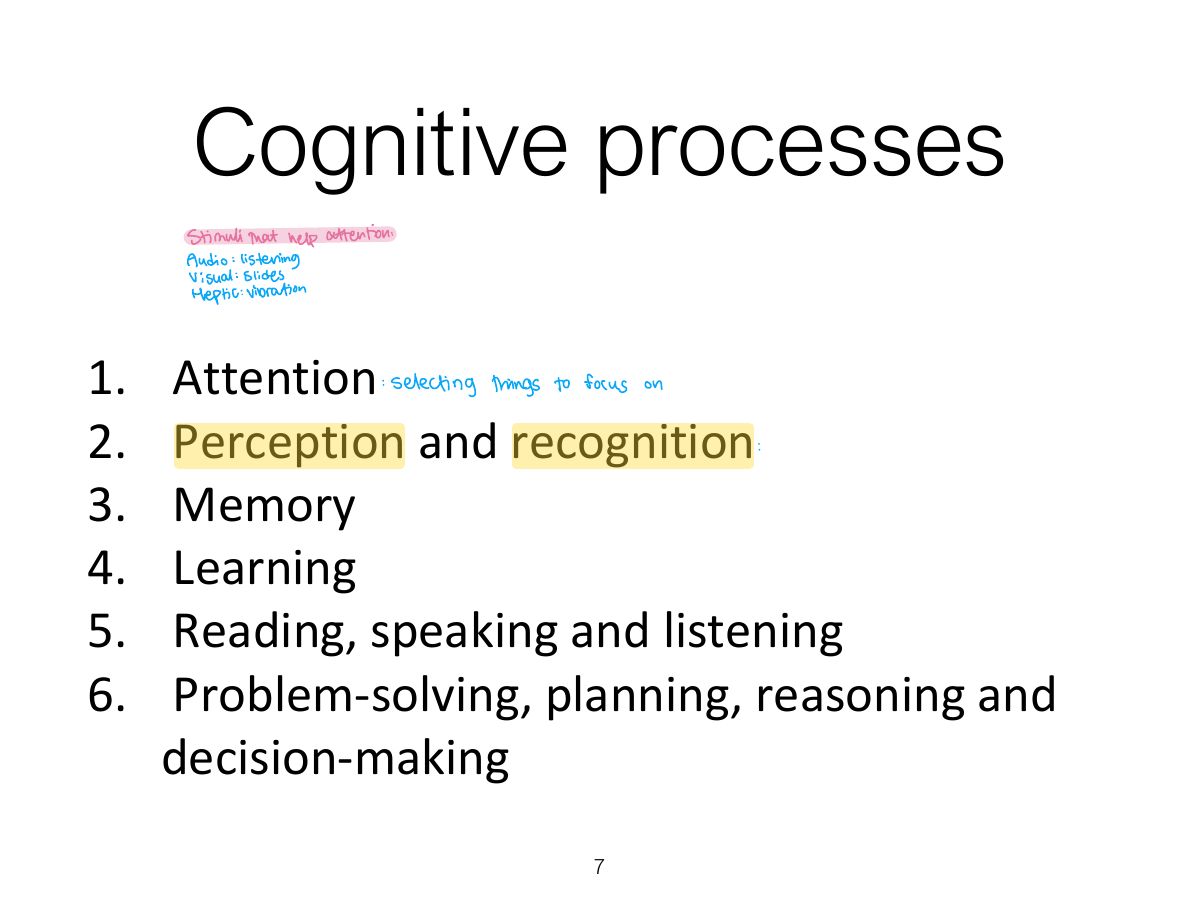
          Slide 7: Cognitive processes
          Exam weight Low

            1. Attention

            • Selecting things to concentrate on at a point in time from the mass of stimuli around us
            • Allows us to to focus on information that is relevant to what we are doing
            • Involves audio and/or visual senses
            • Focussed and divided attention enables us to be selective in terms of the mass of competing stimuli but limits our ability to keep track of all events
            • Information at the interface should be structured to capture users’ attention, e.g. use perceptual boundaries (windows), colour, reverse video, sound and flashing lights
            8
            Exam weight Low
            1. Attention: selecting things to concentrate on; depends on clear goals and how information is displayed.
            Slide 9: Activity: Find the price of a double room at the Holiday Inn in Bradley
            Exam weight Low
              Slide 10: Activity: Find the price for a double room at the Quality Inn in Columbia
              Exam weight Low

                Activity

                • Tullis (1987) found that the two screens produced quite different results
                  • 1st screen - took an average of 5.5 seconds to search
                  • 2nd screen - took 3.2 seconds to search
                • Why, since both displays have the same density of information (31%)?
                • Spacing
                  • In the 1st screen the information is bunched up together, making it hard to search
                  • In the 2nd screen the characters are grouped into vertical categories of information making it easier
                11
                Exam weight Low
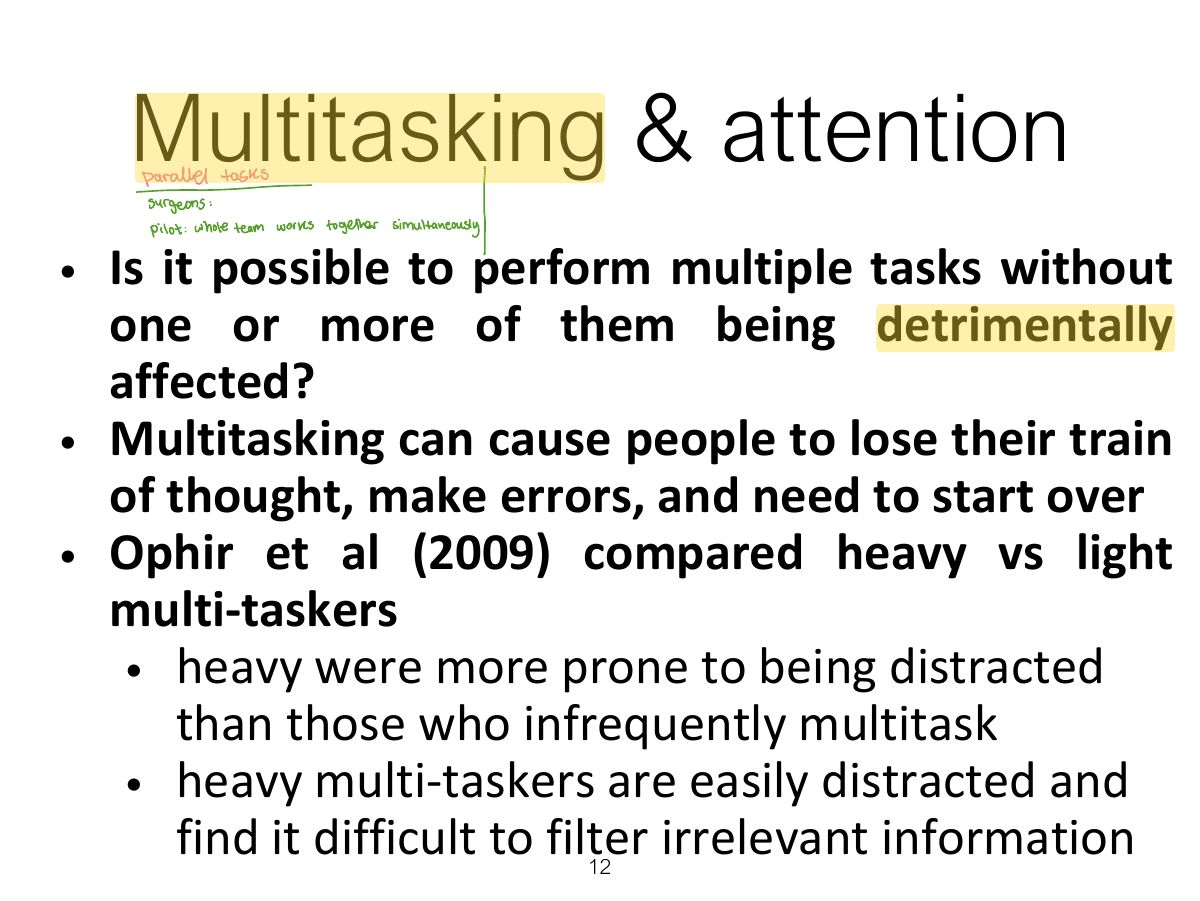
                  Slide 12: Multitasking & attention
                  Exam weight Low
                  1. Multitasking hurts attention: heavy multitaskers are more easily distracted.

                  Multitasking experiment

                  • Lotteridge et al. (2015) conducted another study involving writing an essay under 2 conditions: relevant or irrelevant information
                  • heavy multitaskers were easily distracted but able to put this to good use if the distracting sources were relevant to the task in hand
                  • irrelevant information was found to negatively impact task performance
                  13
                  Exam weight Low

                    Multitasking at work

                    Increasingly common for workers to multitask

                    • e.g. hospital workers have to attend to multiple screens in an operating room that provide new kinds of real-time information
                    • requires clinician’s constant attention to check if any data is unusual or anomalous
                    • need to develop new attention and scanning strategies
                    14
                    Exam weight Low
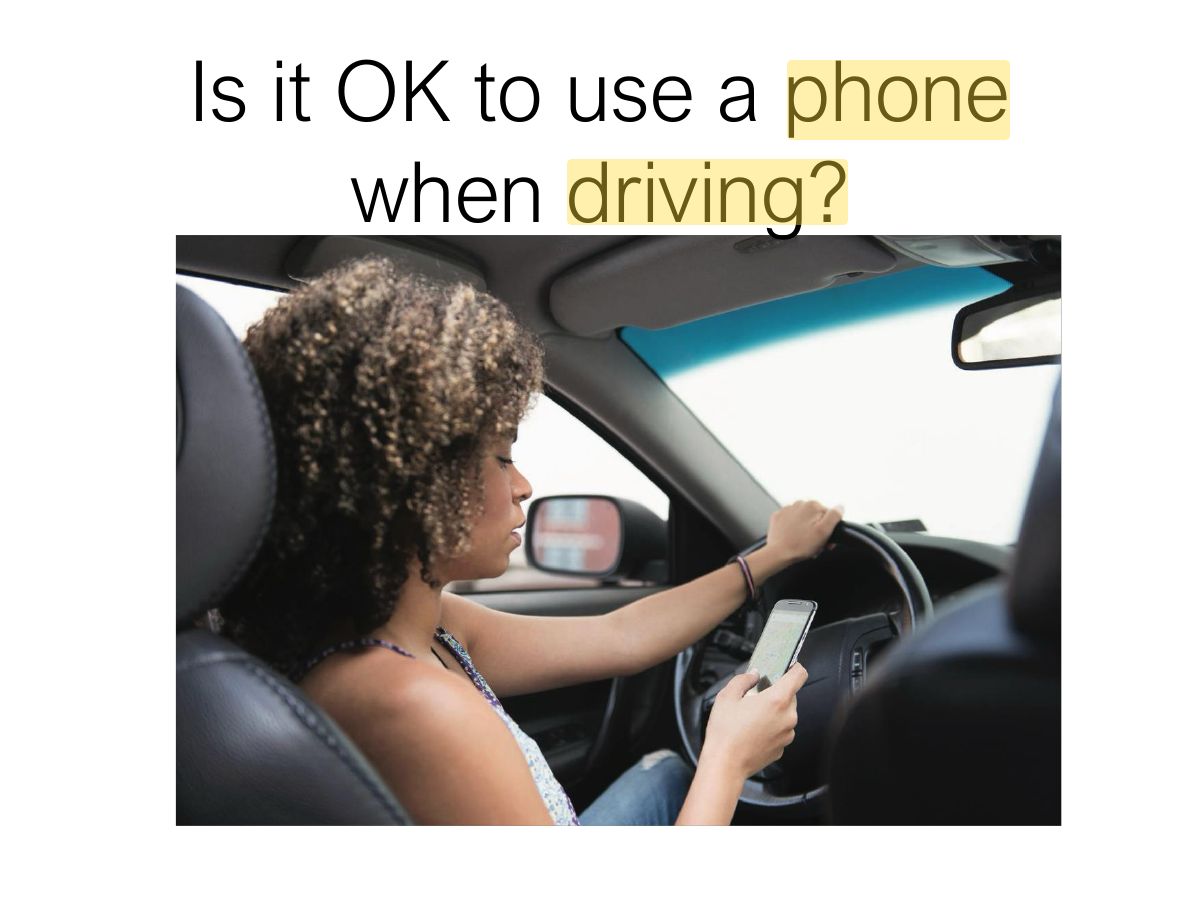
                      Slide 15: Is it OK to use a phone when driving?
                      Exam weight Low
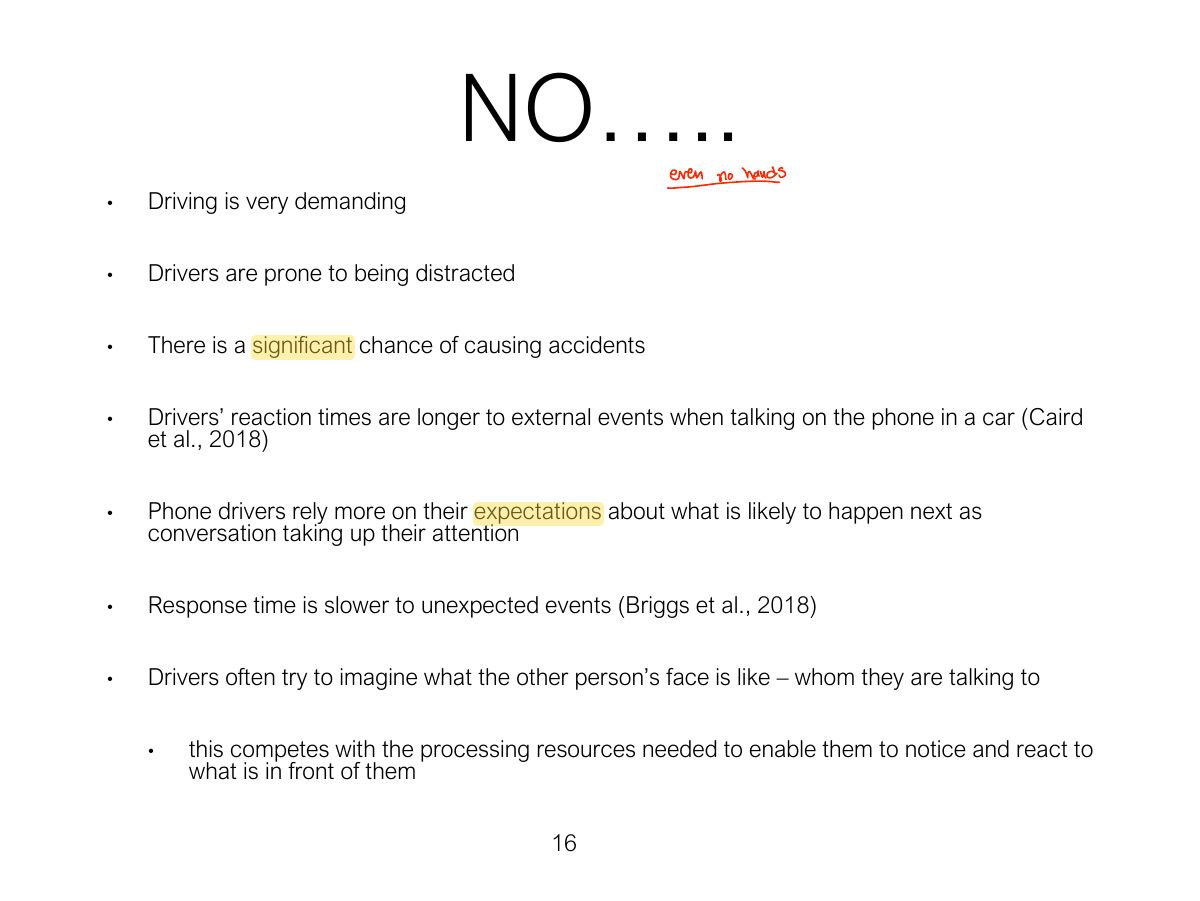
                        Slide 16: NO.....
                        Exam weight Low

                          Are hands-free phones safer to use when driving?

                          • No, as same type of cognitive processing is happening when talking
                          • Same happens when talking with front seat passenger
                            • but both can stop in mid-sentence if see a hazard meaning driver can switch immediately to the road
                            • So less dangerous talking to a front seat passenger than a remote person
                            • a remote person on the end of a phone is not privy to what the driver is seeing and will carry on the conversation when there is a hazard
                            • makes it difficult for the driver to switch all their attention to the road
                          17
                          Exam weight Low

                            Design implications for attention

                            • Make information salient when it needs attending to
                            • Use techniques that make things stand out like color, ordering, spacing, underlining, sequencing and animation
                            • Avoid cluttering the interface with too much information
                            • Avoid using too much because the software allows it
                            • Consider designing different ways of supporting effective switching and returning to an interface
                            18
                            Exam weight Low

                              2. Perception

                              • How information is acquired from the world and transformed into experiences
                              • Obvious implication is to design representations that are readily perceivable, e.g.
                                • Text should be legible
                                • Icons should be easy to distinguish and read
                              19
                              Exam weight Low
                              1. Perception: how information is acquired through the senses and turned into experiences. Use contrast, white space and grouping.

                              Is color contrast good? Find italian

                              20
                              Exam weight Low
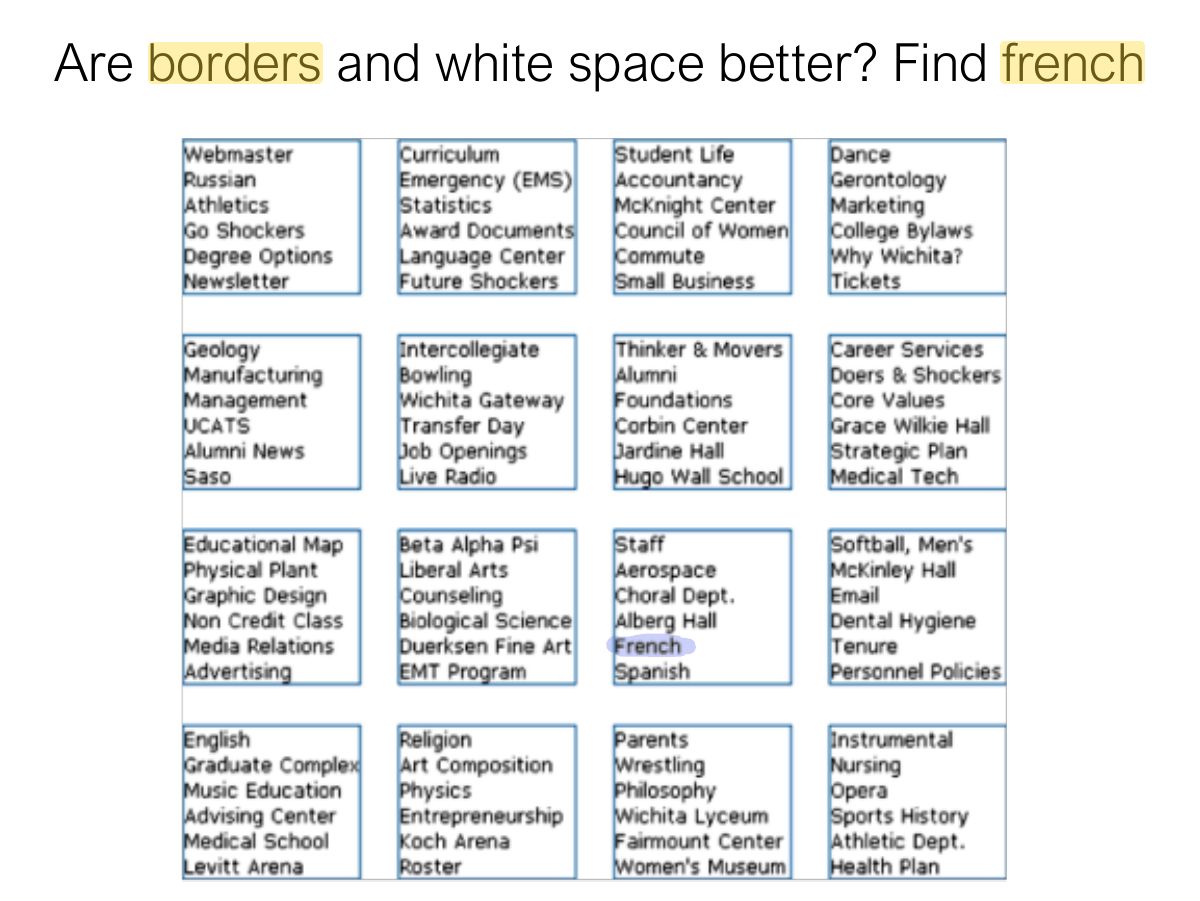
                                Slide 21: Are borders and white space better? Find french
                                Exam weight Low

                                  Activity

                                  • Weller (2004) found people took less time to locate items for information that was grouped
                                    • Using a border (2nd screen) compared with using color contrast (1st screen)
                                  • Some argue that too much white space on web pages is detrimental to search
                                    • Makes it hard to find information
                                  • Do you agree?
                                  22
                                  Exam weight Low
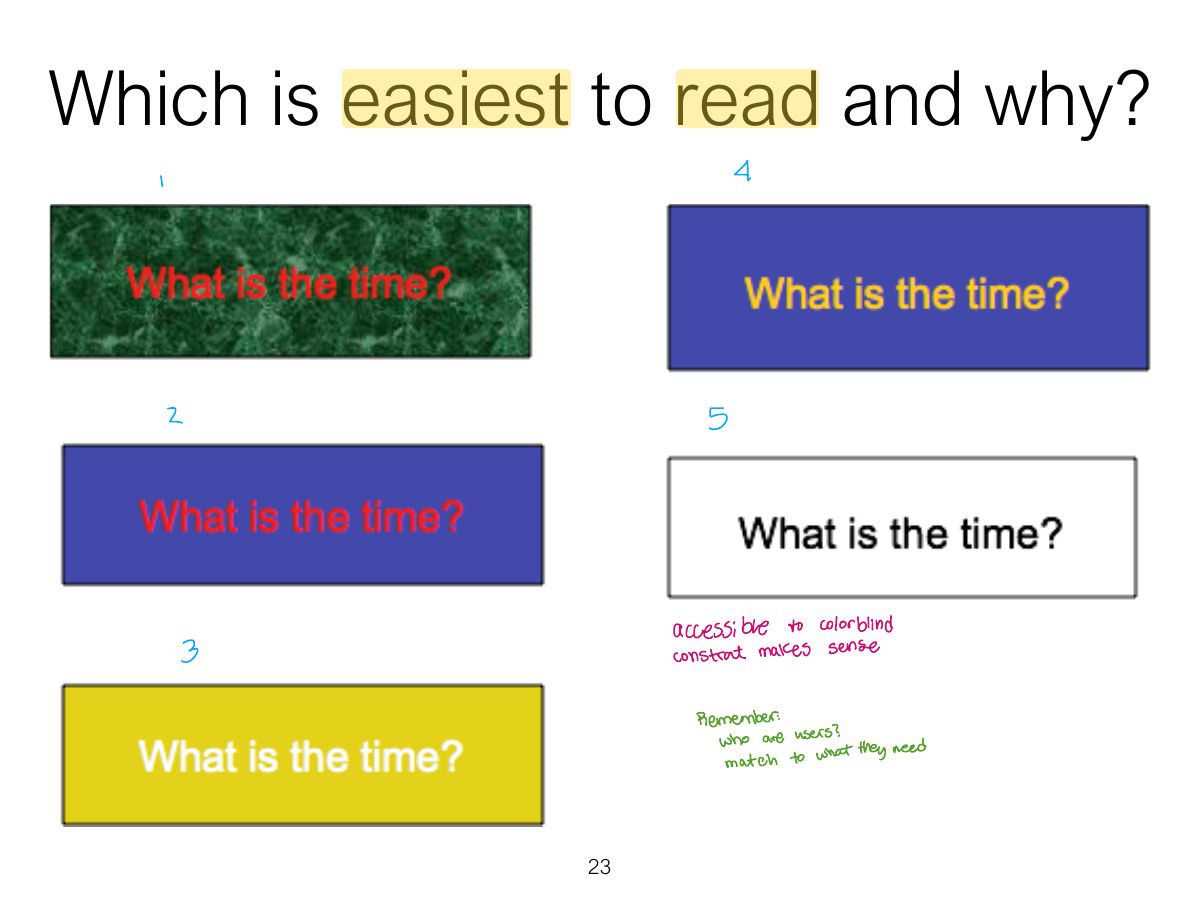
                                    Slide 23: Which is easiest to read and why?
                                    Exam weight Low
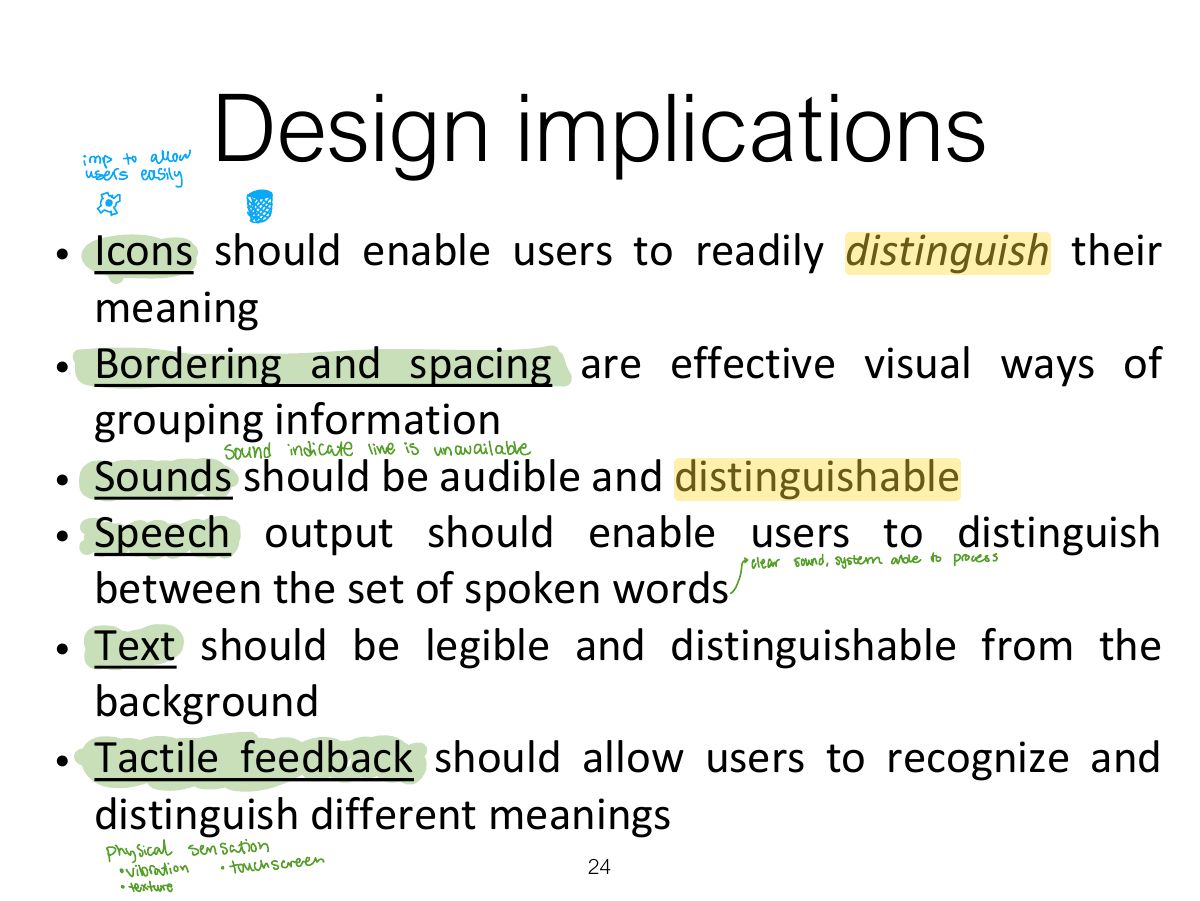
                                      Slide 24: Design implications
                                      Exam weight Low

                                        Design implications

                                        • Research proper color contrast techniques when designing an interface
                                          • Yellow on black or blue is fine
                                          • Yellow on green or white is a no-no
                                        • Haptic feedback should be used judiciously
                                        25
                                        Exam weight Low

                                          3. Memory

                                          • Involves first encoding and then retrieving knowledge
                                          • We don’t remember everything - involves filtering and processing what is attended to
                                          • Context is important in affecting our memory (i.e. where, when)
                                          • We recognize things much better than being able to recall things
                                          26
                                          Exam weight Low
                                          1. Memory: encoding, then retrieval. Context matters; the more attention and processing, the better remembered.

                                          3. Memory

                                          • We remember less about objects we have photographed than when we observe them with the naked eye (Henkel, 2014)
                                          27
                                          Exam weight Low

                                            Processing in memory

                                            • Encoding is first stage of memory
                                              • determines which information is attended to in the environment and how it is interpreted
                                            • The more attention paid to something ...
                                            • The more it is processed in terms of thinking about it and comparing it with other knowledge ...
                                            • The more likely it is to be remembered
                                              • e.g. when learning about HCI, it is much better to reflect upon it, carry out exercises, have discussions with others about it, and write notes than just passively read a book, listen to a lecture or watch a video about it
                                            28
                                            Exam weight Low

                                              Context is important

                                              • Context affects the extent to which information can be subsequently retrieved
                                              • Sometimes it can be difficult for people to recall information that was encoded in a different context:
                                                • “You are on a train and someone comes up to you and says hello. You don’t recognize him for a few moments but then realize it is one of your neighbours. You are only used to seeing your neighbor in the hallway of your apartment block and seeing him out of context makes him difficult to recognize initially”
                                              29
                                              Exam weight Low

                                                Activity

                                                • Try to remember the dates of your grandparents’ birthday
                                                • Try to remember the cover of the last two DVDs you bought or rented
                                                • Which was easiest? Why?
                                                • People are very good at remembering visual cues about things
                                                  • e.g. the color of items, the location of objects and marks on an object
                                                • They find it more difficult to learn and remember arbitrary material
                                                  • e.g. birthdays and phone numbers
                                                30
                                                Exam weight Low
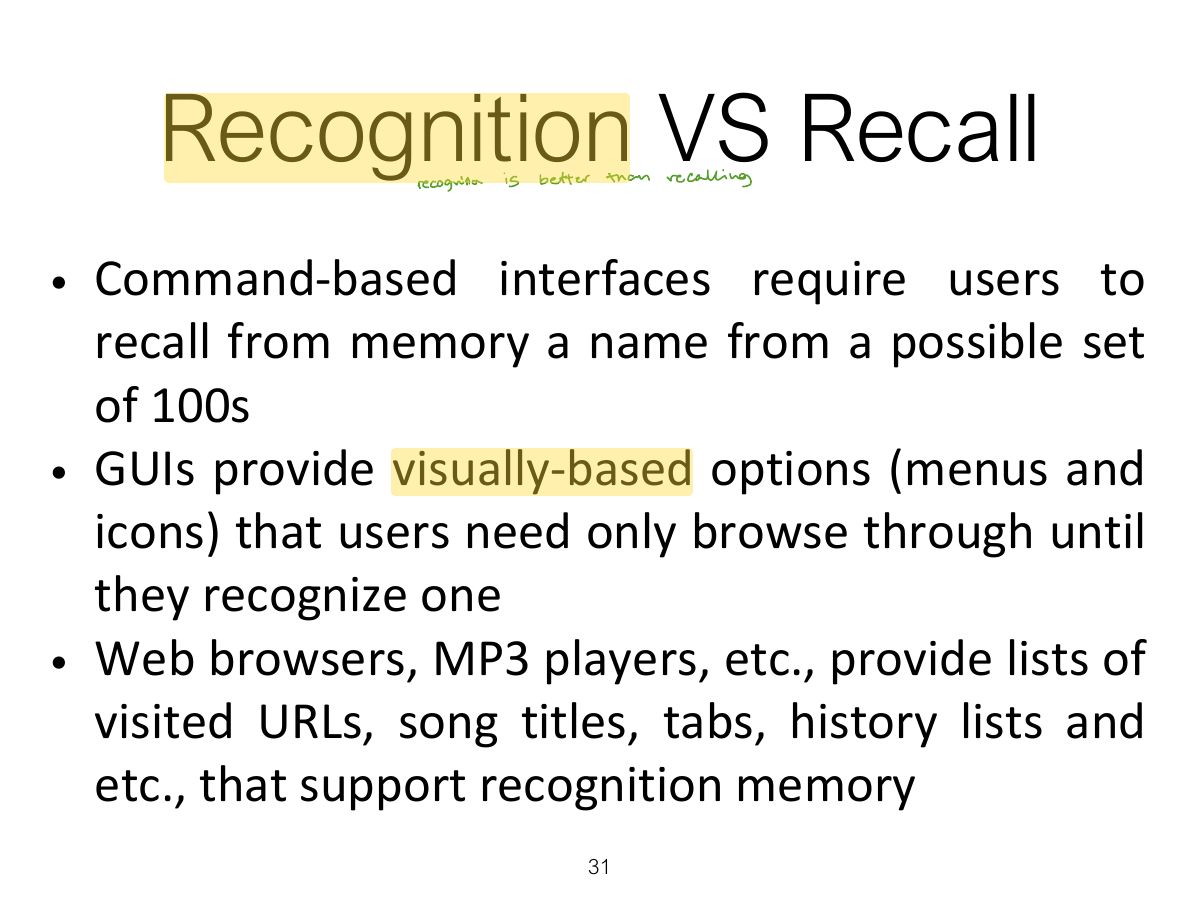
                                                  Slide 31: Recognition VS Recall
                                                  Exam weight High
                                                  1. Recognition is easier than recall: GUIs show options so users recognize rather than remember commands.
                                                  Memory trickMenus and icons = recognition; command lines = recall.
                                                  🎯 How this can come up · 1 question
                                                  MCQ

                                                  Graphical menus are easier than command lines mainly because:

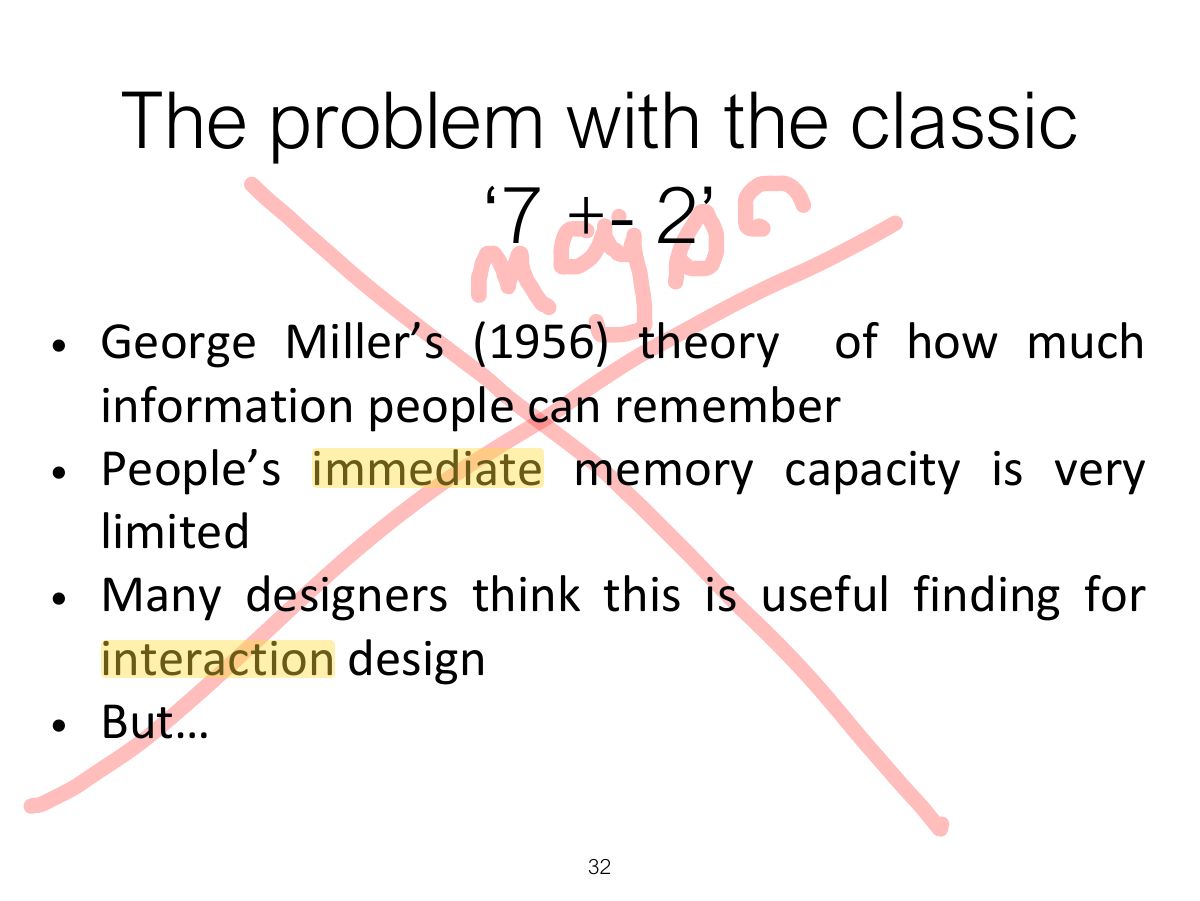
                                                  Slide 32: The problem with the classic
                                                  Exam weight Low
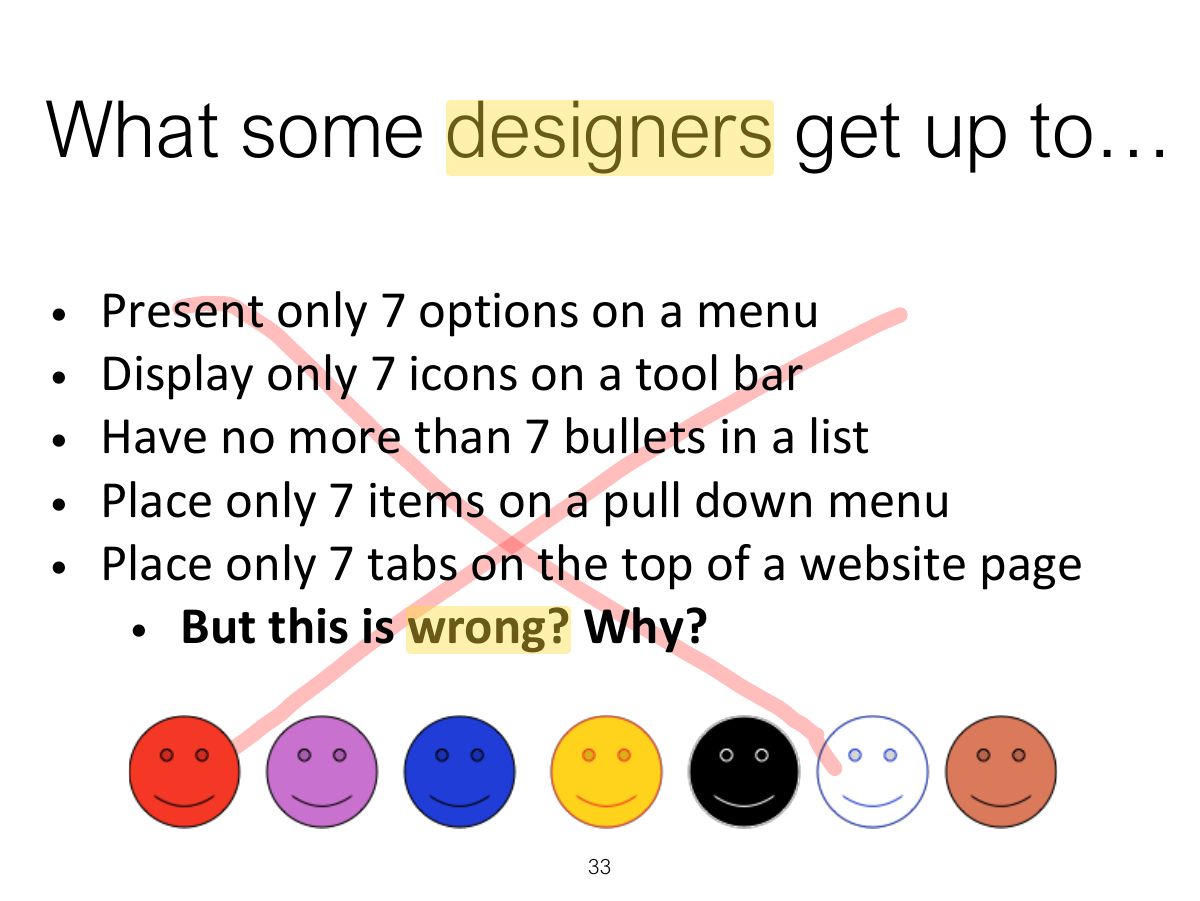
                                                    Slide 33: What some designers get up to...
                                                    Exam weight Low

                                                      Why?

                                                      • Inappropriate application of the theory
                                                      • People can scan lists of bullets, tabs, menu items for the one they want
                                                      • They don’t have to recall them from memory having only briefly heard or seen them
                                                      • Sometimes a small number of items is good
                                                      • But depends on task and available screen estate
                                                      34
                                                      Exam weight Low
                                                        Slide 35: Personal information management (PIM)
                                                        Exam weight Low

                                                          Personal information management

                                                          (cont)

                                                          • Memory involves 2 processes
                                                            • recall-directed and recognition-based scanning
                                                          • File management systems should be designed to optimize both kinds of memory processes
                                                            • e.g. Search box and history list
                                                          • Help users encode files in richer ways
                                                            • Provide them with ways of saving files using colour, flagging, image, flexible text, time stamping, etc
                                                          36
                                                          Exam weight Low

                                                            Personal information management (cont)

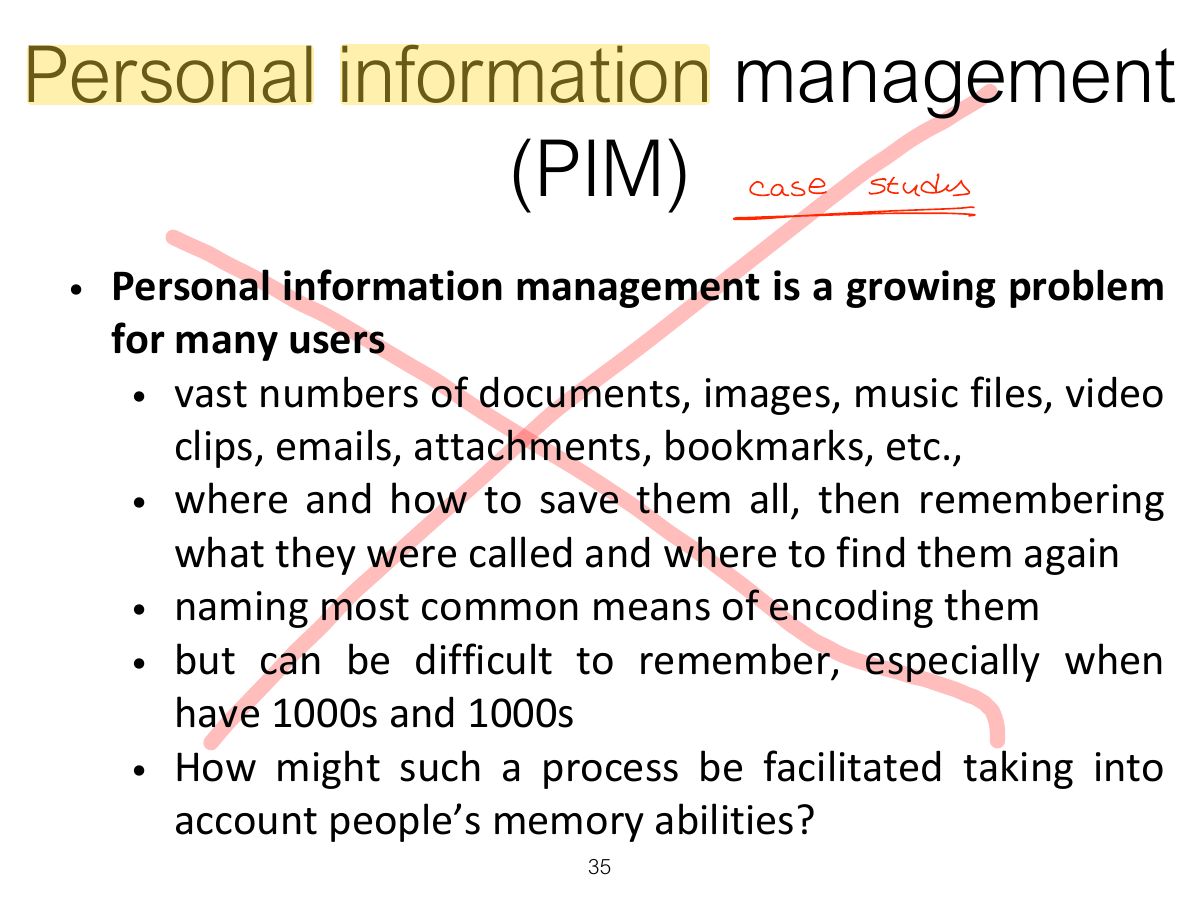
                                                            • Is a growing problem for many users
                                                              • they accumulate a vast numbers of documents, images, music files, video clips, emails, attachments, bookmarks, etc.,
                                                              • where and how to save them all, then remembering what they were called and where to find them again
                                                              • naming most common means of encoding them
                                                              • but can be difficult to remember, especially when have 10,000s ’ s
                                                              • How might such a process be facilitated taking into account people memory abilities?
                                                            37
                                                            Exam weight Low

                                                              Personal information management (cont)

                                                              • Bergman and Whittaker 3 interdependent processes model (2016) to help people manage their stuff: (i) how to decide what stuff to keep (ii) how to organize it when storing (iii) which strategies to use to retrieve it later
                                                              • Most common approach is to use folders and naming
                                                              • Strong preference for scanning across and within folders when looking for something
                                                              • Search engines only helpful if know the name of the file
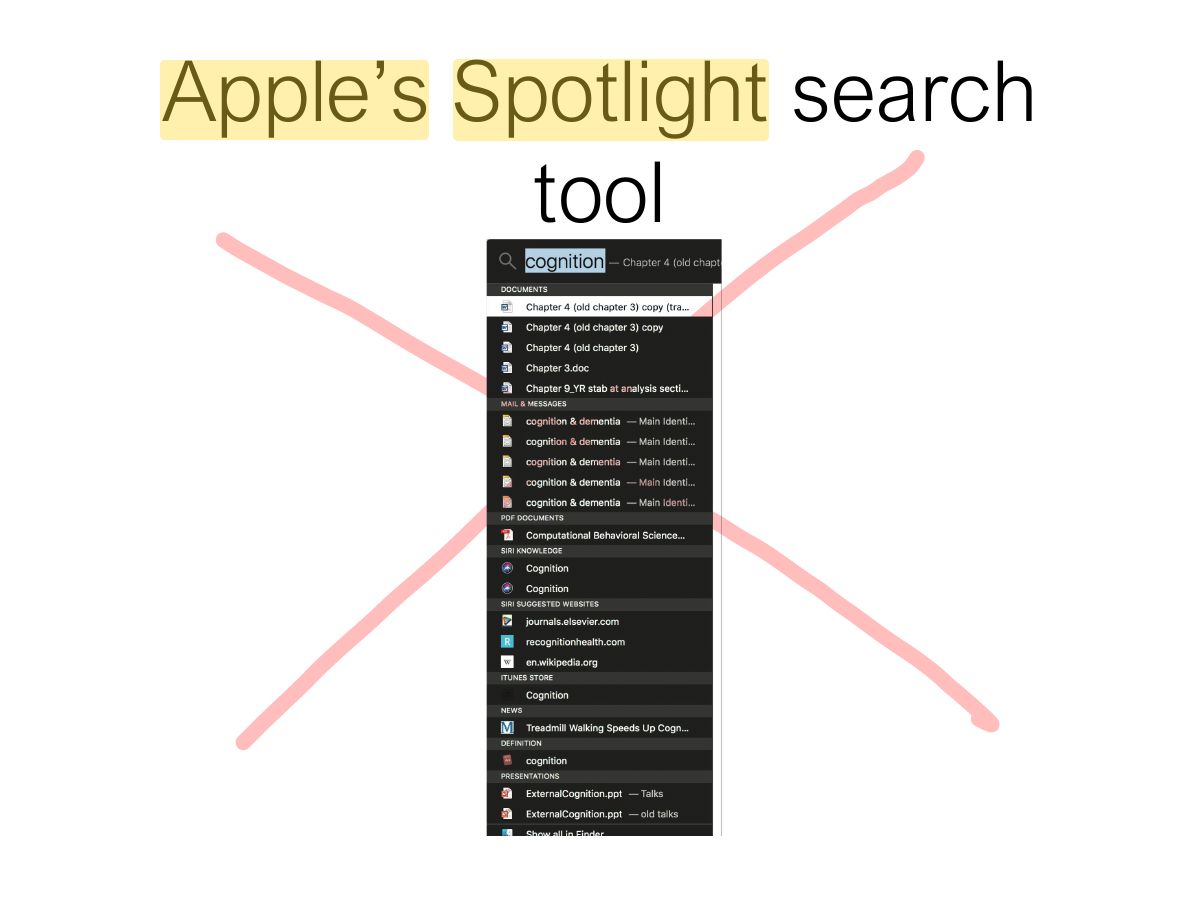
                                                              • Smart search engines help with listing relevant files for partial name or when type in first letter
                                                              38
                                                              Exam weight Low
                                                                Slide 39: Apple ’ s Spotlight search tool
                                                                Exam weight Low
                                                                  Slide 40: Memory aids
                                                                  Exam weight Low

                                                                    Memory load

                                                                    • Online/mobile and phone banking now require users to provide multiple pieces of information to access their account
                                                                      • e.g. ZIP code, birthplace, a memorable date, first school attended
                                                                      • Known as multifactor authentication (MFA)
                                                                    • Why?
                                                                      • Increased security concerns
                                                                    • Password managers such as LastPass have been developed - only need one master password
                                                                      • Reduce stress and memory load on users
                                                                    • Passwords could become extinct with the widespread use of biometrics and computer vision algorithms
                                                                    41
                                                                    Exam weight High
                                                                    1. Memory load: 7 ± 2 (Miller) is about short-term memory items, NOT a rule for menu length.
                                                                    Exam trapDon’t use "7 ± 2" to limit menu items or tabs: the items are visible, so no recall is needed.
                                                                    🎯 How this can come up · 1 question
                                                                    True / False

                                                                    Miller’s 7 ± 2 means menus should never have more than 7 items.

                                                                    Slide 42: Digital Forgetting
                                                                    Exam weight Low

                                                                      Design implications

                                                                      • Don’t overload users’ memories with complicated procedures for carrying out tasks
                                                                      • Design interfaces that promote recognition rather than recall
                                                                      • Provide users with various ways of encoding information to help them remember
                                                                        • e.g. categories, color, flagging, time stamping
                                                                      43
                                                                      Exam weight Low
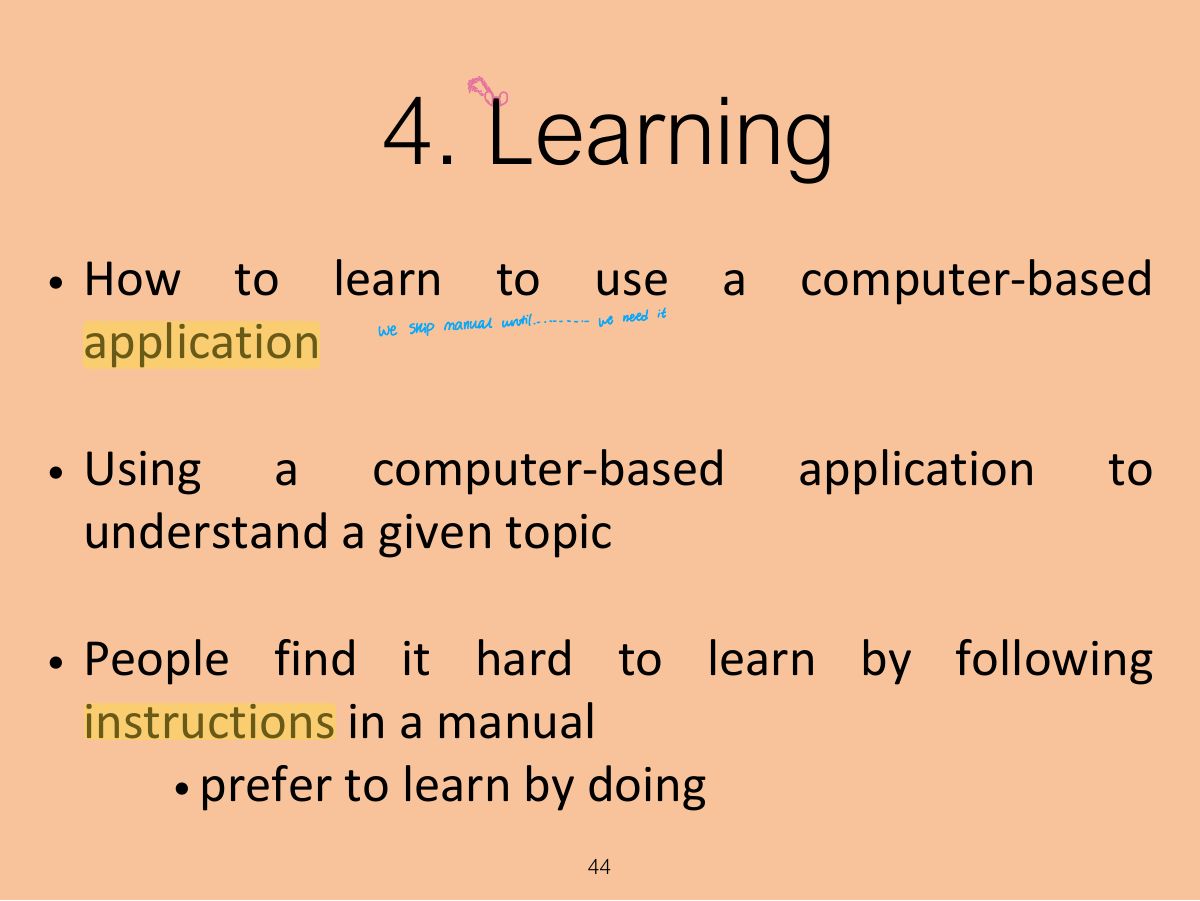
                                                                        Slide 44: 4. Learning
                                                                        Exam weight Low
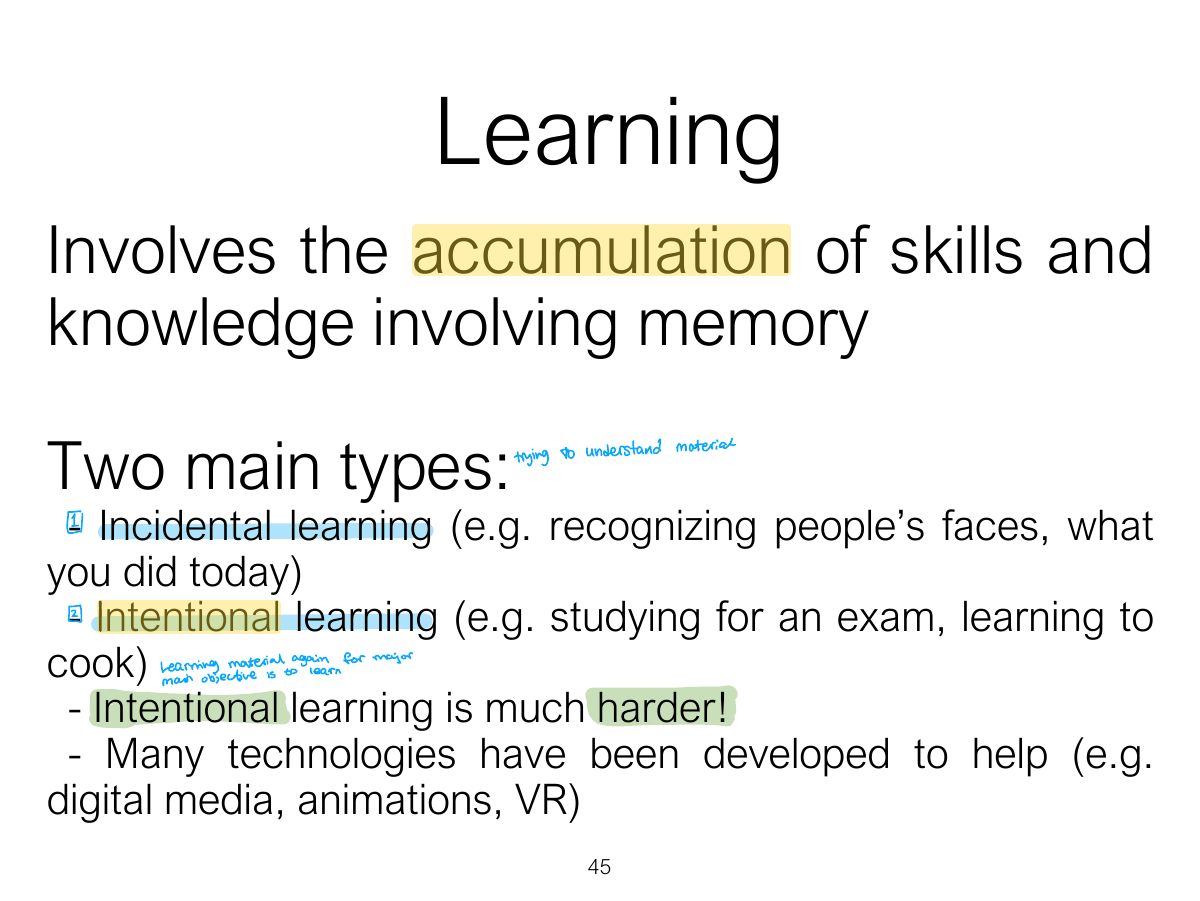
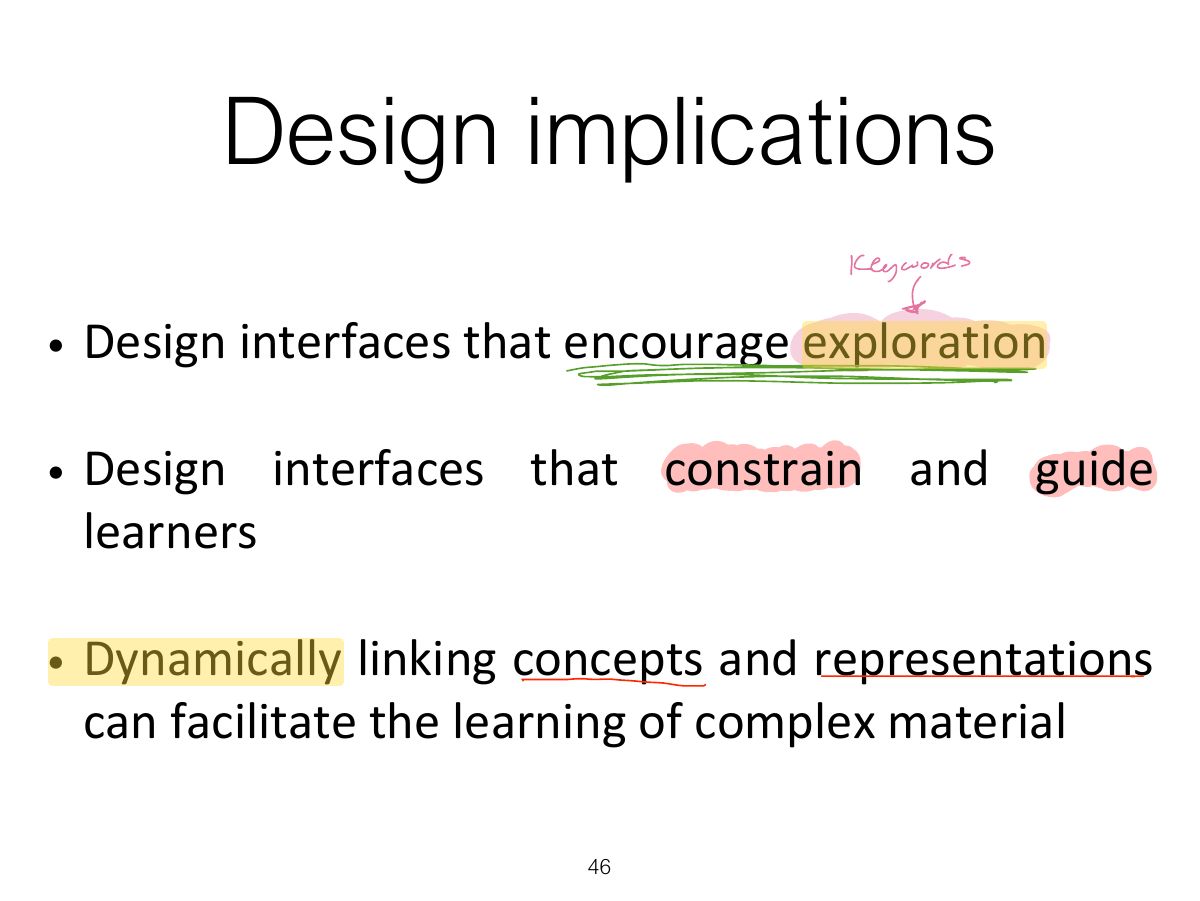
                                                                        1. Learning: people prefer learning by doing; design for exploration and undo.
                                                                        Slide 45: Learning
                                                                        Exam weight Low
                                                                          Slide 46: Design implications
                                                                          Exam weight Low

                                                                            5. Reading, speaking & listening

                                                                            • The ease with which people can read, listen, or speak differs
                                                                              • Many prefer listening to reading
                                                                              • Reading can be quicker than speaking or listening
                                                                              • Listening requires less cognitive effort than reading or speaking
                                                                              • Dyslexics have difficulties understanding and recognizing written words
                                                                            47
                                                                            Exam weight Low

                                                                              Applications

                                                                              • Speech-recognition systems allow users to interact with them by using spoken commands
                                                                                • e.g. Google Voice Search app
                                                                              • Speech-output systems use artificially generated speech
                                                                                • e.g. written-text-to-speech systems for the blind
                                                                              • Natural-language systems enable users to type in questions and give text-based responses
                                                                                • e.g. Ask search engine
                                                                              48
                                                                              Exam weight Low

                                                                                Design implications

                                                                                • Speech-based menus and instructions should be short
                                                                                • Accentuate the intonation of artificially generated speech voices
                                                                                  • they are harder to understand than human voices
                                                                                • Provide opportunities for making text large on a screen
                                                                                49
                                                                                Exam weight Low
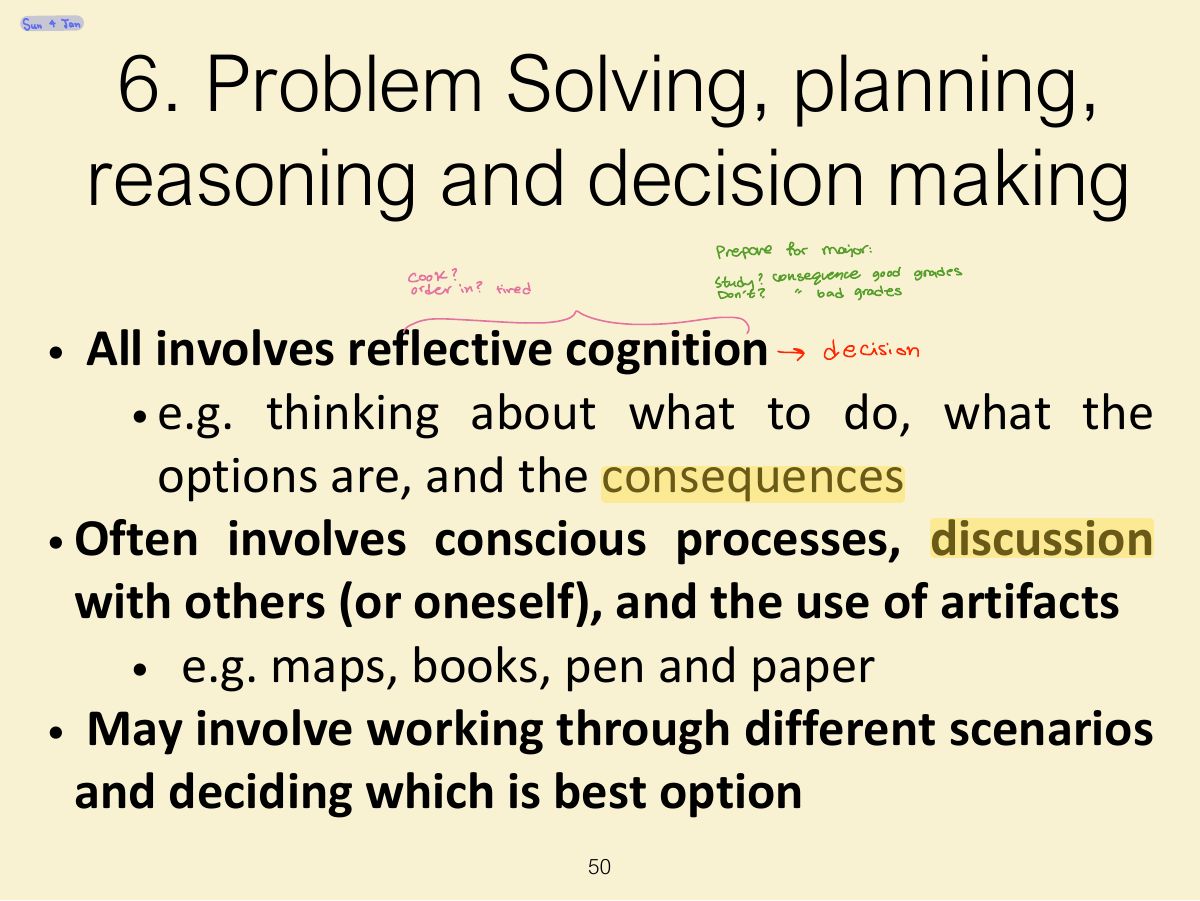
                                                                                  Slide 50: 6. Problem Solving, planning, reasoning and decision making
                                                                                  Exam weight Low
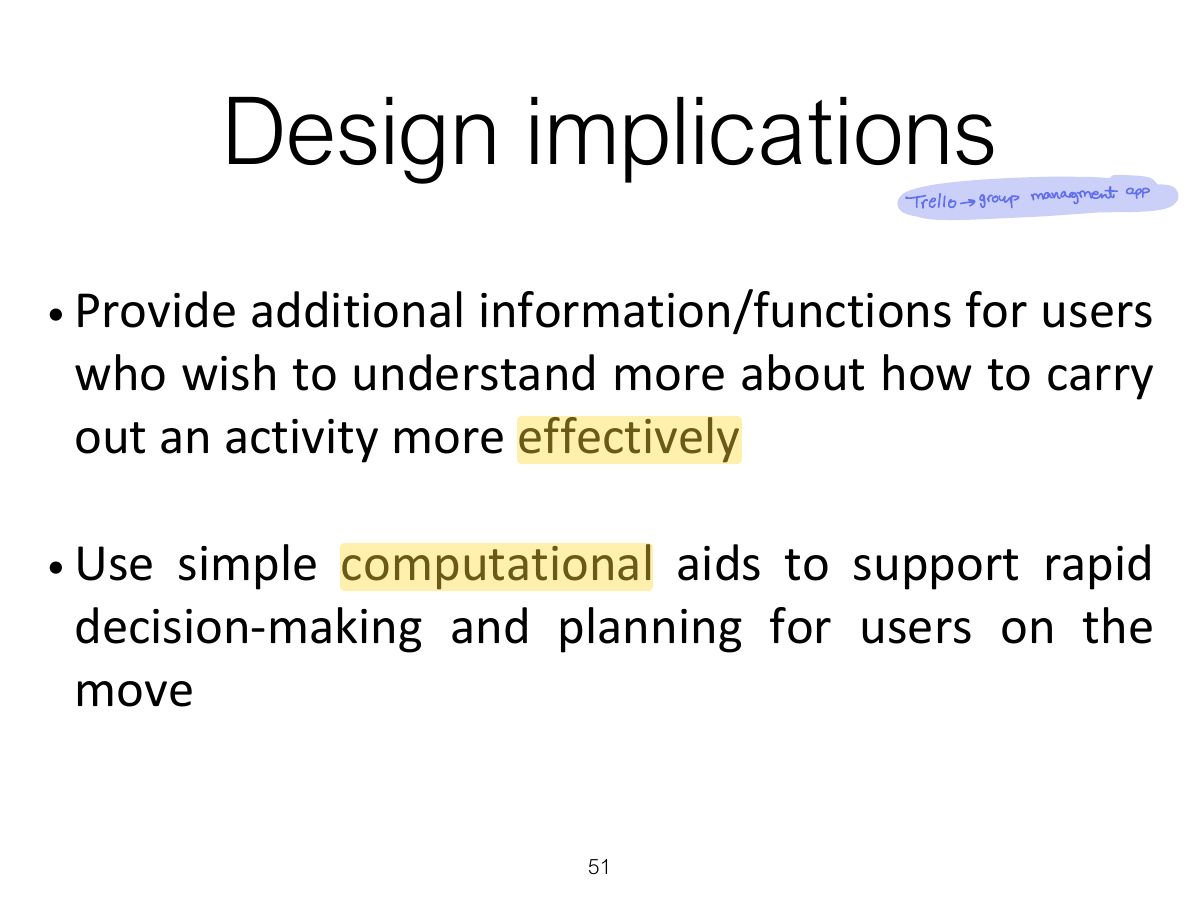
                                                                                  1. Problem solving / planning / reasoning / decision-making: reflective cognition; show information needed for comparisons.
                                                                                  Slide 51: Design implications
                                                                                  Exam weight Low
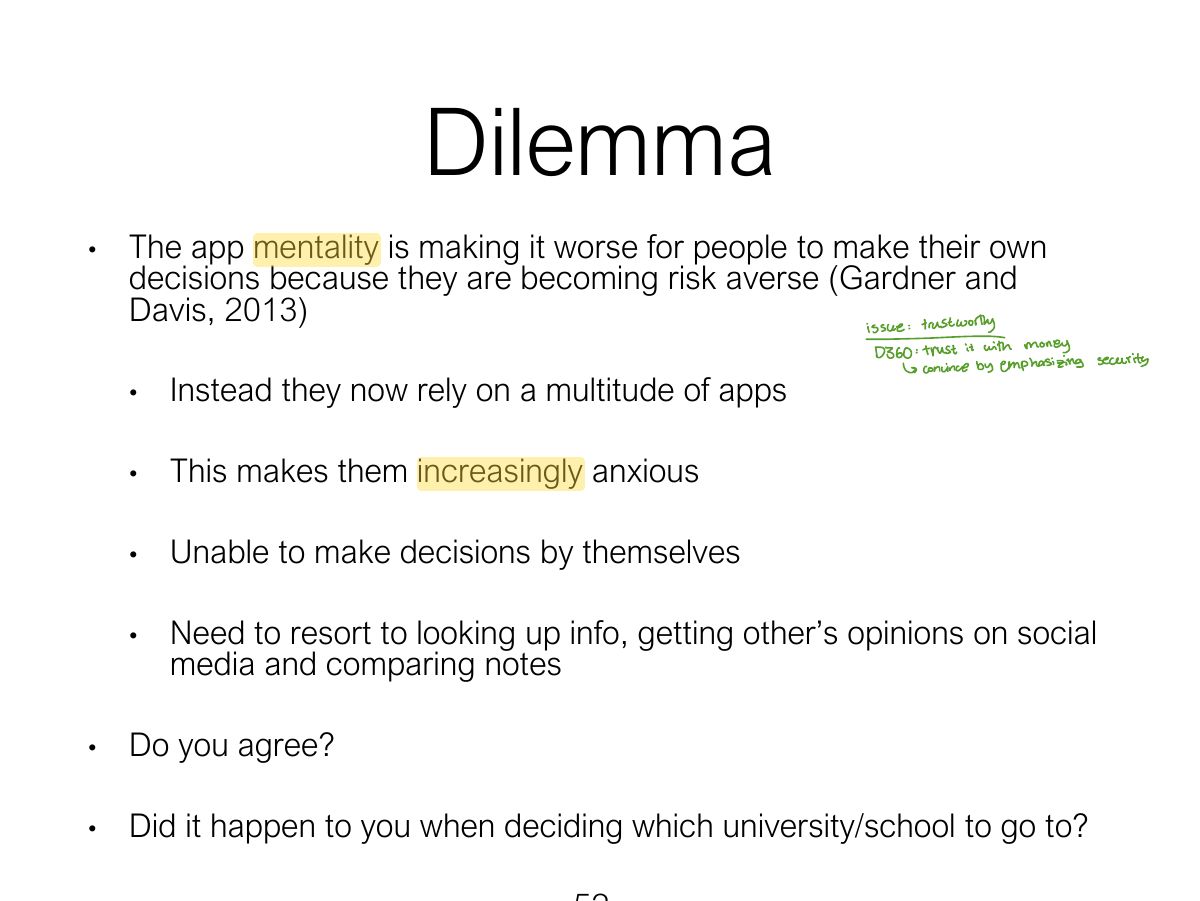
                                                                                    Slide 52: Dilemma
                                                                                    Exam weight Low
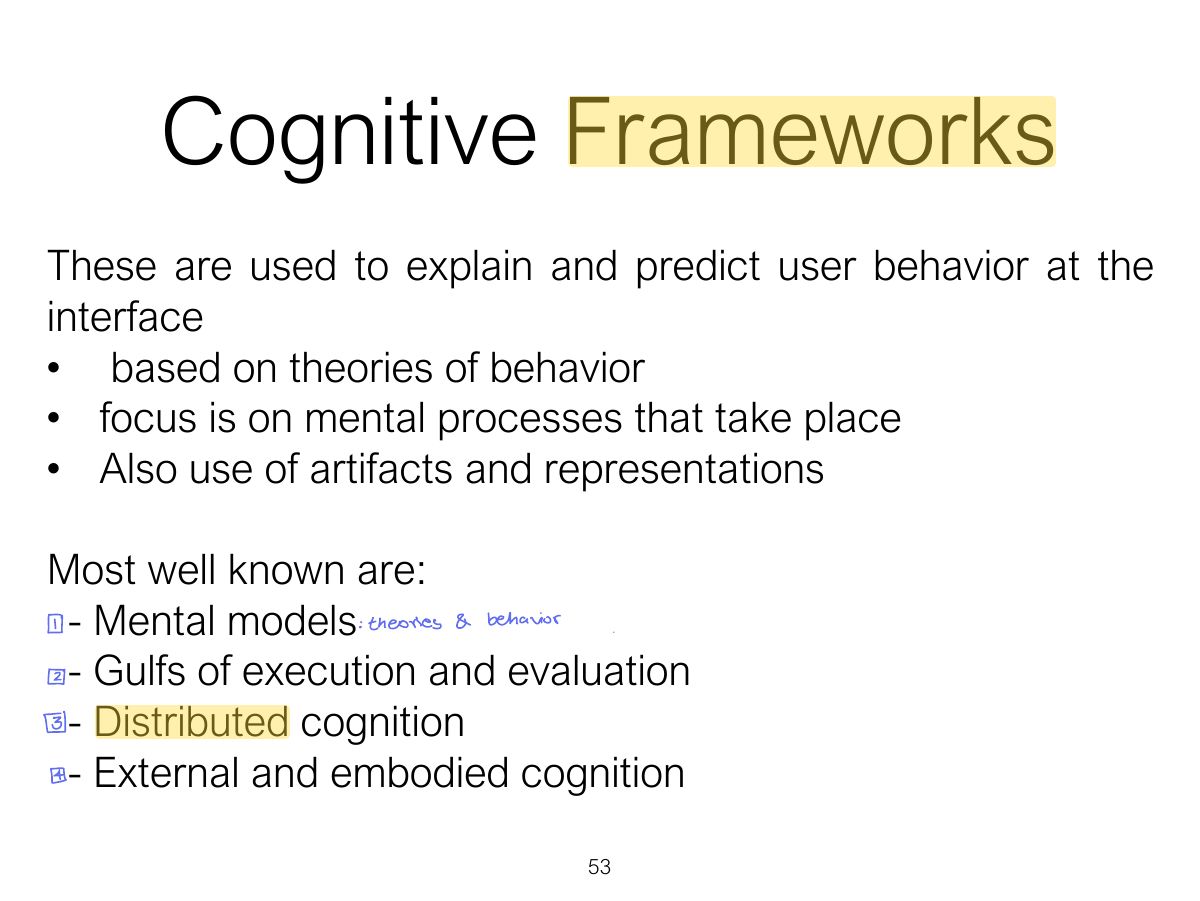
                                                                                      Slide 53: Cognitive Frameworks
                                                                                      Exam weight Low
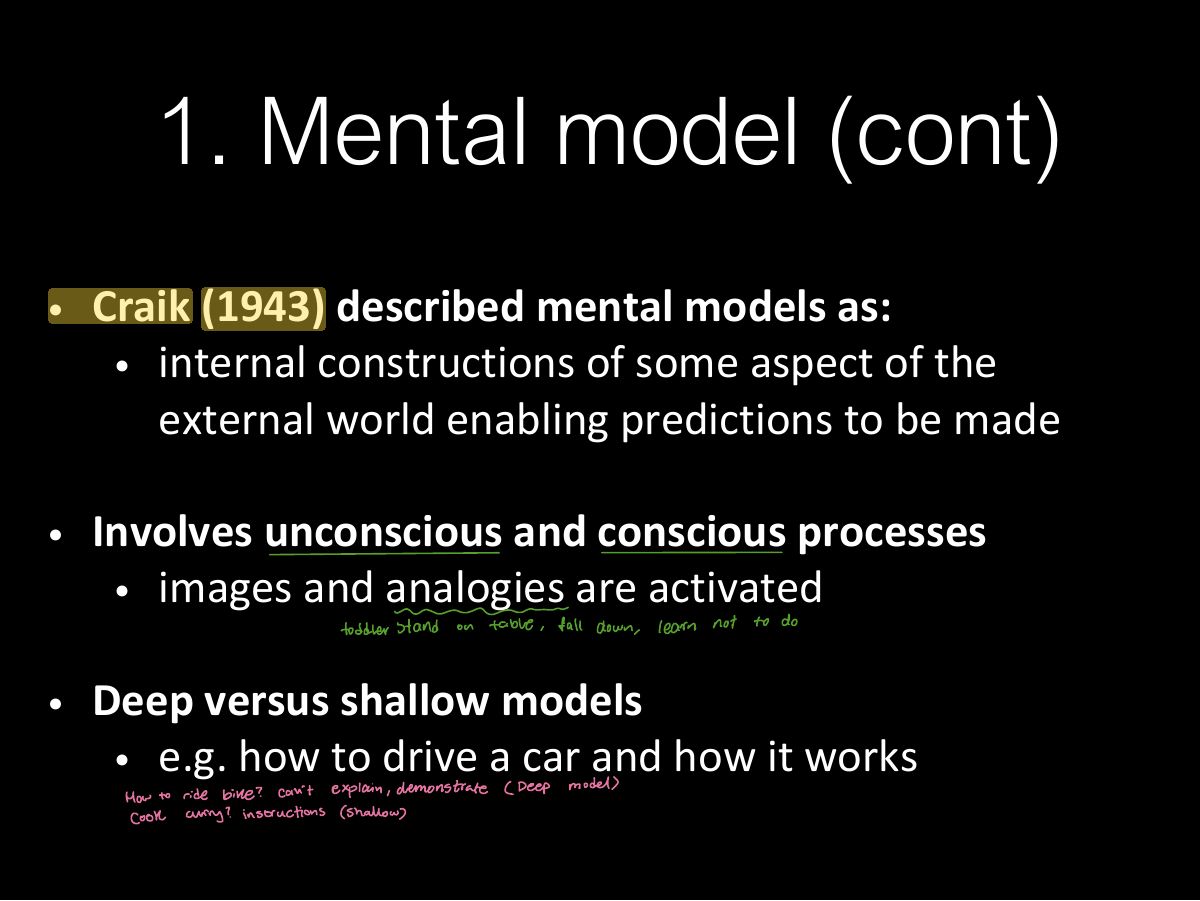
                                                                                        Slide 54: 1. Mental model
                                                                                        Exam weight High
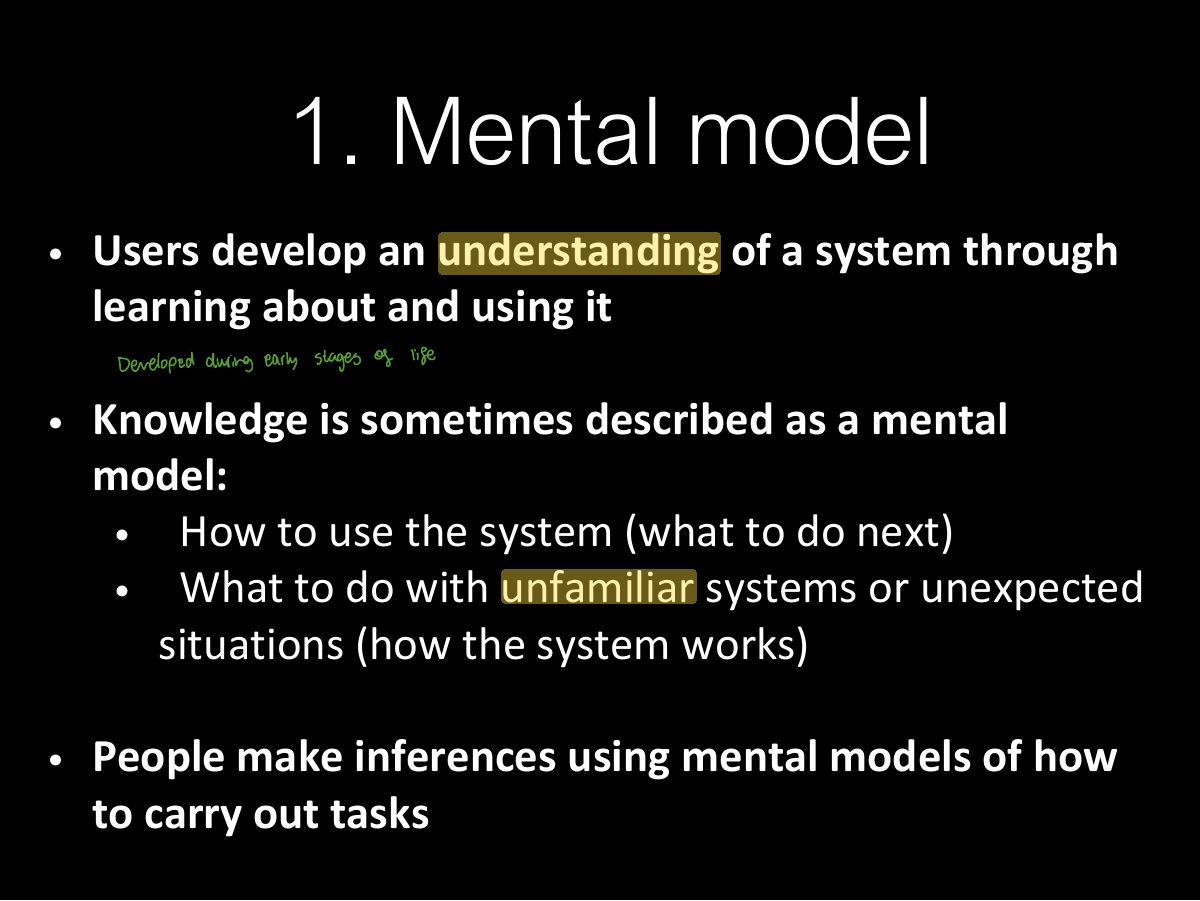
                                                                                        1. Mental model: a user’s internal model of how a system works; often wrong (turning the thermostat up higher heats faster).
                                                                                        🎯 How this can come up · 1 question
                                                                                        MCQ

                                                                                        Setting the thermostat to maximum to heat a room faster reflects a faulty:

                                                                                        Slide 55: 1. Mental model (cont)
                                                                                        Exam weight Low

                                                                                          Everyday reasoning and mental

                                                                                          models

                                                                                          • You arrive home on a cold winter’s night to a cold house. How do you get the house to warm up as quickly as possible? Set the thermostat to be at its highest or to the desired temperature?
                                                                                          • You arrive home starving hungry. You look in the fridge and find all that is left is an uncooked pizza. You have an electric oven. Do you warm it up to 375 degrees first and then put it in (as specified by the instructions) or turn the oven up higher to try to warm it up quicker?
                                                                                          56
                                                                                          Exam weight Low

                                                                                            Heating up a room or oven that is

                                                                                            thermostat-controlled

                                                                                            • Many people have erroneous mental models (Kempton, 1996)
                                                                                            • Why?
                                                                                              • General valve theory, where ‘more is more’ principle is generalised to different settings (e.g. gas pedal, gas cooker, tap, radio volume)
                                                                                              • Thermostats based on model of on-off switch model
                                                                                            57
                                                                                            Exam weight Low

                                                                                              Heating up a room or oven that is

                                                                                              thermostat-controlled (cont)

                                                                                              • Same is often true for understanding how interactive devices and computers work:
                                                                                                • poor, often incomplete, easily confusable, based on inappropriate analogies and superstition (Norman, 1983)
                                                                                                • e.g. elevators and pedestrian crossings - lot of people hit the button at least twice
                                                                                                • Why? Think it will make the lights change faster or ensure the elevator arrives!
                                                                                              58
                                                                                              Exam weight Low
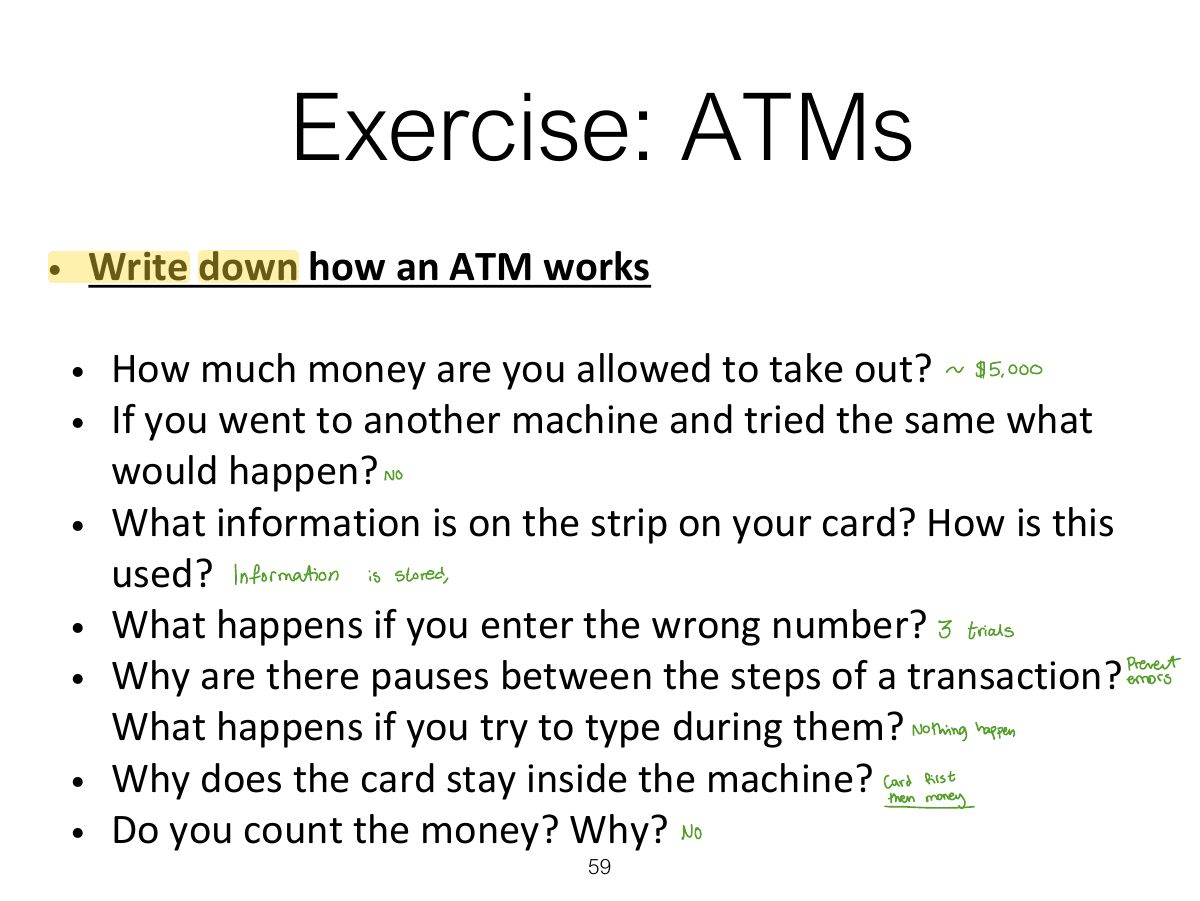
                                                                                                Slide 59: Exercise: ATMs
                                                                                                Exam weight Low

                                                                                                  How did you fare?

                                                                                                  • Your mental model
                                                                                                    • How accurate?
                                                                                                    • How similar?
                                                                                                    • How shallow?
                                                                                                  • Payne (1991) did a similar study and found that people frequently resort to analogies to explain how they work
                                                                                                  • People’s accounts greatly varied and were often ad hoc
                                                                                                  60
                                                                                                  Exam weight Low
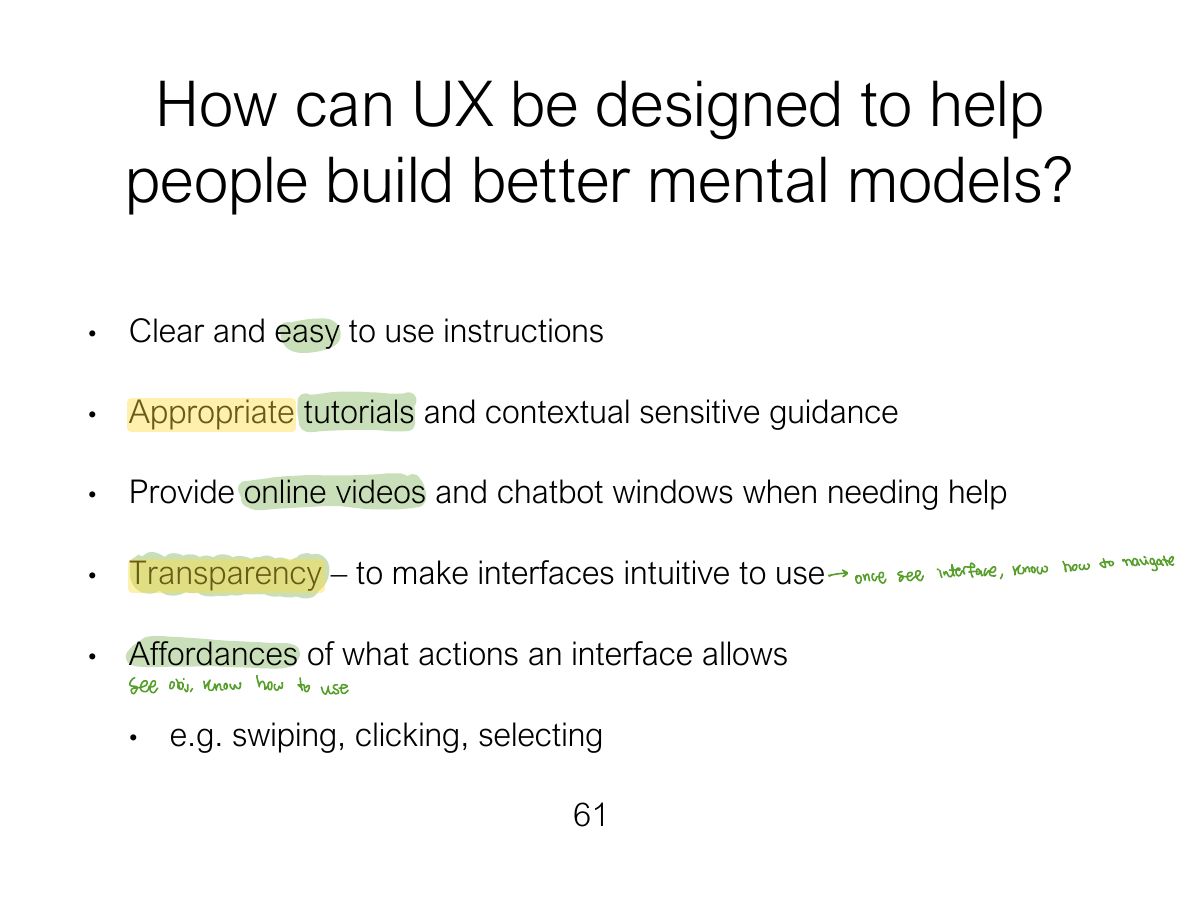
                                                                                                    Slide 61: How can UX be designed to help people build better mental models?
                                                                                                    Exam weight Low
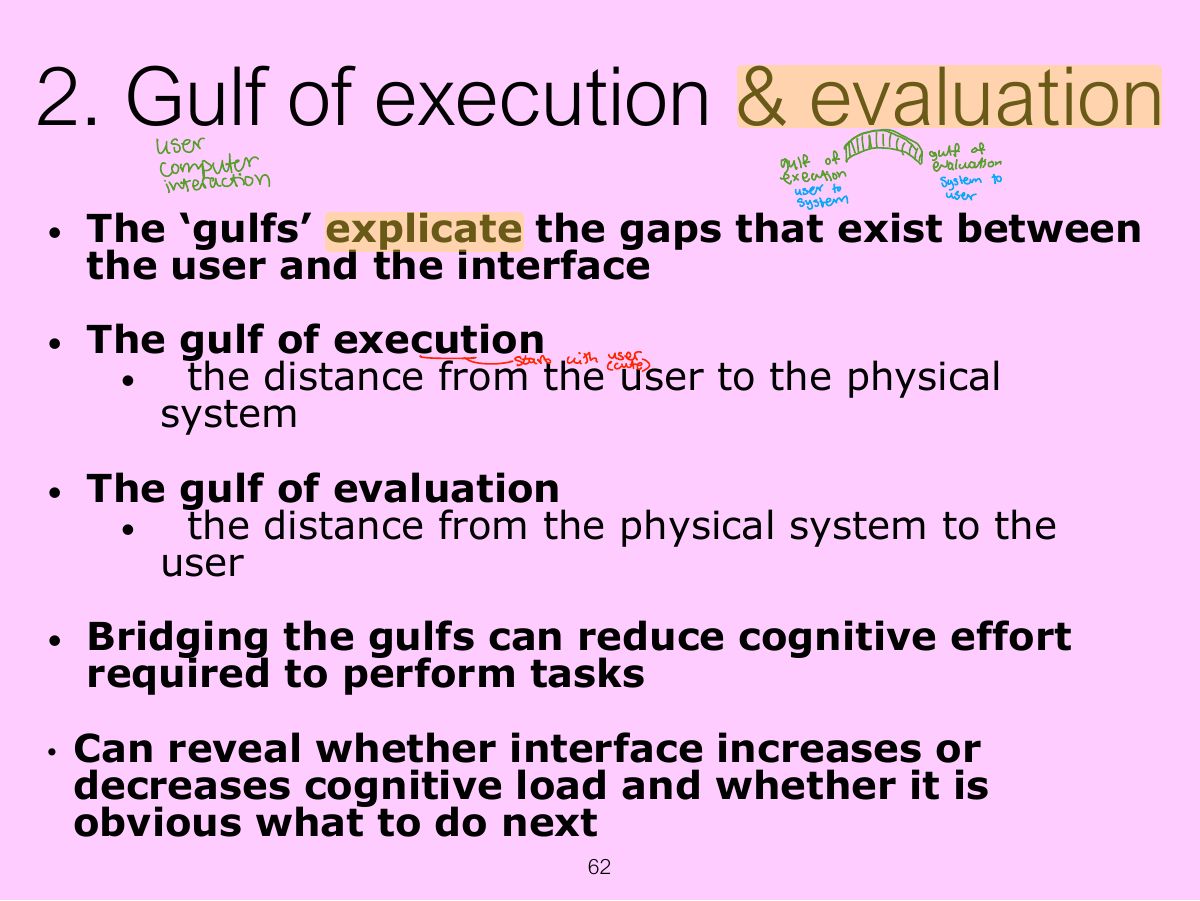
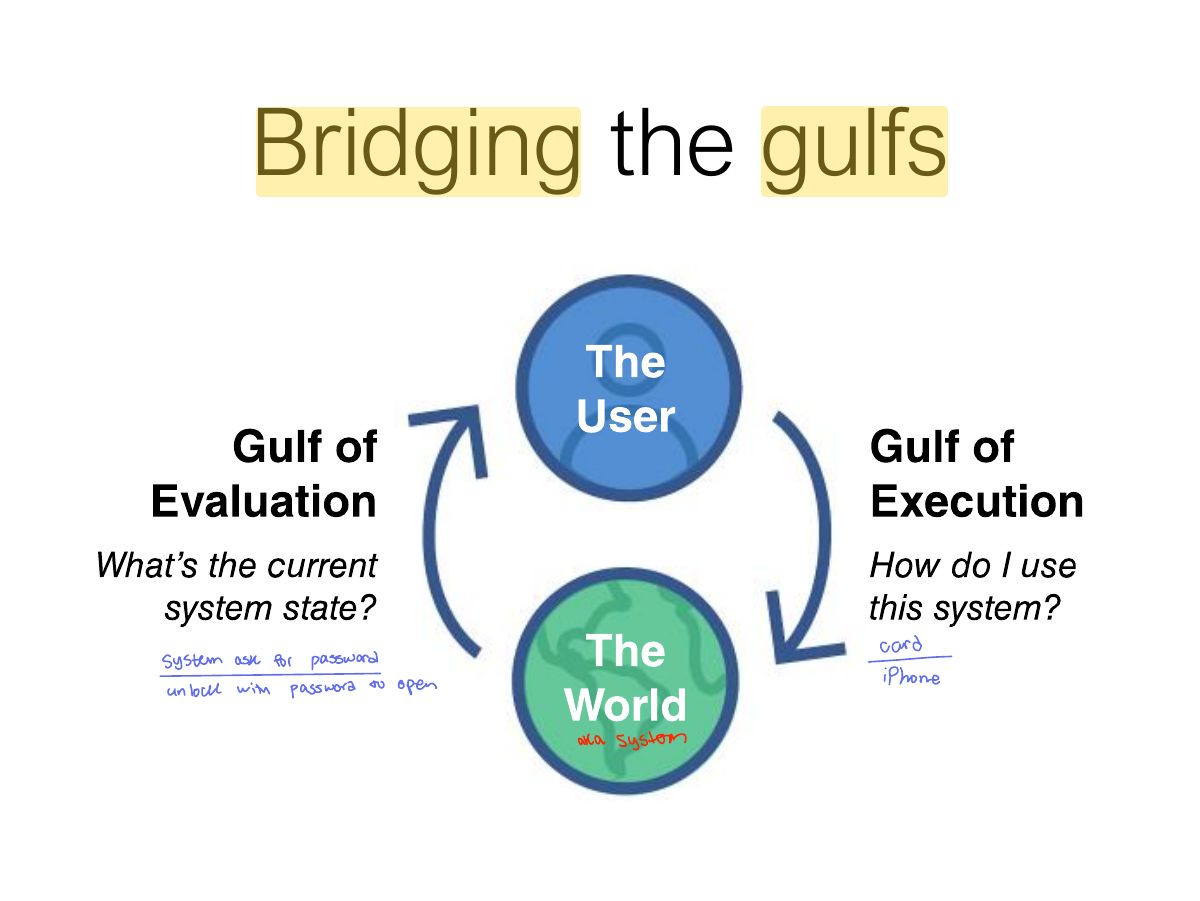
                                                                                                      Slide 62: 2. Gulf of execution & evaluation
                                                                                                      Exam weight High
                                                                                                      1. Gulf of execution: gap between what users want to do and what the system lets them do. Gulf of evaluation: gap between the system state and the user’s ability to interpret it.
                                                                                                      🎯 How this can come up · 1 question
                                                                                                      MCQ

                                                                                                      Users can’t tell whether their file was saved. This is a gulf of:

                                                                                                      Slide 63: Bridging the gulfs
                                                                                                      Exam weight Low
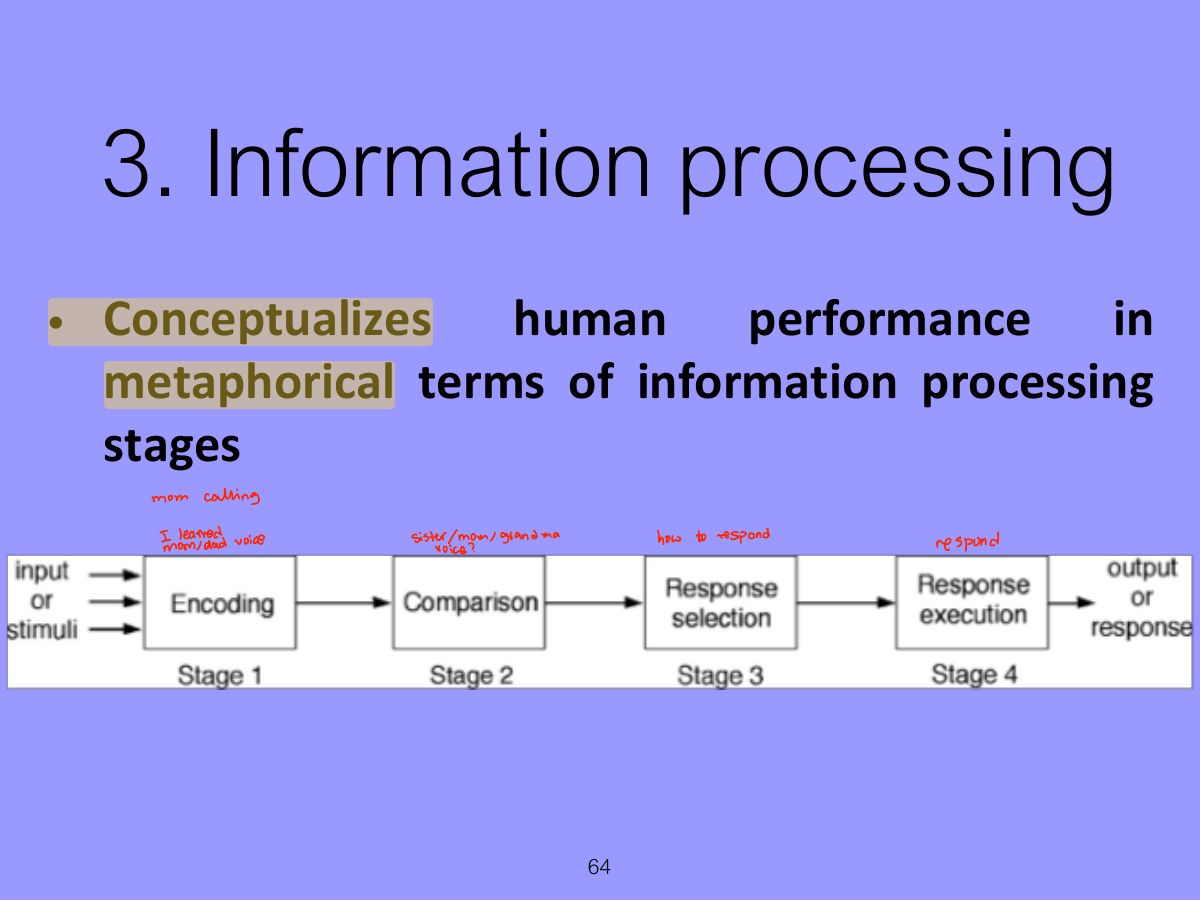
                                                                                                        Slide 64: 3. Information processing
                                                                                                        Exam weight Low
                                                                                                        1. Information processing: mind as a series of stages: encode → compare → select response → execute.

                                                                                                        Limitations

                                                                                                        • Based on modeling mental activities that happen exclusively inside the head
                                                                                                        • Do not adequately account for how people interact with computers and other devices in real world
                                                                                                        65
                                                                                                        Exam weight Low
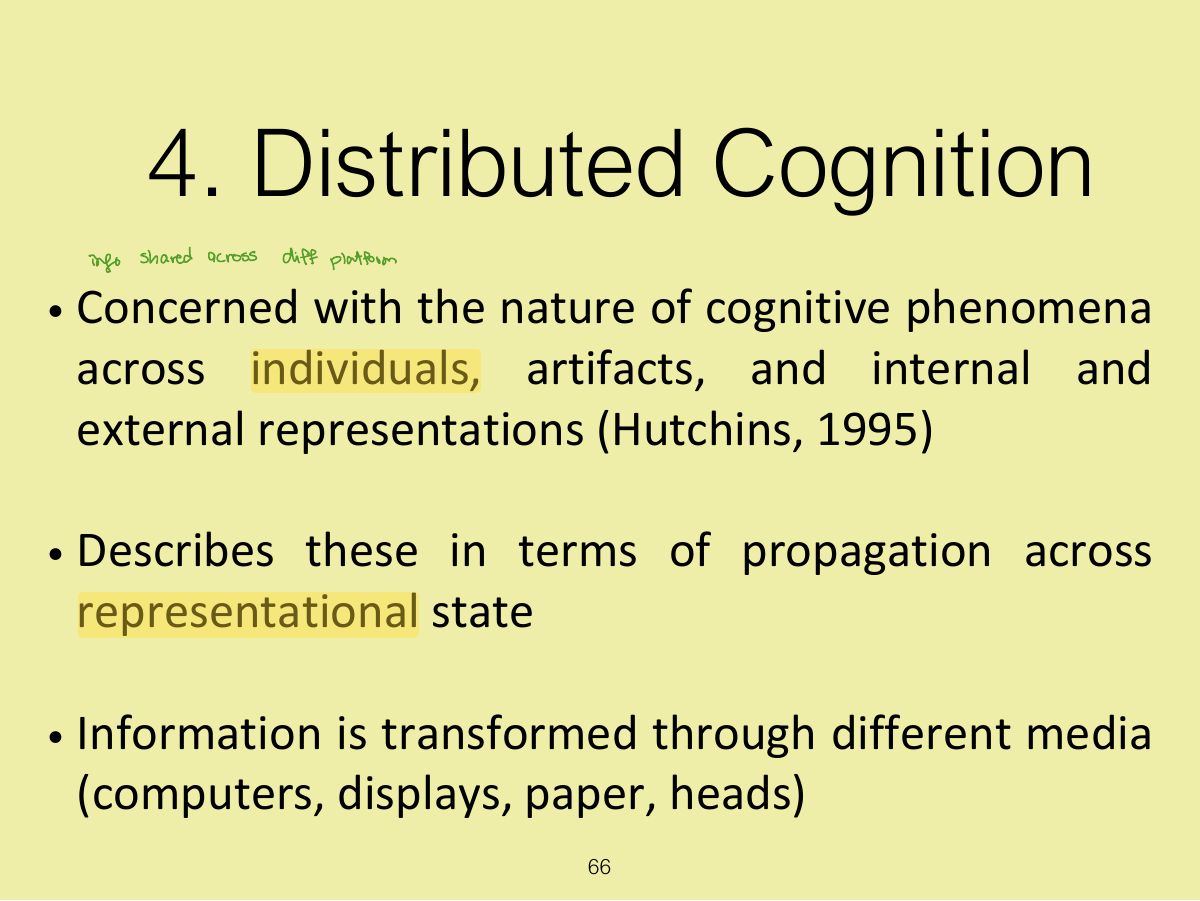
                                                                                                          Slide 66: 4. Distributed Cognition
                                                                                                          Exam weight Low
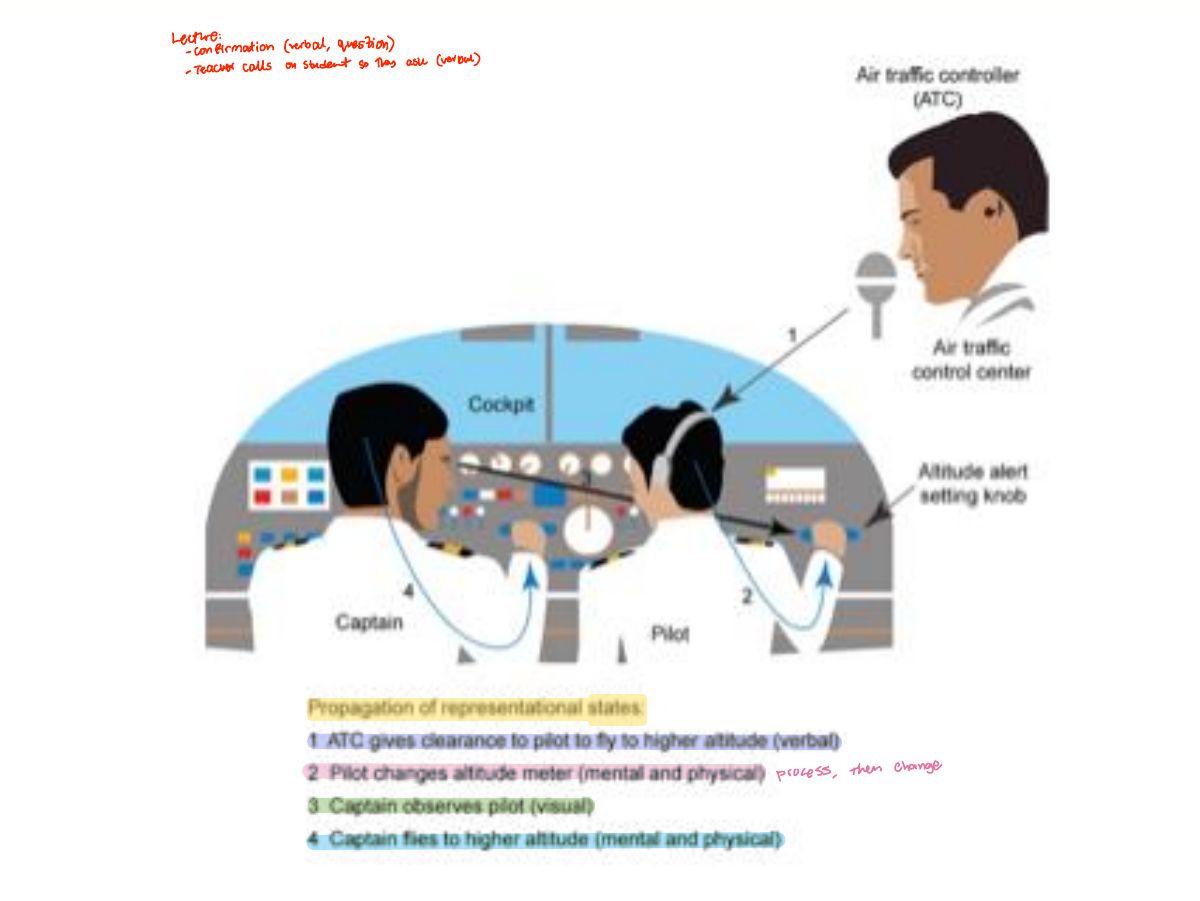
                                                                                                          1. Distributed cognition: cognition spread across people, tools and the environment (e.g. an air-traffic control team).
                                                                                                          Slide 67: Slide 67
                                                                                                          Exam weight Low

                                                                                                            What’s Involved

                                                                                                            • The distributed problem-solving that takes place
                                                                                                            • The role of verbal and non-verbal behavior
                                                                                                            • The various coordinating mechanisms that are used (e.g. rules, procedures)
                                                                                                            • The communication that takes place as the collaborative activity progresses
                                                                                                            • How knowledge is shared and accessed
                                                                                                            68
                                                                                                            Exam weight Low
                                                                                                              Slide 69: 5. External Cognition
                                                                                                              Exam weight Low
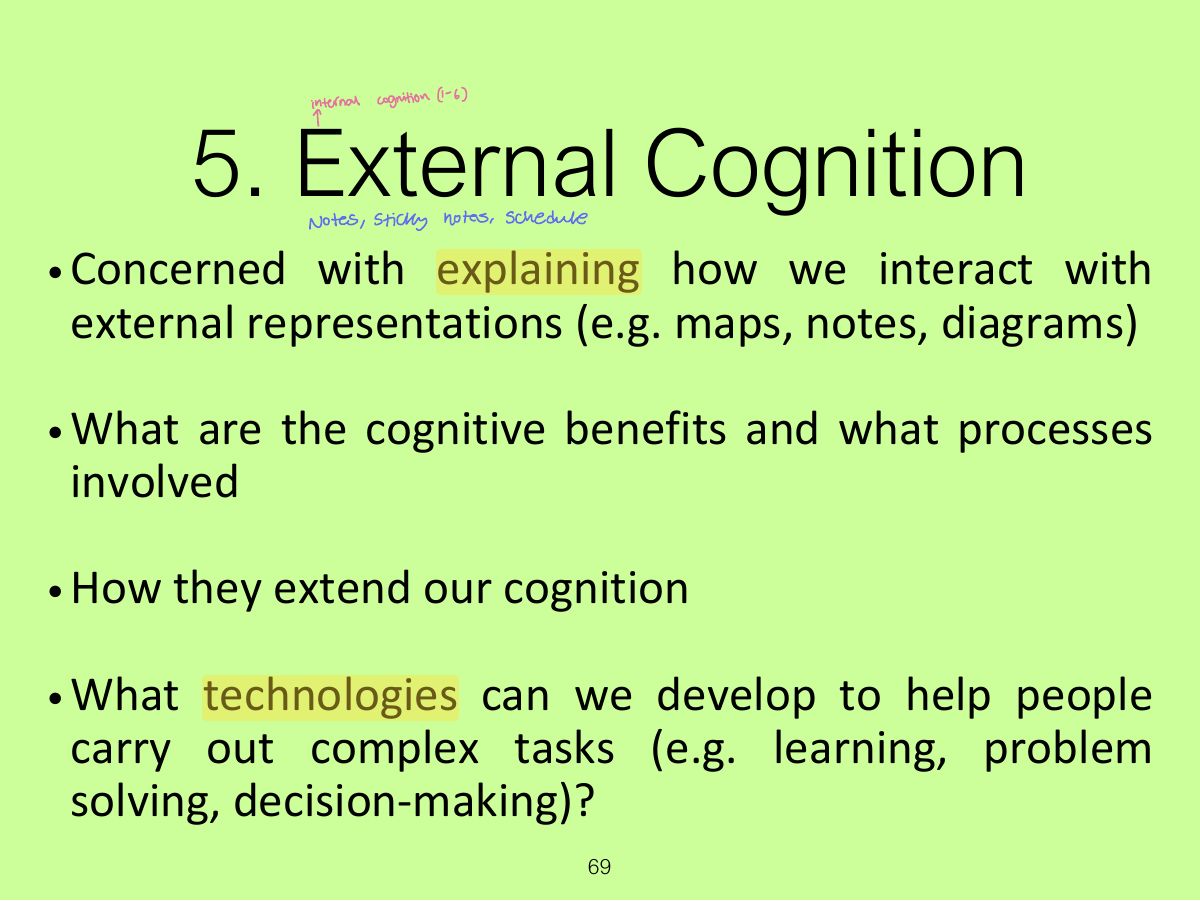
                                                                                                              1. External cognition: using external representations (notes, calendars) to reduce memory load and do computational offloading.

                                                                                                              Externalizing to reduce memory

                                                                                                              load

                                                                                                              • Diaries, reminders, calendars, notes, shopping lists, to-do lists
                                                                                                                • written to remind us of what to do
                                                                                                              • Post-its, piles, marked emails
                                                                                                                • where placed indicates priority of what to do
                                                                                                              • External representations:
                                                                                                                • Remind us that we need to do something (e.g. to buy something for mother’s day)
                                                                                                                • Remind us of what to do (e.g. buy a card)
                                                                                                                • Remind us when to do something (e.g. send a card by a certain date)
                                                                                                              70
                                                                                                              Exam weight Low
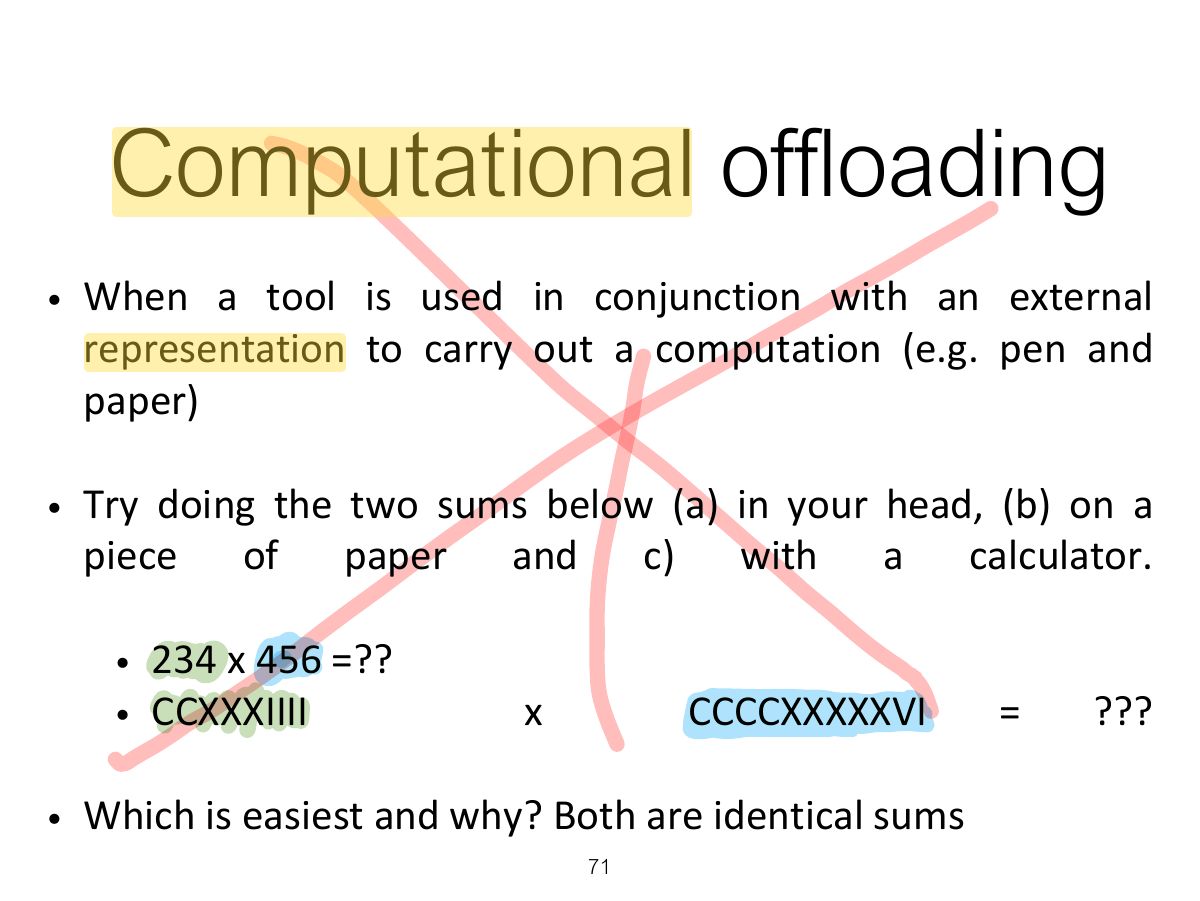
                                                                                                                Slide 71: Computational offloading
                                                                                                                Exam weight Low
                                                                                                                  Slide 72: 6. Embodied interaction
                                                                                                                  Exam weight Low
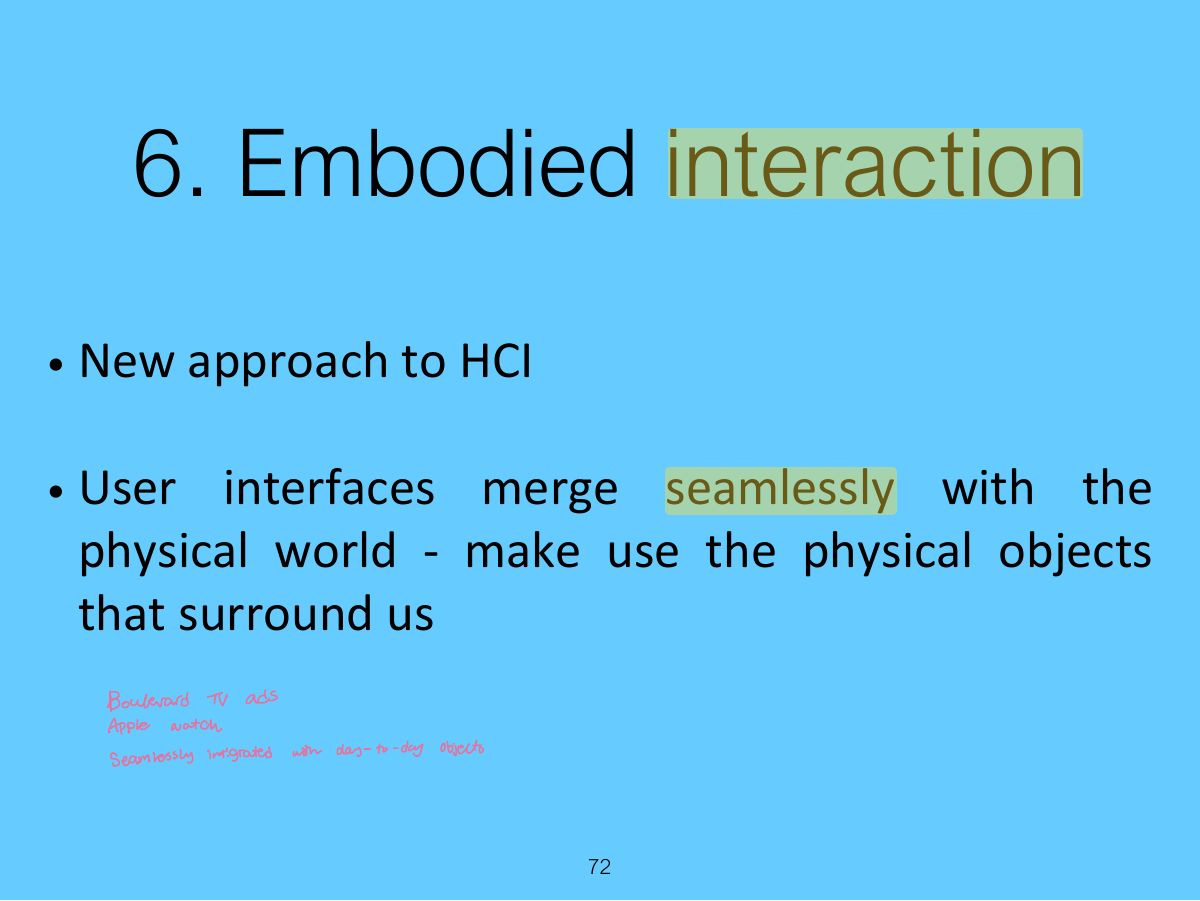
                                                                                                                  1. Embodied interaction: thinking through the body and physical interaction.
                                                                                                                  Slide 73: Summary
                                                                                                                  Exam weight Low

                                                                                                                    Extra Activity

                                                                                                                    Write down how you think a contactless card or smartphone app like Apple Pay works

                                                                                                                    • What information is sent between the card/smartphone and the card reader when it is placed in front of it?
                                                                                                                    • What is the maximum amount you can pay for something using a contactless card, Apple Pay or Google Pay?
                                                                                                                    • Why is there an upper limit?
                                                                                                                    • How many times can you use a contactless card or Apple/Google Pay in a day?
                                                                                                                    • What happens if you have two contactless cards in the same wallet/purse?
                                                                                                                    • What happens when your contactless card is stolen and you report it to the bank? What does the bank do?
                                                                                                                    74
                                                                                                                    Exam weight Low