SE311 · Annotated SlidesChapter 5.1 — Requirements Analysis: Domain Modeling
Chapter 5.1 · Annotated slides

Requirements Analysis: Domain Modeling

Requirements analysis activities, the system requirements specification and ways to write it, and domain modeling: identifying and evaluating classes, associations and attributes, then adding detail.
Slide text Study notes Highlight: key words Tips, tricks & traps Seen again elsewhere How it can come up
Slide 1: Slide 1
Exam weight Low
    Slide 2: Slide 2
    Exam weight Low

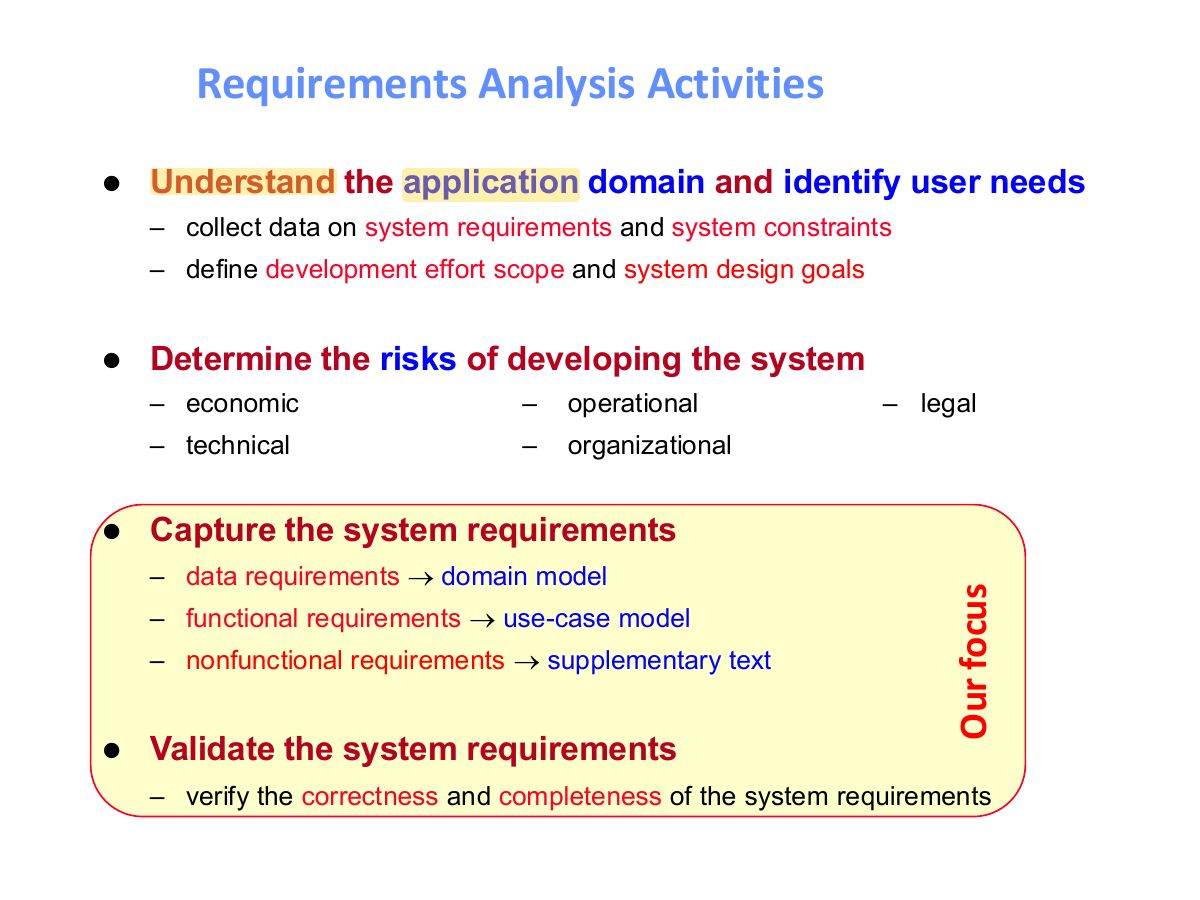
      Requirements Analysis Activities

      Requirements Analysis Activities

      • Capture Data Requirements: Domain Modeling
      • Capture Functional Requirements: Use-Case Modeling
      • Capture Nonfunctional Requirements
      • Validate System Requirements (Discussed in Part 12)
      3
      Exam weight Low
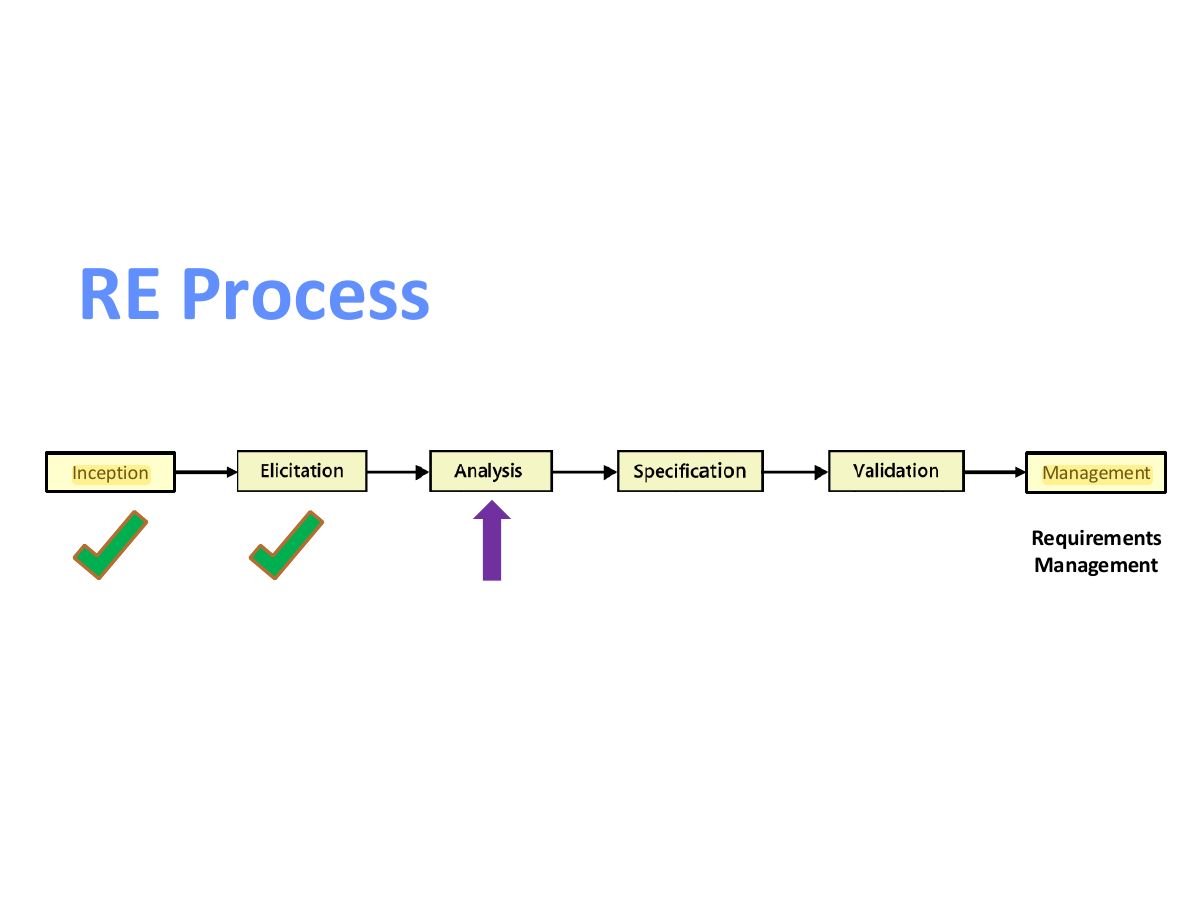
      1. Analysis: model, decompose, prioritize and refine requirements so they are complete and understood.
      Slide 4: Requirements Analysis Activities
      Exam weight Low

        SYSTEMREQUIREMENTSSPECIFICATION(SRS)

        The SRS documents the system requirements.

        ⚫

        • It is the official statement of what is required of the system.
        • It should include both a definition of user requirements and a specification of the system requirements.

        It is NOT a design document.

        ⚫

        • It should state WHAT the system should do, but not HOW it should do it.

        NOTE: Many agile methods argue that producing a SRS is a waste

        of time as requirements change so quickly.

        5
        Exam weight Low
        1. SRS: the system requirements specification; written in natural language, structured templates, or models.

        WAYSOFWRITINGA SRS

        Natural language

        ⚫

        • Uses sentences supplemented by diagrams and tables.

        ⚫

        Structured natural language

        • Uses a restricted language that follows a fixed standard/template.

        Graphical notations

        ⚫

        • Uses graphical models plus text annotations.

        Design description languages

        ⚫

        • Uses a language like a programming language.

        Mathematical specifications

        ⚫

        • Uses notations based on mathematical concepts.
        WAYSOFWRITINGA SRS
        6
        Exam weight Low

          Requirements Analysis Activities

          ➔ System Requirements Capture Activities

          ☞ Capture Data Requirements: Domain Modeling

          • Capture Functional Requirements: Use-Case Modeling
          • Capture Nonfunctional Requirements
          • Validate System Requirements
          7
          Exam weight Low

            DOMAINMODELING

            Captures the most important classes and their associations.

            ⚫

            ☞

            Things that exist or events that occur for which data must be stored.

            ⚫

            The classes and associations are found from user requirements:

            • requirements statement
              • domain experts (users)

            The classes can be:

            ⚫

            • business objects (e.g., orders, accounts, etc.).
            • real-world objects and concepts (e.g., suppliers, customers, etc.).
            • events (e.g., aircraft arrival/departure, sales, reservations, etc.) Provides a Described in a class diagram. glossary of terms.
            8
            Exam weight Low
            1. Domain model: a class diagram of real-world concepts (no methods/implementation) in the problem domain.
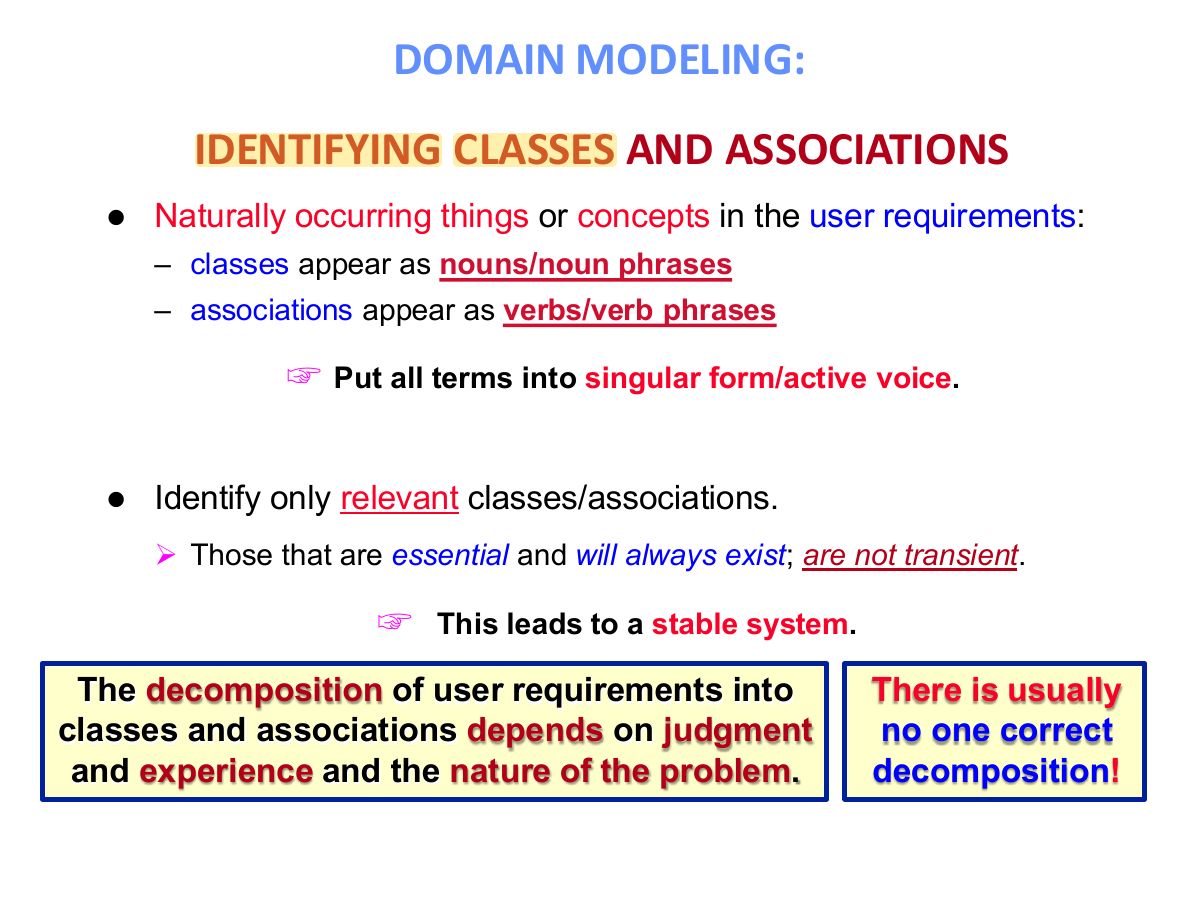
            Slide 9: DOMAINMODELING: IDENTIFYINGCLASSESANDASSOCIATIONS
            Exam weight Low

              DOMAINMODELING:IDENTIFYINGATTRIBUTES

              Attributes usually correspond to nouns followed by possessive

              ⚫

              phrases e.g., password of student; student's address.

              Adjectives usually represent specific enumerated values

              ⚫

              e.g., Fall term; PhD degree.

              Only identify attributes that directly relate to the application

              ⚫

              domain.

              Most attributes will not be given in a requirements statement and will

              have to be obtained from domain experts or application documentation.

              10
              Exam weight High
              1. Find candidate classes from NOUNS in the requirements; associations from verbs/relationships.
              Memory trickNouns → classes or attributes; verbs → associations or operations.
              🎯 How this can come up · 1 question
              MCQ

              When building a domain model, candidate classes come mostly from:

              DOMAINMODELING:EVALUATINGCLASSES

              Are any classes irrelevant to the domain model? → eliminate

              ⚫

              ☞

              A class should represent persistent data, not transient data.

              Are any classes vague (ill-defined)? → makespecific or eliminate

              ⚫

              ☞

              A class should be specific and well-defined.

              Are any classes redundant? → keep most descriptive

              ⚫ ⚫

              Should any classes really be attributes? → consider application requirements ☞

              Is the concept dependent or independent?

              Do any class names describe a role?

              ⚫

              ☞

              Roles also appear as nouns!

              Do any classes describe an operation/action? → eliminate

              ⚫ ⚫

              Do any classes describe implementation constructs? → eliminate

              11
              Exam weight High
              1. Evaluate classes: drop redundant, irrelevant, vague, implementation, or attribute-like ones.
              🎯 How this can come up · 1 question
              MCQ

              "Email address" in a domain model is most likely:

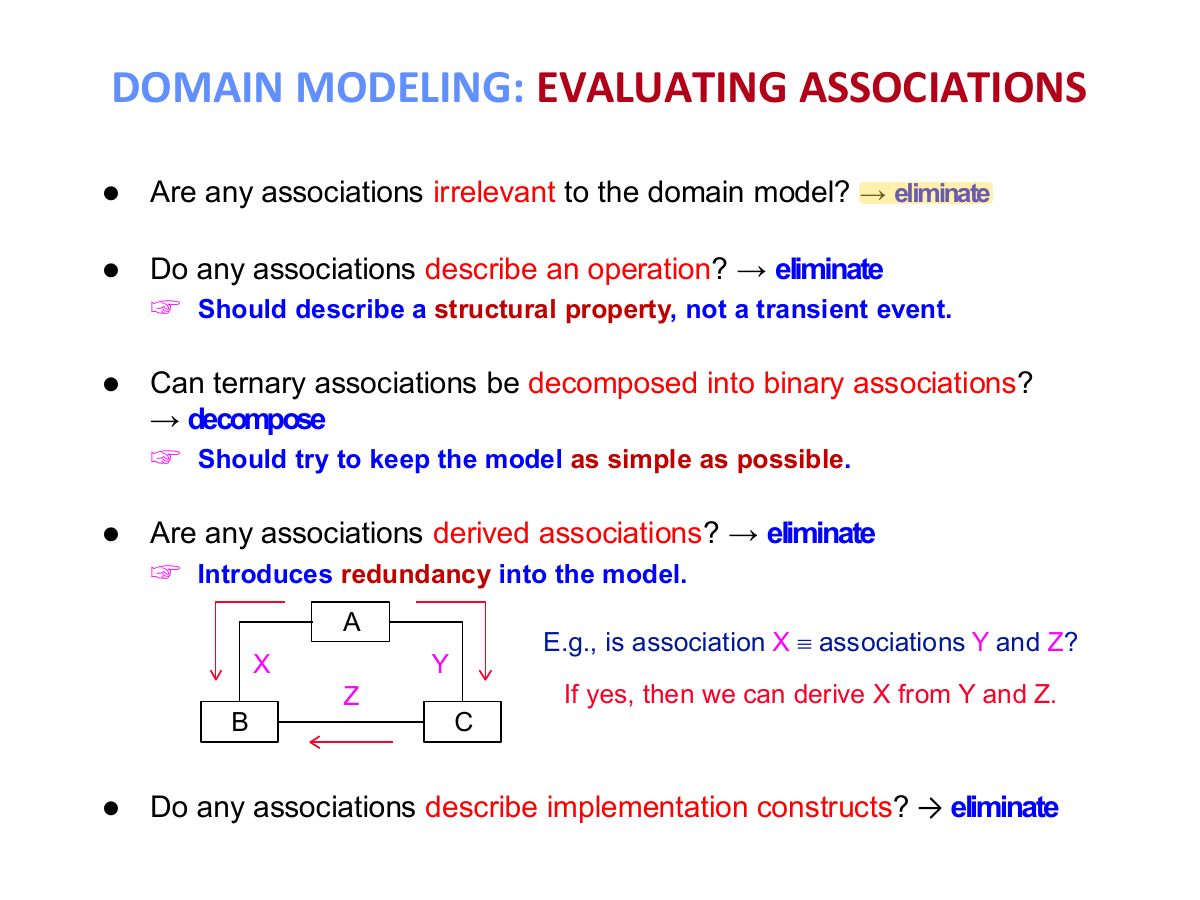
              Slide 12: DOMAINMODELING:EVALUATINGASSOCIATIONS
              Exam weight Low
              1. Evaluate associations: keep those that are needed and lasting; add multiplicities, names, roles.

              DOMAINMODELING:EVALUATINGATTRIBUTES

              Are attributes closely related to the class they are in?

              ⚫

              ☞

              A class should be simple and coherent.

              Should any attributes really be classes?

              ⚫

              ☞

              The concept should be dependent on the class.

              Should any attributes be in an association class?

              ⚫

              ☞

              Does the attribute depend on the existence of an association?

              Have object identifiers been included as attributes?

              ⚫

              ☞

              Object identifiers should not be included in the domain model!

              13
              Exam weight Low

                DOMAINMODELING: DETAIL

                For each class we specify its attributes.

                ⚫

                • Each class is assumed to have two standard operations, get and set, which do not need to be specified.

                ⚫

                For each

                attribute we specify

                • name (unique within a class)
                • type (e.g., string, integer, date, etc.)
                • multiplicity (if greater than 1)

                For each association we specify

                ⚫

                • name → should say “ what ” not “how” or “why”
                • role names (if needed)
                • multiplicity (if known)
                • association class (if needed)
                14
                Exam weight Low
                1. Detail: association classes, aggregation/composition, generalization.

                SYSTEM REQUIREMENTS

                ANALYSIS

                DOMAIN MODELING EXERCISE

                1. Movie Shop System (5.1.1)
                2. PSU Registration System(5.1.2)
                15
                Exam weight Low