SE201 · Annotated SlidesChapter 4 — Software Project Management
Chapter 4 · Annotated slides

Software Project Management

The 4 Ps (people, product, process, project), stakeholders, team leaders and team structures, scope and problem decomposition, signs of project risk, the triple constraint, estimation and scheduling, precedence (activity-on-node) diagrams, the critical path and float, Gantt charts, and risk management.
Slide text Study notes Highlight: key words Tips, tricks & traps Seen again elsewhere How it can come up
Slide 1: Slide 1
Exam weight Low

    Course Learning Outcome

    • CLO4: Demonstrate project management skills by working effectively in small teams, and cooperatively with other teams These slides are designed to accompany Software Engineering: A Practitioner’s Approach, 8/e (McGraw-Hill 2014). Slides copyright 2014 by Roger Pressman.
    2
    Exam weight Low

      Project Management Spectrum

      Effective software project management focuses on the four P ’s: people, product, process, and project

      • People: the most important element of a successful project
      • Product: the software to be built
      • Process: the set of framework activities and software engineering tasks to get the job done
      • Project: all work plan required to make the product a reality These slides are designed to accompany Software Engineering: A Practitioner’s Approach, 8/e (McGraw-Hill 2014). Slides copyright 2014 by Roger Pressman.
      3
      Exam weight Low
      1. Management spectrum: the 4 Ps: People, Product, Process, Project.

      1- People: Stakeholders

      • Every organization needs to continually improve its ability to attract, develop, motivate, organize, and retain the workforce needed to accomplish its strategic business objectives, which helps in effective software project management practices. These slides are designed to accompany Software Engineering: A Practitioner’s Approach, 8/e (McGraw-Hill, 2014)
      4
      Exam weight Low
      1. Stakeholders: senior managers, project managers, practitioners, customers, end users.

      1- People: Stakeholders

      • Senior managers who define the business issues that often have significant influence on the project.
      • Project (technical) managers who must plan, motivate, organize, and control the practitioners who do software work.
      • Practitioners who deliver the technical skills that are necessary to engineer a product or application.
      • Customers or Product owners who specify the requirements for the software to be engineered and other stakeholders who have a peripheral interest in the outcome.
      • End-users who interact with the software once it is released for production use. These slides are designed to accompany Software Engineering: A Practitioner’s Approach, 8/e (McGraw-Hill 2014). Slides copyright 2014 by Roger Pressman.
      5
      Exam weight Low

        1- People: Team Leader

        • Project management is a people-intensive activity. A team leader needs to have/develop 3 skills:
        • Motivation. The ability to encourage (by “push or pull”) technical people to produce to their best ability.
        • Organization. The ability to mold existing processes (or invent new ones) that will enable the initial concept to be translated into a final product.
        • Ideas or innovation. The ability to encourage people to create and feel creative even when they must work within bounds established for a particular software product or application. These slides are designed to accompany Software Engineering: A Practitioner’s Approach, 8/e (McGraw-Hill 2014). Slides copyright 2014 by Roger Pressman.
        6
        Exam weight Low

          1- People: Team Leader

          • An effective project manager emphasizes four key traits:
            • Problem solving skills: diagnose the most relevant technical and organizational issues and systematically structure a solution
            • Managerial Identity: A good project manager must take charge of the project.
            • Achievement: competent manager must reward initiative and accomplishment to optimize the productivity of a project team.
            • Influence and team building: must be able to understand verbal and nonverbal signals and react to the needs of the people These slides are designed to accompany Software Engineering: A Practitioner’s Approach, 8/e (McGraw-Hill 2014). Slides copyright 2014 by Roger Pressman.
          7
          Exam weight Low
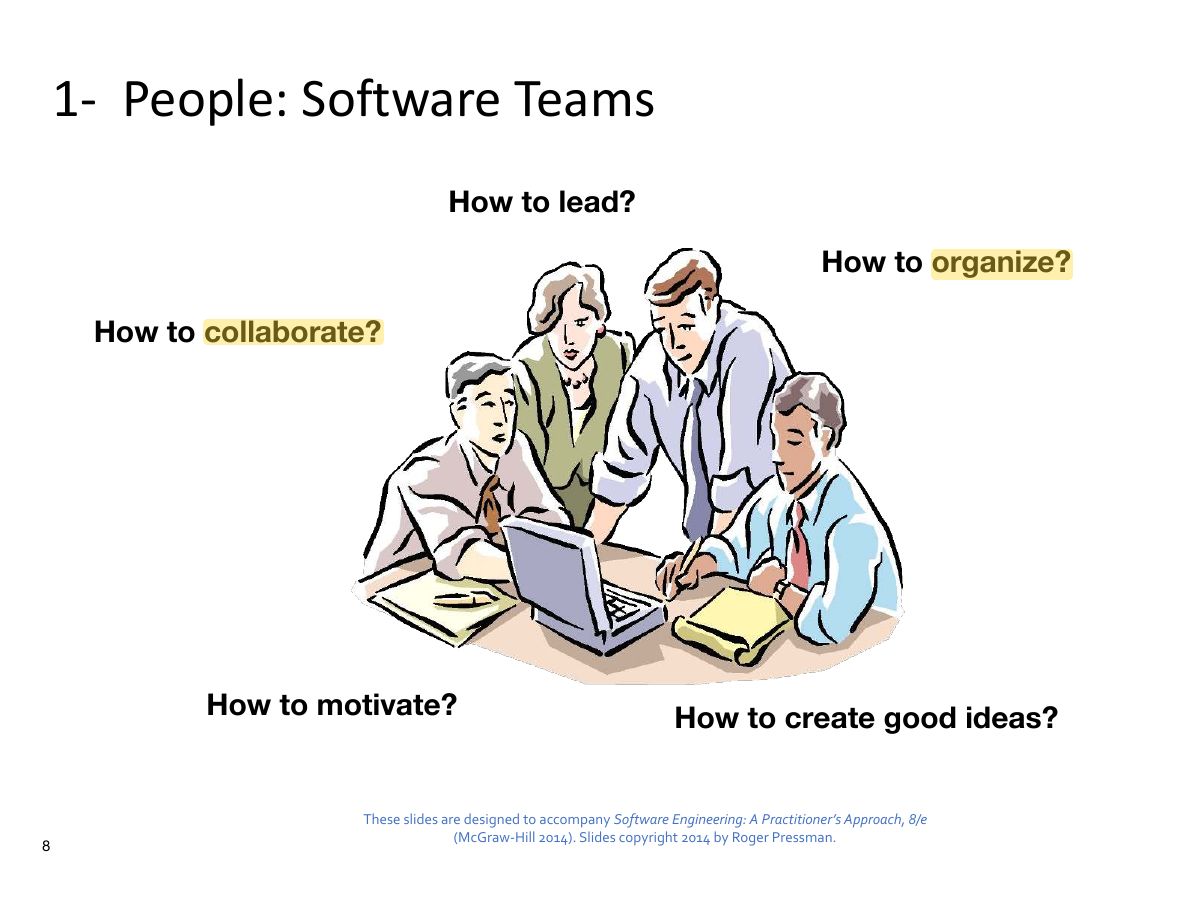
            Slide 8: 1- People: Software Teams
            Exam weight Low

              1- People: Software Teams

              • The “best” team structure depends on the management style of your organization, the number of people who will populate the team and their skill levels, and the overall problem dif culty. fi

              The following factors must be considered when selecting a software

              engineering project team structure ...

              • Difficulty of the problem to be solved
              • Size of the resultant program(s) in lines of code or function points
              • Time that the team will stay together (team lifetime)
              • Degree to which the problem can be modularized
              • Required quality and reliability of the system to be built
              • Rigidity of the delivery date
              • Degree of sociability (communication) required for the project These slides are designed to accompany Software Engineering: A Practitioner’s Approach, 8/e (McGraw-Hill 2014). Slides copyright 2014 by Roger Pressman.
              9
              Exam weight Low
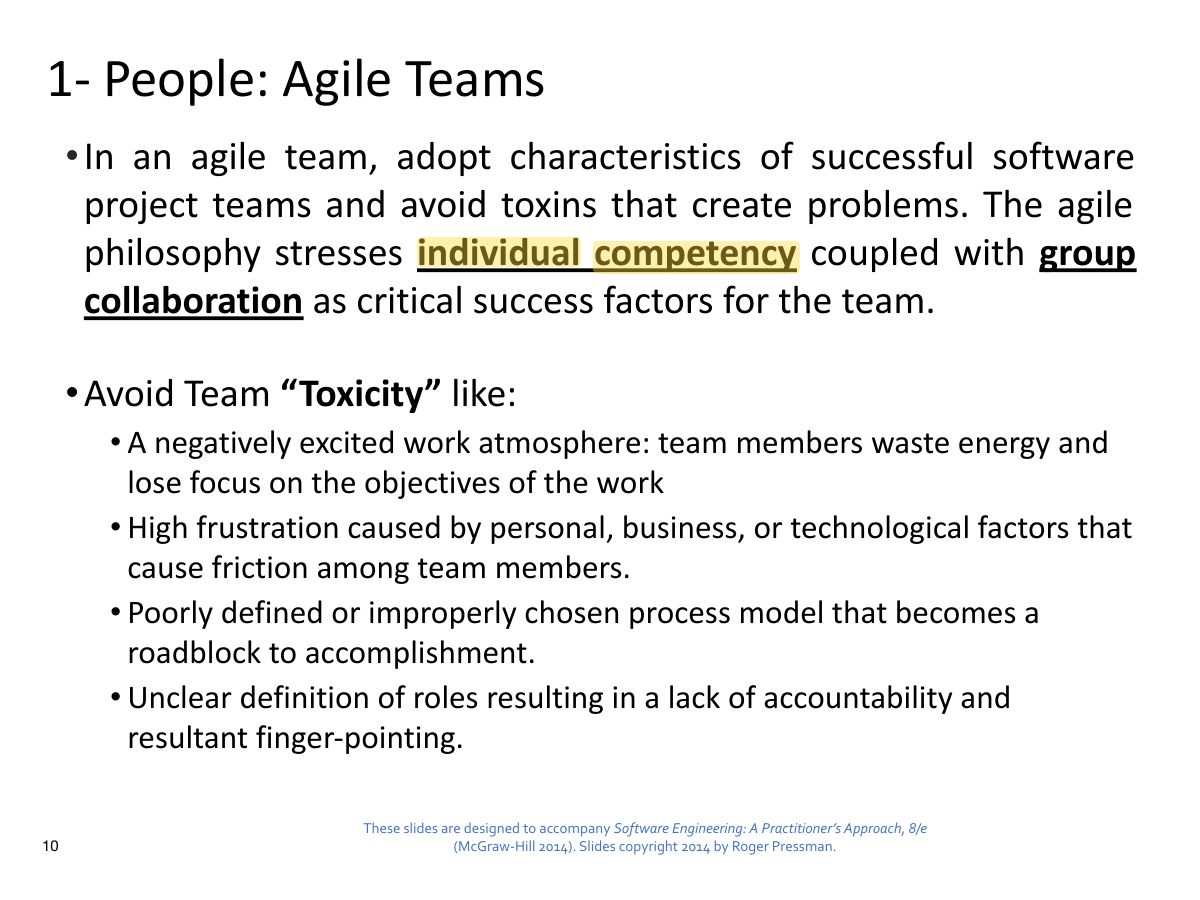
                Slide 10: 1- People: Agile Teams
                Exam weight Low

                  1- People: Agile Teams

                  • The distribution of skills must be appropriate to the problem.
                  • Teams are “self-organizing” in order to make effective use of the competencies of each team member and to foster effective collaboration through a software project.
                  • Agile team gets significant autonomy to make the project management and technical decisions required to get the job done.
                  • Planning is kept to a minimum, and the team is allowed to select its own approach(e.g., process, methods, tools) These slides are designed to accompany Software Engineering: A Practitioner’s Approach, 8/e (McGraw-Hill 2014). Slides copyright 2014 by Roger Pressman.
                  11
                  Exam weight Low

                    1- People: Team Coordination & Communication

                    • Formal, impersonal approaches include software engineering documents and work products (including source code), technical memos, project milestones, schedules, and project control tools, change requests and related documentation, error tracking reports, and repository data.
                    • Formal, interpersonal procedures focus on quality assurance activities applied to software engineering work products. These include status review meetings and design and code inspections. These slides are designed to accompany Software Engineering: A Practitioner’s Approach, 8/e (McGraw-Hill 2014). Slides copyright 2014 by Roger Pressman.
                    12
                    Exam weight Low

                      1- People: Team Coordination & Communication

                      • Informal, interpersonal procedures include group meetings for information dissemination and problem solving and “collocation of requirements and development staff.”
                      • Electronic communication encompasses electronic mail, electronic bulletin boards (real-time chat/forums), and by extension, video-based conferencing systems.
                      • Interpersonal networking includes informal discussions with team members and those outside the project who may have experience or insight that can assist team members. These slides are designed to accompany Software Engineering: A Practitioner’s Approach, 8/e (McGraw-Hill 2014). Slides copyright 2014 by Roger Pressman.
                      13
                      Exam weight Low

                        2- The Product- Scope

                        the software to be built, which meets the requirements of a customer.

                        • Context. How does the software to be built fit into a larger system, product, or business context and what constraints are imposed as a result of the context?
                        • Information objectives. What customer-visible data objects are produced as output from the software? What data objects are required for input?
                        • Function and performance. What function does the software perform to transform input data into output? Are any special performance characteristics to be addressed? These slides are designed to accompany Software Engineering: A Practitioner’s Approach, 8/e (McGraw-Hill 2014). Slides copyright 2014 by Roger Pressman.
                        14
                        Exam weight Low
                        1. Scope: context, information objectives, function and performance. Bounded before estimation.

                        2- The Product- Scope

                        the software to be built, which meets the requirements of the customer.

                        The software project scope must be unambiguous and understandable at the management and technical levels.

                        • A statement of the software scope must be defined. That is, quantitative data (e.g., number of simultaneous users, maximum allowable response time) are stated explicitly, constraints and/or limitations (e.g., product memory size, existing target IT infrastructure, etc.) are noted. These slides are designed to accompany Software Engineering: A Practitioner’s Approach, 8/e (McGraw-Hill 2014). Slides copyright 2014 by Roger Pressman.
                        15
                        Exam weight Low

                          2- The Product: Problem Decomposition

                          • Decomposition is an activity at the core of software requirements analysis. Sometimes called partitioning or problem elaboration.
                          • Problem decomposition is applied in two major areas: (1) the functionality and content (information) that must be delivered and
                          1. the process that will be used to deliver it. These slides are designed to accompany Software Engineering: A Practitioner’s Approach, 8/e (McGraw-Hill 2014).
                          16
                          Exam weight Low

                            2- The Product: Problem Decomposition

                            • A complex problem is partitioned into smaller problems that are more manageable:
                              • Software functions are evaluated and refined to provide more details.
                              • Similarly, major content or data objects are decomposed into their constituent parts, providing a reasonable understanding of the information to be produced by the software. These slides are designed to accompany Software Engineering: A Practitioner’s Approach, 8/e (McGraw-Hill 2014).
                            17
                            Exam weight Low

                              3- Process

                              • The problem is to select the process model that is appropriate for the software to be engineered by your project team
                              • Your team must decide which process model is most appropriate for
                                • (1) the customers who have requested the product and the people who will do the work
                                • (2) the characteristics of the product itself
                                • (3) the project environment in which the software team works
                              • When a process model has been selected, the team then de nes fi a preliminary project plan based on the set of process framework activities
                              • Once the preliminary plan is established, process decomposition begins: Define a task set for each software engineering activity These slides are designed to accompany Software Engineering: A Practitioner’s Approach, 8/e (McGraw-Hill 2014). Slides copyright 2014 by Roger Pressman.
                              18
                              Exam weight Low
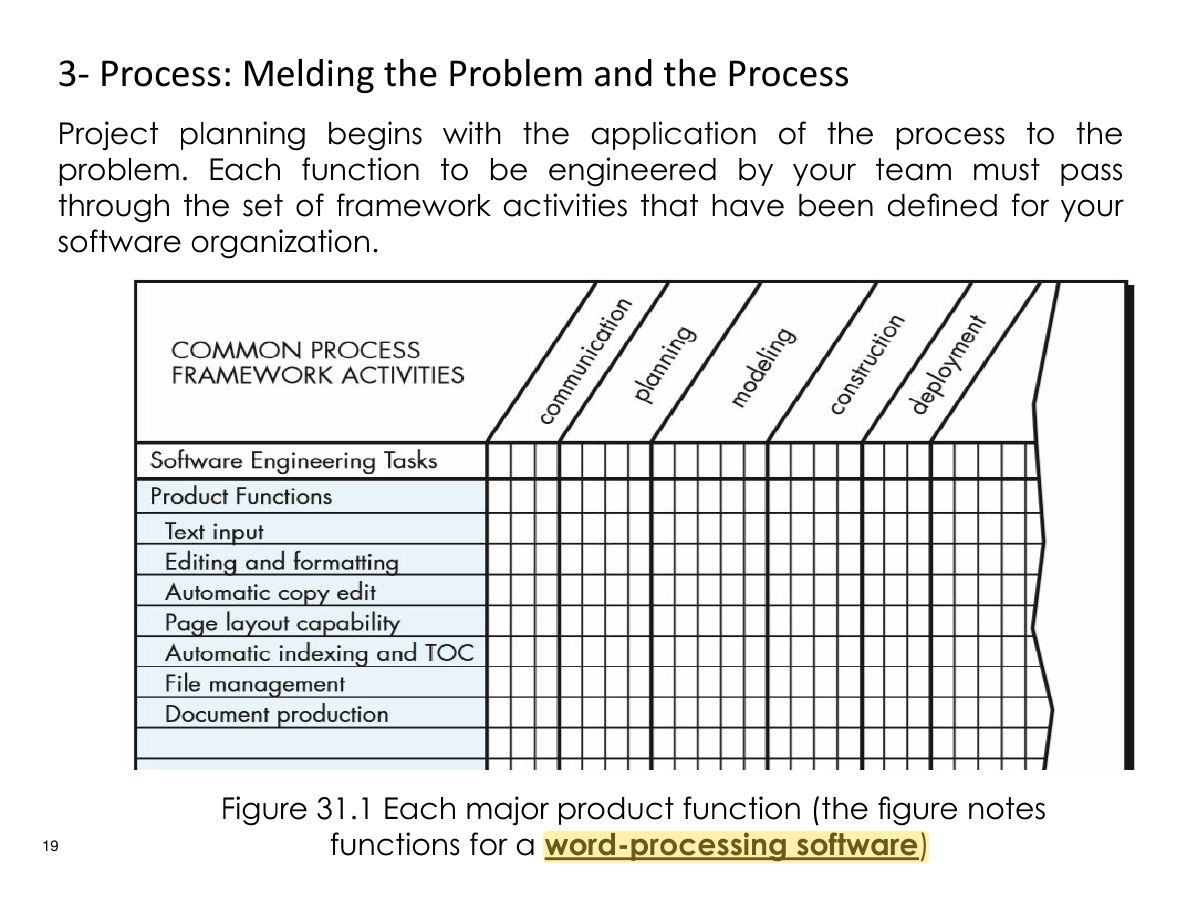
                                Slide 19: 3- Process: Melding the Problem and the Process
                                Exam weight Low
                                  Slide 20: 20
                                  Exam weight Low

                                    4- Signs of Projects Risk

                                    • Ten signs that indicate that project is In trouble whe n: Software people don’t understand their customer’s needs. 1. The product scope is poorly defined. 2. Changes are managed poorly. 3. The chosen technology changes. 4. Business needs change [or are ill-defined]. 5. 6. Deadlines are unrealistic. 7. Users are resistant. 8. Sponsorship is lost [or was never properly obtained]. 9. The project team lacks skills.

                                    10.

                                    Managers [and practitioners] avoid best practices and lessons.

                                    These slides are designed to accompany Software Engineering: A Practitioner’s Approach, 8/e

                                    (McGraw-Hill 2014). Slides copyright 2014 by Roger Pressman.

                                    21
                                    Exam weight Low
                                    1. Signs of trouble: no customer understanding, poorly defined scope, poor change management, unrealistic deadlines, lack of skills.
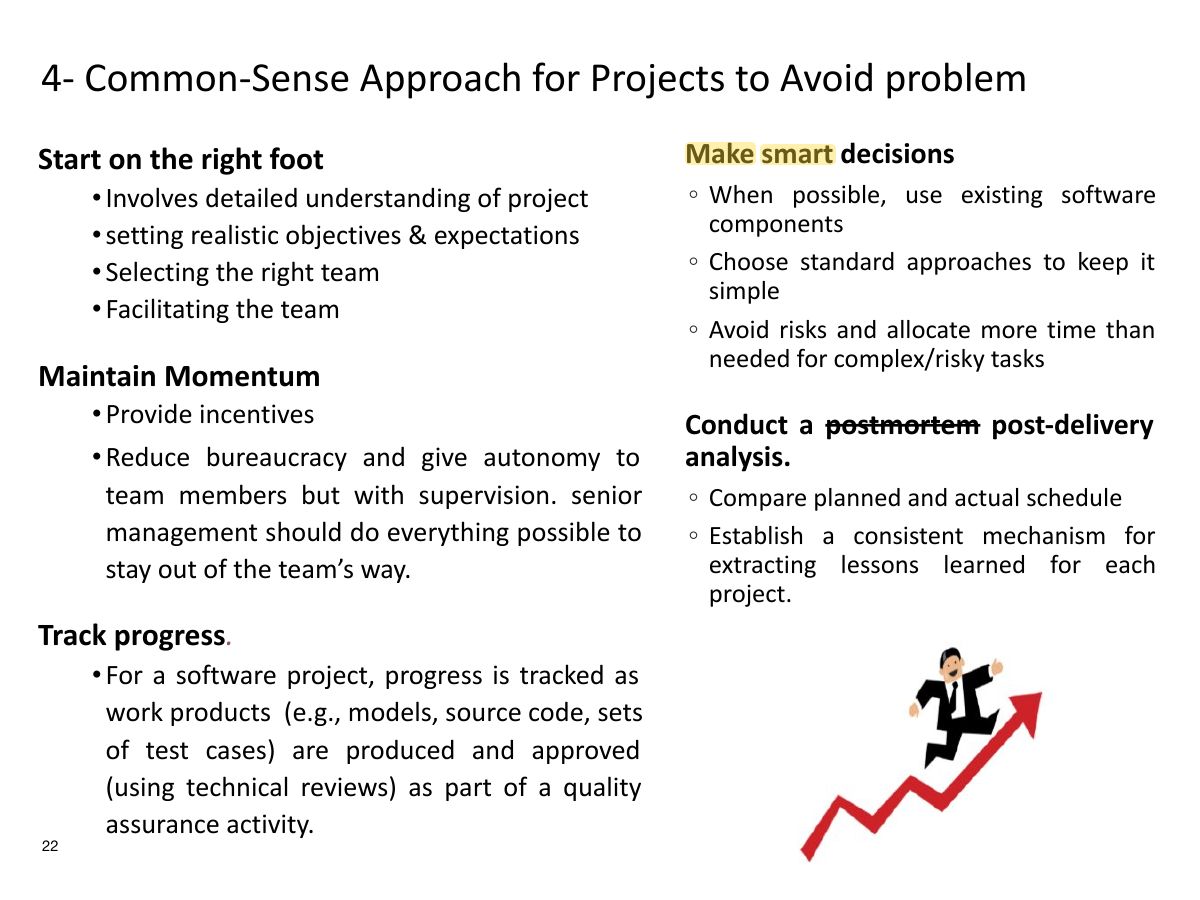
                                    Slide 22: 4- Common-Sense Approach for Projects to Avoid problem
                                    Exam weight Low

                                      4- To Get to the Essence of a Project using W5HH

                                      (Suggested by Barry Boehm)

                                      • Why is the system being developed?
                                      • What will be done?
                                        • Answer to this question establishes the task set required for the project
                                      • When will it be done?
                                        • this question helps the team establish a project schedule by identifying when tasks have to be conducted and when milestones are to be reached
                                      • Who is responsible?
                                        • this question establishes roles and responsibility of each team member
                                      • Where are they organizationally located?
                                        • Answer to this question indicates that all roles and responsibilities are not limited to the software team itself, the customers, users and stakeholders also have responsibilities
                                      • How will the job be done technically and managerially?
                                      • How much of each resource (e.g., people, software, tools, database) will be needed?
                                      23
                                      Exam weight Low

                                        Part II

                                        Project Estimation and Scheduling

                                        24
                                        Exam weight Low
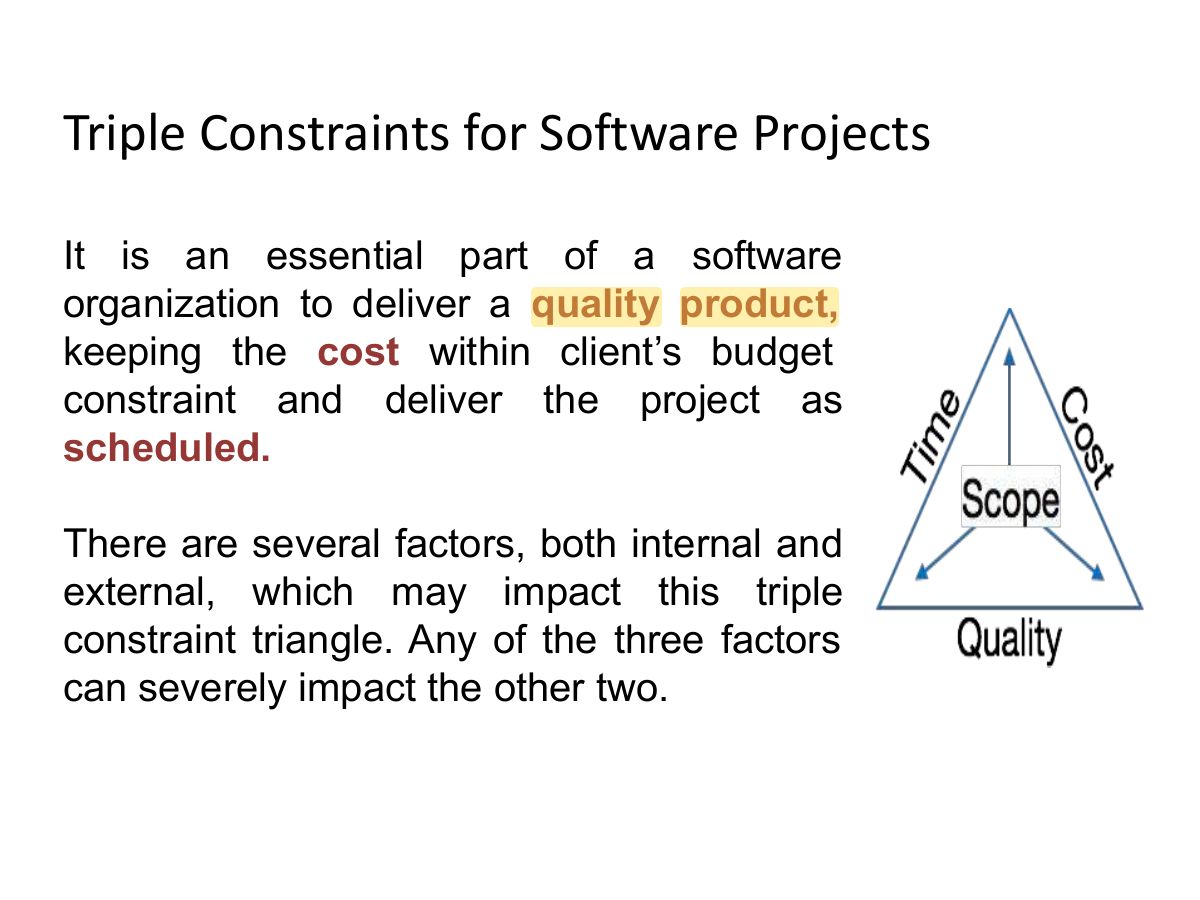
                                          Slide 25: Triple Constraints for Software Projects
                                          Exam weight High
                                          1. Triple constraint: scope, time, cost (quality in the middle); change one and the others move.
                                          🎯 How this can come up · 1 question
                                          MCQ

                                          The triple constraint consists of:

                                          Project Estimation - Scheduling

                                          • Project Scheduling in a project refers to the roadmap of all activities to be done in a specified order and with a time slot allotted to each activity.
                                          • Project managers define various tasks, and project milestones and arrange them keeping various factors in mind.

                                          For scheduling a project, it is necessary to -

                                          • Break down the project tasks into smaller, manageable tasks
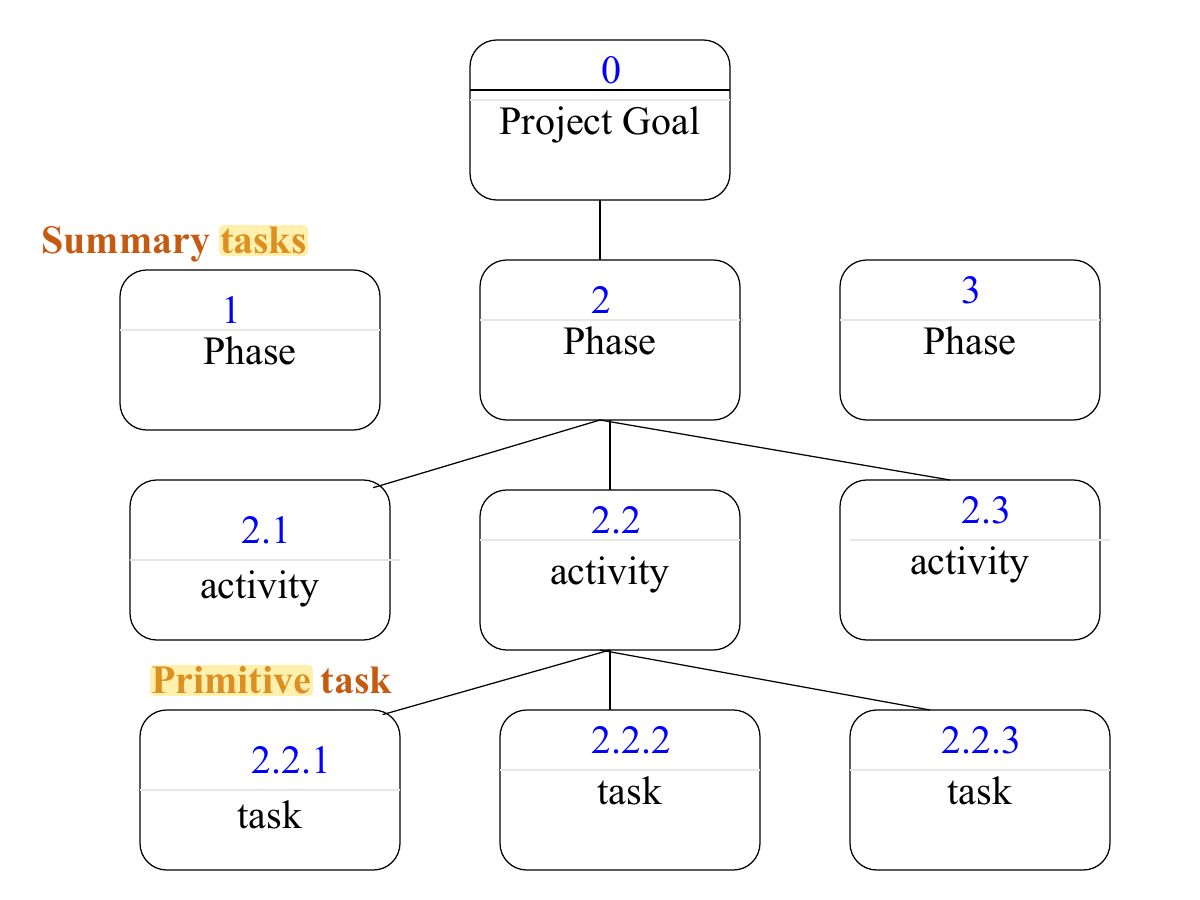
                                          • Logically order them to ensure a smooth evolution between tasks. The hierarchical decomposition of project into phases, activities, and tasks and their sequences is called “work breakdown structure (WBS)”. Some tasks are performed in parallel whereas others follow one another sequentially
                                          26
                                          Exam weight Low
                                            Slide 27: 0 Project Goal
                                            Exam weight Low

                                              Project Estimation - Scheduling

                                              When the WBS is finalised:

                                              • Estimate the required timeframe for each task
                                              • Divide time into work-units (man-hours, man-days)
                                              • Assign adequate number of work-units for each task
                                              • Assign resources to each task.
                                              • Calculate total time required for the project from start to finish
                                              28
                                              Exam weight Low
                                                Slide 29: Project Estimation - Scheduling
                                                Exam weight Low

                                                  Example

                                                  Project Management: Precedence Diagramming Method (PDM)

                                                  • Dr. Lahouari Ghouti, PhD These slides are designed to accompany Software Engineering: A Practitioner’s Approach, 8/e (McGraw-Hill, 2014) Slides
                                                  30
                                                  Exam weight Low
                                                    Slide 31: Project Tasks: Precedence Diagramming Method (PDM)
                                                    Exam weight High
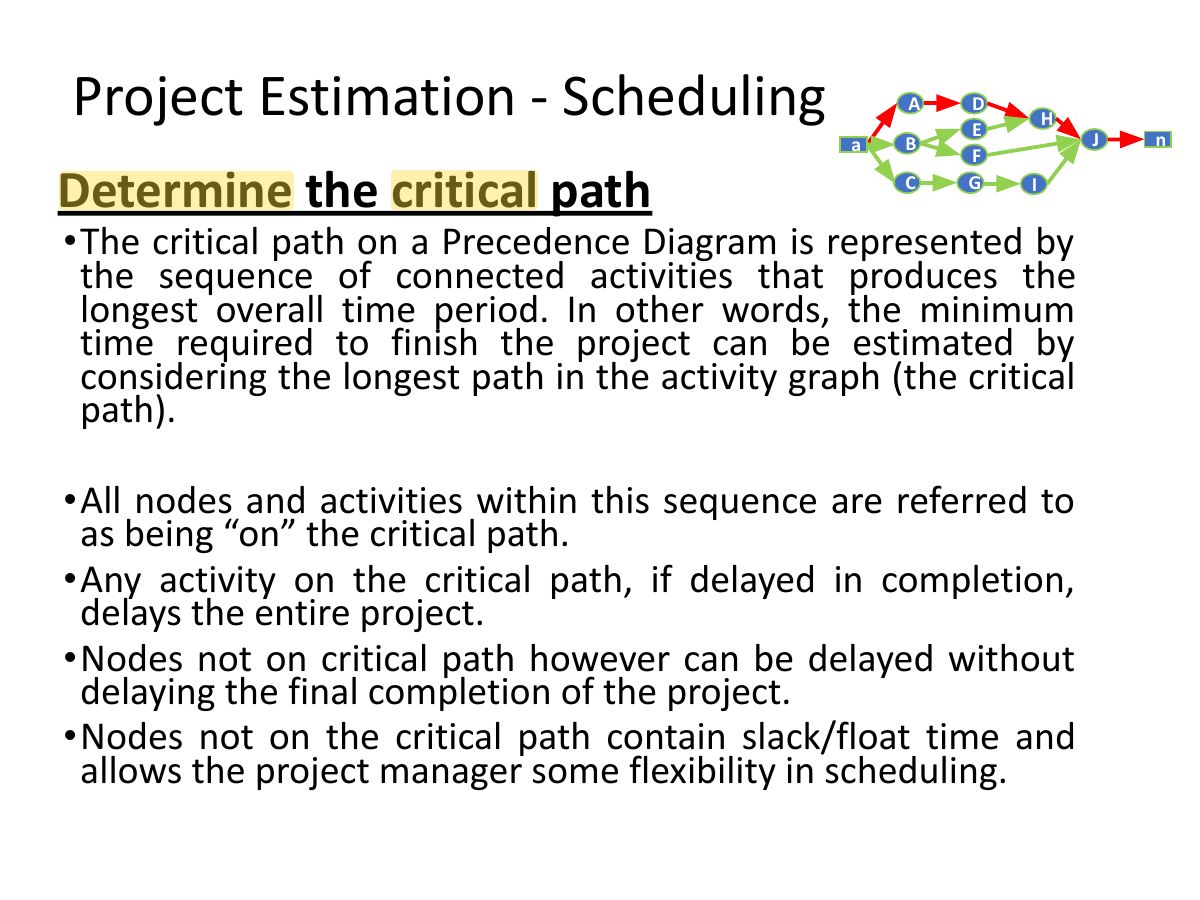
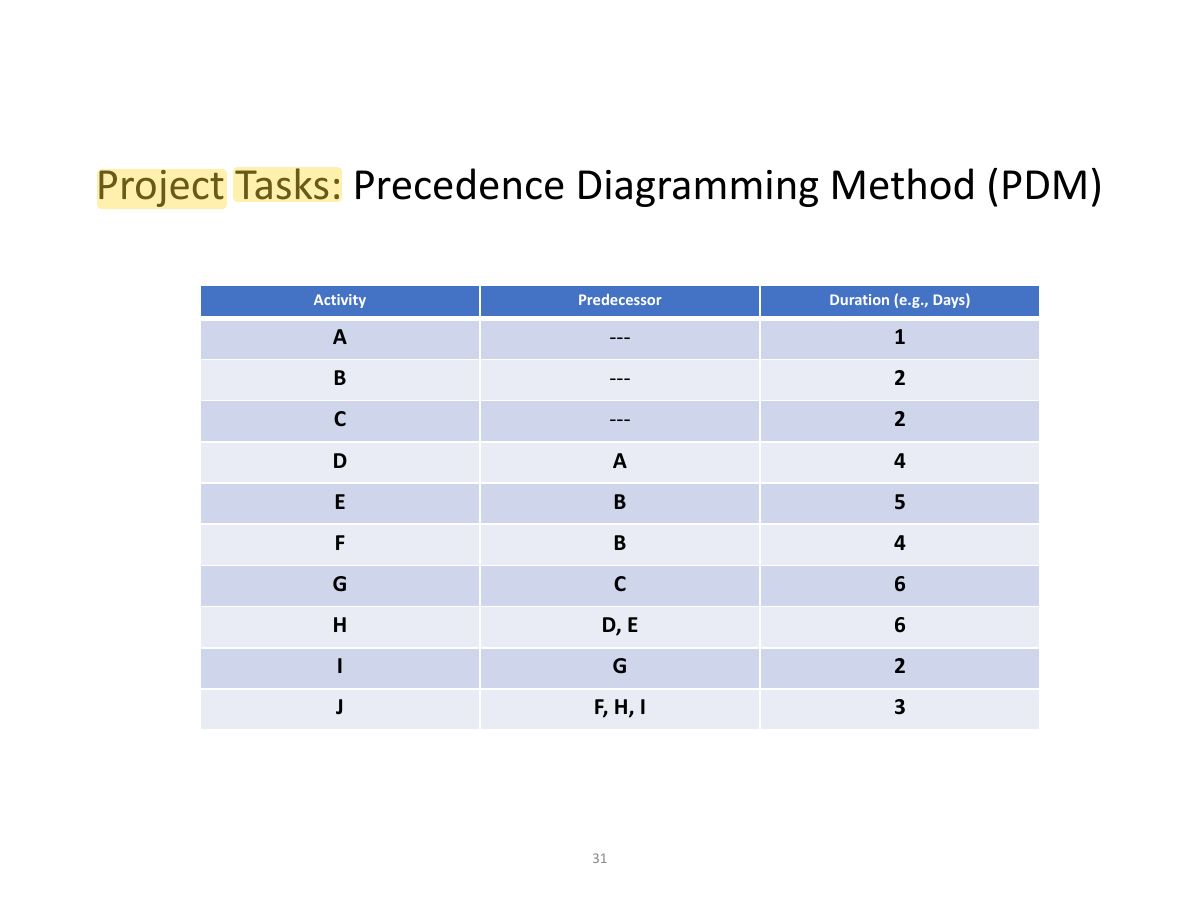
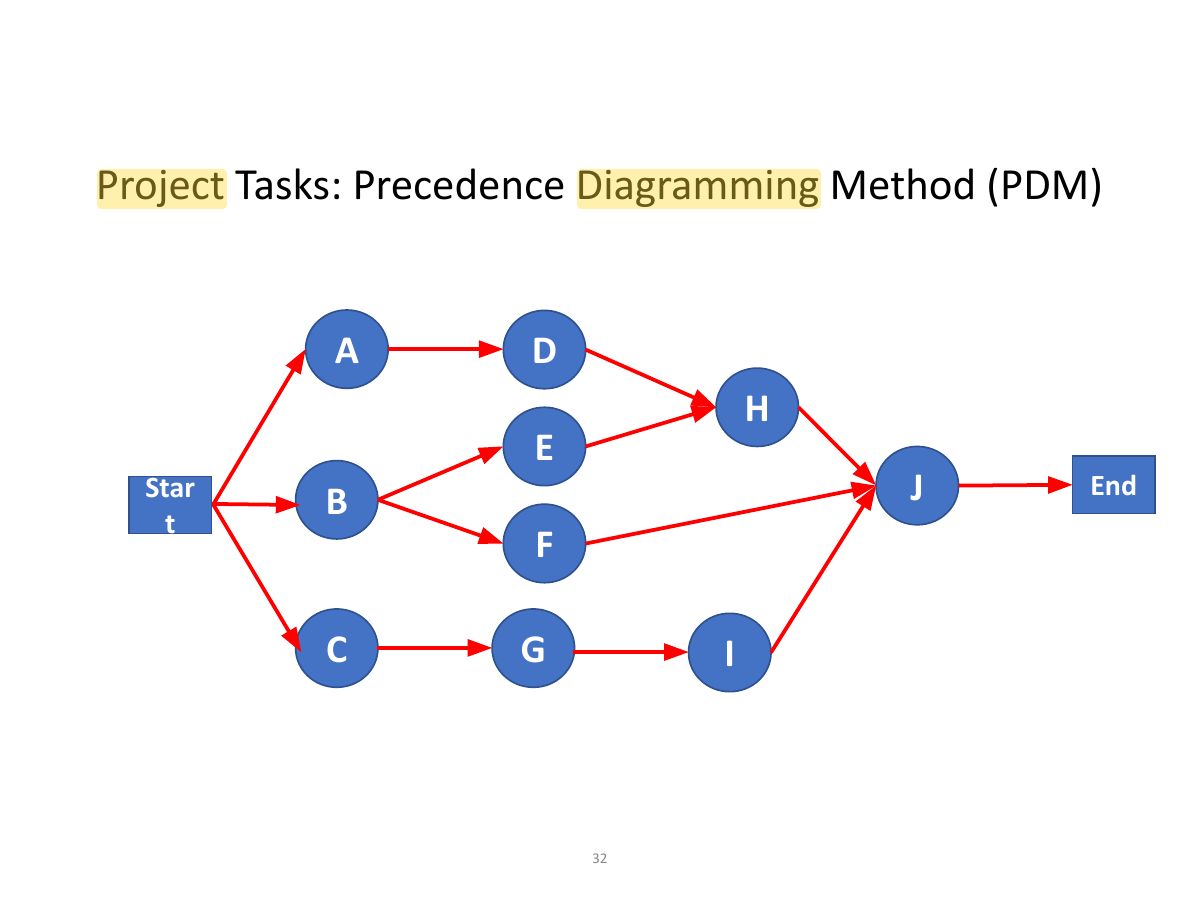
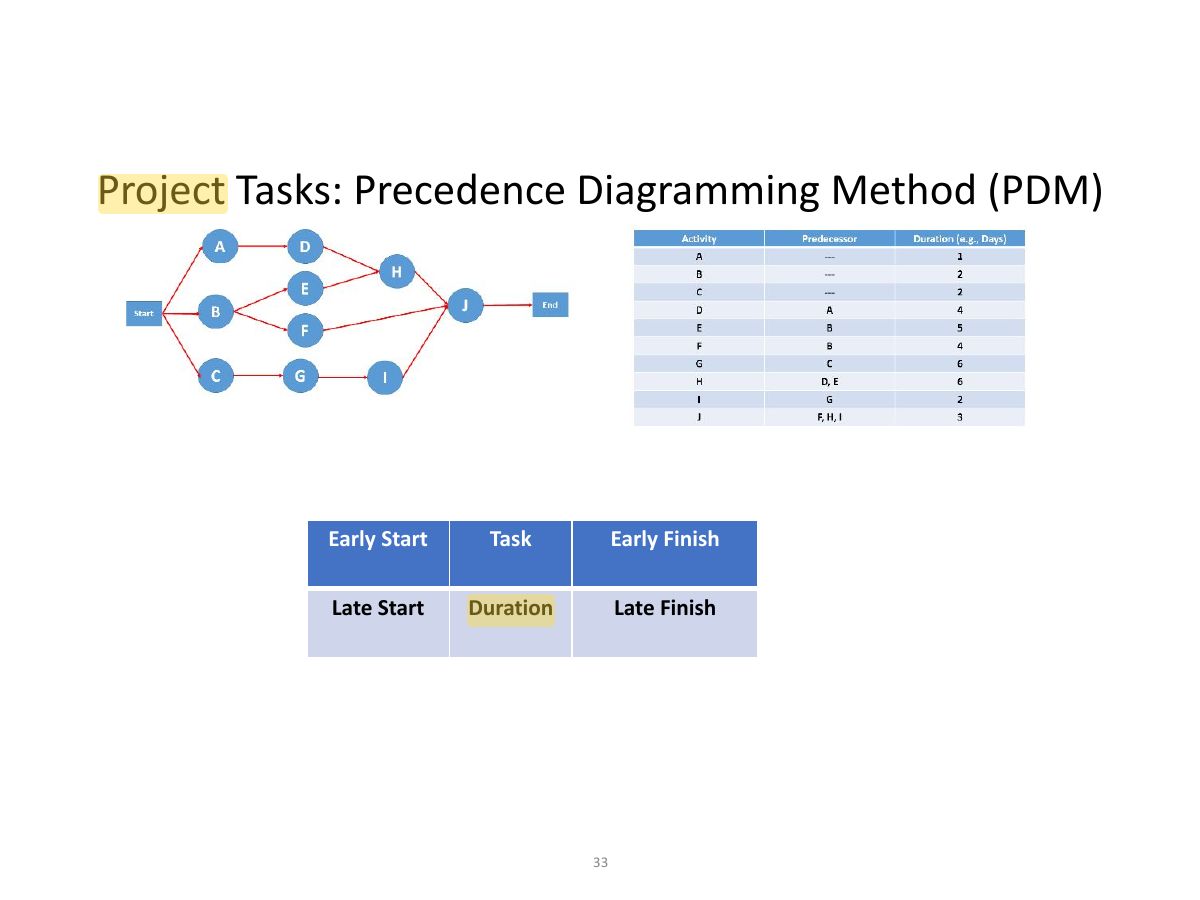
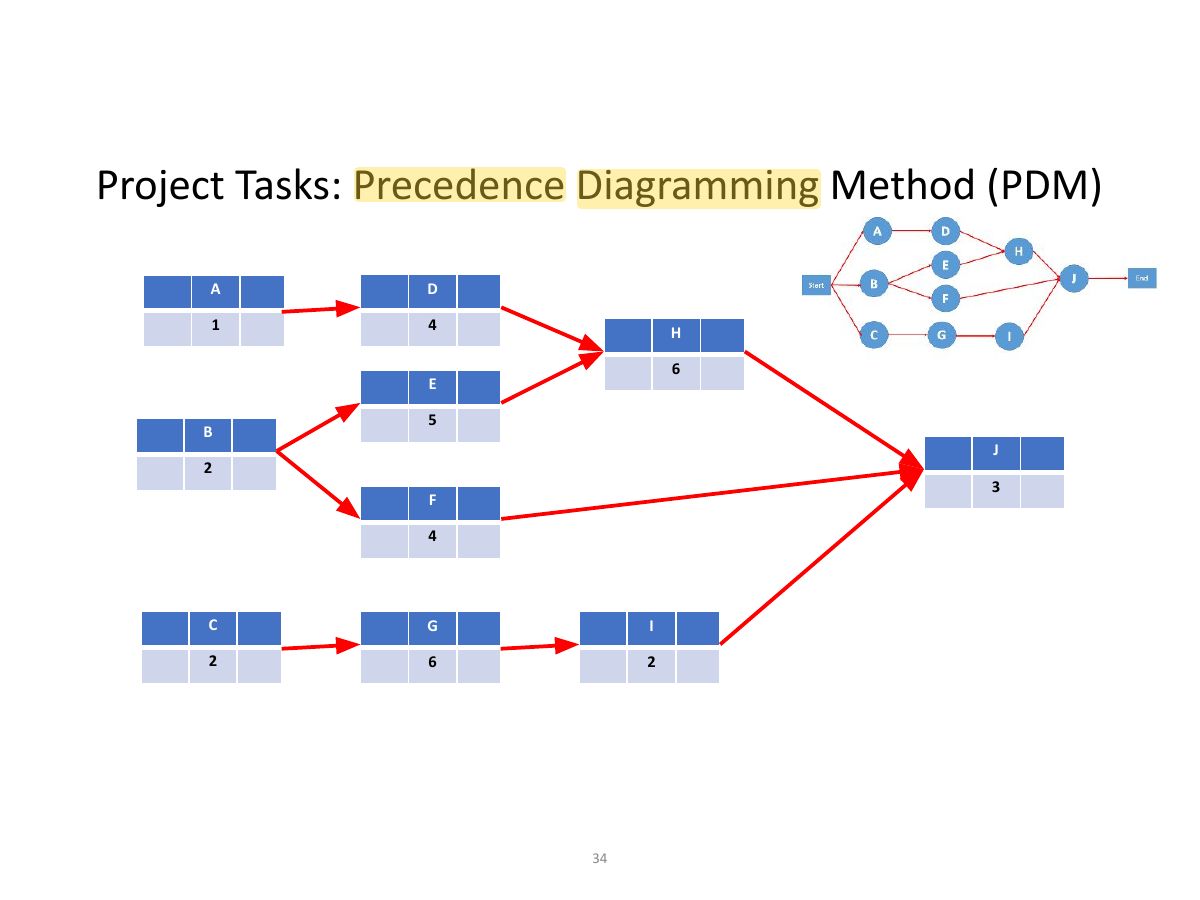
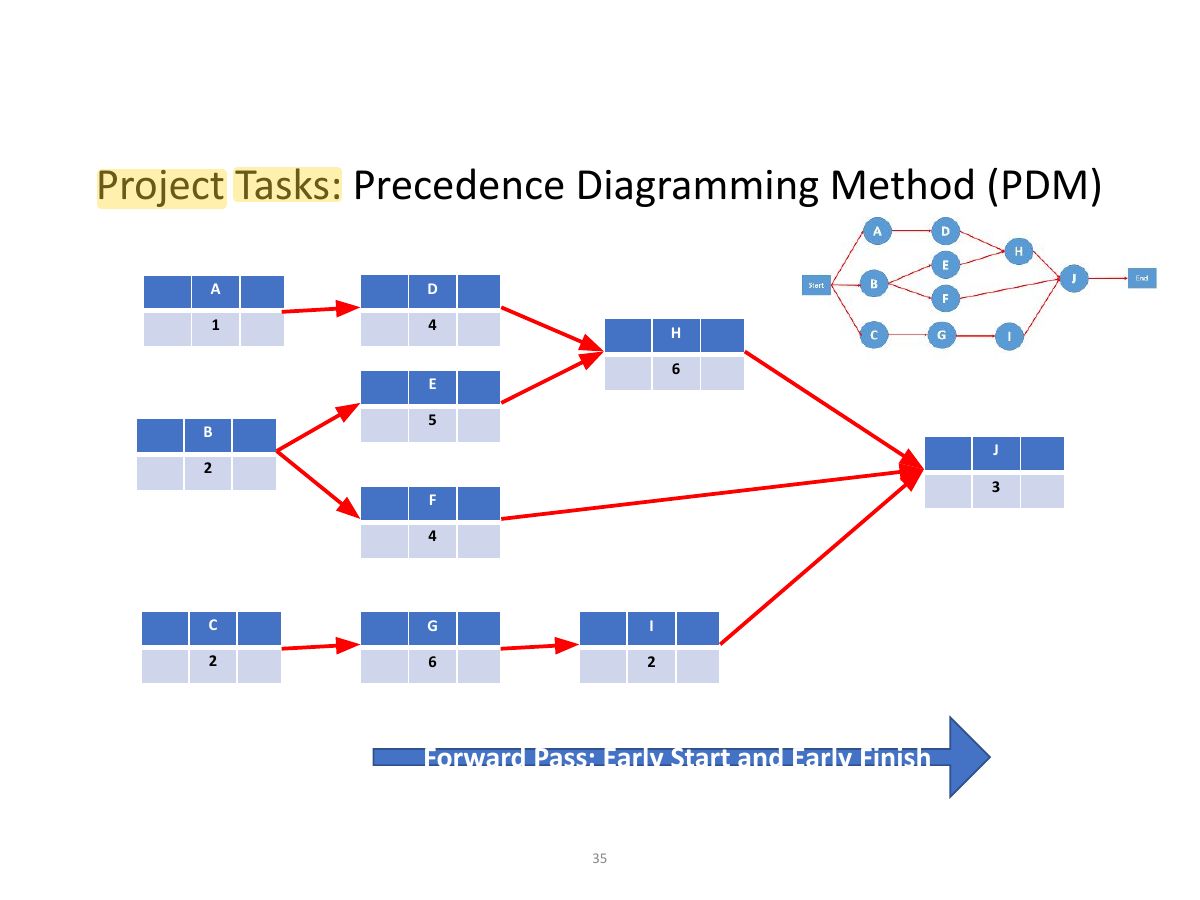
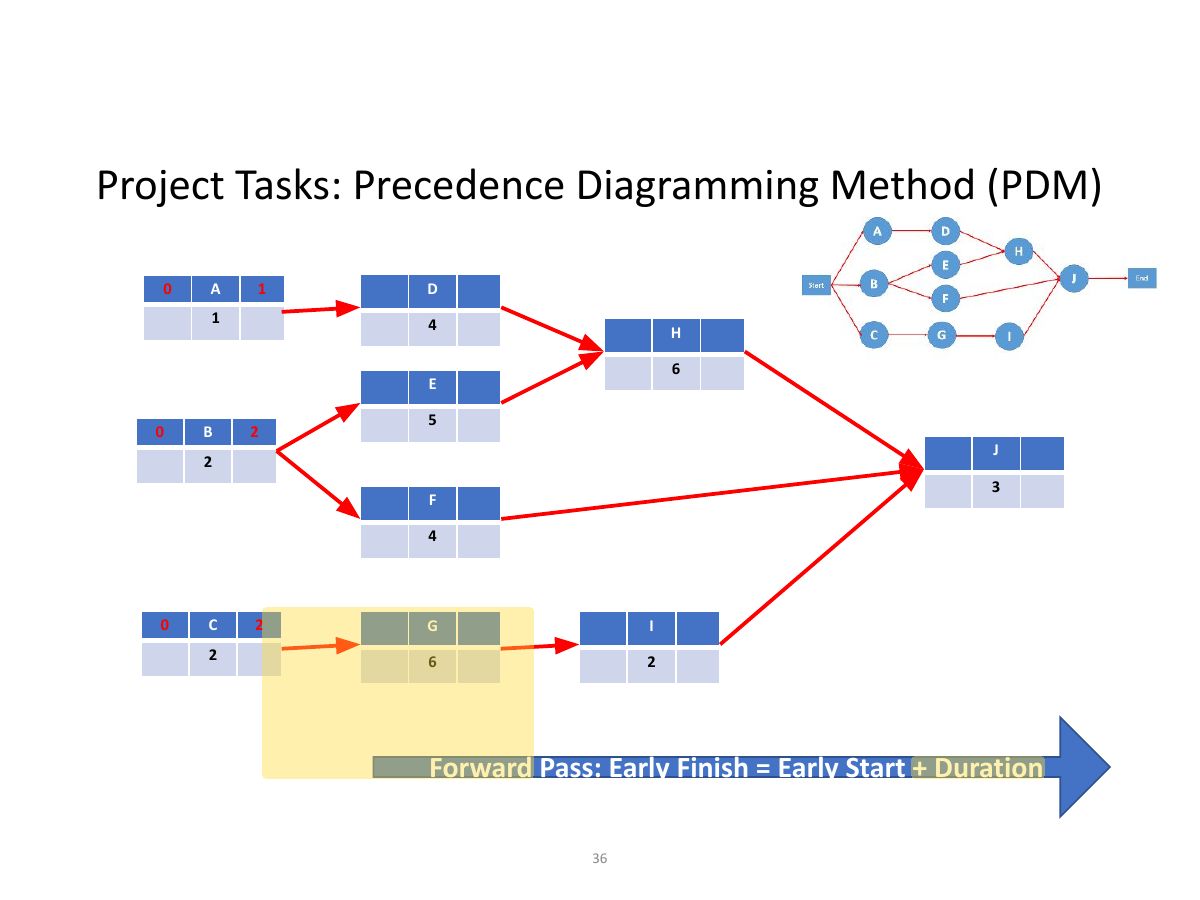
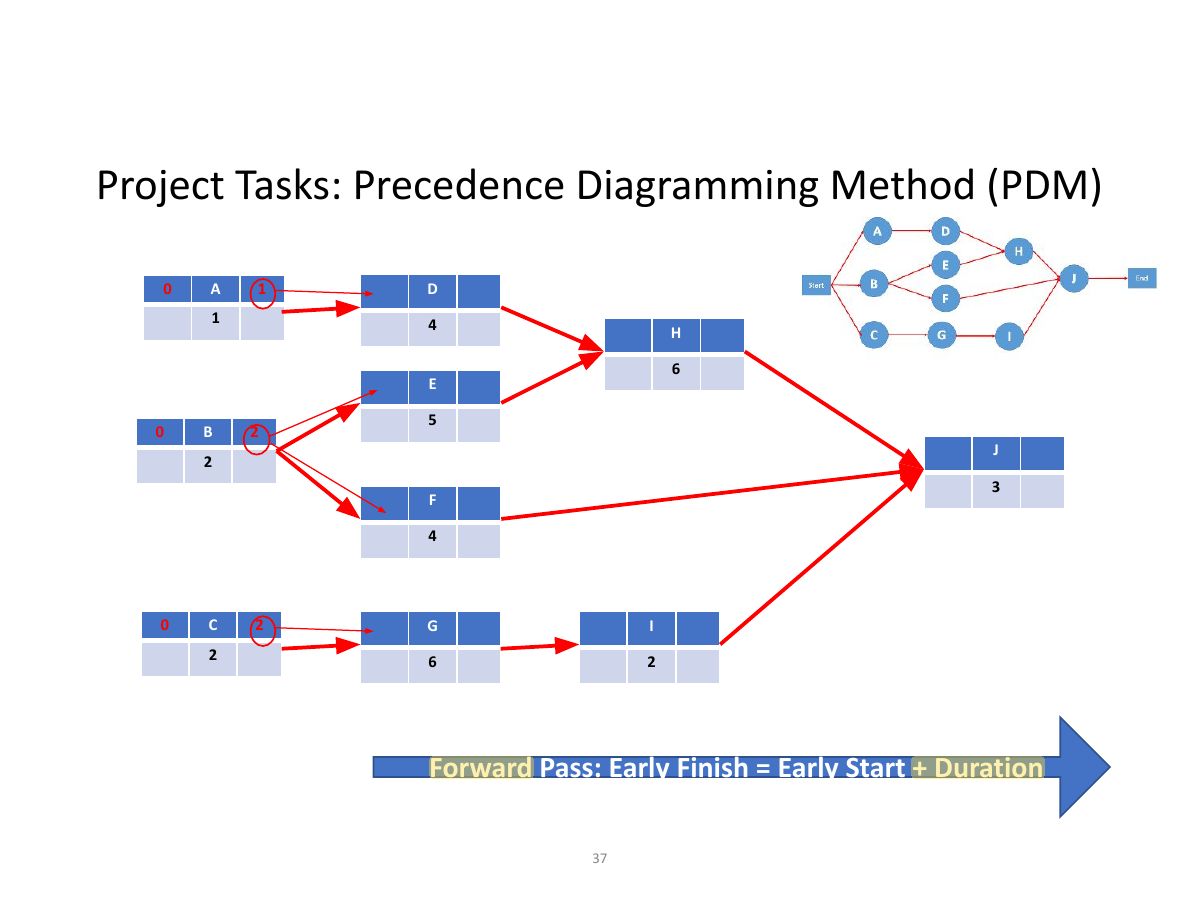
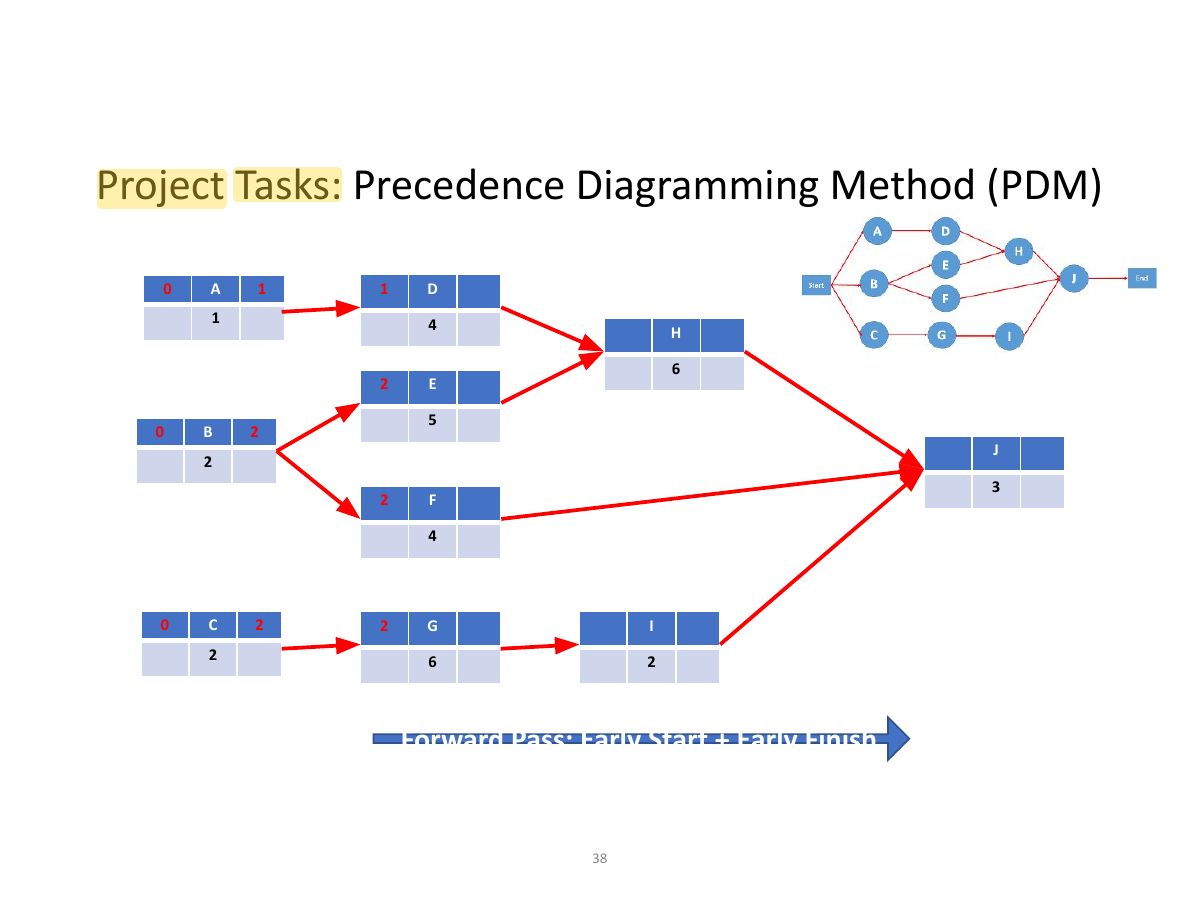
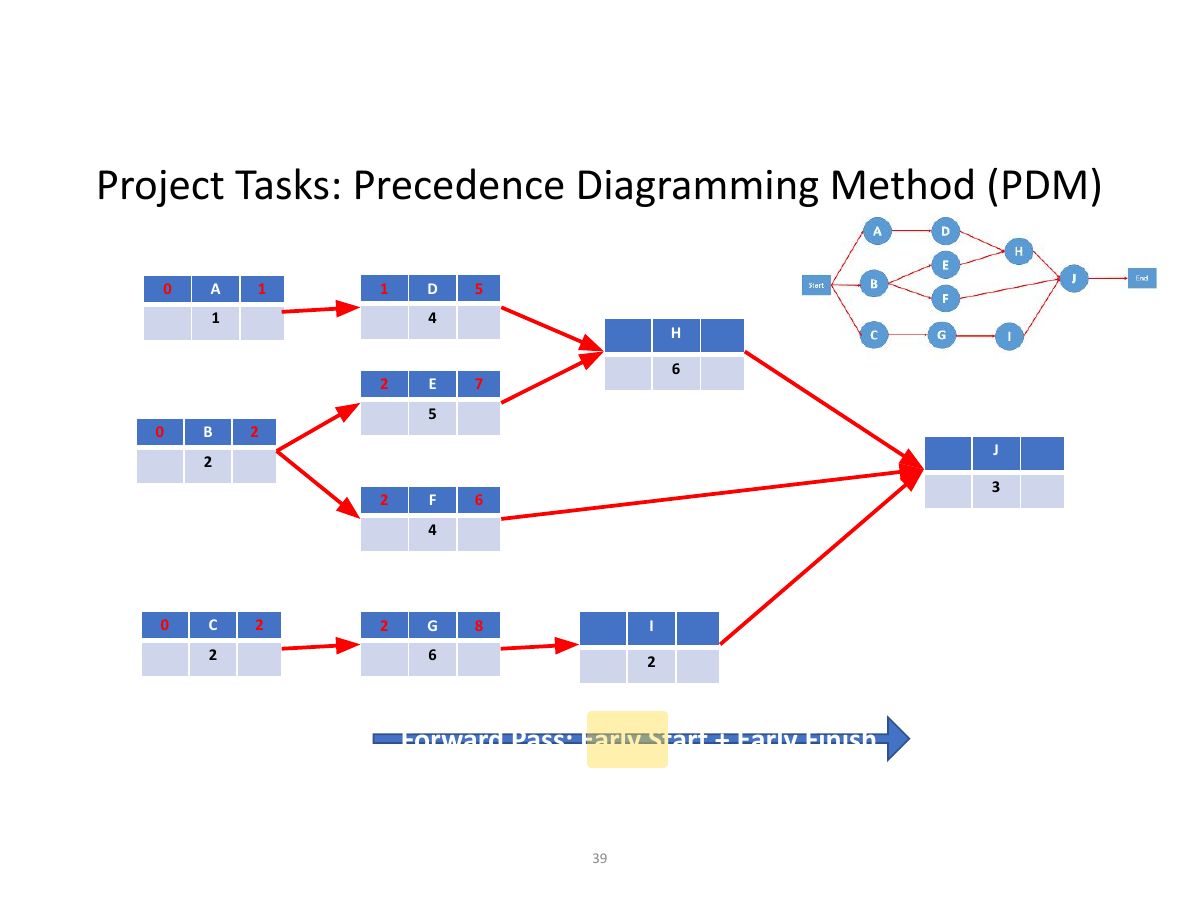
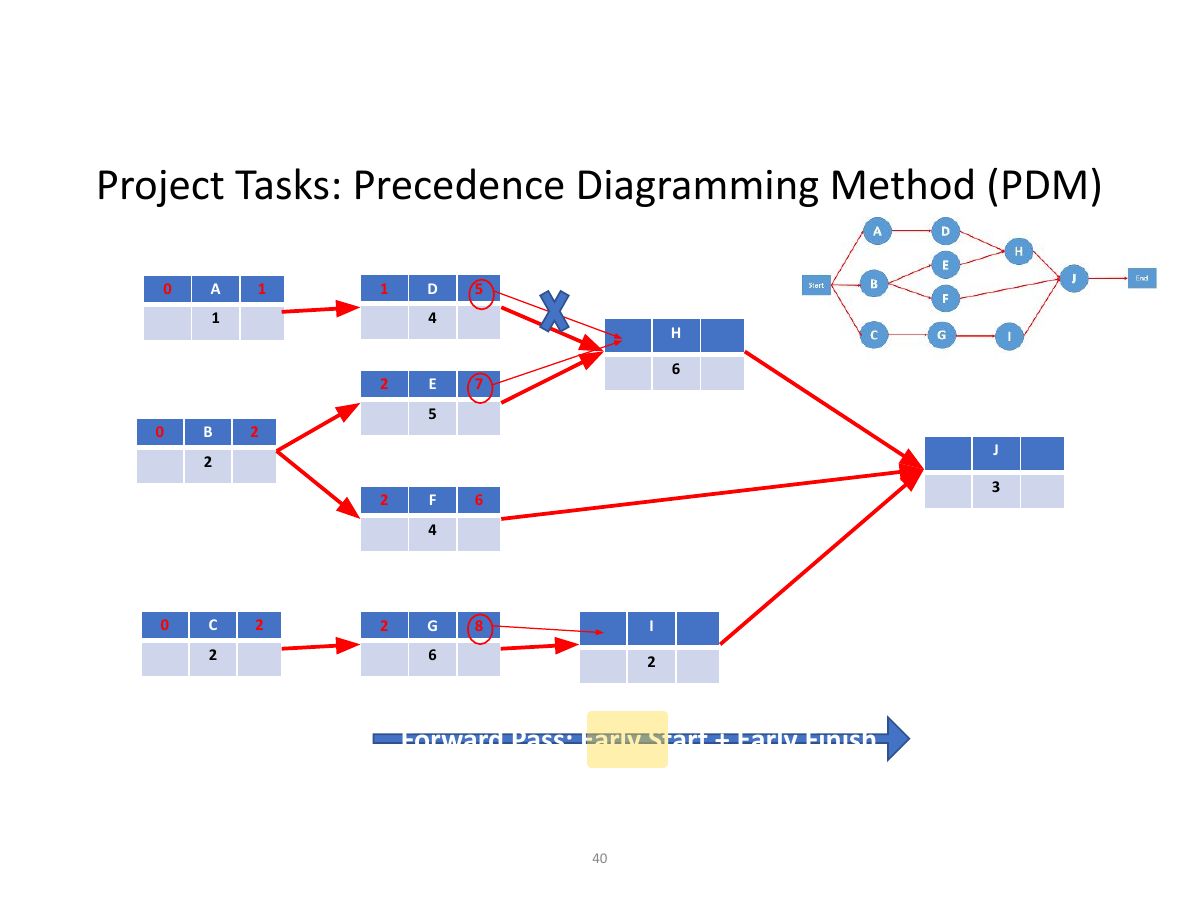
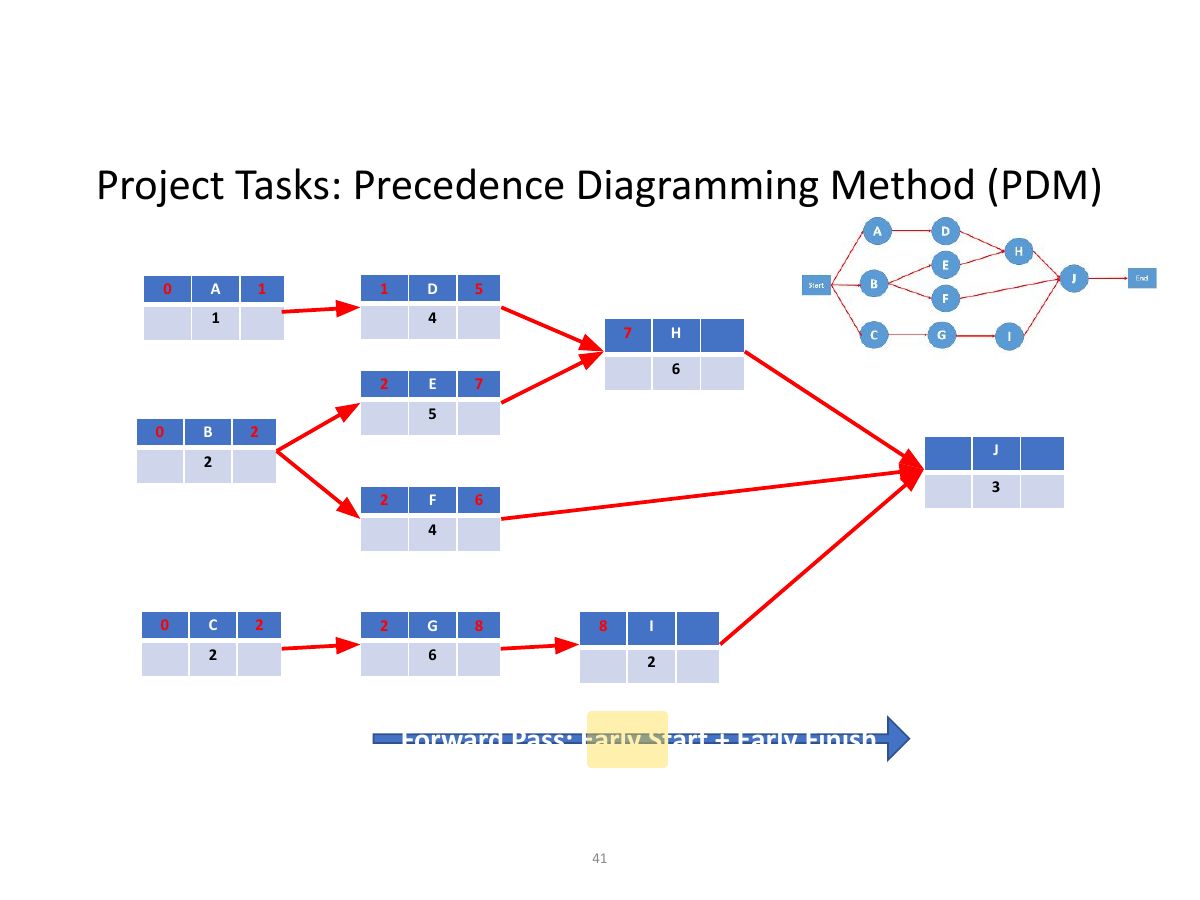
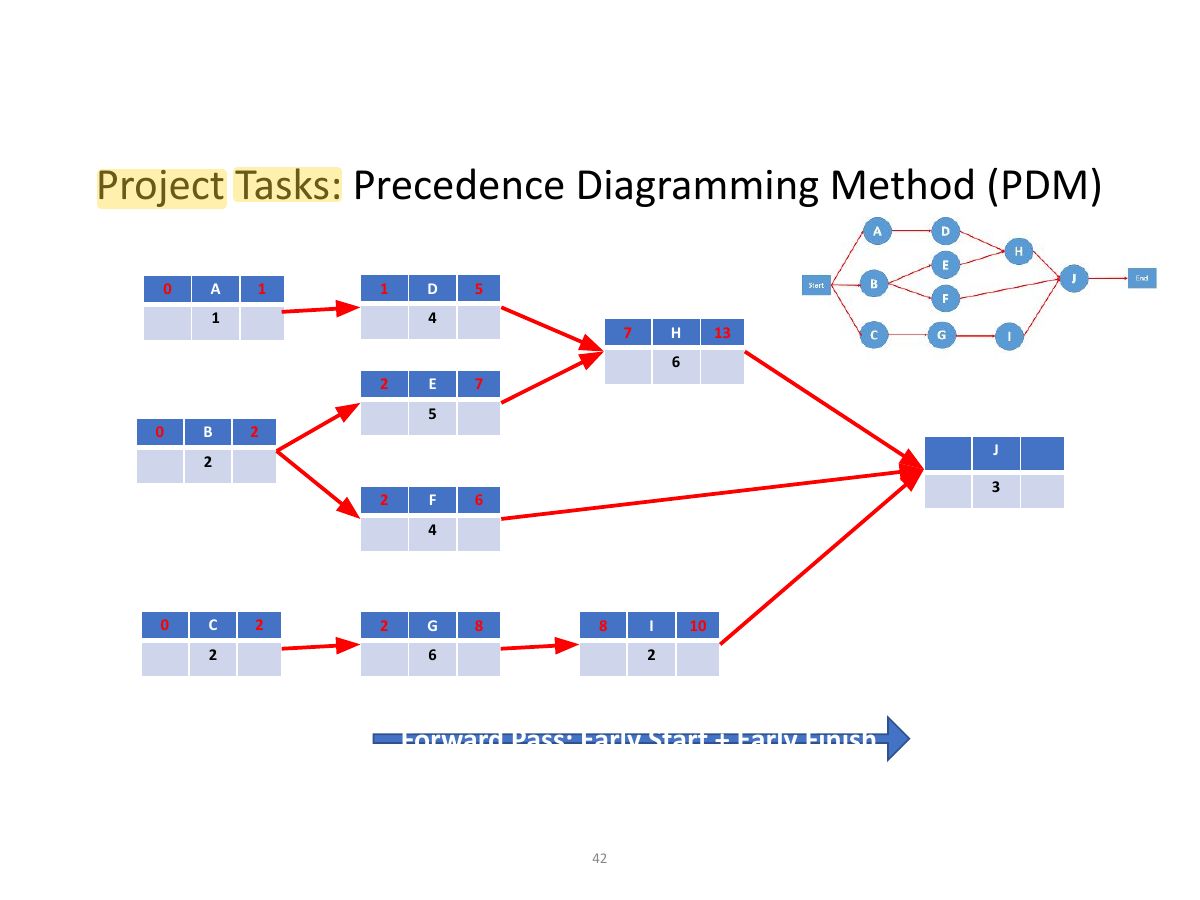
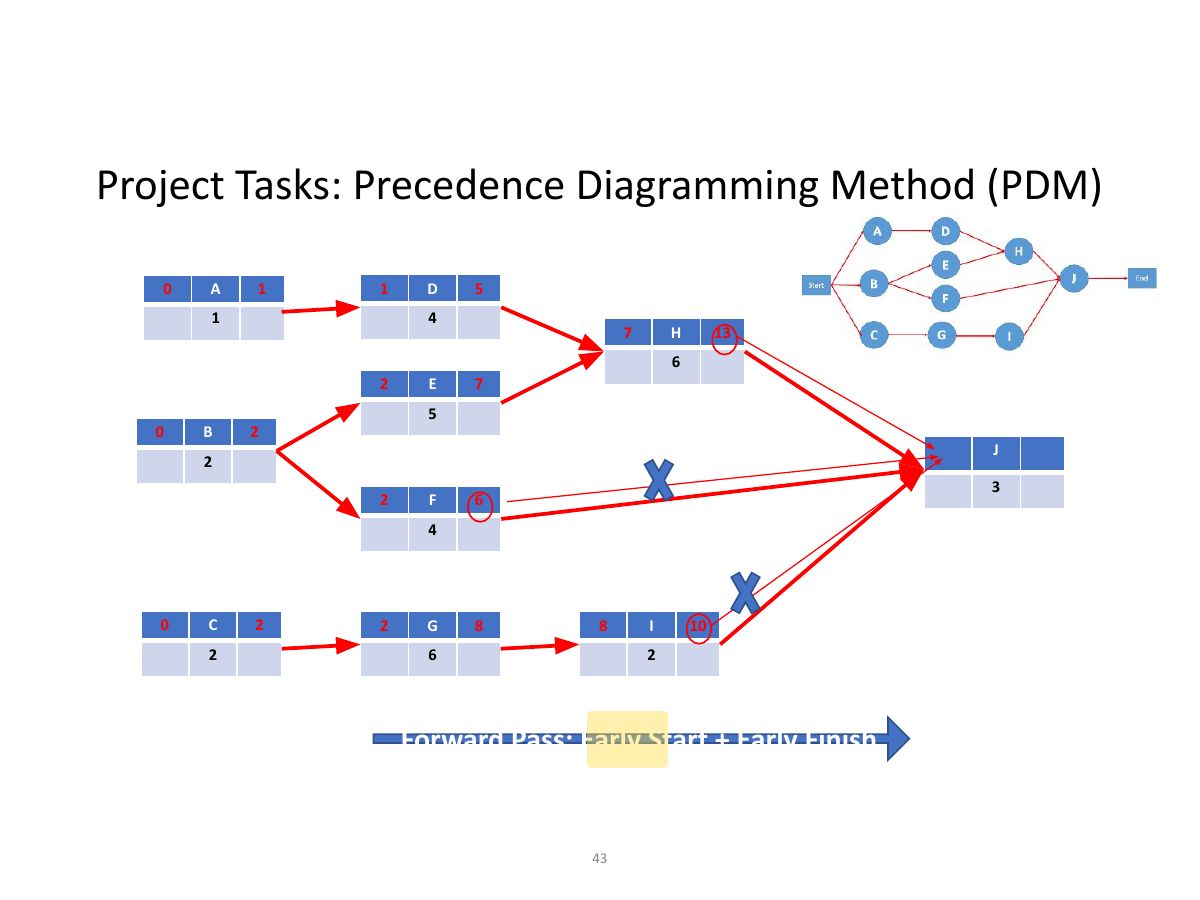
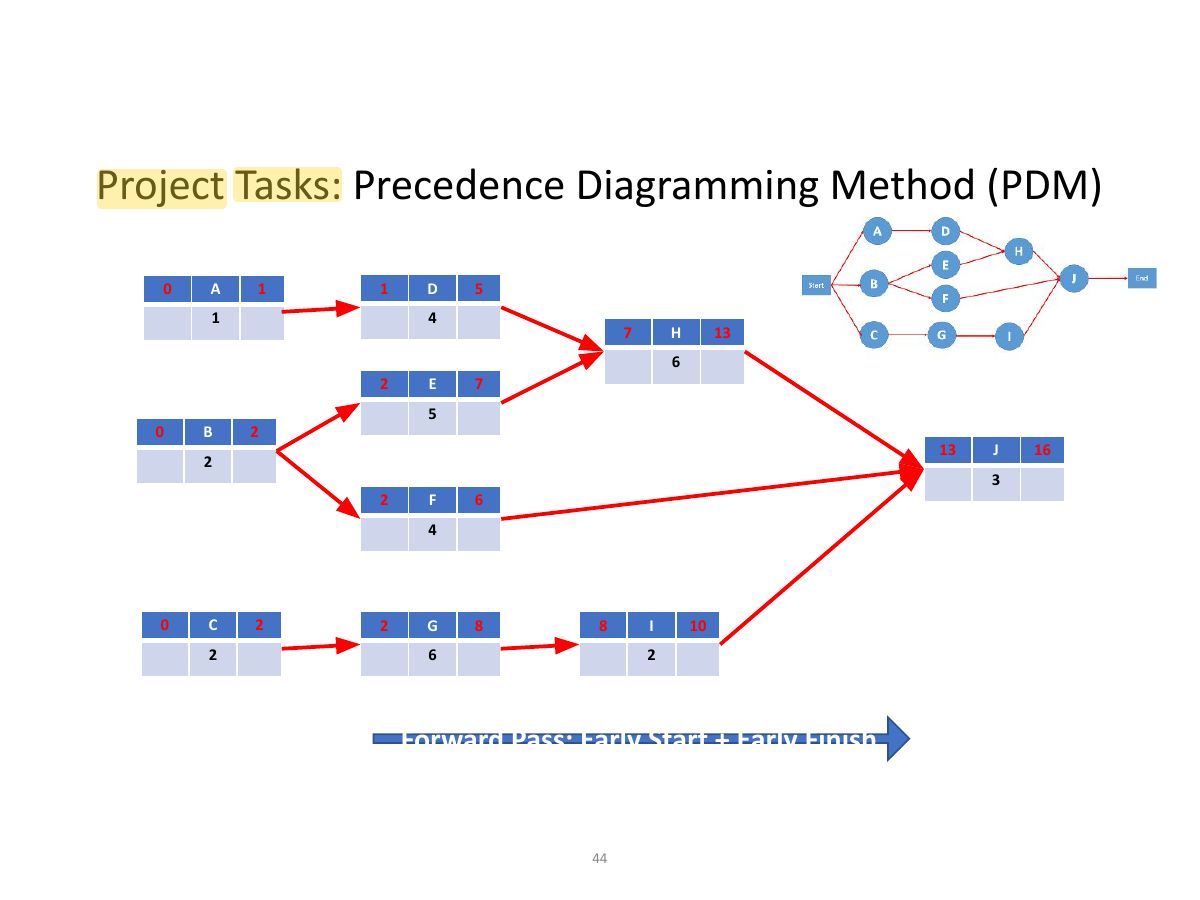
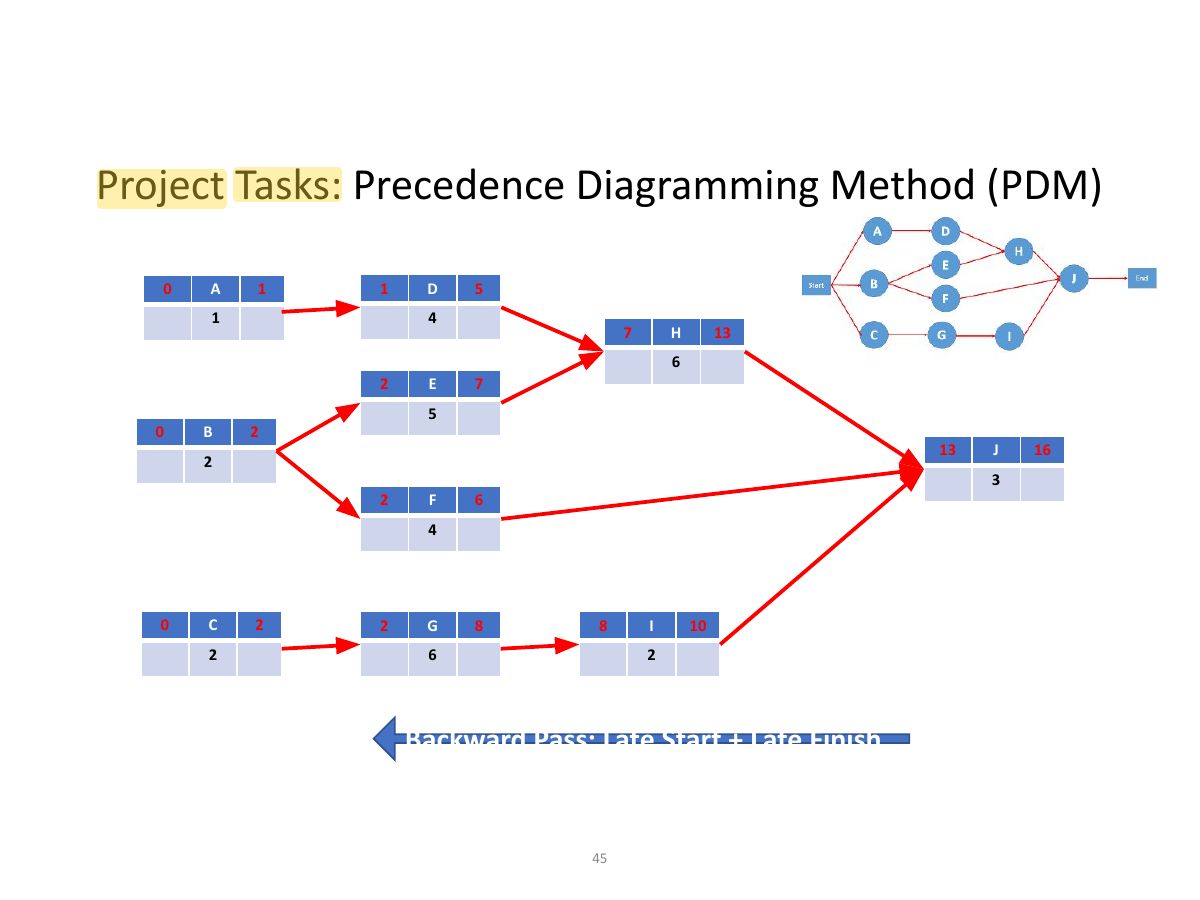
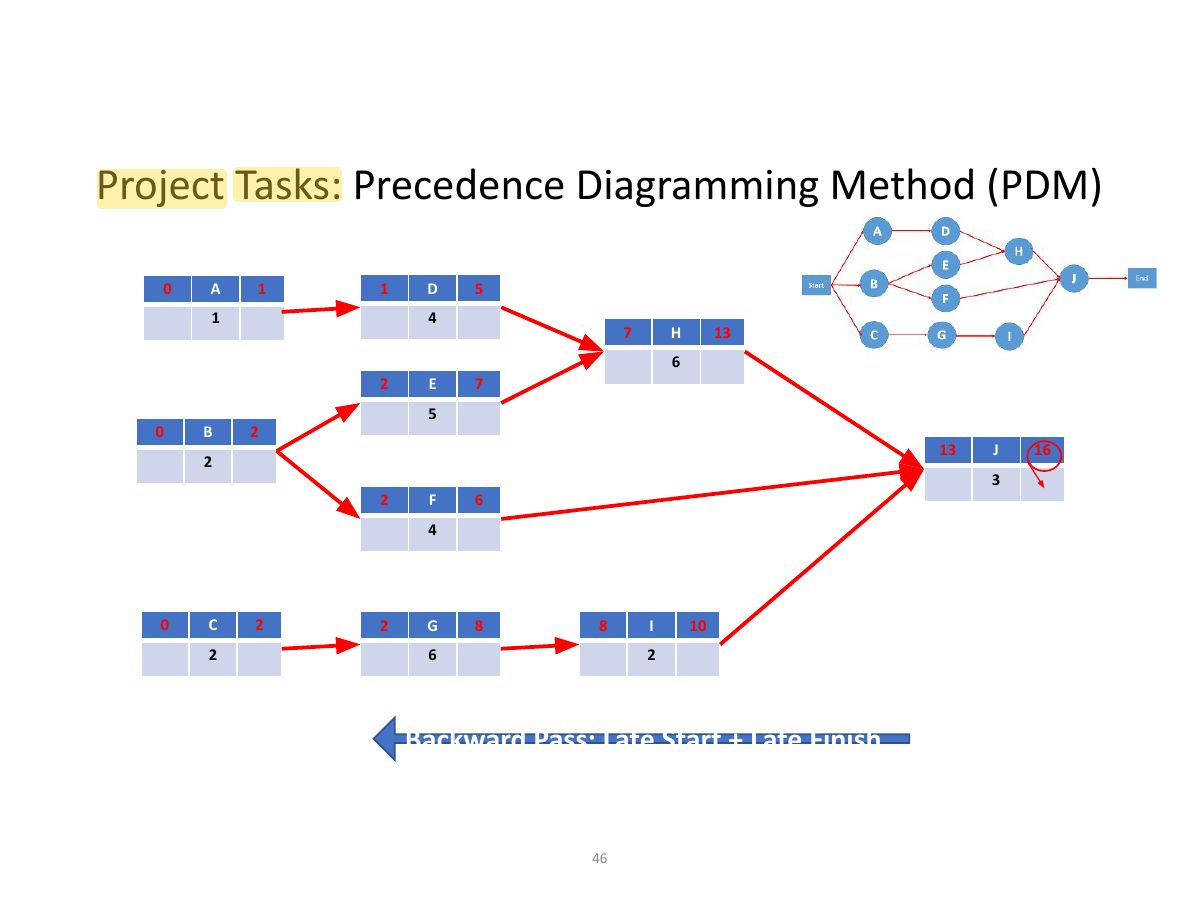
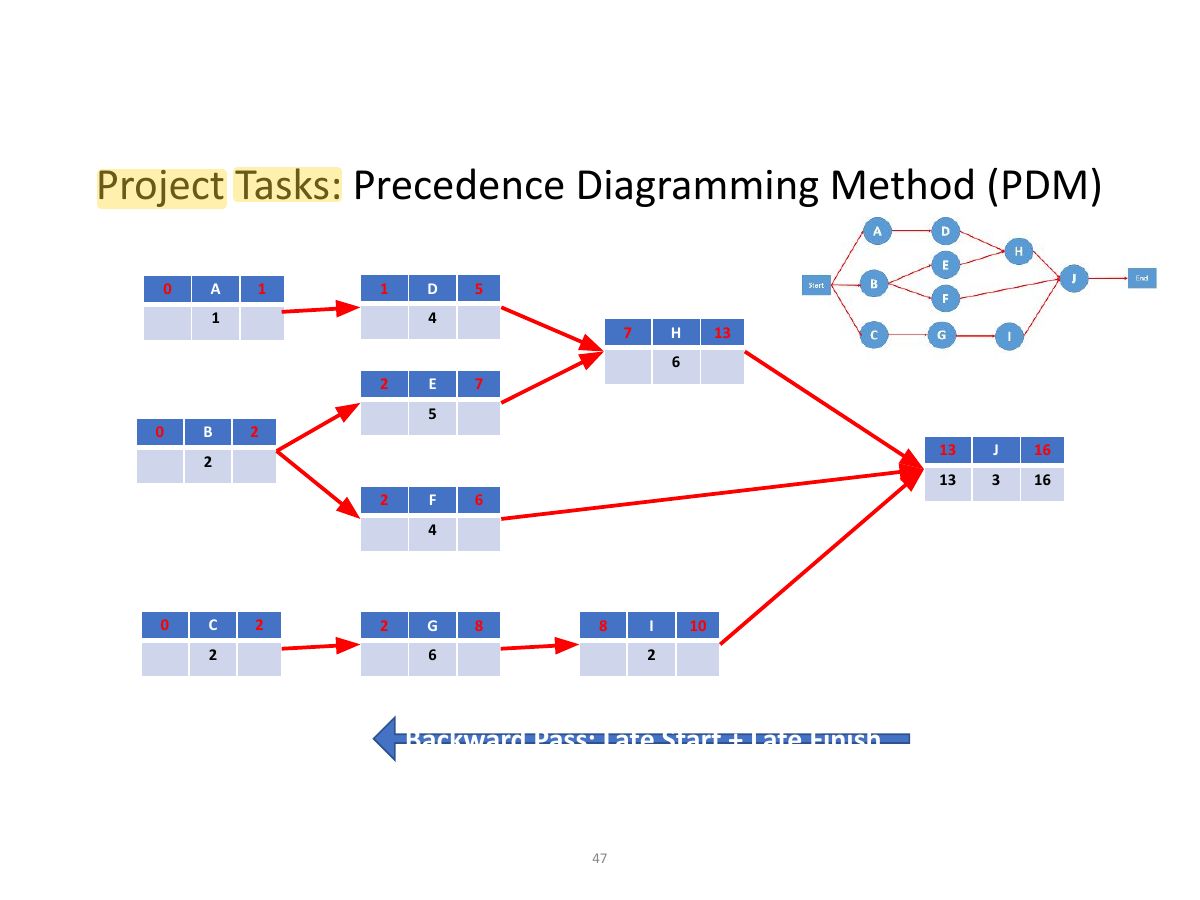
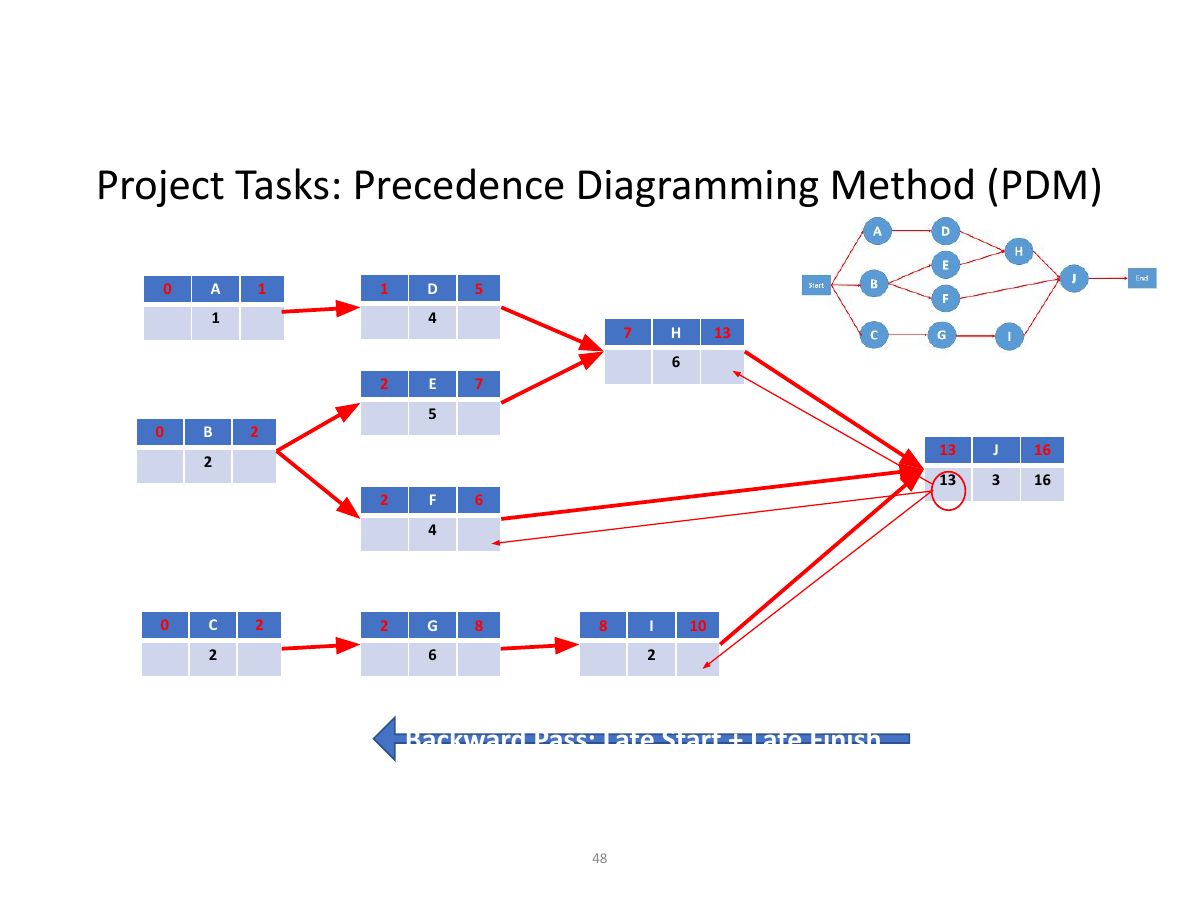
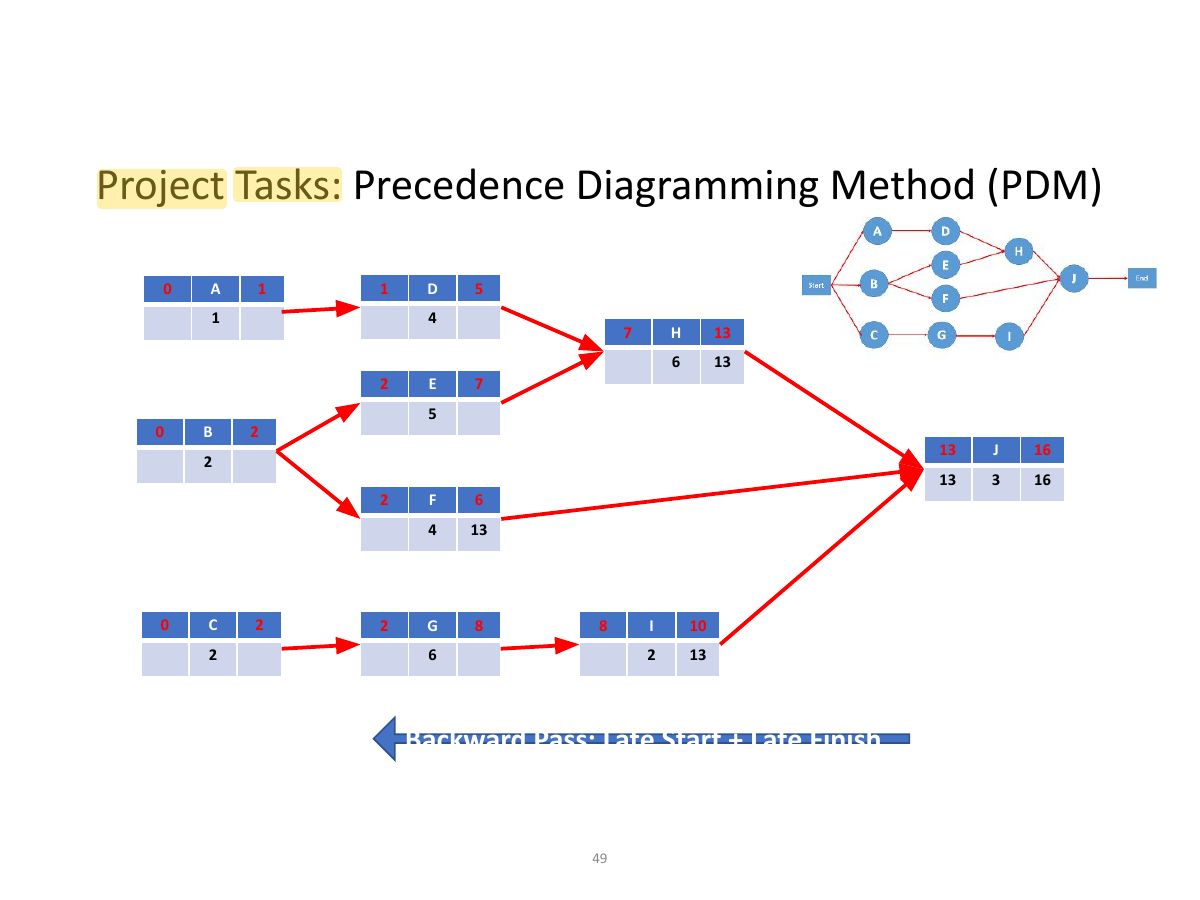
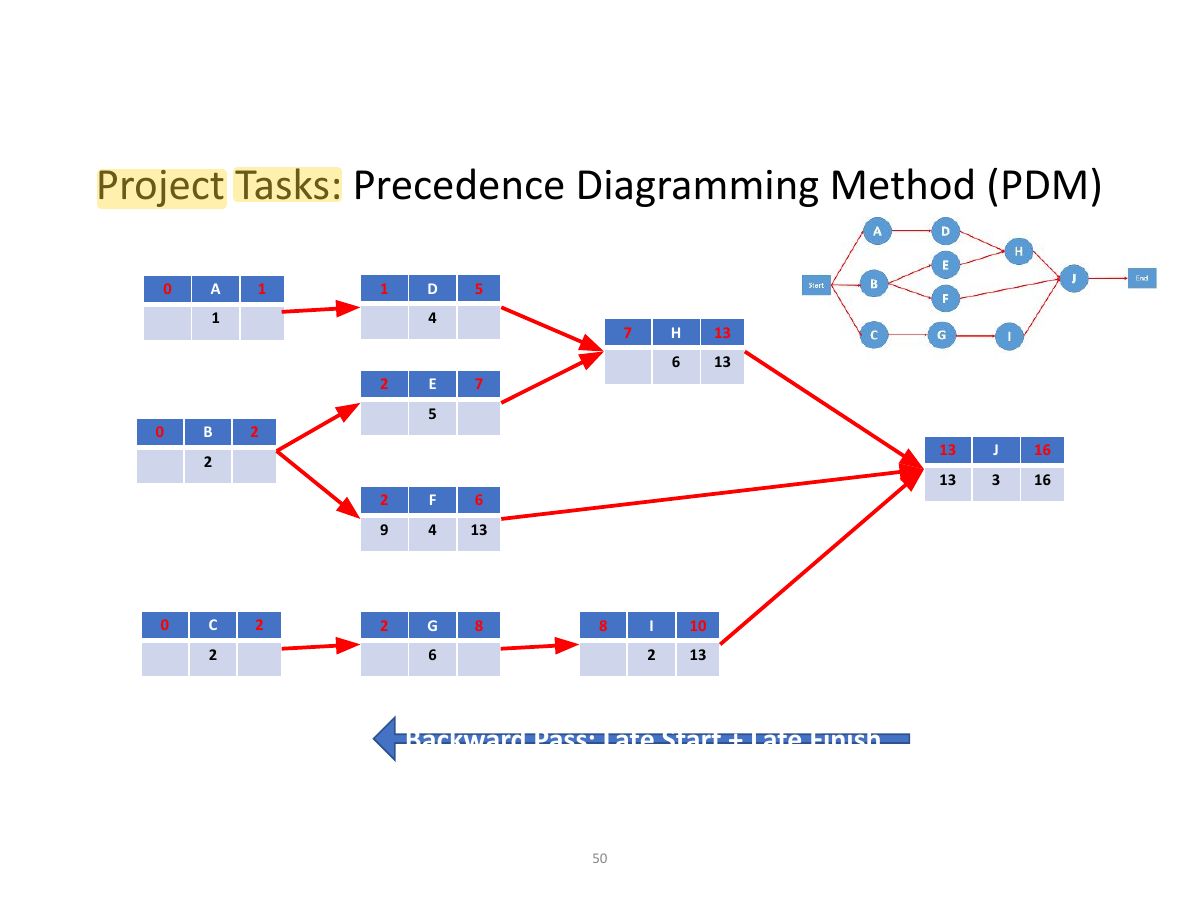
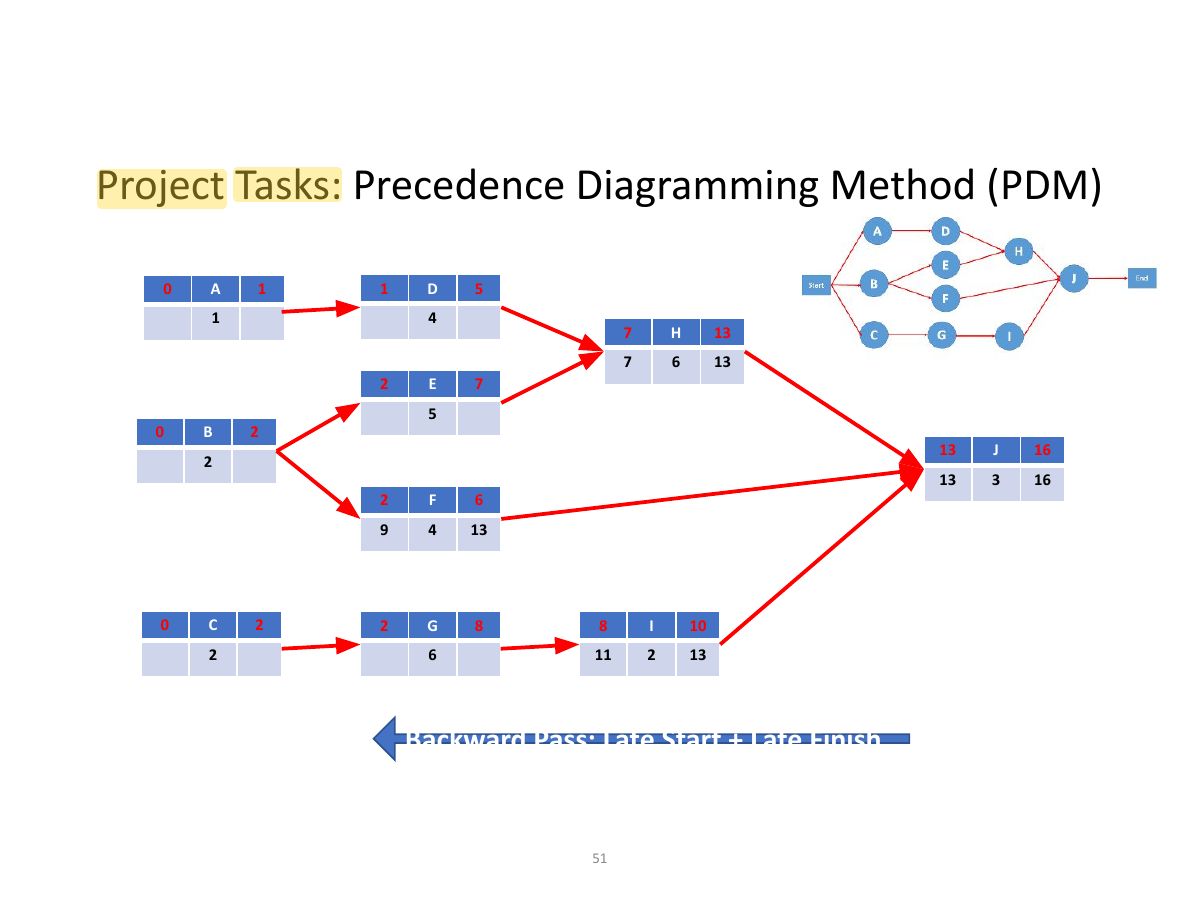
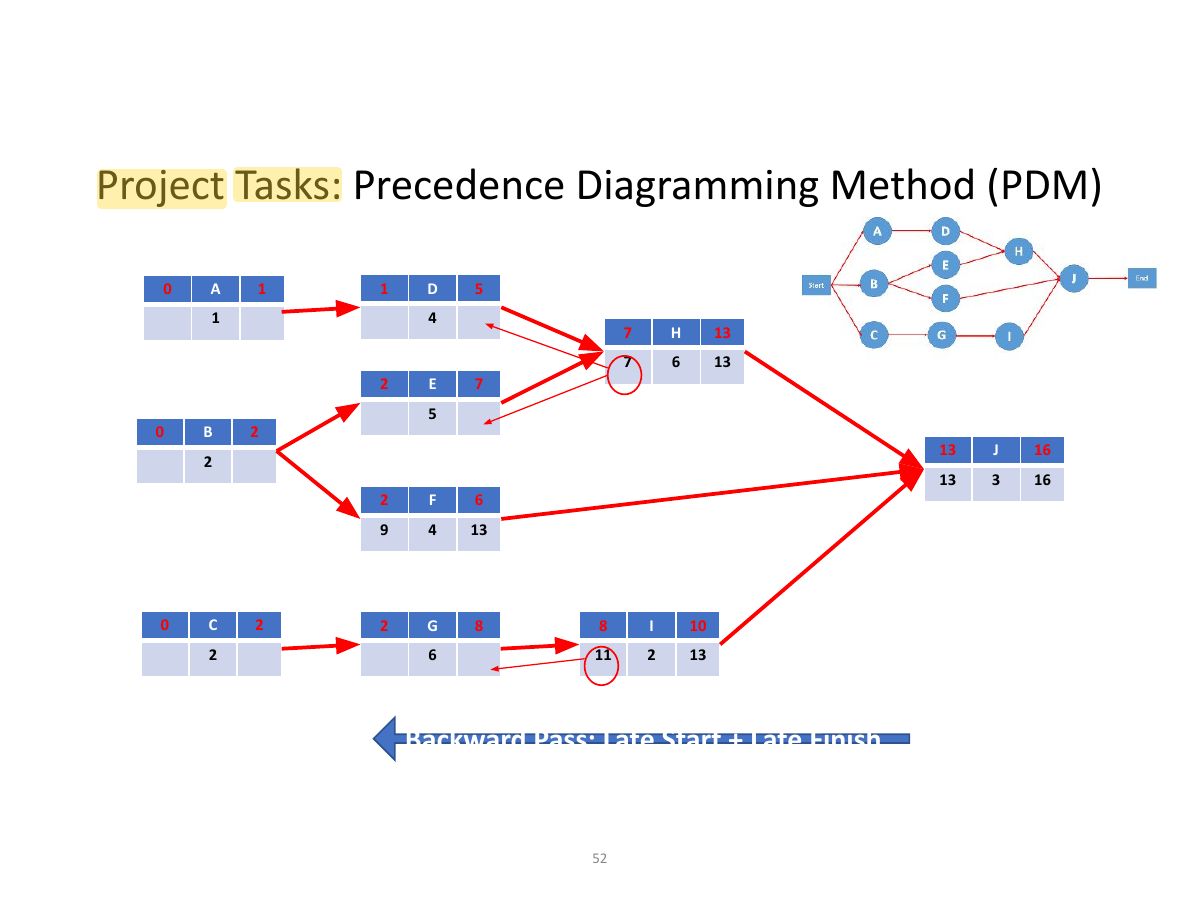
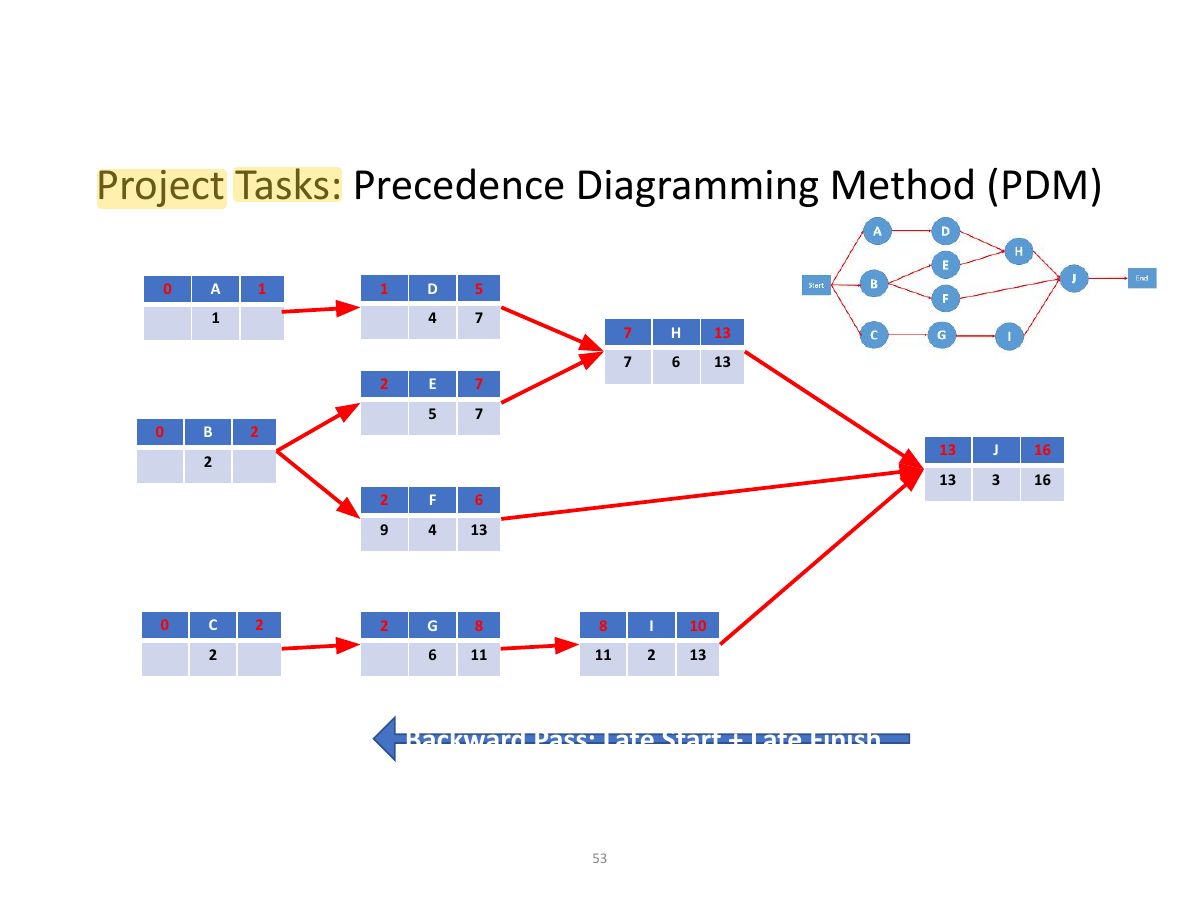
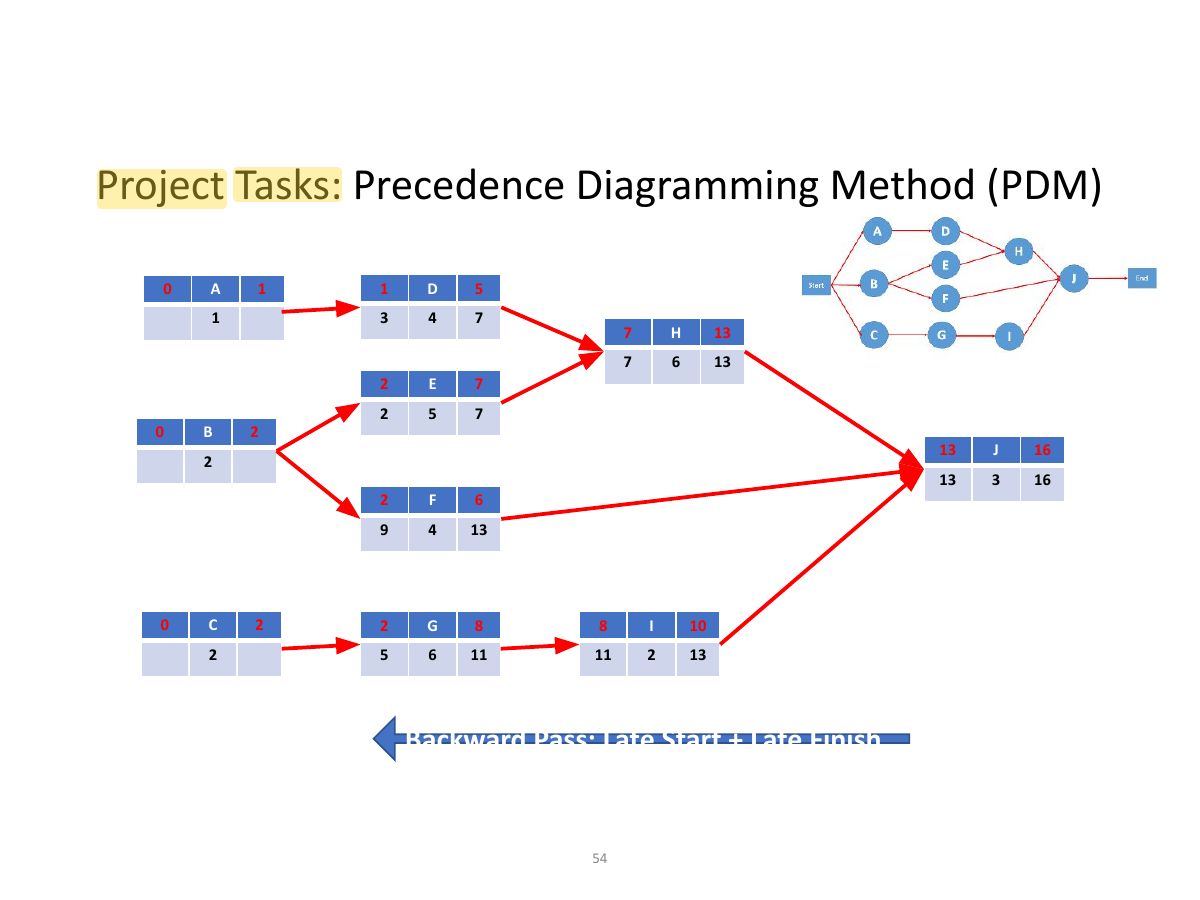
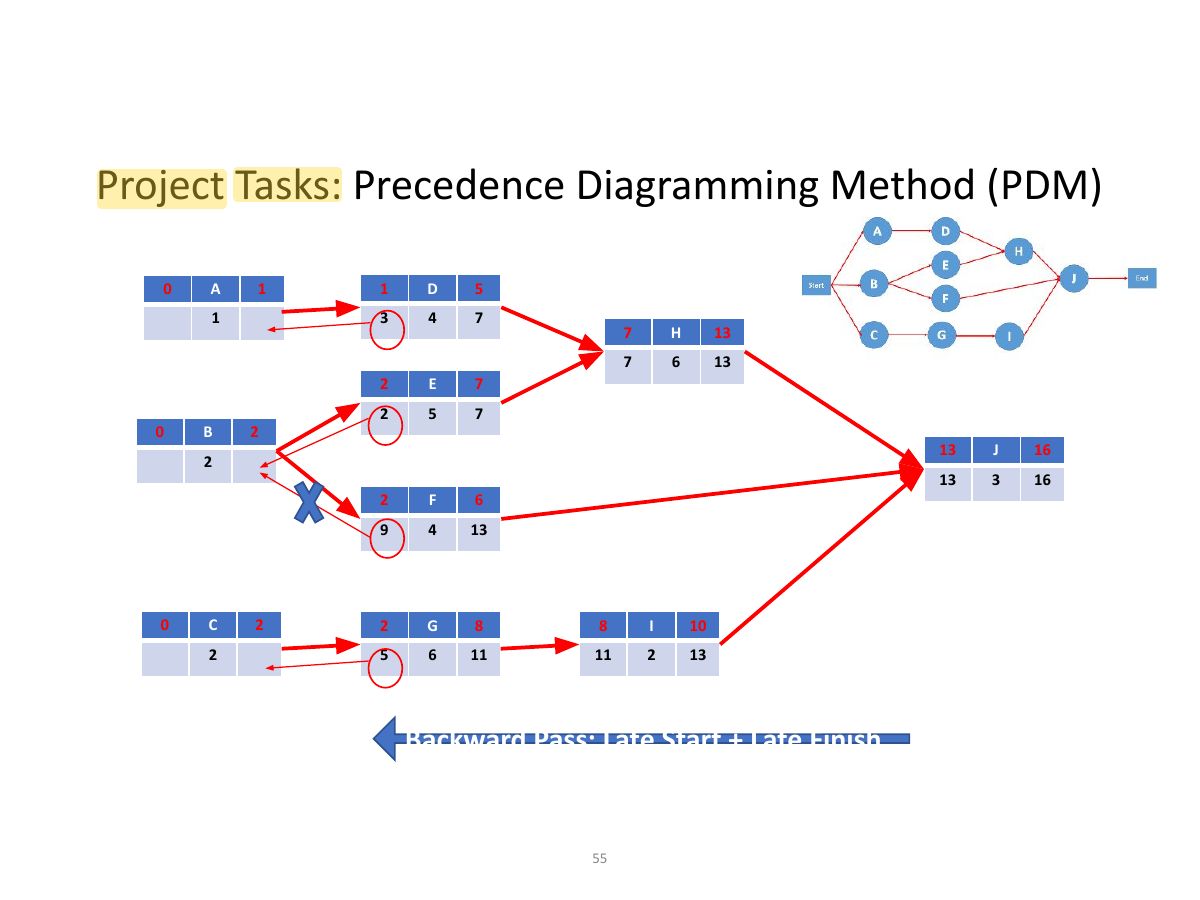
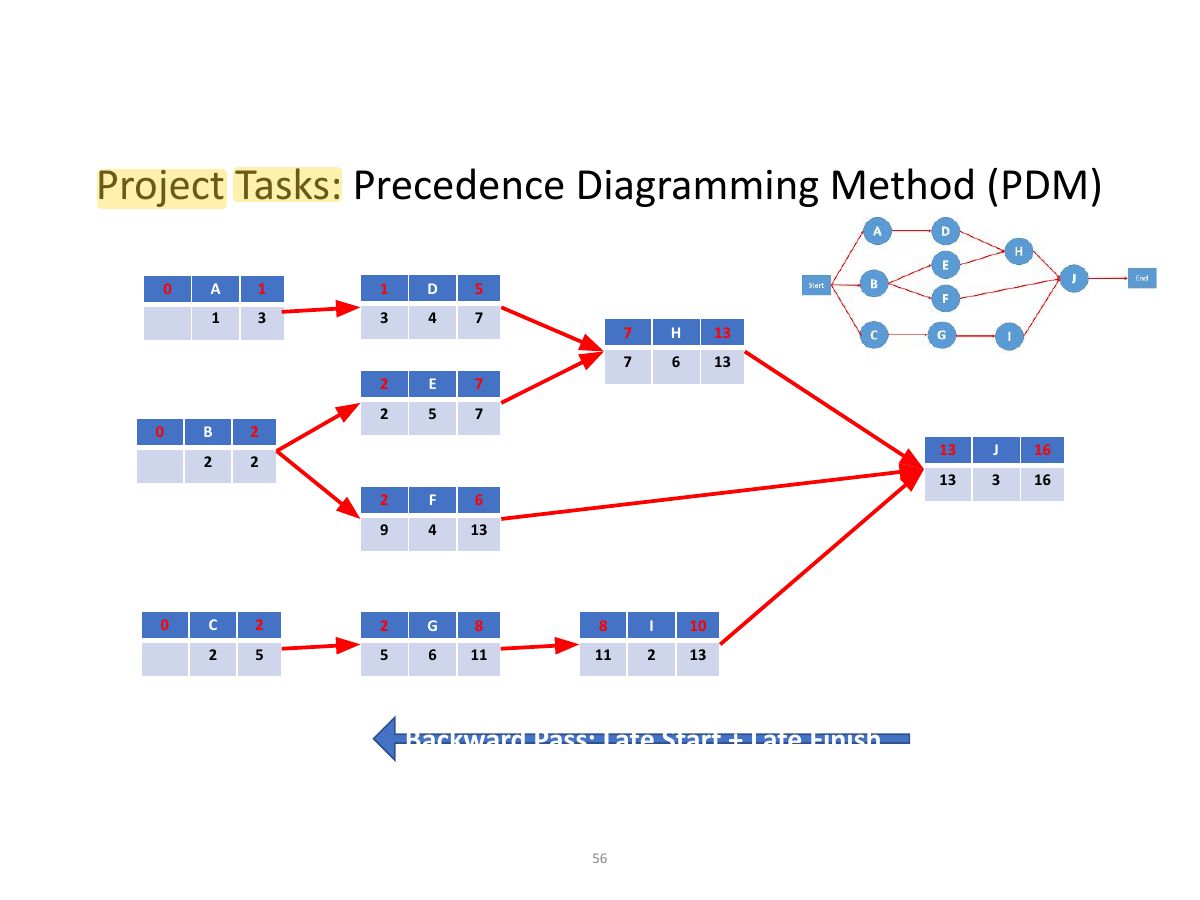
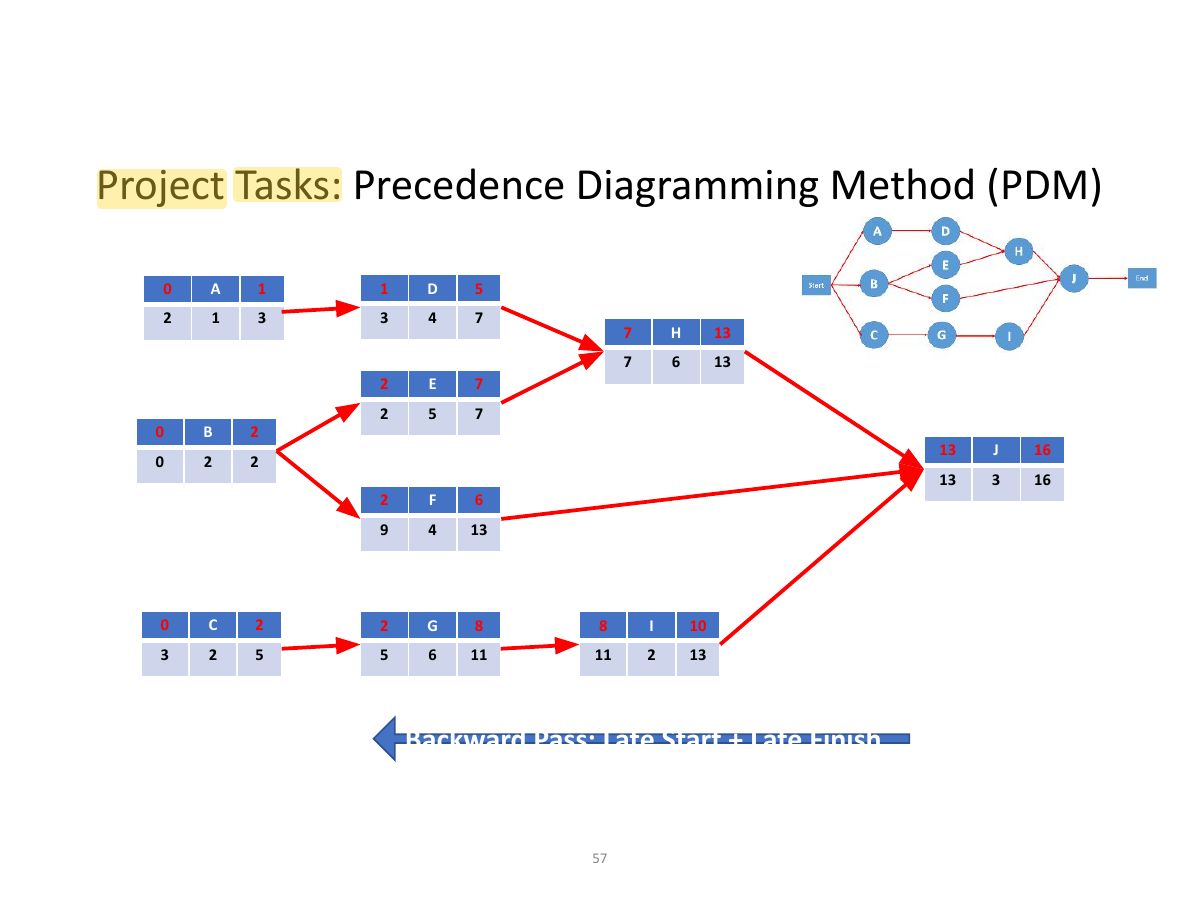
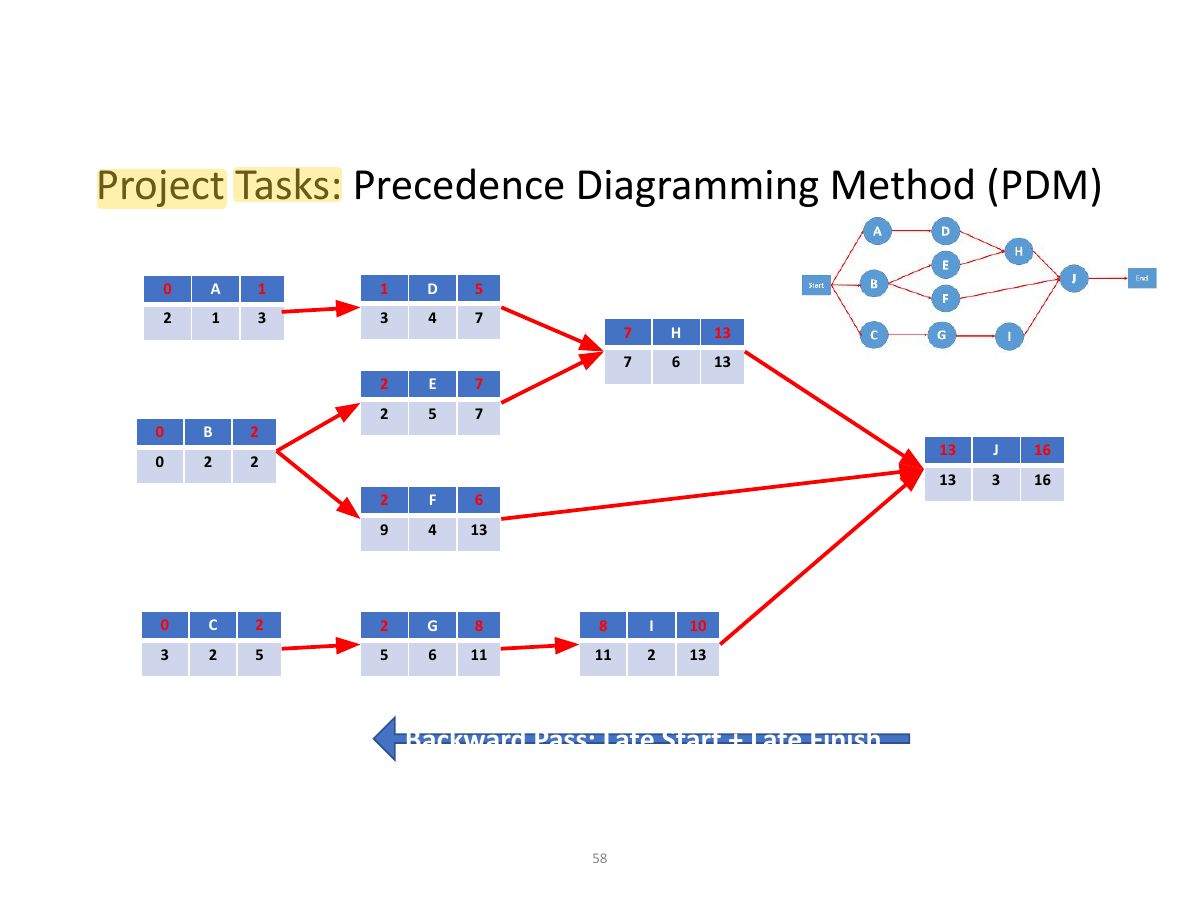
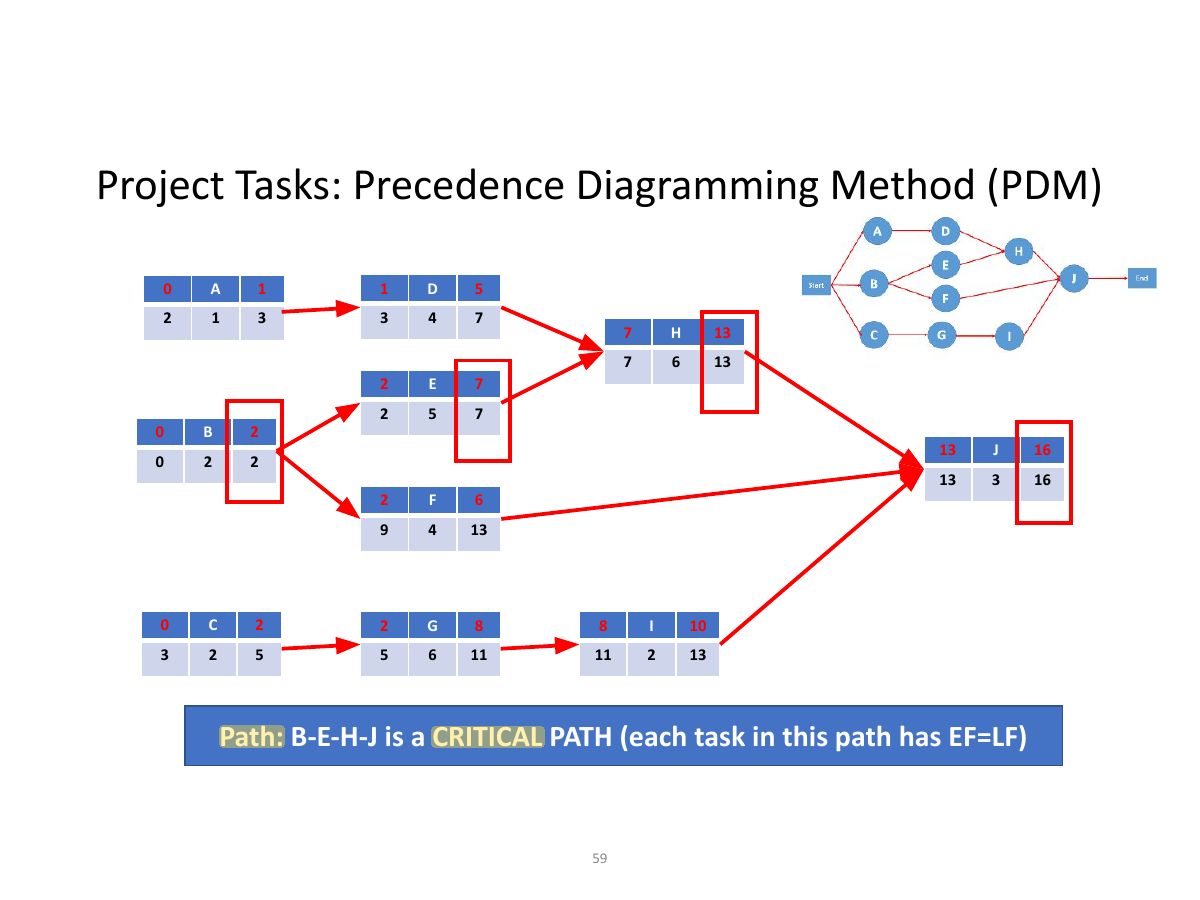
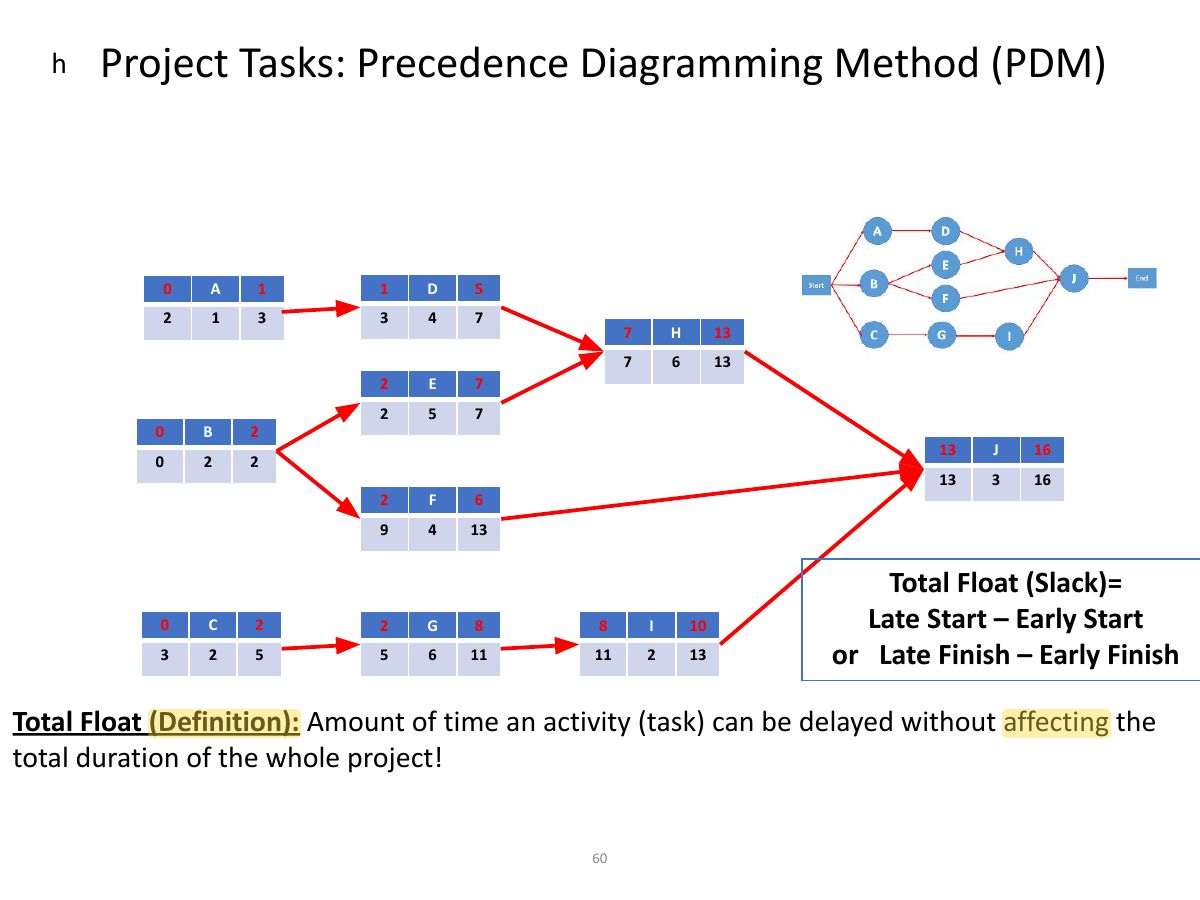
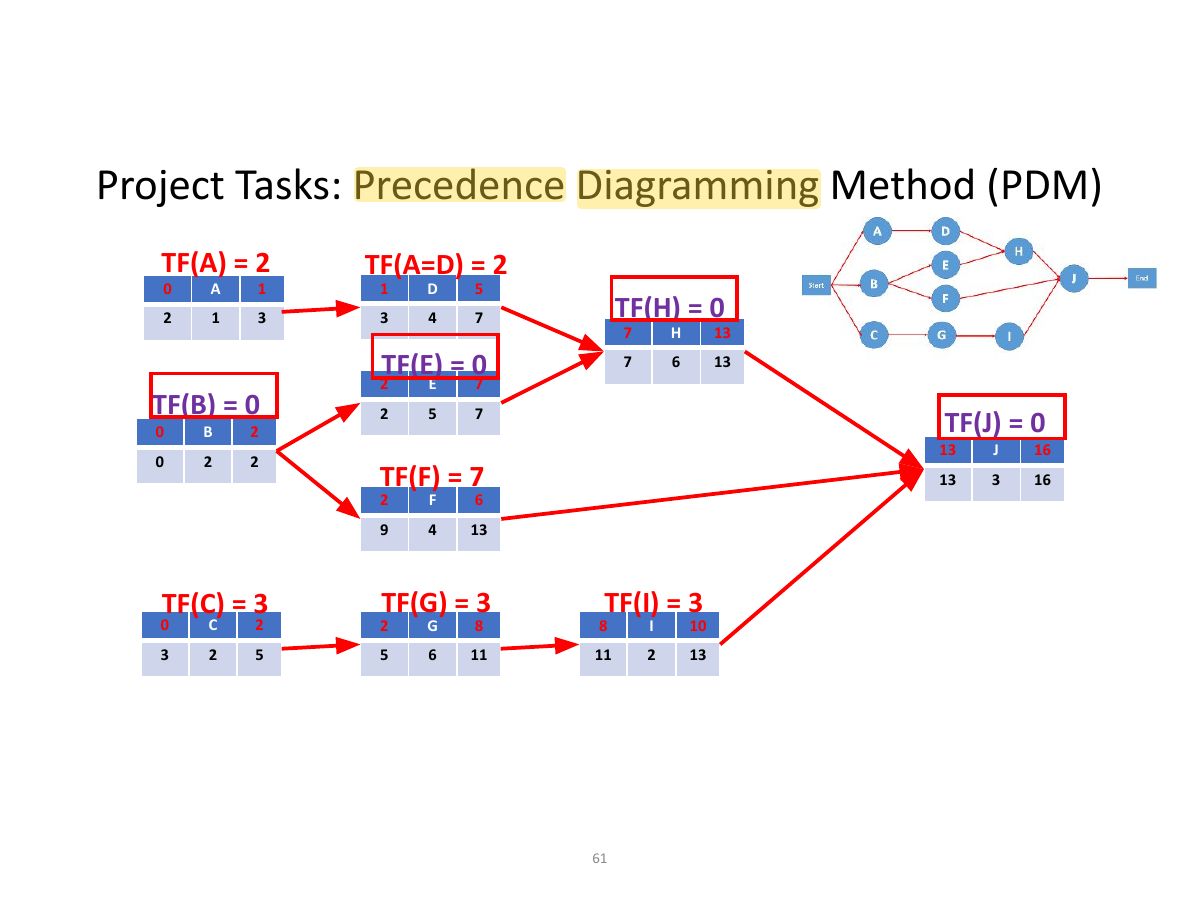
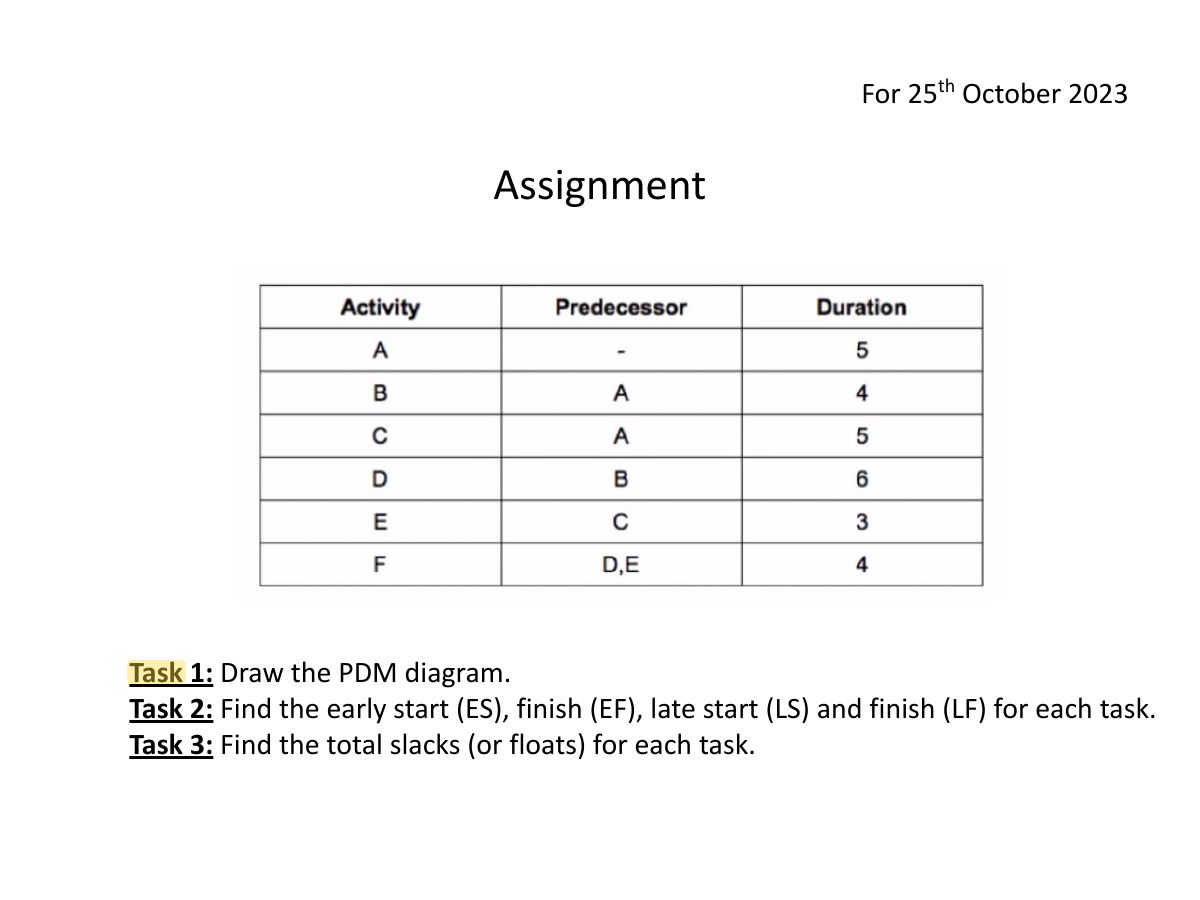
                                                    1. Precedence diagram (activity on node): ES/EF from the forward pass, LS/LF from the backward pass; slack (float) = LS − ES.
                                                    TipForward pass: EF = ES + duration, ES = max(EF of predecessors). Backward pass: LS = LF − duration, LF = min(LS of successors). Critical path = activities with zero float.
                                                    🎯 How this can come up · 2 questions
                                                    MCQ

                                                    The critical path is the:

                                                    Written

                                                    Activity A (3 days) → B (4 days) and A → C (2 days); B and C → D (1 day). Find the project length and the critical path.

                                                    Slide 32: Project Tasks: Precedence Diagramming Method (PDM)
                                                    Exam weight Low
                                                      Slide 33: Project Tasks: Precedence Diagramming Method (PDM)
                                                      Exam weight Low
                                                        Slide 34: Project Tasks: Precedence Diagramming Method (PDM)
                                                        Exam weight Low
                                                          Slide 35: Project Tasks: Precedence Diagramming Method (PDM)
                                                          Exam weight Low
                                                            Slide 36: Project Tasks: Precedence Diagramming Method (PDM)
                                                            Exam weight Low
                                                              Slide 37: Project Tasks: Precedence Diagramming Method (PDM)
                                                              Exam weight Low
                                                                Slide 38: Project Tasks: Precedence Diagramming Method (PDM)
                                                                Exam weight Low
                                                                  Slide 39: Project Tasks: Precedence Diagramming Method (PDM)
                                                                  Exam weight Low
                                                                    Slide 40: Project Tasks: Precedence Diagramming Method (PDM)
                                                                    Exam weight Low
                                                                      Slide 41: Project Tasks: Precedence Diagramming Method (PDM)
                                                                      Exam weight Low
                                                                        Slide 42: Project Tasks: Precedence Diagramming Method (PDM)
                                                                        Exam weight Low
                                                                          Slide 43: Project Tasks: Precedence Diagramming Method (PDM)
                                                                          Exam weight Low
                                                                            Slide 44: Project Tasks: Precedence Diagramming Method (PDM)
                                                                            Exam weight Low
                                                                              Slide 45: Project Tasks: Precedence Diagramming Method (PDM)
                                                                              Exam weight Low
                                                                                Slide 46: Project Tasks: Precedence Diagramming Method (PDM)
                                                                                Exam weight Low
                                                                                  Slide 47: Project Tasks: Precedence Diagramming Method (PDM)
                                                                                  Exam weight Low
                                                                                    Slide 48: Project Tasks: Precedence Diagramming Method (PDM)
                                                                                    Exam weight Low
                                                                                      Slide 49: Project Tasks: Precedence Diagramming Method (PDM)
                                                                                      Exam weight Low
                                                                                        Slide 50: Project Tasks: Precedence Diagramming Method (PDM)
                                                                                        Exam weight Low
                                                                                          Slide 51: Project Tasks: Precedence Diagramming Method (PDM)
                                                                                          Exam weight Low
                                                                                            Slide 52: Project Tasks: Precedence Diagramming Method (PDM)
                                                                                            Exam weight Low
                                                                                              Slide 53: Project Tasks: Precedence Diagramming Method (PDM)
                                                                                              Exam weight Low
                                                                                                Slide 54: Project Tasks: Precedence Diagramming Method (PDM)
                                                                                                Exam weight Low
                                                                                                  Slide 55: Project Tasks: Precedence Diagramming Method (PDM)
                                                                                                  Exam weight Low
                                                                                                    Slide 56: Project Tasks: Precedence Diagramming Method (PDM)
                                                                                                    Exam weight Low
                                                                                                      Slide 57: Project Tasks: Precedence Diagramming Method (PDM)
                                                                                                      Exam weight Low
                                                                                                        Slide 58: Project Tasks: Precedence Diagramming Method (PDM)
                                                                                                        Exam weight Low
                                                                                                          Slide 59: Project Tasks: Precedence Diagramming Method (PDM)
                                                                                                          Exam weight Low
                                                                                                            Slide 60: Project Tasks: Precedence Diagramming Method (PDM)
                                                                                                            Exam weight Low
                                                                                                              Slide 61: Project Tasks: Precedence Diagramming Method (PDM)
                                                                                                              Exam weight Low
                                                                                                                Slide 62: Project Tasks: Gantt chart
                                                                                                                Exam weight Low
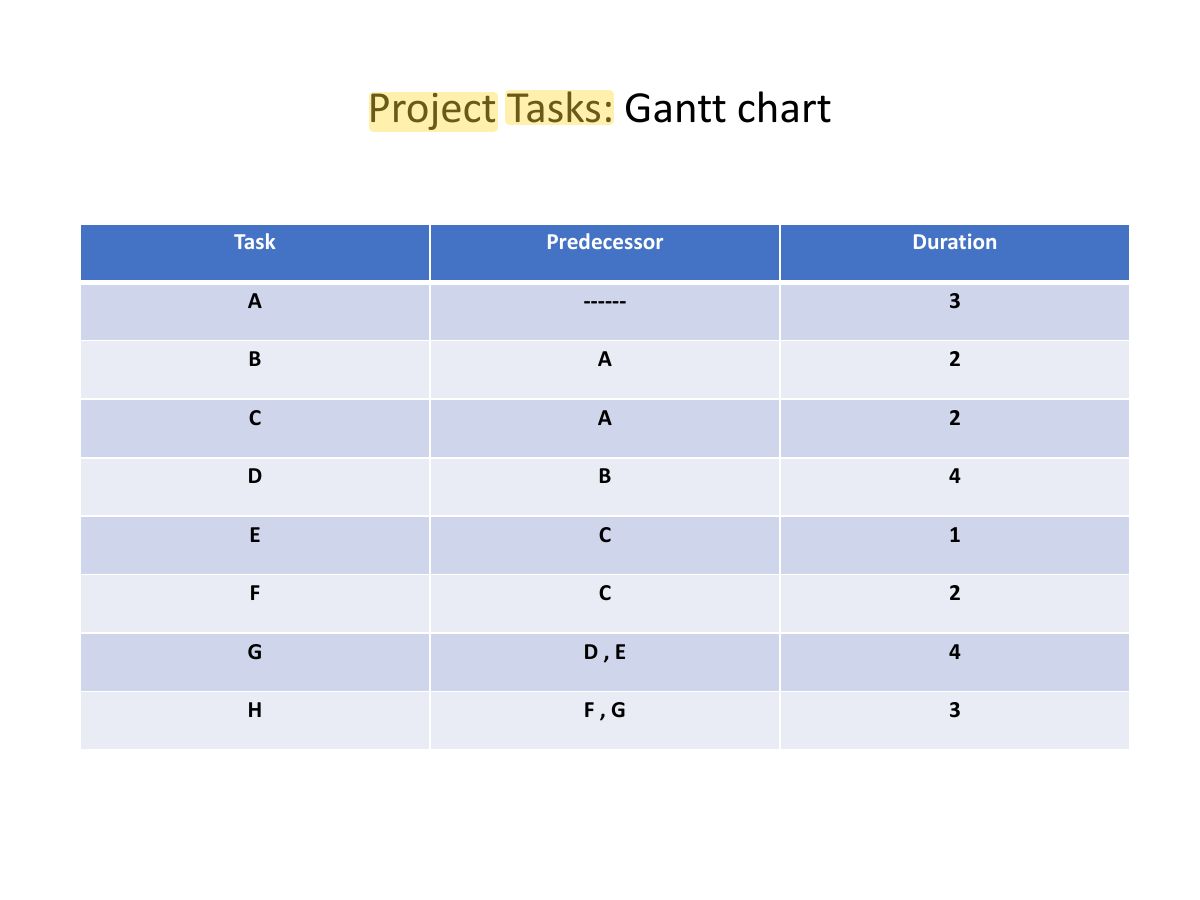
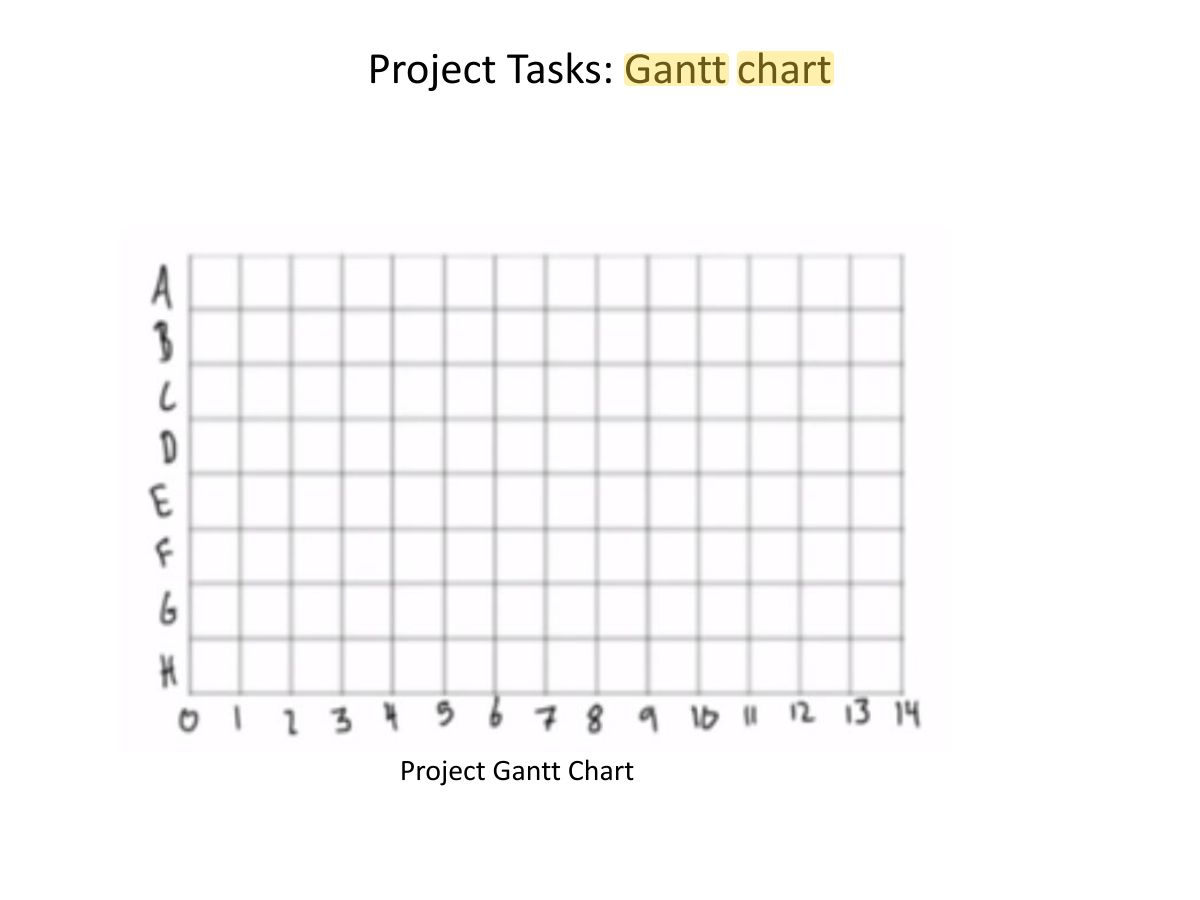
                                                                                                                1. Gantt chart: bars on a calendar show each task’s duration and timing.
                                                                                                                Slide 63: Project Tasks: Gantt chart
                                                                                                                Exam weight Low
                                                                                                                  Slide 64: th October 2023
                                                                                                                  Exam weight Low

                                                                                                                    Part III

                                                                                                                    Risk Management

                                                                                                                    04/12/2014

                                                                                                                    Chapter 22 Project management

                                                                                                                    65
                                                                                                                    Exam weight Low

                                                                                                                      Topics

                                                                                                                      • Risk Management
                                                                                                                      • Communication Management

                                                                                                                      04/12/2014

                                                                                                                      Chapter 22 Project management

                                                                                                                      66
                                                                                                                      Exam weight Low

                                                                                                                        Risk Management

                                                                                                                        • Risk management is concerned with identifying risks affecting the project schedule or the quality of the software and drawing up plans to avoid or minimise their effect on a project.
                                                                                                                        • Software risk management is important because of the inherent uncertainties in software development.
                                                                                                                          • These uncertainties stem from loosely defined requirements, requirements changes due to changes in customer needs, difficulties in estimating the time and resources required for software development, and differences in individual skills.
                                                                                                                        • You have to anticipate risks, understand the impact of these risks on the project, the product and the business, and take steps to avoid these risks.

                                                                                                                        04/12/2014

                                                                                                                        Chapter 22 Project management

                                                                                                                        67
                                                                                                                        Exam weight High
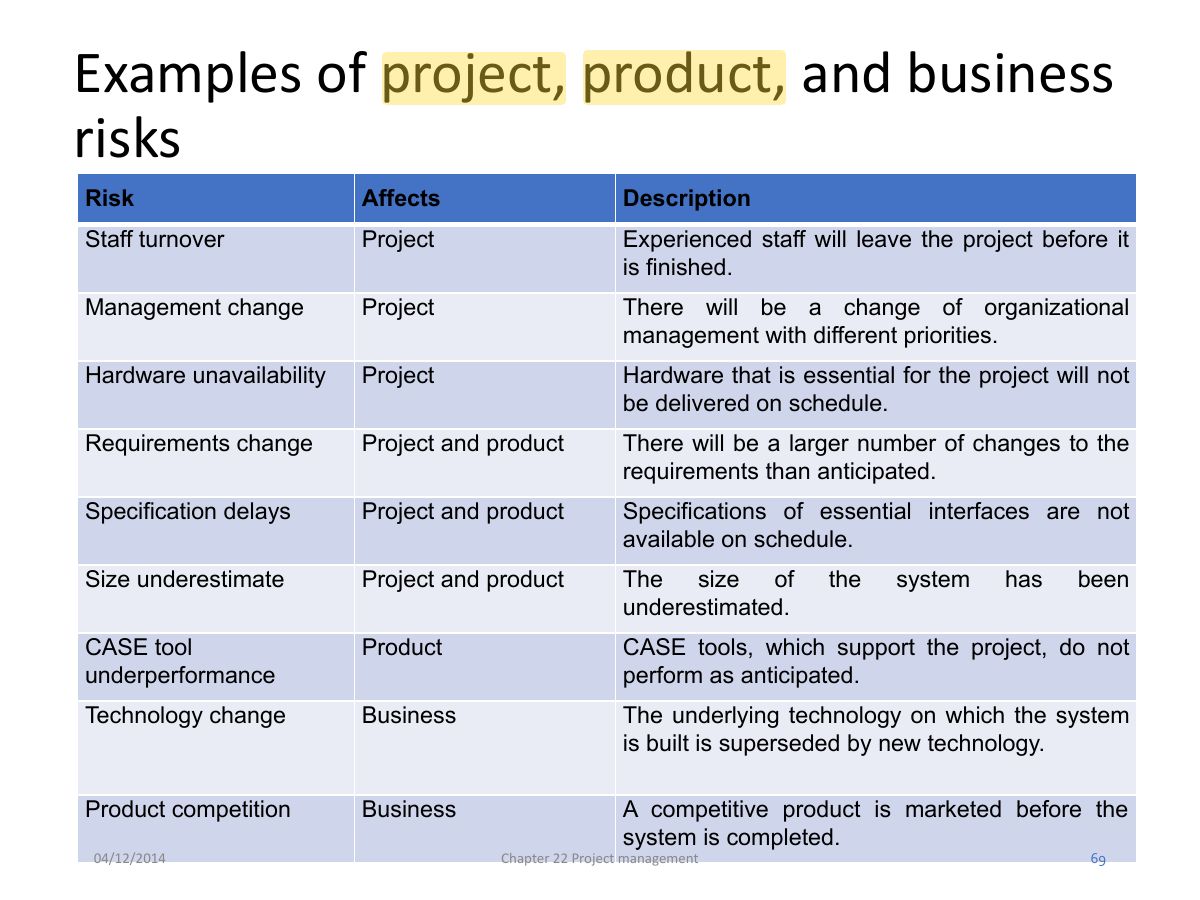
                                                                                                                        1. Risk = an event that may adversely affect the project. Categories: project, product, business risks.
                                                                                                                        🎯 How this can come up · 1 question
                                                                                                                        MCQ

                                                                                                                        Staff turnover is mainly a:

                                                                                                                        Risk Classification

                                                                                                                        There are two dimensions of risk classification

                                                                                                                        • The type of risk (technical, organizational, ..)
                                                                                                                        • what is affected by the risk:
                                                                                                                          • Project risks affect schedule or resources e.g. loss of an experienced programmer.
                                                                                                                          • Product risks affect the quality or performance of the software being developed e.g. failure of a purchased component as expected.
                                                                                                                          • Business risks affect the organisation developing or procuring the software e.g. a competitor launching a new product.

                                                                                                                        04/12/2014

                                                                                                                        Chapter 22 Project management

                                                                                                                        68
                                                                                                                        Exam weight Low
                                                                                                                          Slide 69: Examples of project, product, and business risks
                                                                                                                          Exam weight Low

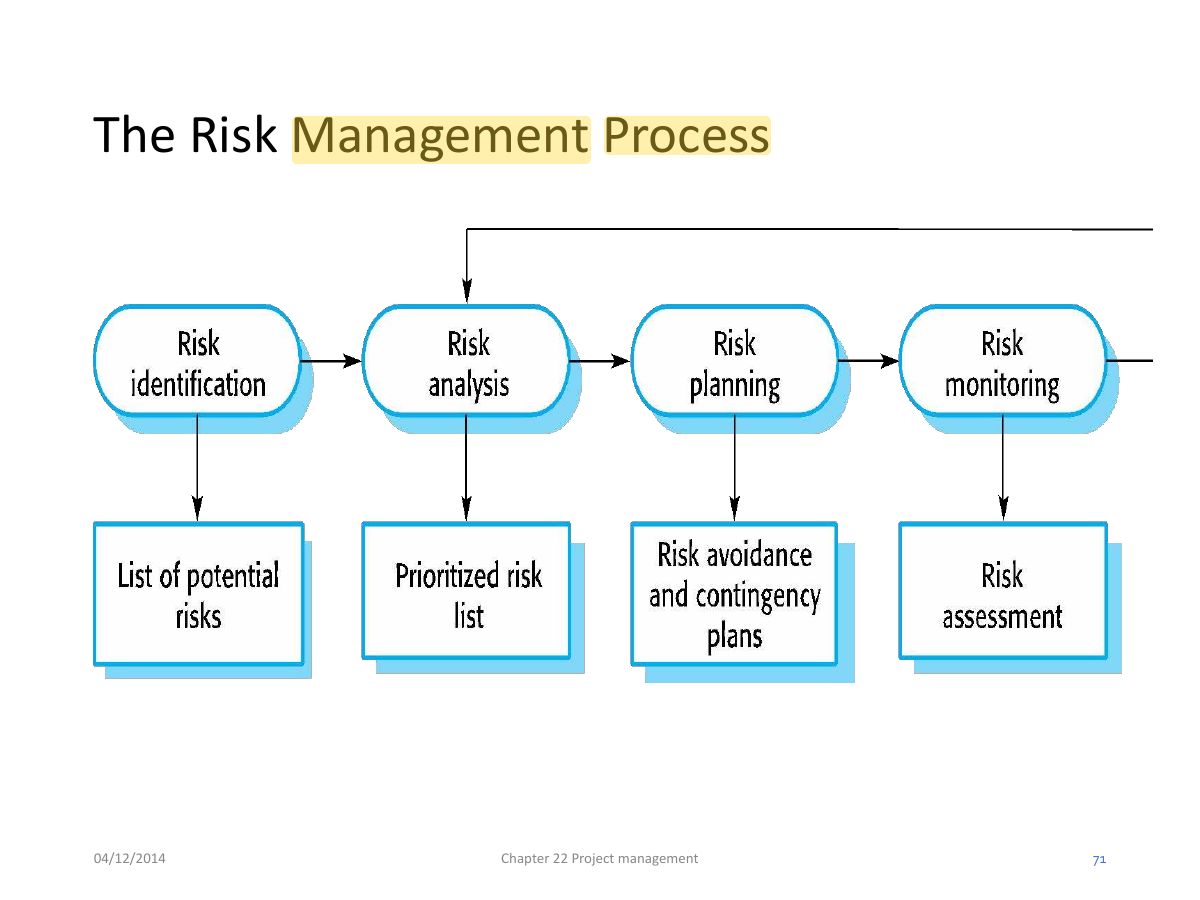
                                                                                                                            The Risk Management Process

                                                                                                                            • Risk Identification Identify project, product and business risks;
                                                                                                                            • Risk Analysis Assess the likelihood and consequences of these risks;
                                                                                                                            • Risk Planning Draw up plans to avoid or minimise the effects of the risk;
                                                                                                                            • Risk Monitoring

                                                                                                                            Regularly assess the risk and your plans for risk mitigation and revise

                                                                                                                            these when you learn more about the risk

                                                                                                                            04/12/2014

                                                                                                                            Chapter 22 Project management

                                                                                                                            70
                                                                                                                            Exam weight High
                                                                                                                            1. Process: identification → analysis (probability, effects) → planning (avoid, minimize, contingency) → monitoring.
                                                                                                                            🎯 How this can come up · 1 question
                                                                                                                            MCQ

                                                                                                                            Correct order of the risk-management process:

                                                                                                                            Slide 71: The Risk Management Process
                                                                                                                            Exam weight Low

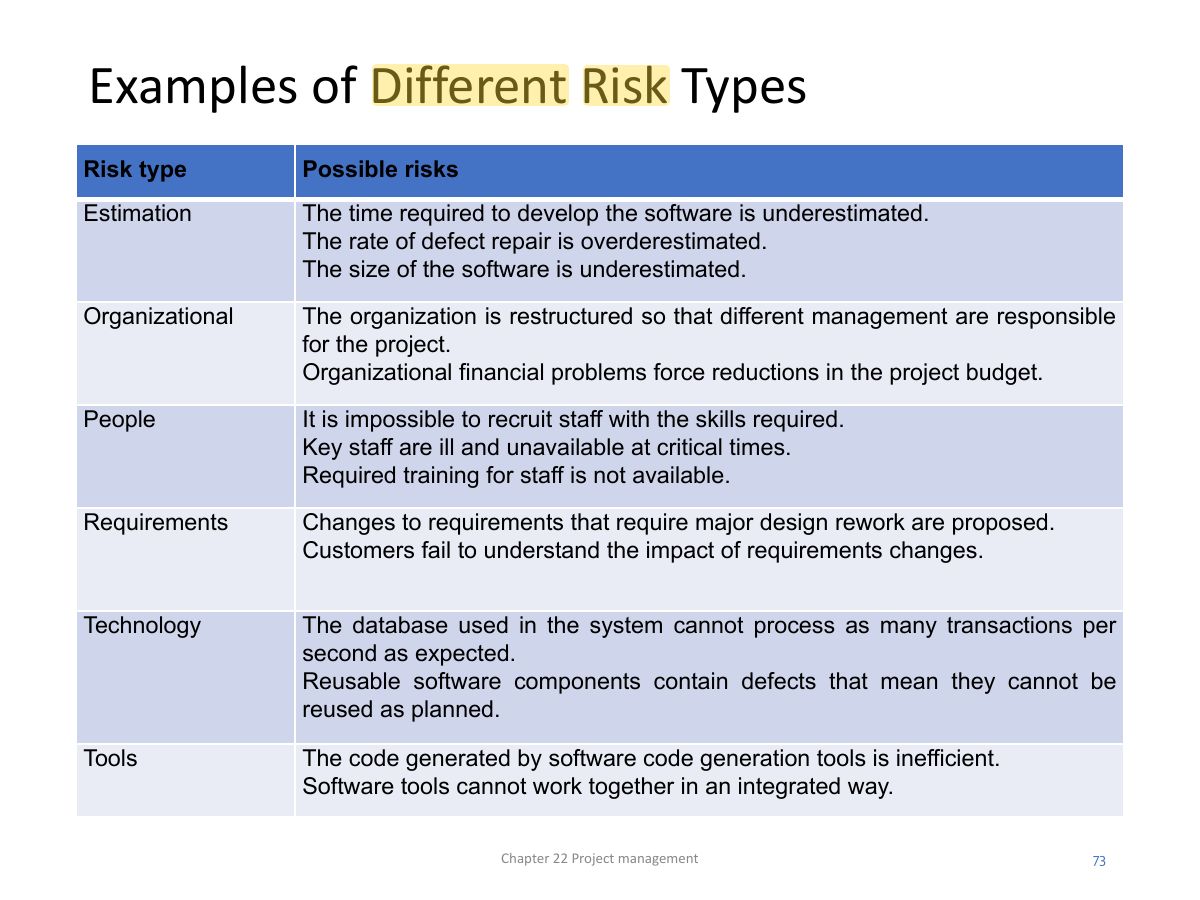
                                                                                                                              Risk Identification

                                                                                                                              • First stage of the risk management process.
                                                                                                                              • May be team activities or based on the individual project manager’s experience to identify the most probable or critical risks.
                                                                                                                              • A checklist of common risks may be used to identify risks in a project
                                                                                                                                • Technology risks.
                                                                                                                                • Organizational risks.
                                                                                                                                • People risks.
                                                                                                                                • Requirements risks.
                                                                                                                                • Estimation risks.
                                                                                                                                • Tools risks

                                                                                                                              04/12/2014

                                                                                                                              Chapter 22 Project management

                                                                                                                              72
                                                                                                                              Exam weight Low
                                                                                                                                Slide 73: Examples of Different Risk Types
                                                                                                                                Exam weight Low

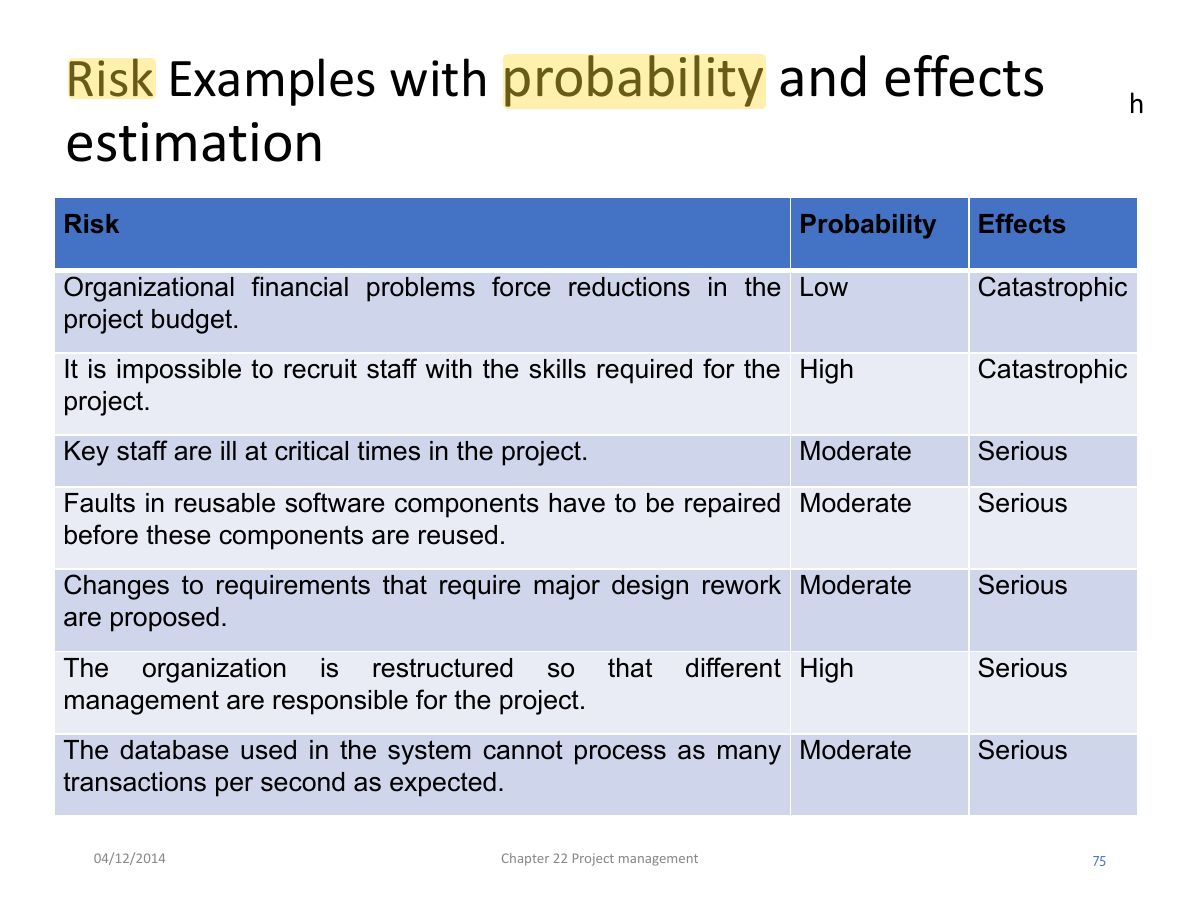
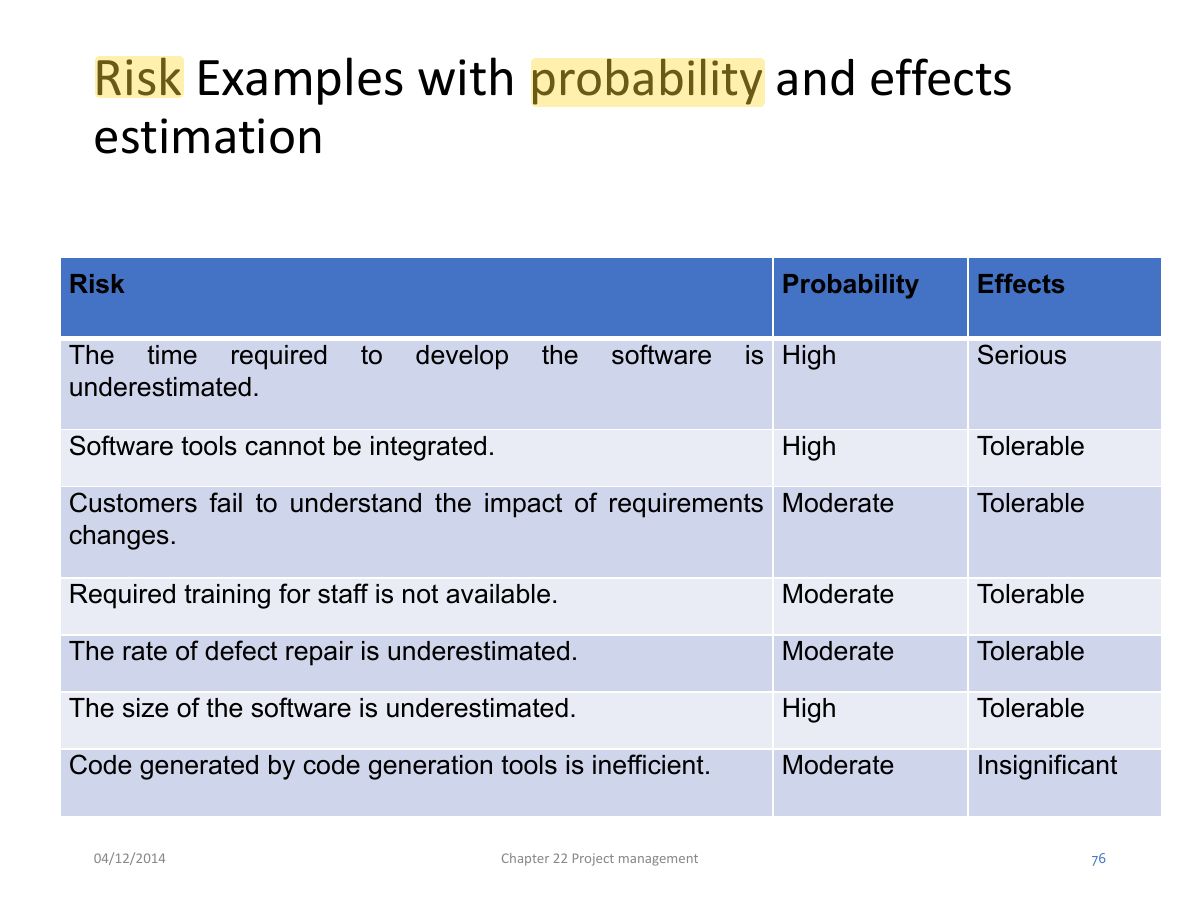
                                                                                                                                  Risk Analysis

                                                                                                                                  • Consider each identified risk and assess probability and seriousness of each risk.
                                                                                                                                  • Mostly rely on the PM’s own judgment and experience of previous projects.
                                                                                                                                  • Probability may be very low(<10%), low, (10-25%), moderate(25-50%), high (50-75%) or very high(>75%).
                                                                                                                                  • Risk consequences might be catastrophic (threaten the survival of the project), serious (would cause major delays), tolerable (delays are within allowed contingency), or insignificant.

                                                                                                                                  04/12/2014

                                                                                                                                  Chapter 22 Project management

                                                                                                                                  74
                                                                                                                                  Exam weight Low
                                                                                                                                    Slide 75: probability and effects
                                                                                                                                    Exam weight Low
                                                                                                                                      Slide 76: Risk Examples with probability and effects
                                                                                                                                      Exam weight Low

                                                                                                                                        Risk Planning

                                                                                                                                        • Consider each identified risk and develop strategies to manage those risks.
                                                                                                                                        • Avoidance strategies The probability that the risk will arise is reduced e.g. dealing with defective components
                                                                                                                                        • Minimization strategies
                                                                                                                                        • The impact of the risk on the project or product will be reduced e.g. the strategy for staff illnesses
                                                                                                                                        • Contingency plans If the risk arises, prepare plans to deal with that risk;

                                                                                                                                        04/12/2014

                                                                                                                                        Chapter 22 Project management

                                                                                                                                        77
                                                                                                                                        Exam weight Low
                                                                                                                                        1. Strategies: avoidance (lower probability), minimization (lower impact), contingency plans (what to do if it happens).

                                                                                                                                        Risk Monitoring

                                                                                                                                        • Assess each identified risks regularly to decide whether or not it is becoming less or more probable.
                                                                                                                                        • Also assess whether the effects of the risk have changed.
                                                                                                                                        • Each key risk should be discussed at management progress meetings.

                                                                                                                                        04/12/2014

                                                                                                                                        Chapter 22 Project management

                                                                                                                                        78
                                                                                                                                        Exam weight Low
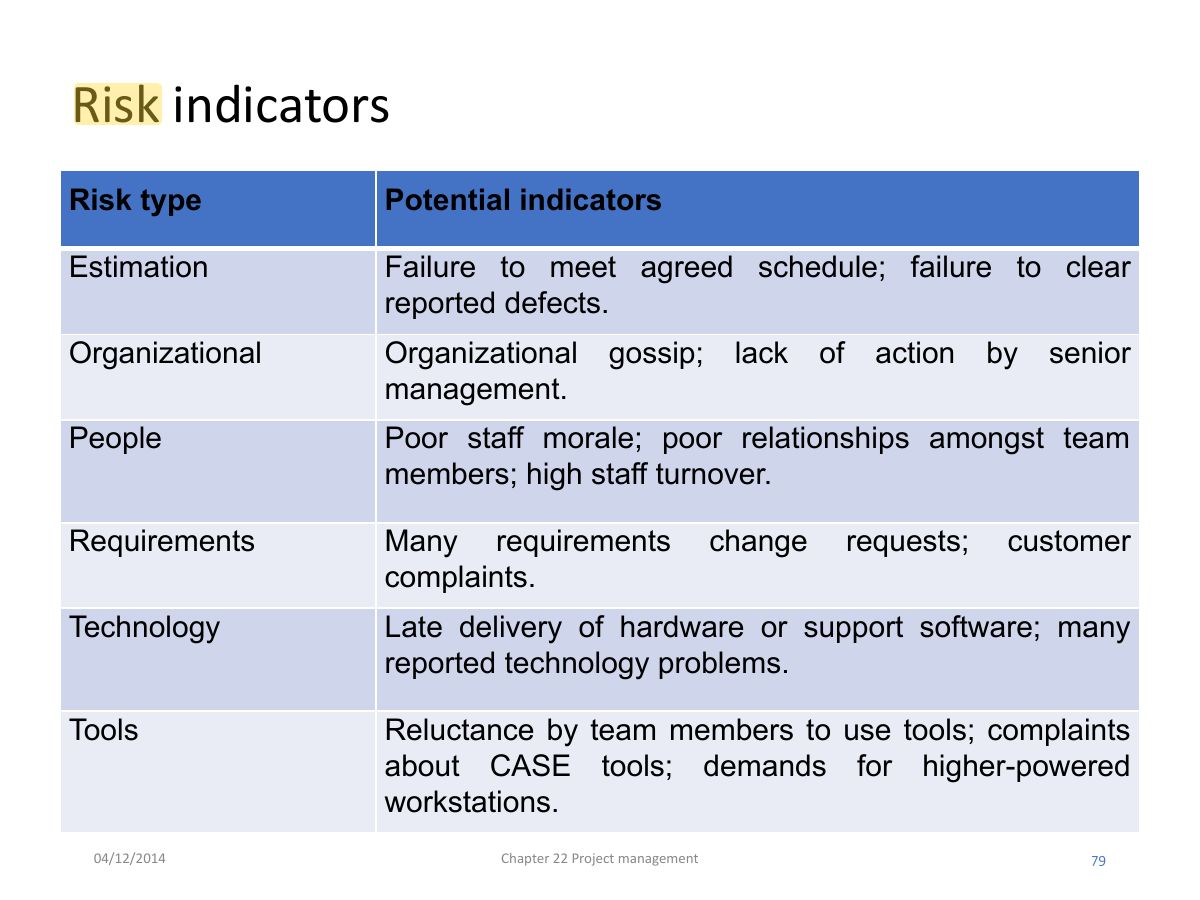
                                                                                                                                          Slide 79: Risk indicators
                                                                                                                                          Exam weight Low