CS223 · Annotated SlidesChapter 5 — Diagonalization
Chapter 5 · Annotated slides

Diagonalization

A = PDP⁻¹ and fast powers Aᵏ = PDᵏP⁻¹, the Diagonalization Theorem (n independent eigenvectors), the step-by-step procedure, and when distinct eigenvalues guarantee diagonalizability.

Slide text Study notes Highlight: key words Tips, tricks & traps Seen again elsewhere How it can come up
Slide 1: Slide 1
Exam weight High
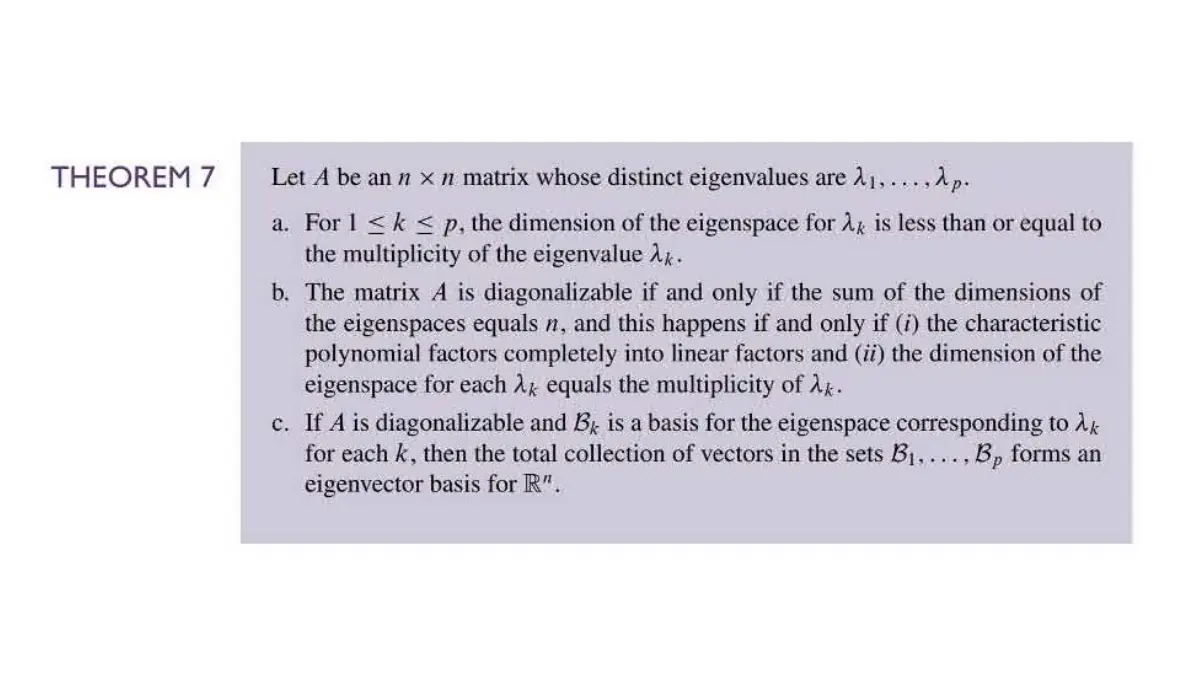
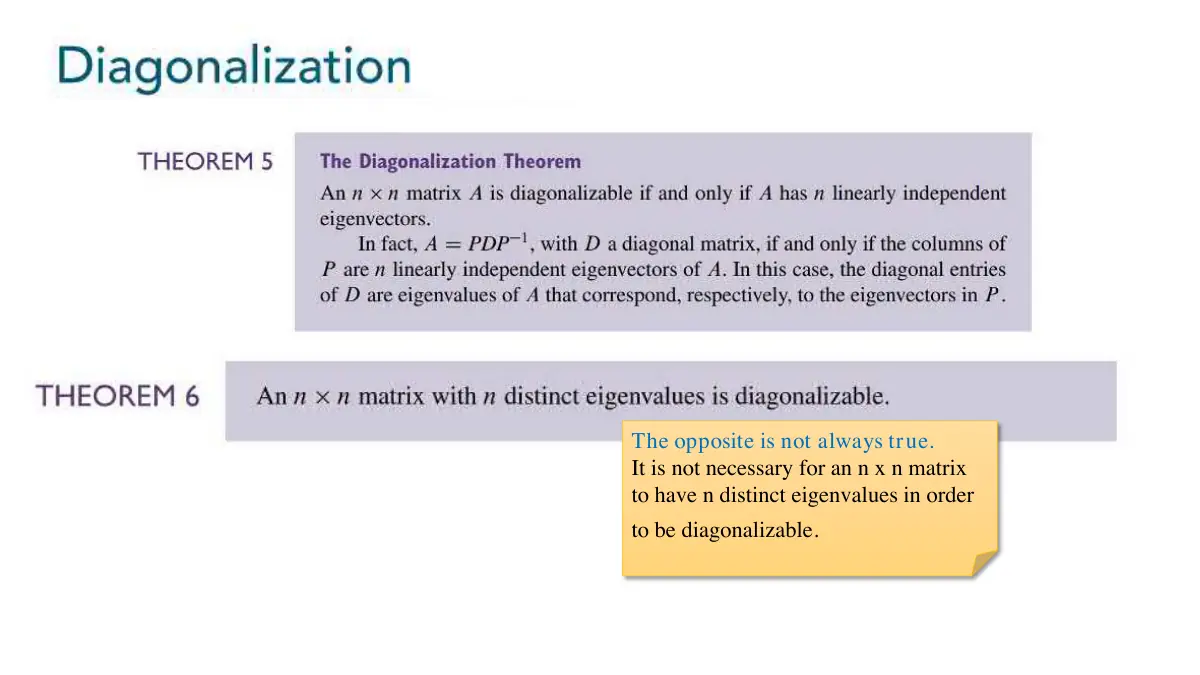
  1. A is diagonalizable ⇔ it has n linearly independent eigenvectors. Then A = PDP⁻¹: P’s columns are eigenvectors, D’s diagonal the matching eigenvalues. Aᵏ = PDᵏP⁻¹.
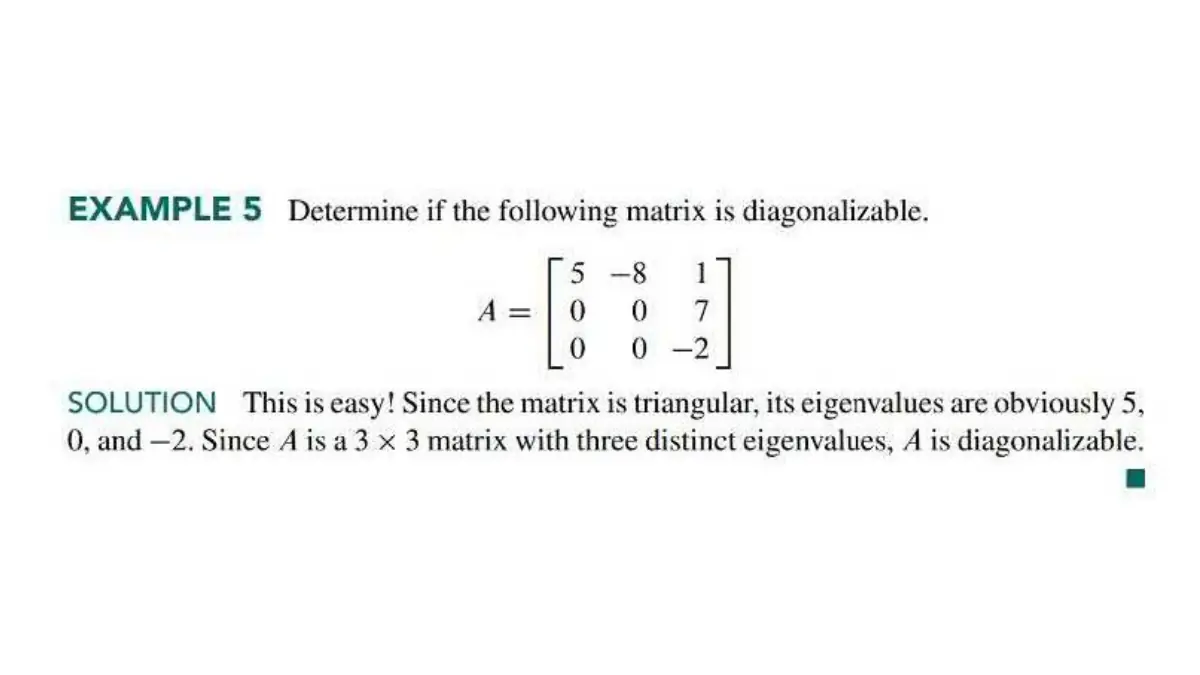
Memory trickn distinct eigenvalues ⇒ diagonalizable (sufficient, not necessary).
🎯 How this can come up · 2 questions
True / False

A 3×3 matrix with 3 distinct eigenvalues is diagonalizable.

True / False

Every diagonalizable matrix is invertible.

Slide 2: Slide 2
Exam weight Low
    Slide 3: Slide 3
    Exam weight Low

      4
      Exam weight Low
        Slide 5: Slide 5
        Exam weight Low
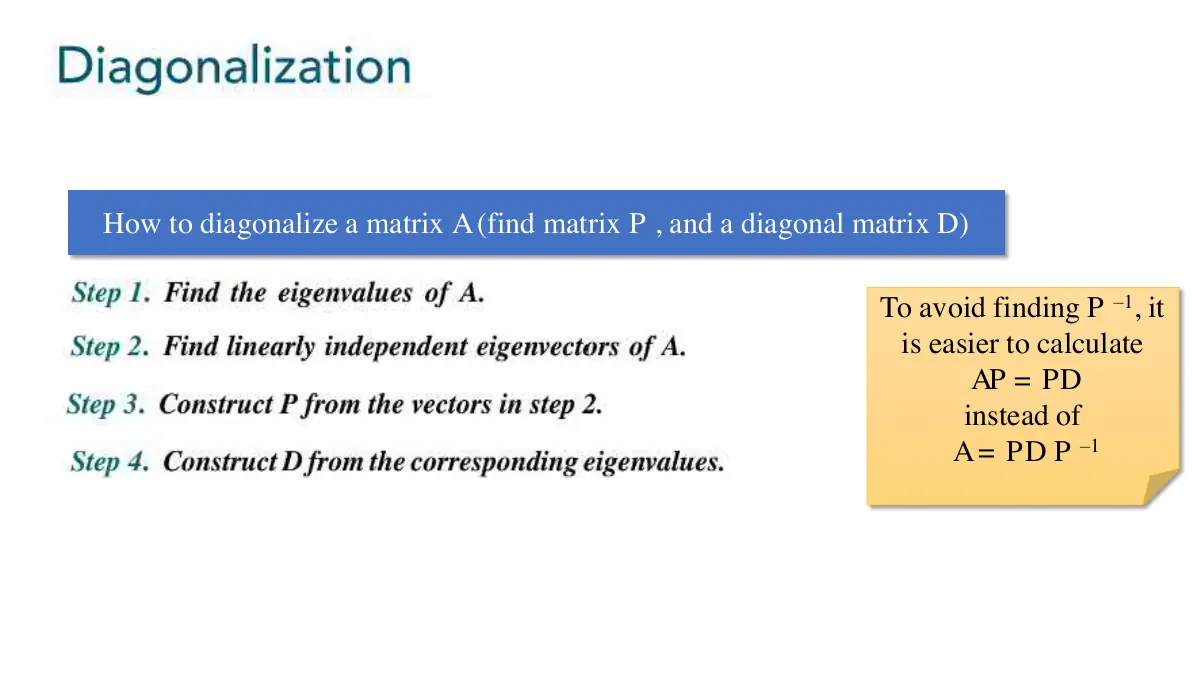
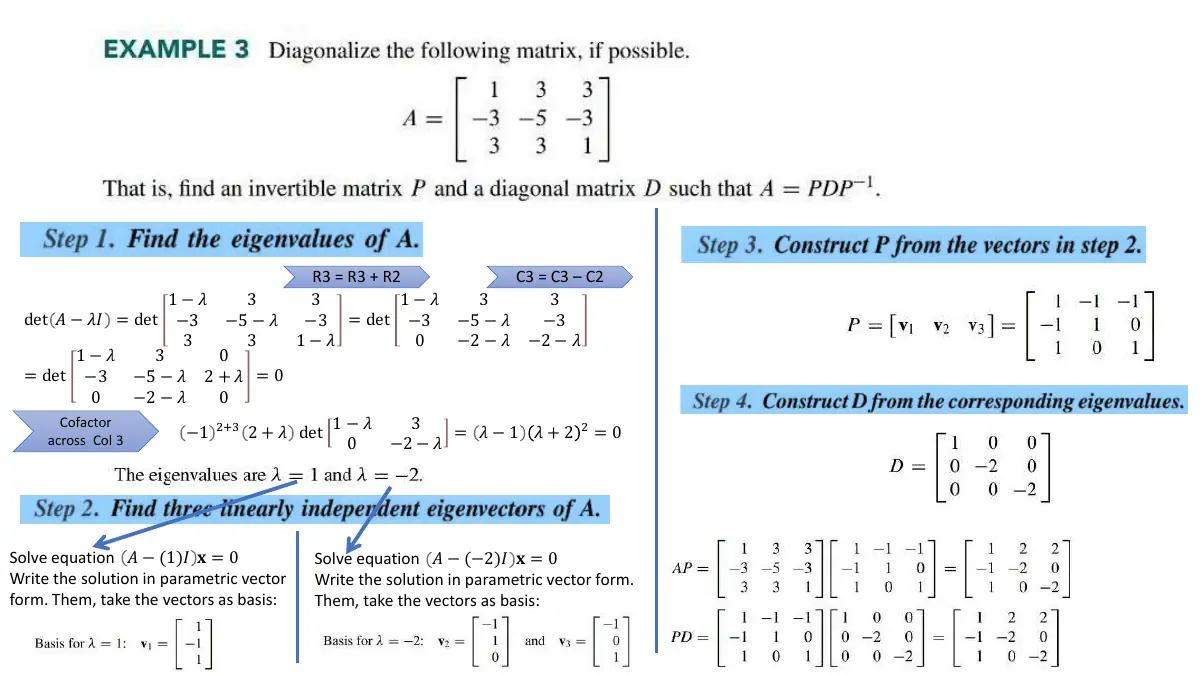
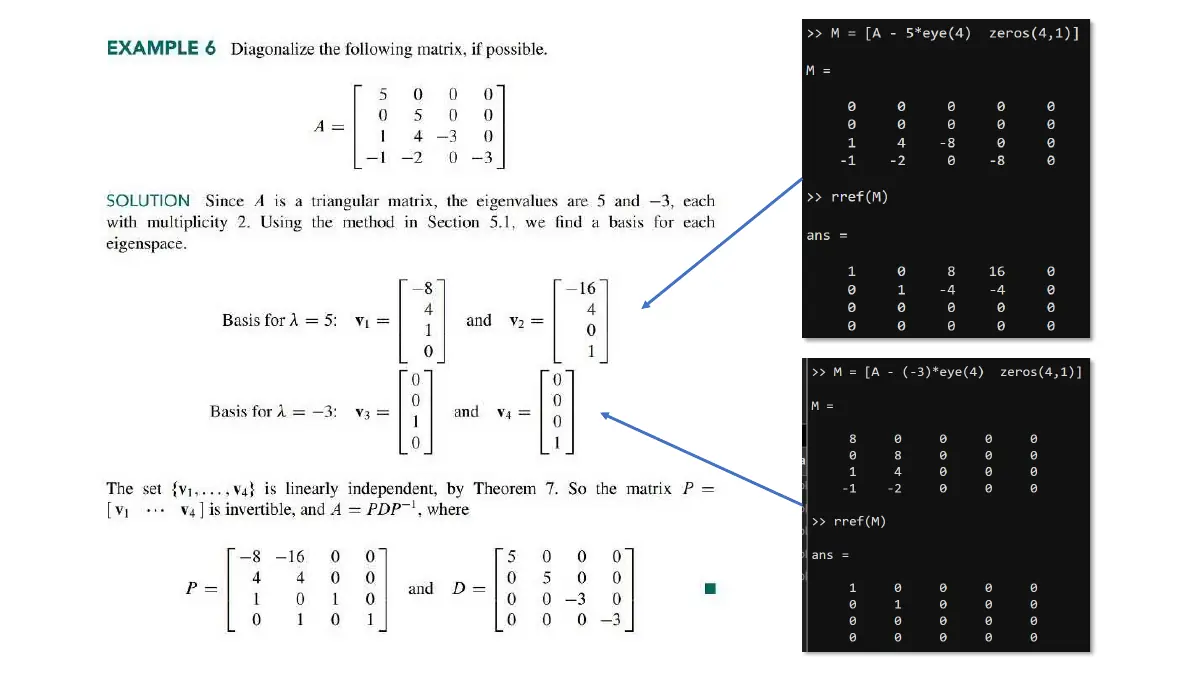
        1. Steps: eigenvalues → basis of each eigenspace → if the total is n vectors, build P and D (same order).
        Slide 6: Slide 6
        Exam weight Low
          Slide 7: Slide 7
          Exam weight Low