CYS406 · Annotated SlidesChapter 9 — Key Distribution and Management
Chapter 9 · Annotated slides

Key Distribution and Management

Key management and its protocols, key hierarchies (master and session keys), symmetric key distribution with a KDC and its MITM risk, hybrid schemes, distributing public keys (announcement, directory, authority, certificates), X.509 certificates and CA hierarchies, revocation (CRL, OCSP) and PKI.
Slide text Study notes Highlight: key words Tips, tricks & traps Seen again elsewhere How it can come up
Slide 1: Slide 1
Exam weight Low

    Key Management

    • Key management, generation, distribution, revocation of cryptographic keys
      • Key distribution, establish required keys
      • Key revocation, remove keys which are known to be compromised
        • usually a challenging issue
    • Scalability is a key concern
    2
    Exam weight Low
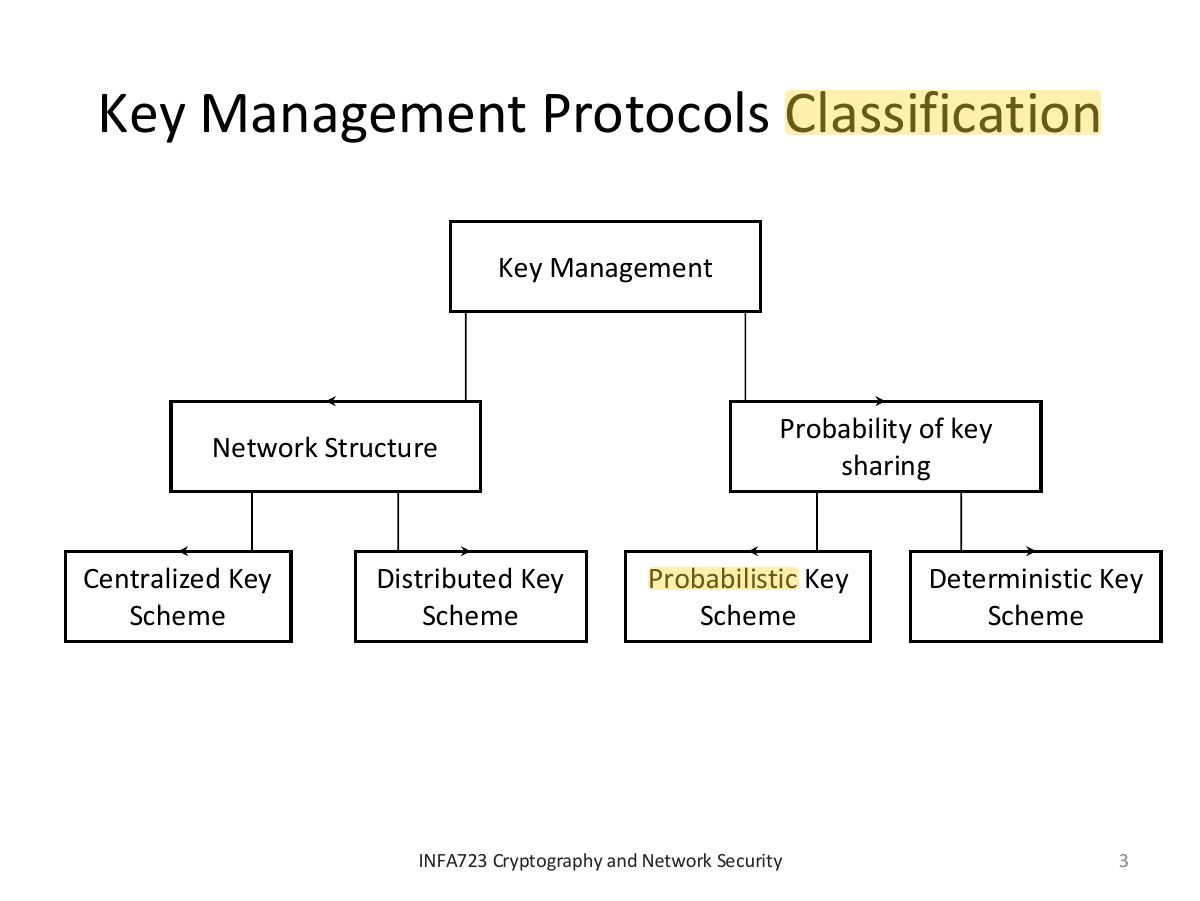
      Slide 3: Key Management Protocols Classification
      Exam weight Low
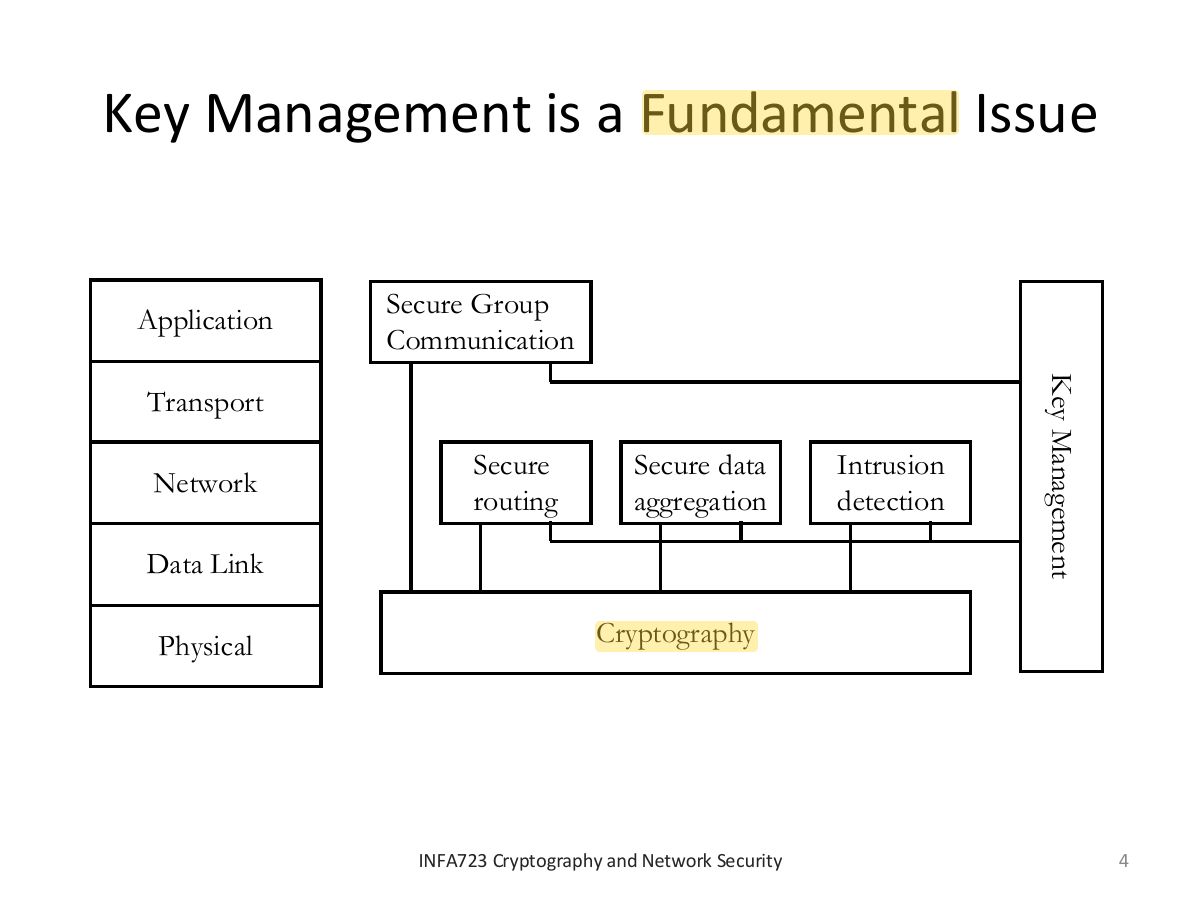
        Slide 4: Key Management is a Fundamental Issue
        Exam weight Low

          Key Management and Distribution

          • topics of cryptographic key management / key distribution are complex
            • cryptographic, protocol, & management issues
          • symmetric schemes require both parties to share a common secret key
          • public key schemes require parties to acquire valid public keys
          • have concerns with doing both
          5
          Exam weight Low

            Key Distribution

            • symmetric schemes require both parties to share a common secret key
            • issue is how to securely distribute this key
            • whilst protecting it from others
            • frequent key changes can be desirable
            • often secure system failure due to a break in the key distribution scheme
            6
            Exam weight Low

              Key Distribution

              • given parties A and B have various key distribution alternatives:
              1. A can select key and physically deliver to B
              2. third party can select & deliver key to A & B
              3. if A & B have communicated previously can use previous key to encrypt a new key
              4. if A & B have secure communications with a third party C, C can relay key between A & B
              7
              Exam weight Low
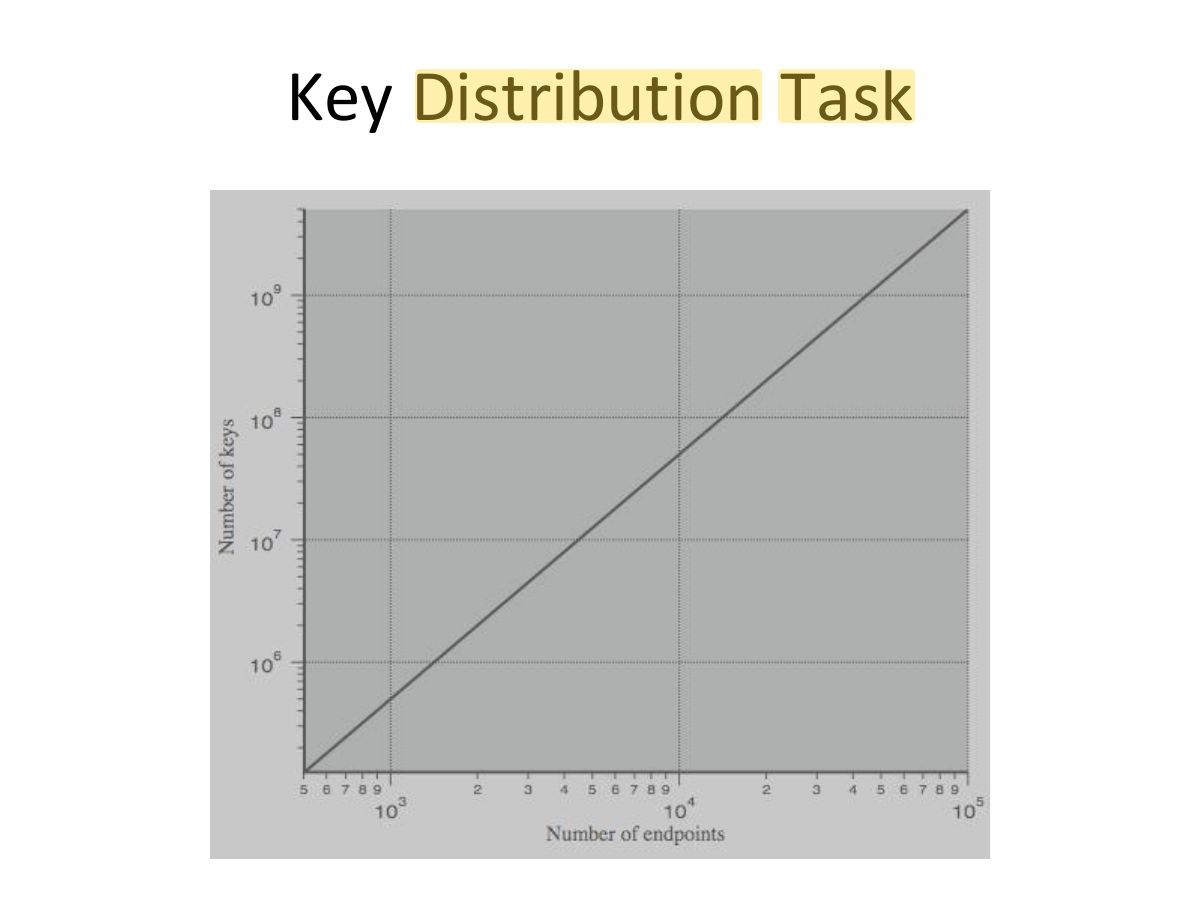
                Slide 8: Key Distribution Task
                Exam weight Low

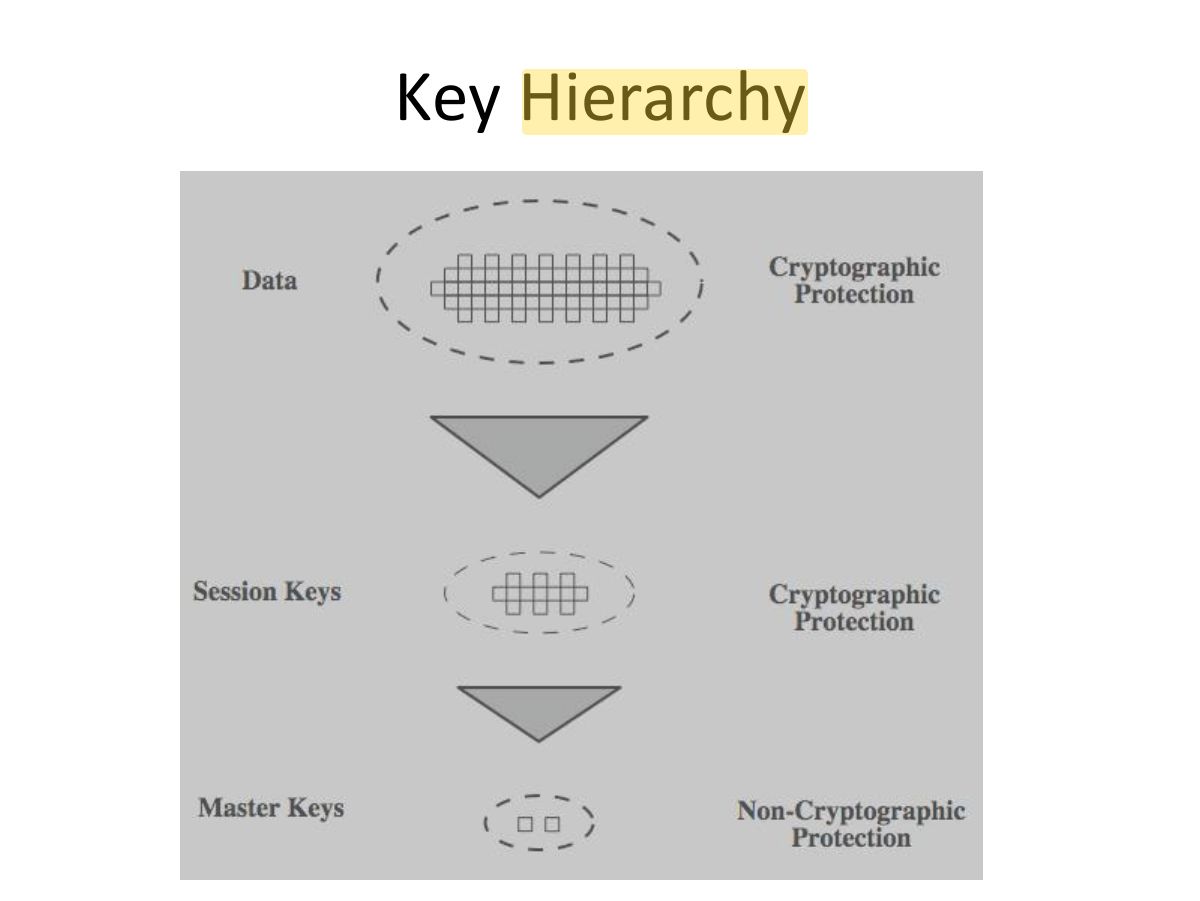
                  Key Hierarchy

                  typically have a hierarchy of keys

                  • session key
                    • temporary key
                    • used for encryption of data between users
                    • for one logical session then discarded master key
                    • used to encrypt session keys
                    • shared by user & key distribution center
                  9
                  Exam weight High
                  1. Key hierarchy: long-term master keys (shared with the KDC) protect short-lived session keys.
                  🎯 How this can come up · 1 question
                  MCQ

                  Keys used for a single communication session and then discarded are:

                  Slide 10: Key Hierarchy
                  Exam weight Low
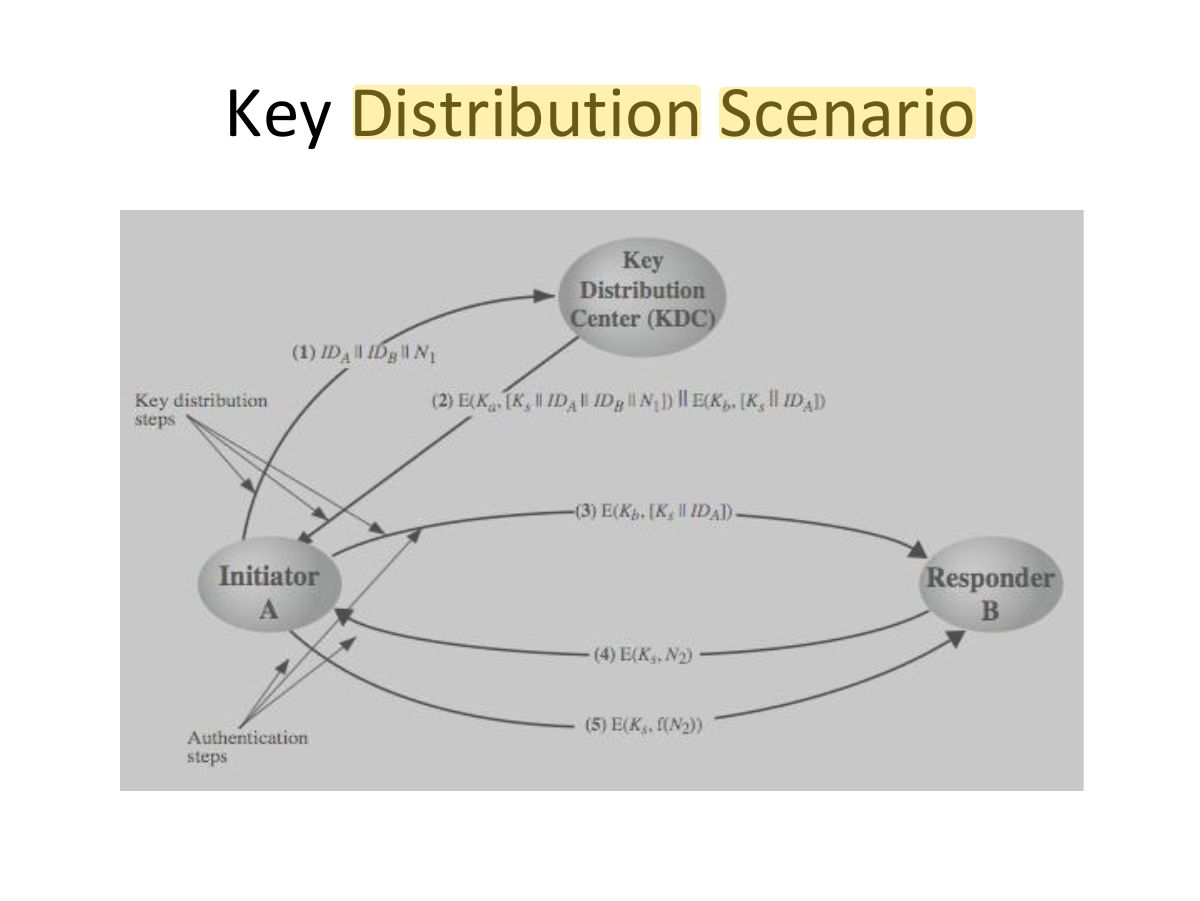
                    Slide 11: Key Distribution Scenario
                    Exam weight Low
                    1. KDC (Key Distribution Center): a trusted third party that creates session keys and sends them encrypted with each user’s master key.

                    Key Distribution Issues

                    • hierarchies of KDC’s required for large networks, but must trust each other
                    • session key lifetimes should be limited for greater security
                    • use of automatic key distribution on behalf of users, but must trust system
                    • use of decentralized key distribution
                    • controlling key usage
                    12
                    Exam weight Low

                      Symmetric Key Distribution Using Public Keys

                      public key cryptosystems are inefficient

                      • so almost never use for direct data encryption
                      • rather use to encrypt secret keys for distribution
                      13
                      Exam weight Low
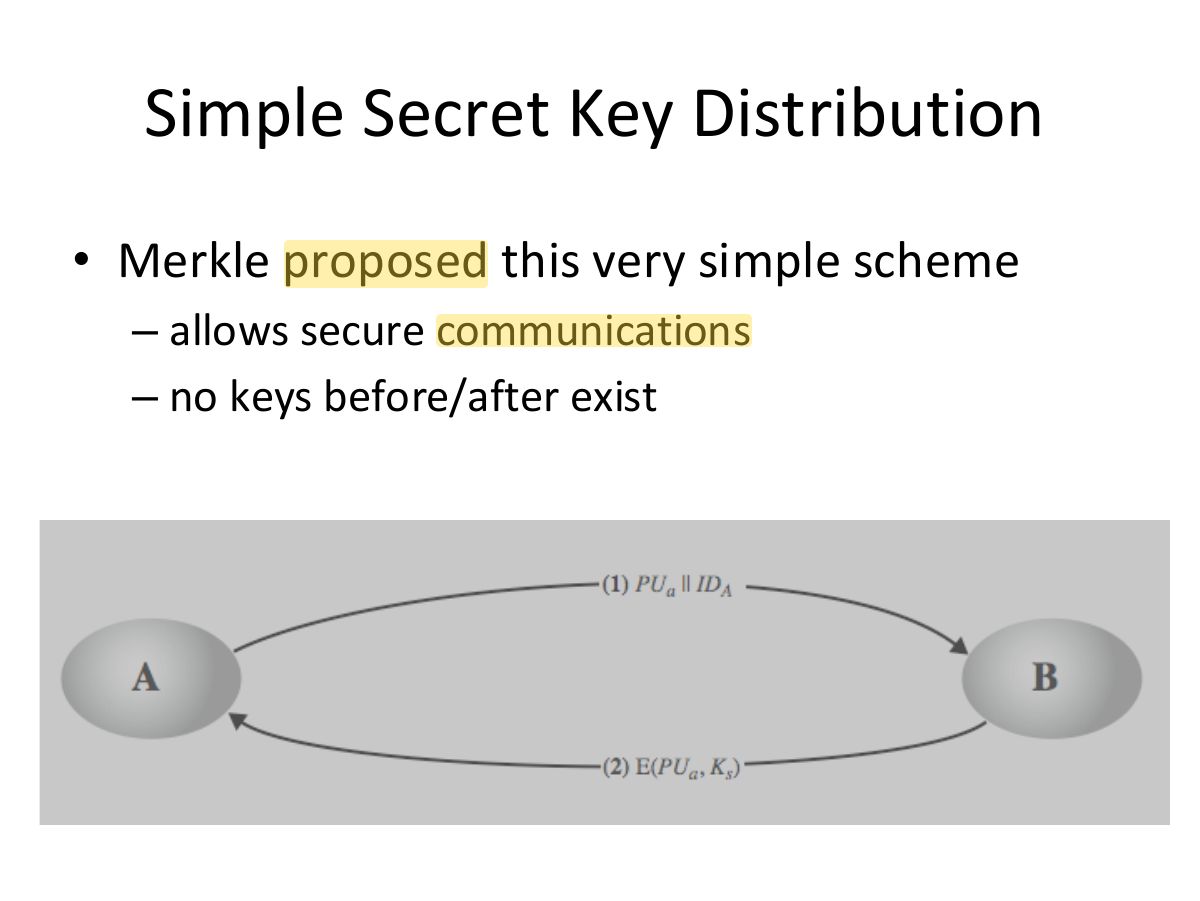
                        Slide 14: Simple Secret Key Distribution
                        Exam weight Low
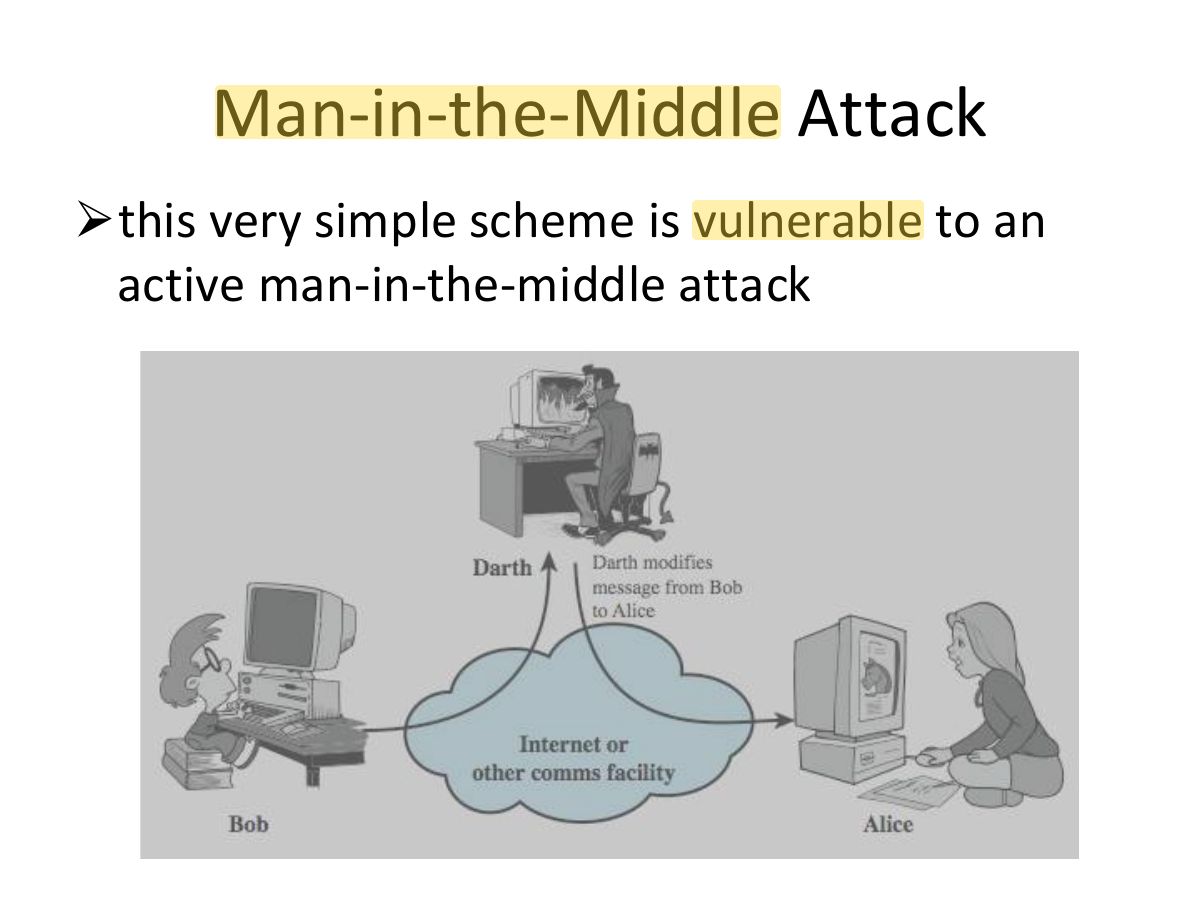
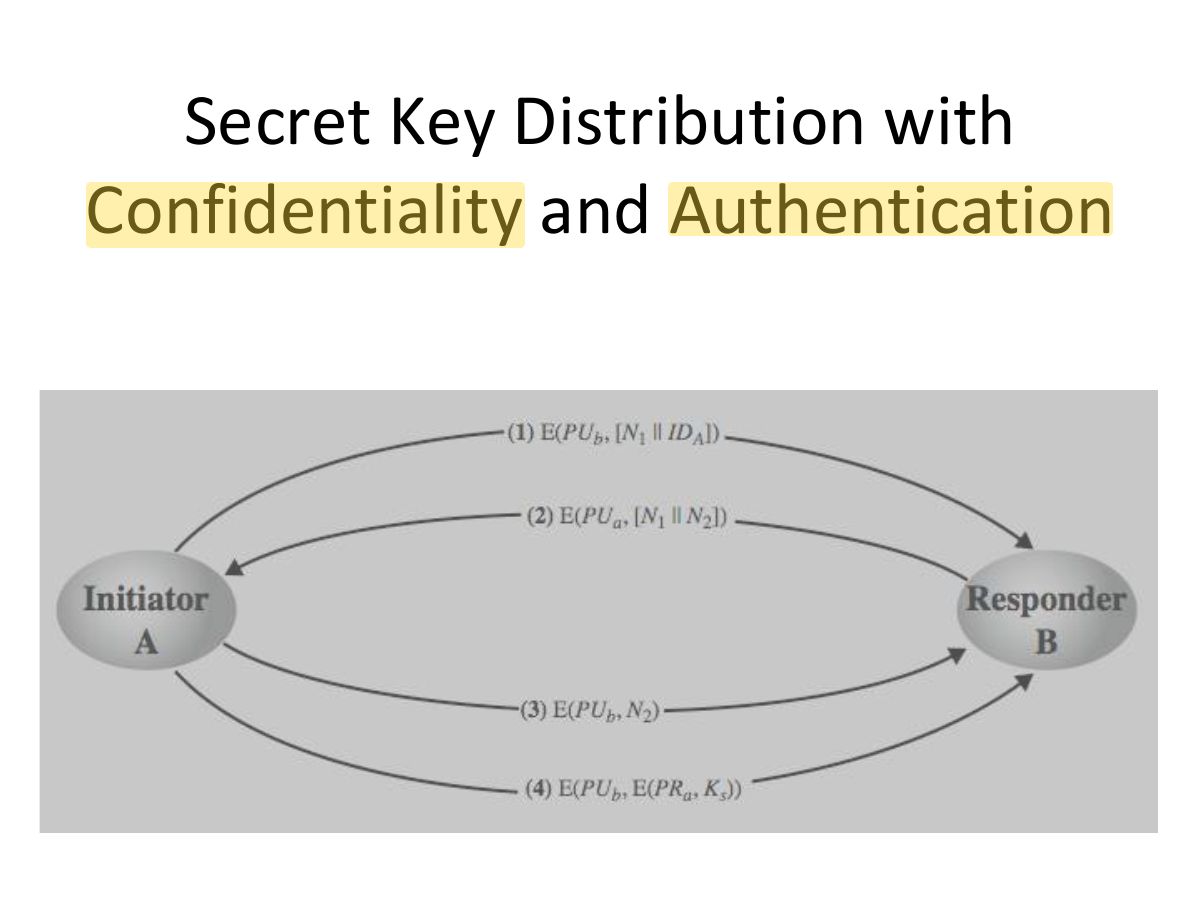
                        1. Merkle’s simple scheme (A sends a public key, B returns a secret key encrypted with it) is open to man-in-the-middle.
                        Slide 15: Man-in-the-Middle Attack
                        Exam weight Low
                          Slide 16: Secret Key Distribution with Confidentiality and Authentication
                          Exam weight Low

                            Hybrid Key Distribution

                            retain use of private-key KDC

                            • shares secret master key with each user
                            • distributes session key using master key
                            • public-key used to distribute master keys
                              • especially useful with widely distributed users rationale
                              • performance
                              • backward compatibility
                            17
                            Exam weight Low

                              Distribution of Public Keys

                              • can be considered as using one of:
                                • public announcement
                                • publicly available directory
                                • public-key authority
                                • public-key certificates
                              18
                              Exam weight Low
                              1. Distributing public keys: public announcement (forgeable), public directory, public-key authority, certificates (best).

                              Public Announcement

                              • users distribute public keys to recipients or broadcast to community at large
                                • eg. append PGP keys to email messages or post to news groups or email list
                              • major weakness is forgery
                                • anyone can create a key claiming to be someone else and broadcast it
                                • until forgery is discovered can masquerade as claimed user
                              19
                              Exam weight Low

                                Publicly Available Directory

                                • can obtain greater security by registering keys with a public directory
                                • directory must be trusted with properties:
                                  • contains {name,public-key} entries
                                  • participants register securely with directory
                                  • participants can replace key at any time
                                  • directory is periodically published
                                  • directory can be accessed electronically
                                • still vulnerable to tampering or forgery
                                20
                                Exam weight Low

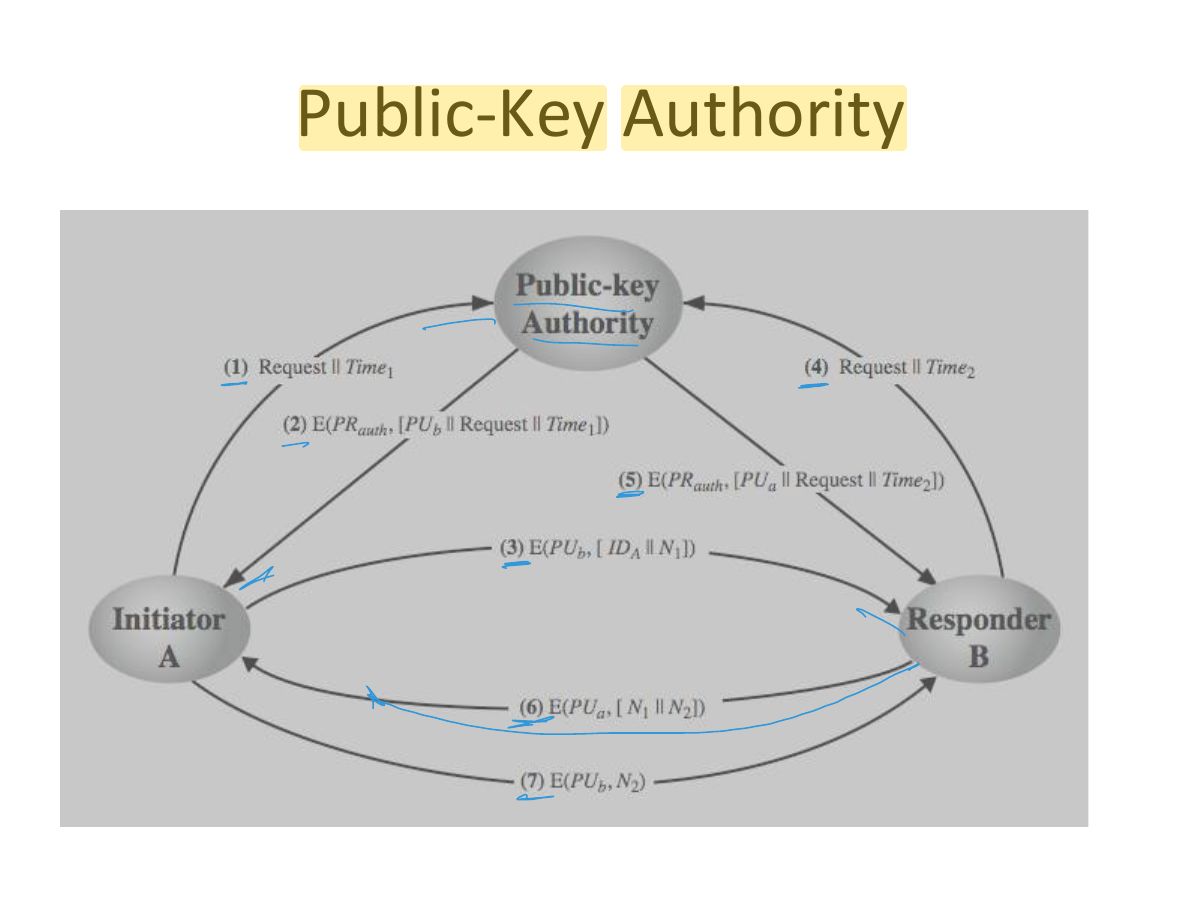
                                  Public-Key Authority

                                  • improve security by tightening control over distribution of keys from directory
                                  • has properties of directory
                                  • and requires users to know public key for the directory
                                  • then users interact with directory to obtain any desired public key securely
                                    • does require real-time access to directory when keys are needed
                                    • may be vulnerable to tampering
                                  21
                                  Exam weight Low
                                    Slide 22: Public-Key Authority
                                    Exam weight Low

                                      Public-Key Certificates

                                      certificates allow key exchange without real-

                                      • time access to public-key authority a certificate binds identity to public key
                                        • usually with other info such as period of validity, rights of use etc with all contents signed by a trusted Public-
                                      • Key or Certificate Authority (CA) can be verified by anyone who knows the
                                      • public-key authorities public-key
                                      23
                                      Exam weight High
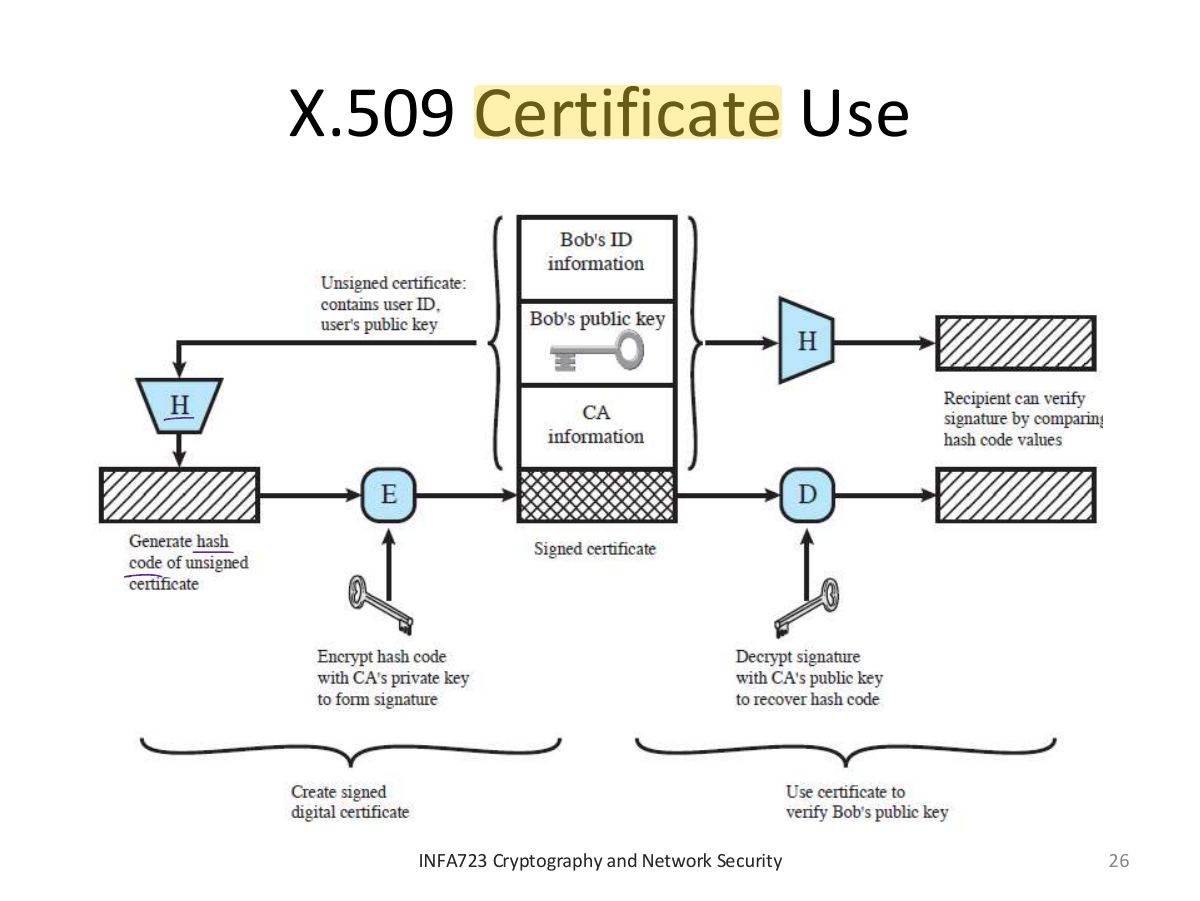
                                      1. Certificate: binds an identity to a public key, signed by a Certificate Authority (CA).
                                      🎯 How this can come up · 1 question
                                      MCQ

                                      A digital certificate binds:

                                      Public-Key Certificates

                                      24
                                      Exam weight Low

                                        X.509 Authentication Service

                                        • part of CCITT X.500 directory service standards
                                          • distributed servers maintaining user info database
                                        • defines framework for authentication services
                                          • directory may store public-key certificates
                                          • with public key of user signed by certification authority
                                        • also defines authentication protocols
                                        • uses public-key crypto & digital signatures
                                          • algorithms not standardised, but RSA recommended
                                        • X.509 certificates are widely used
                                          • have 3 versions
                                        25
                                        Exam weight Low
                                          Slide 26: X.509 Certificate Use
                                          Exam weight Low

                                            X.509 Certificates

                                            • issued by a Certification Authority (CA), containing:
                                              • version V (1, 2, or 3)
                                              • serial number SN (unique within CA) identifying certificate
                                              • signature algorithm identifier AI
                                              • issuer X.500 name CA)
                                              • period of validity TA (from - to dates)
                                              • subject X.500 name A (name of owner)
                                              • subject public-key info Ap (algorithm, parameters, key)
                                              • issuer unique identifier (v2+)
                                              • subject unique identifier (v2+)
                                              • extension fields (v3)
                                              • signature (of hash of all fields in certificate) CA<<A>> denotes certificate for A signed by CA
                                            • notation
                                            27
                                            Exam weight Low
                                            1. X.509 fields: version, serial number, signature algorithm, issuer, validity period, subject, subject’s public key, extensions, CA signature.

                                            X.509 Certificates

                                            28
                                            Exam weight Low

                                              Obtaining a Certificate

                                              any user with access to CA can get any

                                              • certificate from it only the CA can modify a certificate
                                              • because cannot be forged, certificates can be
                                              • placed in a public directory
                                              29
                                              Exam weight Low

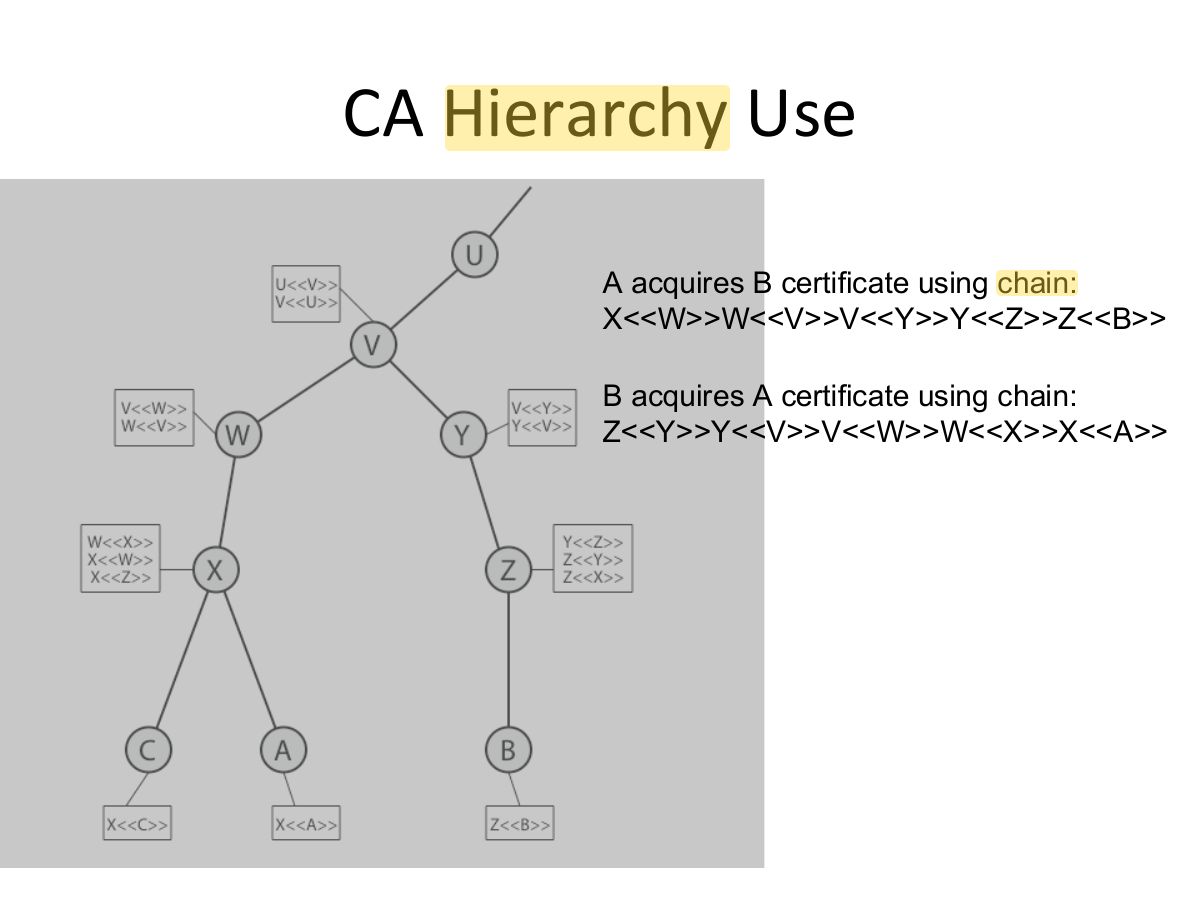
                                                CA Hierarchy

                                                if both users share a common CA then they are

                                                • assumed to know its public key otherwise CA's must form a hierarchy
                                                • use certificates linking members of hierarchy to
                                                • validate other CA's
                                                  • each CA has certificates for clients (forward) and parent (backward) each client trusts parents certificates
                                                • enable verification of any certificate from one CA by
                                                • users of all other CAs in hierarchy
                                                30
                                                Exam weight Low
                                                1. CA hierarchy: root CA → intermediate CAs → end entities; trust flows down a certificate chain.
                                                Slide 31: CA Hierarchy Use
                                                Exam weight Low

                                                  Certificate Revocation

                                                  • certificates have a period of validity
                                                  • may need to revoke before expiry, eg:
                                                  1. user's private key is compromised
                                                  2. user is no longer certified by this CA
                                                  3. CA's certificate is compromised
                                                  • CA’s maintain list of revoked certificates
                                                    • the Certificate Revocation List (CRL)
                                                  • users should check certificates with CA’s CRL
                                                  32
                                                  Exam weight Low
                                                  1. Revocation: compromised key, changed affiliation, superseded. Checked with CRLs or OCSP.

                                                  X.509 Version 3

                                                  • has been recognised that additional information is needed in a certificate
                                                    • email/URL, policy details, usage constraints
                                                  • rather than explicitly naming new fields defined a general extension method
                                                  • extensions consist of:
                                                    • extension identifier
                                                    • criticality indicator
                                                    • extension value
                                                  33
                                                  Exam weight Low

                                                    Certificate Extensions

                                                    • key and policy information
                                                      • convey info about subject & issuer keys, plus indicators of certificate policy
                                                    • certificate subject and issuer attributes
                                                      • support alternative names, in alternative formats for certificate subject and/or issuer
                                                    • certificate path constraints
                                                      • allow constraints on use of certificates by other CA’s
                                                    34
                                                    Exam weight Low

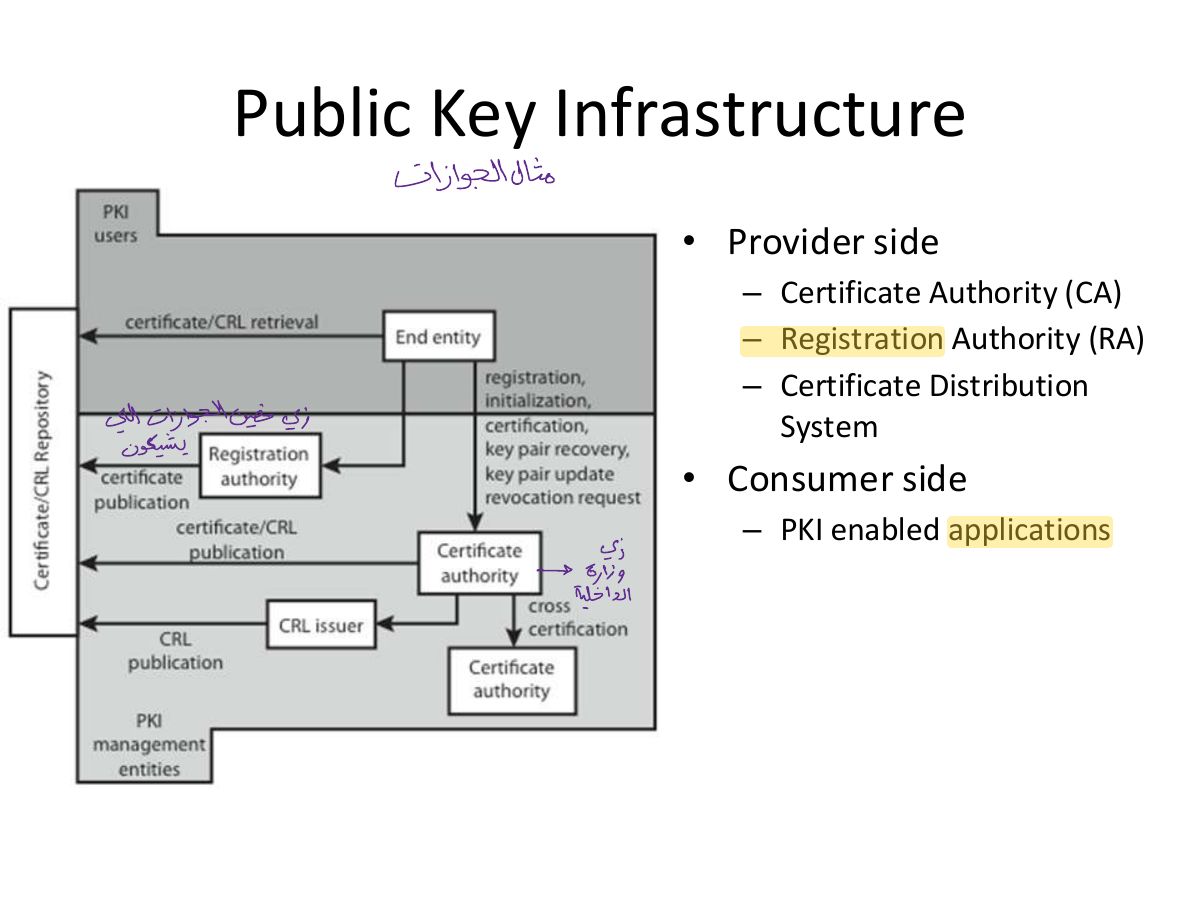
                                                      Public Key Infrastructure (PKI)

                                                      • PKI is an Infrastructure to support and manage Public Key-based Digital Certificates
                                                        • X.509 PKI
                                                        • X.509 Digital Certificates
                                                      • Standards defined by IETF, PKIX WG: http://www.ietf.org/
                                                      35
                                                      Exam weight High
                                                      1. PKI: the hardware, software, people, policies and procedures to create, manage, distribute, use, store and revoke certificates. Parts: CA, RA, repository, end entities.
                                                      🎯 How this can come up · 1 question
                                                      MCQ

                                                      The PKI component that verifies a requester’s identity before the CA issues a certificate is the:

                                                      Slide 36: Public Key Infrastructure
                                                      Exam weight Low
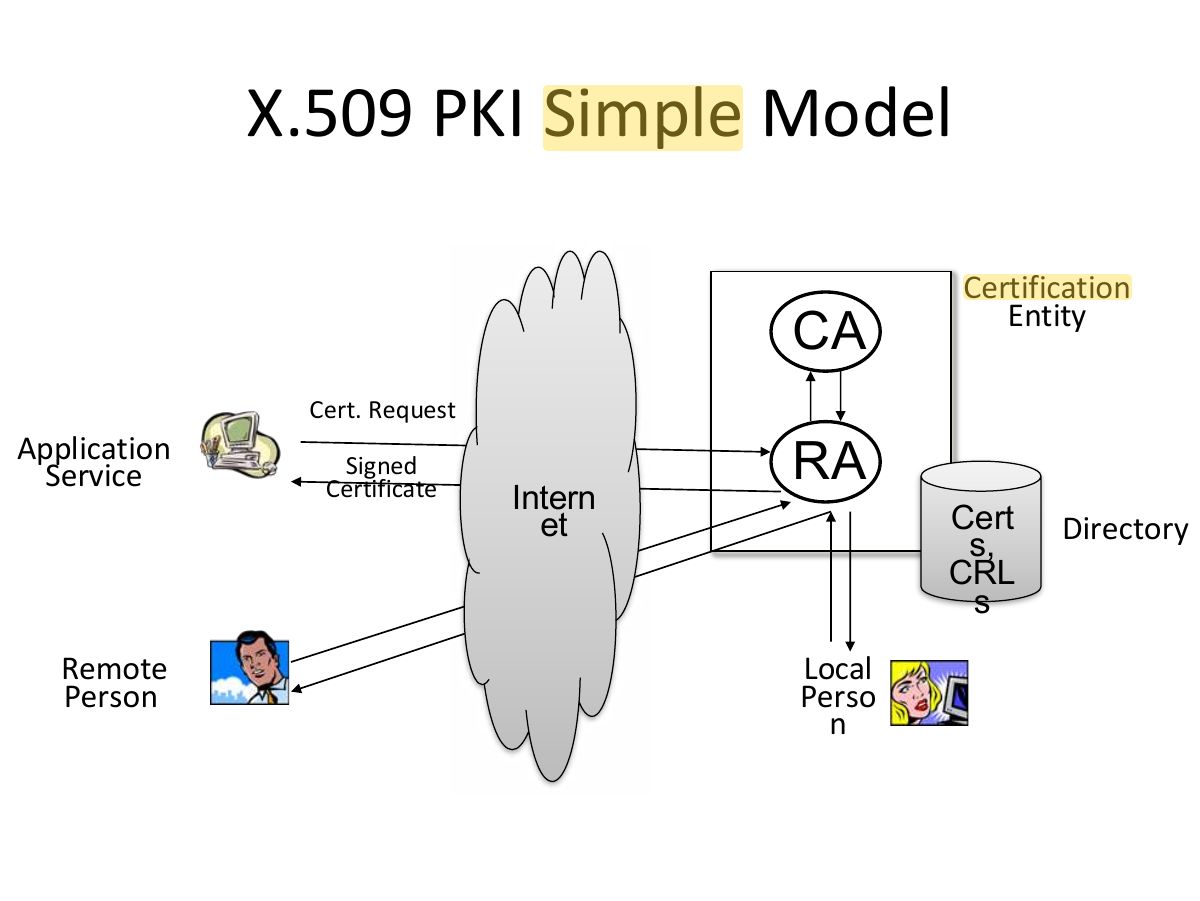
                                                        Slide 37: X.509 PKI Simple Model
                                                        Exam weight Low

                                                          X.509 PKI Certificate Authority (CA)

                                                          • Basic Tasks
                                                            • Key Generation
                                                            • Digital Certificate Generation
                                                            • Certificate Issuance and Distribution
                                                            • Revocation
                                                            • Key Backup and Recovery System
                                                            • Cross-Certification
                                                          38
                                                          Exam weight Low

                                                            X.509 PKI Registration Authority (RA)

                                                            • Basic Tasks:
                                                              • Registration of Certificate Information
                                                              • Face-to-Face Registration
                                                              • Remote Registration
                                                              • Automatic Registration
                                                              • Revocation
                                                            39
                                                            Exam weight Low

                                                              X.509 PKI Certificate Distribution System

                                                              • Provide Repository for:
                                                                • Digital Certificates
                                                                • Certificate Revocation Lists (CRLs)
                                                              • Typically:
                                                                • Special Purposes Databases
                                                                • LDAP directories
                                                              40
                                                              Exam weight Low

                                                                Case Study 1: WellsSecure PKI SHA-1 Hierarchy

                                                                41
                                                                Exam weight Low

                                                                  Case Study 2: WellsSecure PKI SHA-2 Hierarchy

                                                                  To be operational and online in 2012

                                                                  42
                                                                  Exam weight Low

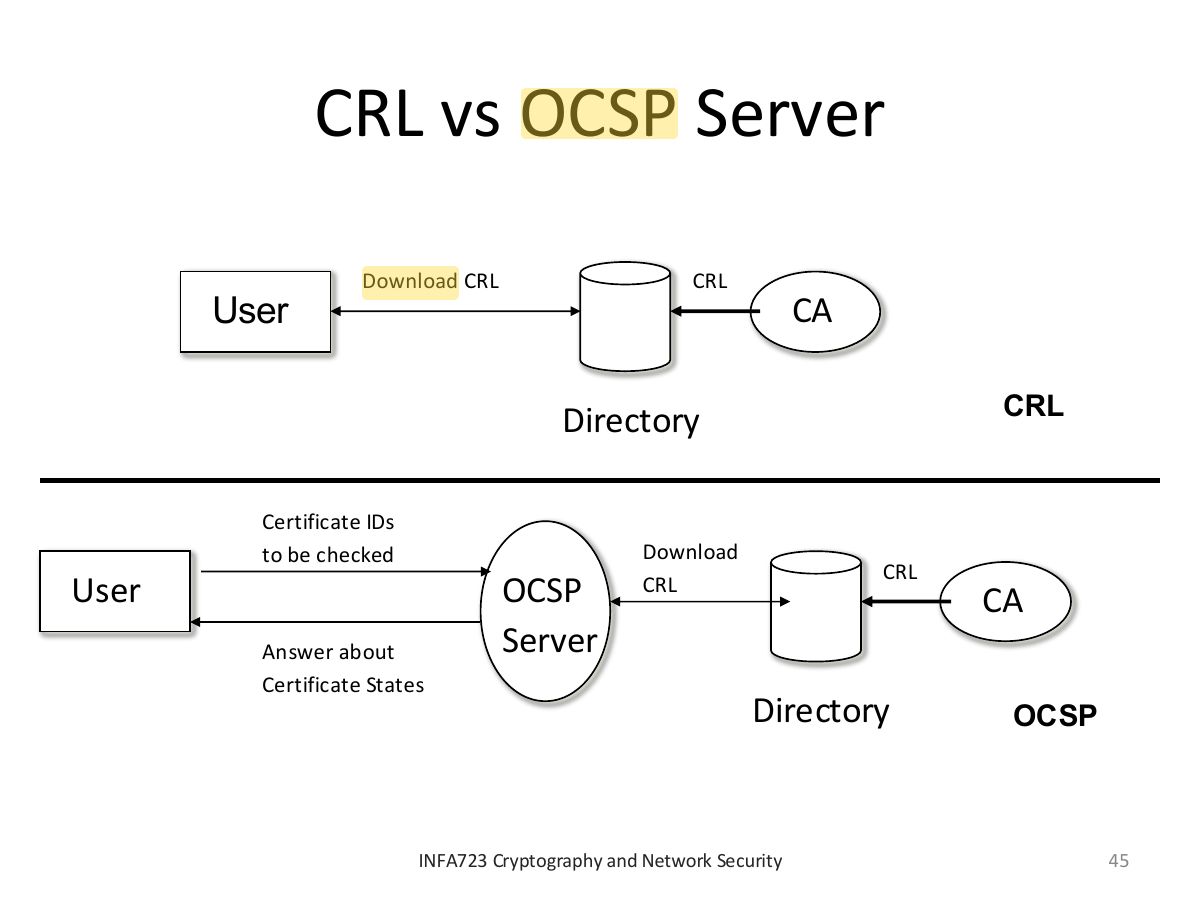
                                                                    Certificate Revocation List (CRL)

                                                                    • CRLs are published by CAs at well defined interval of time
                                                                    • It is a responsibility of “Users” of certificates to “download” a CRL and verify if a certificate has been revoked
                                                                    • User application must deal with the revocation processes
                                                                    • Revoked Certificates remain in CRL until they expire
                                                                    43
                                                                    Exam weight Low
                                                                    1. CRL: a periodically published, signed list of revoked serial numbers.

                                                                    Online Certificate Status Protocol (OCSP)

                                                                    • An alternative to CRLs
                                                                      • IETF/PKIX standard for a real-time check if a certificate has been revoked/suspended
                                                                    • Requires a high availability OCSP Server
                                                                    44
                                                                    Exam weight High
                                                                    1. OCSP: ask a responder in real time about ONE certificate (good / revoked / unknown).
                                                                    🎯 How this can come up · 1 question
                                                                    MCQ

                                                                    Which checks a certificate’s revocation status in real time?

                                                                    Slide 45: CRL vs OCSP Server
                                                                    Exam weight Low
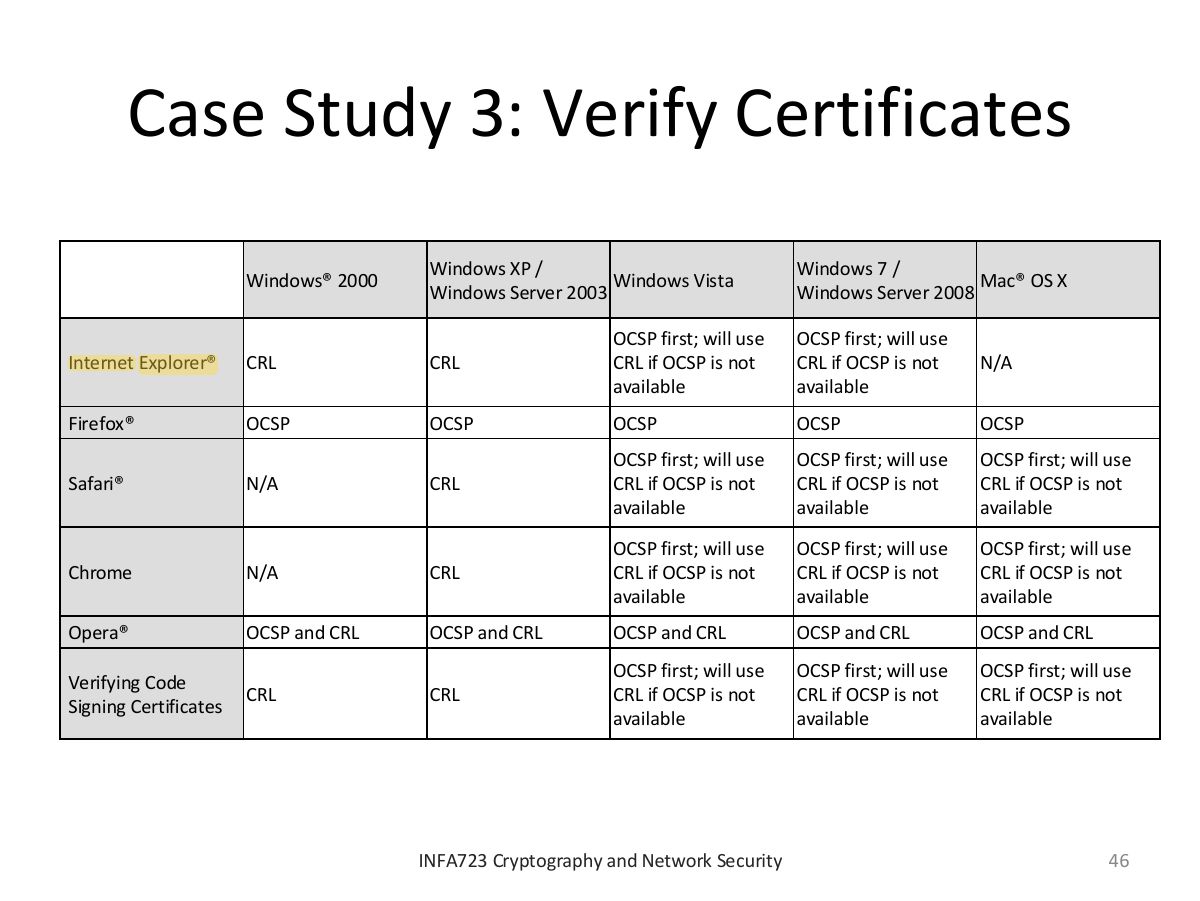
                                                                      Slide 46: Case Study 3: Verify Certificates
                                                                      Exam weight Low

                                                                        X.509 PKI-enabled Applications

                                                                        • Functionality Required:
                                                                          • Cryptographic functionality
                                                                          • Secure storage of Personal Information
                                                                          • Digital Certificate Handling
                                                                          • Directory Access
                                                                          • Communication Facilities
                                                                        47
                                                                        Exam weight Low

                                                                          Summary

                                                                          • have considered:
                                                                            • symmetric key distribution using symmetric encryption
                                                                            • symmetric key distribution using public-key encryption
                                                                            • distribution of public keys
                                                                              • announcement, directory, authrority, CA
                                                                            • X.509 authentication and certificates
                                                                            • public key infrastructure (PKIX)
                                                                          48
                                                                          Exam weight Low