CYS406 · Annotated SlidesChapter 5 — Elliptic Curve Cryptography
Chapter 5 · Annotated slides

Elliptic Curve Cryptography

Elliptic curves and their properties, trapdoor functions, groups and point addition, finite fields, scalar multiplication and cyclic subgroups, the elliptic-curve discrete logarithm problem, ECC encryption, ECDH key exchange, and why ECC gives the same security with smaller keys.

Slide text Study notes Highlight: key words Tips, tricks & traps Seen again elsewhere How it can come up
Slide 1: Slide 1
Exam weight Low

    WHAT ARE ELLIPTIC

    an elliptic curve will simply be the set of

    CURVES?

    points described by the equation:

    y = x

    2 3 + ax + b

    where

    4 a +27 b

    3 2 ≠0

    2
    Exam weight Low
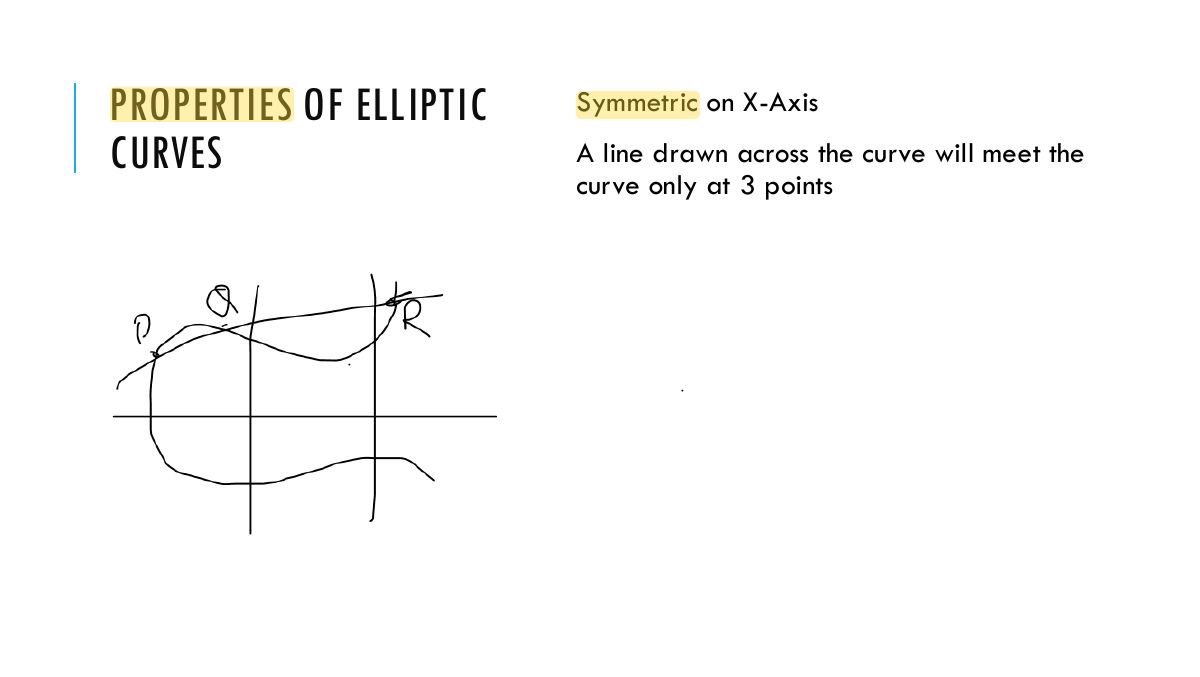
    1. Elliptic curve: y² = x³ + ax + b (with 4a³ + 27b² ≠ 0). Symmetric about the x-axis.
    Slide 3: EXAMPLES
    Exam weight Low
      Slide 4: PROPERTIES OF ELLIPTIC
      Exam weight Low
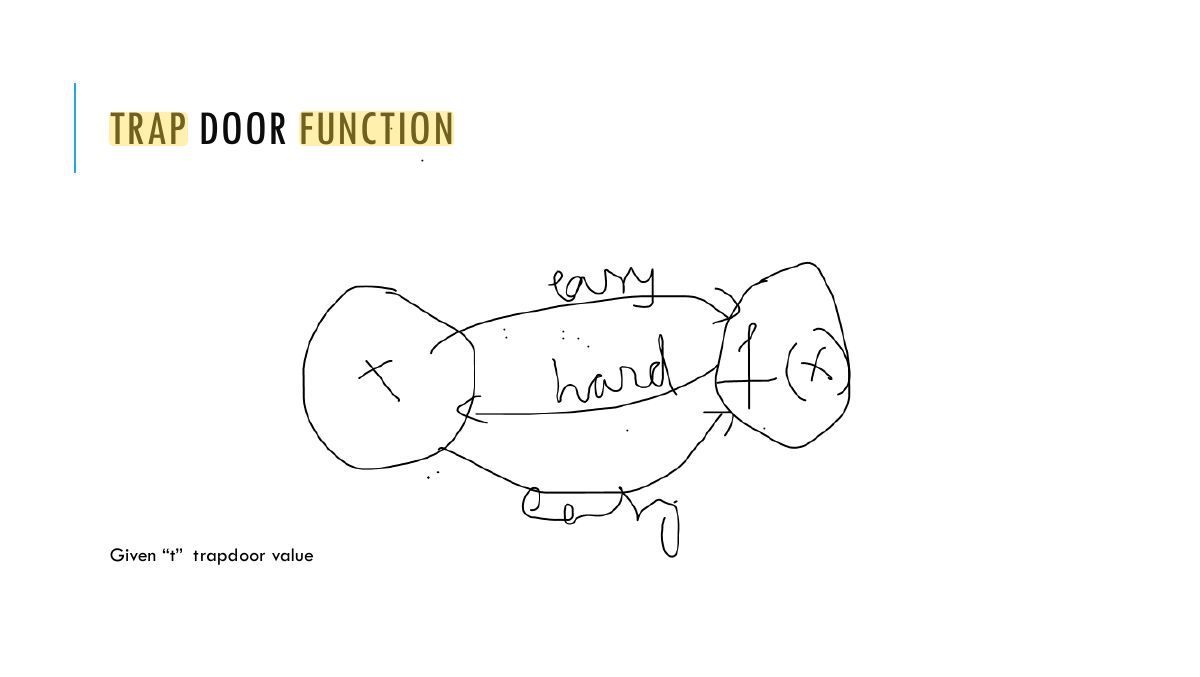
        Slide 5: TRAP DOOR FUNCTION
        Exam weight Low
        1. Trapdoor function: easy one way, hard to reverse without secret information.

        A group in mathematics is a set for which we

        GROUPS

        have defined a binary operation that we call "addition" and indicate with the symbol +.

        In order for the set GG to be a group, addition must defined so that it respects the following four properties:

        6
        Exam weight Low

          closure: if and a b are members of G, then

          GROUP PROPERTIES

          a + b is a member of G; associativity: (a + b )+ c = a +(b + c ); there exists an identity element 0 such that a +0=0+ = ;

          a a

          every element has an inverse, that is: for every

          a there exists such that + =0.

          b

          a b

          If we add a fifth requirement:

          commutativity: + = +

          a b b a,

          then the group is called abelian group.

          7
          Exam weight Low

            GROUPS OVER ELLIPTIC

            We can define a group over elliptic curves.

            Specifically:

            CURVES

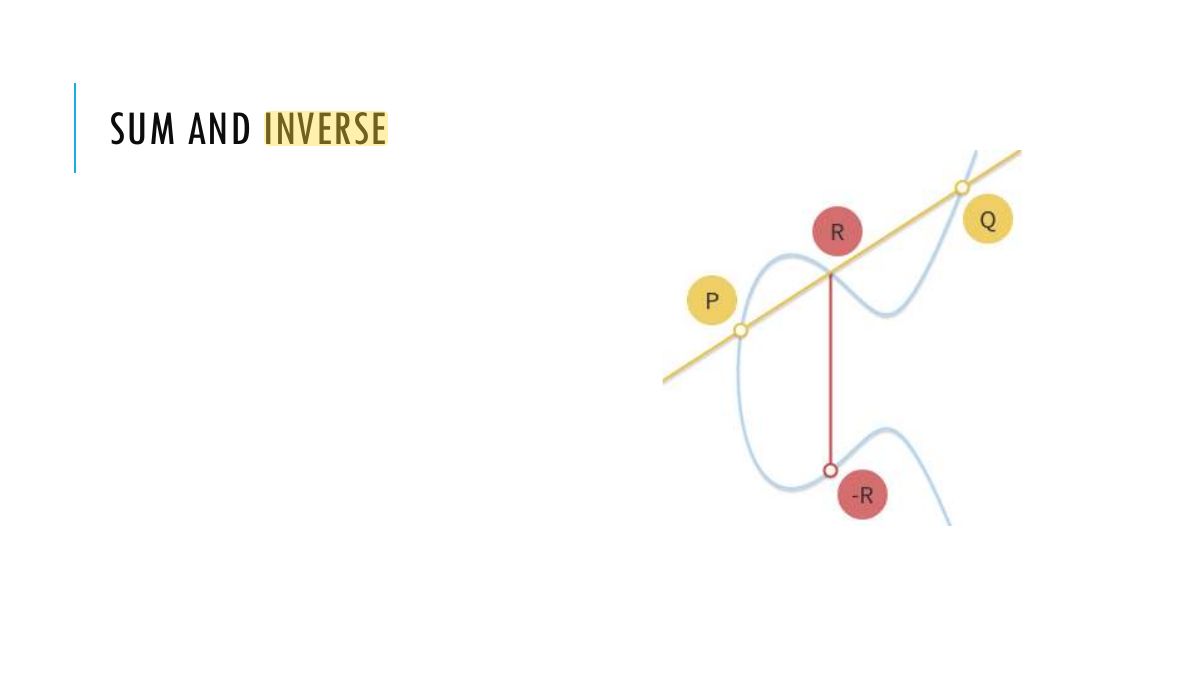
            the elements of the group are the points of an elliptic curve; the identity element is the point at infinity 0; the inverse of a point

            P is the one symmetric

            about the x-axis; addition is given by the following rule:

            given three aligned, non-zero points P,

            Q and R,

            their sum is + +

            P Q R =0

            8
            Exam weight Low
              Slide 9: SUM AND INVERSE
              Exam weight Low
              1. Point addition: the line through P and Q meets the curve at a third point; reflect it to get P + Q. The inverse of (x, y) is (x, −y).

              A finite field is a set with a finite

              FINITE FIELDS

              number of elements.

              An example of finite field is the set of

              p, where is a prime

              p

              integers modulo number.

              Z/ p GF (p) ) or

              It is generally denoted as, F We will use the latter notation.

              p

              10
              Exam weight Low

                In fields we have two binary

                FINITE FIELDS

                operations: addition (+) and multiplication (·).

                Both are closed, associative and commutative.

                For both operations, there exist a unique identity element, and for every element there's a unique inverse element.

                Finally, multiplication is distributive over the addition:

                x (y + z )= x y + x z.

                ⋅

                ⋅ ⋅

                11
                Exam weight Low

                  MULTIPLICATION OVER

                  Multiplication over points for elliptic curves

                  POINTS IN ELLIPTIC

                  in F has an interesting property.

                  p

                  CURVES

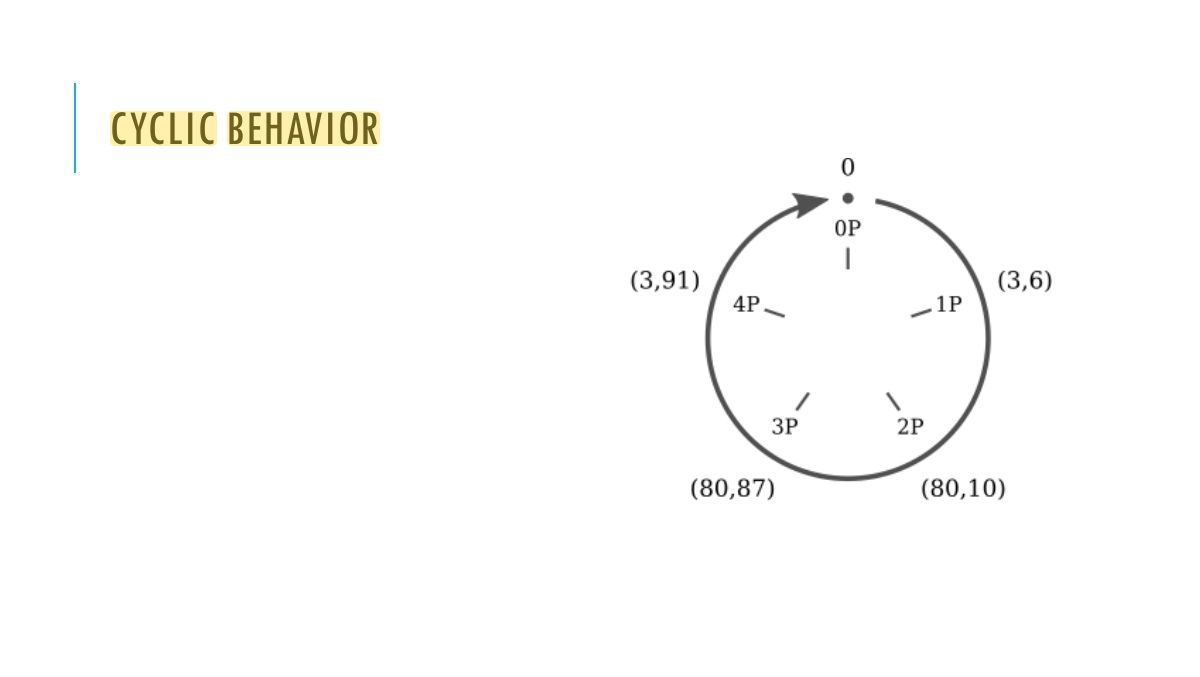
                  Take the curve

                  y x +2 x +3(mod97)and the point

                  ≡ 3 2

                  P =(3,6).

                  Now calculate the multiples of P

                  12
                  Exam weight Low
                  1. Scalar multiplication nP = P + P + … + P (n times), computed fast with double-and-add.
                  Slide 13: CYCLIC BEHAVIOR
                  Exam weight Low

                    CYCLIC SUBGROUPS AND

                    A "subgroup" is a group which is a

                    BASE POINTS

                    subset of another group.

                    A "cyclic subgroup" is a subgroup which elements are repeating cyclically,

                    P is called generator or

                    The point base point of the cyclic subgroup.

                    14
                    Exam weight Low

                      a cyclic subgroup we can give a new,

                      ORDER

                      equivalent definition:

                      the order of P is the smallest positive integer

                      n such that =0.

                      nP

                      In fact, if you look at the previous example, our subgroup contained five points, and we had 5

                      P =0.

                      The order of a subgroup is a divisor of the order of the parent group.

                      In other words, if an elliptic curve contains N points and one of its subgroups contains

                      n

                      points, then n is a divisor of N.

                      15
                      Exam weight Low

                        In the light of this, we can outline the following

                        FINDING THE BASE POINT

                        algorithm:

                        Calculate the order N of the elliptic curve.

                        Choose the order n of the subgroup. For the algorithm to work, this number must be prime and must be a divisor of

                        N.

                        Compute the cofactor = /

                        h N n.

                        Choose a random point P on the curve.

                        Compute =

                        G hP.

                        If G is 0, then go back to step 4. Otherwise we have found a generator of a subgroup with order

                        n and cofactor.

                        h

                        Note that this algorithm only works if n is a prime. If n wasn't a prime, then the order of G G could be one of the divisors of n.

                        16
                        Exam weight Low

                          ELLIPTIC CURVES IN CRYPTOGRAPHY

                          Elliptic Curve (EC) systems as applied to cryptography were first proposed in 1985 independently by Neal Koblitz and Victor Miller.

                          The discrete logarithm problem on elliptic curve groups is believed to be more difficult than the corresponding problem in (the multiplicative group of nonzero elements of) the underlying finite field.

                          17
                          Exam weight Low
                            Slide 18: DISCRETE LOGARITHMS IN FINITE FIELDS
                            Exam weight High
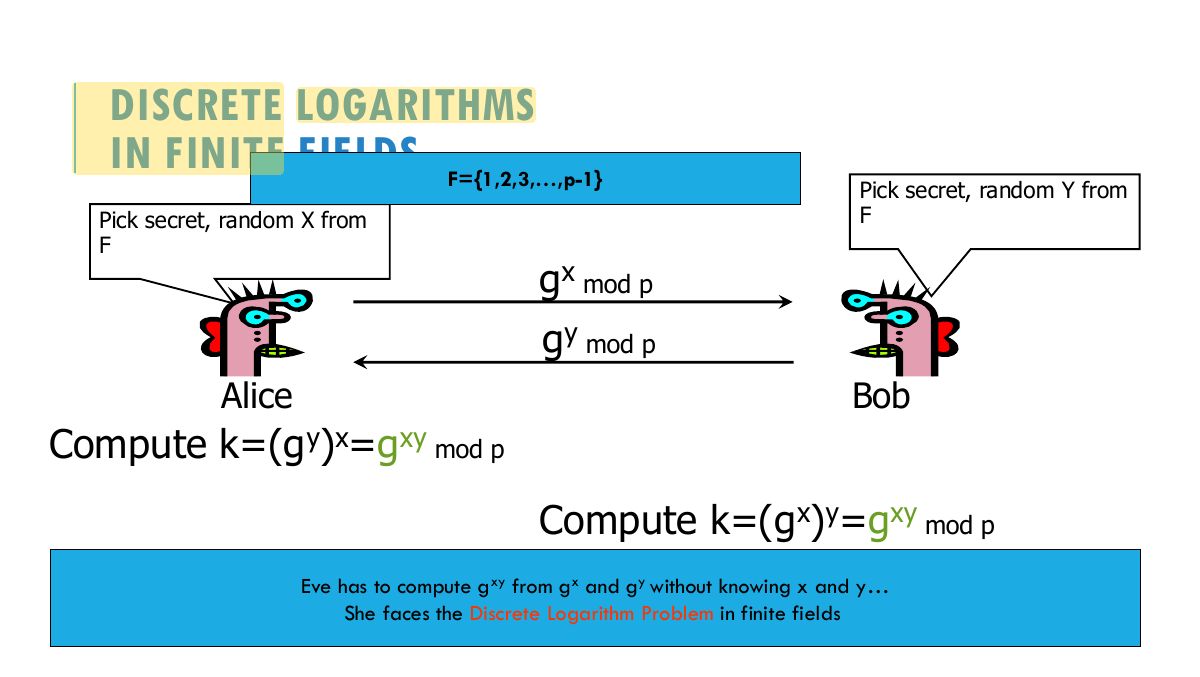
                            1. ECDLP: given P and Q = kP, finding k is infeasible. That is ECC’s hard problem.
                            🎯 How this can come up · 1 question
                            MCQ

                            ECC’s security relies on the difficulty of:

                            DEFINITION OF ELLIPTIC CURVES

                            An elliptic curve over a field

                            K is a nonsingular cubic curve in two

                            variables,

                            f(x,y) =0 with a rational point (which may be a point at infinity).

                            The field K is usually taken to be the complex numbers, reals, rationals, algebraic extensions of rationals, p-adic numbers, or a finite field.

                            Elliptic curves groups for cryptography are examined with the underlying fields of F (where p>3 is a prime) and F

                            m (a binary representation with 2

                            m

                            p

                            2

                            elements ).

                            19
                            Exam weight Low

                              WHAT IS ELLIPTIC CURVE CRYPTOGRAPHY (ECC)?

                              Elliptic curve cryptography [ECC] is a public-key cryptosystem just like RSA, Rabin, and El Gamal.

                              Every user has a public and a private key.

                               Public key is used for encryption/signature verification.

                               Private key is used for decryption/signature generation.

                              Elliptic curves are used as an extension to other current cryptosystems.

                               Elliptic Curve Diffie-Hellman Key Exchange  Elliptic Curve Digital Signature Algorithm

                              20
                              Exam weight Low

                                USING ELLIPTIC CURVES IN CRYPTOGRAPHY

                                The central part of any cryptosystem involving elliptic curves is the elliptic group.

                                All public-key cryptosystems have some underlying mathematical operation.

                                 RSA has exponentiation (raising the message or ciphertext to the public or private

                                values)

                                 ECC has point multiplication (repeated addition of two points).

                                21
                                Exam weight Low

                                  GENERIC PROCEDURES OF ECC

                                  Both parties agree to some publicly-known data items  The elliptic curve equation

                                   values of a and bp

                                  prime,

                                   The elliptic group computed from the elliptic curve equation  A base point, B, taken from the elliptic group

                                   Similar to the generator used in current cryptosystems

                                  Each user generates their public/private key pair  Private Key = an integer, x, selected from the interval [1, p-1]  Public Key = product, Q, of private key and base point

                                   (Q = x*B)

                                  22
                                  Exam weight Low

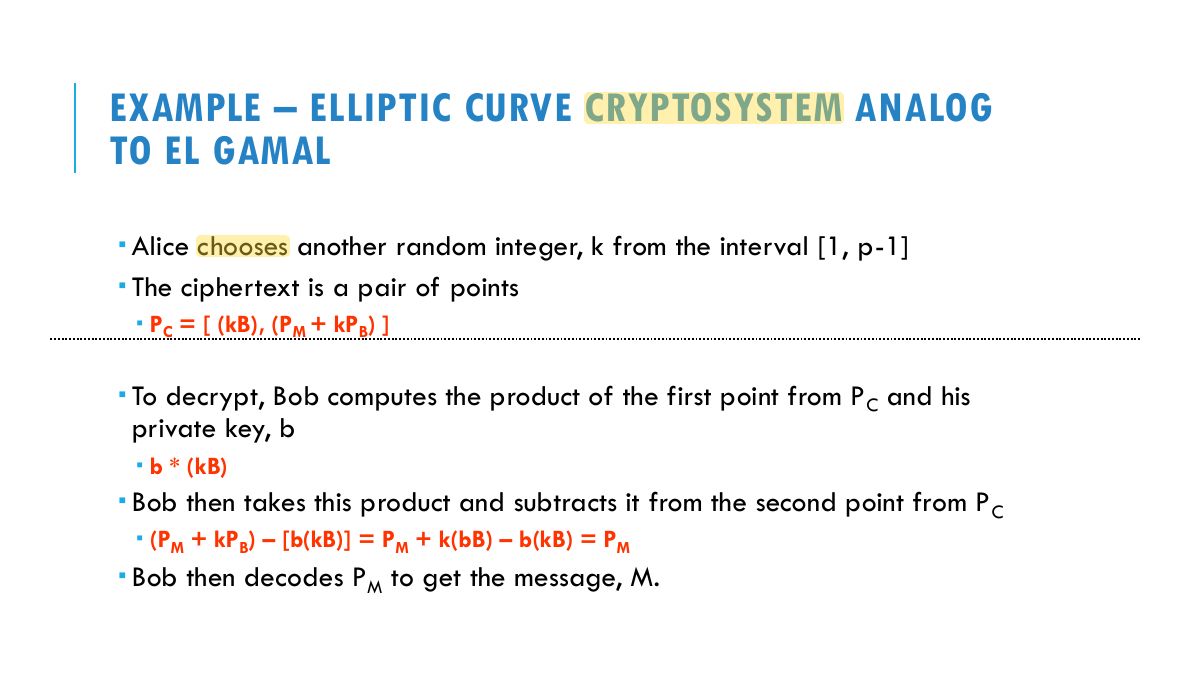
                                    EXAMPLE – ELLIPTIC CURVE CRYPTOSYSTEM ANALOG TO EL GAMAL

                                    Suppose Alice wants to send to Bob an encrypted message.

                                     Both agree on a base point, B.

                                     Alice and Bob create public/private keys.

                                     Alice

                                     Private Key = a  Public Key = P = a * B

                                    A

                                     Bob

                                     Private Key = b  Public Key = P = b * B

                                    B

                                     Alice takes plaintext message, M, and encodes it onto a point, P, from the

                                    M

                                    elliptic group

                                    23
                                    Exam weight Low
                                      Slide 24: EXAMPLE – ELLIPTIC CURVE CRYPTOSYSTEM ANALOG TO EL GAMAL
                                      Exam weight Low

                                        EXAMPLE – COMPARE TO EL GAMAL

                                         The ciphertext is a pair of points

                                         P = [ (kB), (P + kP) ]

                                        C

                                        M B

                                         The ciphertext in El Gamal is also a pair.

                                         C = (g k mod p, mP k mod p)

                                        B

                                        --------------------------------------------------------------------------  Bob then takes this product and subtracts it from the second point from P

                                        C

                                         (P + kP) – [b(kB)] = P + k(bB) – b(kB) = P

                                        M B

                                        M

                                        M

                                         In El Gamal, Bob takes the quotient of the second value and the first value

                                        raised to Bob’s private value  m = mP k / (g k) b = mg k*b / g k*b = m

                                        B

                                        25
                                        Exam weight Low

                                          DIFFIE-HELLMAN (DH) KEY EXCHANGE

                                          26
                                          Exam weight Low

                                            EXAMPLE – ELLIPTIC CURVE DIFFIE-HELLMAN EXCHANGE

                                            Alice and Bob want to agree on a shared key.

                                             Alice and Bob compute their public and private keys.

                                             Alice

                                             Private Key = a  Public Key = P = a * B

                                            A

                                             Bob

                                             Private Key = b  Public Key = P = b * B

                                            B

                                             Alice and Bob send each other their public keys.

                                             Both take the product of their private key and the other user’s public key.

                                             Alice → K = a(bB)

                                            AB

                                             Bob → K = b(aB)

                                            AB

                                            Shared Secret Key = K = abB

                                            AB

                                            28
                                            Exam weight Low

                                              WHY USE ECC?

                                              How do we analyze Cryptosystems?

                                               How difficult is the underlying problem that it is based upon

                                               RSA – Integer Factorization  DH – Discrete Logarithms  ECC - Elliptic Curve Discrete Logarithm problem

                                               How do we measure difficulty?

                                               We examine the algorithms used to solve these problems

                                              29
                                              Exam weight High
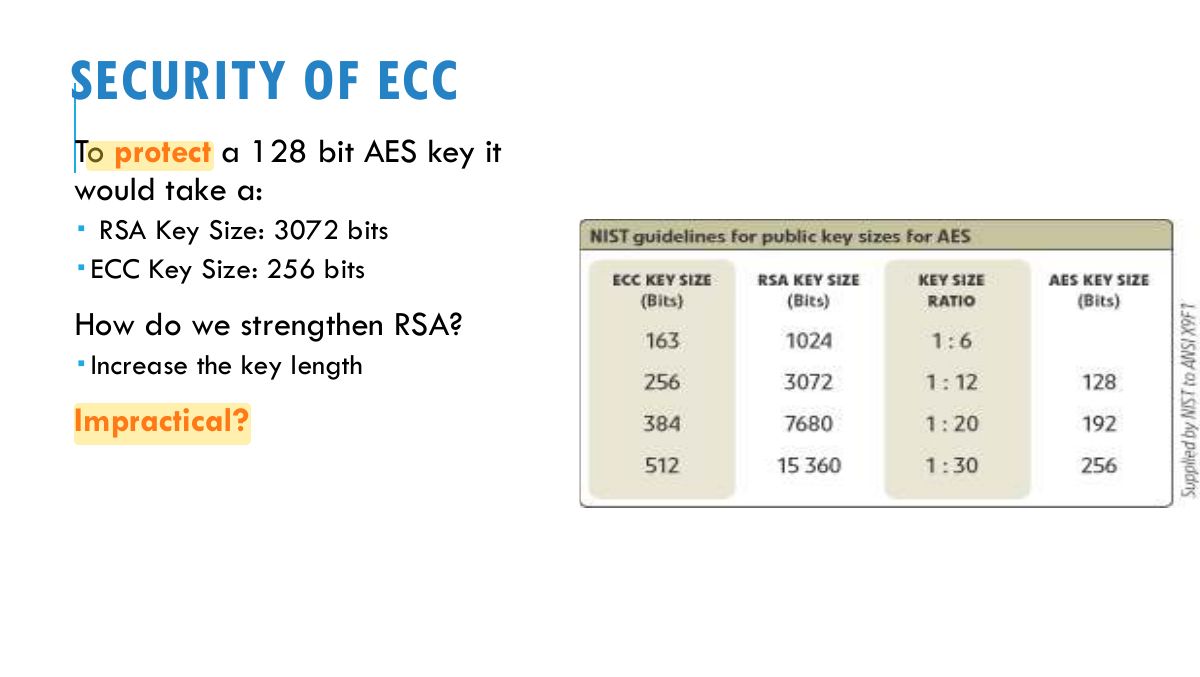
                                              1. A 256-bit ECC key ≈ 3072-bit RSA security: smaller keys, faster, less power and bandwidth (good for mobile and IoT).
                                              🎯 How this can come up · 1 question
                                              MCQ

                                              The main advantage of ECC over RSA is:

                                              Slide 30: SECURITY OF ECC
                                              Exam weight Low

                                                APPLICATIONS OF ECC

                                                Many devices are small and have limited storage and computational power Where can we apply ECC?

                                                Wireless communication devices  Smart cards  Web servers that need to handle many encryption sessions  Any application where security is needed but lacks the power, storage

                                                and computational power that is necessary for our current cryptosystems

                                                31
                                                Exam weight Low
                                                1. Applications: TLS key exchange, ECDSA signatures, Bitcoin, mobile devices.

                                                BENEFITS OF ECC

                                                Same benefits of the other cryptosystems: confidentiality, integrity, authentication and non- repudiation but...

                                                Shorter key lengths  Encryption, Decryption and Signature Verification speed up  Storage and bandwidth savings

                                                32
                                                Exam weight Low

                                                  SUMMARY OF ECC

                                                  “ Hard problem ” analogous to discrete log  , where

                                                  Q=kP Q,P belong to a prime curve given

                                                  k,P → “easy” to compute

                                                  Q

                                                  given

                                                  Q,P → “hard” to find

                                                  k

                                                   known as the elliptic curve logarithm problem

                                                   k must be large enough

                                                  ECC security relies on elliptic curve logarithm problem  compared to factoring, can use much smaller key sizes than with RSA etc

                                                  for similar security ECC offers significant

                                                  ➔

                                                  computational advantages

                                                  33
                                                  Exam weight Low