CYS405 · Annotated SlidesChapter 11 — Wireless Network Hacking
Chapter 11 · Annotated slides

Wireless Network Hacking

Wireless modes and components, threats and the SSID, IEEE 802.11 frames and services, WEP and its flaws, WPA, WPA2 and WPA3, securing transmissions and access points, the wireless hacking methodology (discovery, GPS mapping, traffic analysis, attacks such as rogue AP and evil twin, cracking) and defenses.
Slide text Study notes Highlight: key words Tips, tricks & traps Seen again elsewhere How it can come up
Slide 1: Slide 1
Exam weight Low

    Wireless Security Overview

    • Concerns for wireless security are similar to those found in a wired environment.
    • Security requirements are the same:
      • Confidentiality, integrity, availability, authenticity, accountability
      • Most significant source of risk is the underlying communications medium.
    2
    Exam weight Low

      Wireless Network Modes

      • The 802.11 wireless networks operate in two basic modes:
        • Infrastructure mode
        • Ad-hoc mode
      • Infrastructure mode
        • Each wireless client connects directly to a central device called Access Point (AP)
        • No direct connection between wireless clients
        • AP acts as a wireless hub that performs the connections and handles them between wireless clients.
      3
      Exam weight Low
      1. Modes: infrastructure (clients through an access point) and ad hoc (device to device).

      Wireless Network Modes

      • Ad-hoc mode:
        • Each wireless client connects directly with each other
        • No central device managing the connections.
        • Rapid deployment of a temporal network where no infrastructures exist (advantage in case of disaster…)
        • Each node must maintain its proper authentication list.
      4
      Exam weight Low

        Key Factors Contributing to Risks

        q Channel: broadcast communication (more susceptible to eavesdropping and

        jamming)

        q Mobility: additional risks q Resources: advanced OS (iPhone, Android), but limited resources (memory,

        processing)

        q Accessibility: Certain devices may be left unattended.

        5
        Exam weight Low

          Wireless Networking Components (Facilitating points of attack)

          1. Wireless client: WIFI-enabled laptop/tablet, cell phone, Bluetooth device, ...
          2. Access point: Cell towers, WIFI hotspots, wireless routers
          3. Transmission medium: carries signals
          6
          Exam weight Low
            Slide 7: Wireless Network Threats
            Exam weight Low
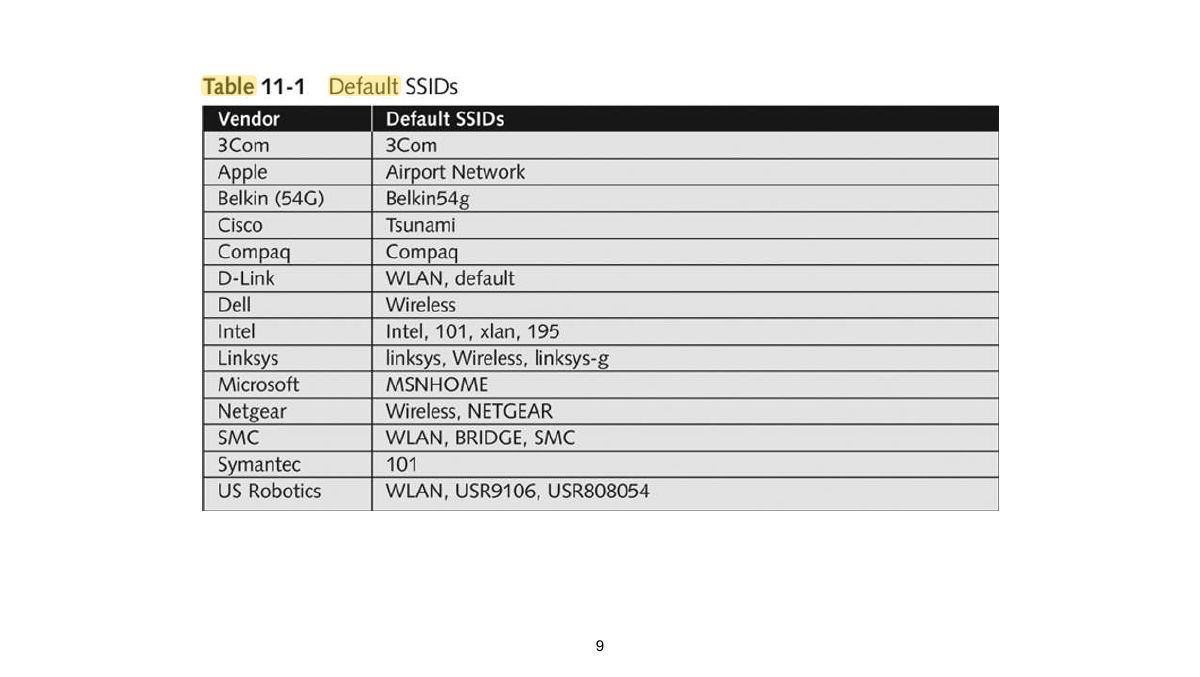
              Slide 8: Service Set Identifier (SSID)
              Exam weight High
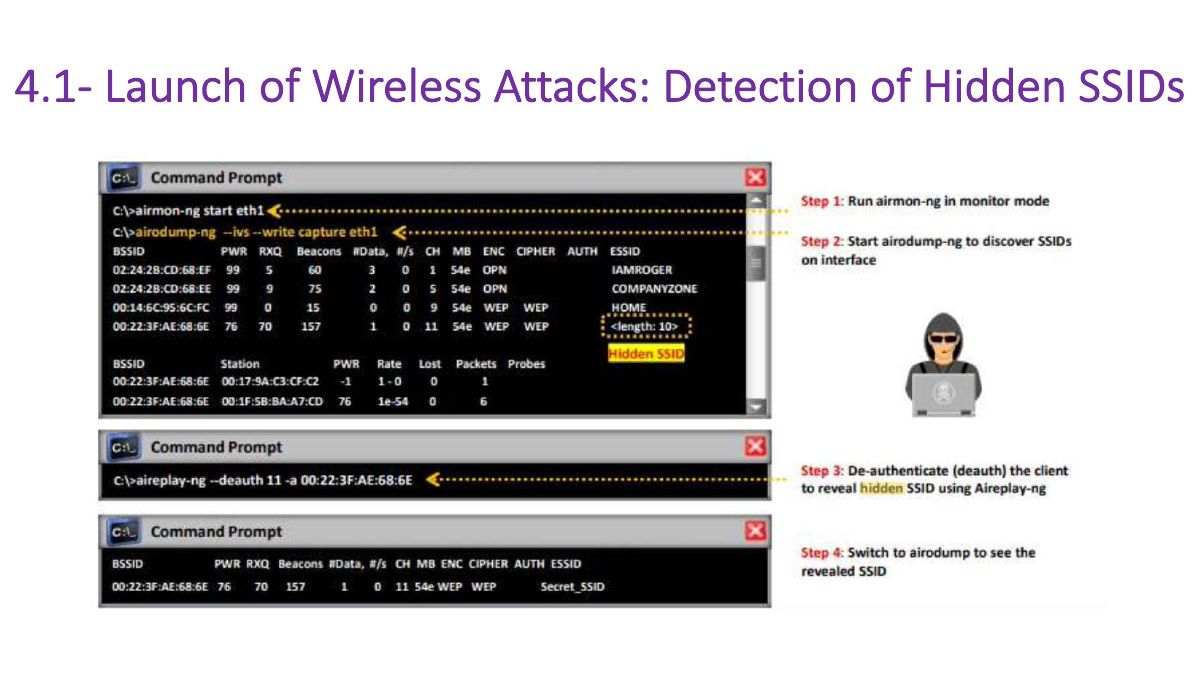
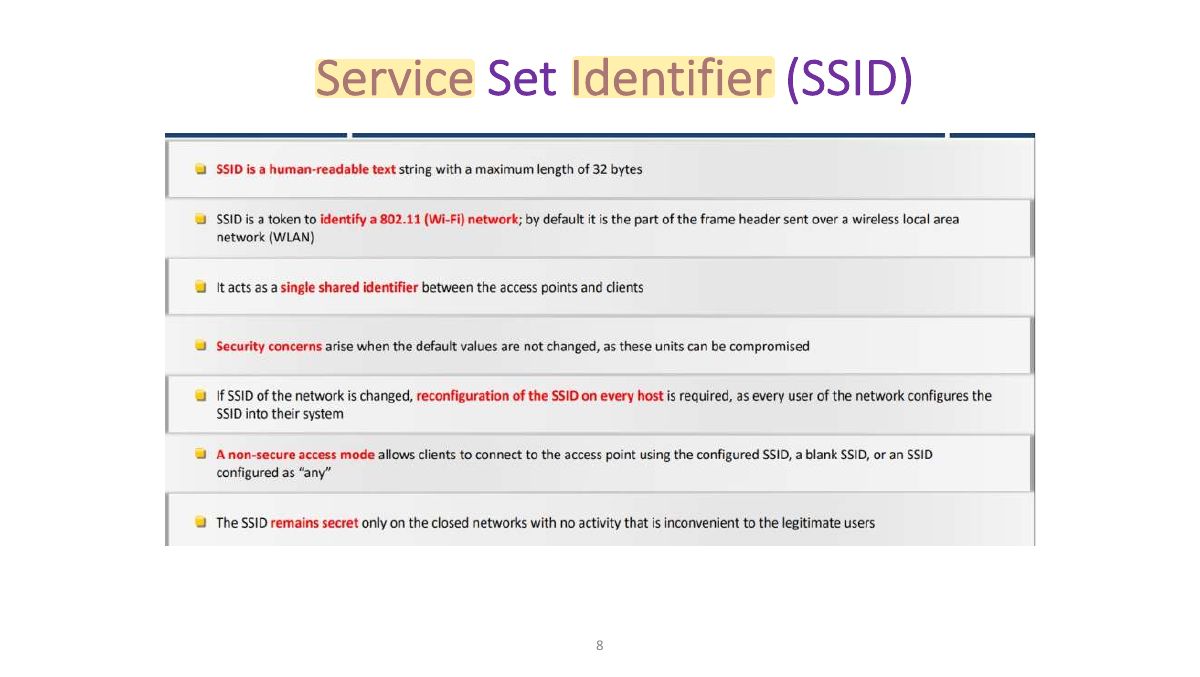
              1. SSID: the network name. Hiding it is NOT real security (it still appears in probe traffic).
              Exam trapHiding the SSID and MAC filtering are easily bypassed; use WPA2/WPA3.
              🎯 How this can come up · 1 question
              True / False

              Disabling SSID broadcast makes a wireless network secure.

              Slide 9: Slide 9
              Exam weight Low

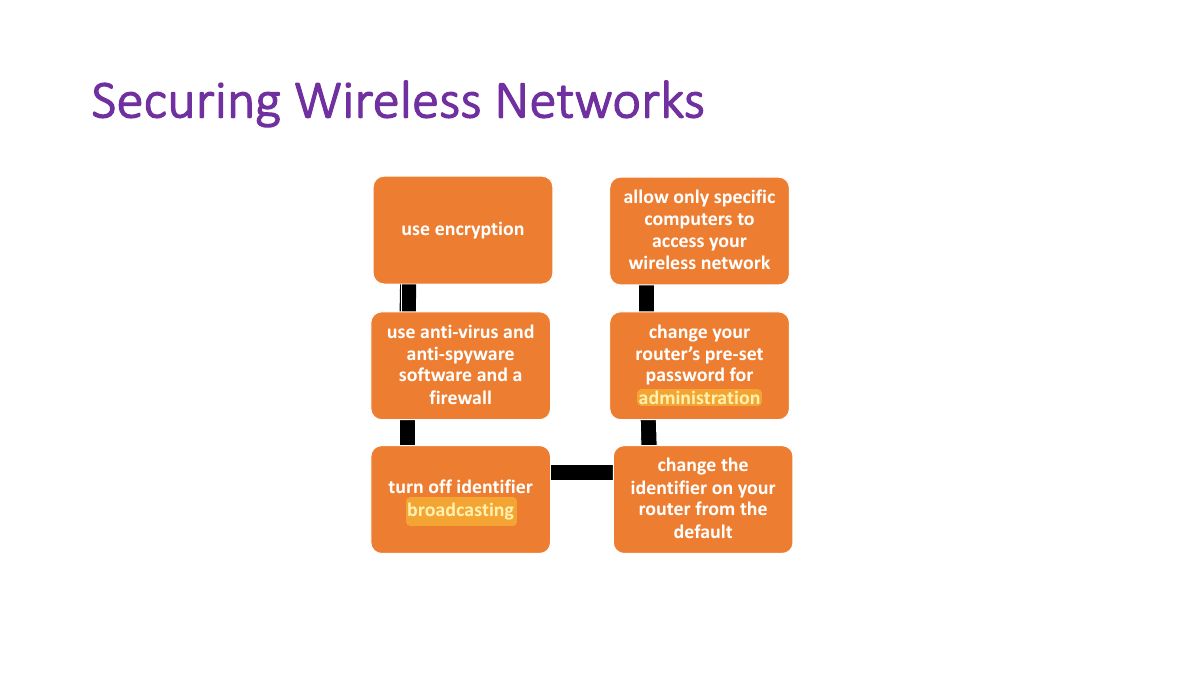
                Securing Wireless Networks

                • Use encryption
                • Use and enable anti-virus, anti-spyware, firewall
                • Turn off SSID broadcasting
                • Change default identifier on router
                • Change router’s preset password
                • Apply MAC-filtering
                  • Reduce signal strengths (place away from windows and external walls
                  • Directional antennas
                10
                Exam weight Low

                  IEEE 802.11 Wireless LAN

                  • IEEE 802: a committee responsible for LANs
                  • IEEE 802.11: responsible for developing wireless protocols
                    • Many standards
                  • The Wi-Fi alliance: became popular with 802.11b
                    • Wi-Fi Protected Access (WPA, WPA2)
                  11
                  Exam weight Low
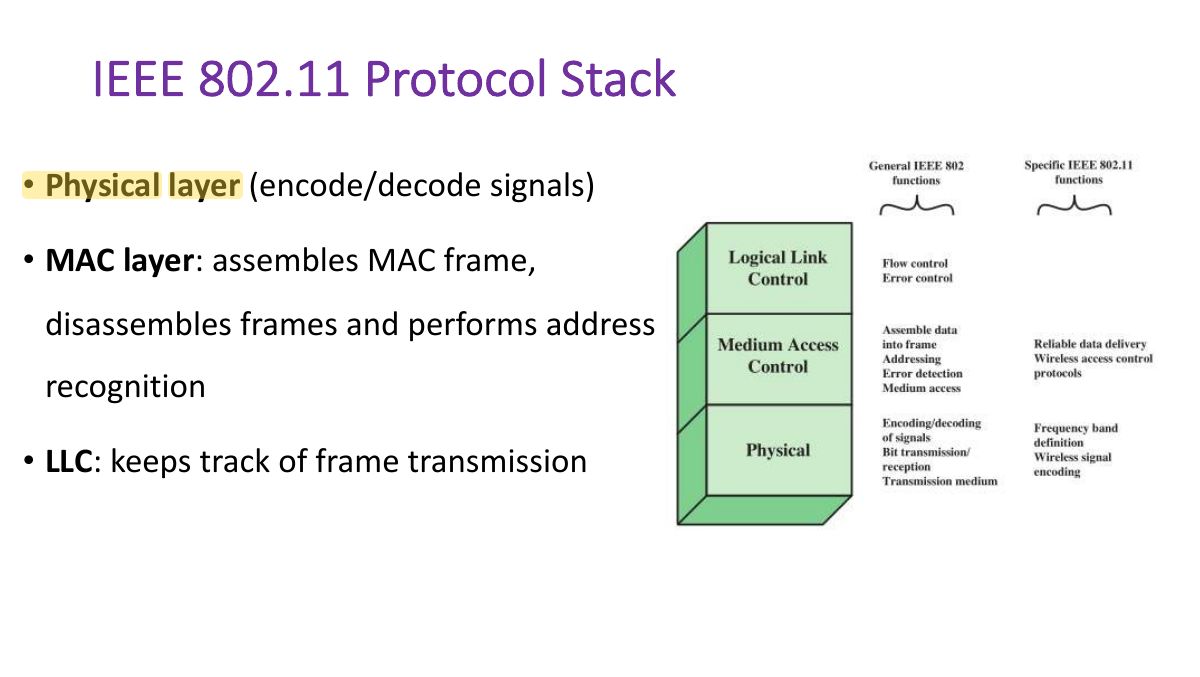
                    Slide 12: IEEE 802.11 Protocol Stack
                    Exam weight Low
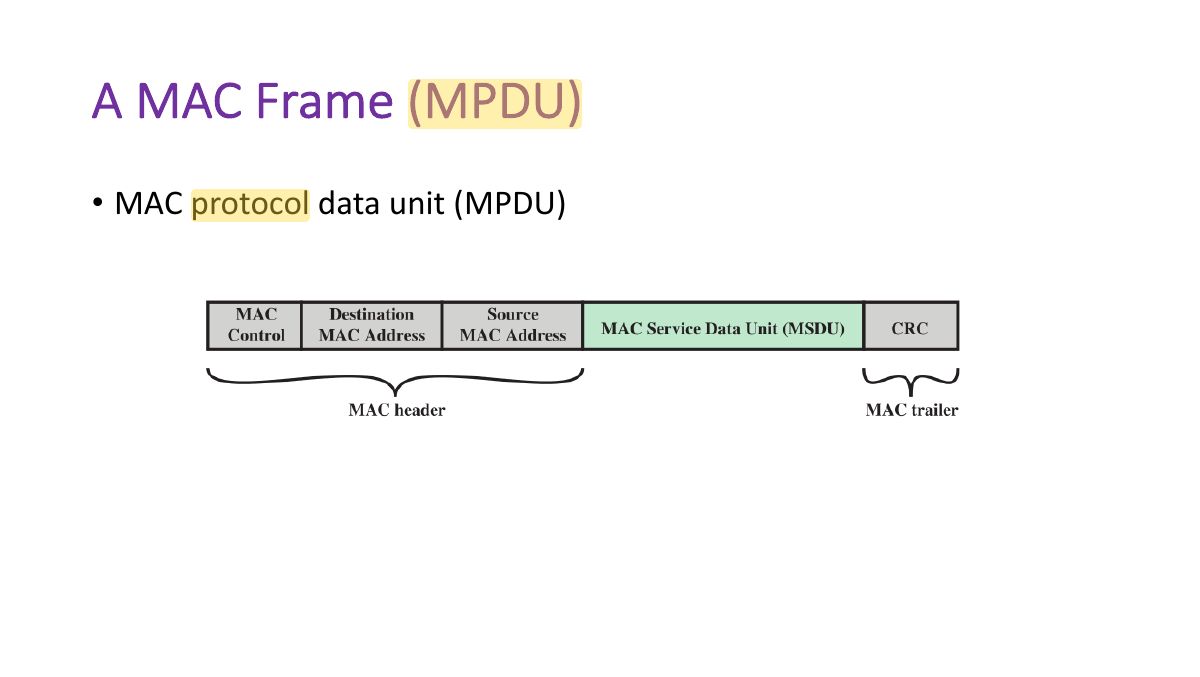
                      Slide 13: A MAC Frame (MPDU)
                      Exam weight Low
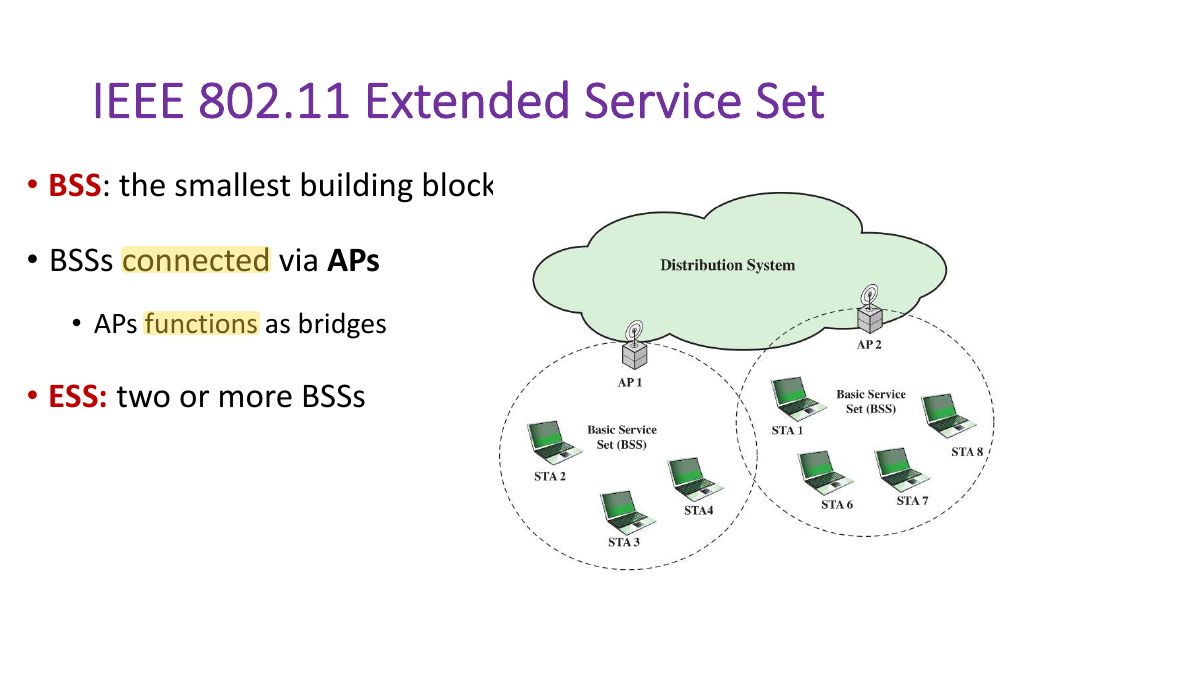
                        Slide 14: IEEE 802.11 Extended Service Set
                        Exam weight Low

                          IEEE 802.11# Wireless Security

                          • Wired Equivalent Privacy (WEP)
                          • Wi-Fi Protected Access (WPA)
                          • WPA2
                          • WPA3
                          15
                          Exam weight Low

                            WEP - Wired Equivalent Privacy

                            • The original native security mechanism for WLAN
                            • Provides security through an 802.11 network
                            • Used to protect wireless communication from eavesdropping (confidentiality)
                            • Prevents unauthorized access to a wireless network (access control)
                            • Prevents tampering with transmitted messages
                            • Provides users with the equivalent level of privacy inbuilt in wireless networks.
                            16
                            Exam weight High
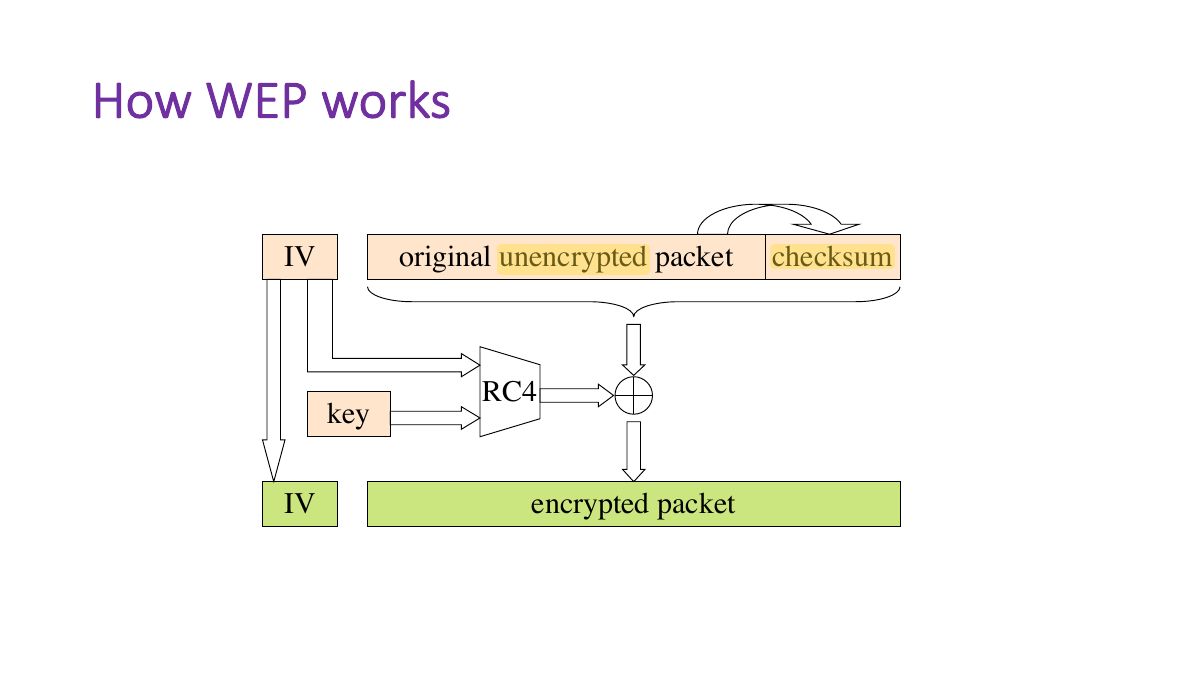
                            1. WEP: RC4 with a 24-bit IV. IVs repeat quickly, so keys can be cracked in minutes. Never use WEP.
                            🎯 How this can come up · 1 question
                            MCQ

                            WEP’s main weakness is its:

                            Slide 17: How WEP works
                            Exam weight Low

                              WEP Flaws and Vulnerabilities

                              • Weak keys: ü It allows an attacker to discover the default key being used by the Access Point and client stations ü This enables an attacker to decrypt all messages being sent over the encrypted channel.
                              • IV (initialization vector) reuse and small size: ü There are 2 24 different IVs ü On a busy network, the IV will surely be reused, if the default key has not been changed and the original message can be retrieved relatively easily.
                              18
                              Exam weight Low

                                Attacks on WEP

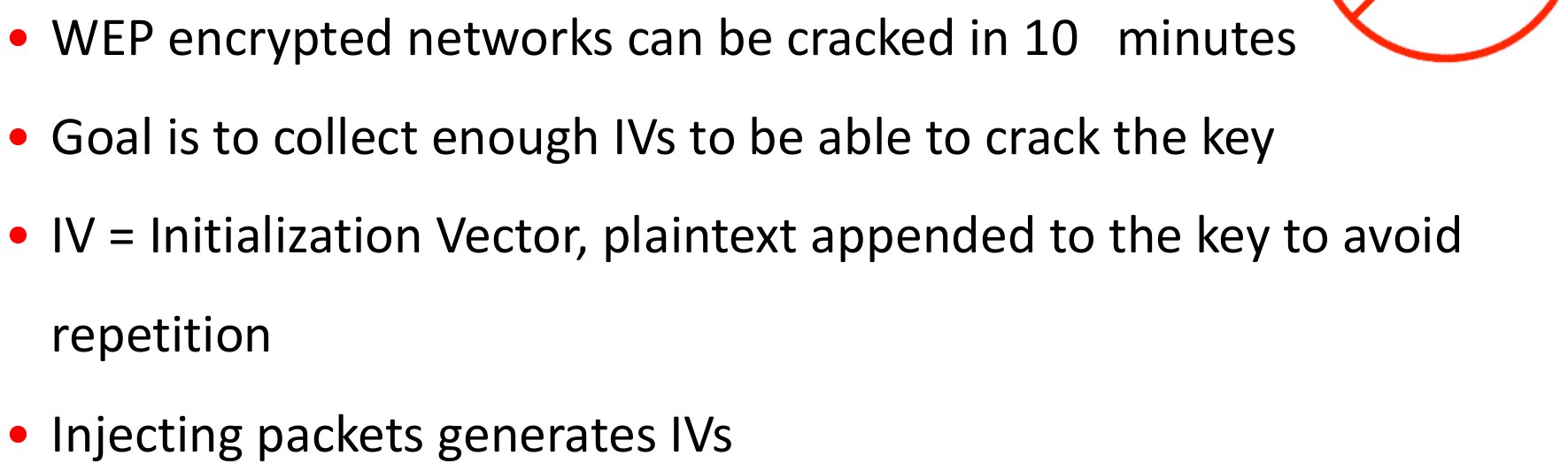
                                • WEP encrypted networks can be cracked in 10 minutes
                                • Goal is to collect enough IVs to be able to crack the key
                                • IV = Initialization Vector, plaintext appended to the key to avoid repetition
                                • Injecting packets generates IVs
                                Attacks on WEP
                                19
                                Exam weight Low

                                  WPA - WI-FI Protected Access

                                  • New technique in 2002
                                  • Replacement of security flaws of WEP
                                  • Improved data encryption
                                  • Strong user authentication
                                  • Because of many attacks related to static key, WPA minimize shared secret key in accordance with the frame transmission
                                  • Use the RC4 algorithm in a proper way and provide fast transfer of the data before someone can decrypt the data.
                                  20
                                  Exam weight Low
                                  1. WPA: TKIP (still RC4), per-packet keys, MIC. An interim fix.

                                  WPA2 - WI-FI Protected Access 2

                                  • Based on the IEEE 802.i standard
                                  • 2 versions: Personal & Enterprise
                                  • The primary enhancement over WPA is the use of the AES (Advanced Encryption Standard) algorithm
                                  • The encryption in WPA2 is done by utilizing either AES or TKIP
                                  21
                                  Exam weight High
                                  1. WPA2: AES-CCMP. Personal (PSK) or Enterprise (802.1X/RADIUS).
                                  🎯 How this can come up · 1 question
                                  MCQ

                                  WPA2 uses which encryption?

                                  WPA2

                                  • WPA2 has immunity against many types of hacker attacks ü Man-in-the middle ü Authentication forging ü Replay ü Key collision ü Weak keys ü Packet forging ü Dictionary attacks
                                  22
                                  Exam weight Low

                                    WPA3

                                    Wi-Fi Protected Access 3, or WPA3, superseded WPA2 in 2018. WPA3 is the latest, updated implementation of WPA.

                                    • WPA3 support is not automatically added to every device. Users who wish to use WPA3-approved devices, such as wireless routers, must either buy new routers that support WPA3 or have the device updated by the manufacturer.
                                    • New updates and features of WPA3 include the following:

                                    ü 256-bit Galois/Counter Mode Protocol encryption (GCMP-256); ü 384-bit Hashed Message Authentication Mode (HMAC); ü 256-bit Broadcast/Multicast Integrity Protocol (BIP-GMAC-256);

                                    23
                                    Exam weight Low
                                    1. WPA3: SAE handshake (resists offline dictionary attacks), forward secrecy, 192-bit enterprise mode.

                                    24
                                    Exam weight Low

                                      Securing Wireless Transmission

                                      • Signal hiding (and SSID hiding)
                                        • Reduce signal strengths
                                      • Encryption: encrypt all wireless transmissions
                                      25
                                      Exam weight Low

                                        Securing Access Point

                                        • Disallow unauthorized access to the AP
                                        • Require authentication for any access including for devices wishing to attach themselves to the AP
                                        26
                                        Exam weight Low
                                        1. Secure the AP: change defaults, update firmware, strong encryption, disable WPS, limit admin access.
                                        Slide 27: Securing Wireless Networks
                                        Exam weight Low
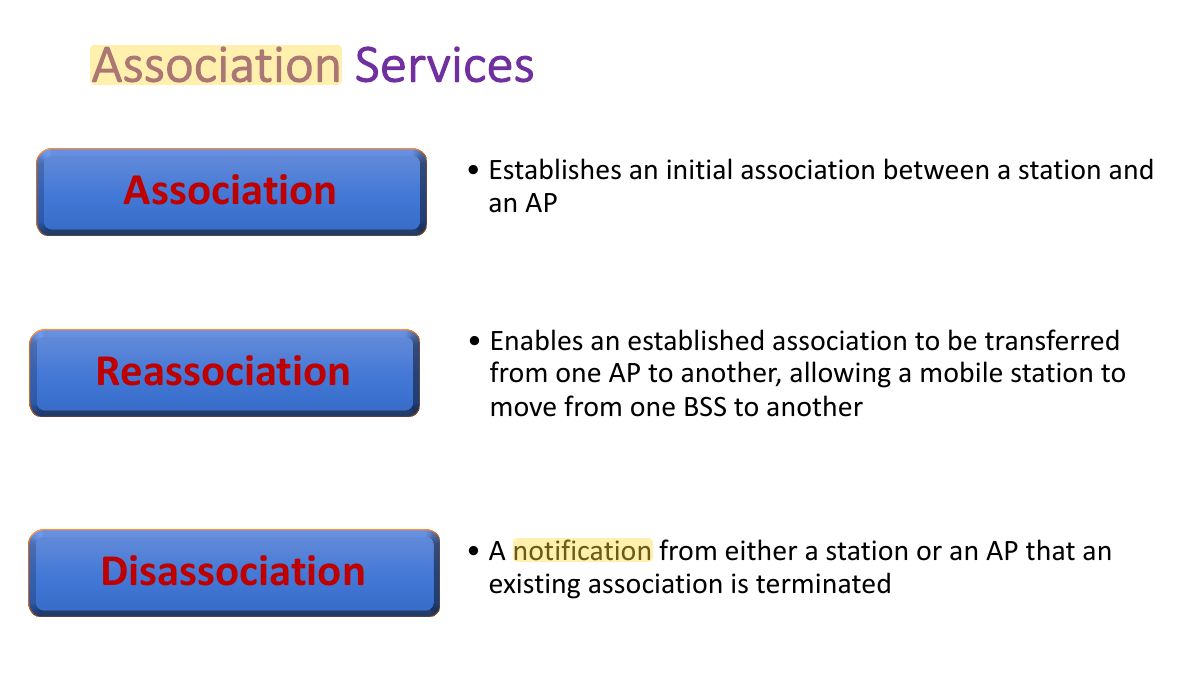
                                          Slide 28: Association Services
                                          Exam weight Low

                                            Wireless Hacking Methodology

                                            The wireless hacking methodology helps an attacker reach the goal of hacking a target wireless Network. An attacker usually follows a hacking methodology to be sure of finding every single entry point to break into the target network.

                                            The attacker uses the following steps to perform wireless hacking:

                                            1. Wi-Fi discovery
                                            2. GPS mapping
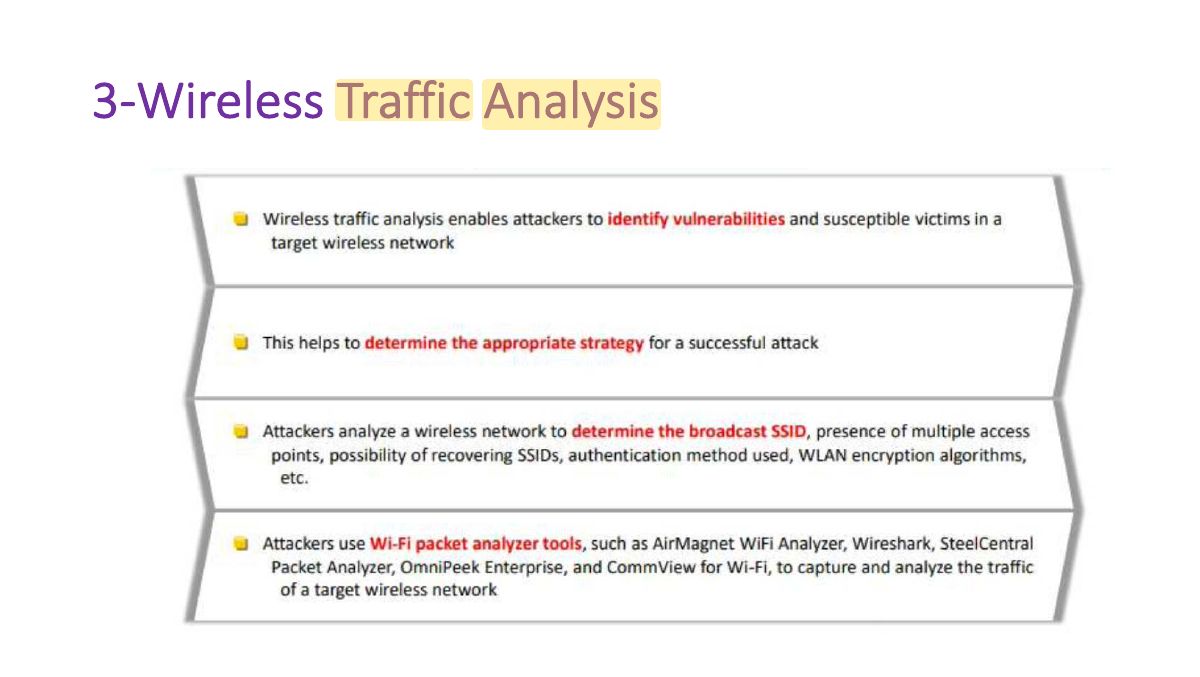
                                            3. Wireless traffic analysis
                                            4. Launch of wireless attacks
                                            5. Wi-Fi encryption cracking
                                            29
                                            Exam weight Low
                                            1. Methodology: Wi-Fi discovery → GPS mapping → traffic analysis → launch attacks → crack encryption.

                                            1- Wi-Fi Discovery: 1.1- Wireless Network Footprinting

                                            30
                                            Exam weight Low
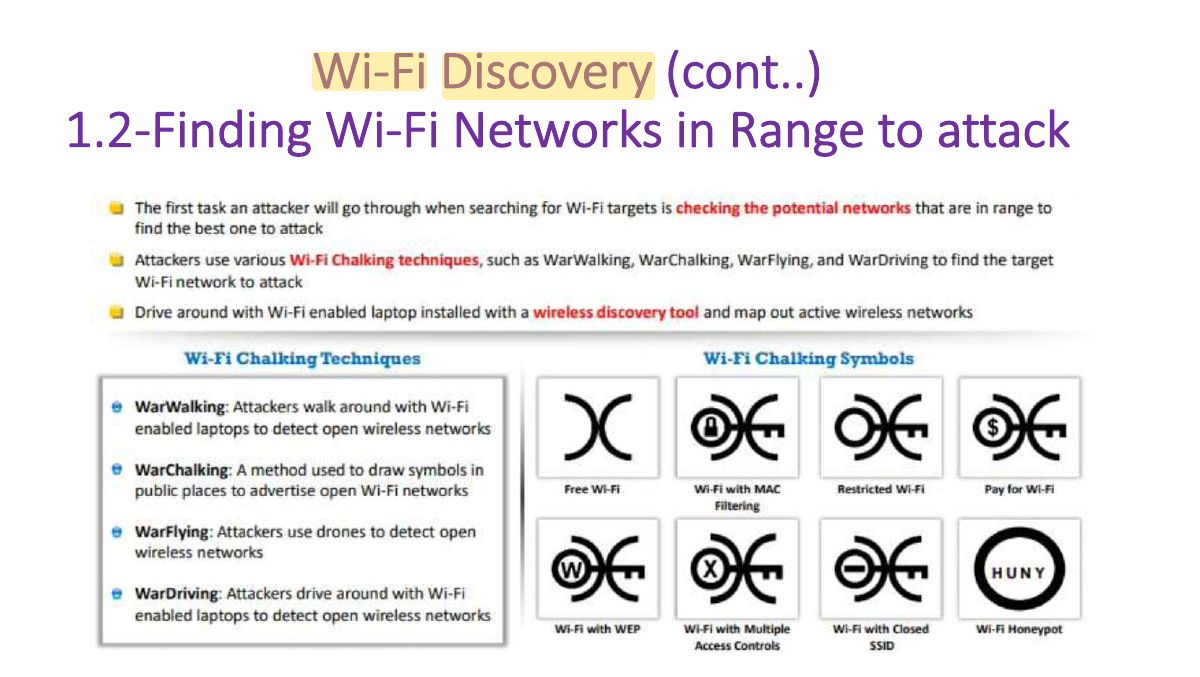
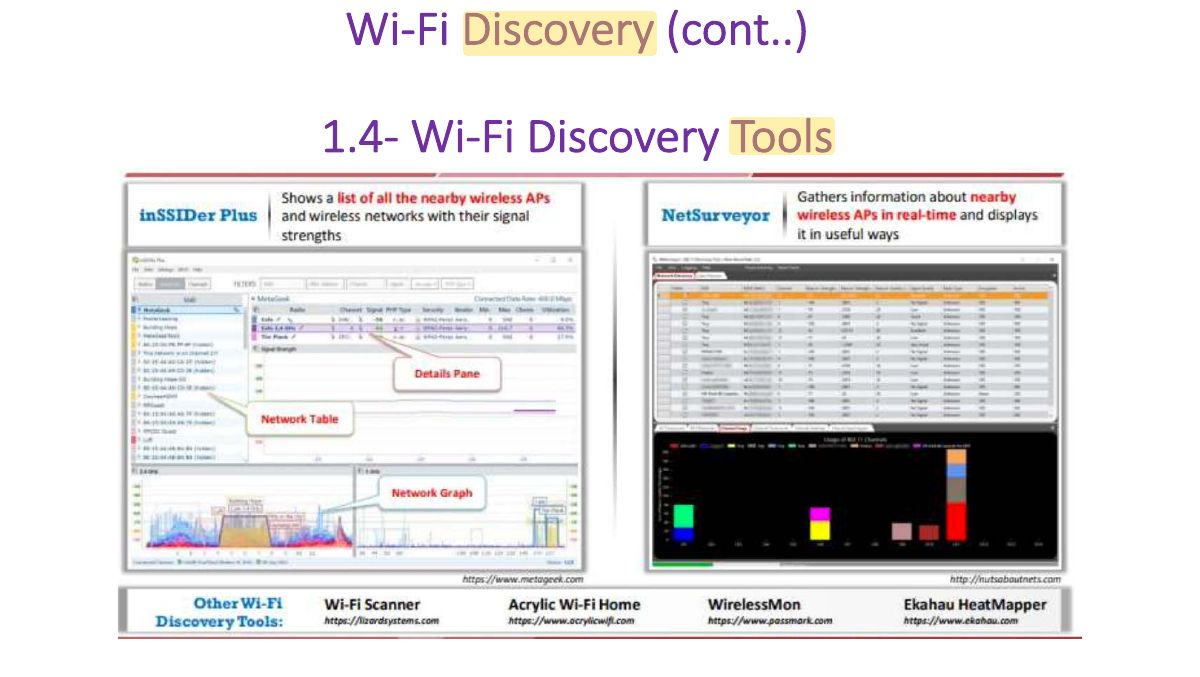
                                              Slide 31: Wi-Fi Discovery (cont..) 1.2-Finding Wi-Fi Networks in Range to attack
                                              Exam weight Low
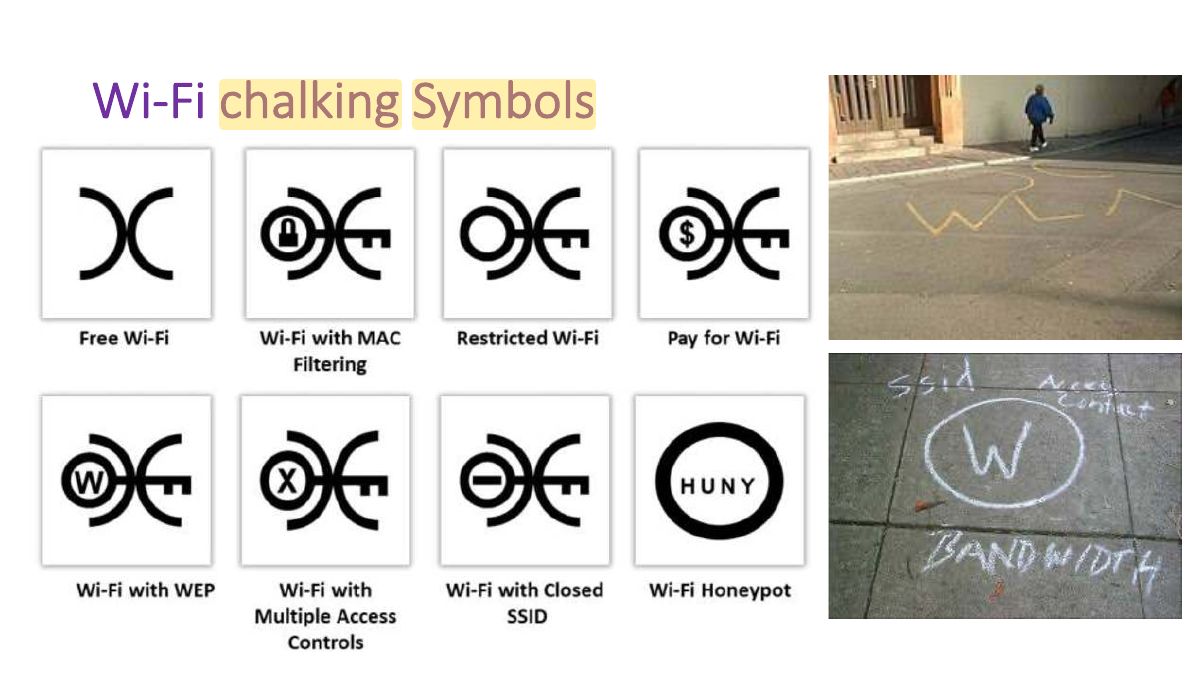
                                                Slide 32: Wi-Fi chalking Symbols
                                                Exam weight Low
                                                1. War driving: searching for Wi-Fi from a moving car; war chalking: marking found networks with symbols.
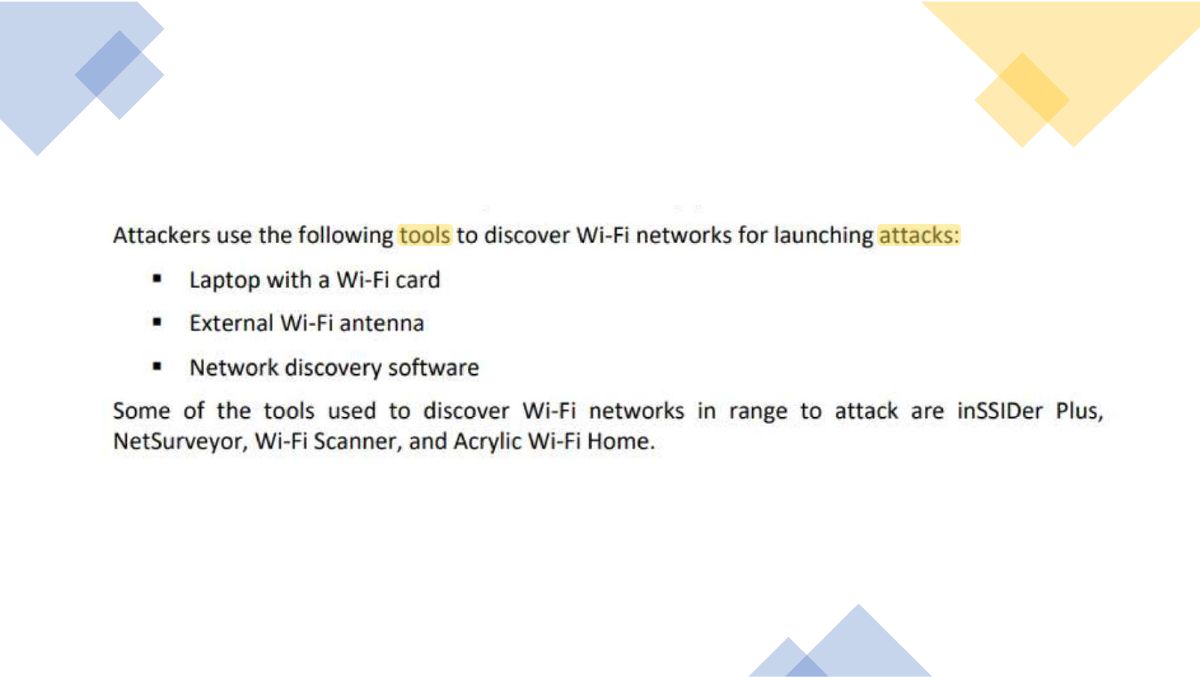
                                                Slide 33: Slide 33
                                                Exam weight Low
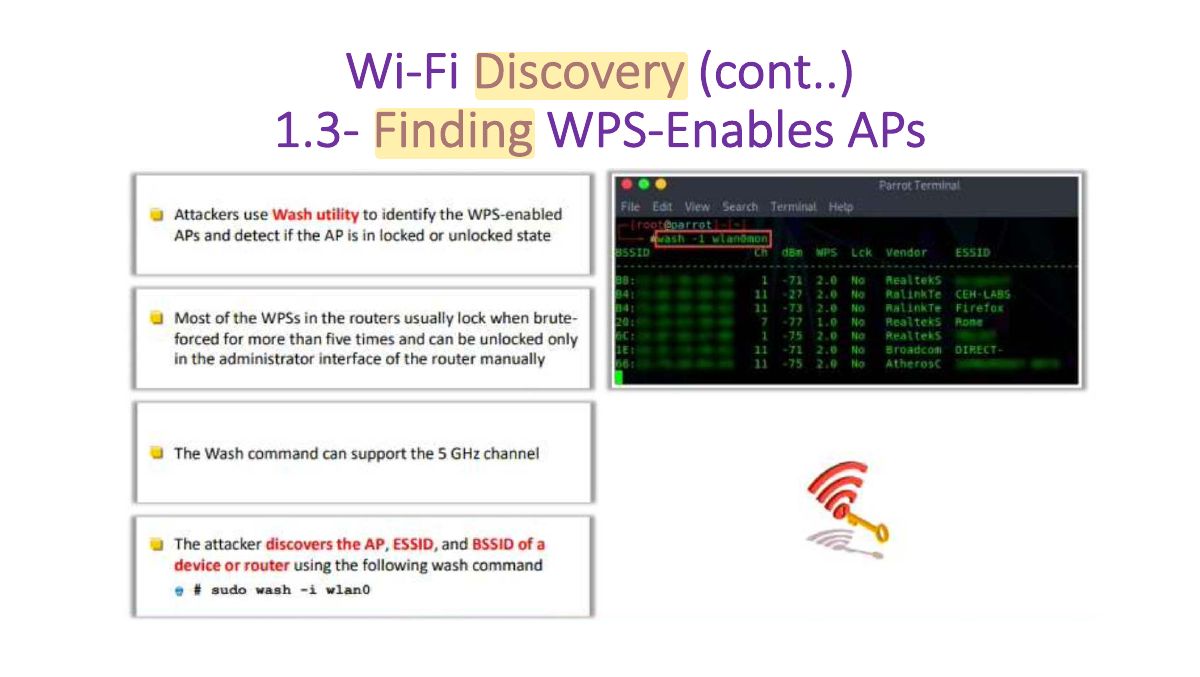
                                                  Slide 34: Wi-Fi Discovery (cont..) 1.3- Finding WPS-Enables APs
                                                  Exam weight Low
                                                    Slide 35: Wi-Fi Discovery (cont..)
                                                    Exam weight Low

                                                      2- GPS Mapping

                                                      36
                                                      Exam weight Low
                                                        Slide 37: 3-Wireless Traffic Analysis
                                                        Exam weight Low
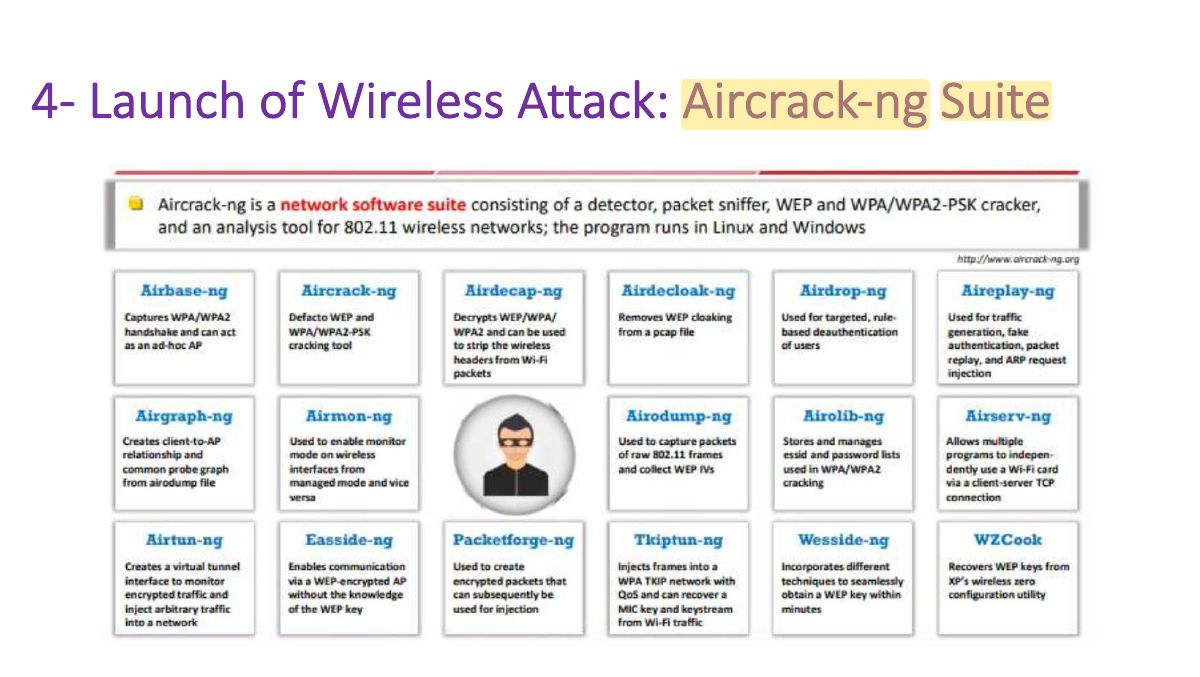
                                                          Slide 38: 4- Launch of Wireless Attack: Aircrack-ng Suite
                                                          Exam weight Low
                                                            Slide 39: 4.1- Launch of Wireless Attacks: Detection of Hidden SSIDs
                                                            Exam weight Low

                                                              4.2- MAC Spoofing Attack

                                                              40
                                                              Exam weight Low

                                                                4.3- DoS: Disassociation and De-authentication Attacks

                                                                41
                                                                Exam weight Low
                                                                1. De-authentication attack: forged deauth frames disconnect clients (DoS, or to capture the WPA handshake).

                                                                4.4- Man in the Middle Attack

                                                                42
                                                                Exam weight Low

                                                                  4.5- Rogue Access Point

                                                                  43
                                                                  Exam weight Low
                                                                  1. Rogue AP: an unauthorized access point plugged into the corporate network.
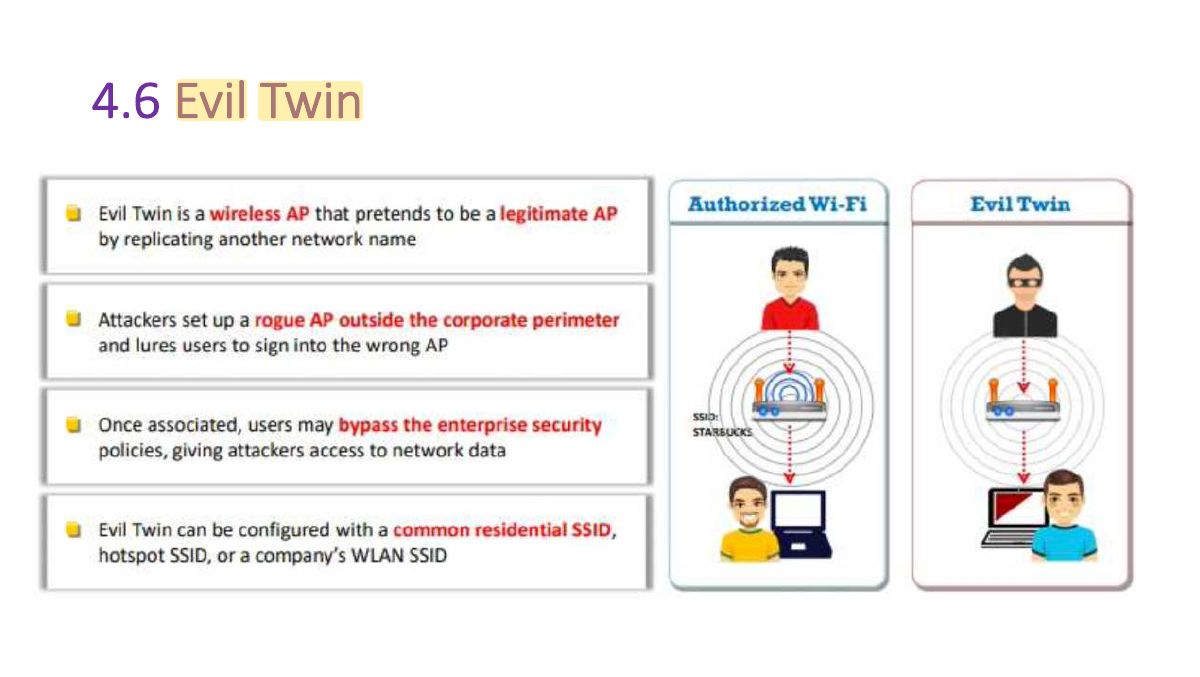
                                                                  Slide 44: 4.6 Evil Twin
                                                                  Exam weight High
                                                                  1. Evil twin: a fake AP with the SAME SSID as a legitimate one to lure clients.
                                                                  🎯 How this can come up · 1 question
                                                                  MCQ

                                                                  An attacker’s AP broadcasting the coffee shop’s exact SSID is a(n):

                                                                  4.7 Misconfigured Access Point Attack

                                                                  Most organizations spend significant amounts of time defining and implementing Wi-Fi security policies, but it may be possible for a client of a wireless network to change the security setting on AP unintentionally.

                                                                  This in turn may lead to misconfigurations in APs. A misconfigured AP can expose an otherwise well-secured network to attacks. It is difficult to detect a misconfigured AP as it is an authorized, legitimate device on the network.

                                                                  ,

                                                                  Attackers can easily connect to the secured network through misconfigured APs, and the device continues to function normally as it will not trigger any alerts even if the attacker uses it to compromise security.

                                                                  45
                                                                  Exam weight Low

                                                                    Some of the key elements that play an important role in this kind of

                                                                    attack include:

                                                                    q SSID Broadcast q Weak Password q Configuration Error

                                                                    46
                                                                    Exam weight Low
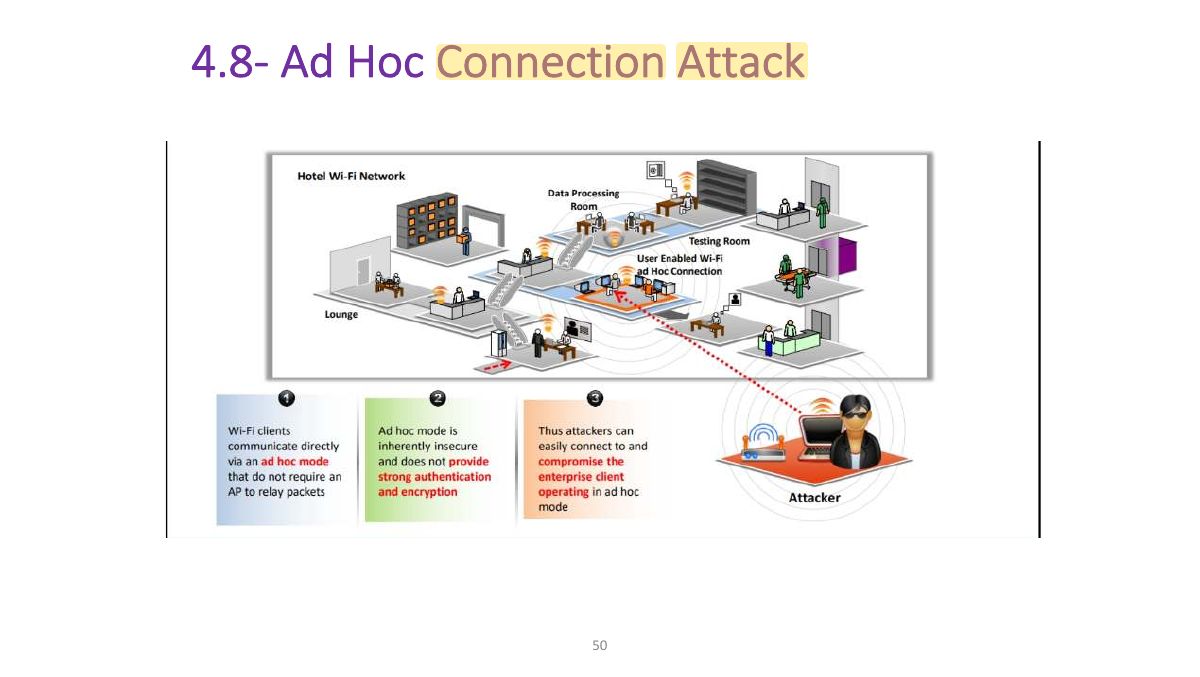
                                                                      Slide 47: 4.8- Ad Hoc Connection Attack
                                                                      Exam weight Low
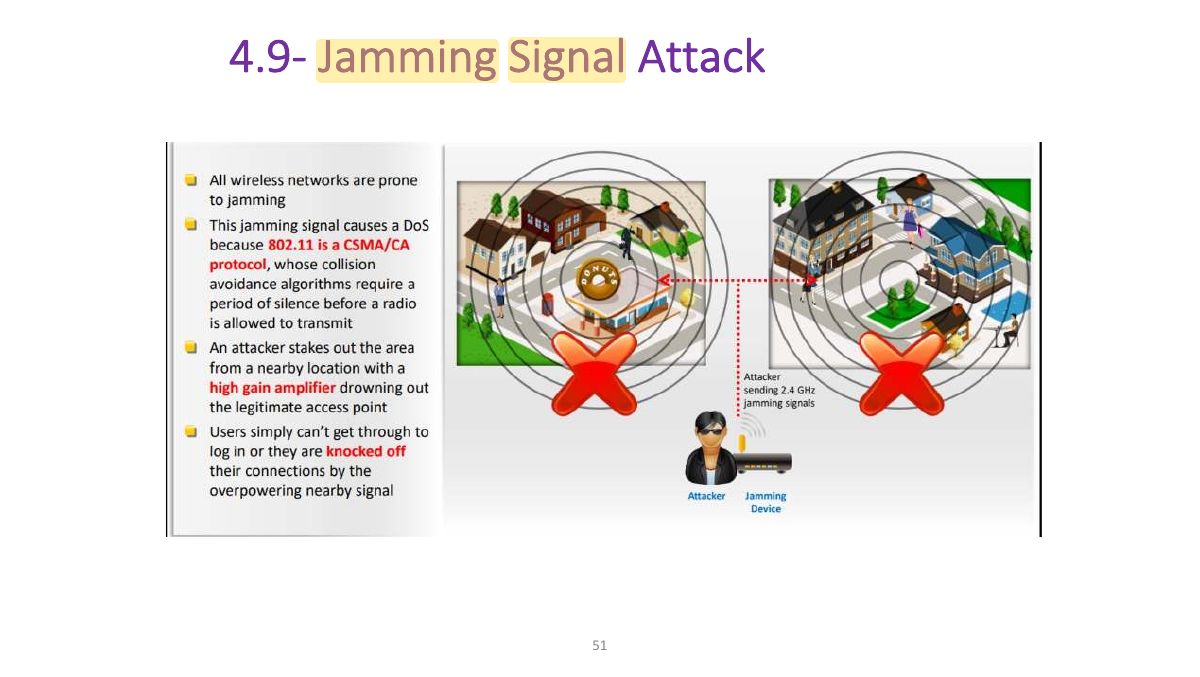
                                                                        Slide 48: 4.9- Jamming Signal Attack
                                                                        Exam weight Low
                                                                        1. Jamming: radio interference that denies service.

                                                                        5- Wi-Fi Encryption Cracking: WEP Encryption Cracking

                                                                        49
                                                                        Exam weight Low
                                                                        1. Cracking: WEP by collecting IVs (aircrack-ng); WPA/WPA2-PSK by capturing the 4-way handshake and running a dictionary attack.
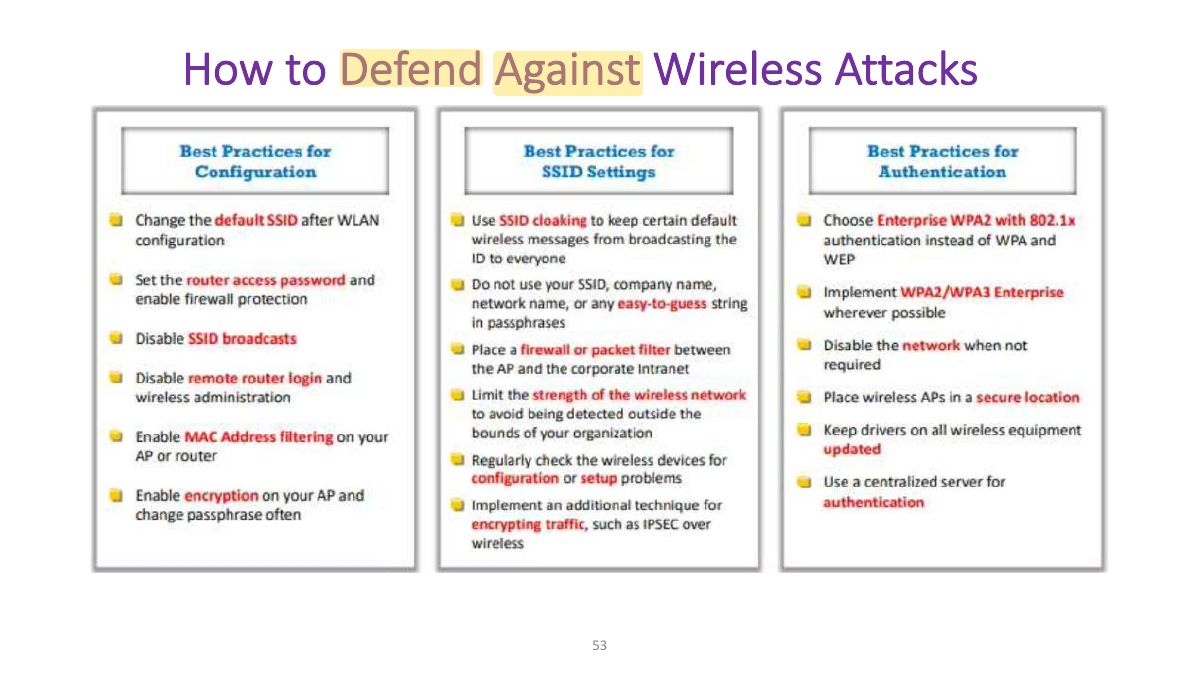
                                                                        Slide 50: How to Defend Against Wireless Attacks
                                                                        Exam weight Low
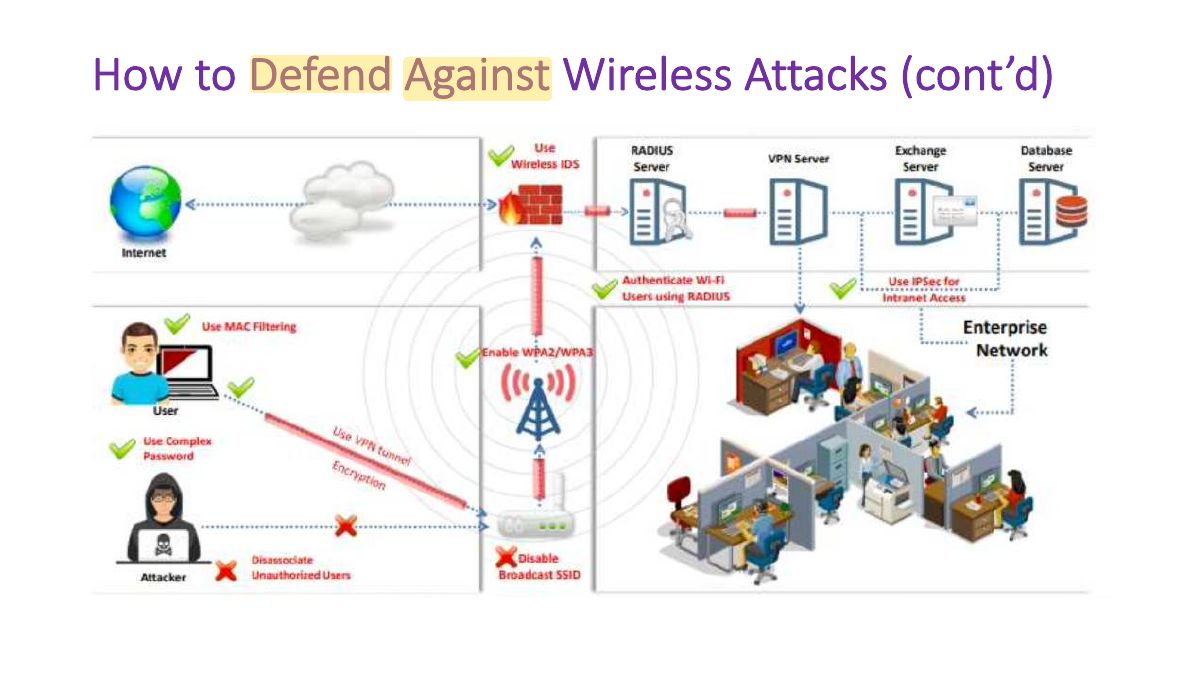
                                                                        1. Defenses: WPA2/WPA3 with strong passphrases, 802.1X, WIDS/WIPS, rogue-AP detection, disable WPS.
                                                                        Slide 51: How to Defend Against Wireless Attacks (cont’d)
                                                                        Exam weight Low