CYS405 · Annotated SlidesChapter 10 — Sniffing, Session Hijacking and DoS Attacks
Chapter 10 · Annotated slides

Sniffing, Session Hijacking and DoS Attacks

Sniffers and passive vs. active sniffing, protocols vulnerable to sniffing, switch CAM tables and MAC flooding, ARP poisoning and its prevention, session hijacking (prediction, active-session identification, spoofing vs. hijacking), and DoS/DDoS techniques and botnets.

Slide text Study notes Highlight: key words Tips, tricks & traps Seen again elsewhere How it can come up
Slide 1: Slide 1
Exam weight Low

    Key Concepts

    • Network sniffing and traffic analysis
    • Session hijacking
    • Denial of service (DoS)
    • Distributed denial of service (DDoS) attacks
    • Botnets
    2
    Exam weight Low

      Slide 3
      3
      Exam weight Low
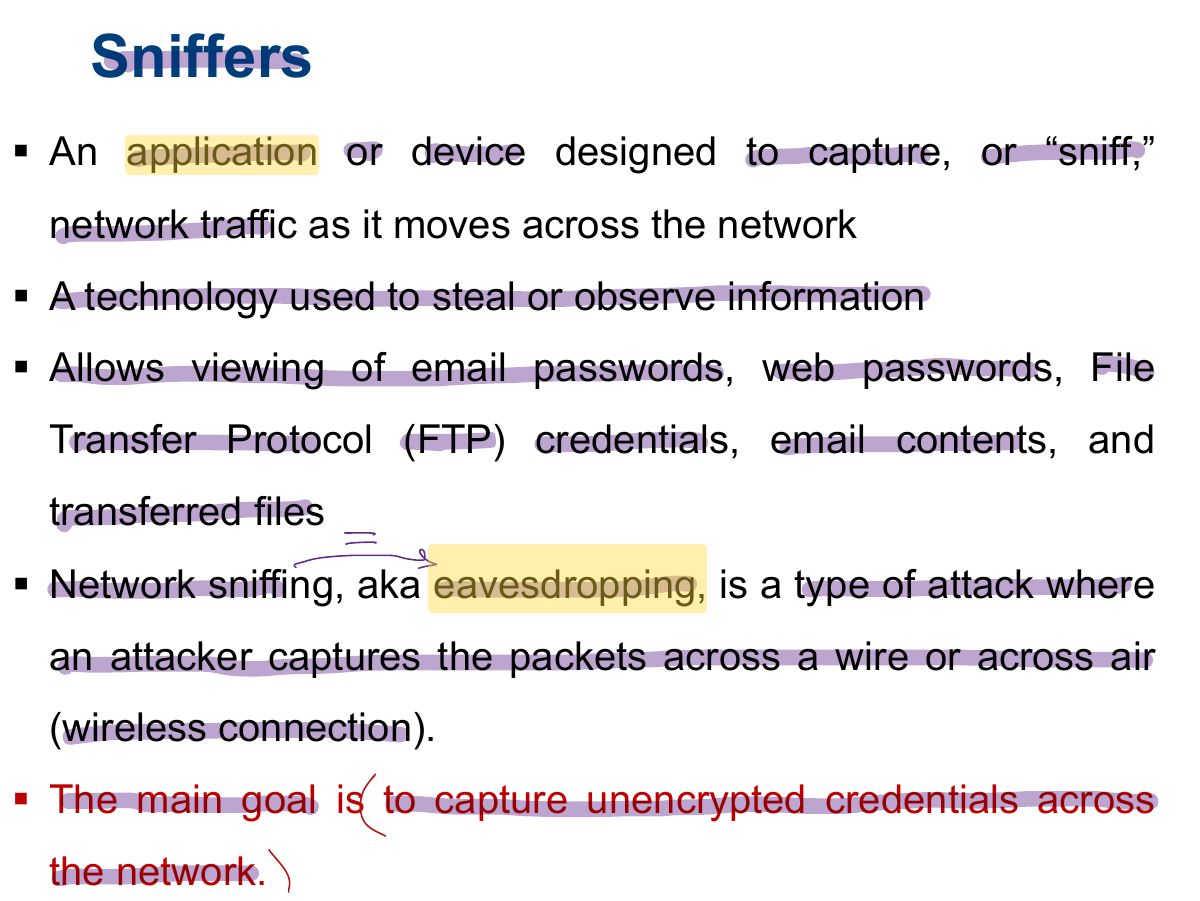
        Slide 4: Sniffers
        Exam weight Low
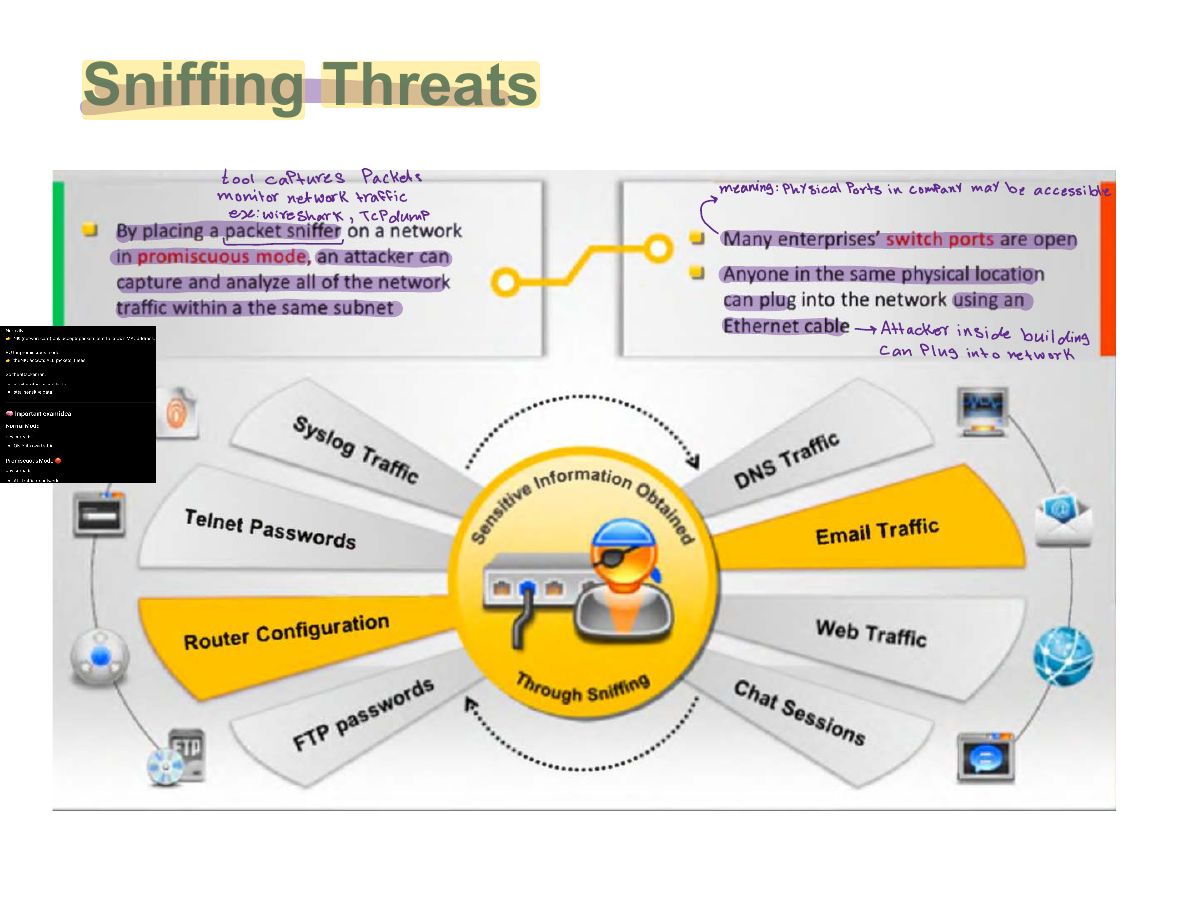
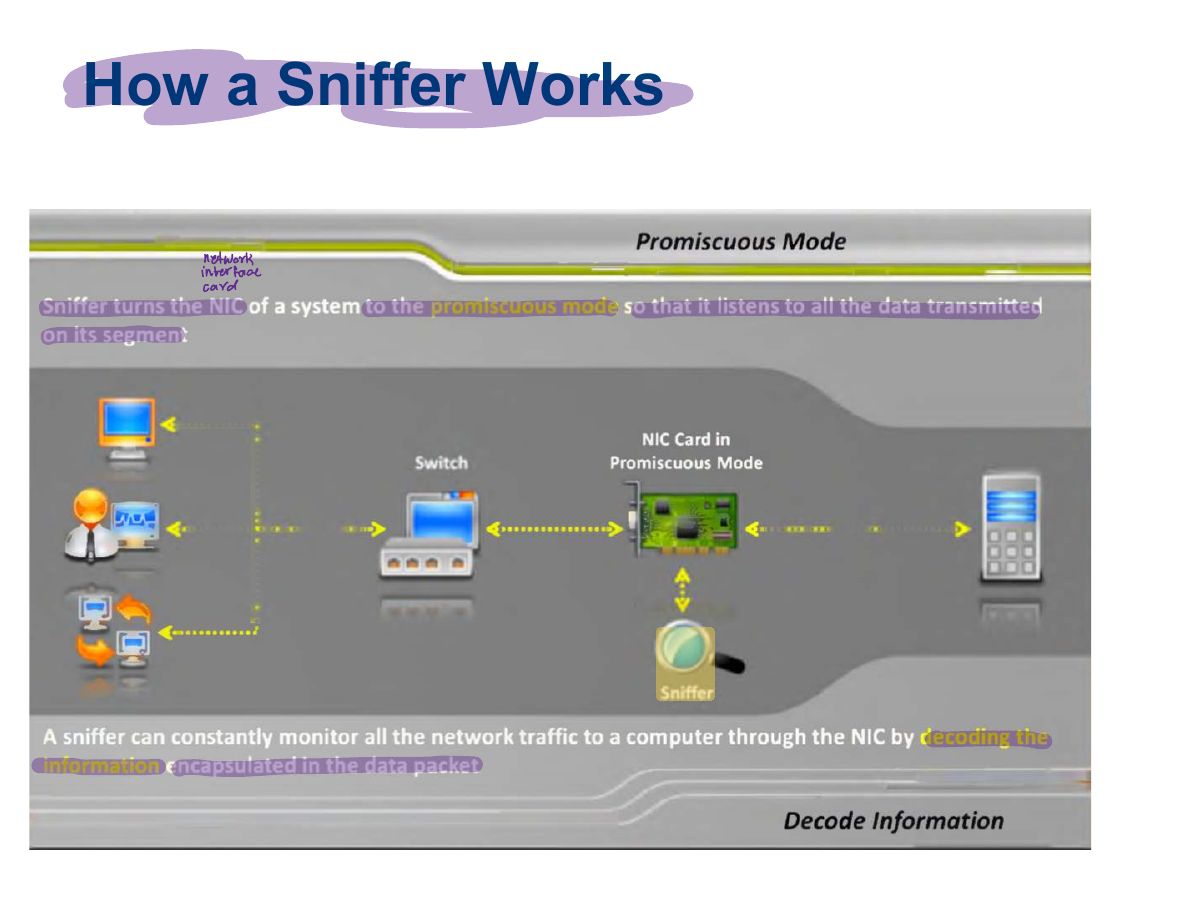
        1. A sniffer captures packets on the network; the NIC runs in promiscuous mode.
        Slide 5: Sniffing Threats
        Exam weight Low
          Slide 6: How a Sniffer Works
          Exam weight Low
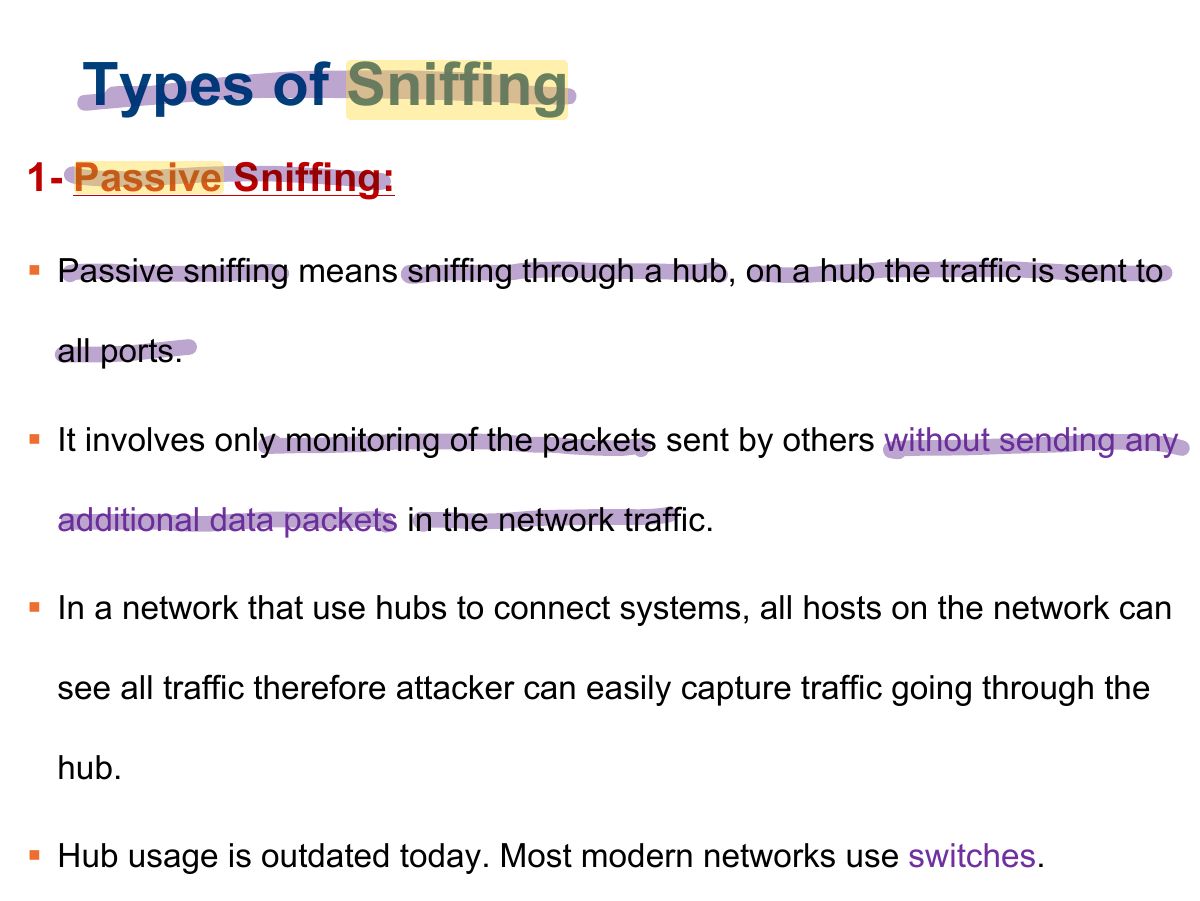
            Slide 7: Types of Sniffing
            Exam weight High
            1. Passive sniffing: just listen (works on hubs). Active sniffing: inject traffic to sniff a switched network (MAC flooding, ARP poisoning).
            🎯 How this can come up · 1 question
            MCQ

            Sniffing on a switched network requires:

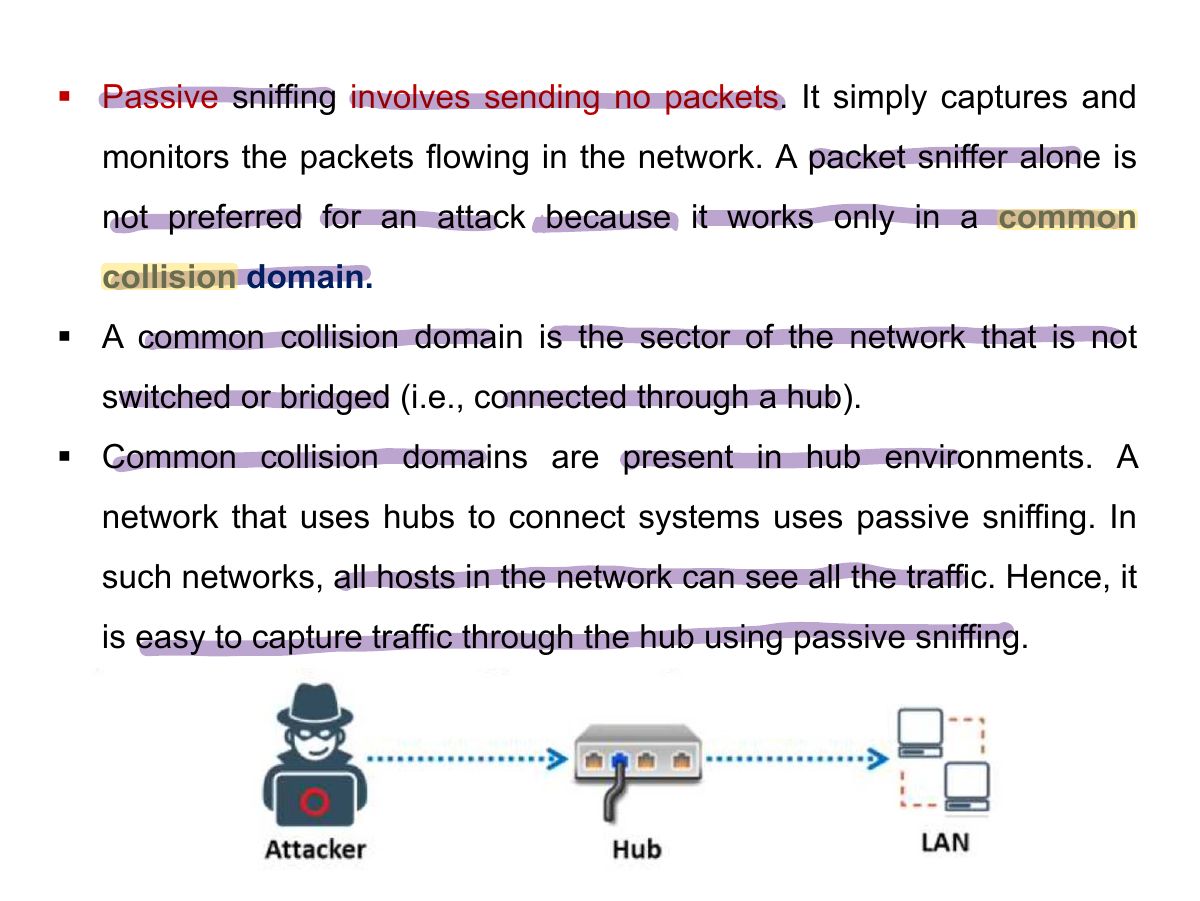
            Slide 8: § Passive sniffing involves sending no packets. It simply captures and
            Exam weight Low
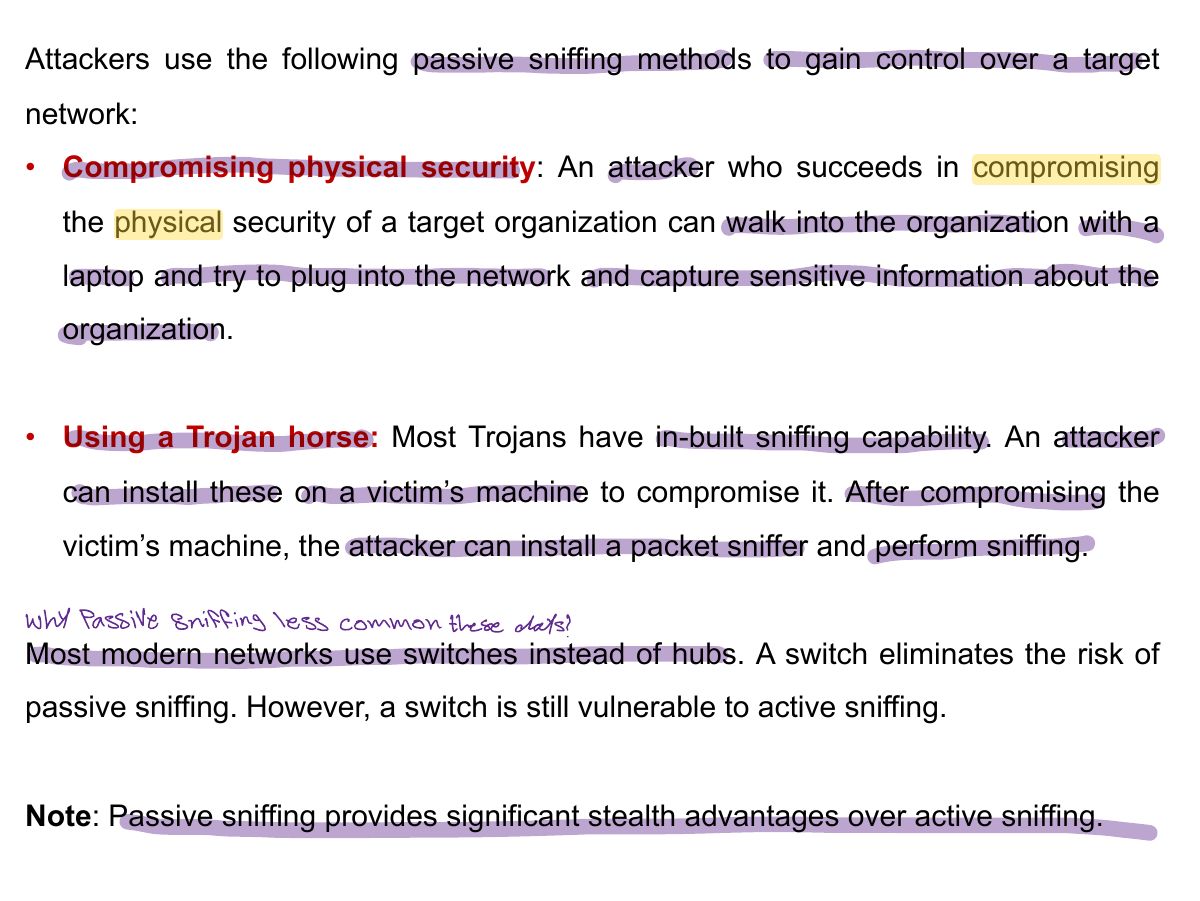
              Slide 9: Attackers use the following passive sniffing methods to gain control over a target
              Exam weight Low
                Slide 10: Types of Sniffing (cont.)
                Exam weight Low

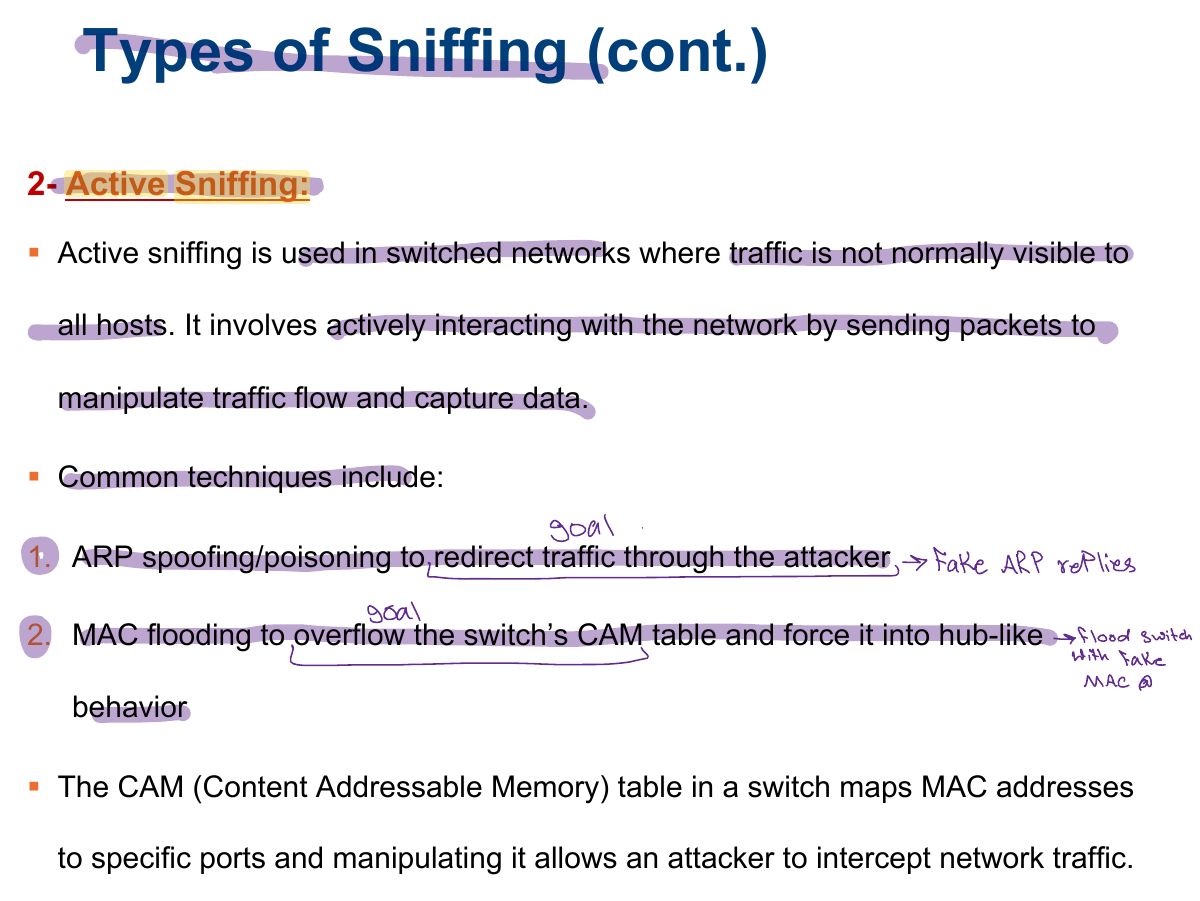
                  Types of Sniffing (cont.)

                  q Active sniffing is used to capture network traffic in switched LAN environments by

                  actively injecting packets into the network. Unlike hub-based networks, where data is broadcast to all devices, switches forward packets only to the intended destination based on MAC addresses. As a result, passive sniffing is ineffective in switched networks.

                  q To overcome this limitation, attackers use active techniques such as ARP spoofing

                  or MAC flooding to manipulate traffic and redirect it through their system. Switches rely on a Content Addressable Memory (CAM) table, which maps MAC addresses to specific ports. By exploiting this mechanism, an attacker can intercept traffic that would not normally be accessible.

                  q A sniffer can then capture and analyze packets, potentially exposing sensitive

                  information such as credentials or confidential data

                  11
                  Exam weight Low

                    Detectability: Leaving Fingerprints

                    Passive Sniffing: Passive sniffing is very difficult to detect because it does not generate additional network traffic. Detection is possible only through advanced techniques such as:

                    • Monitoring NIC mode: Identifying network interfaces running in promiscuous mode using specialized tools (rarely performed in practice)
                    • Analyzing host performance: Unusual CPU or disk usage may indicate packet capture activity, though this method is indirect and unreliable

                    Active Sniffing: Active sniffing is easier to detect than passive sniffing because it introduces abnormal traffic into the network. Security systems such as Intrusion Detection Systems (IDS) can identify signs of attack, including:

                    • Unusual ARP traffic: Large numbers of ARP replies without corresponding requests or inconsistent IP-to-MAC mappings
                    • MAC address flapping: A MAC address appearing on multiple switch ports in a short time
                    • Duplicate IP addresses: Network conflicts caused by spoofed ARP responses
                    12
                    Exam weight Low

                      Protocols Vulnerable to Sniffing

                      13
                      Exam weight High
                      1. Plaintext protocols leak credentials: Telnet, FTP, HTTP, POP3, IMAP, SMTP, SNMPv1.
                      🎯 How this can come up · 1 question
                      MCQ

                      Which protocol sends credentials in clear text?

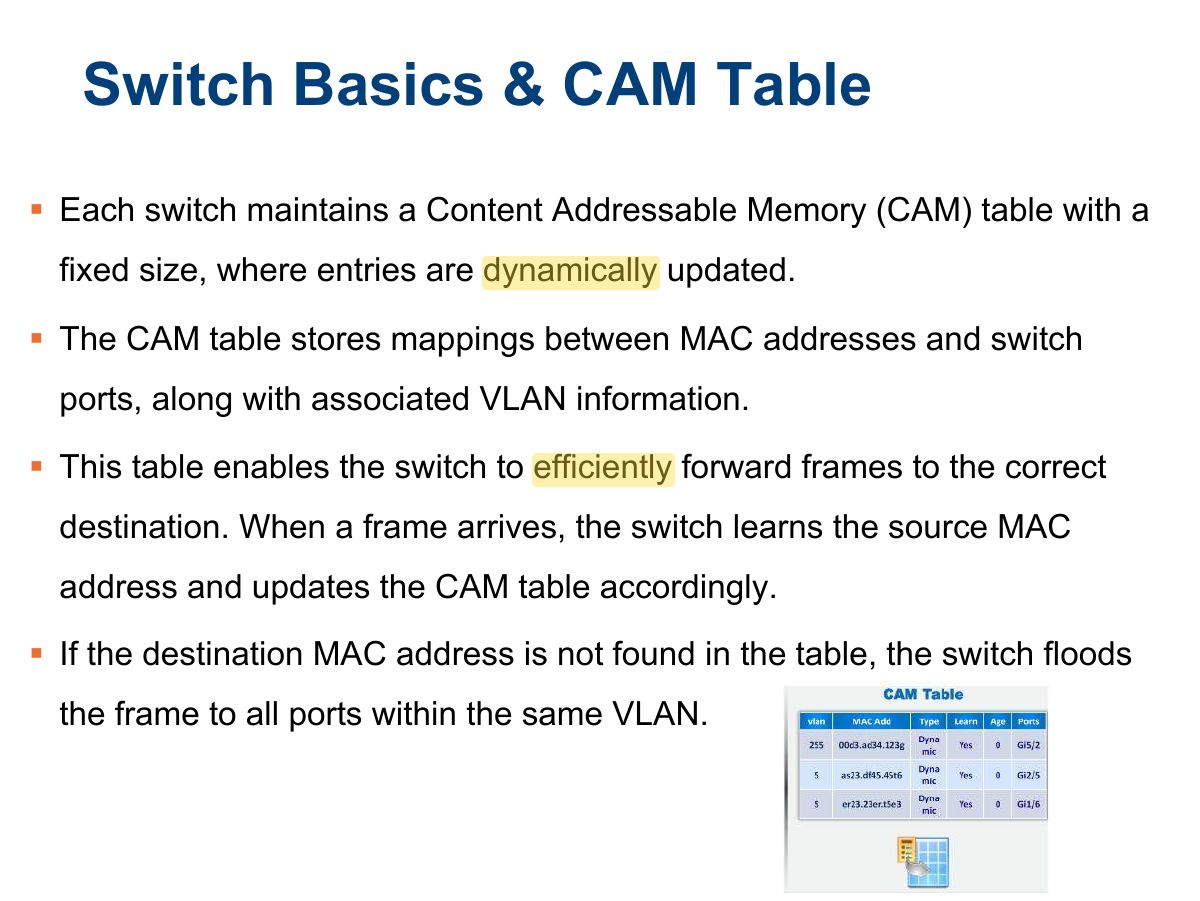
                      Slide 14: Switch Basics & CAM Table
                      Exam weight Low
                      1. A switch’s CAM table maps MAC addresses to ports.

                      How CAM Works

                      15
                      Exam weight Low

                        ARP Protocol Basics

                        Purpose:

                        • Resolves IP addresses to MAC addresses
                        • Enables communication within a local network (LAN)
                        • Bridges the Network Layer (IP) and Data Link Layer (MAC)

                        How It Works:

                        1. The host checks its ARP cache for an existing mapping
                        2. If not found, it broadcasts an ARP Request: → “Who has IP X.X.X.X?”
                        3. The target host replies with an ARP Reply (unicast): → “IP X.X.X.X is at MAC XX:XX:XX:XX:XX:XX”
                        4. The mapping is stored in the ARP cache (duration varies by OS)

                        Key Characteristics:

                        • Stateless protocol: no session or verification mechanism
                        • No authentication: replies are automatically trusted → vulnerable to spoofing
                        • Local scope only: operates within a LAN (does not cross routers)
                        • Broadcast/Unicast behavior:
                          • Requests → broadcast
                          • Replies → unicast
                        16
                        Exam weight Low
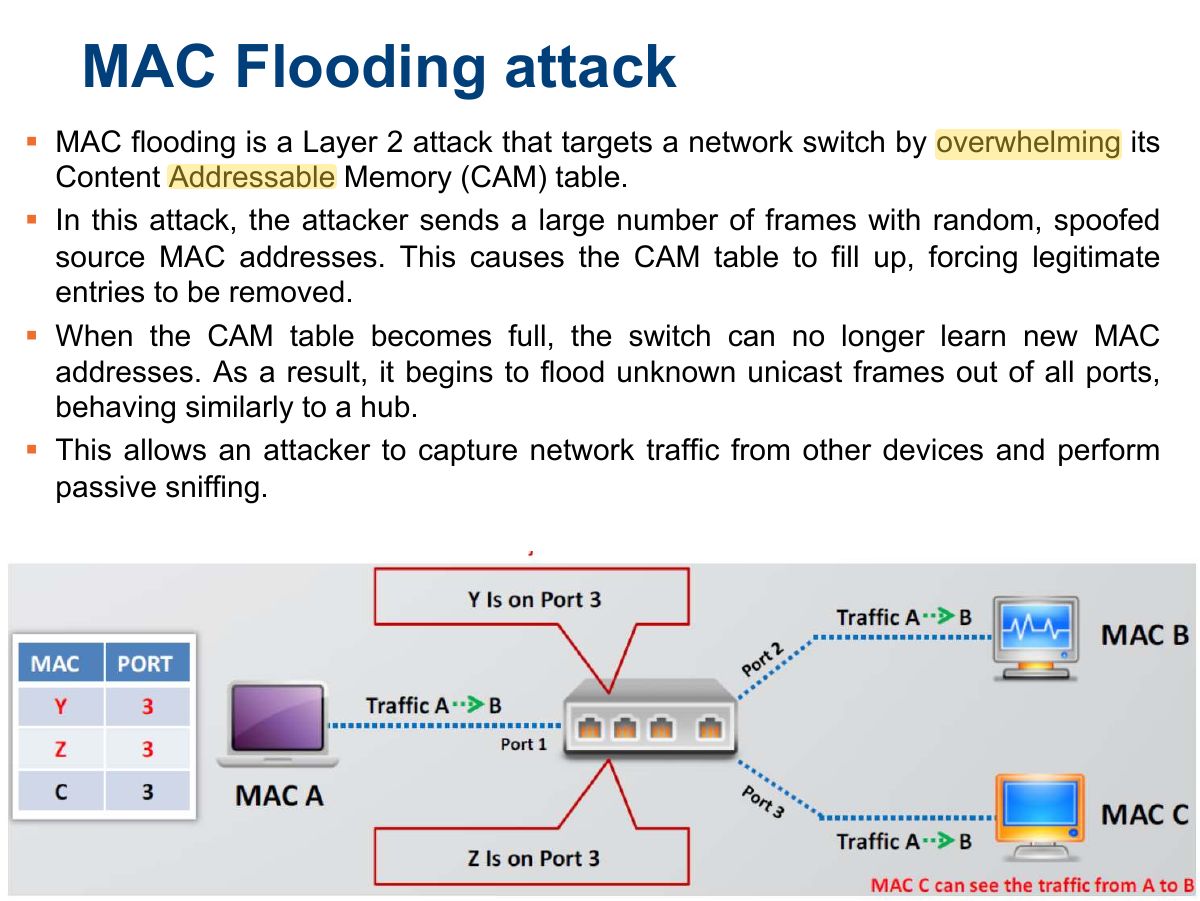
                          Slide 17: MAC Flooding attack
                          Exam weight High
                          1. MAC flooding: fill the CAM table with fake MACs so the switch fails open and floods frames like a hub. Defense: port security.
                          🎯 How this can come up · 1 question
                          MCQ

                          Port security on a switch defends against:

                          18
                          Exam weight Low

                            How to Defend against MAC Attacks

                            Port Security Definition:

                            • Port security is a switch feature that restricts access to a port by limiting the MAC addresses
                            • allowed to connect. When enabled, the switch forwards traffic only from authorized MAC addresses.

                            Security Violation Conditions occur: q When a port is configured as secure and the maximum number of secure MAC addresses is

                            reached.

                            q When a machine's MAC address attempting to access the port does not match any identified

                            secure MAC addresses.

                            Methods for Configuring Secure MAC Addresses: ü Manually configure all secure MAC addresses using the switch port port-security mac-

                            address command.

                            ü Allow the port to dynamically learn and configure secure MAC addresses from connected

                            devices.

                            ü Configure a specific number of addresses manually and allow the remainder to be

                            dynamically learned.

                            Benefits of Port Security:

                            • Limits MAC flooding attacks.
                            • Locks down ports to authorized devices only.
                            • Sends SNMP traps for security monitoring and alerts.
                            19
                            Exam weight Low

                              20
                              Exam weight Low

                                21
                                Exam weight Low

                                  ARP Poisoning / ARP Spoofing

                                  • Definition : ARP poisoning is a cyberattack in which an attacker sends forged ARP messages onto a local network to manipulate ARP tables (ARP cache) of other devices.
                                  • Primary Primary Goal: To associate the attacker’s MAC address with the IP address of a legitimate device (e.g., the default gateway or another host)
                                  • Result: Once successful, network traffic is redirected through the attacker’s machine, enabling them to:
                                  • Intercept and steal data (Man-in-the-Middle attack)
                                  • Launch Denial-of-Service (DoS) attacks
                                  • Perform session hijacking
                                  22
                                  Exam weight High
                                  1. ARP poisoning: send forged ARP replies linking the attacker’s MAC to the gateway’s IP → man in the middle.
                                  🎯 How this can come up · 1 question
                                  MCQ

                                  ARP poisoning works because ARP:

                                  How does ARP Poisoning Works

                                  • Step 1: Reconnaissance
                                    • The attacker identifies the IP addresses of:
                                    • The target victim
                                    • The default gateway
                                  • Step 2: The Poisoning
                                    • The attacker sends forged ARP replies:

                                  To the victim:

                                  → “I am the gateway. My MAC address is [Attacker’s MAC].” To the gateway:

                                  → “I am the victim. My MAC address is [Attacker’s MAC].”

                                  • These fake replies are sent continuously to maintain the attack.
                                  • Step 3: The Redirection
                                    • Both the victim and the gateway update their ARP caches with false mappings
                                    • Traffic between them is now redirected through the attacker’s machine
                                  • Step 4: The Attack
                                    • Sniff (capture sensitive data)
                                    • Modify (alter packets in transit)
                                  23
                                  Exam weight Low

                                    How Does ARP Spoofing Work

                                    24
                                    Exam weight Low

                                      Why is ARP Poisoning Possible?

                                      The Core Vulnerability: ARP is a Trust-Based Protocol

                                      • No Authentication: Devices automatically trust ARP replies without verifying their legitimacy.
                                      • Stateless Behavior: Devices accept ARP replies even if they did not send a request (unsolicited responses)
                                      • No Integrity Verification: There is no mechanism to validate that the IP–MAC mapping is correct
                                      • Result:This lack of security allows attackers to inject forged ARP replies and poison ARP caches, enabling traffic interception and Man-in-the-Middle attacks.
                                      25
                                      Exam weight Low

                                        ARP Spoofing Prevention

                                        1. Encryption (Mitigation, not prevention)

                                        • Use a VPN (Virtual Private Network)
                                        • Encrypts traffic, making intercepted data unreadable to attackers
                                        • Does not stop ARP spoofing, but reduces its impact

                                        2. Static ARP Entries

                                        • Manually bind IP addresses to MAC addresses
                                        • Prevents devices from accepting fake ARP replies
                                        • Limitation: Not scalable for large networks

                                        3. Packet Filtering & Monitoring

                                        • Use IDS/IPS systems to detect abnormal ARP activity

                                        Identify:

                                        • Conflicting IP–MAC mappings
                                        • Suspicious ARP traffic patterns
                                        • Block malicious packets before they reach hosts
                                        26
                                        Exam weight Low
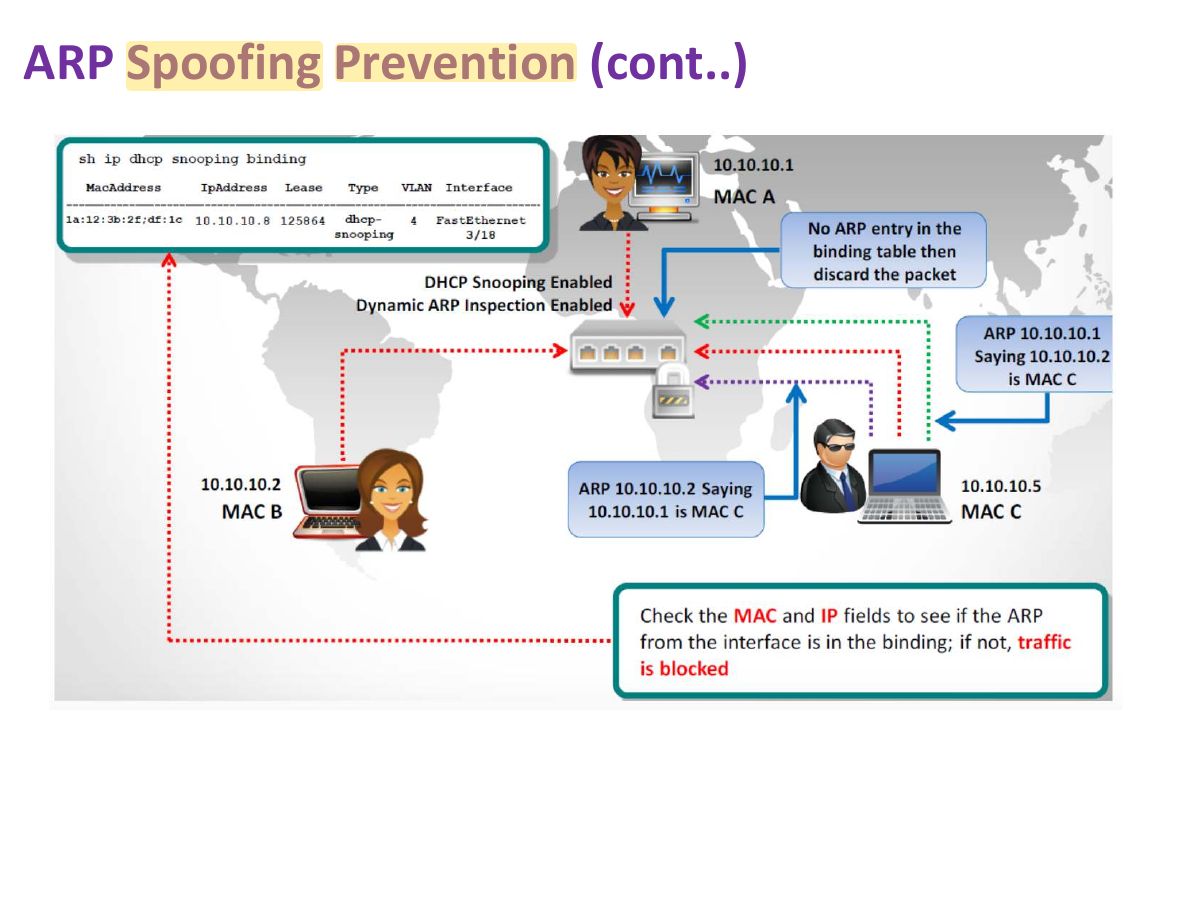
                                        1. ARP spoofing prevention: static ARP entries, Dynamic ARP Inspection (DAI) with DHCP snooping, encryption.

                                        ARP Spoofing Prevention (Cont..)

                                        1. Dynamic ARP Inspection (DAI)
                                        • Validates ARP packets using the DHCP Snooping binding table
                                        • Drops invalid or spoofed ARP packets
                                        • One of the most effective network-level defenses
                                        1. Security Testing (Penetration Testing)
                                        • Perform controlled ARP spoofing tests to evaluate defenses
                                        • Identify vulnerabilities and improve security measures
                                        27
                                        Exam weight Low
                                          Slide 28: ARP Spoofing Prevention (cont..)
                                          Exam weight Low
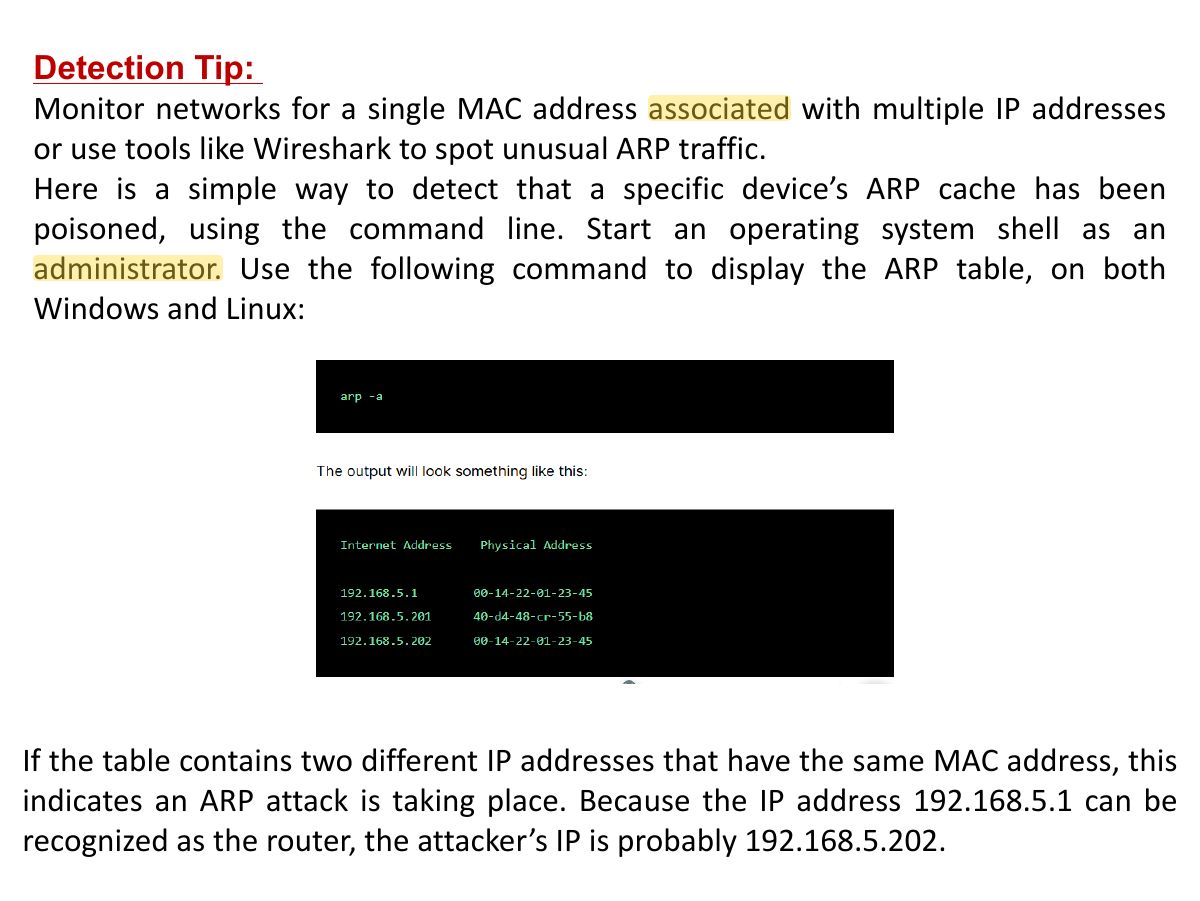
                                            Slide 29: Detection Tip: Monitor networks for a single MAC address associated with multiple IP addresses or use tools like Wireshark to spot unusual ARP traffic. Here is a simple way to detect that a specific device’s ARP cache has been poisoned, using the command line. Start an operating system shell as an administrator. Use the following command to display the ARP table, on both
                                            Exam weight Low
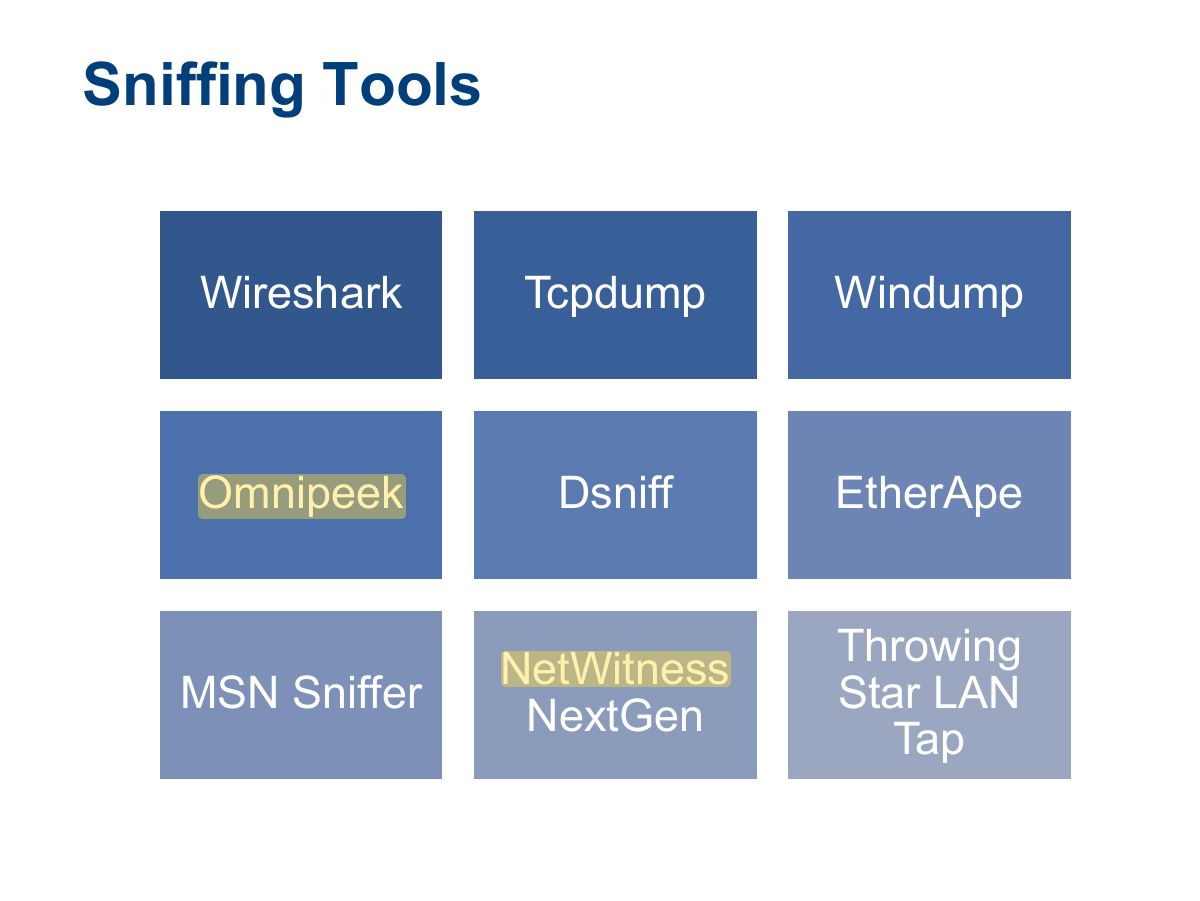
                                              Slide 30: Sniffing Tools
                                              Exam weight Low
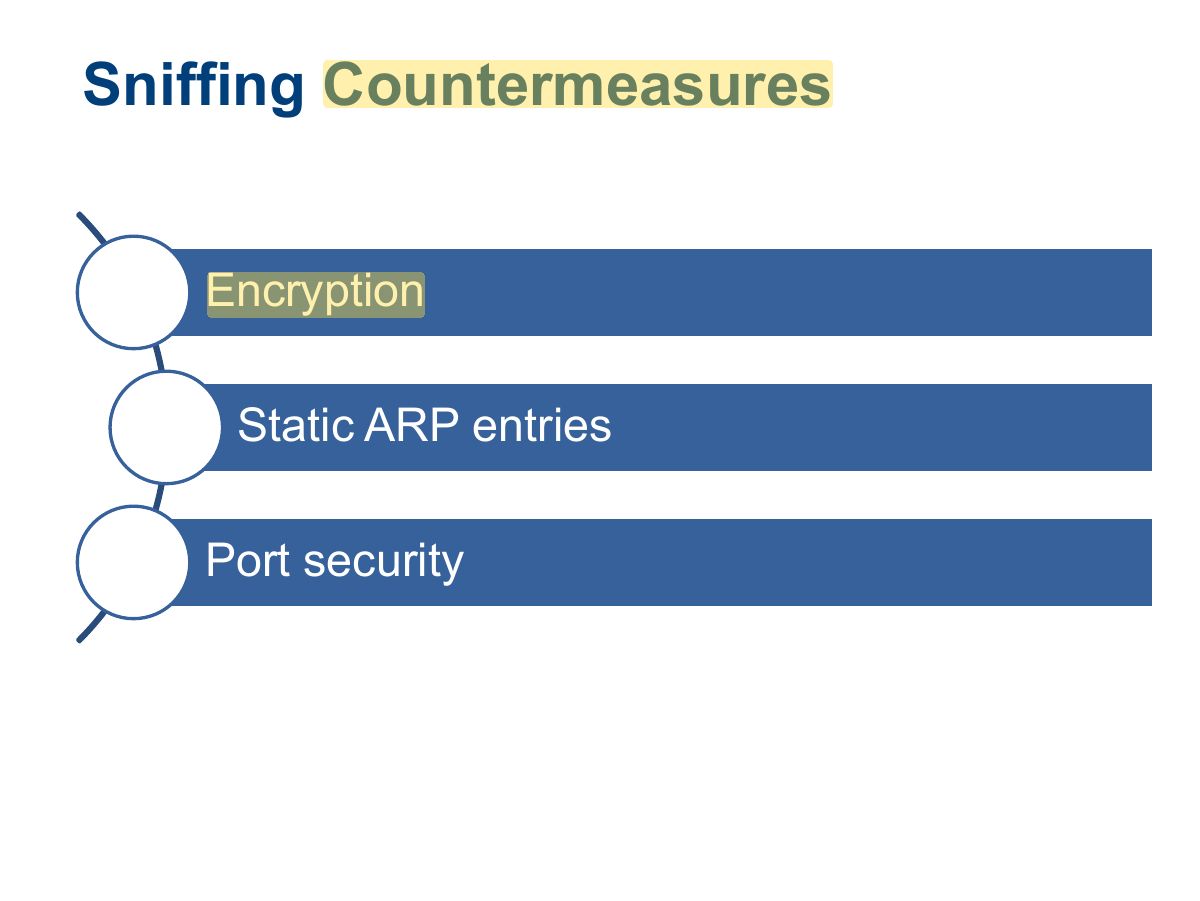
                                                Slide 31: Sniffing Countermeasures
                                                Exam weight Low
                                                  Slide 32: Slide 32
                                                  Exam weight Low
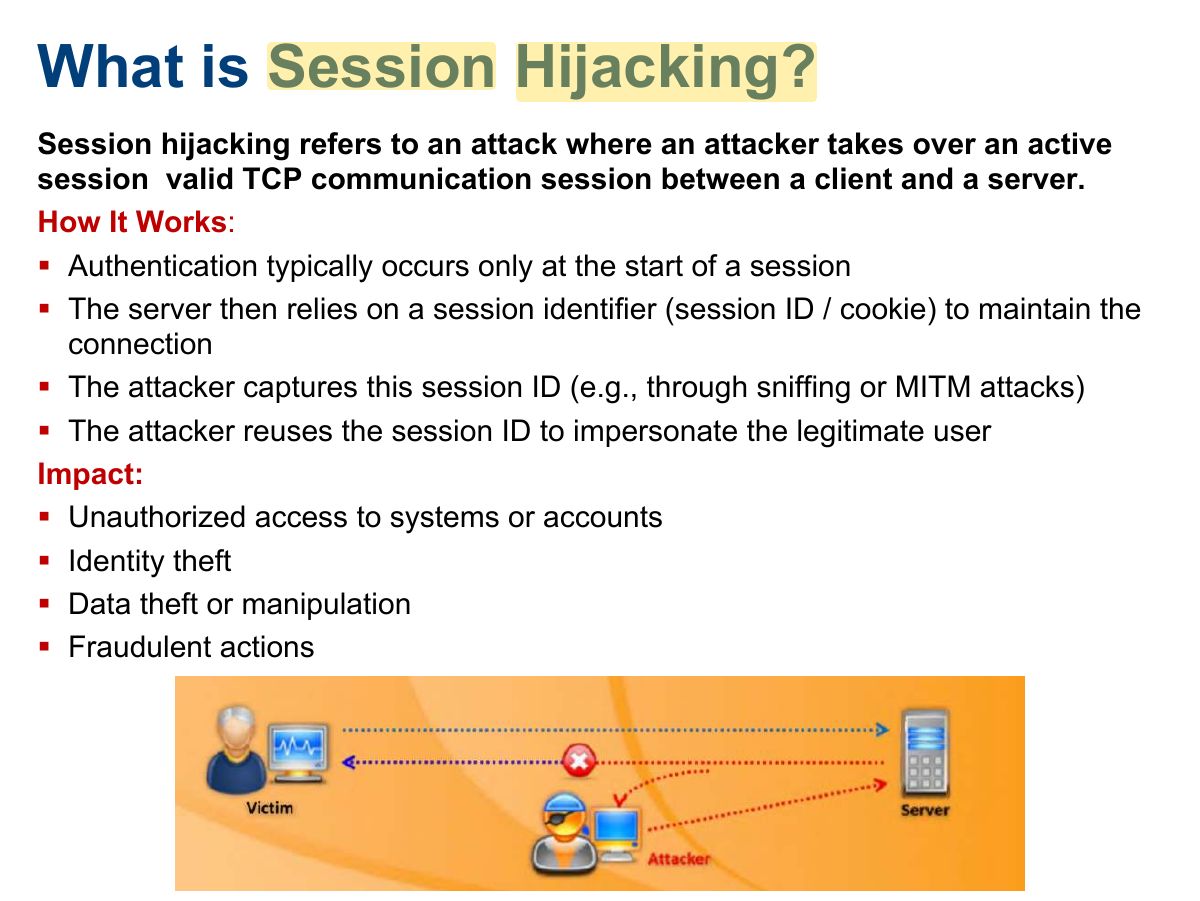
                                                    Slide 33: What is Session Hijacking?
                                                    Exam weight Low
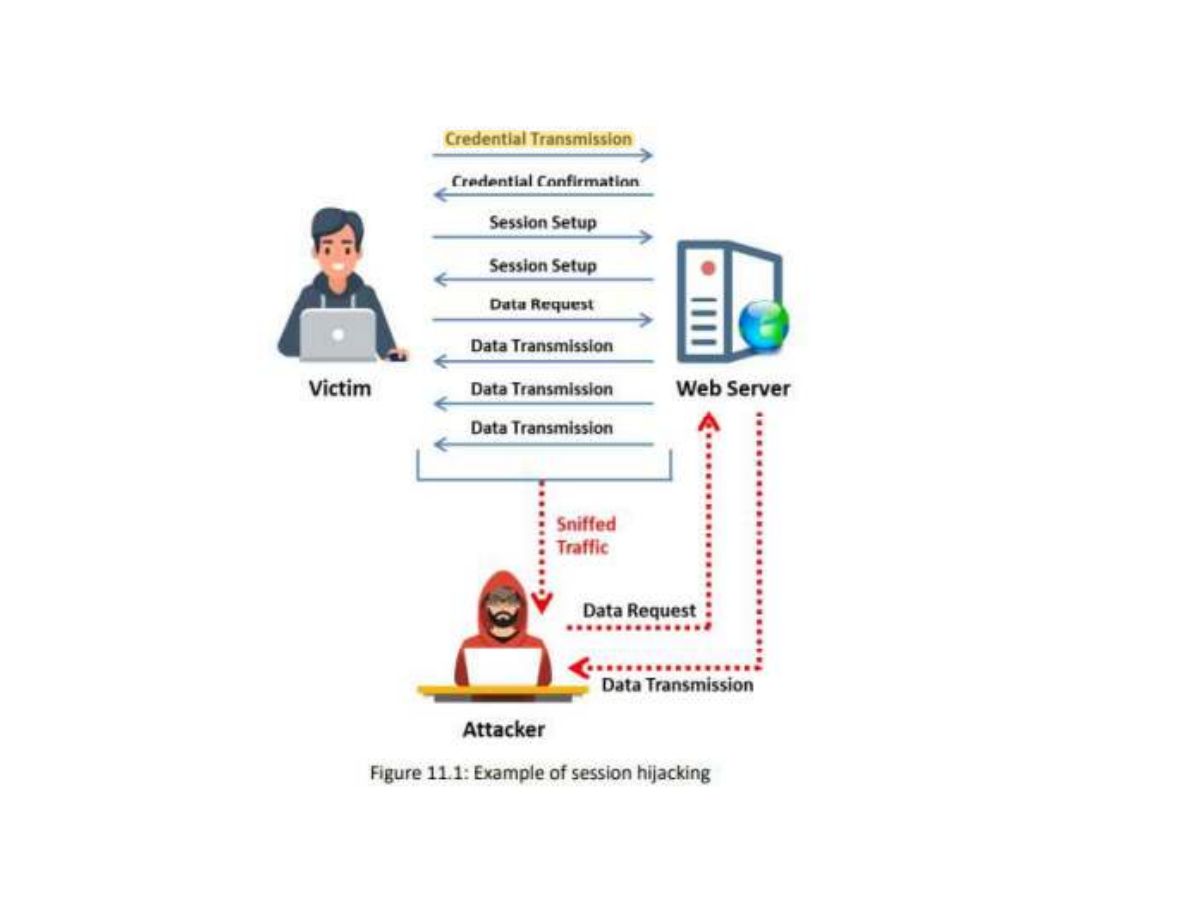
                                                    1. Session hijacking: take over an authenticated session by stealing or predicting the session ID.
                                                    Slide 34: Slide 34
                                                    Exam weight Low
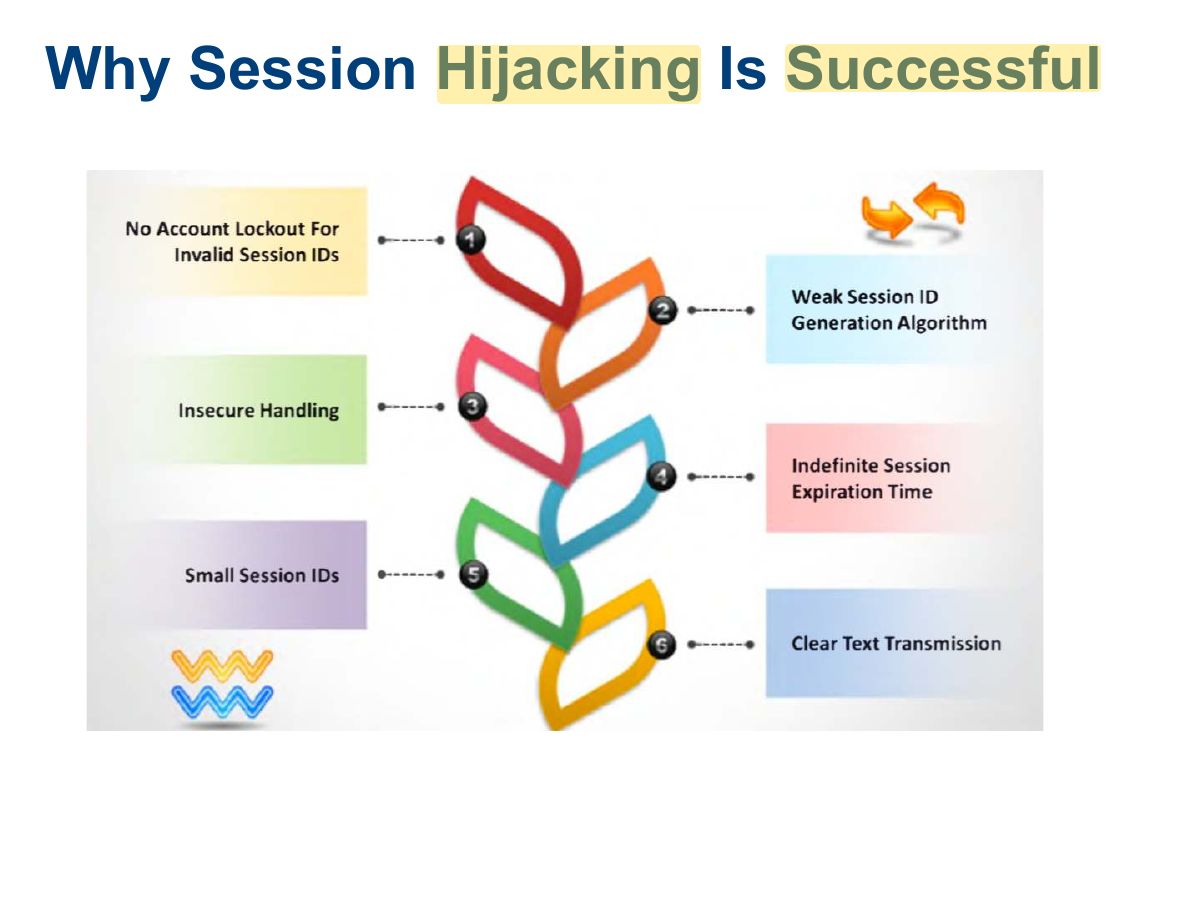
                                                      Slide 35: Why Session Hijacking Is Successful
                                                      Exam weight Low
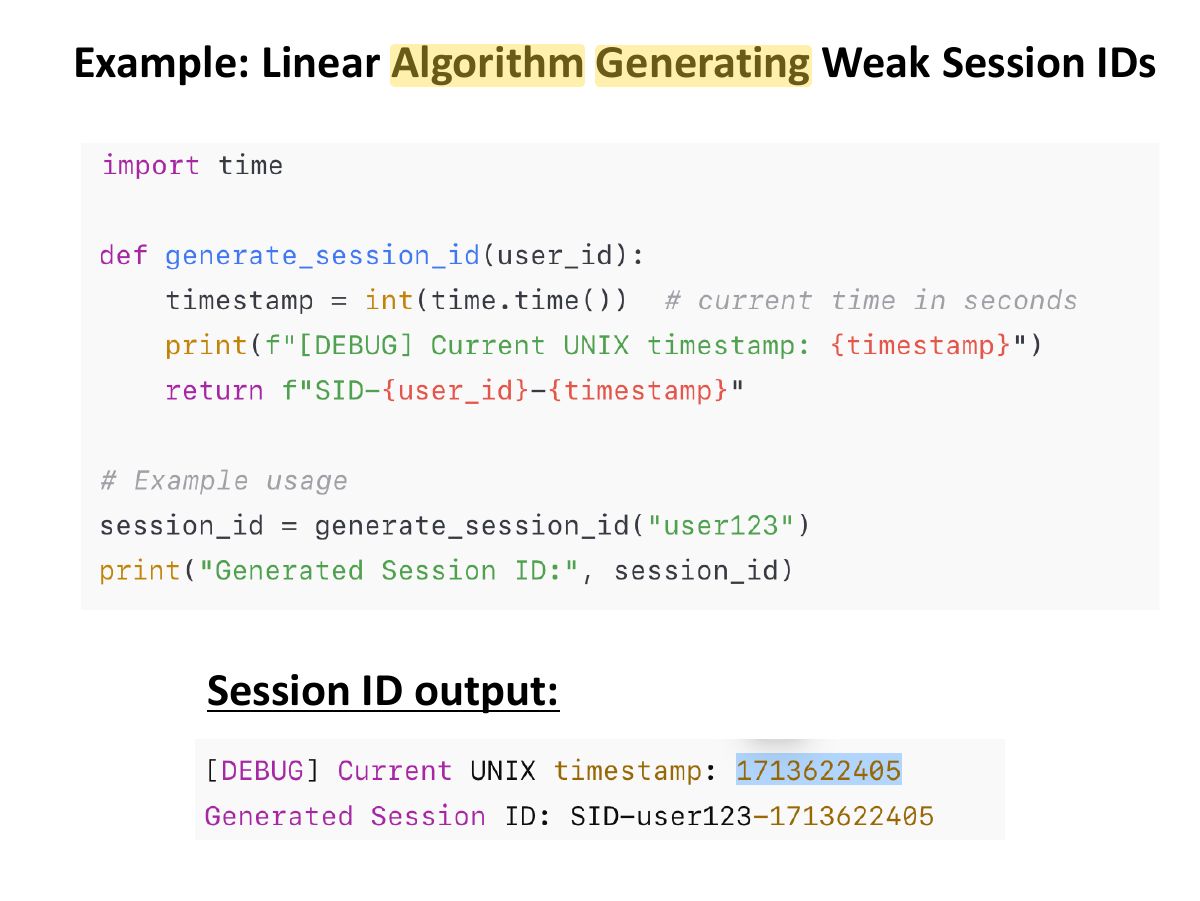
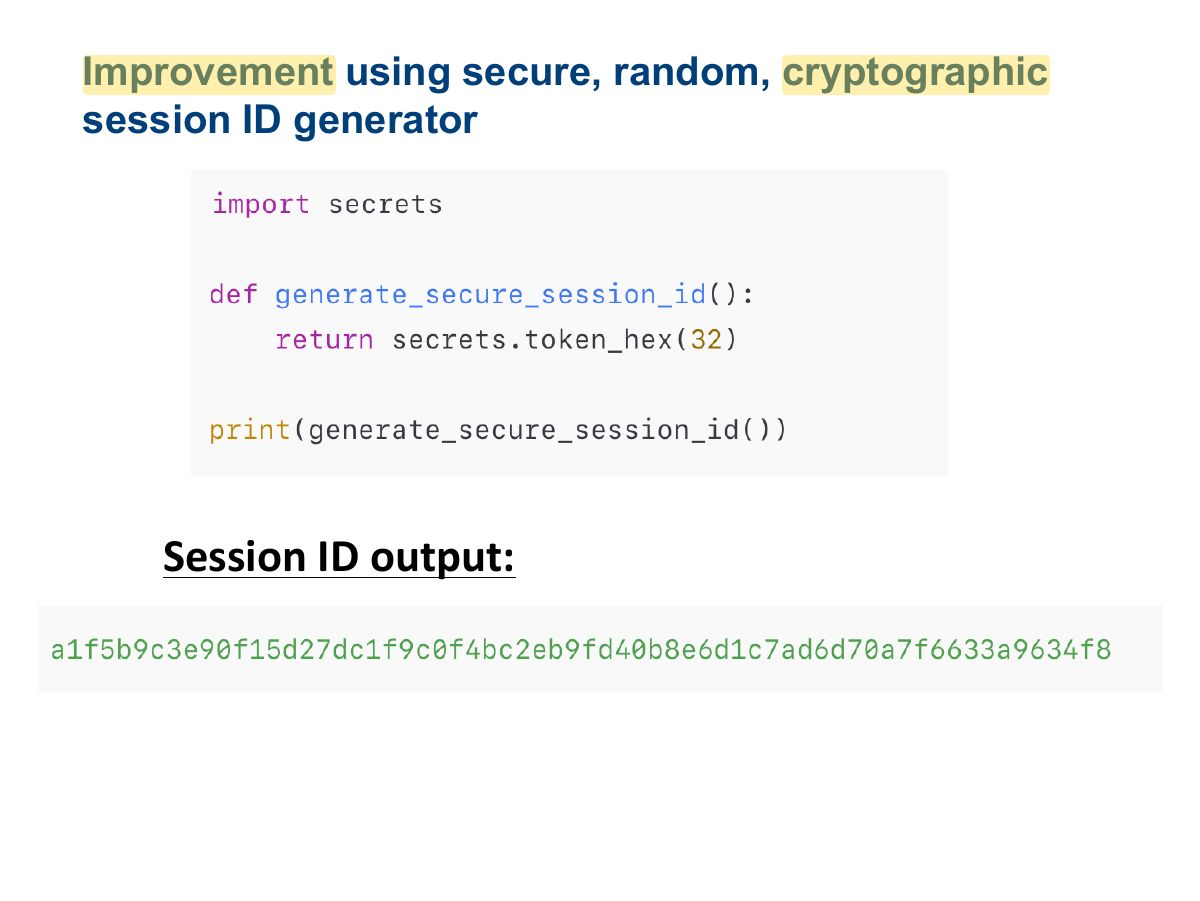
                                                        Slide 36: Example: Linear Algorithm Generating Weak Session IDs
                                                        Exam weight Low
                                                        1. Predictable (linear) session IDs can be guessed; use long, random IDs.
                                                        Slide 37: Improvement using secure, random, cryptographic session ID generator
                                                        Exam weight Low

                                                          38
                                                          Exam weight Low

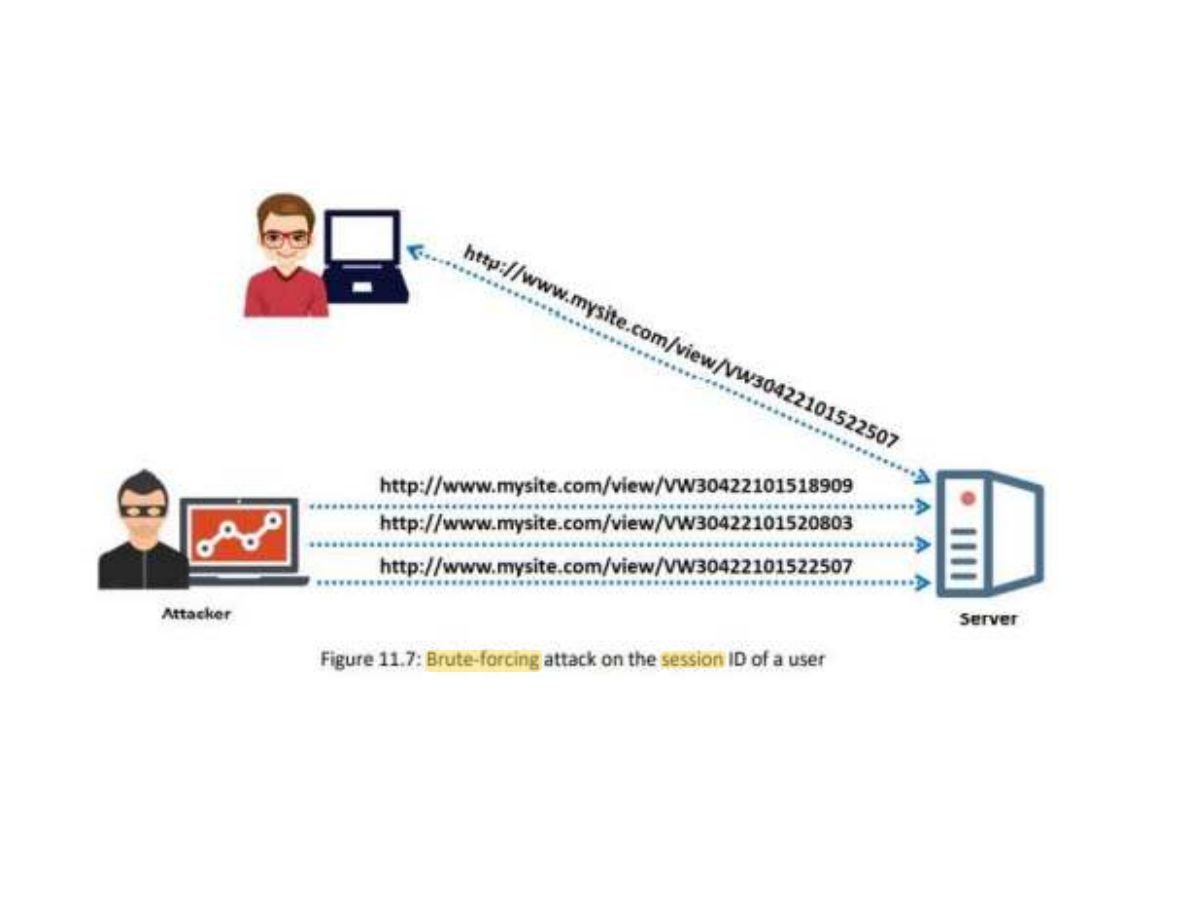
                                                            An attacker implements various techniques such as stealing, guessing, and brute forcing to obtain a valid session ID, which helps in acquiring control over a valid user’s session while it is in progress.

                                                            Stealing:

                                                            Attackers use different techniques to steal session IDs.

                                                            • An attacker can steal the session key through physical access by, for example, acquiring the files containing session IDs or memory contents of either the user’s system or the server.
                                                            • The attacker can also use sniffing tools such as Wireshark or SteelCentral Packet Analyzer to sniff the traffic between the client and server to extract the session IDs from the packets.

                                                            Guessing:

                                                            An attacker attempts to guess the session IDs by observing session variables. In the case of session hijacking, the range of session ID values that can be guessed is limited. Thus, guessing techniques are effective only when servers use weak or flawed session-ID generation mechanisms.

                                                            Brute forcing:

                                                            In the brute-force technique, an attacker obtains session IDs by attempting all possible permutations of session ID values until finding one that works. An attacker using a digital subscriber line (DSL) can generate up to 1,000 session IDs per second. This technique is most useful when the algorithm that produces session IDs is non-random.

                                                            39
                                                            Exam weight Low

                                                              Identifying an Active Session

                                                              • Session hijacking builds on sniffing techniques
                                                              • It involves not only observing traffic but also taking control of an active session
                                                              • The attacker targets a session that has already been authenticated
                                                              • For a successful attack, the attacker must identify a valid and active session

                                                              This is challenging due to:

                                                              ü Network segmentation ü Switched networks ü Encryption mechanisms

                                                              40
                                                              Exam weight Low

                                                                Identifying an Active Session (Cont.)

                                                                • Sequence number facts:
                                                                  • TCP sequence numbers are 32-bit values

                                                                → Over 4 billion possible combinations

                                                                • They ensure packets are:
                                                                • Ordered correctly
                                                                • Reassembled properly at the destination

                                                                To hijack a TCP session, the attacker must:

                                                                Predict or obtain valid sequence numbers

                                                                41
                                                                Exam weight Low

                                                                  Identifying an Active Session (Cont.)

                                                                  • Sequence number prediction: q A TCP session begins with the 3-way handshake: 1) Client → Server: SYN Server → Client: SYN/ACK 2) Client → Server: ACK 3) q During this process:
                                                                    • Each side selects an Initial Sequence Number (ISN)
                                                                    • Modern systems use pseudo-random ISNs q If sequence numbers are predictable:

                                                                  ü

                                                                  The attacker can forge packets

                                                                  ü

                                                                  Establish a connection using a spoofed IP address

                                                                  ü

                                                                  Potentially hijack the session

                                                                  42
                                                                  Exam weight Low
                                                                    Slide 43: Slide 43
                                                                    Exam weight Low
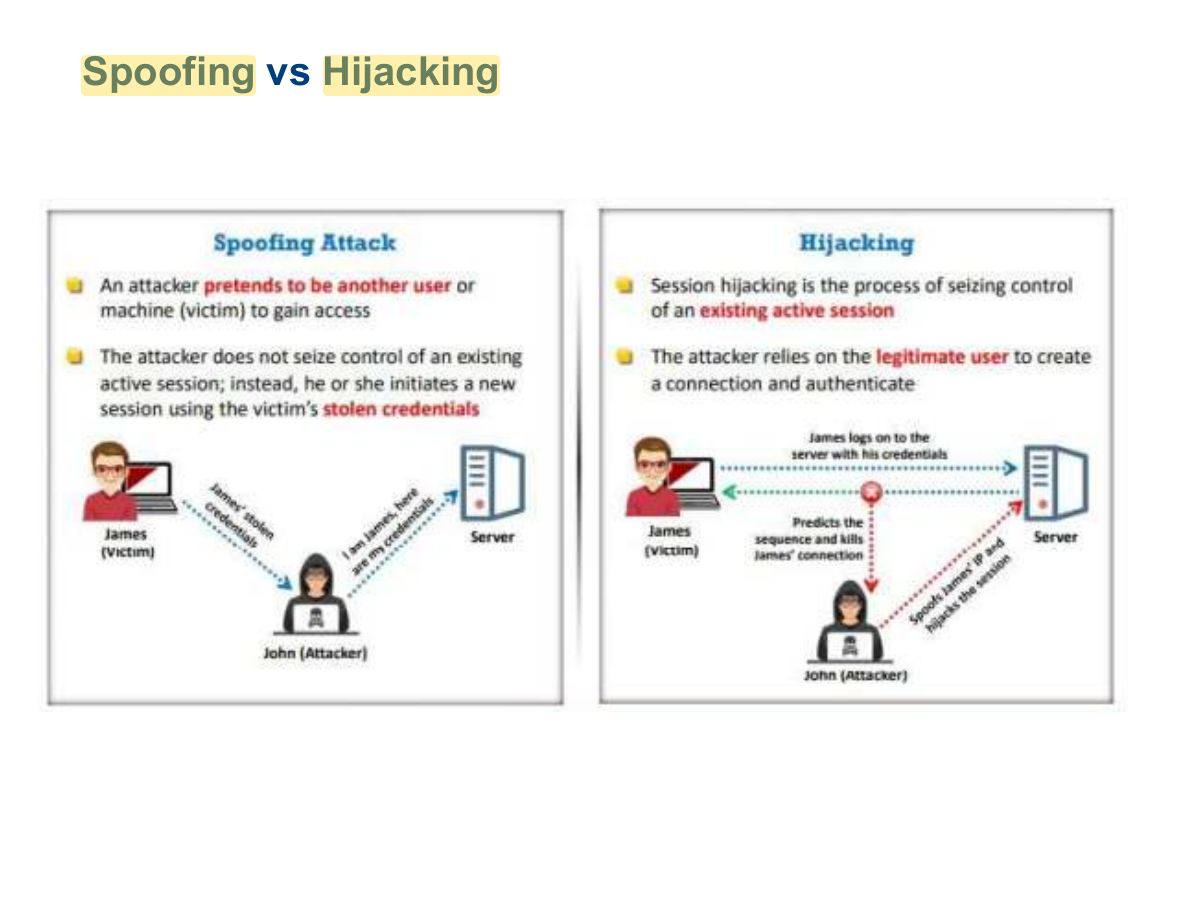
                                                                      Slide 44: Spoofing vs Hijacking
                                                                      Exam weight High
                                                                      1. Spoofing pretends to be another user to START a session; hijacking takes over an EXISTING session.
                                                                      🎯 How this can come up · 1 question
                                                                      MCQ

                                                                      Taking over a session that a user has already authenticated is:

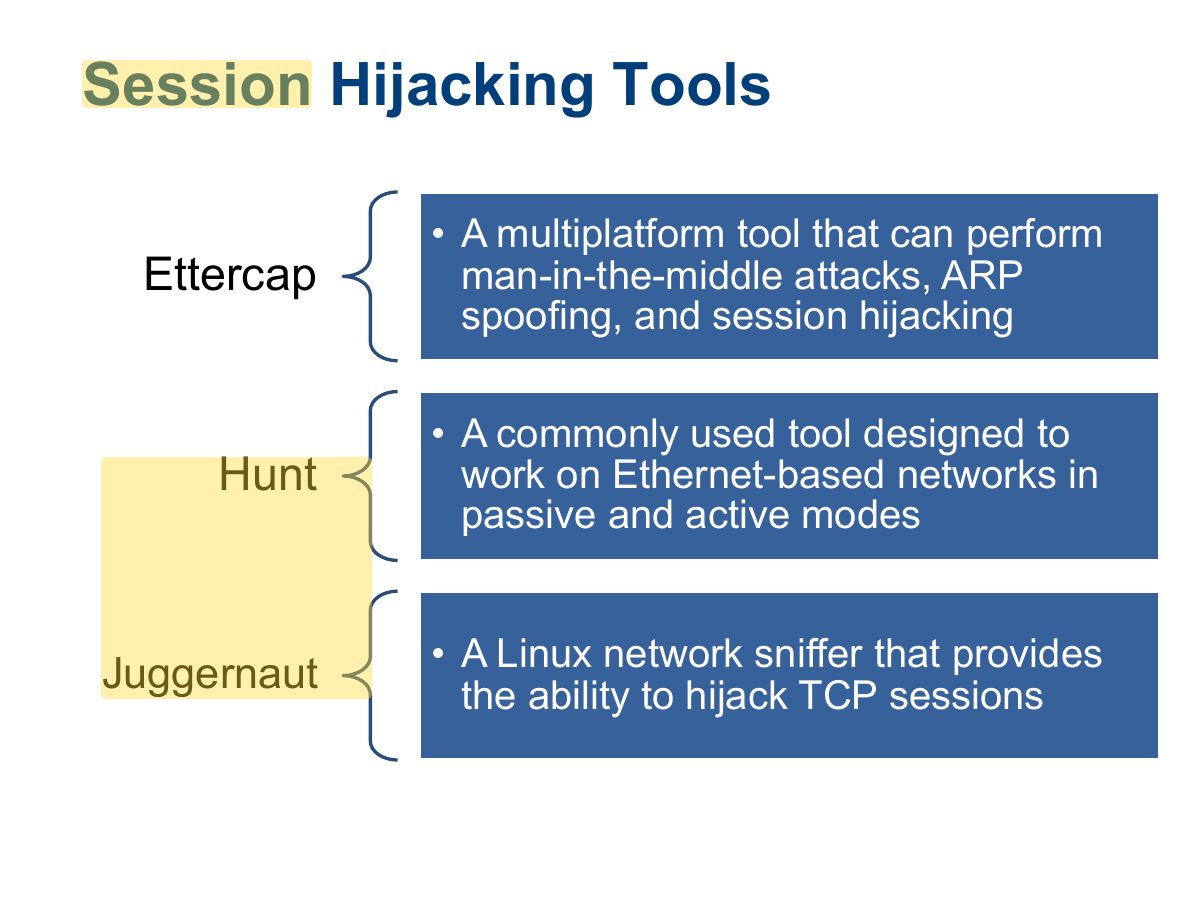
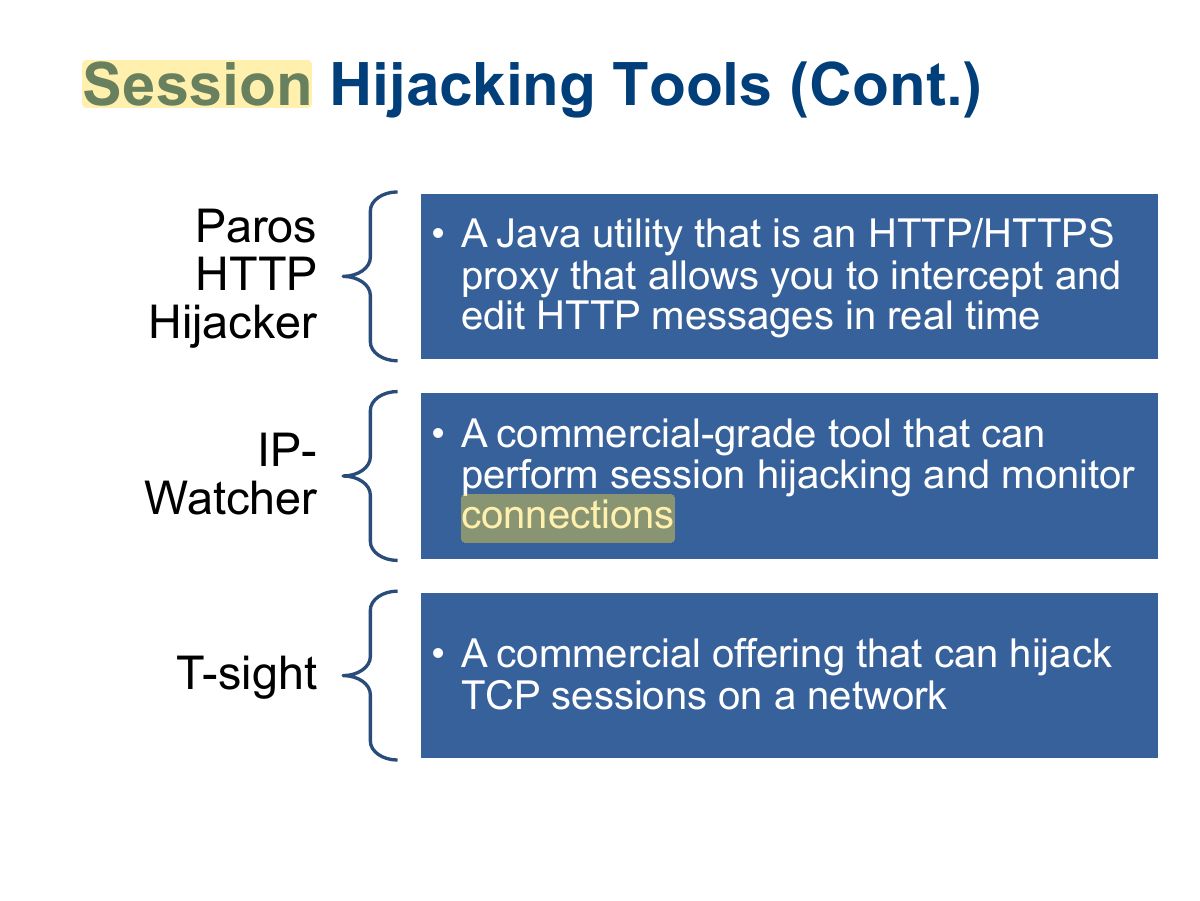
                                                                      Slide 45: Session Hijacking Tools
                                                                      Exam weight Low
                                                                        Slide 46: Session Hijacking Tools (Cont.)
                                                                        Exam weight Low
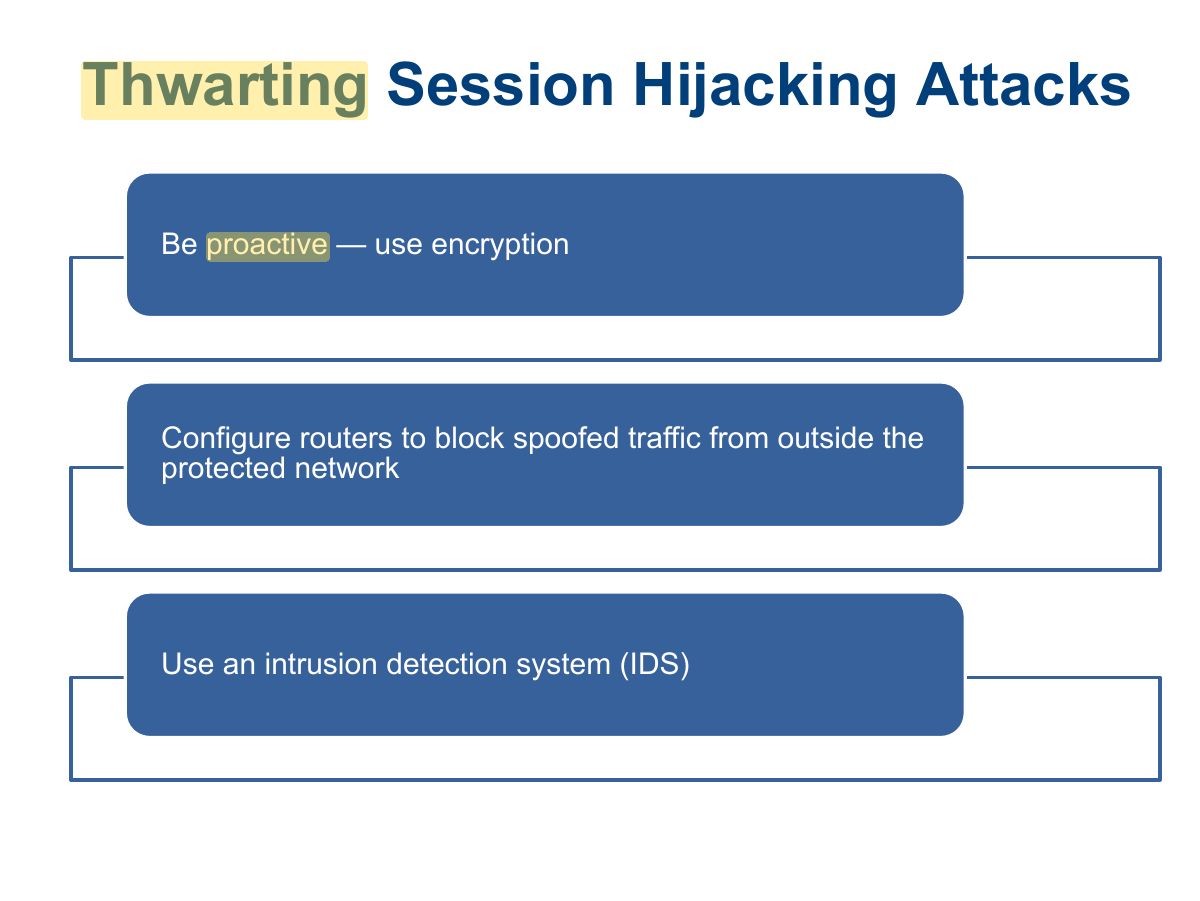
                                                                          Slide 47: Thwarting Session Hijacking Attacks
                                                                          Exam weight Low
                                                                          1. Thwart hijacking: encryption (HTTPS, IPsec), random session IDs, timeouts, re-authentication.
                                                                          Slide 48: Slide 48
                                                                          Exam weight Low

                                                                            Denial of Service (DoS) Attacks

                                                                            • Denial-of-service (DoS) is an attack that prevents authorized users from accessing a computer or network.
                                                                            • DoS attacks target the network bandwidth or connectivity.
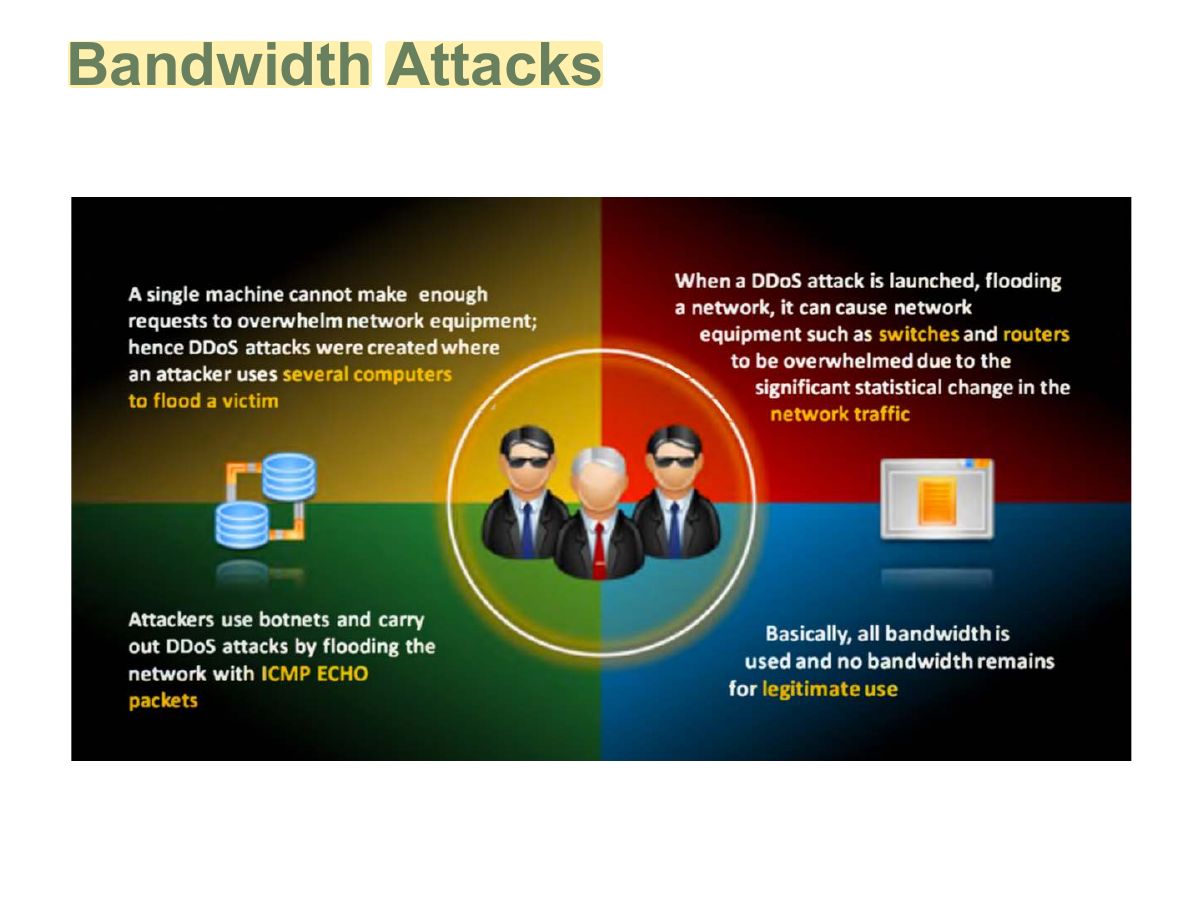
                                                                            • Bandwidth attacks overflow the network with a high volume of traffic using existing network resources, thus depriving legitimate users of these resources.
                                                                            • Connectivity attacks overflow a computer with a large amount of connection requests, consuming all available operating system resources, so that the computer cannot process legitimate user requests.
                                                                            49
                                                                            Exam weight Low
                                                                            1. DoS: make a resource unavailable. DDoS: from many sources (a botnet).

                                                                            DoS Attack Techniques :

                                                                            There are seven kinds of techniques that are used by the attacker to perform DOS attacks on a computer or a network.

                                                                            50
                                                                            Exam weight Low
                                                                              Slide 51: Bandwidth Attacks
                                                                              Exam weight Low
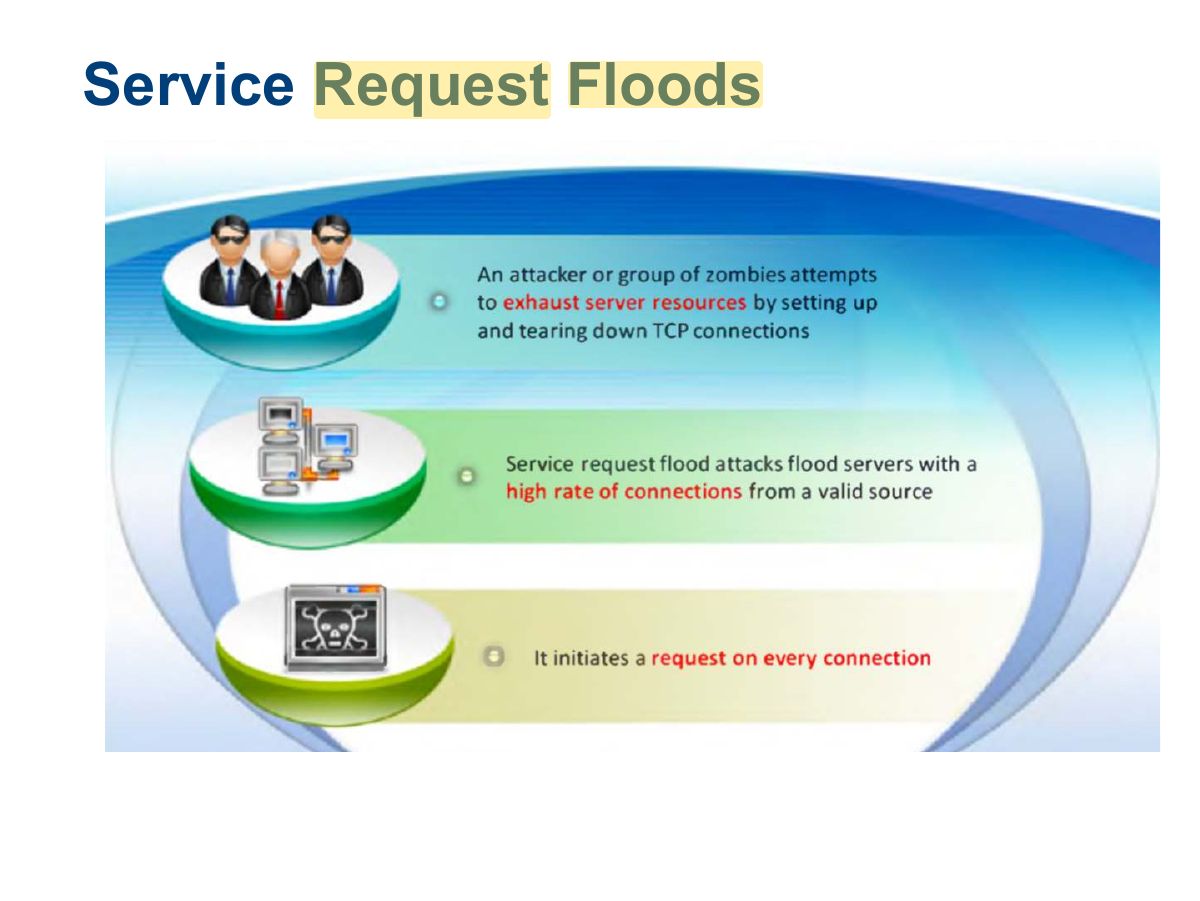
                                                                                Slide 52: Service Request Floods
                                                                                Exam weight Low
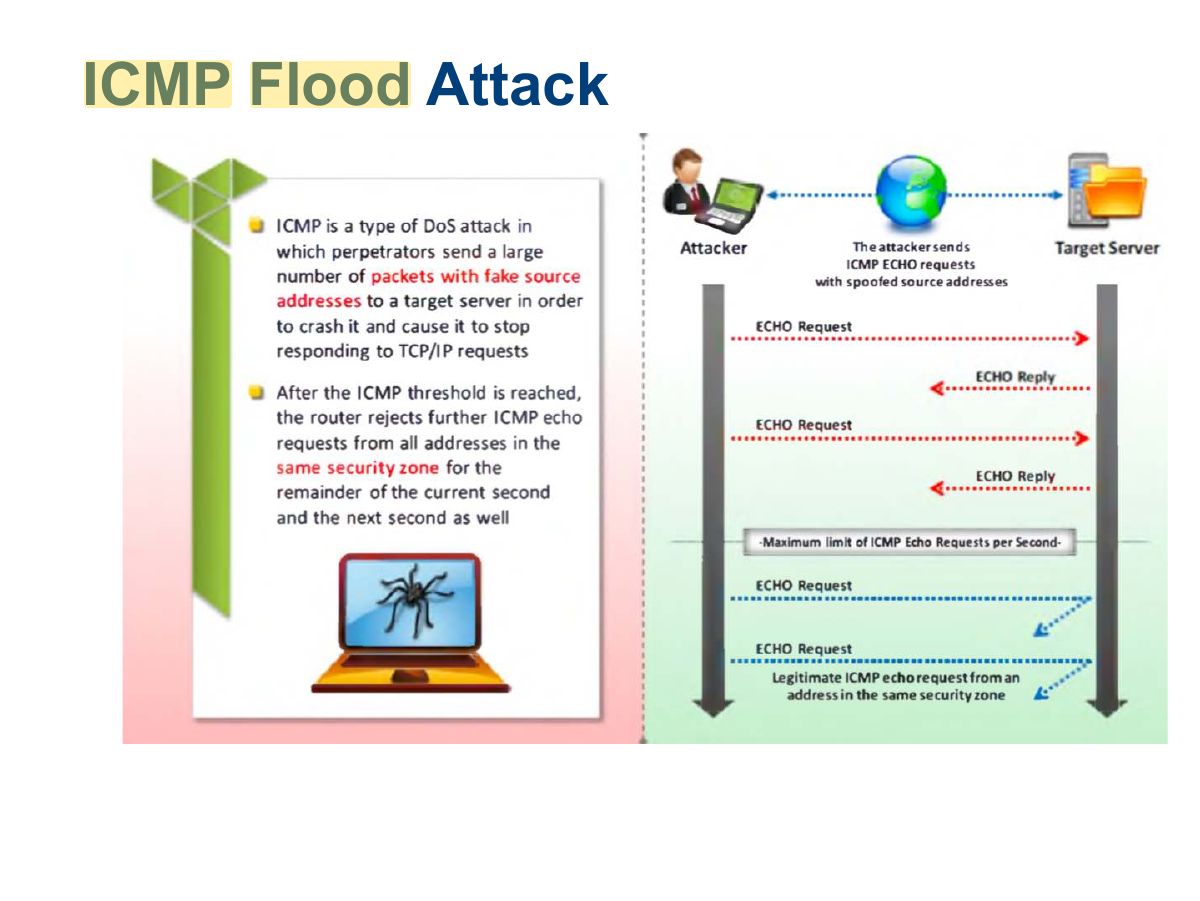
                                                                                  Slide 53: ICMP Flood Attack
                                                                                  Exam weight Low
                                                                                  1. ICMP flood / Smurf (spoofed broadcast pings). Ping of death: oversized packets.

                                                                                  § ICMP flood — Comes in two variants: Smurf attack and ping

                                                                                  flood

                                                                                  • Smurf attack — Carried out when a large amount of traffic is directed to the broadcast address of a network instead of to a specific system; because the attacker configures the packet with the intended victim as the source, all hosts on the network respond to the victim instead of to the attack
                                                                                  • Ping flood — Carried out by sending a large number of ping packets to the victim with the intent of overwhelming the victim; very simple attack
                                                                                  54
                                                                                  Exam weight Low

                                                                                    SYN Flooding

                                                                                    55
                                                                                    Exam weight High
                                                                                    1. SYN flood: many SYNs without the final ACK fill the half-open connection queue. Defense: SYN cookies.
                                                                                    🎯 How this can come up · 2 questions
                                                                                    MCQ

                                                                                    A SYN flood exploits:

                                                                                    MCQ

                                                                                    SYN cookies defend against:

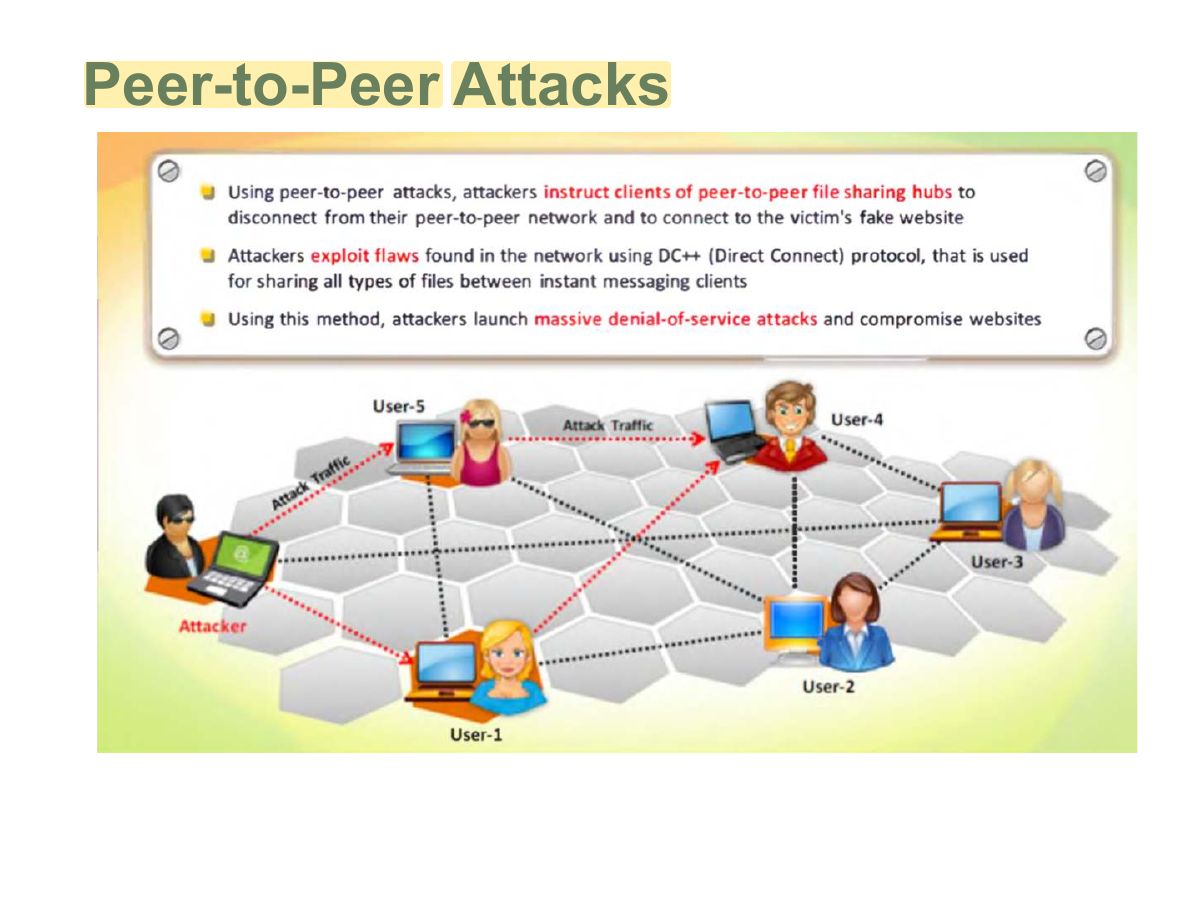
                                                                                    Slide 56: Peer-to-Peer Attacks
                                                                                    Exam weight Low
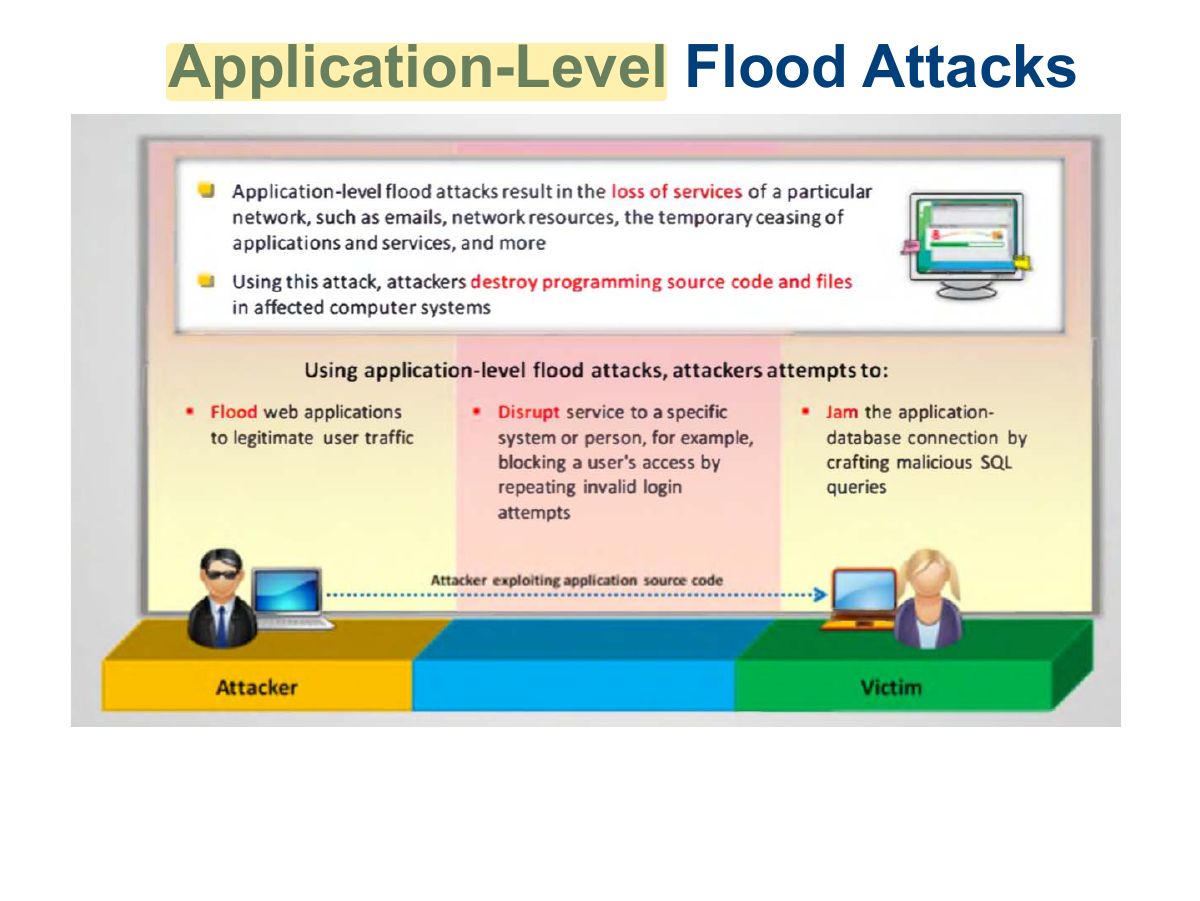
                                                                                      Slide 57: Application-Level Flood Attacks
                                                                                      Exam weight Low

                                                                                        What are Distributed Denial of Service Attacks?

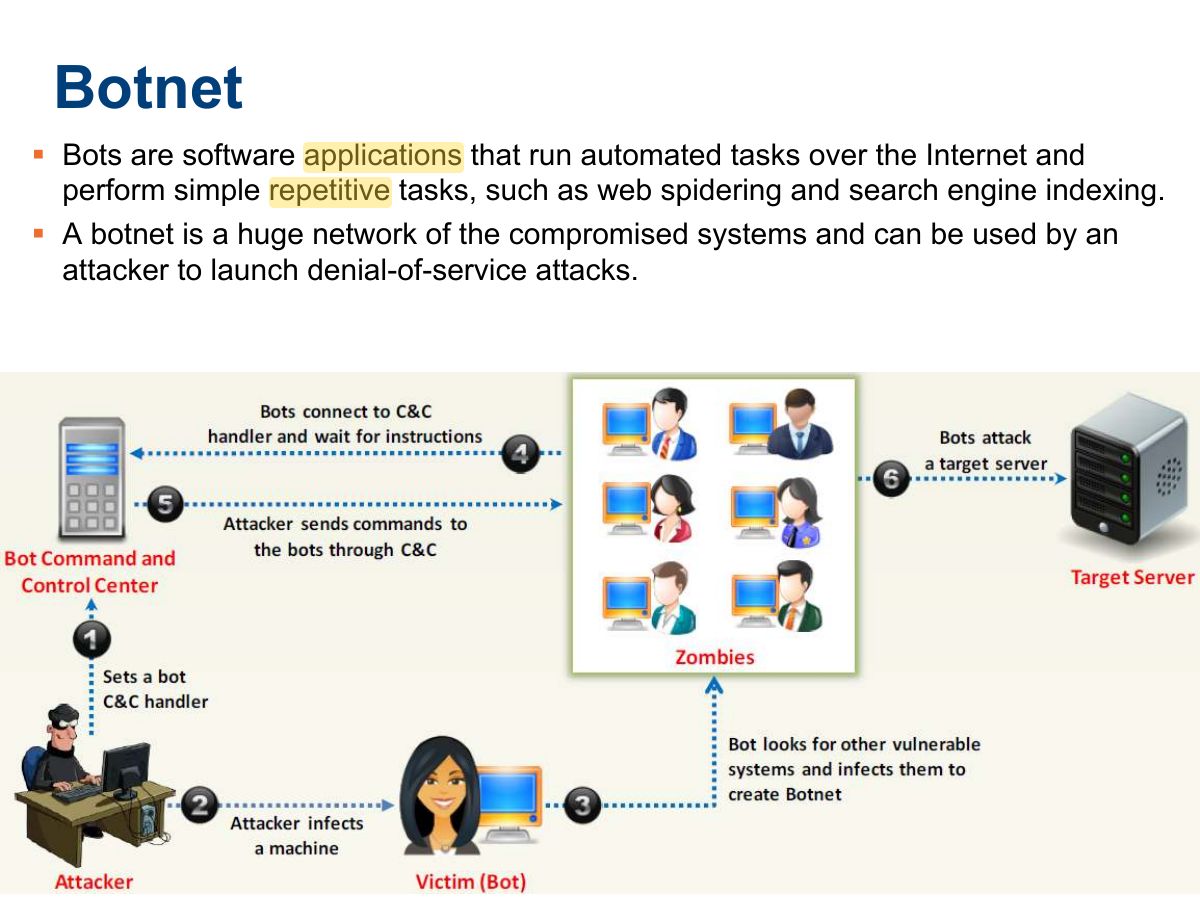
                                                                                        • A distributed denial-of-service (DDoS) attack involves a multitude of compromised systems attacking a single target, thereby causing denial of service for users of the targeted system.
                                                                                        • To launch a DDoS attack, an attacker uses botnets and attacks a single system.
                                                                                        58
                                                                                        Exam weight Low
                                                                                          Slide 59: Botnet
                                                                                          Exam weight Low
                                                                                          1. Botnet: compromised "zombie" machines controlled by a command-and-control (C&C) server.

                                                                                          Summary

                                                                                          • Network sniffing and traffic analysis
                                                                                          • Session hijacking
                                                                                          • Denial of service (DoS)
                                                                                          • Distributed denial of service (DDoS) attacks
                                                                                          • Botnets
                                                                                          60
                                                                                          Exam weight Low