CS340 · Annotated SlidesChapter 6 — Basic SQL
Chapter 6 · Annotated slides

Basic SQL

SQL as a declarative language, SELECT–FROM–WHERE with projection and selection, duplicates and DISTINCT, renaming, LIKE patterns, arithmetic, BETWEEN, ORDER BY, the set operators UNION / INTERSECT / EXCEPT, and INSERT, DELETE and UPDATE.
Slide text Study notes Highlight: key words Tips, tricks & traps Seen again elsewhere How it can come up

Basic SQL

CS340 · Chapter 6
1

LEARNING GOALS

CLO1: Create a relational database schema in SQL that incorporates key, entity integrity, and referential integrity constraints and uses a declarative query language (SQL) to elicit information from a database. (Skills) Chapter objectives:

  • Write basic SQL queries. Includes: selection, projection, join, ordering, and set operations.
  • Define relational algebra and be able to state why it is important
2
Exam weight Low

    BEFORE WE START..

    Make sure you have access to a machine with a functional DBMS, I recommend MySQL. You can use the lab machine, or bring your own laptop to class.

    Alternatively, you can use Oracle Apex. We will try to make it work.

    We will do many practical exercises throughout the lectures.

    We will use Java and JDBC to execute SQL queries, later on.

    From now on:

    • Tutorials
    • Labs
    3
    Exam weight Low

      DATABASES SO FAR..

      When last we left databases...

      We had decided they were great things We knew how to conceptually model them in ER diagrams We knew how to logically model them in the relational model We could formally specify queries Now: how do most people write queries? SQL!

      4
      Exam weight Low
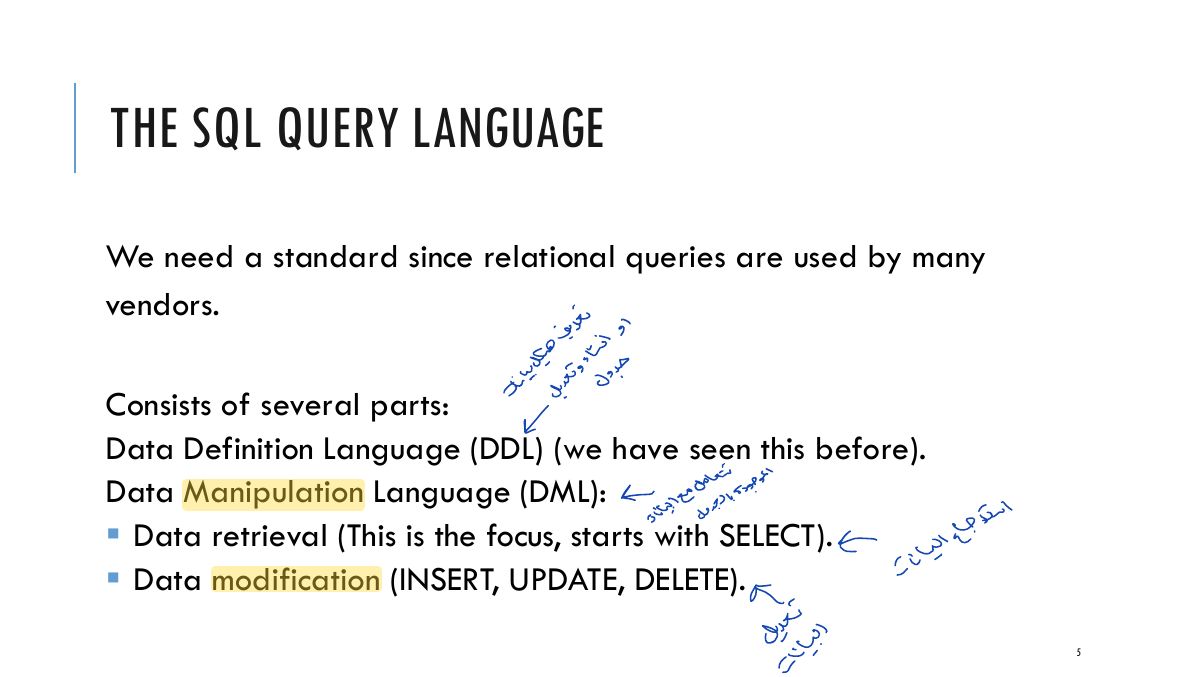
        Slide 5: THE SQL QUERY LANGUAGE
        Exam weight Low
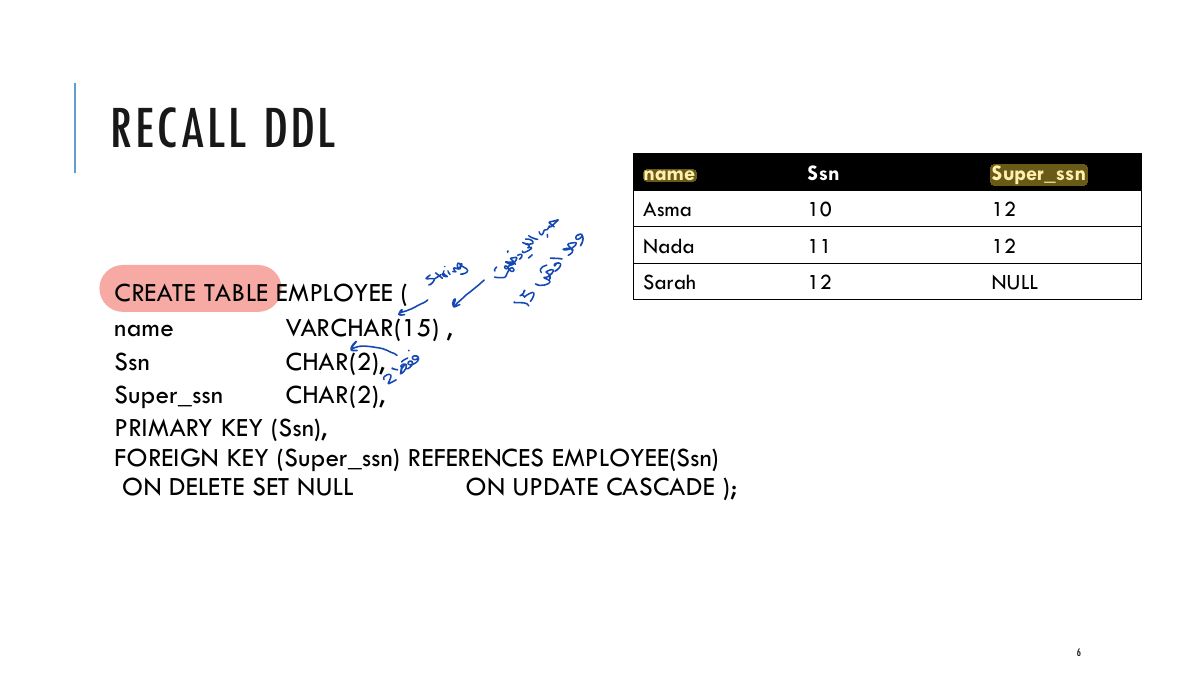
          Slide 6: RECALL DDL
          Exam weight Low
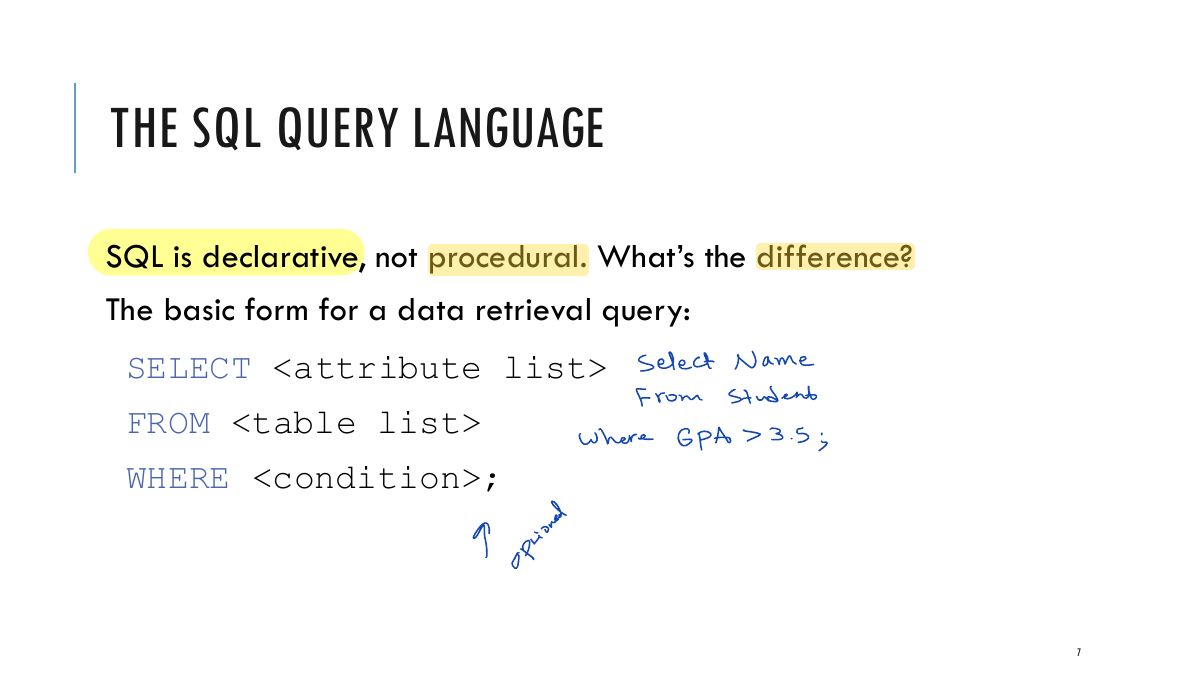
            Slide 7: THE SQL QUERY LANGUAGE
            Exam weight Low
            1. SQL is declarative: say WHAT you want, not how to get it.
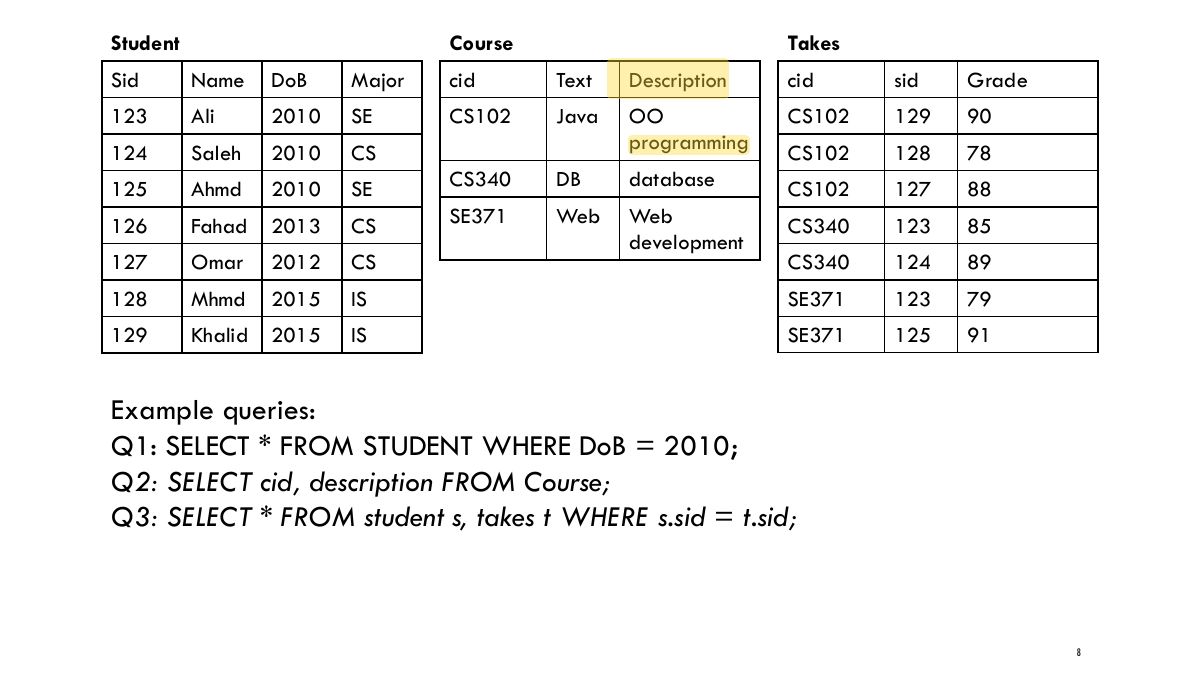
            Slide 8: Student Course Takes
            Exam weight Low
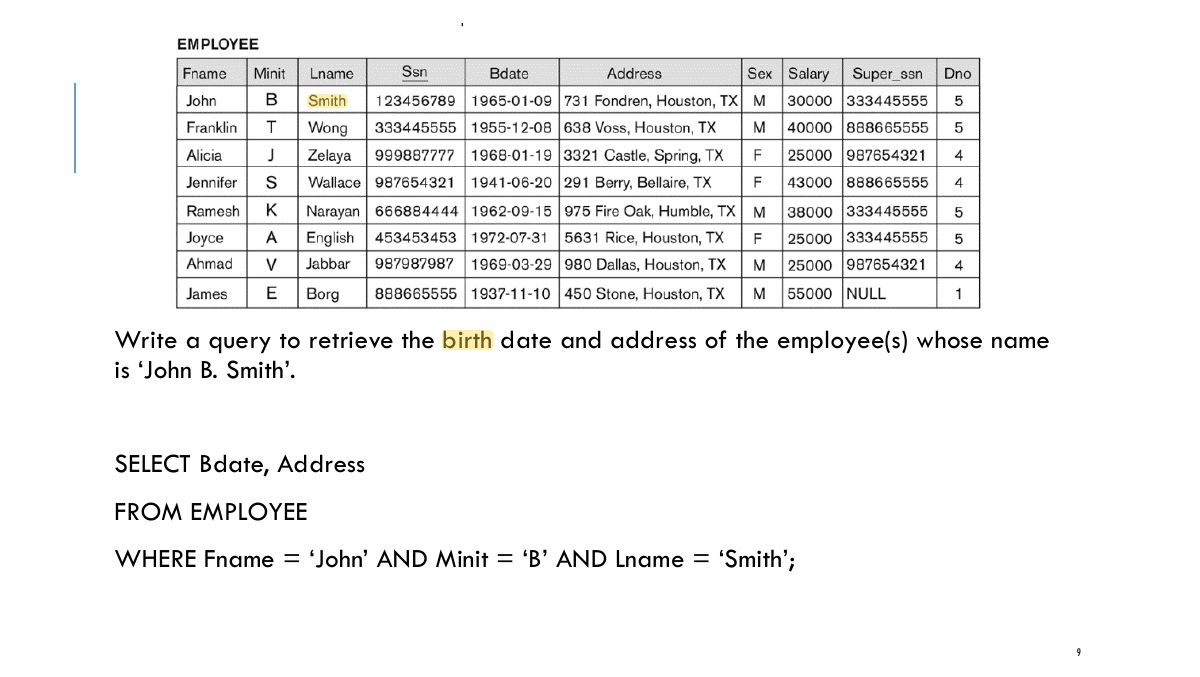
              Slide 9: Slide 9
              Exam weight Low
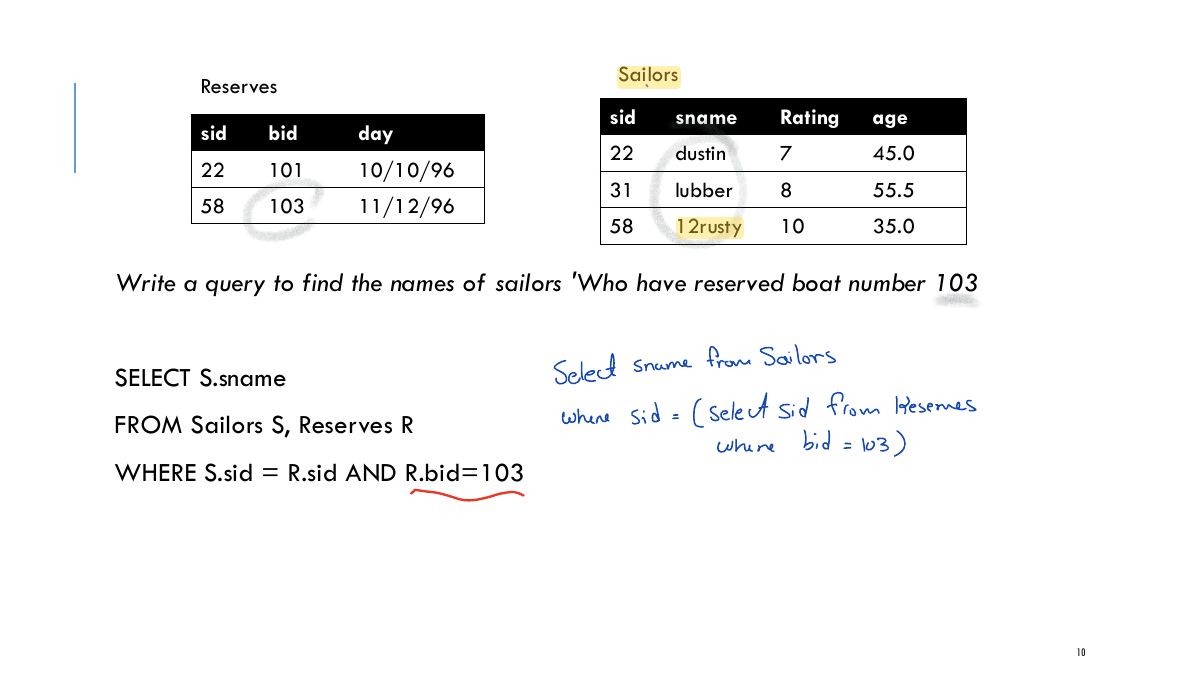
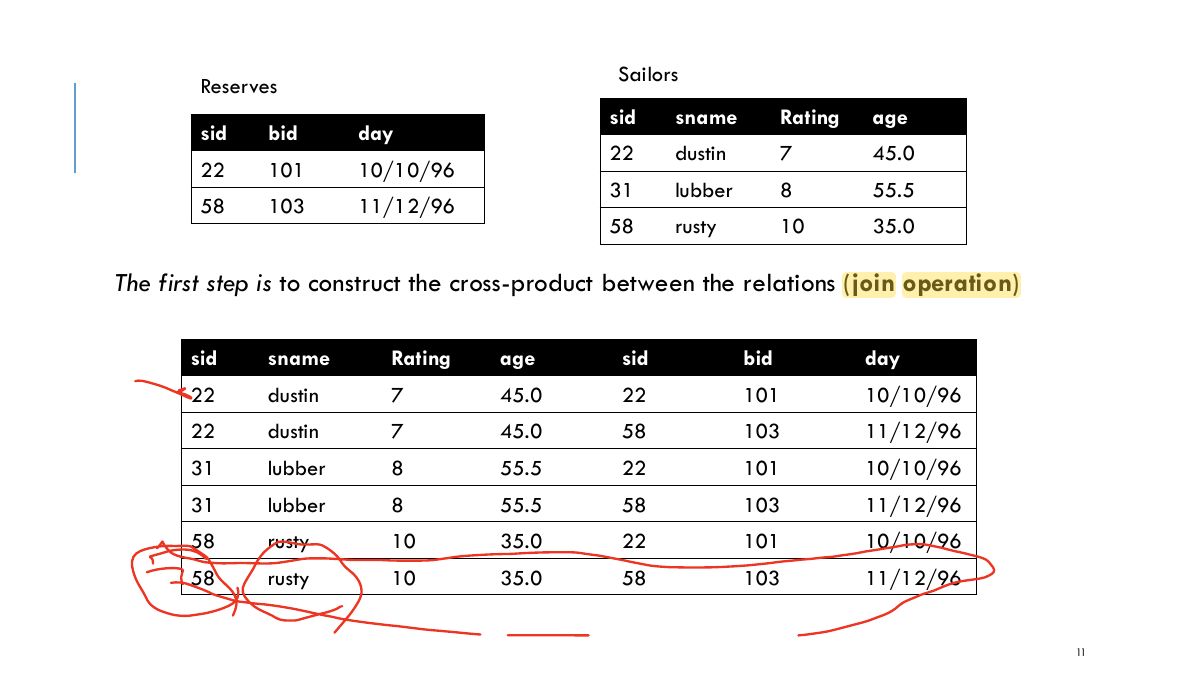
                Slide 10: Sailors Reserves sid sname Rating age sid bid day 22 dustin 7 45.0 22 101 10/10/96
                Exam weight Low
                  Slide 11: Sailors Reserves sid sname Rating age sid bid day 22 dustin 7 45.0 22 101 10/10/96 31 lubber 8 55.5 58 103 11/12/96
                  Exam weight Low
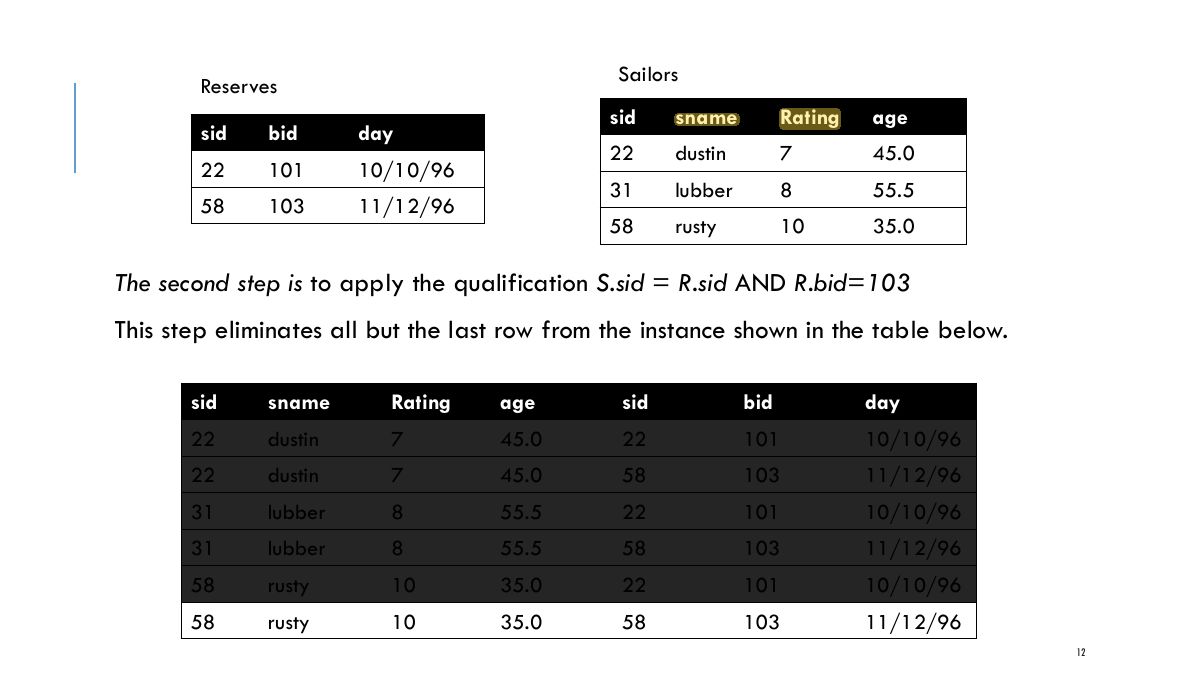
                    Slide 12: Sailors Reserves sid sname Rating age sid bid day 22 dustin 7 45.0 22 101 10/10/96 31 lubber 8 55.5 58 103 11/12/96
                    Exam weight Low
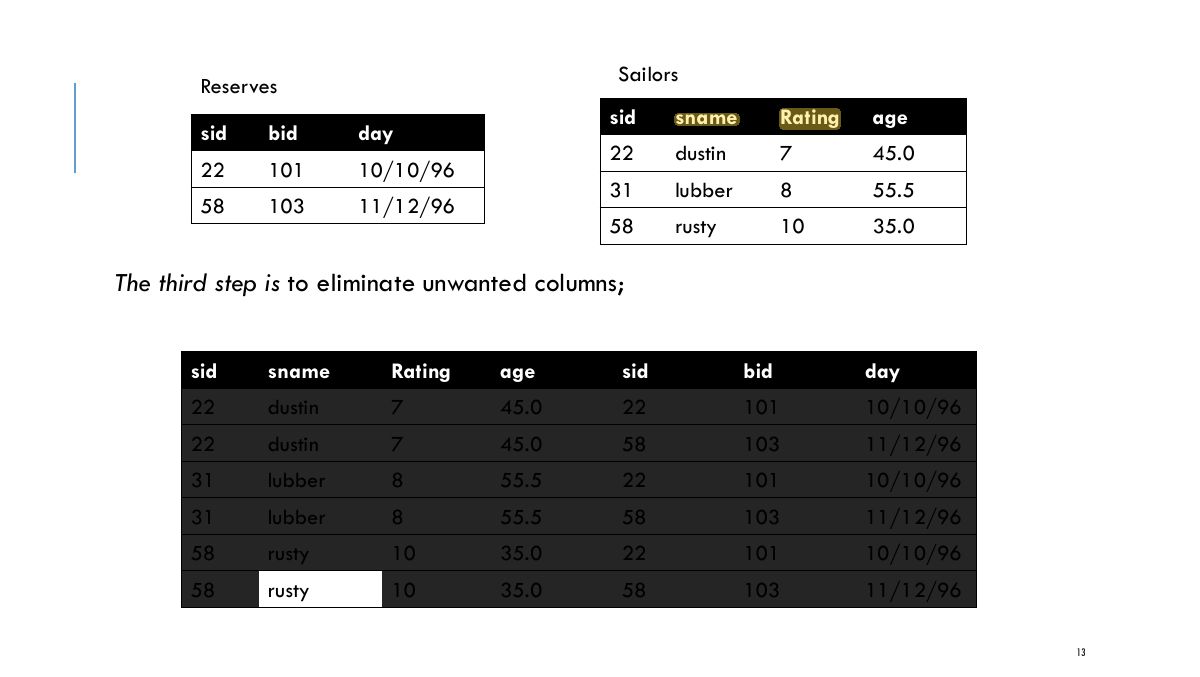
                      Slide 13: Sailors Reserves sid sname Rating age sid bid day 22 dustin 7 45.0 22 101 10/10/96 31 lubber 8 55.5 58 103 11/12/96
                      Exam weight Low
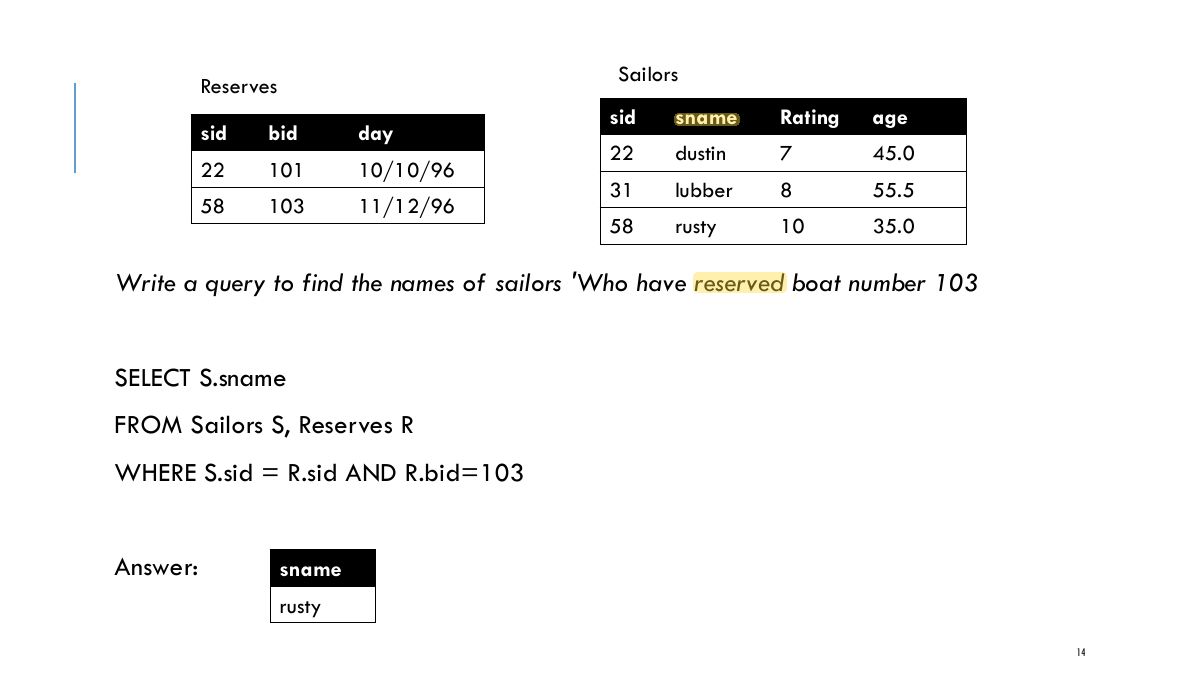
                        Slide 14: Sailors Reserves sid sname Rating age sid bid day 22 dustin 7 45.0 22 101 10/10/96 31 lubber 8 55.5 58 103 11/12/96
                        Exam weight Low

                          CREATINGTABLESINSQL(DDL) - REVISITED

                          A SQL relation is defined using the

                          create table command:

                          create table r (A D, A D, ..., A D, (integrity-constraint ),...,(integrity-constraint ))

                          1 1 2 2

                          n n

                          k

                          Integrity constraints can be: primary keys, candidate keys, foreign keys Example:

                          CREATE TABLE Student (sid CHAR(20),

                          name CHAR(20), address CHAR(20), phone CHAR(8), major CHAR(4), primary key (sid))

                          15
                          Exam weight Low

                            RUNNING EXAMPLE IN YOUR DATABASE

                            Download the DDL code from LMS.

                            3 tables:

                            1. Sailors
                            2. Boats
                            3. Reserves

                            We will use this example throughout the lecture.

                            16
                            Exam weight Low
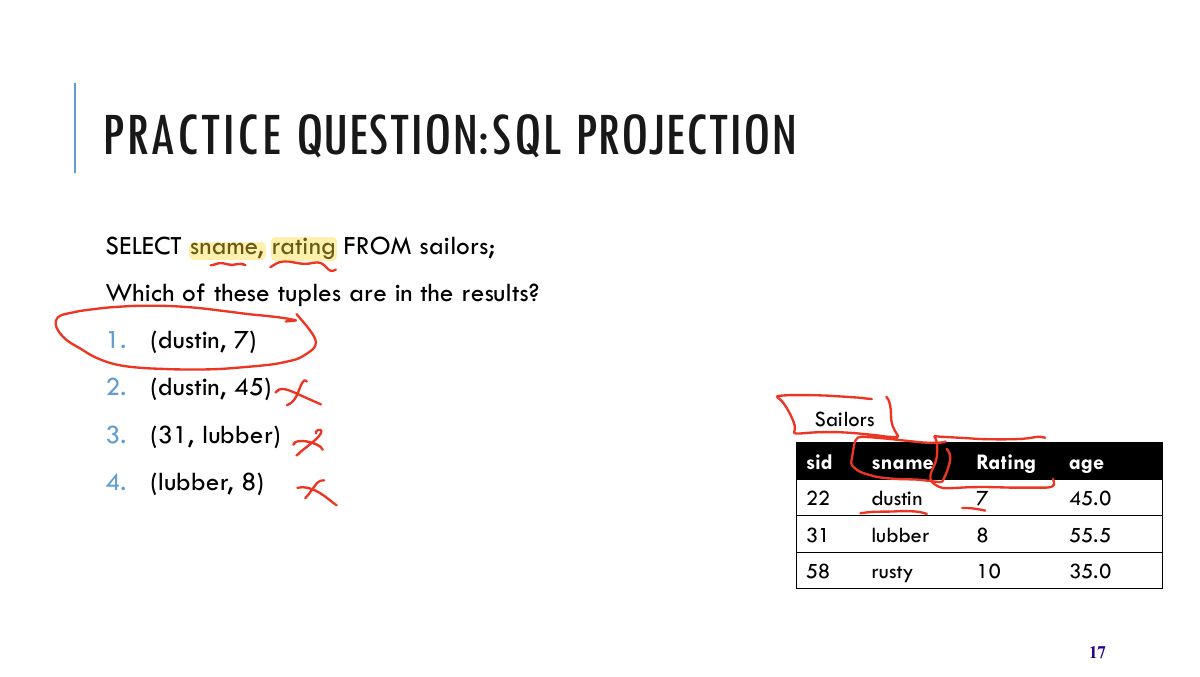
                              Slide 17: PRACTICE QUESTION:SQLPROJECTION
                              Exam weight Low
                              1. Projection = choose columns in SELECT.

                              SELECTION IN SQL

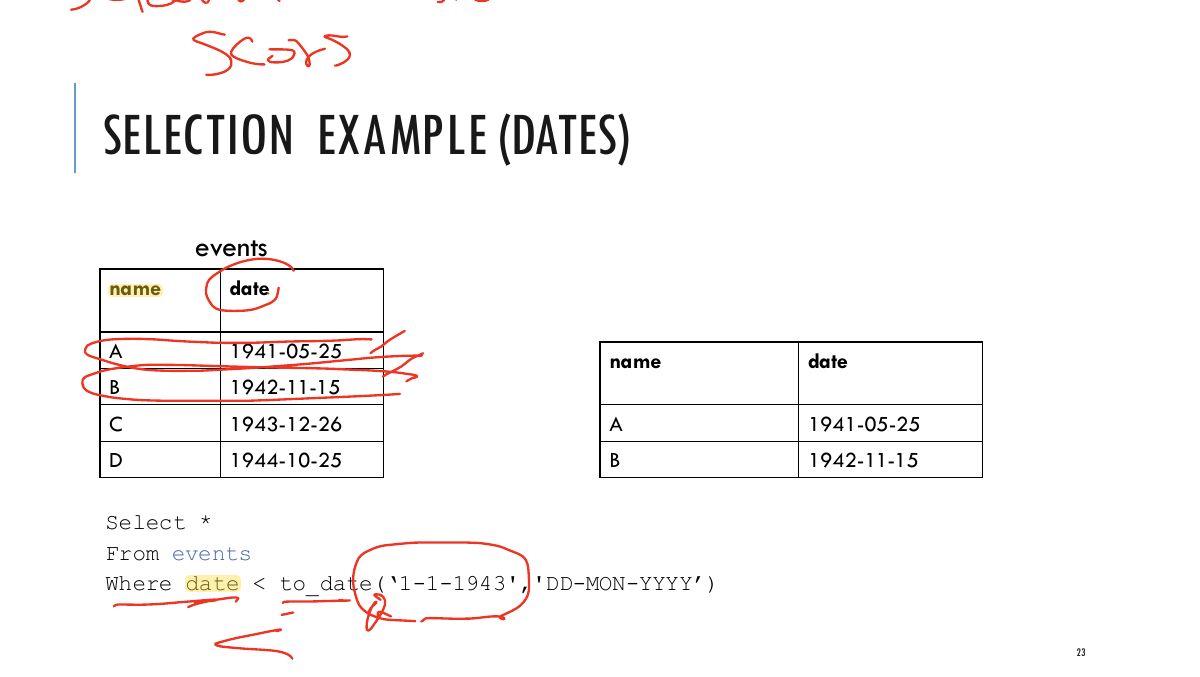
                              SELECTION is in the WHERE clause You can use:

                              1. Attribute names of the relation(s) used in the FROM. comparison operators: =, <>, <, >, <=, >=
                              2. Apply arithmetic operations: rating*2
                              3. Operations on strings (e.g., “||” for concatenation).
                              4. Lexicographic order on strings.
                              5. Pattern matching: s LIKE p
                              6. Special format for comparing dates and times.
                              7. AND, OR to combine operations.
                              18
                              Exam weight High
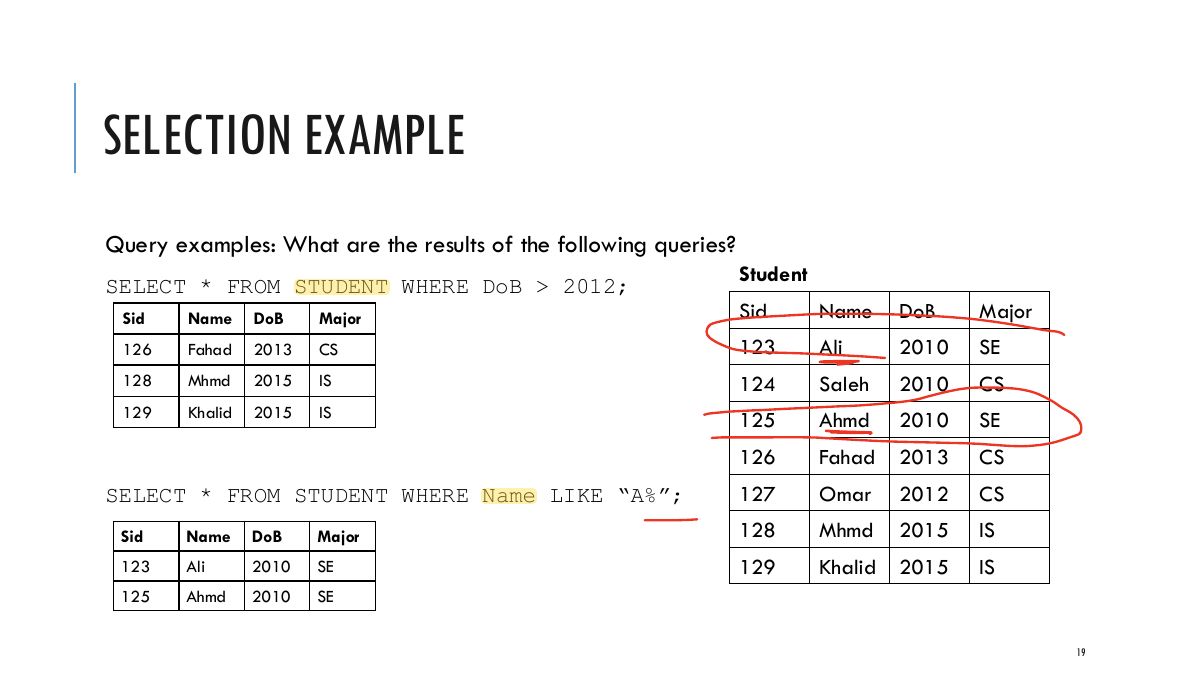
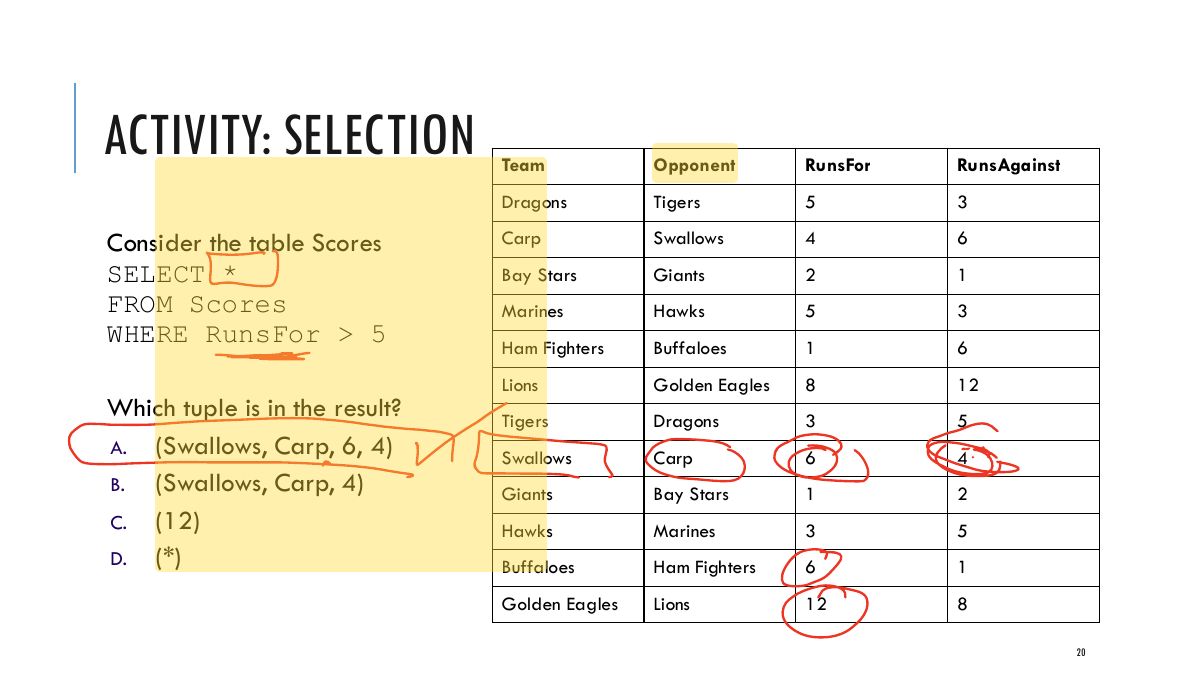
                              1. Selection = choose rows in WHERE (=, <>, <, >, AND, OR, NOT).
                              🎯 How this can come up · 1 question
                              MCQ

                              In SQL, rows are filtered in the:

                              Slide 19: SELECTION EXAMPLE
                              Exam weight Low
                                Slide 20: ACTIVITY: SELECTION
                                Exam weight Low
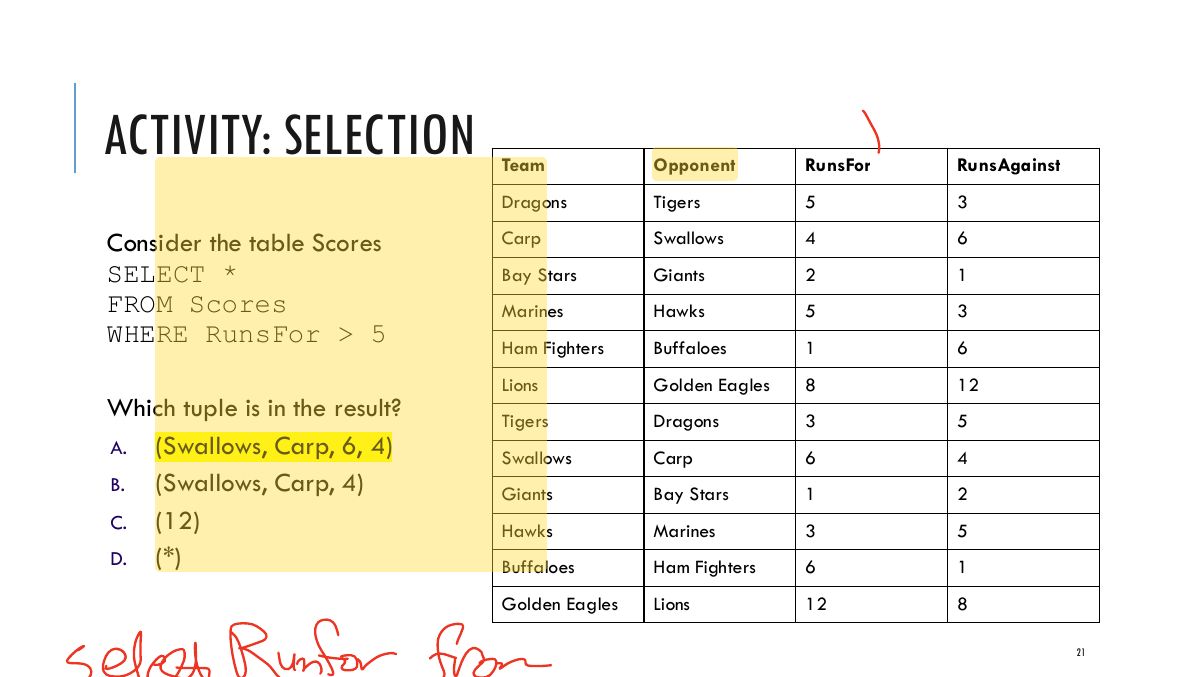
                                  Slide 21: ACTIVITY: SELECTION
                                  Exam weight Low
                                    Slide 22: R fro
                                    Exam weight Low
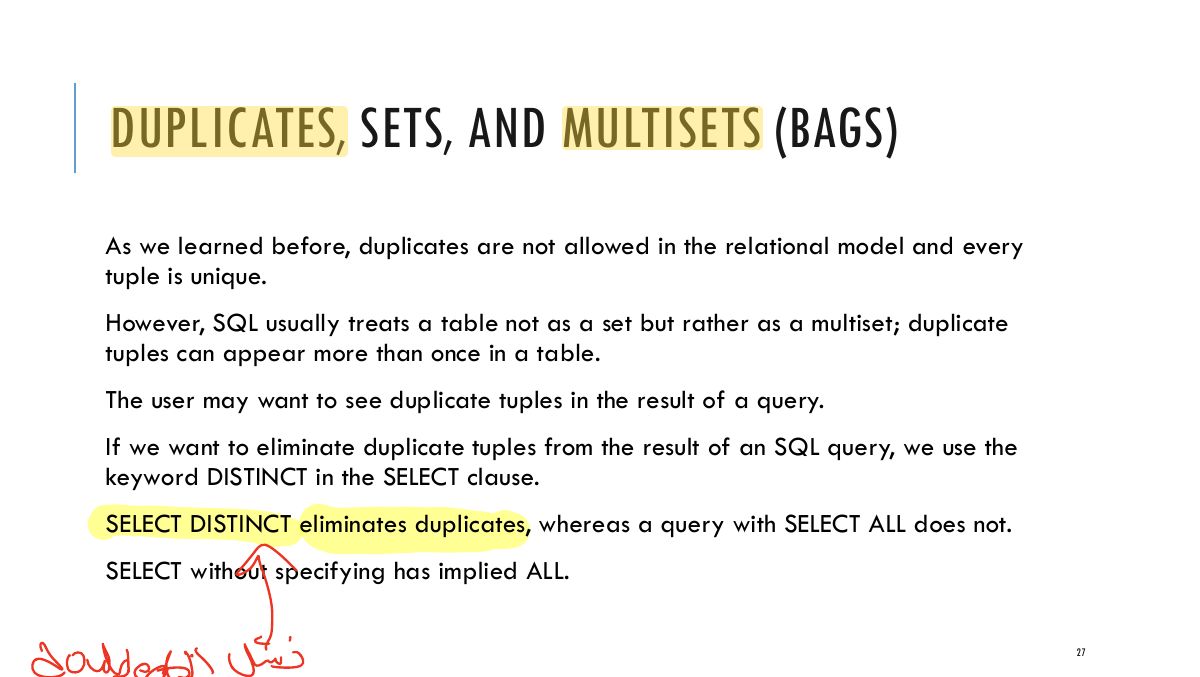
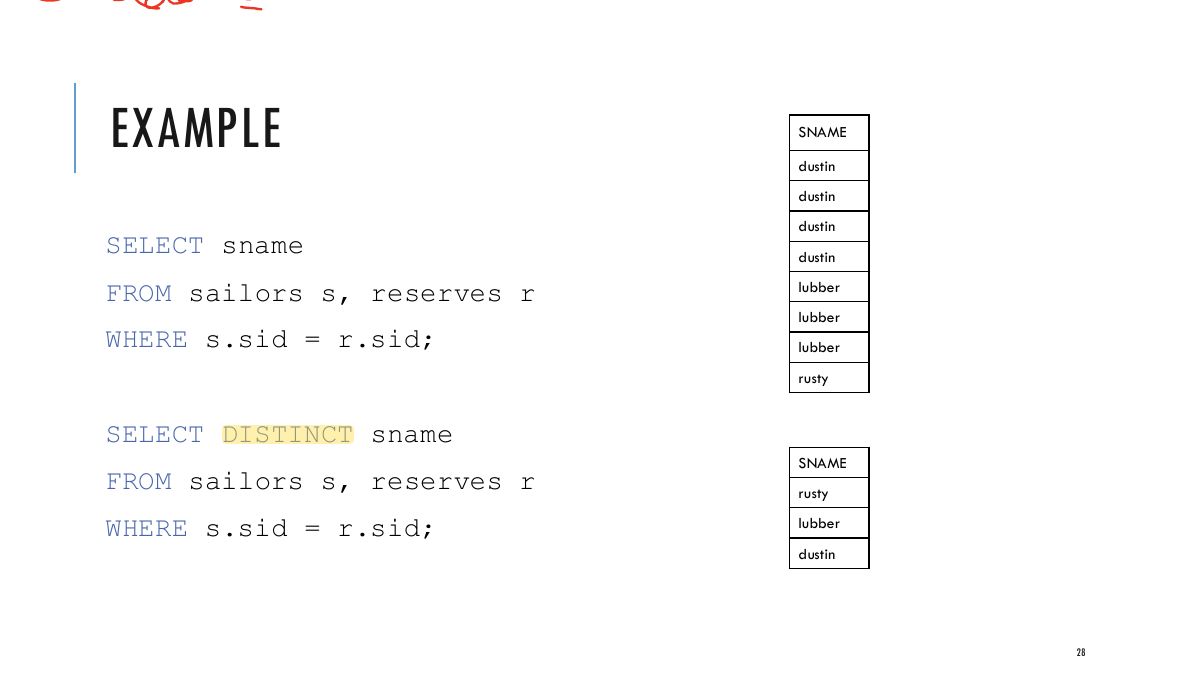
                                      Slide 23: DUPLICATES, SETS, AND MULTISETS (BAGS)
                                      Exam weight High
                                      1. SQL tables are multisets (bags): duplicates are kept unless you write SELECT DISTINCT.
                                      🎯 How this can come up · 1 question
                                      True / False

                                      SELECT removes duplicate rows by default.

                                      Slide 24: d ubeds
                                      Exam weight Low
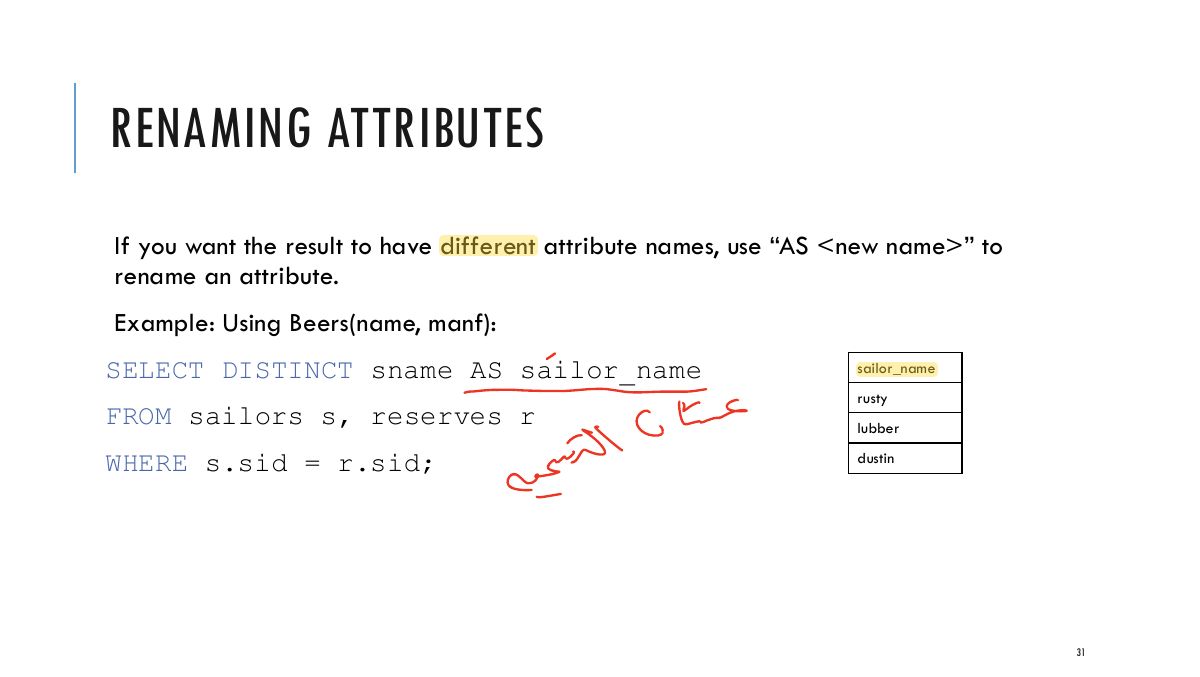
                                        Slide 25: RENAMING ATTRIBUTES
                                        Exam weight Low
                                        1. Rename with AS: SELECT S.sname AS name FROM Sailors AS S.
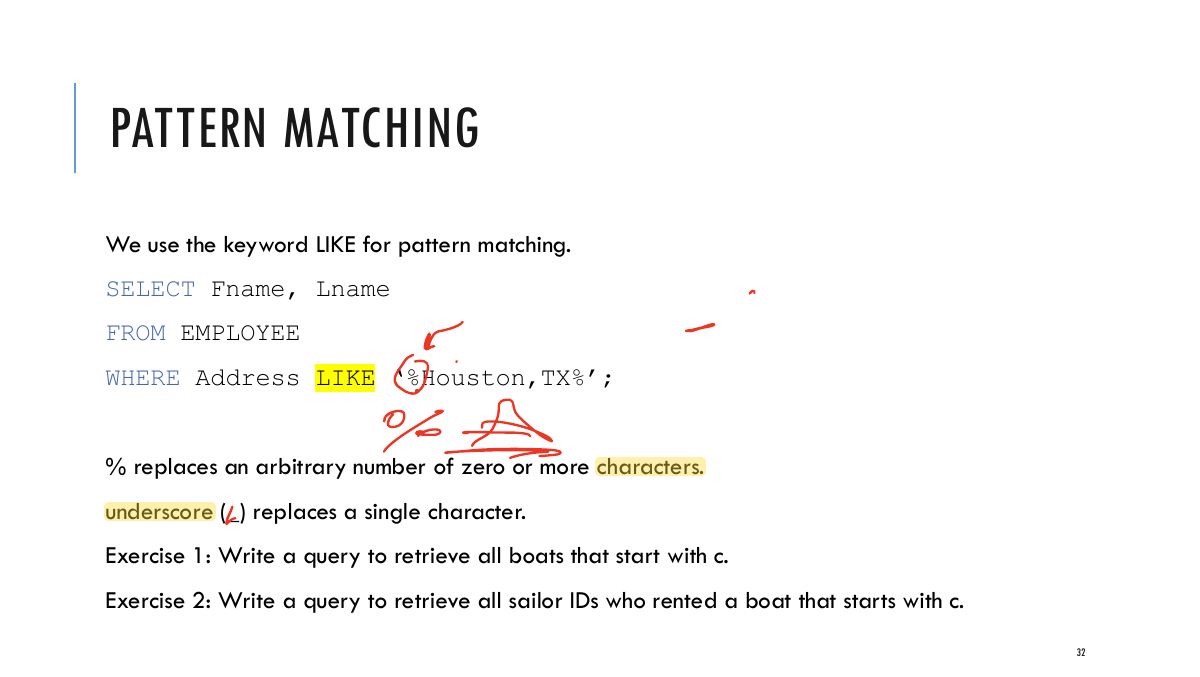
                                        Slide 26: PATTERN MATCHING
                                        Exam weight High
                                        1. LIKE: % = any number of characters, _ = exactly one. '_A%' = second letter is A.
                                        🎯 How this can come up · 1 question
                                        MCQ

                                        WHERE name LIKE '_a%' matches names whose:

                                        ARITHMETIC OPERATIONS

                                        Show the resulting salaries if every employee is given a 10% raise.

                                        SELECT Fname, Lname, 1.1 * E.Salary FROM EMPLOYEE ; Exercise: Write a query to retrieve all sailor names and ratings, and show their rating out of 5 instead of 10.

                                        27
                                        Exam weight Low
                                          Slide 28: BETWEEN OPERATOR
                                          Exam weight Medium
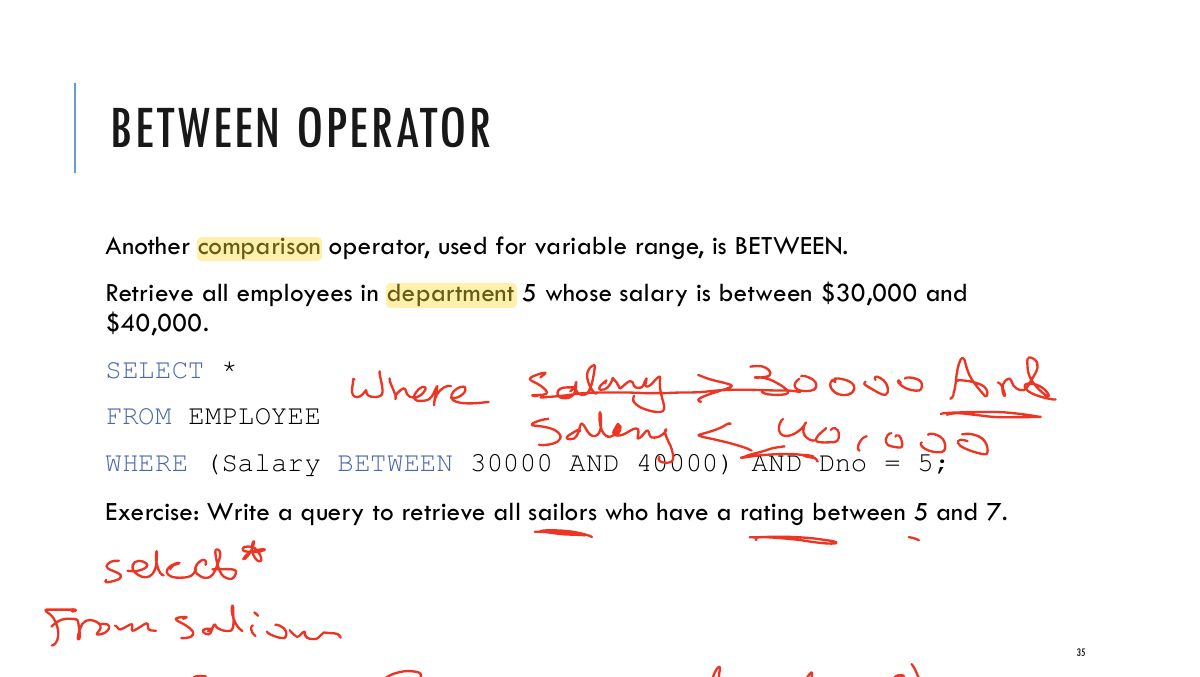
                                          1. BETWEEN a AND b is INCLUSIVE of both ends.
                                          🎯 How this can come up · 1 question
                                          True / False

                                          rating BETWEEN 5 AND 7 includes ratings 5 and 7.

                                          And

                                          Between

                                          when

                                          rating

                                          ORDER BY CLAUSE SQL allows the user to order the tuples in the result of a query by the values of one or more of the attributes that appear in the query result, by using the ORDER BY clause.

                                          Retrieve a list of employees and the projects they are working on, ordered by department and, within each department, ordered alphabetically by last name, then first name.

                                          SELECT D.Dname, E.Lname, E.Fname, P.Pname FROM DEPARTMENT D, EMPLOYEE E, WORKS_ON W, PROJECT P WHERE D.Dnumber = E.Dno AND E.Ssn = W.Essn AND W.Pno = P.Pnumber ORDER BY D.Dname, E.Lname, E.Fname;

                                          29
                                          Exam weight Low
                                            Slide 30: ORDER BY CLAUSE (CONTD)
                                            Exam weight Low
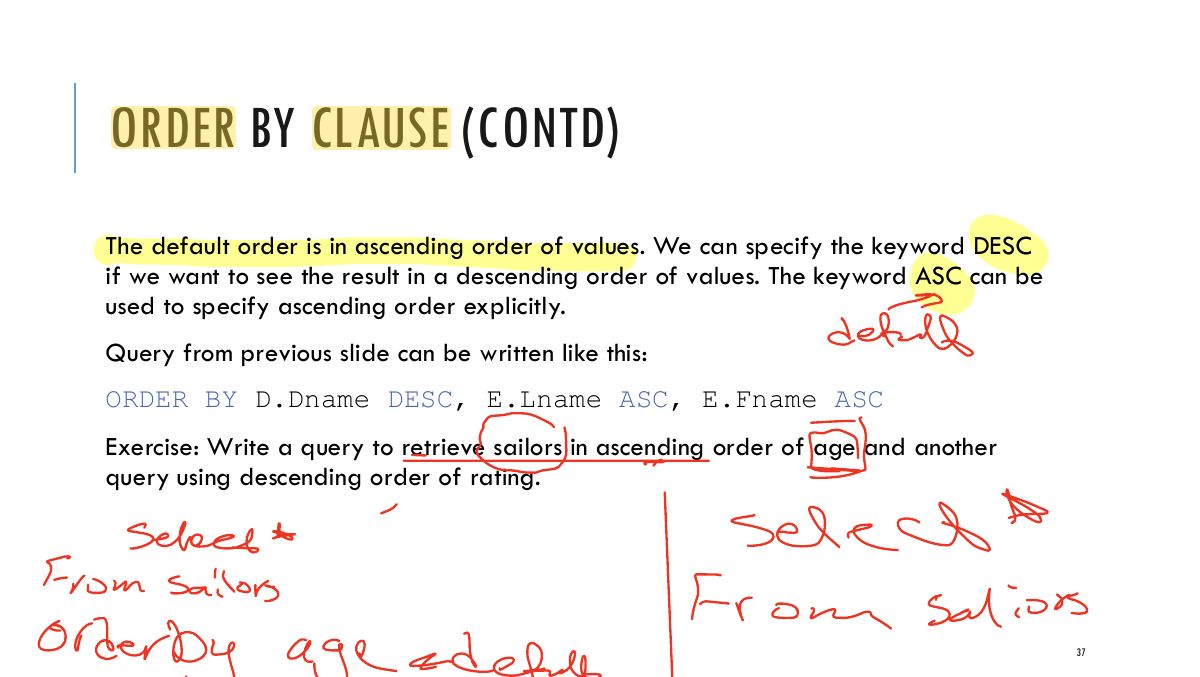
                                            1. ORDER BY col [ASC | DESC]; ascending is the default.
                                            Slide 31: y
                                            Exam weight Low
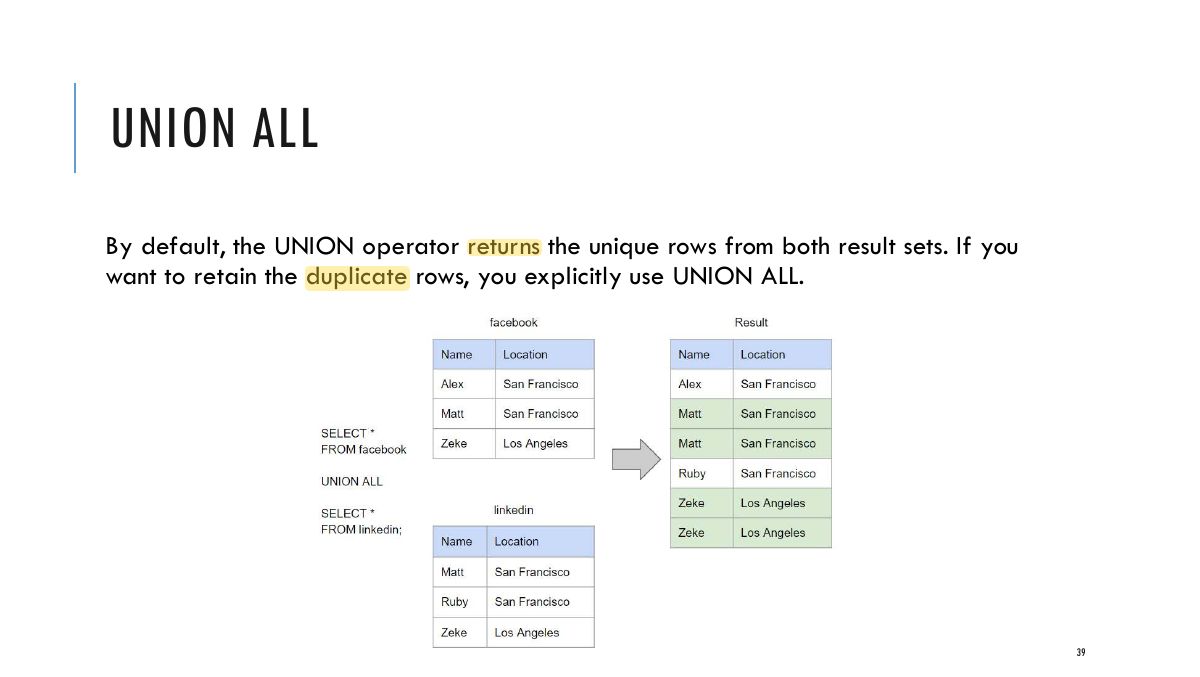
                                              Slide 32: UNION ALL
                                              Exam weight Low
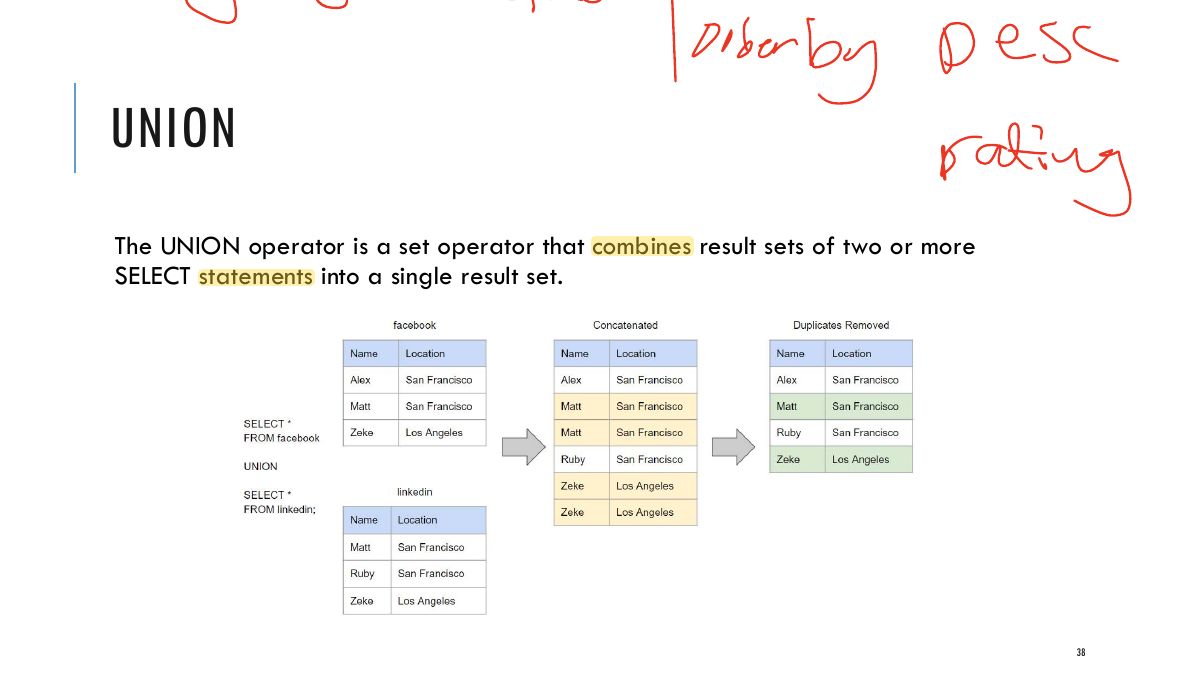
                                              1. UNION removes duplicates; UNION ALL keeps them. Both queries must be union-compatible (same number and types of columns).

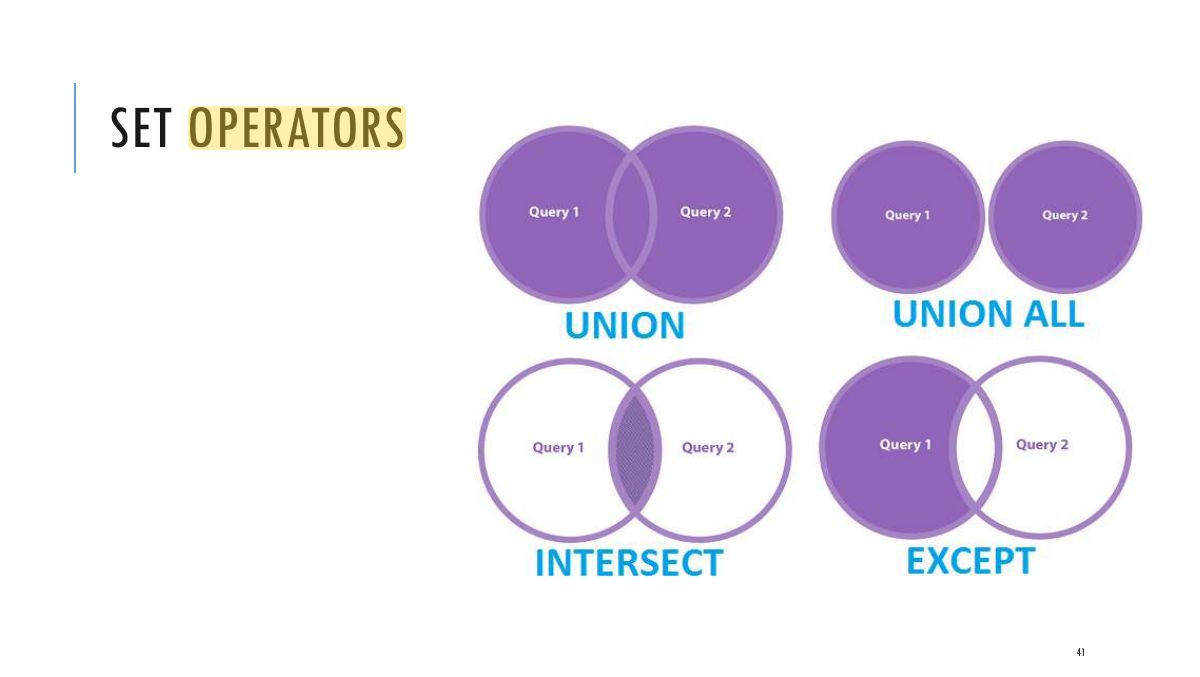
                                              MORE SET OPERATORS (EXCEPT/MINUS- INTERSECT)

                                              The

                                              EXCEPT/Minus operator in SQL is used to retrieve all the unique records from

                                              the left operand (query), except the records that are present in the result set of the right operand (query).

                                              The INTERSECT operator in SQL is used to retrieve the records that are identical/common between the result sets of two or more queries.

                                              33
                                              Exam weight High
                                              1. INTERSECT: rows in both. EXCEPT (MINUS): rows in the first but not the second.
                                              🎯 How this can come up · 1 question
                                              MCQ

                                              Sailors who reserved a red boat but NOT a green boat:

                                              Slide 34: SET OPERATORS
                                              Exam weight Low

                                                REVIEW OF BASIC QUERIES

                                                Basic query form:

                                                SELECT <attribute list> FROM <table list> [ WHERE <condition> ] [ ORDER BY <attribute list> ]; A simple retrieval query in SQL can consist of up to four clauses (that we have seen so far), but only the first two SELECT and

                                                —

                                                FROM are mandatory.

                                                —

                                                35
                                                Exam weight Low

                                                  INSERT, DELETE, AND UPDATE STATEMENTS IN SQL

                                                  In SQL, three commands can be used to modify the database: INSERT, DELETE, and UPDATE.

                                                  We discuss each of these in turn.

                                                  36
                                                  Exam weight Low
                                                    ★ Past exam

                                                    INSERT

                                                    In its simplest form, INSERT is used to add a single tuple (row) to a relation (table).

                                                    The values should be listed in the same order in which the attributes were specified in the CREATE TABLE command.

                                                    Example:

                                                    INSERT INTO sailors VALUES(22, 'dustin',7,45.0); Alternatively, we can specify the attributes to insert into.

                                                    Example:

                                                    INSERT INTO sailors(sid, sname, rating) VALUES(22, 'dustin',7); What happens to attribute age here?

                                                    37
                                                    Exam weight Medium
                                                    1. INSERT INTO T VALUES (…) or INSERT INTO T (cols) VALUES (…); values must respect the constraints.

                                                    INSERT (CONTD)

                                                    INSERT commands must meet constraints specified in the CREATE TABLE DDL code.

                                                    Try it:

                                                    INSERT INTO sailors VALUES(22, 'dustin',7,45.0); INSERT INTO sailors(sname, rating) VALUES('dustin',7); What happens in each case?

                                                    Can you think of an INSERT statement that violates referential integrity?

                                                    38
                                                    Exam weight Low

                                                      INSERT (CONTD)

                                                      A variation of INSERT enables inserting the results of a query into a table.

                                                      CREATE TABLE WORKS_ON_INFO (Emp_name VARCHAR(15), Proj_name VARCHAR(15), Hours_per_week DECIMAL(3,1) ); INSERT INTO WORKS_ON_INFO (Emp_name, Proj_name, Hours_per_week) SELECT E.Lname, P.Pname, W.Hours FROM PROJECT P, WORKS_ON W, EMPLOYEE E WHERE P.Pnumber = W.Pno AND W.Essn = E.Ssn;

                                                      39
                                                      Exam weight Low

                                                        INSERT (CONTD)

                                                        Another variation is to do this with CREATE TABLE:

                                                        CREATE TABLE D5EMPS LIKE EMPLOYEE (SELECT E.* FROM EMPLOYEE AS E WHERE E.Dno = 5) WITH DATA; All DBMSs have a data loading command from files, so you do not need to manually write all your INSERT statements for every tuple.

                                                        Example: LOAD DATA INFILE

                                                        in MySQL

                                                        40
                                                        Exam weight Low

                                                          DELETE

                                                          The DELETE command removes tuples from a relation.

                                                          It includes a WHERE clause to select the tuples to be deleted.

                                                          Tuples are explicitly deleted from only one table at a time. However, the deletion may propagate to tuples in other relations if referential triggered actions are specified in the referential integrity constraints of the DDL. Example: ON DELETE CASCADE Example:

                                                          DELETE FROM EMPLOYEE WHERE Lname

                                                          = ‘Brown’;

                                                          Exercise: delete all sailors that are older than 50.

                                                          41
                                                          Exam weight High
                                                          1. DELETE FROM T WHERE …; without WHERE it deletes every row (the table stays).
                                                          Exam trapDELETE FROM T removes the rows; DROP TABLE T removes the table itself.

                                                          UPDATE

                                                          The UPDATE command is used to modify attribute values of one or more selected tuples. It includes a WHERE clause to select the tuples to be deleted.

                                                          Tuples are explicitly updated from only one table at a time. However, However, updating a primary key value may propagate to the foreign key values of tuples in other relations.

                                                          Example: ON UPDATE CASCADE The SET clause in the UPDATE command specifies the attributes and their new values.

                                                          Example:

                                                          UPDATE EMPLOYEE SET Salary = Salary * 1.1 WHERE Dno = 5; Exercise: update the age of sailors to increase by 1.

                                                          42
                                                          Exam weight High
                                                          1. UPDATE T SET col = value WHERE …;
                                                          🎯 How this can come up · 1 question
                                                          MCQ

                                                          Give every employee in department 5 a 10% raise:

                                                          SUMMARY

                                                          We have also looked at basic SQL commands.

                                                          In the next chapter, we will present the following features of SQL:

                                                          complex retrieval queries; views; triggers and assertions; and schema modification commands.

                                                          43
                                                          Exam weight Low