CS340 · Annotated SlidesChapter 4 — The Relational Model and DBMS Architecture
Chapter 4 · Annotated slides

The Relational Model and DBMS Architecture

DBMS languages (DDL, DML, DCL, TCL), relations, tuples, attributes and domains, characteristics of relations, domain, key, NULL, entity-integrity and referential-integrity constraints, update operations and their violations, DBMS modules, and centralized, two-tier and three-tier architectures.
Slide text Study notes Highlight: key words Tips, tricks & traps Seen again elsewhere How it can come up

The Relational Model

CS340 · Chapter 4
1

PROJECT NEXT STEPS (SPECIFICATIONS)

Submission of team names, tech, and ideas today.

Specification for next step will be uploaded to Moodle shortly in sha’ Allah.

Read it carefully and follow all the steps.

Pay attention to the deadline.

Submission through Moodle.

2
Exam weight Low

    LEARNING GOALS

    CLO1: Define the "database”, its architecture, the main concepts and characteristics of databases, as well as concepts related to the design, and implementation of a relational databases.

    (Knowledge & Understanding) Chapter objectives:

     Compare logical and physical data independence.

     Define the components of relational model: tables, rows,

    columns, etc.

     Briefly describe DBMS languages.

     Learn about database language terms.

     Learn about relational database constraints.

     Learn the difference between database architectures.

    3
    Exam weight Low
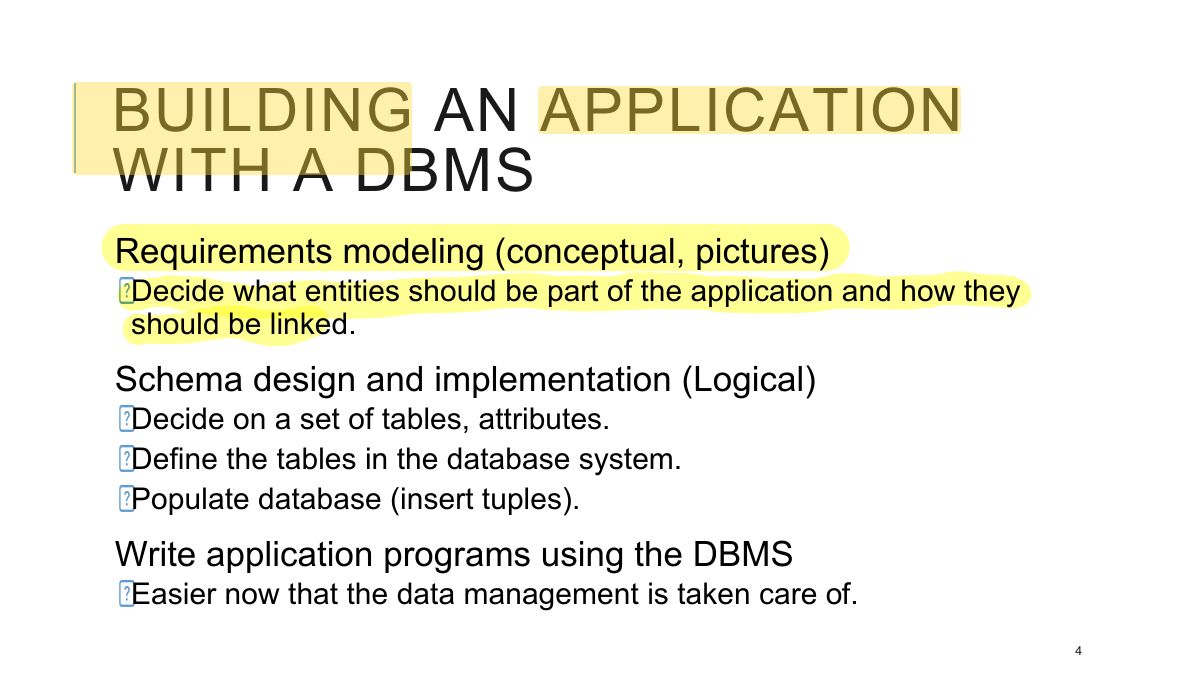
      Slide 4: BUILDING AN APPLICATION WITH A DBMS
      Exam weight Low

        DATABASE DESIGN

        Why do we need it?

        Agree on structure of the database before deciding on a particular implementation.

        Consider issues such as:

        What entities to model

        How entities are related

        What constraints exist in the domain

        How to achieve good designs

        ER diagrams can be translated to relational schema. We will see how.

        We will start translating ER diagrams to SQL very soon.

        5
        Exam weight Low

          LOGICAL DESIGN

           We want to store our data without worrying about

          files on disk.

           We want to query (retrieve) our data.

           We want a representation that is easy to

          understand.

           We want to easily map our ER diagrams.

           We want this to be separate from application code.

          6
          Exam weight Low
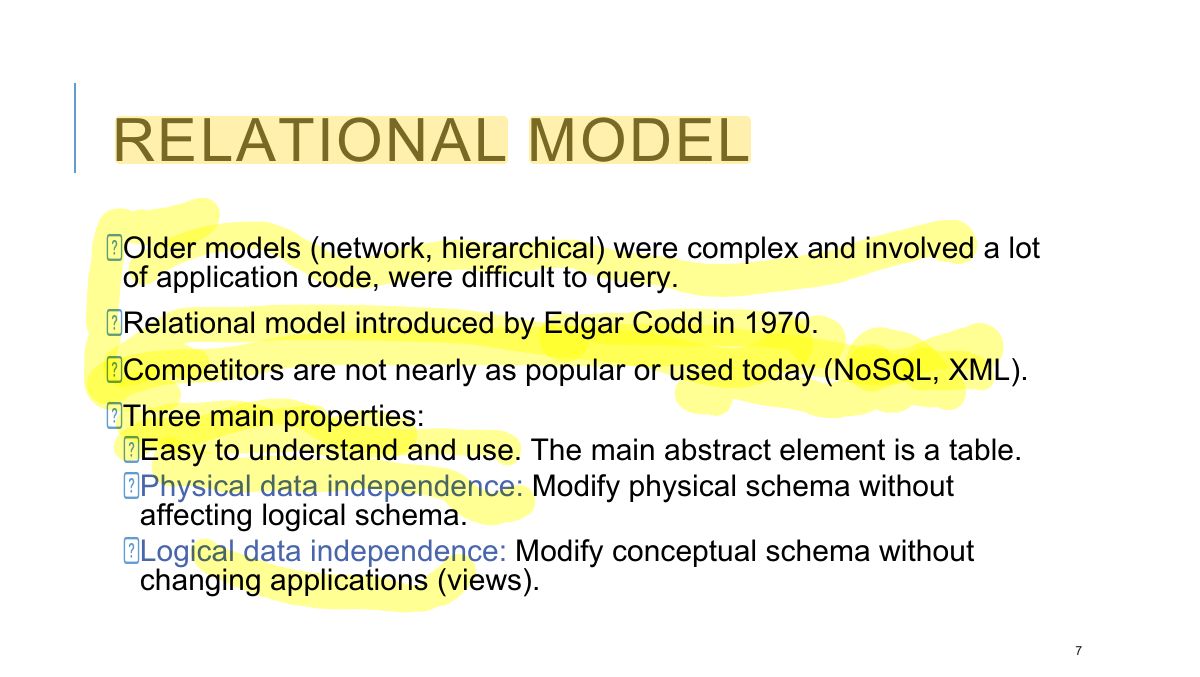
            Slide 7: RELATIONAL MODEL
            Exam weight Low
              ★ Past exam

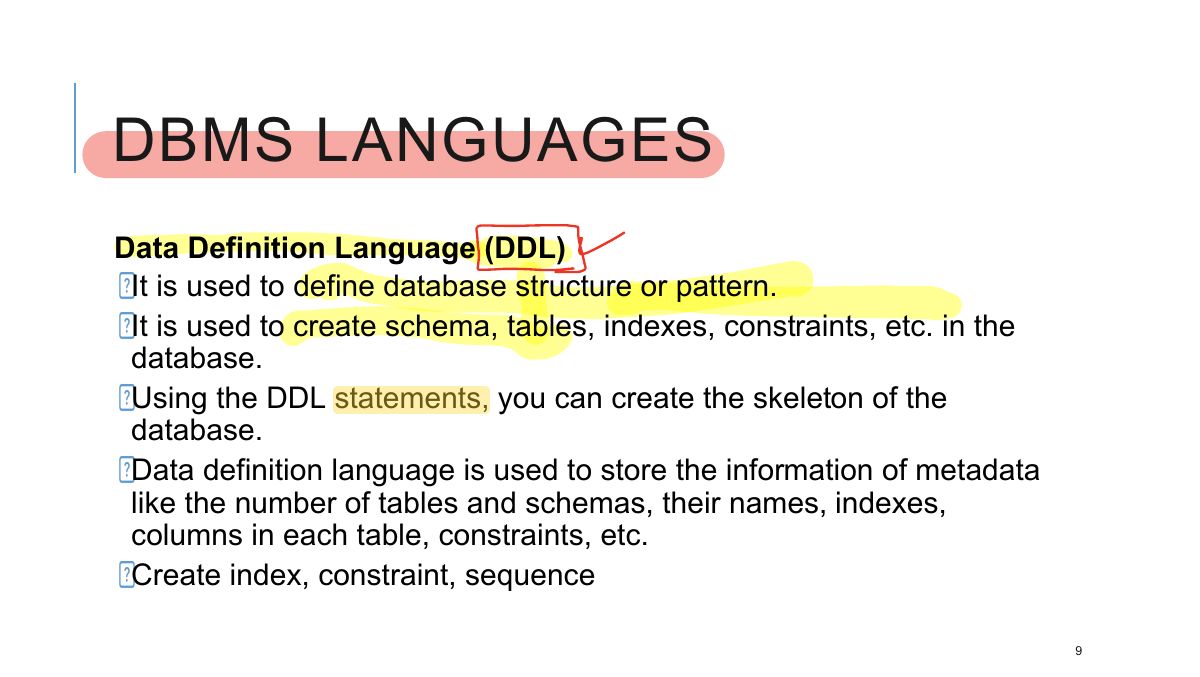
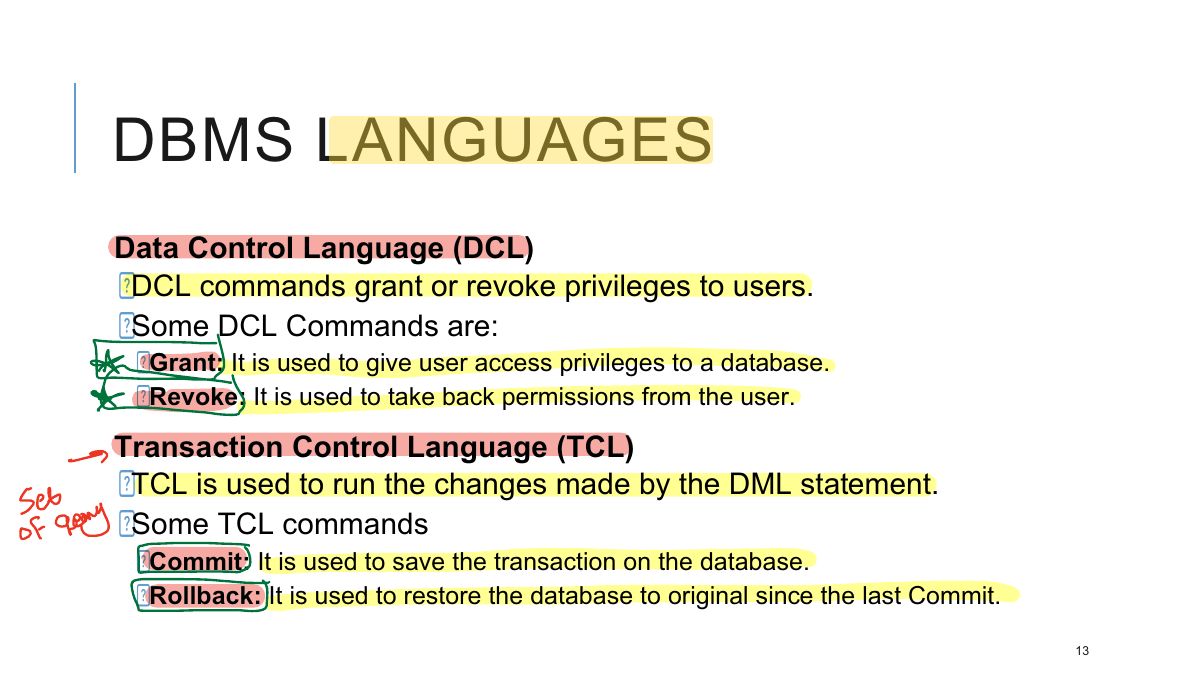
              DBMS LANGUAGES

              We will briefly look at DBMS languages:

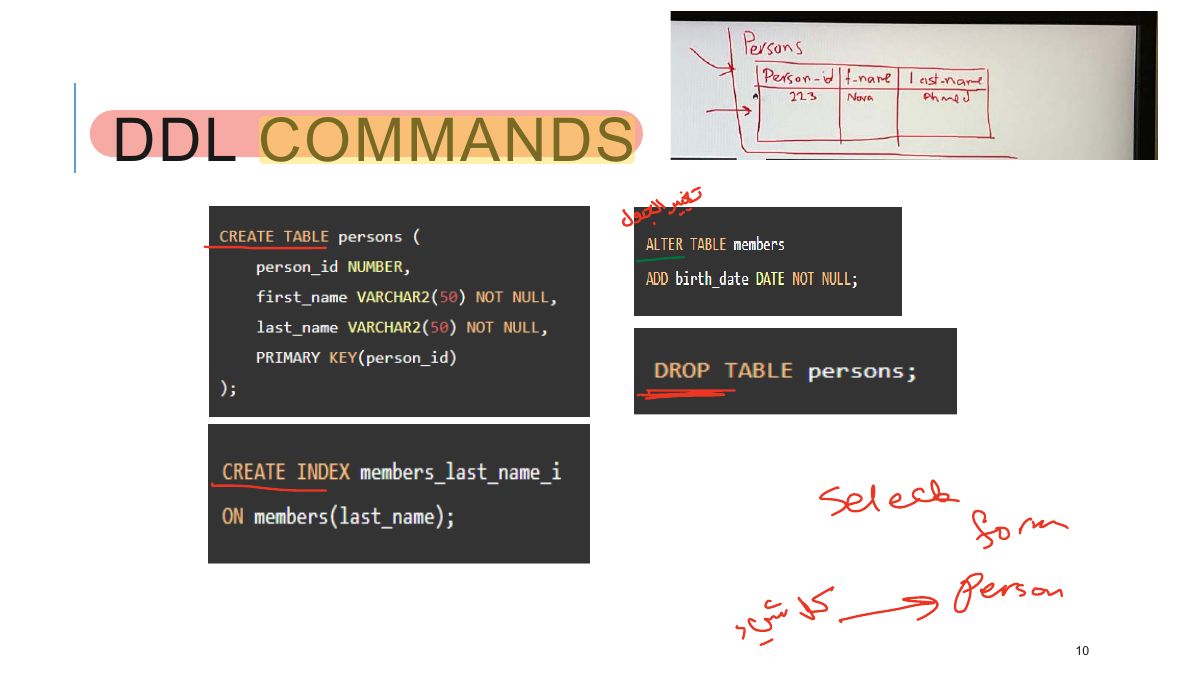
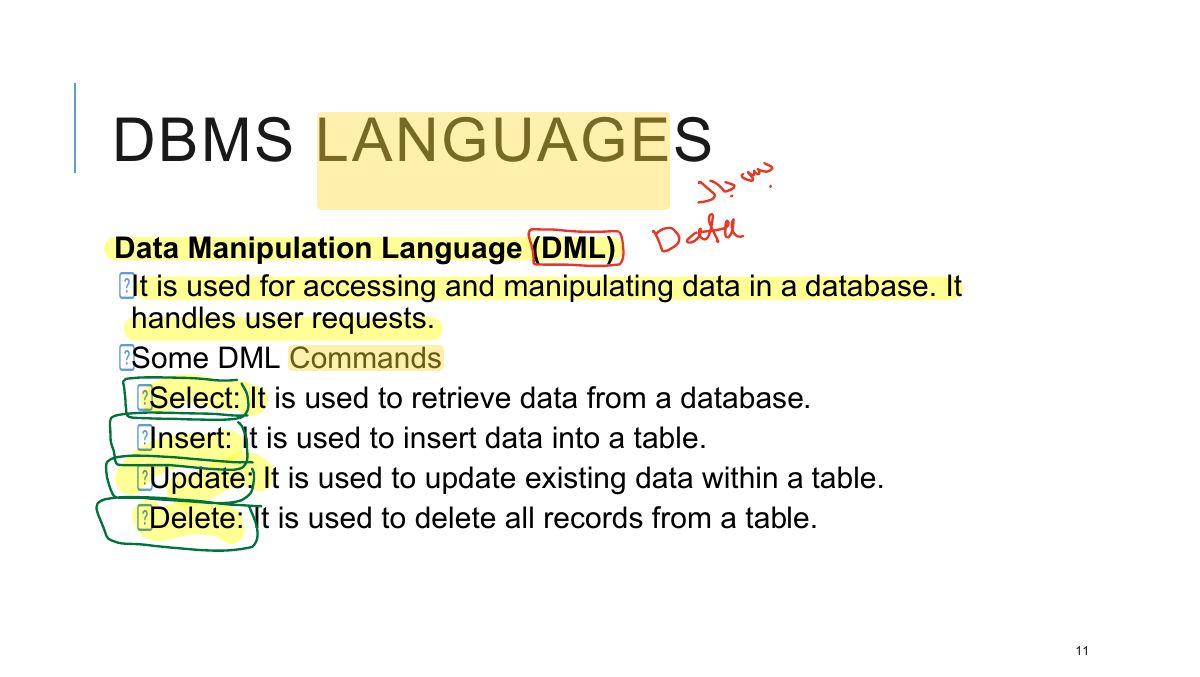
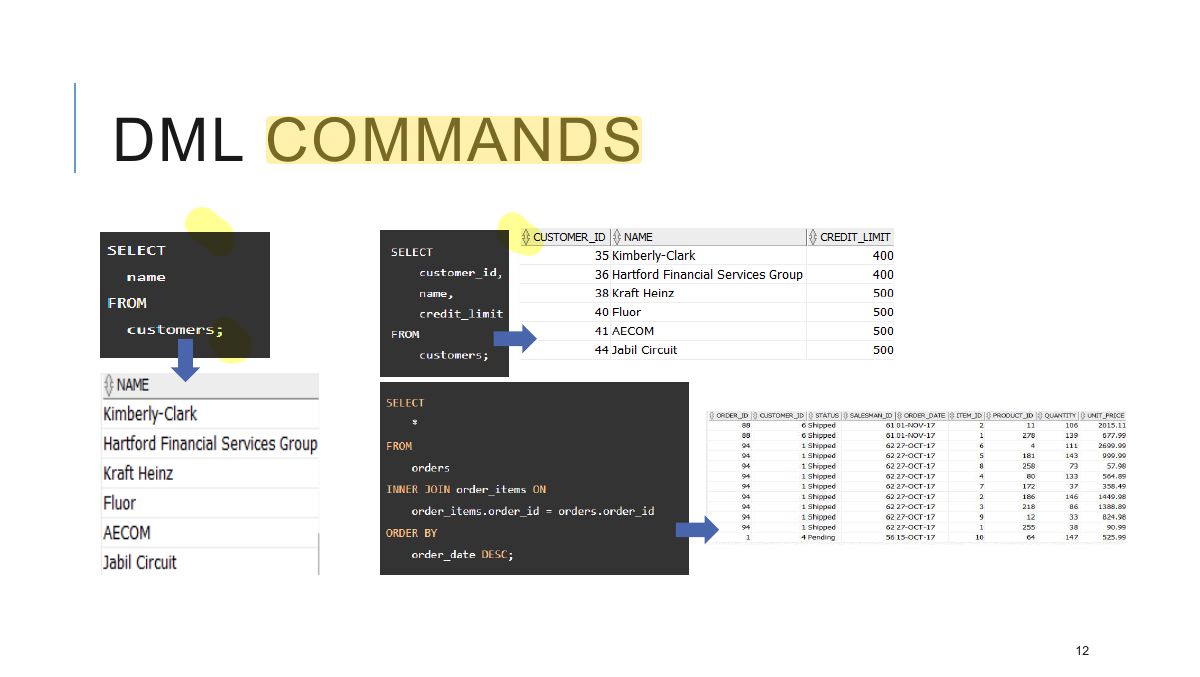
               DDL  DML  DCL  TCL  We will cover DDL in the next chapter, then DML in the one after.

              8
              Exam weight High
              1. DDL defines structure (CREATE, ALTER, DROP). DML queries and changes data (SELECT, INSERT, UPDATE, DELETE). DCL: GRANT/REVOKE. TCL: COMMIT/ROLLBACK.
              🎯 How this can come up · 2 questions
              MCQ

              Which language queries and manipulates data?

              MCQ

              ALTER TABLE belongs to:

              Slide 9: DBMS LANGUAGES
              Exam weight Low
                Slide 10: DDL COMMANDS
                Exam weight Low
                  Slide 11: DIE
                  Exam weight Low
                    Slide 12: DML COMMANDS
                    Exam weight Low
                      Slide 13: DBMS LANGUAGES
                      Exam weight Low

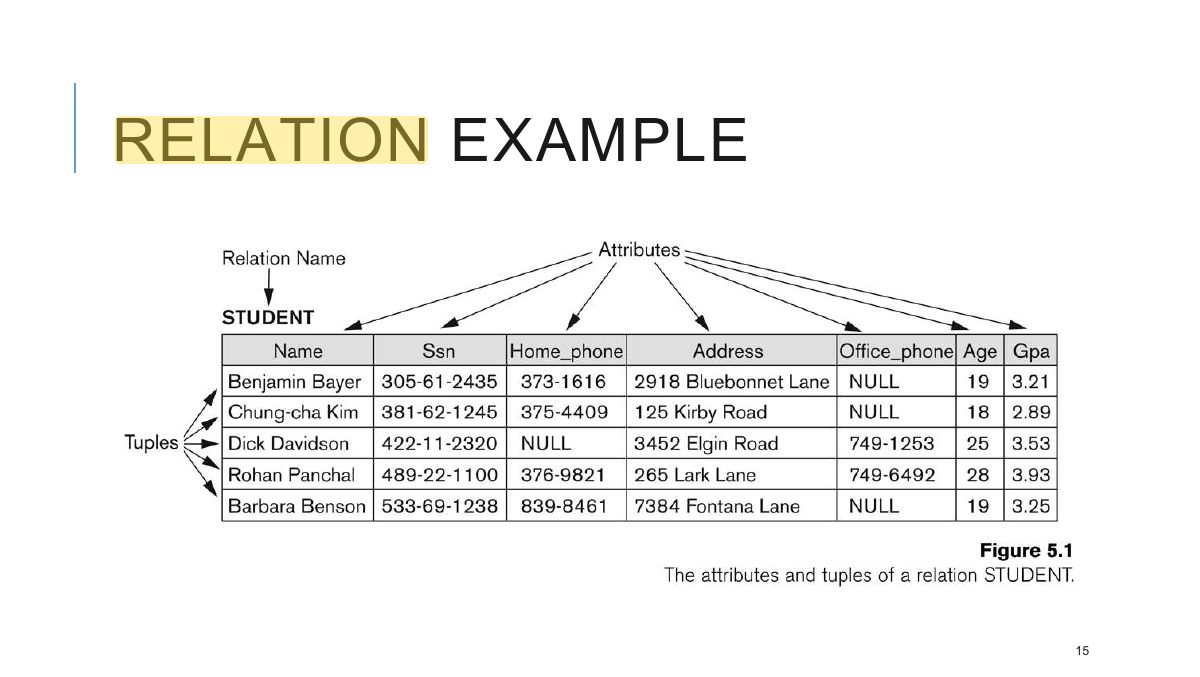
                        RELATIONAL MODEL COMPONENTS

                         Relational database: A set of relations.

                         Relation: 2 parts:

                         Schema: The name of relation, and name and type of attributes.

                         Example: Employee (ID: string, name: string, dob: date).

                         Instance: A table with rows (tuples) and columns.

                         Number of rows is cardinality.

                         Number of columns is degree or arity.

                         Relational database schema: collection of all schemas.

                         Database instance: collection of instances of all relations.

                        14
                        Exam weight High
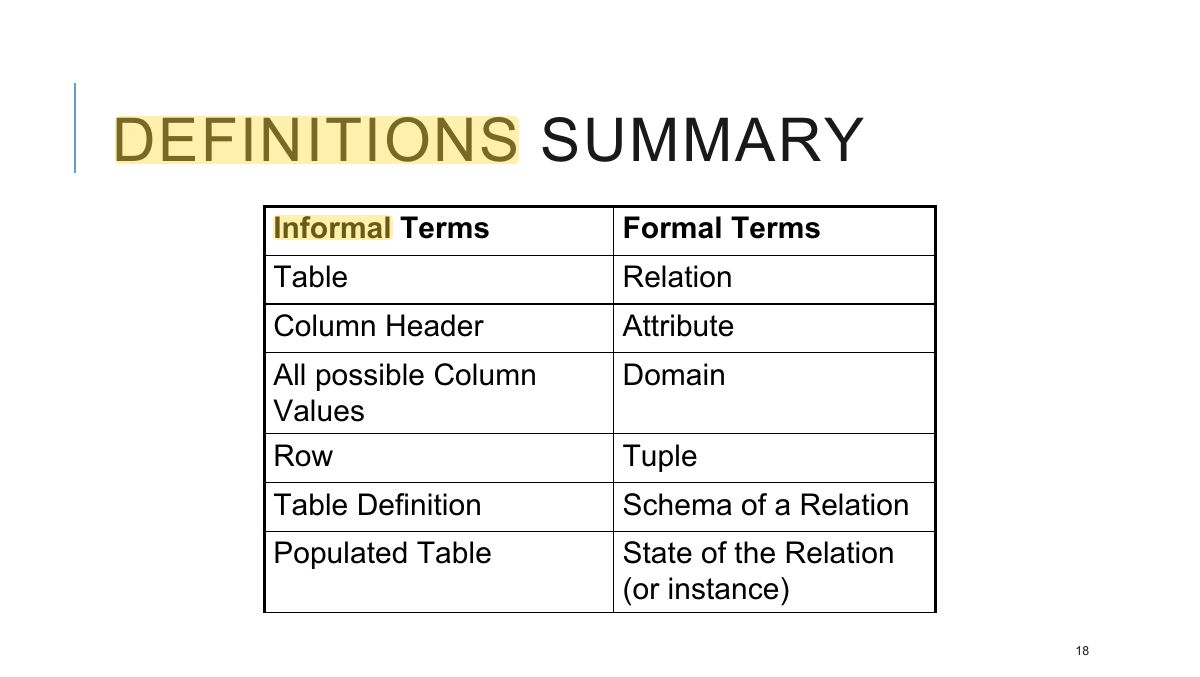
                        1. Relation = table; tuple = row; attribute = column; domain = set of allowed values; degree = number of attributes; cardinality = number of tuples.
                        🎯 How this can come up · 1 question
                        MCQ

                        The number of attributes in a relation is its:

                        Slide 15: RELATION EXAMPLE
                        Exam weight Low

                          FORMAL DEFINITIONS

                          The Schema (or description) of a Relation:

                          Denoted by R(A, A, .....A)

                          1 2

                          n

                          R is the name of the relation

                           attributes of the relation are A, A

                          The

                          , ..., A

                          1 2

                          n

                           is in D, which is the domain of the i-th attribute.

                          A

                          i

                          i

                           domain also contains null which is a special value that indicates

                          A unknown value.

                           , ..., A are attributes with domains D ,..., D then (A :D, ..., A :D

                          If A

                          n

                          i

                          n

                          1 1

                          n

                          ) is a relation schema that defines a relation type. Sometimes the

                          n domains are not included.

                          16
                          Exam weight Low
                            Slide 17: ACTIVITY
                            Exam weight Low
                              Slide 18: DEFINITIONS SUMMARY
                              Exam weight Low

                                CHARACTERISTICS OF RELATIONS

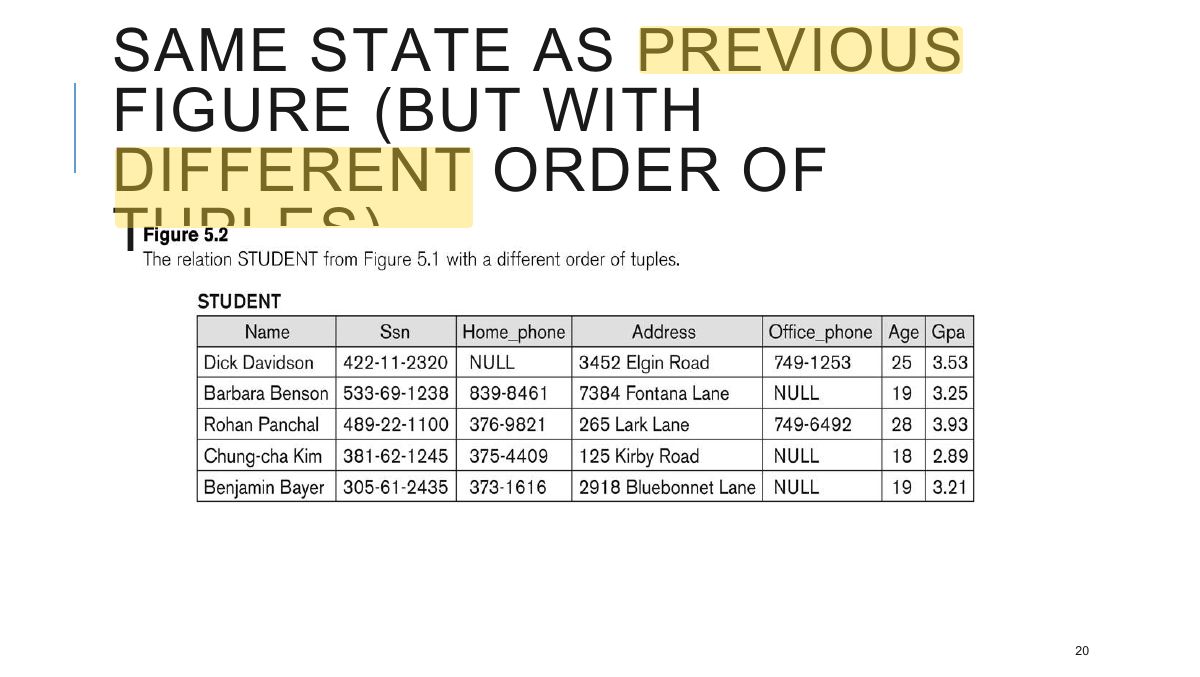
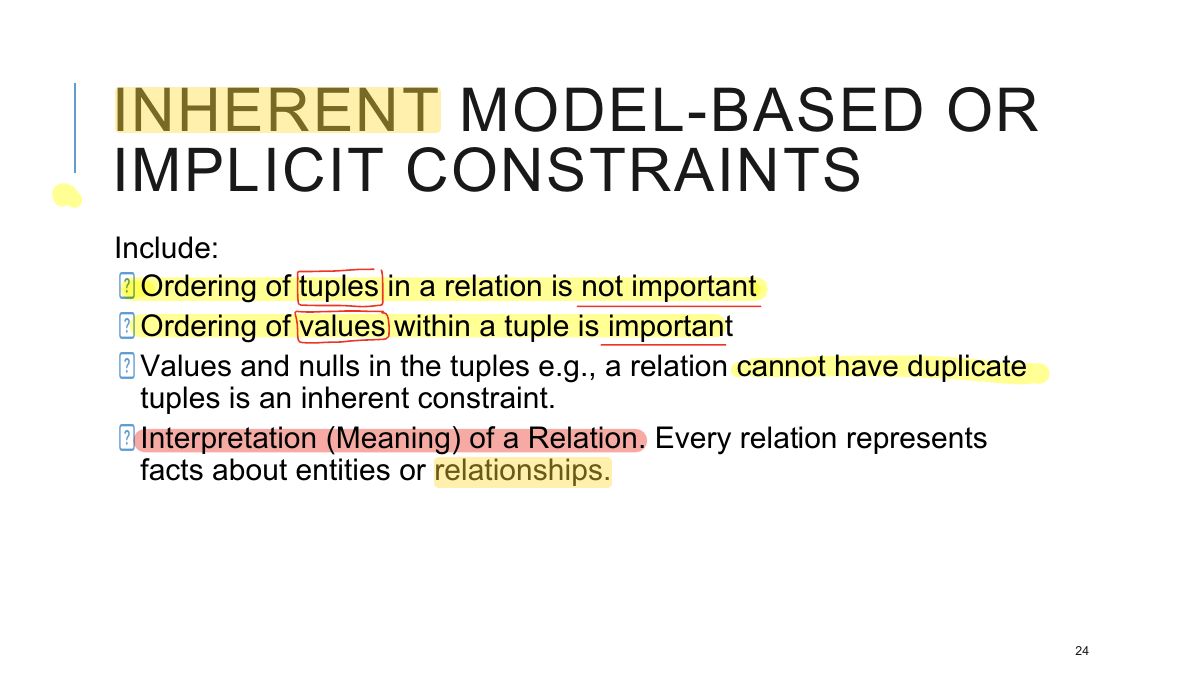
                                Ordering of tuples in a relation r(R):

                                 The tuples are not considered to be ordered, even if they appear to be in the

                                tabular form.

                                Ordering of attributes in a relation schema R (and of values within each tuple):

                                 We will consider the attributes in R(A1, A2, ..., An) and the values in t=<v1, v2, ...,

                                vn> to be ordered.

                                 (However, a more general alternative definition of relation does not require this

                                ordering. It includes both the name and the value for each of the attributes ).

                                 Example: t= { <name, “John” >, <SSN, 123456789> }  This representation may be called as “self-describing”.

                                19
                                Exam weight Low
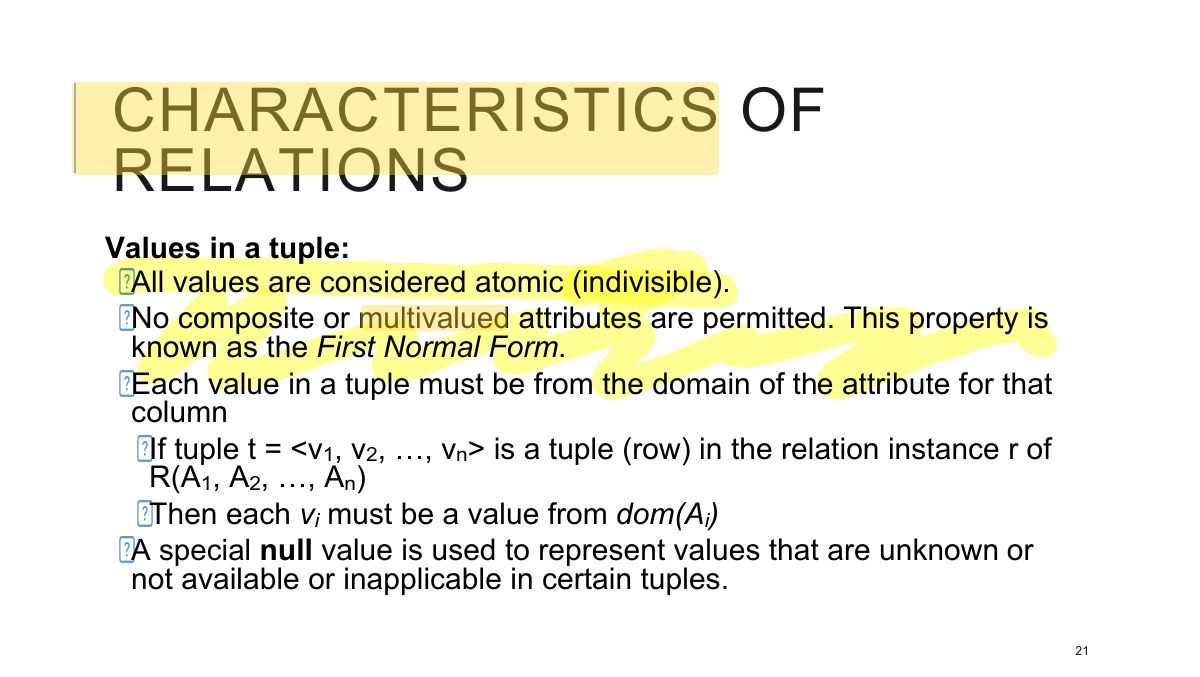
                                1. Tuples are unordered; values are atomic (1NF); NULL means unknown or not applicable.
                                Slide 20: SAME STATE AS PREVIOUS FIGURE (BUT WITH DIFFERENT ORDER OF
                                Exam weight Low
                                  Slide 21: CHARACTERISTICS OF RELATIONS
                                  Exam weight Low

                                    CHARACTERISTICS OF RELATIONS

                                    Notation:

                                    We refer to component values of a tuple t by:

                                     ] or t.A

                                    t[A

                                    i

                                    i

                                    This is the value v of attribute A for tuple t

                                    i

                                    i

                                    Similarly, t[A, A, ..., A ] refers to the sub-tuple of t containing the

                                    u v

                                    w

                                    values of attributes A, A, ..., A, respectively in t

                                    u v

                                    w

                                    22
                                    Exam weight Low
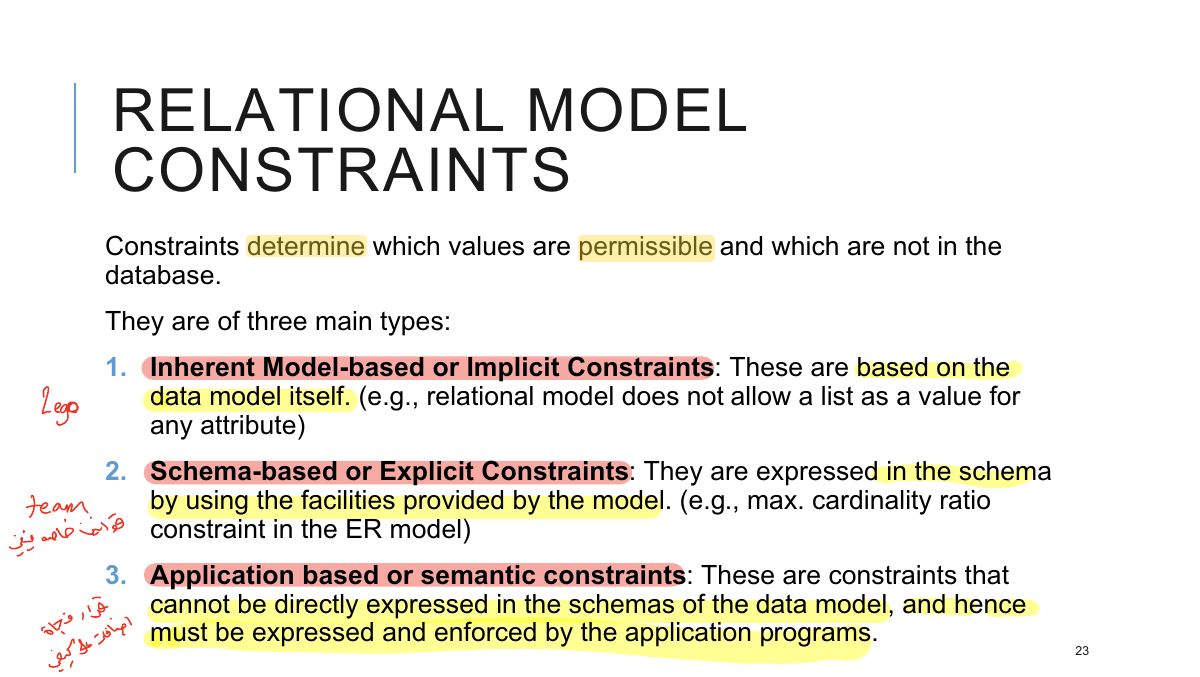
                                      Slide 23: RELATIONAL MODEL CONSTRAINTS
                                      Exam weight Low
                                      1. Constraint families: inherent (model-based), schema-based (DDL), application-based (business rules).
                                      Slide 24: INHERENT MODEL-BASED OR IMPLICIT CONSTRAINTS
                                      Exam weight Low
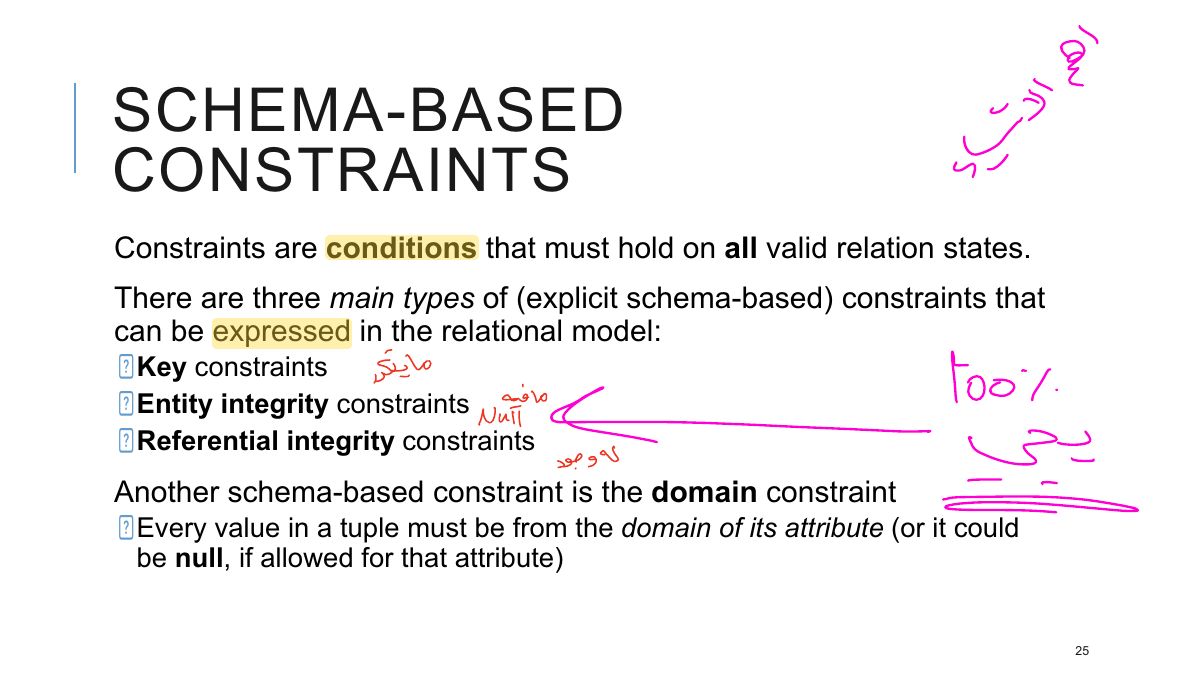
                                        Slide 25: SCHEMA-BASED CONSTRAINTS
                                        Exam weight Low

                                          SCHEMA-BASED CONSTRAINTS

                                          Sli

                                          is

                                          C O N S T R A I N T S Include:

                                          Domain constraints.

                                          Key constraints.

                                          Constraints on nulls.

                                          Entity integrity constraints.

                                          Referential integrity constraints.

                                          26
                                          Exam weight High
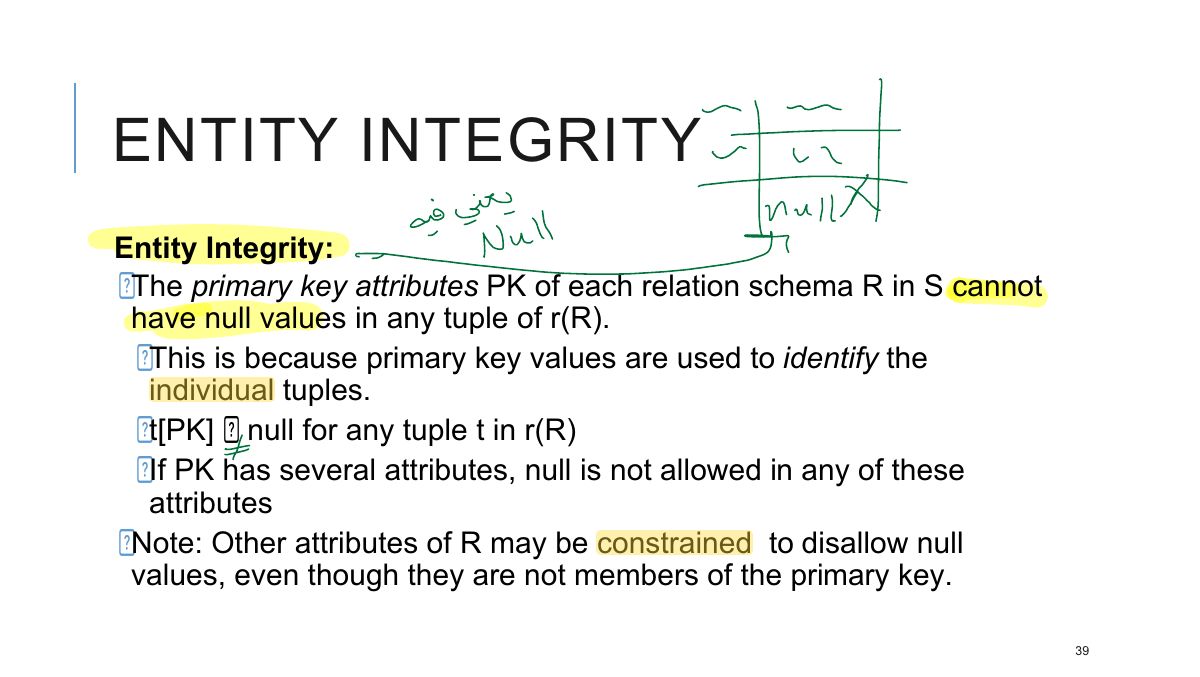
                                          1. Entity integrity: the primary key can’t be NULL.
                                          🎯 How this can come up · 1 question
                                          True / False

                                          A primary-key attribute may be NULL if it is unknown.

                                          DOMAIN CONSTRAINTS

                                          They specify that within each tuple, the value of each attribute must be an atomic value from the domain.

                                          The data types associated with domains includes:

                                          integers, real numbers, characters, Booleans, fixed length strings, variable length strings, date, time, timestamp...etc.

                                          Other possible domains can be a range of values from a data type or as an enumerated data type in which all possible values are explicitly listed.

                                          27
                                          Exam weight Low
                                          1. Domain constraint: each value must come from the attribute’s domain (type, range).

                                          CONSTRAINTS ON NULL VALUES

                                          Specifies whether NULL values are or are not permitted e.g.if every STUDENT tuple must have a valid, non-NULL value for the Name attribute, then the Name of STUDENT is constrained to be NOT NULL.

                                          28
                                          Exam weight Low
                                            Slide 29: sjw
                                            Exam weight Low

                                              KEY CONSTRAINTS (CONTINUED)

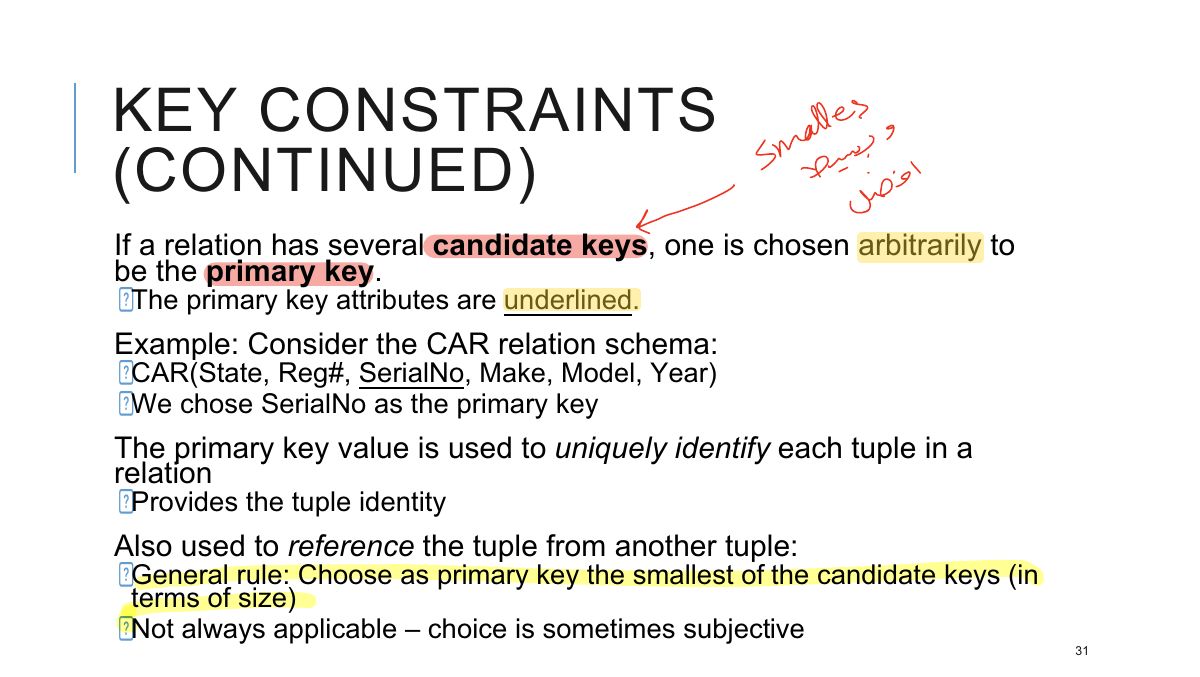
                                              Example: Consider the CAR relation schema:

                                               CAR(State, Reg#, SerialNo, Make, Model, Year)  CAR has two keys:

                                               Key1 = {State, Reg#}  Key2 = {SerialNo}

                                               Both are also superkeys of CAR  {SerialNo, Make} is a superkey but not a key.

                                              In general:

                                               Any key is a superkey (but not vice versa)  Any set of attributes that includes a key is a superkey  A minimal superkey is also a key

                                              30
                                              Exam weight High
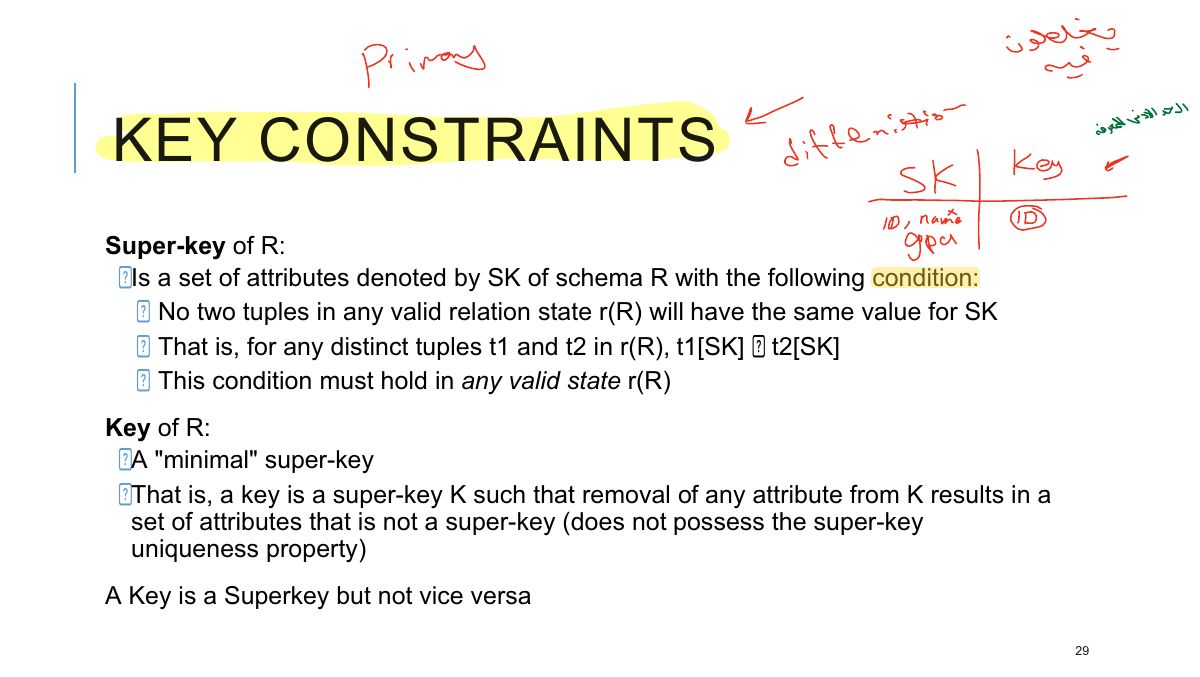
                                              1. Superkey: any set of attributes that is unique. Key (candidate key): a MINIMAL superkey. Primary key: the chosen candidate key (underlined).
                                              Exam trapEvery key is a superkey, but a superkey is a key only if no attribute can be removed.
                                              🎯 How this can come up · 1 question
                                              MCQ

                                              A minimal superkey is a:

                                              Slide 31: set
                                              Exam weight Low
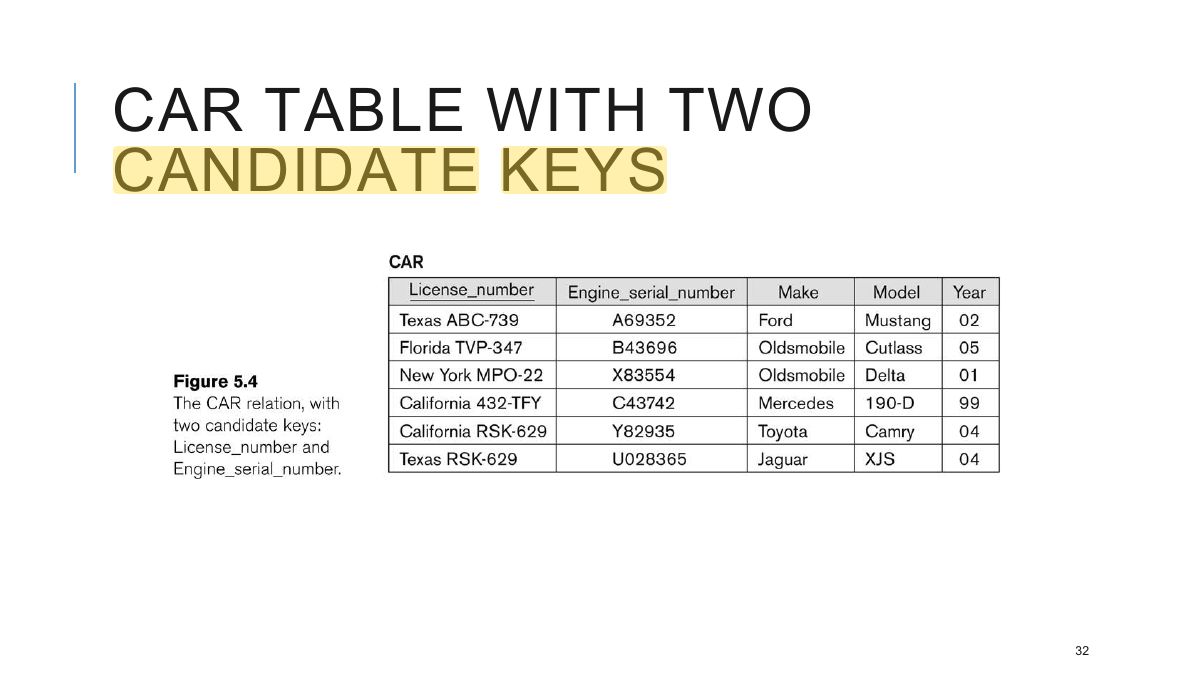
                                                Slide 32: CAR TABLE WITH TWO CANDIDATE KEYS
                                                Exam weight Low

                                                  ACTIVITY

                                                  Department(Dept_num, Dept_name, Location, Manager_name)

                                                  • Write the key, candidate keys, and super-keys for the Department relation.
                                                  • Write an appropriate domain for each attribute of the Department relation.
                                                  33
                                                  Exam weight Low

                                                    RELATIONAL DATABASE SCHEMA

                                                    S C H E M A Relational Database Schema:

                                                    A set S of relation schemas that belong to the same database.

                                                    S is the name of the whole database schema

                                                    S = {R1, R2, ..., Rn} and a set IC of integrity constraints.

                                                    R1, R2, ..., Rn are the names of the individual relation schemas within the database S

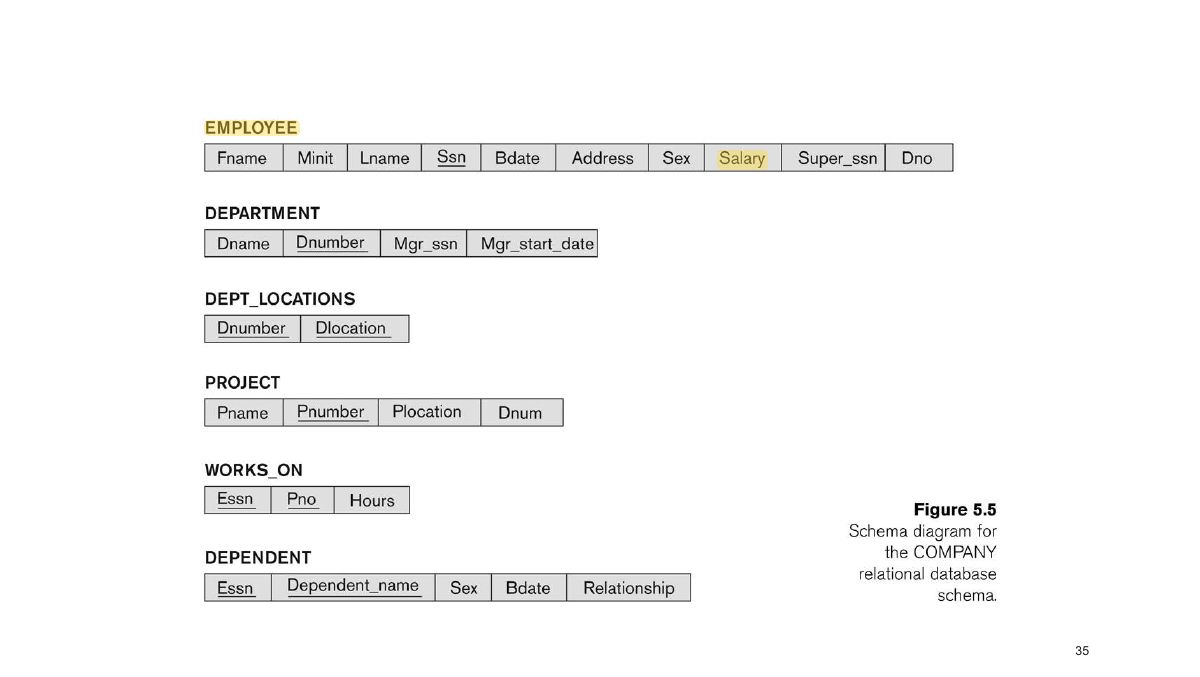
                                                    Following slide shows a COMPANY database schema with 6 relation schemas

                                                    34
                                                    Exam weight Low
                                                      Slide 35: Slide 35
                                                      Exam weight Low

                                                        RELATIONAL DATABASE STATE

                                                        A relational database state DB of S is a set of relation states DB = { r, r, ..., r } such that each r is a state of R and such that

                                                        1 2

                                                        m

                                                        i

                                                        i

                                                        the r relation states satisfy the integrity constraints specified in

                                                        i

                                                        IC.

                                                        A relational database state is sometimes called a relational database snapshot or instance.

                                                        We will not use the term

                                                        instance since it also applies to single

                                                        tuples.

                                                        A database state that does not meet the constraints is an invalid state

                                                        36
                                                        Exam weight Low

                                                          POPULATED DATABASE STATE

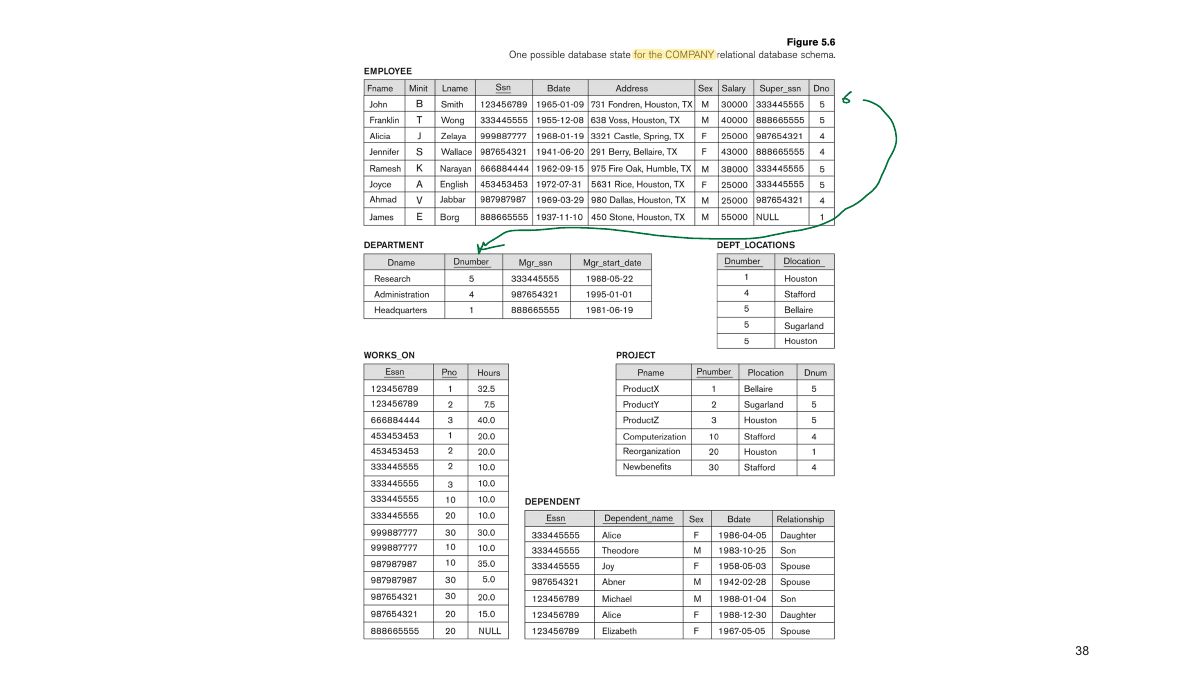
                                                          S T A T E Each relation will have many tuples in its current relation state The relational database state is a union of all the individual relation states Whenever the database is changed, a new state arises Basic operations for changing the database:

                                                          INSERT a new tuple in a relation

                                                          DELETE an existing tuple from a relation

                                                          MODIFY an attribute of an existing tuple

                                                          Next slide (Fig. 5.6) shows an example state for the COMPANY database schema shown in Fig. 5.5.

                                                          37
                                                          Exam weight Low
                                                            Slide 38: Slide 38
                                                            Exam weight Low
                                                              Slide 39: Eat
                                                              Exam weight Low
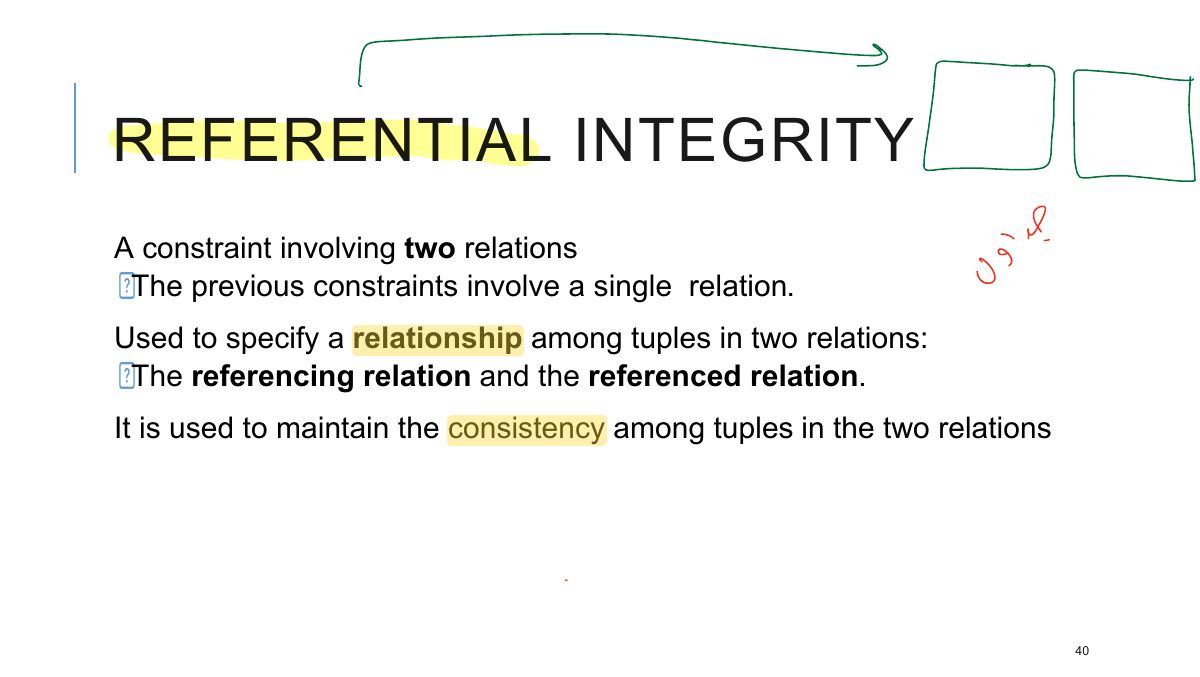
                                                                Slide 40: o
                                                                Exam weight Low
                                                                  ★ Past exam

                                                                  REFERENTIAL INTEGRITY

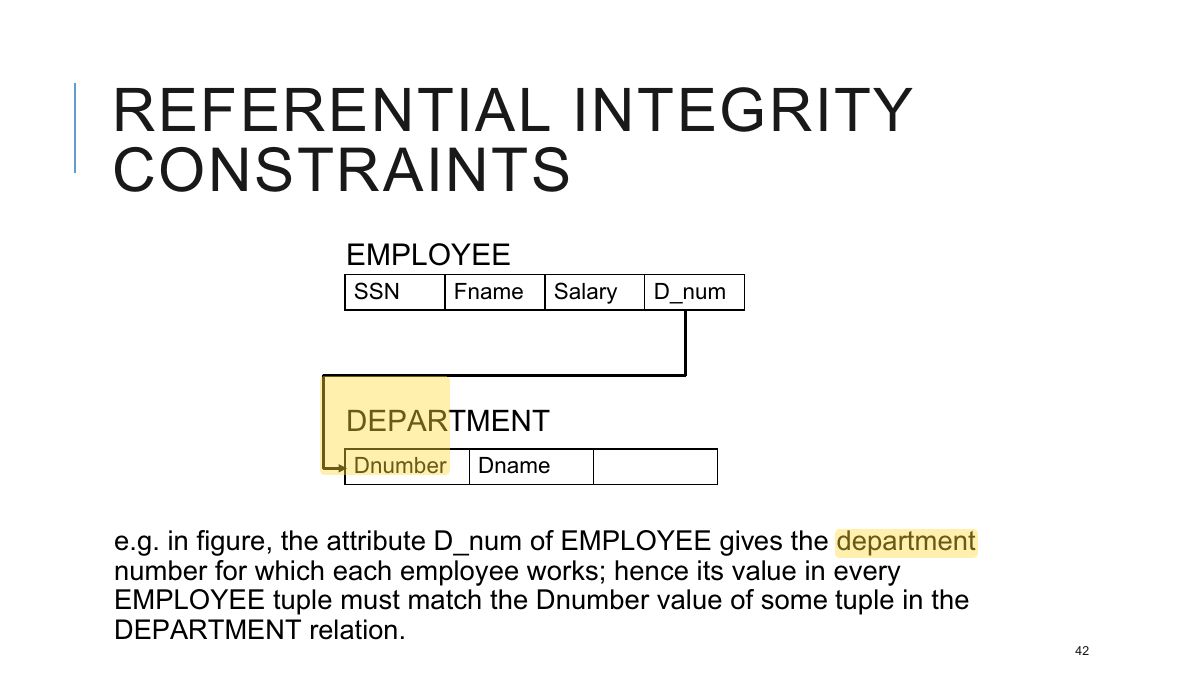
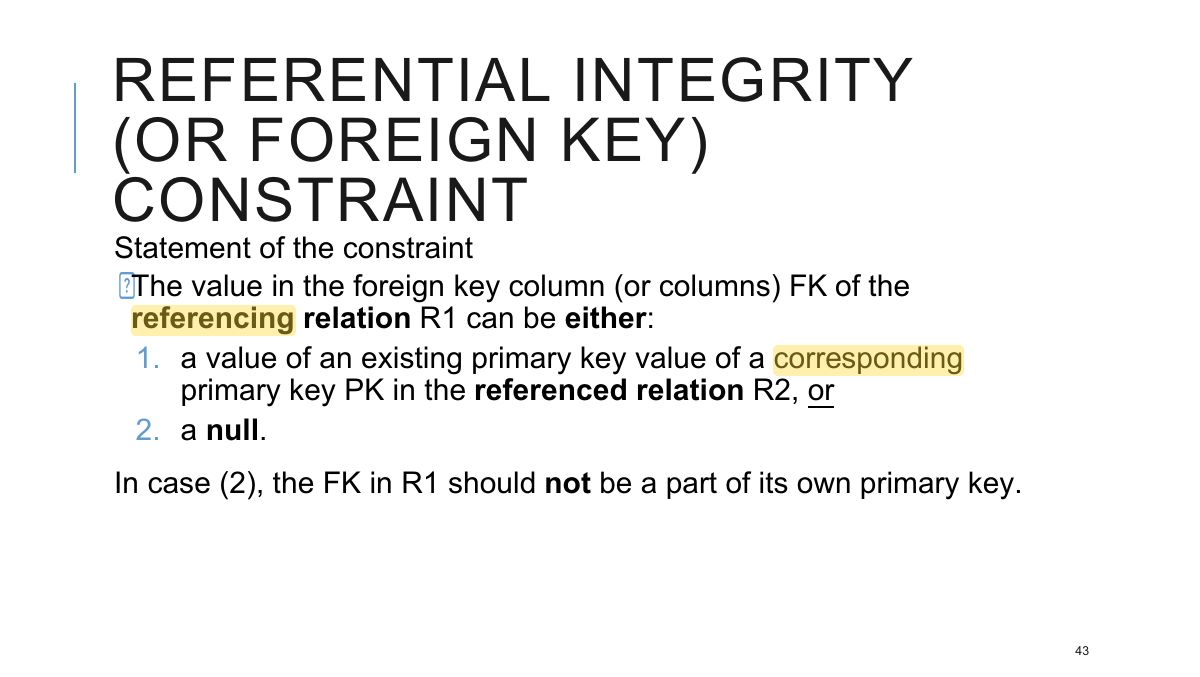
                                                                  Tuples in the referencing relation R1 have attributes FK (called foreign key attributes) that reference the primary key attributes PK of the referenced relation R2.

                                                                  A tuple t1 in R1 is said to reference a tuple t2 in R2 if t1[FK] = t2[PK].

                                                                  A referential integrity constraint can be displayed in a relational database schema as a directed arc from R1.FK to R2.

                                                                  41
                                                                  Exam weight High
                                                                  1. Referential integrity: a foreign key value must match an existing primary key in the referenced relation, or be NULL.
                                                                  🎯 How this can come up · 1 question
                                                                  MCQ

                                                                  The primary function of a foreign key is to:

                                                                  Slide 42: REFERENTIAL INTEGRITY CONSTRAINTS
                                                                  Exam weight Low
                                                                    Slide 43: REFERENTIAL INTEGRITY (OR FOREIGN KEY) CONSTRAINT
                                                                    Exam weight Low

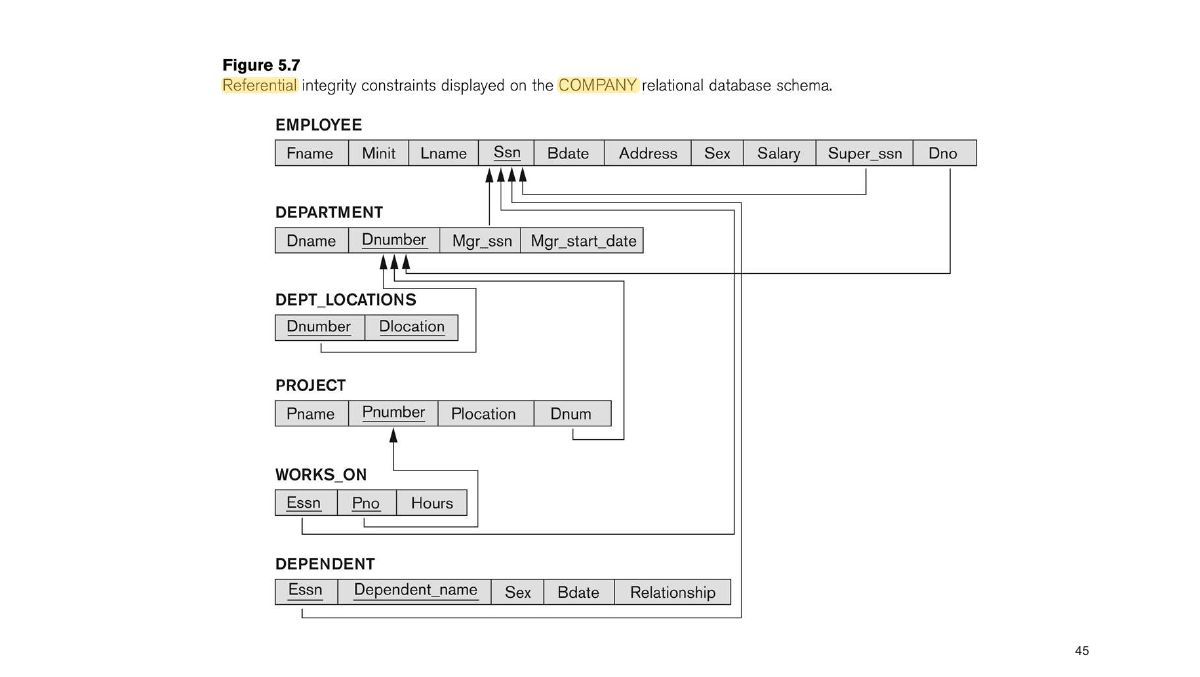
                                                                      DISPLAYING A RELATIONAL DATABASE SCHEMA AND ITS CONSTRAINTS

                                                                      Each relation schema can be displayed as a row of attribute names The name of the relation is written above the attribute names The primary key attribute (or attributes) will be underlined A A foreign key (referential integrity) constraints is displayed as a directed arc (arrow) from the foreign key attributes to the referenced table  Can also point the the primary key of the referenced relation for

                                                                      clarity

                                                                      Next slide shows the COMPANY relational schema diagram with referential integrity constraints

                                                                      44
                                                                      Exam weight Low
                                                                        Slide 45: Slide 45
                                                                        Exam weight Low
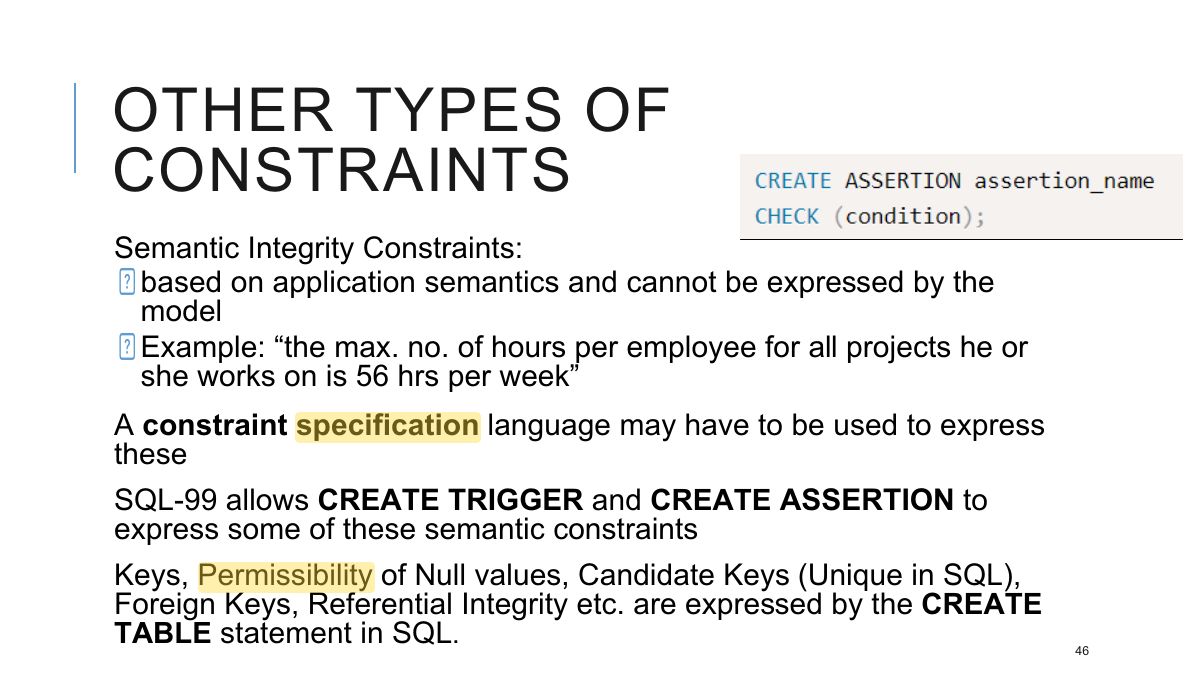
                                                                          Slide 46: OTHER TYPES OF CONSTRAINTS
                                                                          Exam weight Low
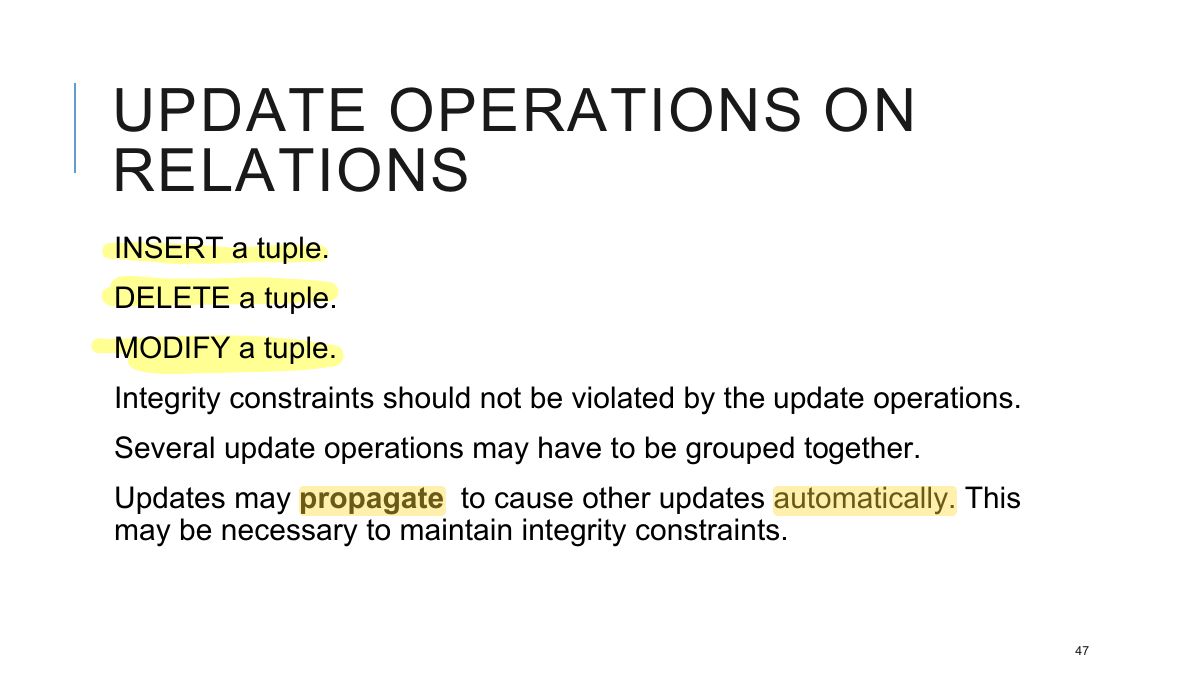
                                                                            Slide 47: UPDATE OPERATIONS ON RELATIONS
                                                                            Exam weight High
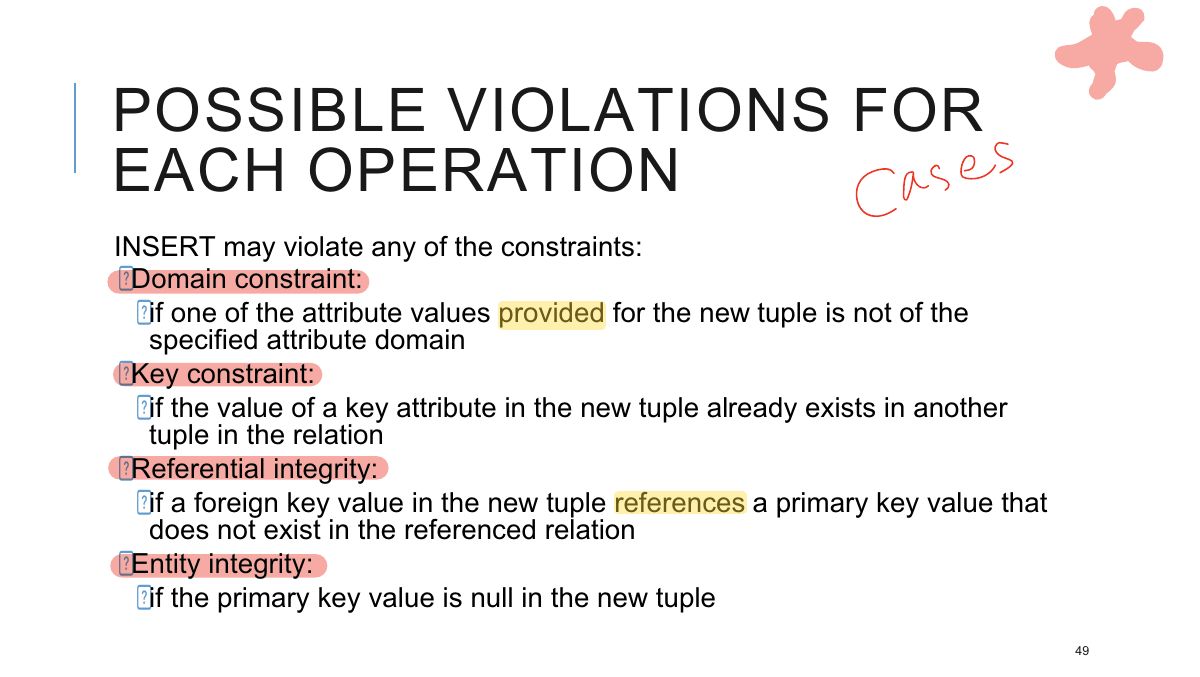
                                                                            1. Insert, delete, update can violate constraints. Insert: domain, key, entity, referential. Delete: only referential.
                                                                            🎯 How this can come up · 1 question
                                                                            MCQ

                                                                            Deleting a DEPARTMENT row that employees still reference violates:

                                                                            UPDATE OPERATIONS ON RELATIONS

                                                                            In case of integrity violation, several actions can be taken:

                                                                             Cancel the operation that causes the violation (RESTRICT or

                                                                            REJECT option)

                                                                             Perform the operation but inform the user of the violation  Trigger additional updates so the violation is corrected (CASCADE

                                                                            option, SET NULL option)

                                                                             Execute a user-specified error-correction routine

                                                                            48
                                                                            Exam weight Low
                                                                              Slide 49: cases
                                                                              Exam weight Low

                                                                                POSSIBLE VIOLATIONS FOR EACH OPERATION

                                                                                DELETE may violate only referential integrity:

                                                                                If the primary key value of the tuple being deleted is referenced from other tuples in the database  Can be remedied by several actions: RESTRICT, CASCADE, SET NULL (see

                                                                                Chapter 6 for more details)  RESTRICT option: reject the deletion  CASCADE option: propagate the new primary key value into the foreign keys of the

                                                                                referencing tuples

                                                                                 SET NULL option: set the foreign keys of the referencing tuples to NULL

                                                                                One of the above options must be specified during database design for each foreign key constraint.

                                                                                on delete set null.

                                                                                on delete cascade

                                                                                50
                                                                                Exam weight Low
                                                                                1. On a referential violation from delete: RESTRICT (reject), CASCADE (delete the referencing rows), SET NULL / SET DEFAULT.

                                                                                THE DELETE OPERATION

                                                                                Delete the WORKS_ON tuple with Essn =‘999887777’ and Pno = 10 The seletion is acceptable and deletes exactly one tuple Delete the EMPLOYEE tuple with Ssn = ‘999887777’ This deletion is unacceptable, because there are tuples in WORK_ON that refer to this tuple. Hence if the tuple in EMPLOYEE is deleted, referential integrity violations will result.

                                                                                Delete the EMPLOYEE tuple with Ssn = ‘333445555’ The deletion is unacceptable because the tuple involved is referenced by tuples from the EMPLOYEE, DEPARTMENT, WORKS_ON and DEPENDENT relation.

                                                                                51
                                                                                Exam weight Low

                                                                                  POSSIBLE VIOLATIONS FOR EACH OPERATION

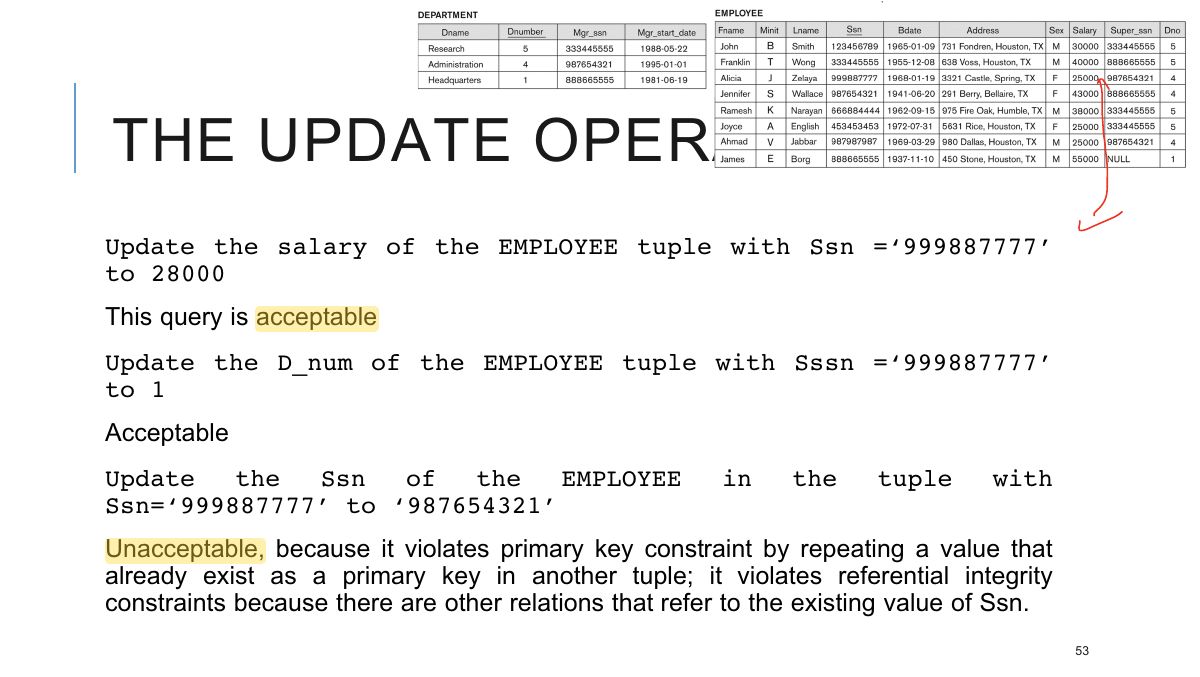
                                                                                  UPDATE may violate domain constraint and NOT NULL constraint on an attribute being modified Any of the other constraints may also be violated, depending on the attribute being updated:

                                                                                  Updating the primary key (PK):

                                                                                  Similar to a DELETE followed by an INSERT

                                                                                  Need to specify similar options to DELETE

                                                                                  Updating a foreign key (FK):

                                                                                  May violate referential integrity

                                                                                  Updating an ordinary attribute (neither PK nor FK):

                                                                                  Can only violate domain constraints

                                                                                  52
                                                                                  Exam weight Low
                                                                                    Slide 53: t
                                                                                    Exam weight Low

                                                                                      ACTIVITY

                                                                                      Consider the following relations for a database that keeps track of student enrollment in courses and the books adopted for each course:

                                                                                      STUDENT(SSN, Name, Major, Bdate) COURSE(Course#, Cname, Dept) ENROLL(SSN, Course#, Quarter, Grade) BOOK_ADOPTION(Course#, Quarter, Book_ISBN) TEXT(Book_ISBN, Book_Title, Publisher, Author) Draw a relational schema diagram specifying the foreign keys for this schema.

                                                                                      54
                                                                                      Exam weight Low

                                                                                        NEXT..

                                                                                        We have also looked at all possible constraints in the database.

                                                                                        We will look at some DBMS components next.

                                                                                        55
                                                                                        Exam weight Low
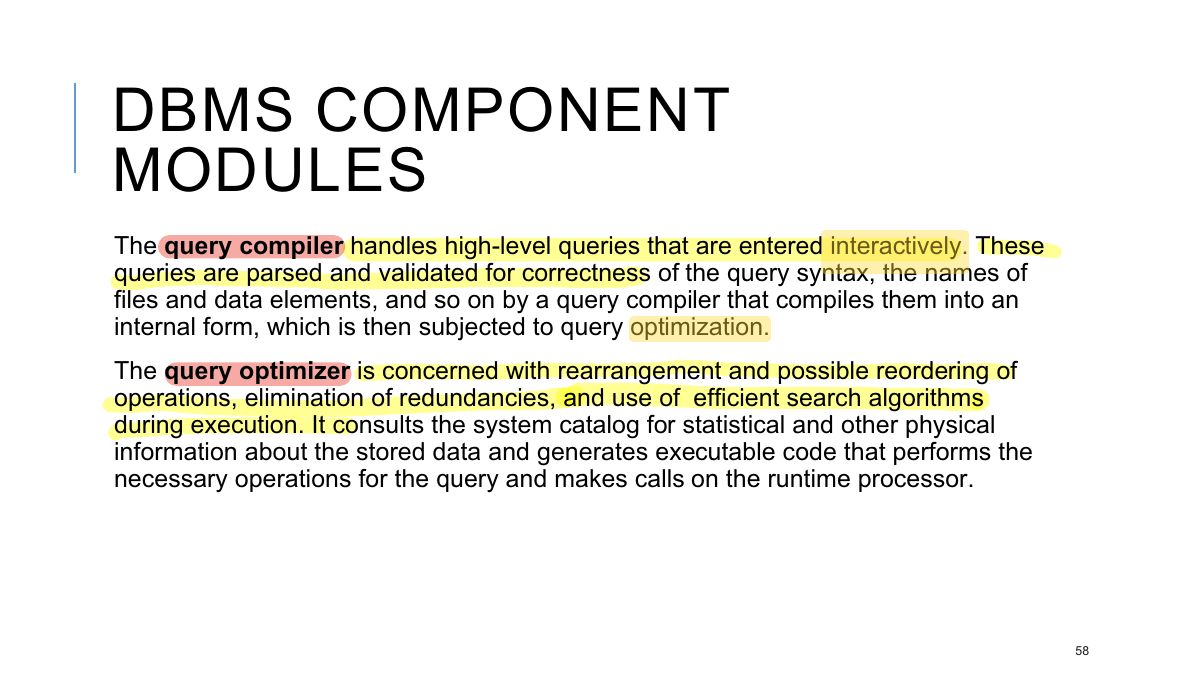
                                                                                          Slide 56: TYPICAL DBMS COMPONENT MODULES
                                                                                          Exam weight Low
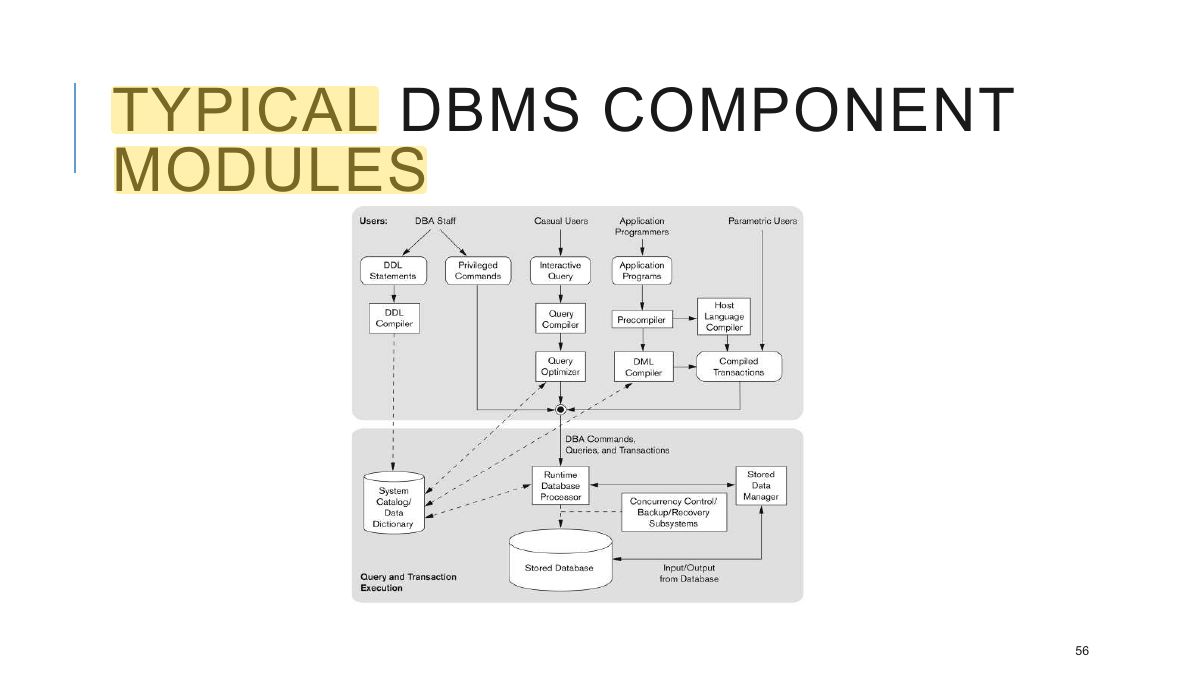
                                                                                          1. DBMS modules: DDL compiler, query compiler and optimizer, runtime processor, stored data manager, concurrency/recovery.

                                                                                          DBMS COMPONENT MODULES

                                                                                          The database and DBMS catalog are usually stored on disk.

                                                                                          Access to the disk is controlled by the operating system (OS) which schedules disk read/write.

                                                                                          A higher-level, stored data manager module (component) controls access to DBMS information that is stored on disk, whether it is part of the database or the catalog.

                                                                                          DBMS has interfaces for the DBA staff who work on defining the database and tuning it by making changes to its definition using the DDL and other privileged commands.

                                                                                          57
                                                                                          Exam weight Low
                                                                                            Slide 58: DBMS COMPONENT MODULES
                                                                                            Exam weight Low

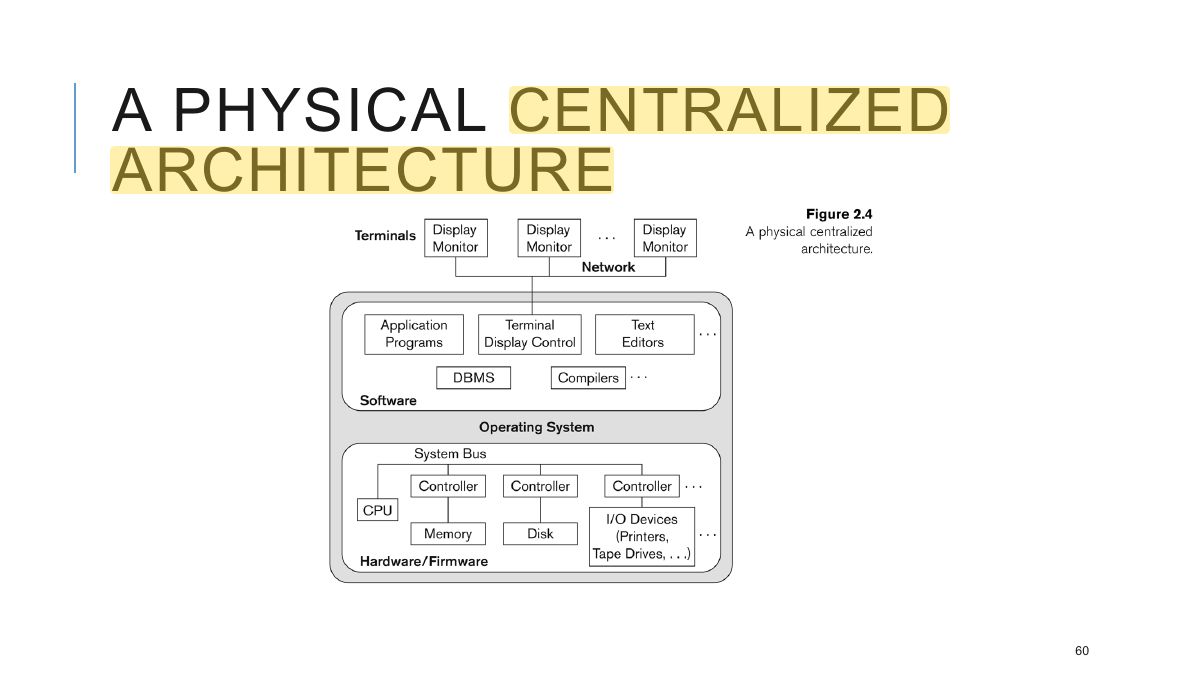
                                                                                              CENTRALIZED AND CLIENT- SERVER DBMS ARCHITECTURES

                                                                                              Centralized DBMS:

                                                                                              Combines everything into single system including- DBMS software, hardware, application programs, and user interface processing software.

                                                                                              User can still connect through a remote terminal – however, all processing is done at centralized site.

                                                                                              59
                                                                                              Exam weight Low
                                                                                                Slide 60: A PHYSICAL CENTRALIZED ARCHITECTURE
                                                                                                Exam weight Low

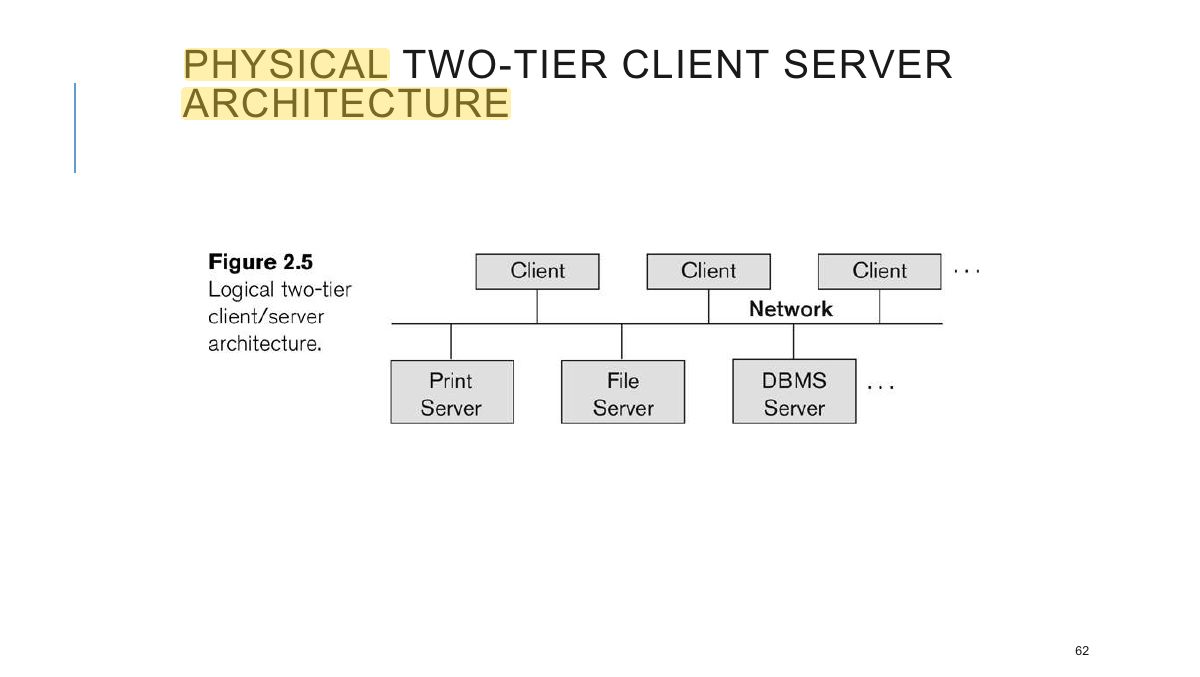
                                                                                                  BASIC 2-TIER CLIENT- SERVER ARCHITECTURES

                                                                                                  Specialized Servers with Specialized functions 

                                                                                                  Print server

                                                                                                  File server

                                                                                                  DBMS server

                                                                                                  Web server

                                                                                                  Email server

                                                                                                  Clients can access the specialized servers as needed

                                                                                                  61
                                                                                                  Exam weight Low
                                                                                                  1. Two-tier: client (UI + application) talks directly to the DB server.
                                                                                                  Slide 62: PHYSICAL TWO-TIER CLIENT SERVER ARCHITECTURE
                                                                                                  Exam weight Low

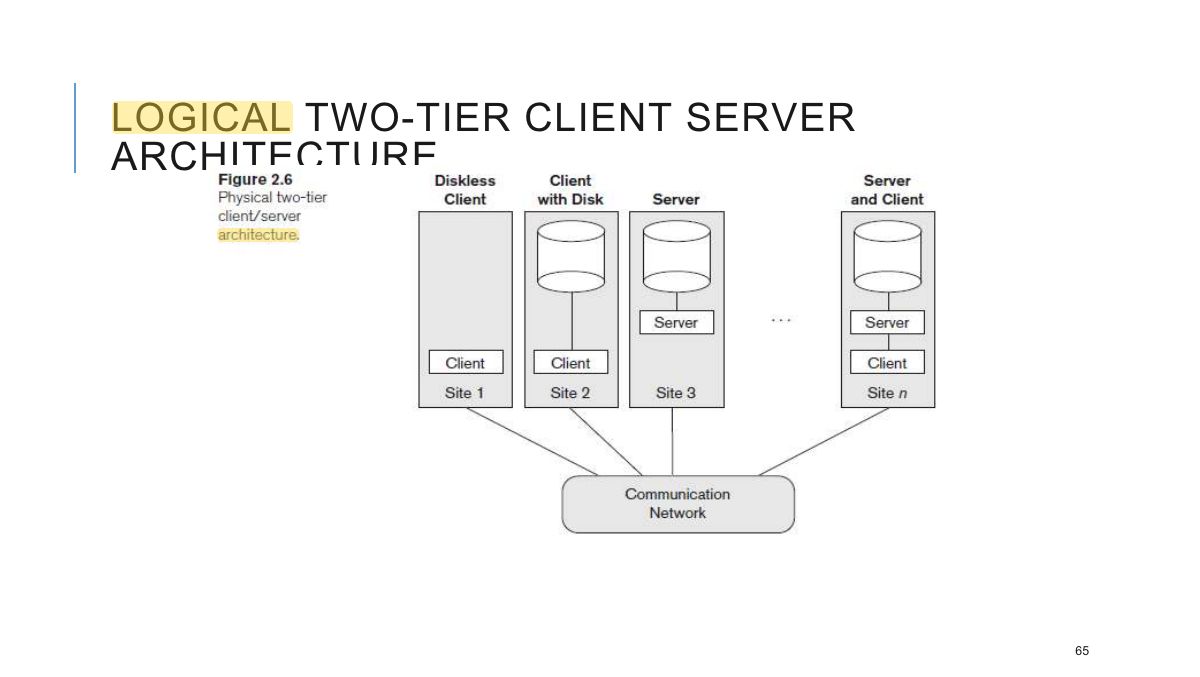
                                                                                                    CLIENTS

                                                                                                    Provide appropriate interfaces through a client software module to access and utilize the various server resources.

                                                                                                    Clients may be diskless machines or PCs or Workstations with disks with only the client software installed.

                                                                                                    Connected to the servers via some form of a network.

                                                                                                    (LAN: local area network, wireless network, etc.)

                                                                                                    63
                                                                                                    Exam weight Low

                                                                                                      DBMS SERVER

                                                                                                      Provides database query and transaction services to the clients Relational DBMS servers are often called SQL servers, query servers, or transaction servers Applications running on clients utilize an Application Program Interface (API) to access server databases via standard interface such as:

                                                                                                      ODBC: Open Database Connectivity standard

                                                                                                      JDBC: for Java programming access

                                                                                                      64
                                                                                                      Exam weight Low
                                                                                                        Slide 65: LOGICAL TWO-TIER CLIENT SERVER ARCHITECTURE
                                                                                                        Exam weight Low
                                                                                                          ★ Past exam
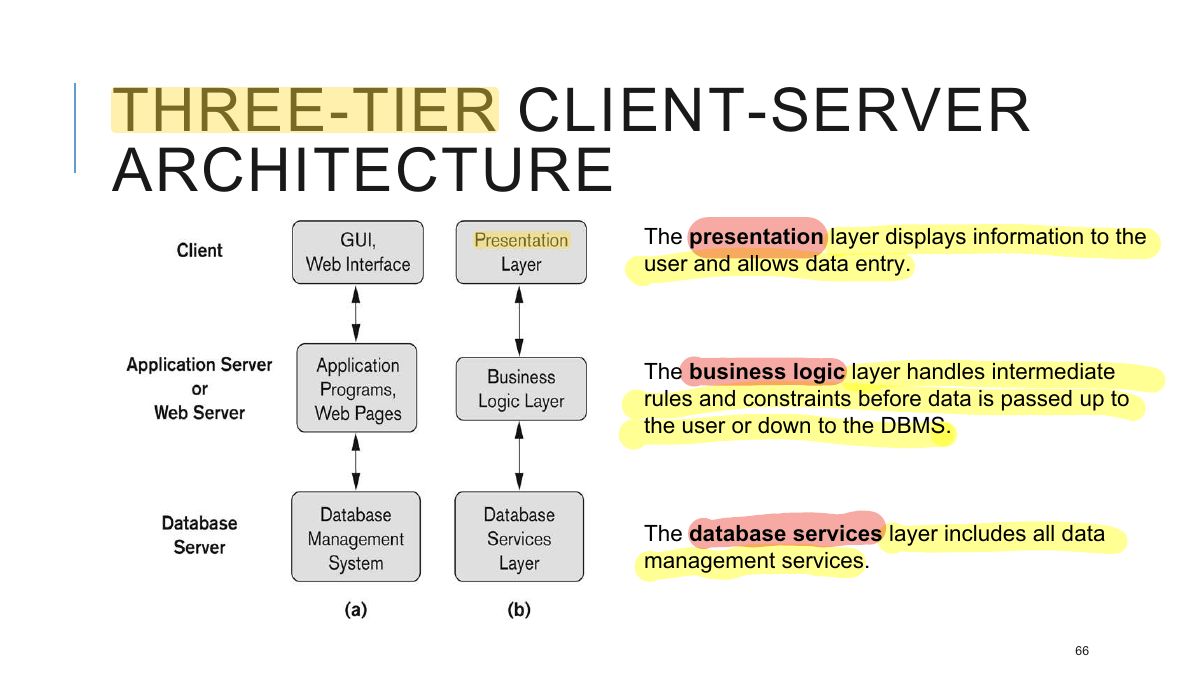
                                                                                                          Slide 66: THREE-TIER CLIENT-SERVER ARCHITECTURE
                                                                                                          Exam weight High
                                                                                                          1. Three-tier: client → application (web) server with business logic → database server. Typical for web apps.
                                                                                                          🎯 How this can come up · 1 question
                                                                                                          MCQ

                                                                                                          In a three-tier architecture, business logic lives in:

                                                                                                          THREE TIER CLIENT-SERVER ARCHITECTURE

                                                                                                          The emergence of web changed the roles of client and server.

                                                                                                          Common for Web applications Three-tier architecture is a well-established software application architecture that organizes applications into three logical and physical computing tiers: the presentation tier, or user interface; the application tier, where data is processed; and the data tier, where the data associated with the application is stored and managed.

                                                                                                          The chief benefit of three-tier architecture is that because each tier runs on its own infrastructure, each tier can be developed simultaneously by a separate development team, and can be updated or scaled as needed without impacting the other tiers.

                                                                                                          67
                                                                                                          Exam weight Low

                                                                                                            THREE TIER CLIENT-SERVER ARCHITECTURE

                                                                                                            Intermediate Layer called Application Server or Web Server:

                                                                                                            Stores the web connectivity software and the business logic part of the application used to access the corresponding data from the database server

                                                                                                            Acts like a conduit for sending partially processed data between the database server and the client.

                                                                                                            Three-tier Architecture Can Enhance Security:

                                                                                                            Database server only accessible via middle tier

                                                                                                            Clients cannot directly access database server

                                                                                                            Clients contain user interfaces and Web browsers

                                                                                                            The client is typically a PC or a mobile device connected to the Web

                                                                                                            68
                                                                                                            Exam weight Low

                                                                                                              THREE TIER CLIENT-SERVER ARCHITECTURE

                                                                                                              Faster development: Because each tier can be developed simultaneously by different teams, an organization can bring the application to market faster, and programmers can use the latest and best languages and tools for each tier.

                                                                                                              Improved scalability: Any tier can be scaled independently of the others as needed.

                                                                                                              Improved reliability: An outage in one tier is less likely to impact the availability or performance of the other tiers.

                                                                                                              Improved security: Because the presentation tier and data tier can't communicate directly, a well-designed application tier can function as a sort of internal firewall, preventing SQL injections and other malicious exploits.

                                                                                                              69
                                                                                                              Exam weight Low

                                                                                                                SUMMARY

                                                                                                                Presented Relational Model Concepts 

                                                                                                                Definitions

                                                                                                                Characteristics of relations

                                                                                                                Discussed Relational Model Constraints and Relational Database Schemas 

                                                                                                                Domain constraints

                                                                                                                Key constraints

                                                                                                                Entity integrity

                                                                                                                Referential integrity

                                                                                                                Described the Relational Update Operations and Dealing with Constraint Violations

                                                                                                                70
                                                                                                                Exam weight Low