CS330 · Annotated SlidesChapter 12 — File-System Implementation
Chapter 12 · Annotated slides

File-System Implementation

On-disk and in-memory file-system structures, the allocation methods (contiguous, linked, FAT, indexed and the UNIX combined scheme), and free-space management with bit vectors, linked lists, grouping and counting.
Slide text Study notes Highlight: key words Tips, tricks & traps Seen again elsewhere How it can come up
Slide 1: Slide 1
Exam weight Low

    Outline of this lecture

    In this lecture, we will discuss the following:

    • File-System Implementation
    • Directory Implementation
    • Allocation Methods
    • Free-Space Management
    2
    Exam weight Low

      Objectives

       To describe the details of implementing local

      file systems and directory structures

       To discuss block allocation and free-block

      algorithms and trade-offs

      3
      Exam weight Low

        File System Implementation

         The implementation must

        Keep track of the files and directories stored in the file

        system, i.e. which disk blocks/sectors store the file data.

        Keep track of the free blocks/sectors in the disk.

         Structures used for implementing FS:

        on-disk structure – fast,

        1.

        2.

        in-memory structure

        4
        Exam weight Low

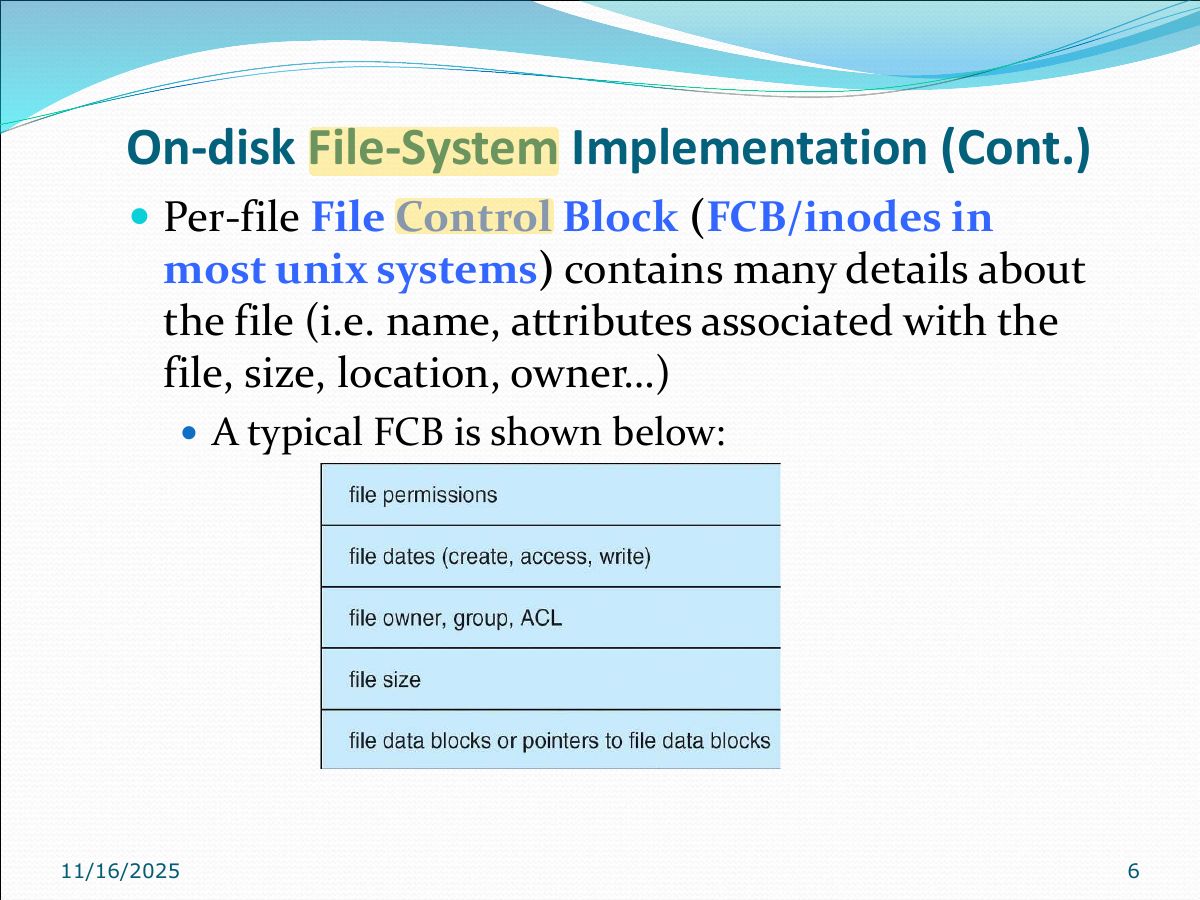
          on-disk File-System Implementation

           There are various on disk data structures

          that are used

          to implement a file system. This structure may vary depending upon the OS. The FS may contain info about

          Boot control block (Boot Sector) contains info

          needed by system to boot OS from that volume

          Needed if volume contains OS, usually first block of volume

          Volume control block (superblock, master file

          table) contains volume (partitions) details

          Total # of blocks, # of free blocks, block size, free block

          pointers or array

          Directory structure

          is used to organize the files -

          all

          starting with the root directory

          In UNIX, it includes inode numbers associated to file names.

          5
          Exam weight Low
          1. On disk: boot control block, volume control block (superblock), directory structure, per-file FCB (inode).
          Slide 6: On-disk File-System Implementation (Cont.)
          Exam weight Low

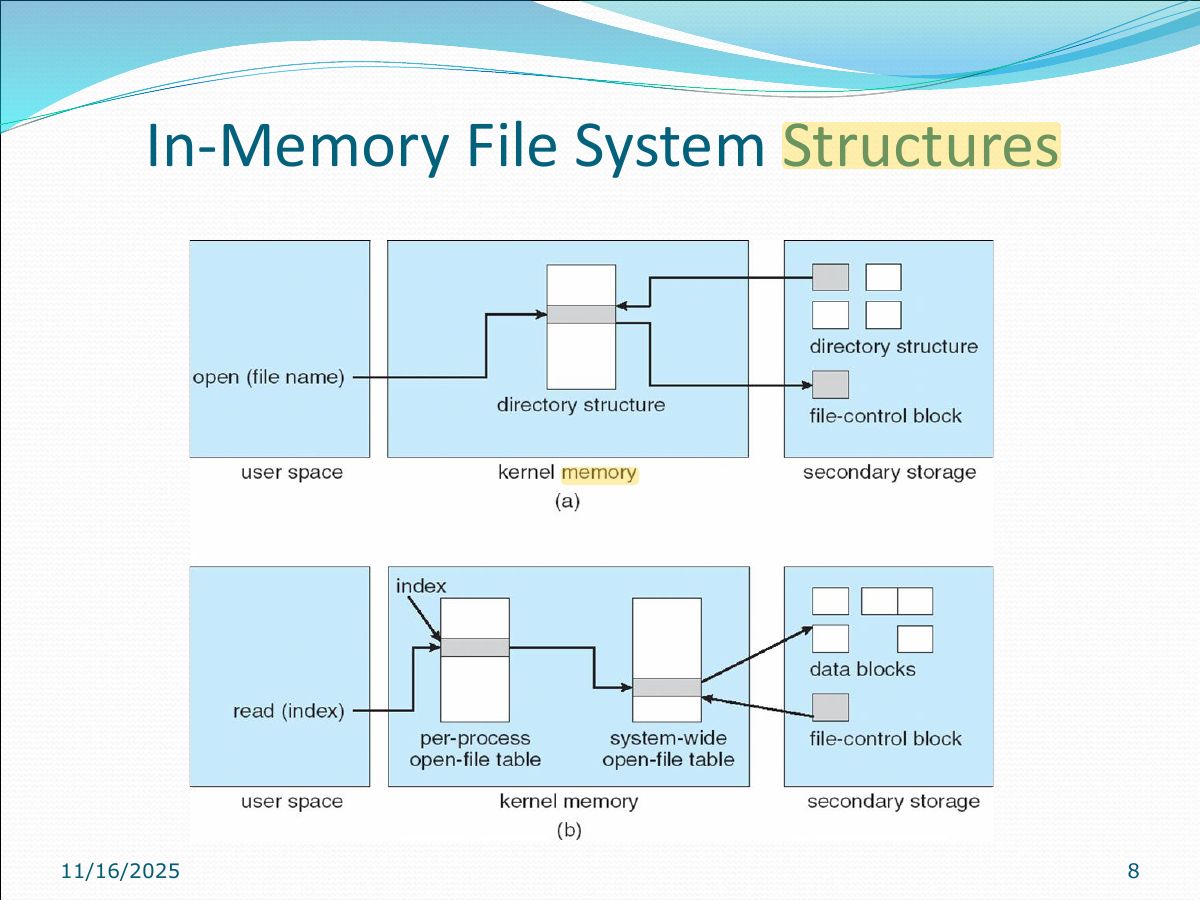
            In-Memory File System Structures

            A mount table – contains information about each mounted volume- list of all the devices which are being mounted to the system.

            A directory structure cache – info about recently accessed directories by the CPU.

            A system-wide open file table contains a copy of the

            FCB of all open file in the system and other info.

            process file info)

            A per-process open-file table (1 contains a pointer to the appropriate entry in the system-wide open-file table and other info.

            Buffers that hold file-system blocks as they are being

            read and written to the disk.

            7
            Exam weight Low
            1. In memory: mount table, directory cache, system-wide and per-process open-file tables.
            Slide 8: In-Memory File System Structures
            Exam weight Low
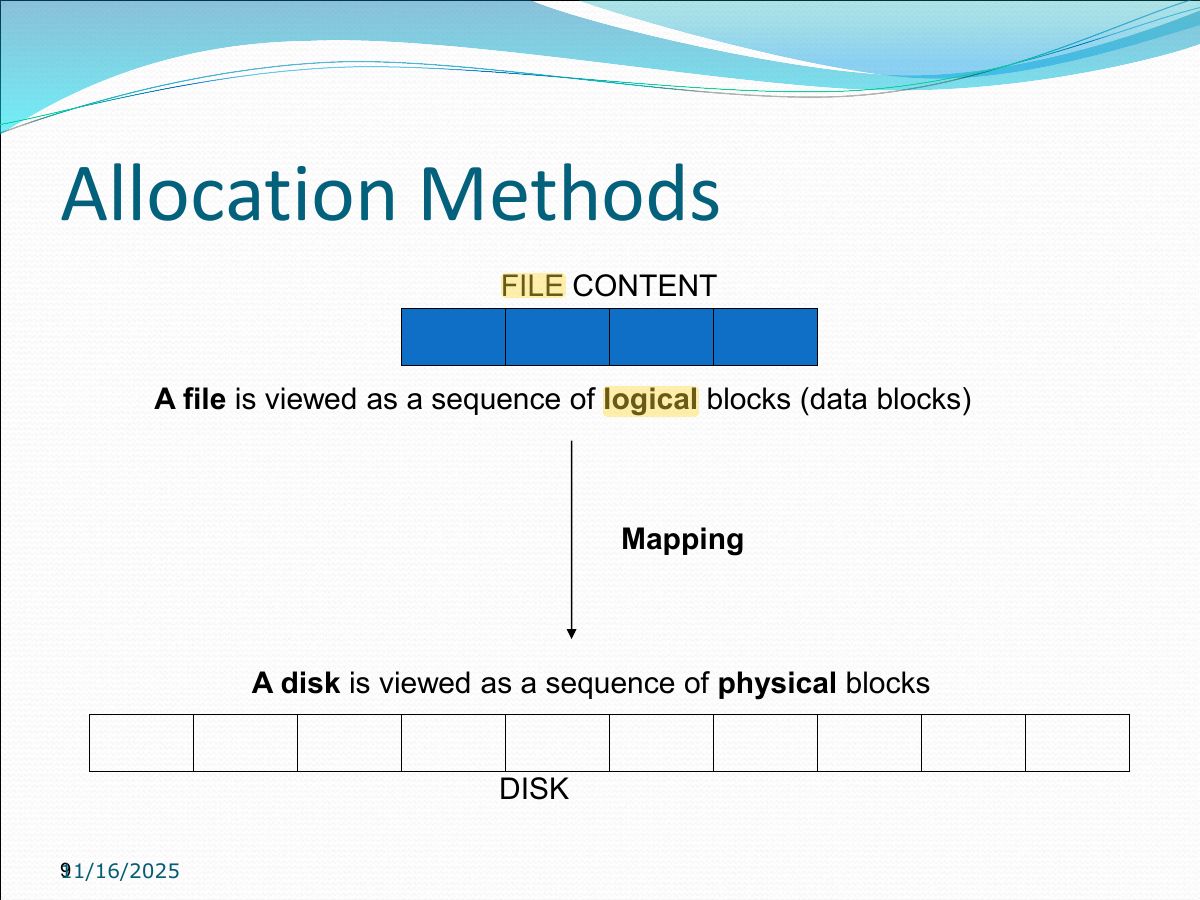
              Slide 9: Allocation Methods
              Exam weight Low
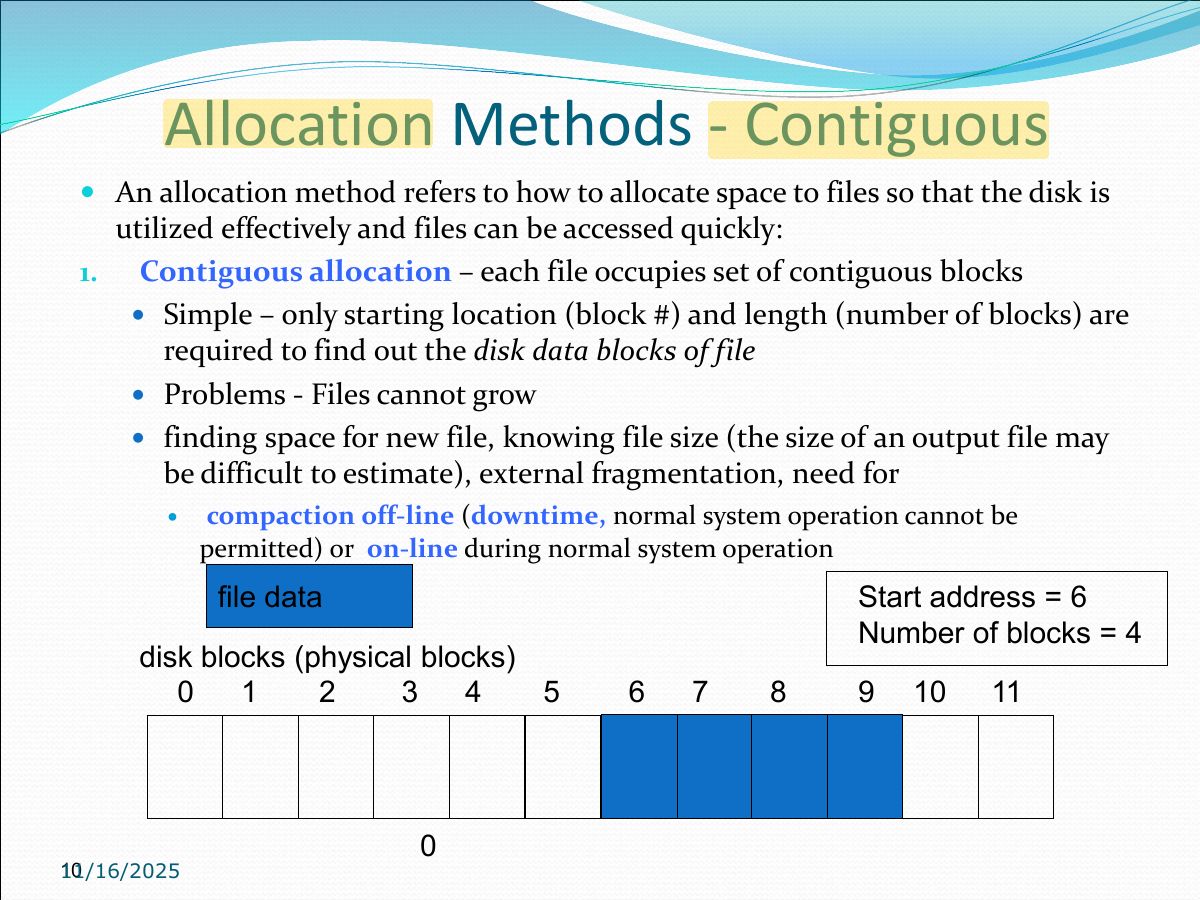
                Slide 10: Allocation Methods - Contiguous
                Exam weight High
                1. Contiguous: each file occupies consecutive blocks (start, length). Fast sequential and direct access; external fragmentation, hard to grow.
                🎯 How this can come up · 1 question
                MCQ

                Which allocation method suffers from external fragmentation?

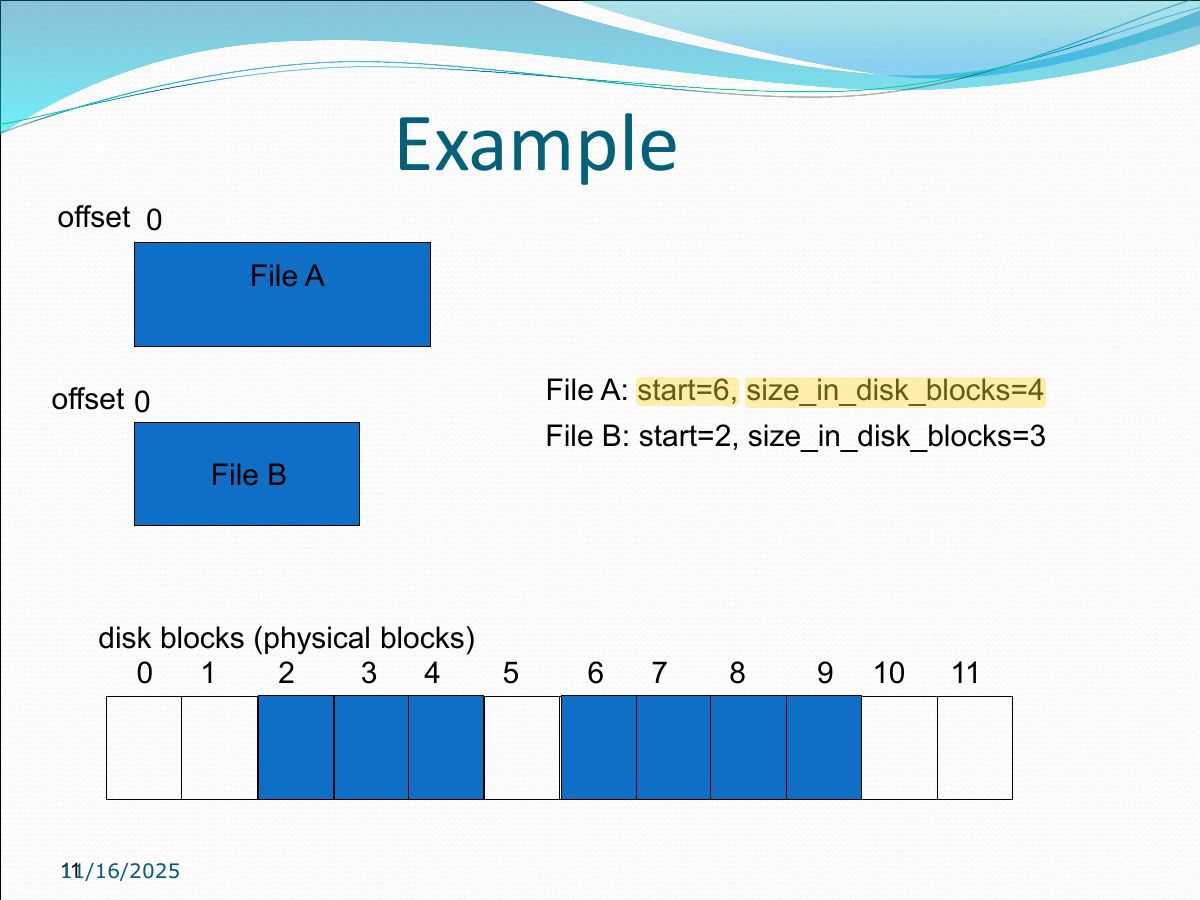
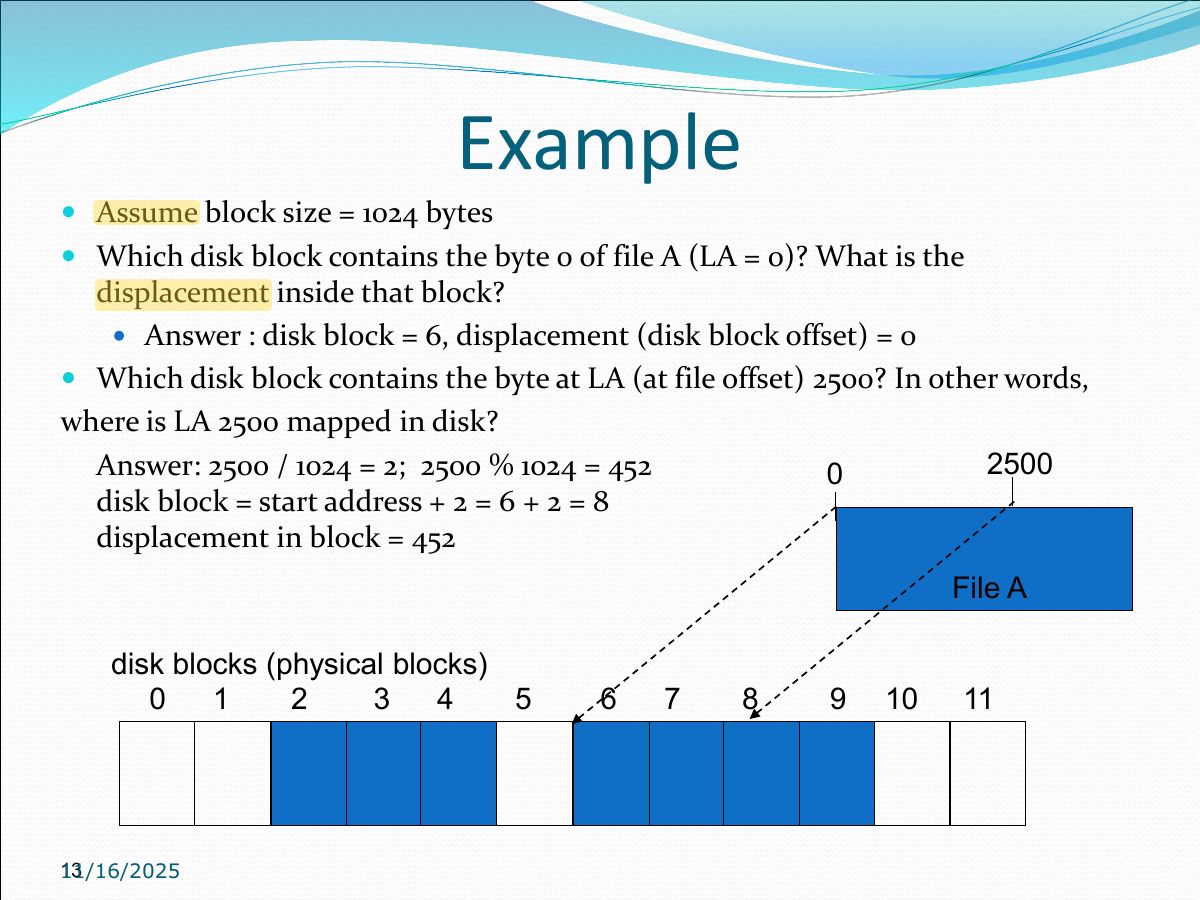
                Slide 11: Example
                Exam weight Low
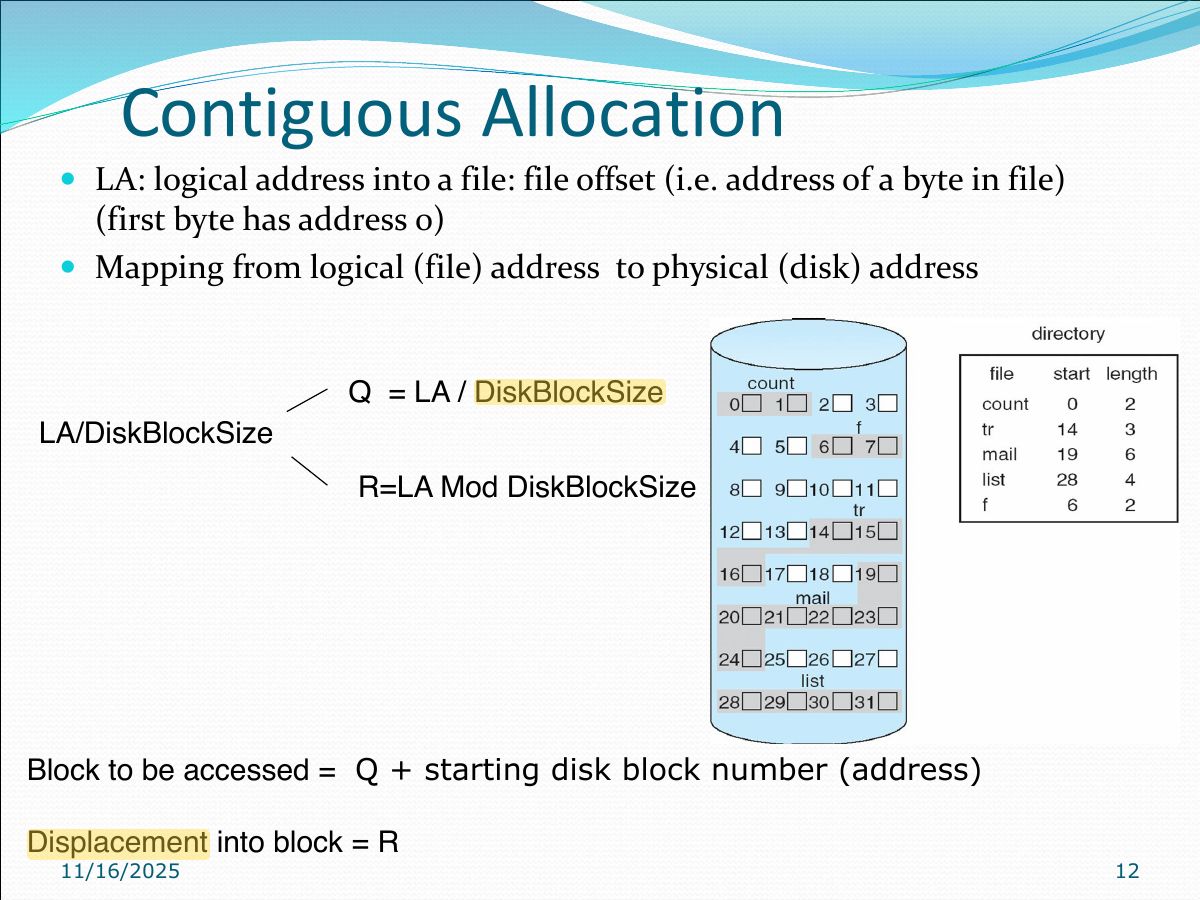
                  Slide 12: Contiguous Allocation
                  Exam weight Low
                    Slide 13: Example
                    Exam weight Low
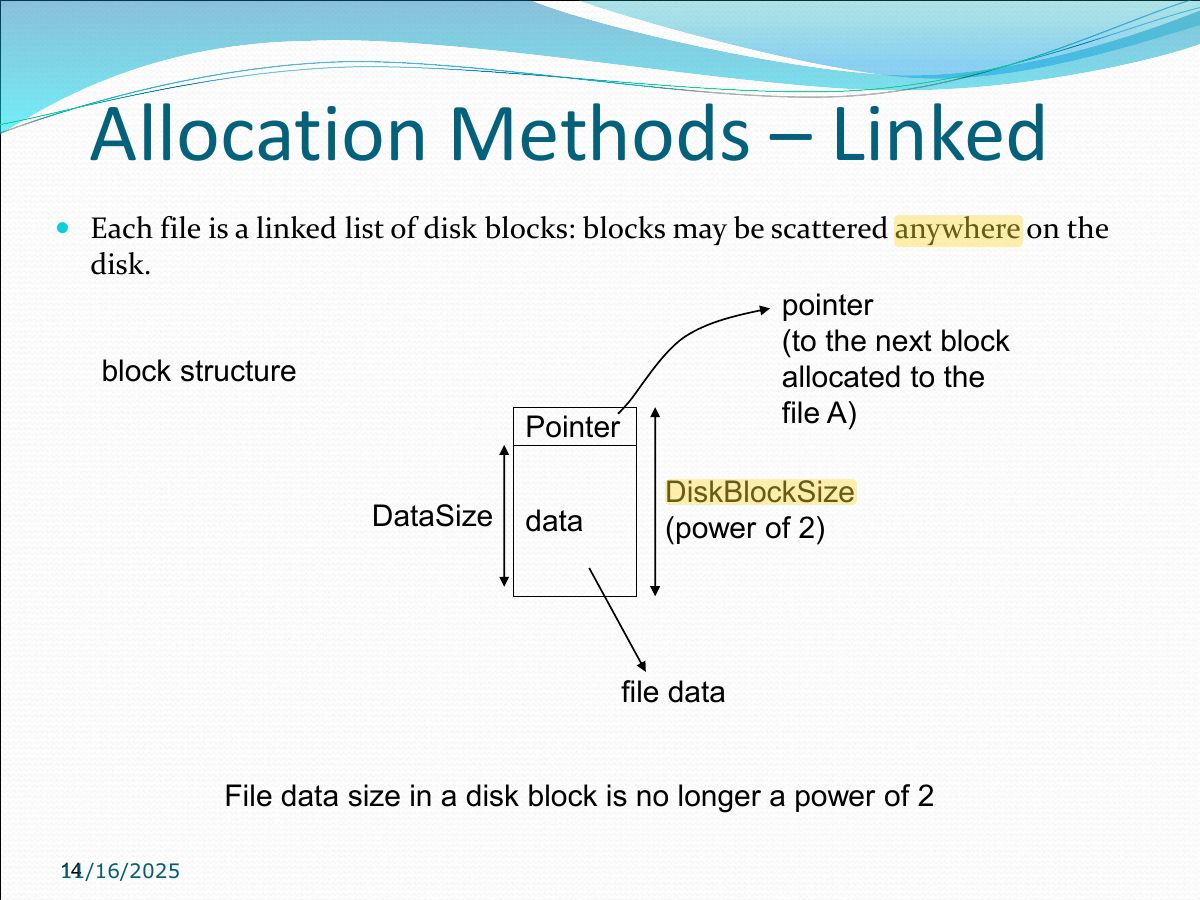
                      Slide 14: Allocation Methods – Linked
                      Exam weight High
                      1. Linked: each block points to the next. No external fragmentation, but direct access is slow and a lost pointer breaks the chain.
                      🎯 How this can come up · 1 question
                      True / False

                      Linked allocation supports efficient direct access.

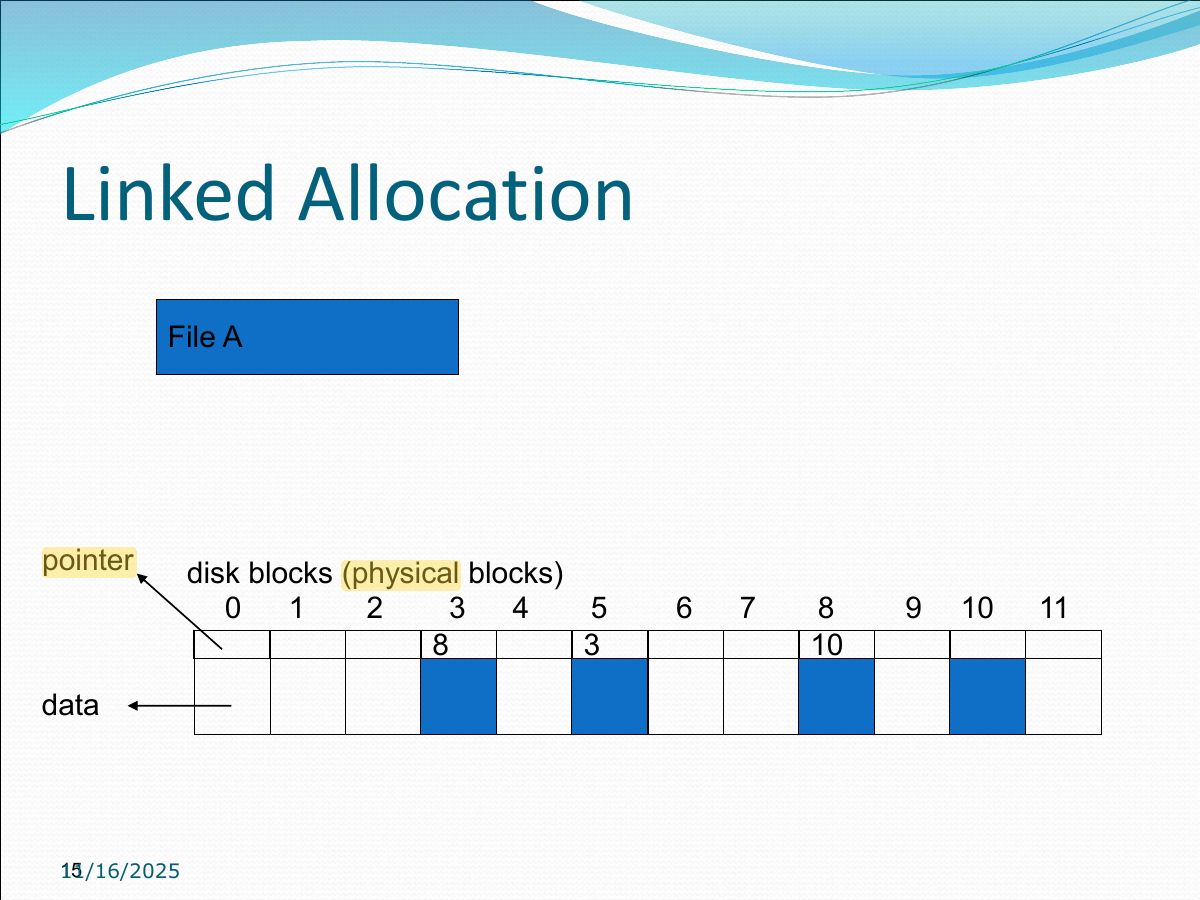
                      Slide 15: Linked Allocation
                      Exam weight Low

                        Linked Allocation

                        2. Linked allocation – solves all problems of contiguous allocation.

                        No external fragmentation

                        No compaction, external fragmentation

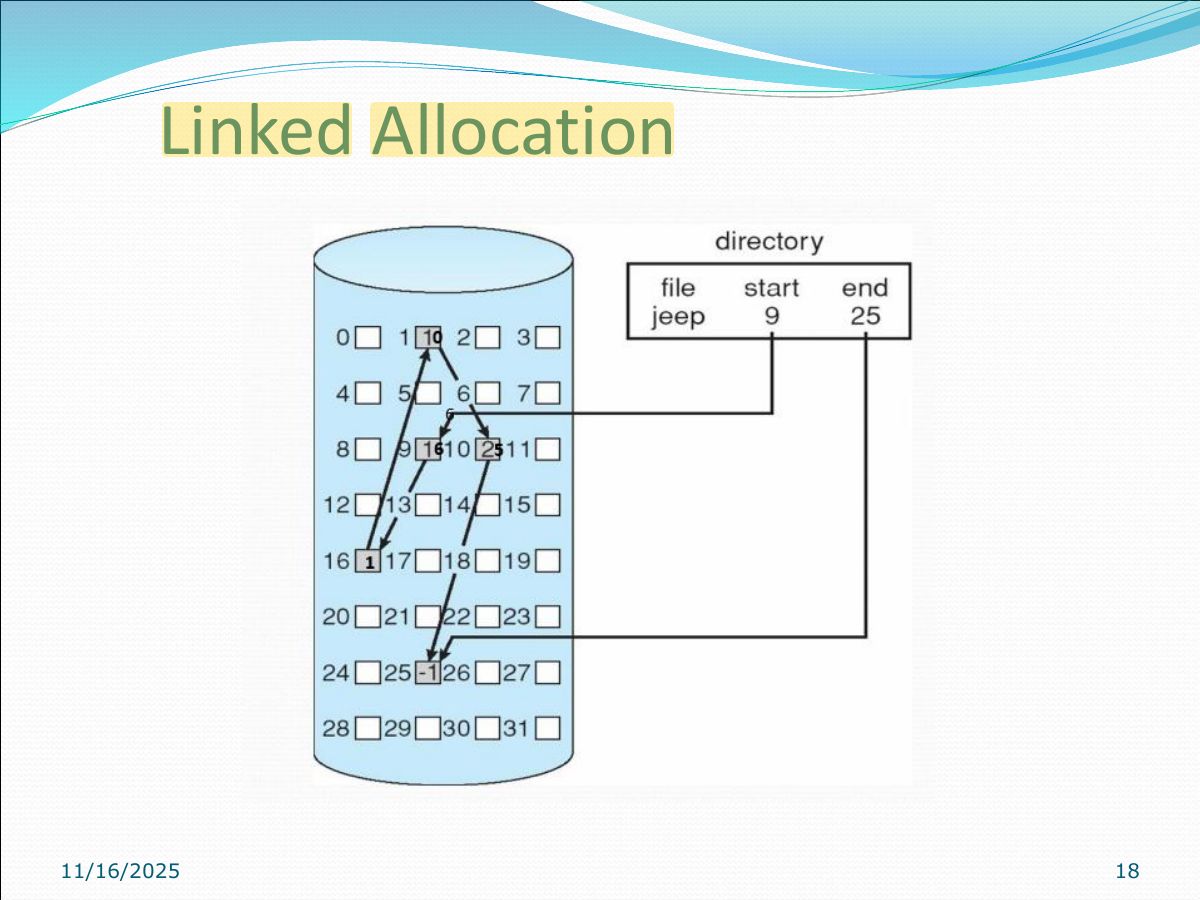
                        Each block contains pointer to next block

                        File ends at nil pointer (the end-of-list pointer value)

                        Free space management system called when new block needed

                        Locating a block can take many I/Os and disk seeks

                        can be used only for sequential access file (to find the ith block of a file, we must start at the begining of that file & follow the pointers until we get to the ith block).

                        The space required for the pointers. i.e. Each file requires more space that it would

                        otherwise Improve efficiency by clustering blocks into groups but increases internal

                        fragmentation ( More space is wasted when a cluster is partially full than when the block is partially full.)

                        Reliability can be a problem

                        16
                        Exam weight Low

                          Linked Allocation (Cont.)

                          Mapping Algorithm

                          Q

                          Logical Address (LA) / (BlockSize -PointerSize)

                          R

                          Block to be accessed = the Qth disk block in the linked chain of disk blocks representing the file.

                          Displacement into disk block = R + PointerSize

                          17
                          Exam weight Low
                            Slide 18: Linked Allocation
                            Exam weight Low

                              Allocation Methods – Linked (Cont.)

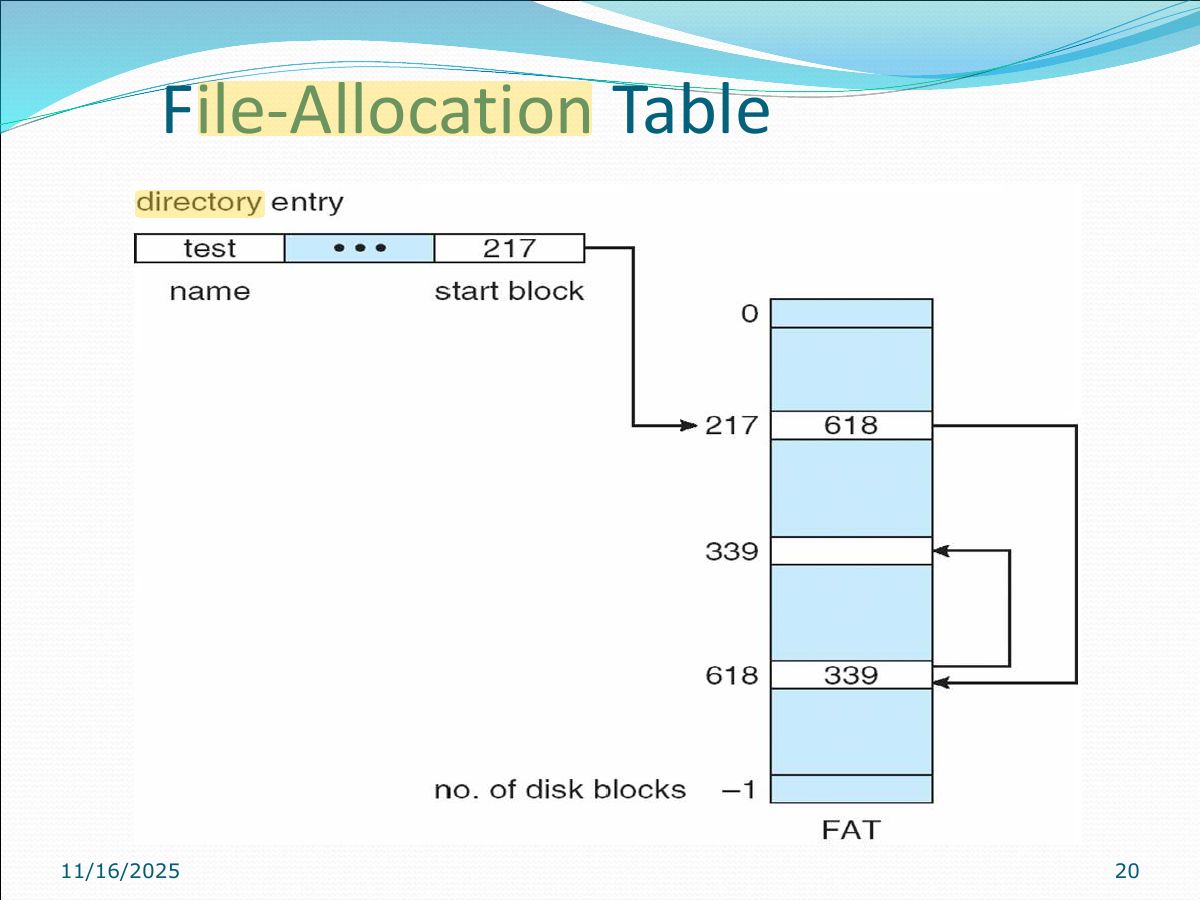
                               FAT (File Allocation Table) variation on linked allocation – disk-space

                              allocation used by MS-DOS and OS/2.

                              Simple but efficient method of disk space allocation A section of disk at the Beginning of volume has table, which has 1 entry

                              for each disk block & indexed by block no Much like a linked list, but faster on disk and cacheable

                               

                              Pointers (i.e. disk data blocks numbers) are kept in a table (FAT)

                              Data Block does not hold a pointer; hence data size in a disk block is a power of 2.

                              Disadvantages:  Linked allocation cannot support efficient direct access since the pointers to

                              the blocks are scattered with the block themselves all over the disk.

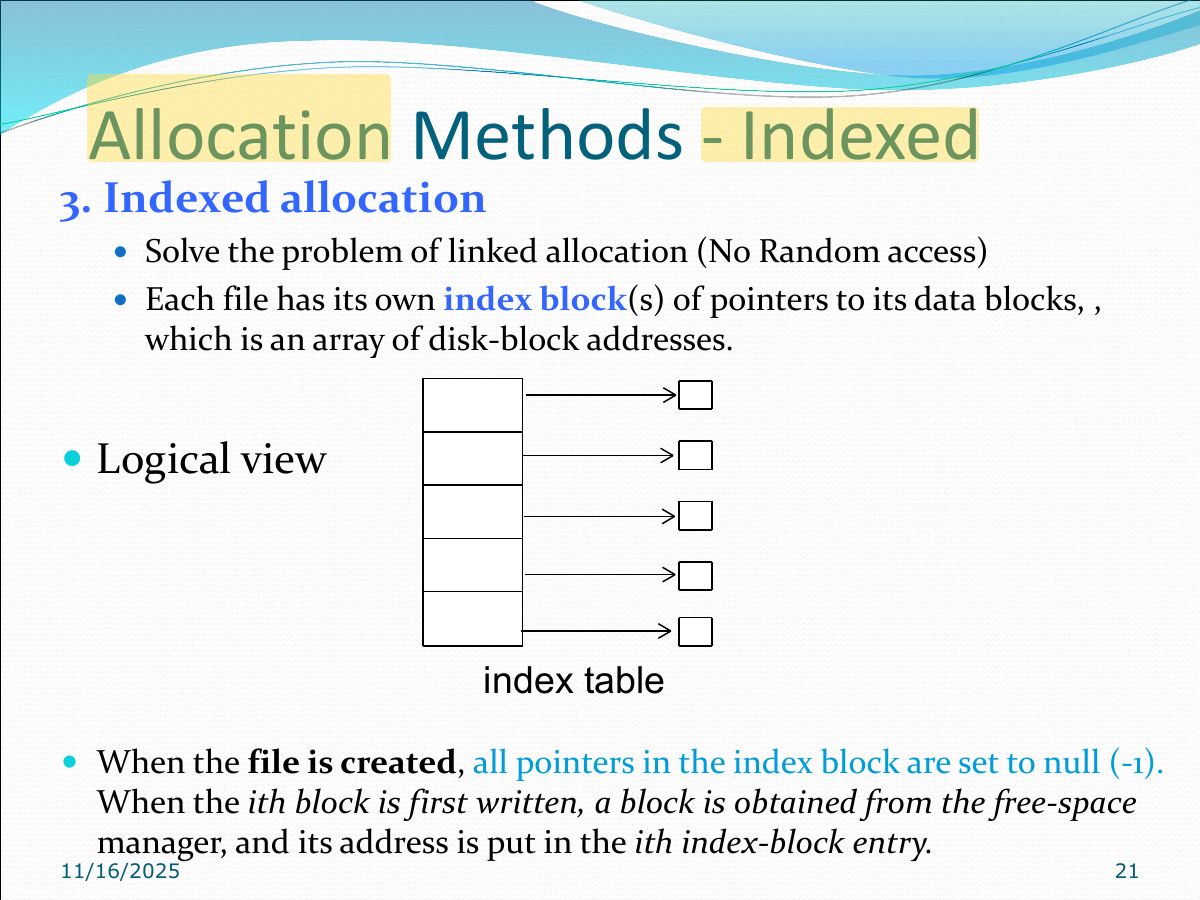
                              Solution: bringing all the pointers together into 1 location: the index

                              block

                              19
                              Exam weight Low
                                Slide 20: File-Allocation Table
                                Exam weight Low
                                1. FAT: the next-block pointers live in a table at the start of the volume (cached), so direct access is faster.
                                Slide 21: Allocation Methods - Indexed
                                Exam weight High
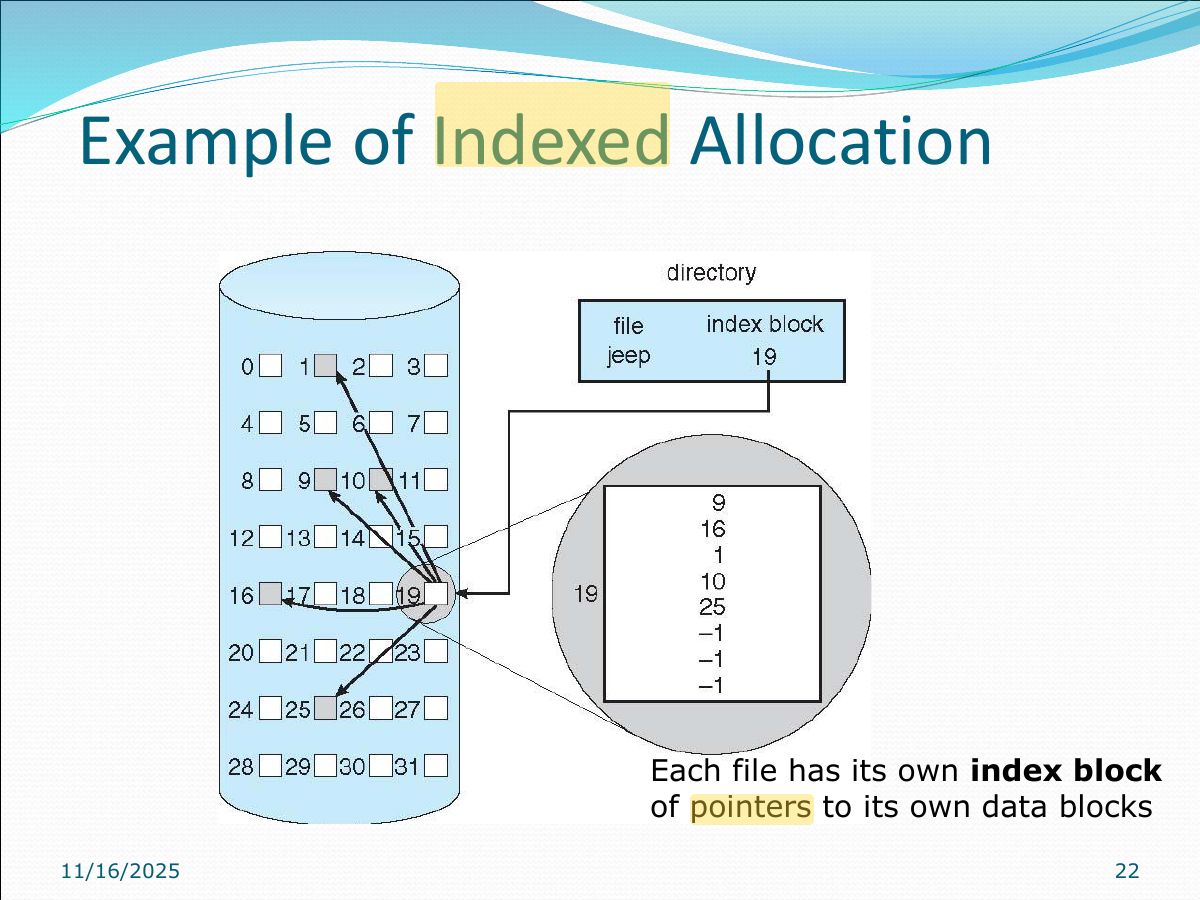
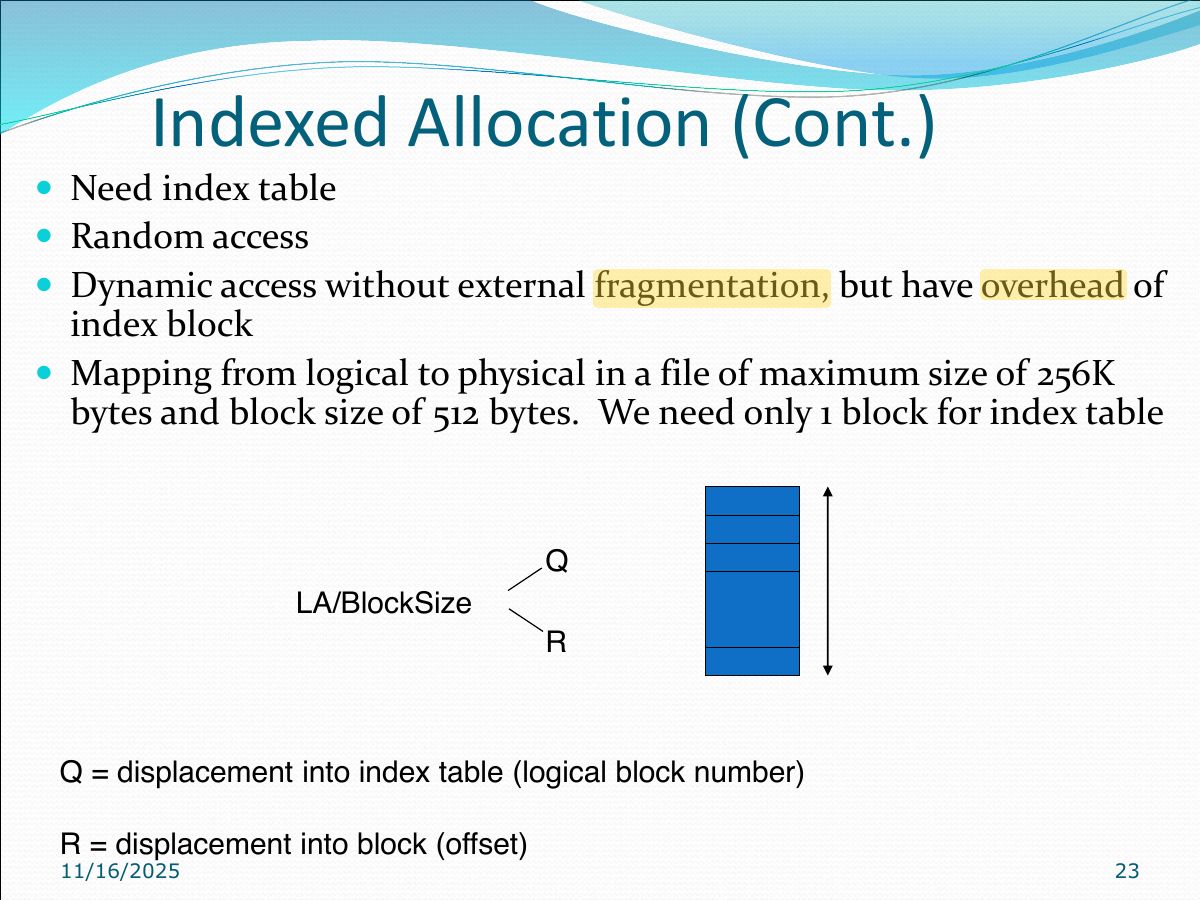
                                1. Indexed: each file has an index block of pointers. Direct access without external fragmentation; costs the index block.
                                Slide 22: Example of Indexed Allocation
                                Exam weight Low
                                  Slide 23: Indexed Allocation (Cont.)
                                  Exam weight Low
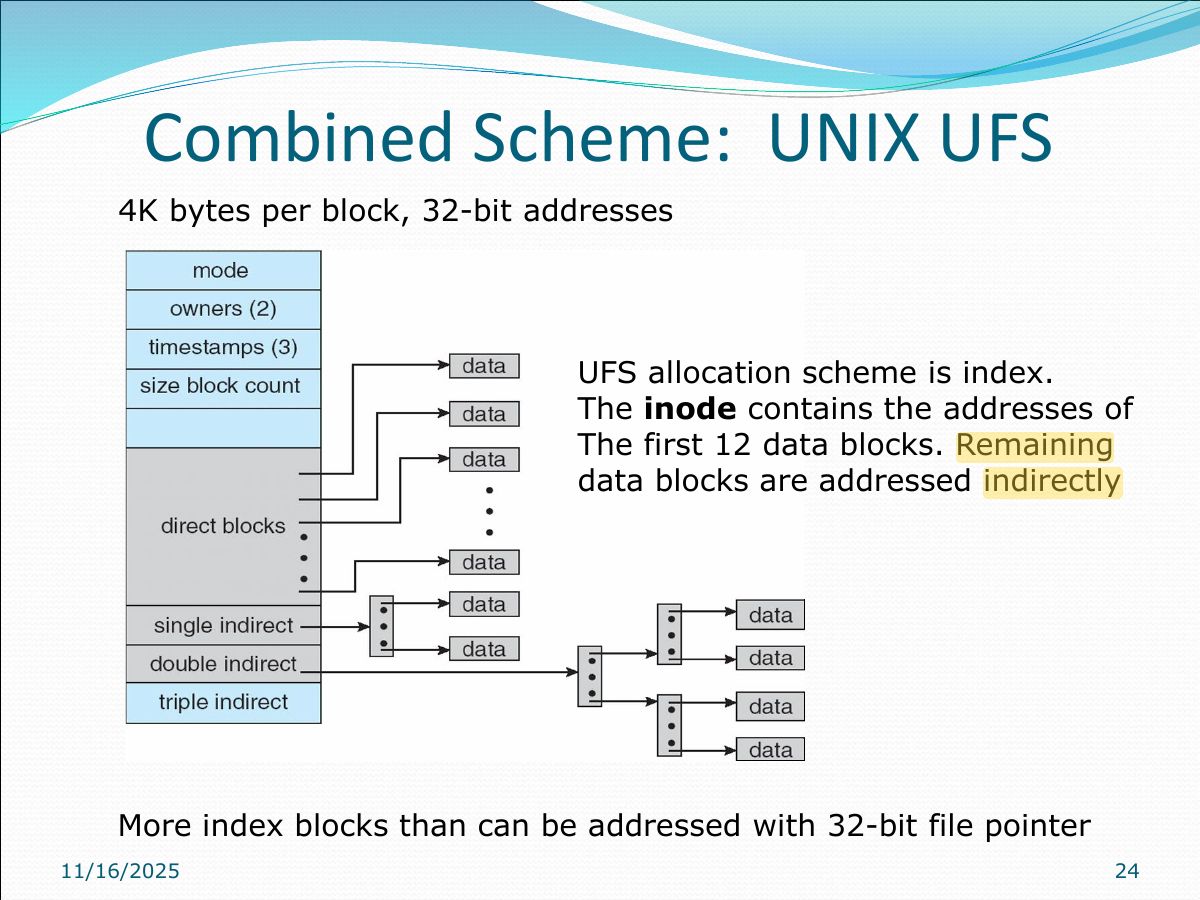
                                    Slide 24: Combined Scheme: UNIX UFS
                                    Exam weight High
                                    1. UNIX inode: 12 direct pointers + single, double and triple indirect blocks.
                                    🎯 How this can come up · 1 question
                                    Written

                                    4 KB blocks and 4-byte pointers. How much data can one single-indirect block address?

                                    Free Space Management

                                     File system maintains free-space list to track available blocks/clusters

                                    (Using term

                                    “ block for simplicity)

                                    ”

                                     How can we keep track of free blocks of the disk?

                                    Which blocks are free?

                                     We need this info when we want to allocate a new block to a file.

                                    Allocate a block that is free.

                                     There are several methods to keep track of free blocks:

                                    Bit vector (bitmap) method

                                    Linked list method Grouping

                                    Counting

                                    25
                                    Exam weight Low

                                      Free-Space Management: 1) Bit Vector

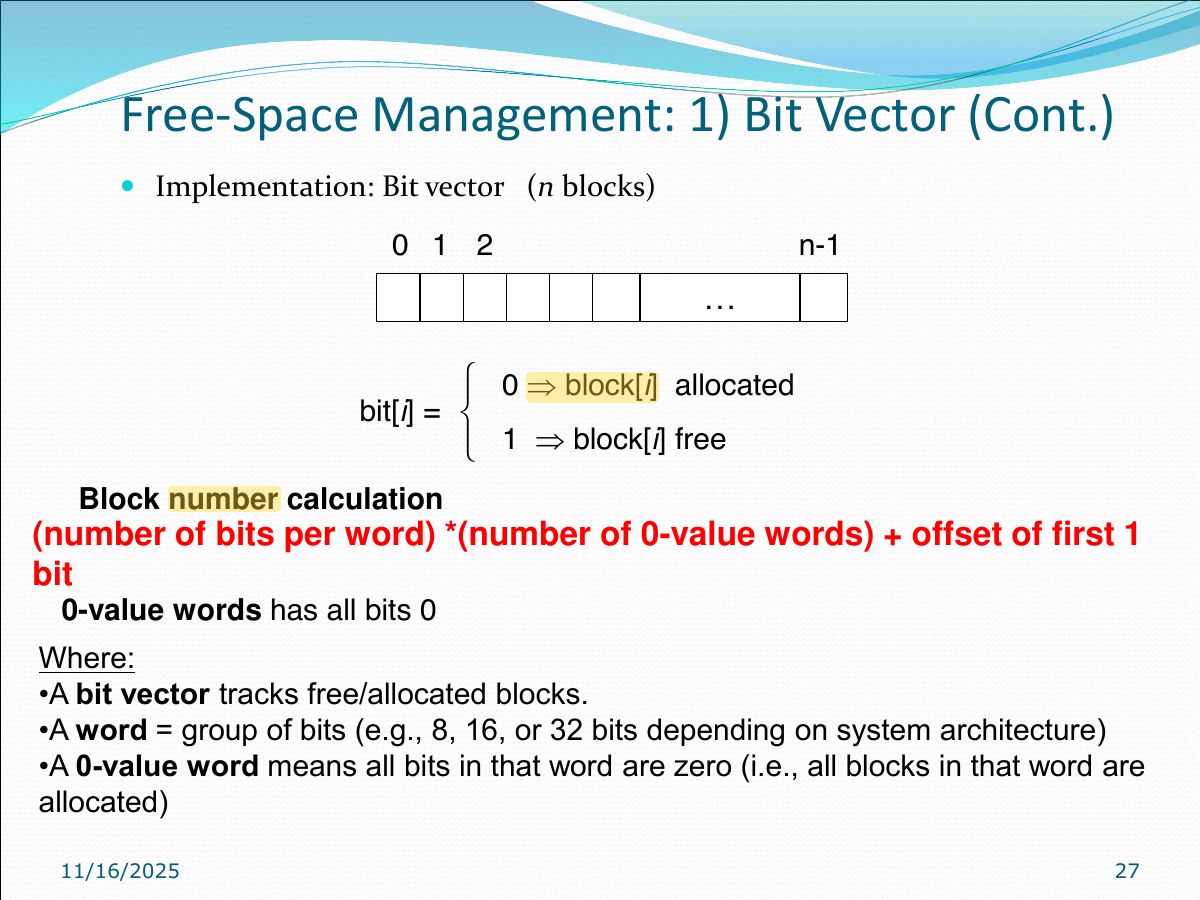
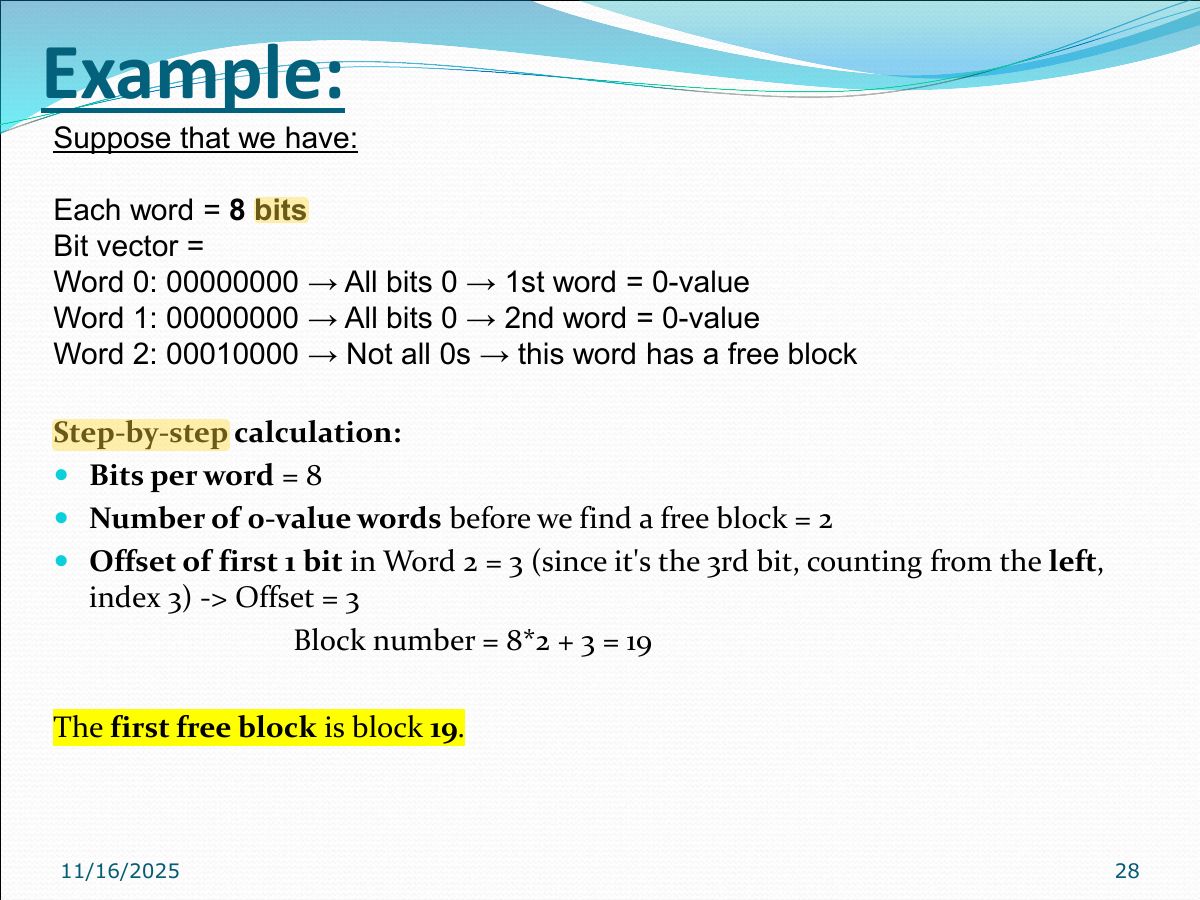
                                       The free-space list is implemented as a bit map or bit vector.

                                       Each block is represented by 1 bit.

                                      If the block is free, the bit is 1;

                                      If the block is allocated, the bit is 0.

                                       For example, consider a disk where blocks 2, 3, 4, 5, 8, 9, 10, 11, 12, 13, 17,

                                      18,25,26, and 27 are free and the rest of the blocks are allocated.

                                       The free-space bit map would be 001111001111110001100000011100000  The main advantage of this approach is its relative simplicity and its

                                      efficiency in finding the first free block or n consecutive free blocks on the disk.

                                      26
                                      Exam weight High
                                      1. Bit vector: one bit per block (1 = free in the slides). Easy to find contiguous space; the map takes disk-size / block-size bits.
                                      🎯 How this can come up · 1 question
                                      MCQ

                                      A 1 TB disk with 4 KB blocks needs a bit map of:

                                      Slide 27: Free-Space Management: 1) Bit Vector (Cont.)
                                      Exam weight Low
                                        Slide 28: Example:
                                        Exam weight Low

                                          Free-Space Management: 1) Bit Vector (Cont.)

                                           Easy to get contiguous files  Inefficient unless the entire vector is kept in memory

                                          (possible for smaller disks but not for larger ones)

                                           Bit map requires extra space

                                          Example:

                                          29
                                          Exam weight Low

                                            Given the following: • Block Size: 4 KB=4096 bytes • Disk Size: 1 TB=1024^4=1,099,511,627,776 bytes Calculation:

                                            To manage a disk with a bitmap:

                                            1. Calculate the number of blocks on the disk:

                                            Number of Blocks=Block Size/Disk Size

                                            =1,099,511,627,776 / 4096 = 268,435,456 blocks

                                            1. Each block requires 1 bit in the bitmap to indicate whether it is free or used.
                                            2. Convert the number of bits required for the bitmap into bytes:

                                            Bitmap Size (in bytes)= Number of Blocks / 8 =268,435,456 / 8

                                            = 33,554,432bytes = 32MB

                                            The space required for the bitmap to manage a 1 TB disk

                                            with a 4 KB block size is 32 MB.

                                            30
                                            Exam weight Low
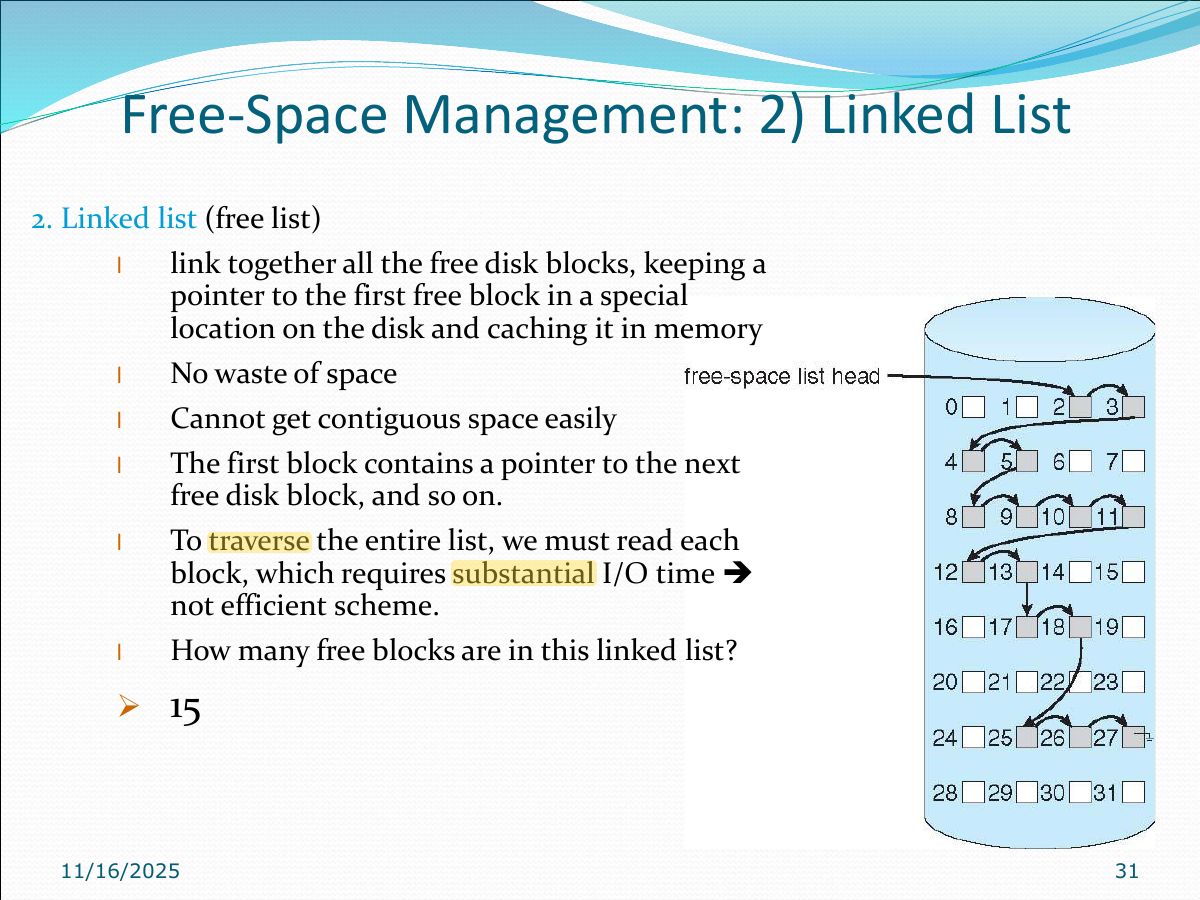
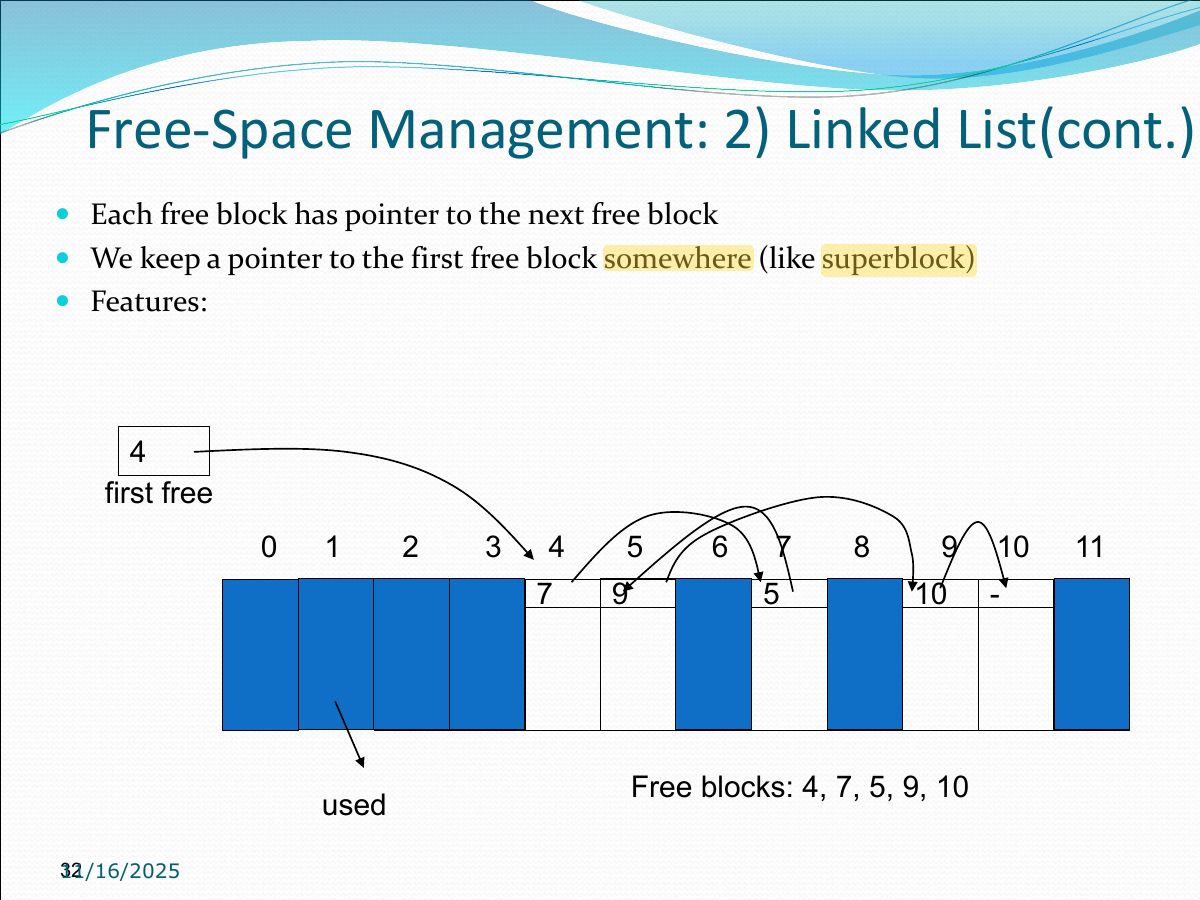
                                              Slide 31: Free-Space Management: 2) Linked List
                                              Exam weight Low
                                              1. Linked free list: each free block points to the next; no wasted space but slow to traverse.
                                              Slide 32: Free-Space Management: 2) Linked List(cont.)
                                              Exam weight Low

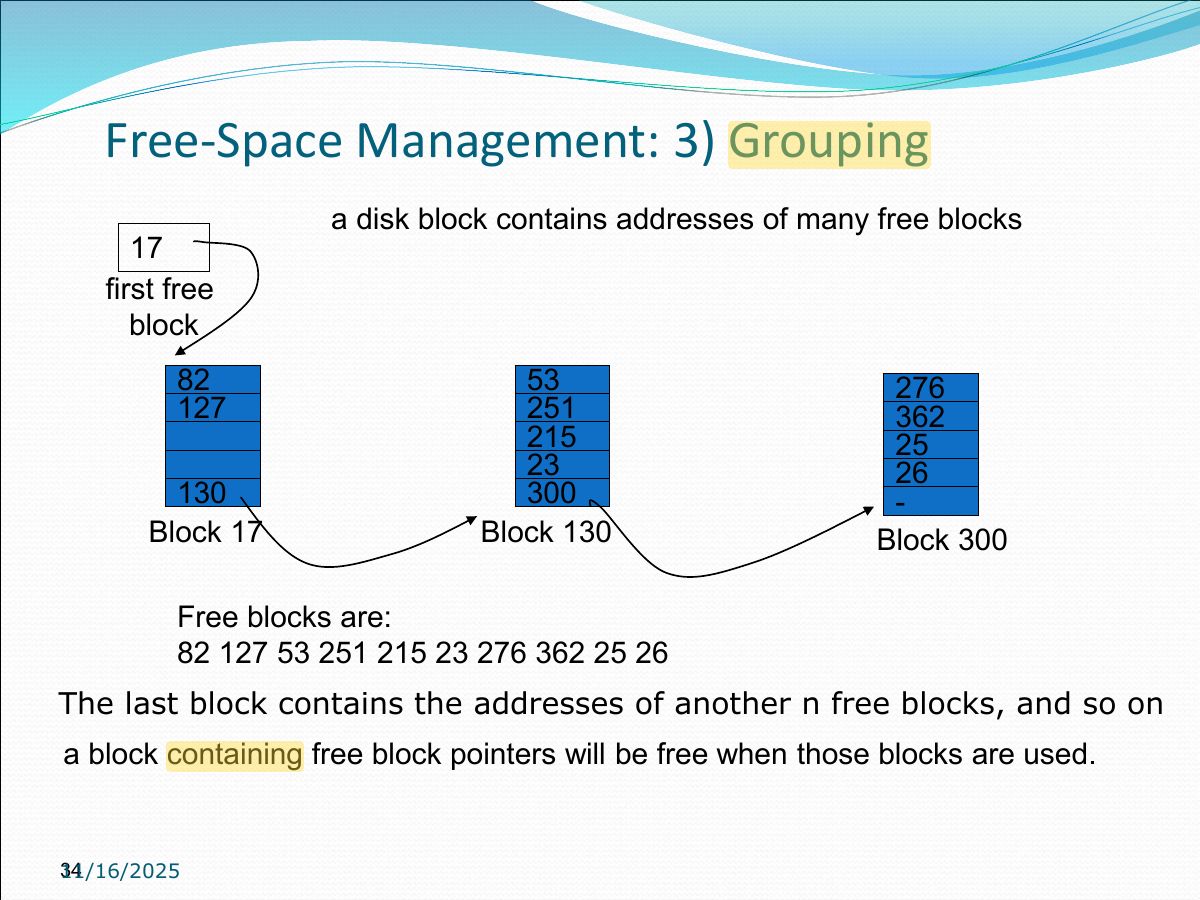
                                                Free-Space Management: 3) Grouping

                                                 A modification of the free-list approach is to store the addresses of n

                                                free blocks in the first free block.

                                                 The first n-1 of these blocks are actually free. The last block contains

                                                the addresses of another n free blocks, and so on.

                                                 The addresses of a large number of free blocks can now be found

                                                quickly, unlike the situation when the standard linked-list approach is used.

                                                33
                                                Exam weight Low
                                                1. Grouping: the first free block stores the addresses of n free blocks.
                                                Slide 34: Free-Space Management: 3) Grouping
                                                Exam weight Low

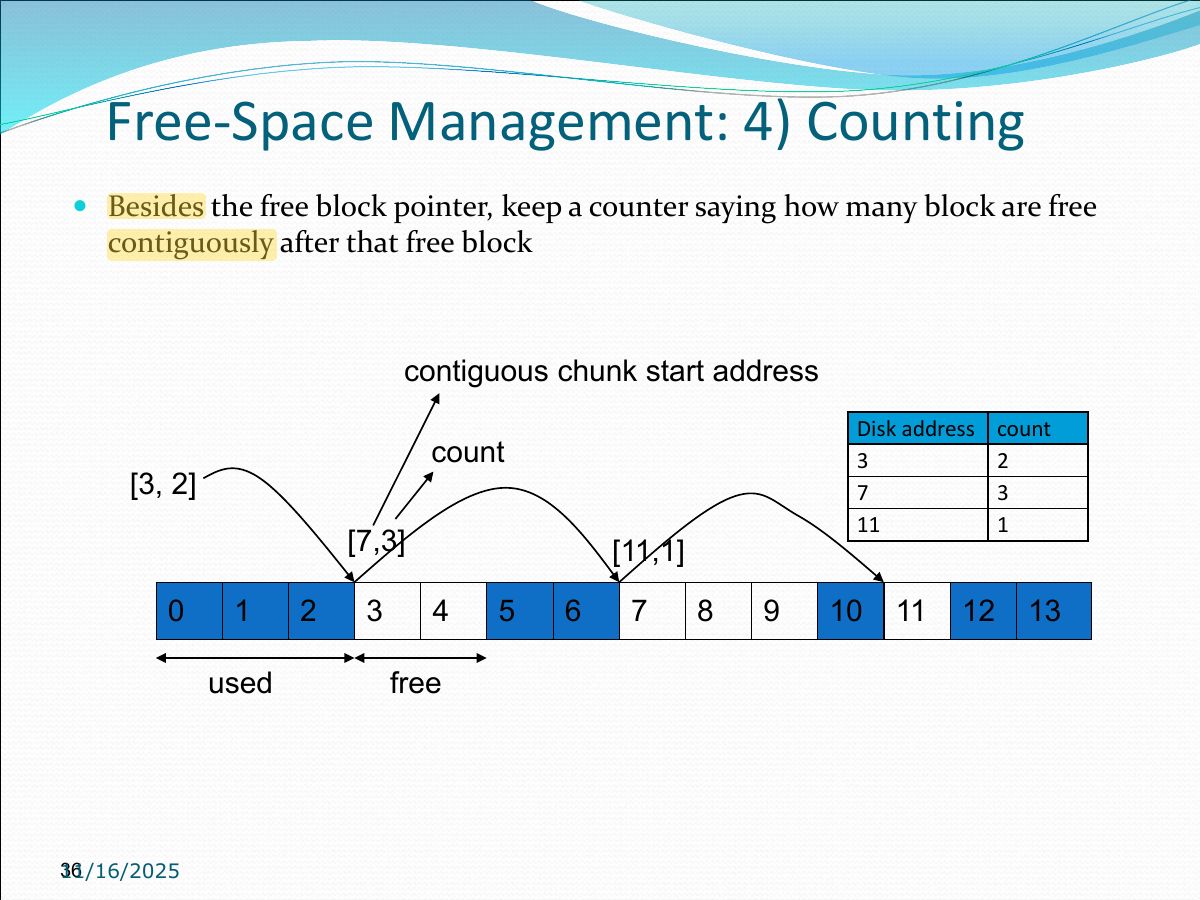
                                                  Free-Space Management: 4) Counting

                                                   rather than keeping a list of n free disk addresses, we can keep the address of

                                                  the first free block and the number (n) of free contiguous blocks that follow the first block.

                                                   Each entry in the free-space list then consists of a disk address and a count.

                                                  Although each entry requires more space than would a simple disk address, the overall list will be shorter, as long as the count is generally greater than 1.

                                                  35
                                                  Exam weight Low
                                                  1. Counting: store (first free block, count of contiguous free blocks).
                                                  Slide 36: Free-Space Management: 4) Counting
                                                  Exam weight Low

                                                    End of Chapter 11

                                                    37
                                                    Exam weight Low