CS102 · Annotated SlidesInheritance — Inheritance
Inheritance · Annotated slides

Inheritance

Superclasses and subclasses, direct vs. indirect superclasses and Object, is-a vs. has-a, the CommissionEmployee / BasePlusCommissionEmployee example with and without inheritance, constructors and super(...), overriding with @Override, and private members in a hierarchy.

Slide text Study notes Highlight: key words Tips, tricks & traps Seen again elsewhere How it can come up

Inheritance

CS102
1

Learning Outcomes

  • How inheritance promotes software reusability.
  • The notions of superclasses and subclasses and the relationship between them.
  • To use keyword extends to create a class that inherits attributes and behaviors from another class.
  • To access superclass members with super.
  • How constructors are used in inheritance hierarchies.
  • The methods of class Object, the direct or indirect superclass of all classes.
2
Exam weight Low

    Introduction

    • Inheritance
      • A form of software reuse in which a new class is created by absorbing an existing class’s members and embellishing them with new or modified capabilities.
      • Can save time during program development by basing new classes on existing proven and debugged high-quality software.
      • Increases the likelihood that a system will be implemented and maintained effectively.
    3
    Exam weight Low
    1. Inheritance = reuse: a new class absorbs an existing class’s members and adds or modifies some.

    Introduction (Cont.)

    • When creating a class, rather than declaring completely new members, you can designate that the new class should inherit the members of an existing class.
      • Existing class is the superclass
      • New class is the subclass
    • Each subclass can be a superclass of future subclasses.
    • A subclass can add its own fields and methods.
    • A subclass is more specific than its superclass and represents a more specialized group of objects.
    • The subclass exhibits the behaviors of its superclass and can add behaviors that are specific to the subclass.
      • This is why inheritance is sometimes referred to as specialization.
    4
    Exam weight High
    1. Existing class = superclass; new class = subclass (extends).
    🎯 How this can come up · 1 question
    MCQ

    Which keyword makes a class inherit from another?

    Introduction (Cont.)

    • The direct superclass is the superclass from which the subclass explicitly inherits.
    • An indirect superclass is any class above the direct superclass in the class hierarchy.
    • The Java class hierarchy begins with class Object (in package java.lang)
      • Every class in Java directly or indirectly extends (or “inherits from”) Object .
    • Java supports only single inheritance, in which each class is derived from exactly one direct superclass.
    5
    Exam weight High
    1. Direct superclass: the one you extend. Indirect: higher up. Every class ultimately extends Object.
    🎯 How this can come up · 1 question
    True / False

    Java supports multiple inheritance of classes (a class can extend two classes).

    Inheritance

    • Generic are usually the superclasses
    • Specific are subclasses that implement specific behavior
    • Why inheritance is useful?
      • to reduce the size of the code and development time
      • make the code modification easier and more efficient
      • improve modularity and promote software reuse
    6
    Exam weight Low

      Superclasses and Subclasses

      • Figure 9.1 lists several simple examples of superclasses and subclasses
        • Superclasses tend to be “more general” and subclasses “more specific.”
      • Because every subclass object is an object of its superclass, and one superclass can have many subclasses, the set of objects represented by a superclass is typically larger than the set of objects represented by any of its subclasses.
      7
      Exam weight Low
      1. Superclasses are more general, subclasses more specific; a subclass object IS-A superclass object.

      8
      Exam weight Low
        Slide 9: Superclasses and Subclasses (Cont.)
        Exam weight Low

          10
          Exam weight Low

            Relationship

            • We distinguish between the is-a relationship and the has-a relationship
            • Is-a represents inheritance
              • In an is-a relationship, an object of a subclass can also be treated as an object of its superclass
            • Has-a represents composition
              • In a has-a relationship, an object contains as members references to other objects
            11
            Exam weight High
            1. is-a = inheritance (a Car is a Vehicle). has-a = composition (a Car has an Engine).
            🎯 How this can come up · 1 question
            MCQ

            “A Manager is an Employee” suggests:

            Superclasses and Subclasses (Cont.)

            • Not every class relationship is an inheritance relationship.
            • Has-a relationship
              • Create classes by composition of existing classes.
              • Example: Given the classes Employee BirthDate TelephoneNumber , and , it’s improper to say that an Employee BirthDate is a or that an Employee is a TelephoneNumber .
              • However, an Employee has a BirthDate , and an Employee has a TelephoneNumber .
            12
            Exam weight Low

              Superclasses and Subclasses (Cont.)

              • Objects of all classes that extend a common superclass can be treated as objects of that superclass.
              • Inheritance issue
                • A subclass can inherit methods that it does not need or should not have.
                • Even when a superclass method is appropriate for a subclass, that subclass often needs a customized version of the method.
                • The subclass can override (redefine) the superclass method with an appropriate implementation.
              13
              Exam weight Low
              1. A subclass may inherit methods it doesn’t want; it can override them.

              Example Without Using Inheritance

              • In what follows, we have two classes of CommissionEmployee, and BasePlusComissionEmployee.
              • The only difference is that the BasePlusComissionEmployee has a base salary in addition to attributes of ComissionEmployee, and thus its earning method is slightly different.
              • The code shows the implementation of both classes without using inheritance.
              • Observe the following: There is a lot of redundancy in both codes
              • BasePlusComissionEmployee has more than 110 lines of code.
              • Certainly, this programming style is not efficient. It is also not easy to modify the code of the related classes.
              • Solution: using inheritance as shown in the next section
              14
              Exam weight Low
              1. Without inheritance, BasePlusCommissionEmployee copies almost all of CommissionEmployee.

              See code Without Using Inheritance

              15
              Exam weight Low

                Relationship between Superclasses and Subclasses

                • Inheritance hierarchy containing types of employees in a company’s payroll application
                • Commission employees are paid a percentage of their sales
                • Base-salaried commission employees receive a base salary plus a percentage of their sales.
                16
                Exam weight Low

                  Example Using Inheritance

                  • Considering the drawbacks of the first approach, we now use an important concept in Object Oriented Programming that is inheritance. Observe the following:
                  • The class CommissionEmployee, that is the generic class (or superclass) remains unchanged (same code as above)
                  • The class BasePlusComissionEmployee now extends the class CommissionEmployee
                  • How much code is reduced with using inheritance: 50 lines with inheritance as compared to more than 110 lines without using inheritance in the BasePlusComissionEmployee
                  17
                  Exam weight Low

                    See Code Using Inheritance

                    18
                    Exam weight Low

                      Creating and Using a CommissionEmployee Class

                      • Constructors are not inherited.
                      • The first task of a subclass constructor is to call its direct superclass’s constructor explicitly or implicitly
                        • Ensures that the instance variables inherited from the superclass are initialized properly.
                      • If the code does not include an explicit call to the superclass constructor, Java implicitly calls the superclass’s default or no-argument constructor.
                      • A class’s default constructor calls the superclass’s default or no-argument constructor.
                      19
                      Exam weight High
                      1. Constructors are NOT inherited. A subclass constructor must call a superclass constructor first (explicitly with super(...) or implicitly).
                      🎯 How this can come up · 1 question
                      True / False

                      Constructors are inherited by subclasses.

                      Creating and Using a CommissionEmployee Class (Cont.)

                      • To override a superclass method, a subclass must declare a method with the same signature as the superclass method
                      • @Override annotation
                        • Indicates that a method should override a superclass method with the same signature.
                        • If it does not, a compilation error occurs.
                      20
                      Exam weight High
                      1. Overriding: same signature in the subclass; @Override asks the compiler to check it.
                      Exam trapOverloading = same name, different parameters (same class). Overriding = same signature in a subclass.
                      🎯 How this can come up · 1 question
                      MCQ

                      A subclass method with the same signature as a superclass method:

                      Slide 21: Creating and Using a BasePlus- CommissionEmployee Class
                      Exam weight Low
                        Slide 22: Creating and Using a BasePlus- CommissionEmployee Class (Cont.)
                        Exam weight Low

                          Creating and Using a BasePlus- CommissionEmployee Class (Cont.)

                          • We literally copied CommissionEmployee ’s code, pasted it into BasePlusCommissionEmployee, then modified the new class to include a base salary and methods that manipulate the base salary.
                            • This “copy-and-paste” approach is often error prone and time consuming.
                            • It spreads copies of the same code throughout a system, creating a code-maintenance nightmare.
                          23
                          Exam weight Low
                          1. Copy-and-paste reuse is error-prone and a maintenance nightmare → use inheritance.
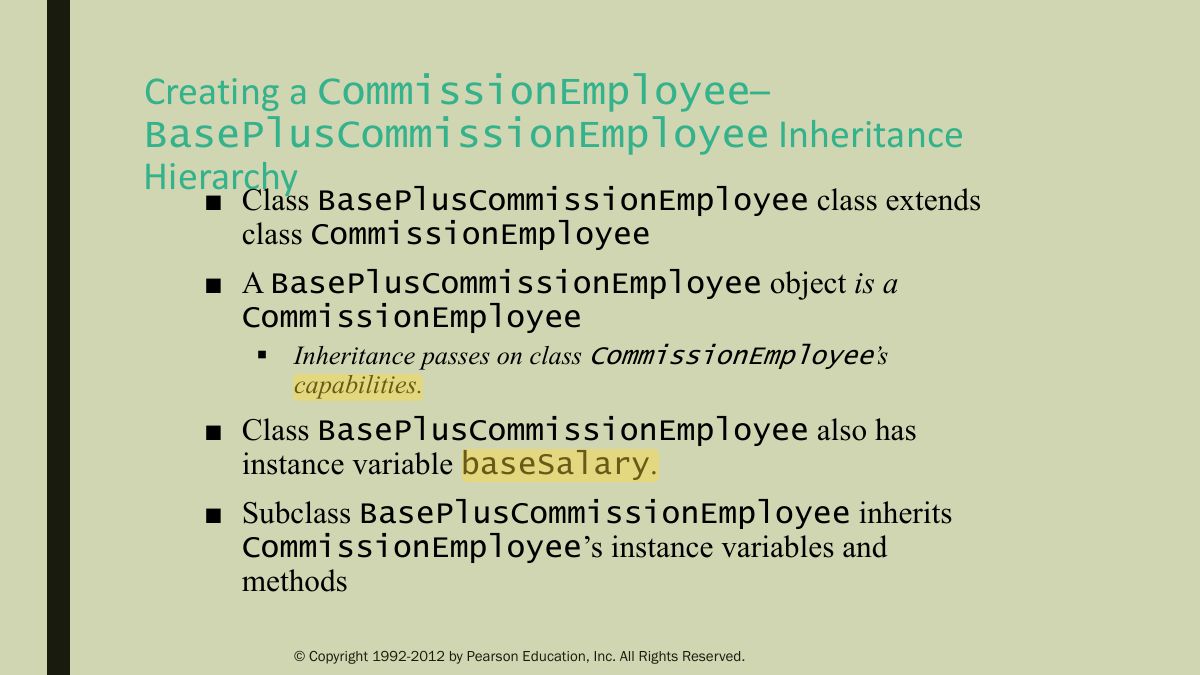
                          Slide 24: Creating a CommissionEmployee – BasePlusCommissionEmployee Inheritance Hierarchy
                          Exam weight Low
                          1. class BasePlusCommissionEmployee extends CommissionEmployee: only the base salary is new.

                          Creating a CommissionEmployee – BasePlusCommissionEmployee Inheritance Hierarchy (Cont.)

                          • Each subclass constructor must implicitly or explicitly call its superclass constructor to initialize the instance variables inherited from the superclass.
                            • Superclass constructor call syntax—keyword super , followed by a set of parentheses containing the superclass constructor arguments.
                            • Must be the first statement in the subclass constructor’s body.
                          • If the subclass constructor did not invoke the superclass’s constructor explicitly, Java would attempt to invoke the superclass’s no-argument or default constructor.
                            • Class CommissionEmployee does not have such a constructor, so the compiler would issue an error.
                          • You can explicitly use super to call the superclass’s no-argument or default constructor, but this is rarely done.
                          25
                          Exam weight High
                          1. super(args) must be the FIRST statement in the subclass constructor.
                          🎯 How this can come up · 1 question
                          MCQ

                          Where must the call super(first, last, ssn) appear in a subclass constructor?

                          Creating a CommissionEmployee – BasePlusCommissionEmployee Inheritance Hierarchy (Cont.)

                          • Compilation errors occur when the subclass attempts to access the superclass’s private instance variables.
                          • These lines could have used appropriate get methods to retrieve the values of the superclass’s instance variables.
                          26
                          Exam weight High
                          1. A subclass can’t access the superclass’s PRIVATE fields directly → use get methods (or protected).
                          🎯 How this can come up · 1 question
                          True / False

                          A subclass can directly read its superclass’s private instance variables.